

What do you think?

The Duke in His Domain
Now Brando looked at people with assurance, and with what can only be called a pitying expression, as though he dwelt in spheres of enlightenment where they, to his regret, did not.
This mesmerizing profile of an insecure, vulnerable young Marlon Brando, brooding in a Kyoto hotel during a break from filming, is a peerless piece of journalism.
Penguin fifty new books celebrating the pioneering spirit of the iconic Penguin Modern Classics series, with each one offering a concentrated hit of its contemporary, international flavour. Here are authors ranging from Kathy Acker to James Baldwin, Truman Capote to Stanislaw Lem and George Orwell to Shirley Jackson; essays radical and inspiring; poems moving and disturbing; stories surreal and fabulous; taking us from the deep South to modern Japan, New York's underground scene to the farthest reaches of outer space.
This mesmerizing profile of an insecure, vulnerable young Marlon Brando, brooding in a Kyoto hotel during a break from filming, is a peerless piece of journalism.
Penguin fifty new books celebrating the pioneering spirit of the iconic Penguin Modern Classics series, with each one offering a concentrated hit of its contemporary, international flavour. Here are authors ranging from Kathy Acker to James Baldwin, Truman Capote to Stanislaw Lem and George Orwell to Shirley Jackson; essays radical and inspiring; poems moving and disturbing; stories surreal and fabulous; taking us from the deep South to modern Japan, New York's underground scene to the farthest reaches of outer space.
50 pages, Paperback
First published November 9, 1957
About the author
Truman Capote
374 books7,542 followersLibrarian Note: There is more than one author by this name in the Goodreads database.
Truman Capote was an American writer whose non-fiction, stories, novels and plays are recognised literary classics, including the novella Breakfast at Tiffany's (1958) and In Cold Blood (1965), which he labeled a "non-fiction novel." At least 20 films and TV dramas have been produced from Capote novels, stories and screenplays.
He was born as Truman Streckfus Persons to a salesman Archulus Persons and young Lillie Mae. His parents divorced when he was four and he went to live with his mother's relatives in Monroeville, Alabama. He was a lonely child who learned to read and write by himself before entering school. In 1933, he moved to New York City to live with his mother and her new husband, Joseph Capote, a Cuban-born businessman. Mr. Capote adopted Truman, legally changing his last name to Capote and enrolling him in private school. After graduating from high school in 1942, Truman Capote began his regular job as a copy boy at The New Yorker. During this time, he also began his career as a writer, publishing many short stories which introduced him into a circle of literary critics. His first novel, Other Voices, Other Rooms, published in 1948, stayed on The New York Times bestseller list for nine weeks and became controversial because of the photograph of Capote used to promote the novel, posing seductively and gazing into the camera.
In the 1950s and 1960s, Capote remained prolific producing both fiction and non-fiction. His masterpiece, In Cold Blood, a story about the murder of the Clutter family in Holcomb, Kansas, was published in 1966 in book form by Random House, became a worldwide success and brought Capote much praise from the literary community. After this success he published rarely and suffered from alcohol addiction. He died in 1984 at age 59.
Truman Capote was an American writer whose non-fiction, stories, novels and plays are recognised literary classics, including the novella Breakfast at Tiffany's (1958) and In Cold Blood (1965), which he labeled a "non-fiction novel." At least 20 films and TV dramas have been produced from Capote novels, stories and screenplays.
He was born as Truman Streckfus Persons to a salesman Archulus Persons and young Lillie Mae. His parents divorced when he was four and he went to live with his mother's relatives in Monroeville, Alabama. He was a lonely child who learned to read and write by himself before entering school. In 1933, he moved to New York City to live with his mother and her new husband, Joseph Capote, a Cuban-born businessman. Mr. Capote adopted Truman, legally changing his last name to Capote and enrolling him in private school. After graduating from high school in 1942, Truman Capote began his regular job as a copy boy at The New Yorker. During this time, he also began his career as a writer, publishing many short stories which introduced him into a circle of literary critics. His first novel, Other Voices, Other Rooms, published in 1948, stayed on The New York Times bestseller list for nine weeks and became controversial because of the photograph of Capote used to promote the novel, posing seductively and gazing into the camera.
In the 1950s and 1960s, Capote remained prolific producing both fiction and non-fiction. His masterpiece, In Cold Blood, a story about the murder of the Clutter family in Holcomb, Kansas, was published in 1966 in book form by Random House, became a worldwide success and brought Capote much praise from the literary community. After this success he published rarely and suffered from alcohol addiction. He died in 1984 at age 59.
Ratings & Reviews
Friends & Following
Create a free account to discover what your friends think of this book!
Community Reviews
Displaying 1 - 30 of 160 reviews

September 20, 2020
...love the way he talks about the Japanese people...yikes 👁️👄👁️

Sooo aside from that it's an interesting read.
Sooo aside from that it's an interesting read.

September 11, 2022
A fascinating and perceptive profile of Marlon Brando. I need to read more of Capote.

September 14, 2022
Gorgeously written and surprisingly fascinating! I picked this up more because of Capote's reputation as a writer than because of Brando's reputation as an actor, but I wasn't disappointed by either. What did Brando think of James Dean? And why did he abandon the theater for film? Well, he certainly doesn't leave anyone wondering, and Capote leaves you wanting even more. There's behind the scenes drama surrounding the film Sayonara, and Capote evokes Kyoto's atmosphere beautifully, especially at the end. Having yet to read In Cold Blood or The Muses Are Heard, I already wish Capote had written more long-form nonfiction.
October 13, 2025
A Portrait of Marlon Brando 1956
A review of the Penguin Modern paperback (February 22, 2018) of an article originally published in The New Yorker magazine November 9, 1957 and later collected in the Penguin Modern Classics collection A Capote Reader (2002).
Truman Capote visited Marlon Brando in Kyoto, Japan in 1956 where the actor was filming Sayonara (1957) dir. Joshua Logan based on the James Michener novel Sayonara (1953). Presumably the film production arranged for the interview as part of the publicity campaign for the movie. Capote meets Brando at his hotel and joins the actor for dinner and an evening's conversation.
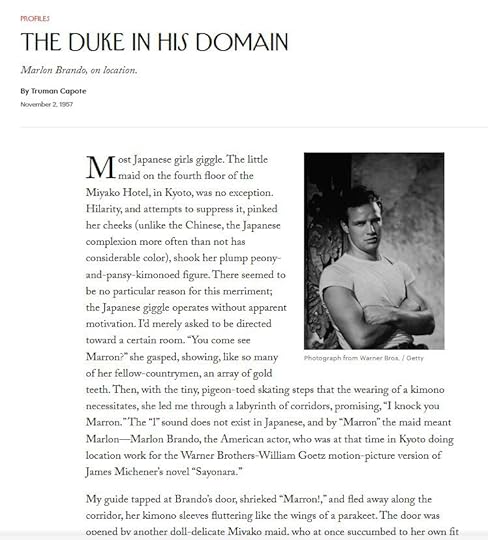
The opening page of the online posting for "The Duke in His Domain." Image sourced from The New Yorker (see link below).
Brando had already made a reputation for being a difficult actor to deal with, whether in the theatre or on screen. Regardless of that, he was a bankable star and Sayonara was already his 10th film in the space of 6 years. Capote's portrait shows both his insecurities and his egotism (the article title is Brando's own self-description) as he frets about the emptiness of movie star life while reading works on Buddhist knowledge and working on a script called A Burst of Vermilion which he describes as a western.
Capote captures it all very well. The only downside here are the rather cringey portrayals of the Japanese hotel workers and some disparaging comments (made by Capote, not Brando) about Japanese food and drink.
Trivia and Links
The entire original article is currently available on The New Yorker website here and is not behind the paywall as of mid-October 2025. That free access may not be permanent.
Truman Capote's The Duke in His Domain is part of a 50-volume Penguin Modern (May 30, 2019) boxset issued by Penguin Books. The promo description reads:
The box set is a limited edition which may gradually become rarer to source. The books are available individually, but are also likely to become rare items.
WARNING Amazon.ca and Amazon.com are showing only a nominal fee ($1.99 Cdn, $2.53 US) for a supposed Kindle edition of the 50-volume boxset. DO NOT FALL FOR THIS SCAM, THE KINDLE ITEM IS A LIST OF TITLES ONLY AND DOES NOT CONTAIN THE ACTUAL COMPLETE BOOKS.
You can read the list of titles for free at the Penguin Modern link above.
A review of the Penguin Modern paperback (February 22, 2018) of an article originally published in The New Yorker magazine November 9, 1957 and later collected in the Penguin Modern Classics collection A Capote Reader (2002).
“I’ve seriously considered—I’ve very seriously thought about—throwing the whole thing up. This business of being a successful actor. What’s the point, if it doesn’t evolve into anything?”
Truman Capote visited Marlon Brando in Kyoto, Japan in 1956 where the actor was filming Sayonara (1957) dir. Joshua Logan based on the James Michener novel Sayonara (1953). Presumably the film production arranged for the interview as part of the publicity campaign for the movie. Capote meets Brando at his hotel and joins the actor for dinner and an evening's conversation.
The opening page of the online posting for "The Duke in His Domain." Image sourced from The New Yorker (see link below).
Brando had already made a reputation for being a difficult actor to deal with, whether in the theatre or on screen. Regardless of that, he was a bankable star and Sayonara was already his 10th film in the space of 6 years. Capote's portrait shows both his insecurities and his egotism (the article title is Brando's own self-description) as he frets about the emptiness of movie star life while reading works on Buddhist knowledge and working on a script called A Burst of Vermilion which he describes as a western.
Capote captures it all very well. The only downside here are the rather cringey portrayals of the Japanese hotel workers and some disparaging comments (made by Capote, not Brando) about Japanese food and drink.
Trivia and Links
The entire original article is currently available on The New Yorker website here and is not behind the paywall as of mid-October 2025. That free access may not be permanent.
Truman Capote's The Duke in His Domain is part of a 50-volume Penguin Modern (May 30, 2019) boxset issued by Penguin Books. The promo description reads:
This box set of the 50 books in the new Penguin Modern series celebrates the pioneering spirit of the Penguin Modern Classics list and its iconic authors. Including avant-garde essays, radical polemics, newly translated poetry and great fiction, here are brilliant and diverse voices from across the globe. Ground-breaking and original in their day, their words still have the power to move, challenge and inspire.
The box set is a limited edition which may gradually become rarer to source. The books are available individually, but are also likely to become rare items.
WARNING Amazon.ca and Amazon.com are showing only a nominal fee ($1.99 Cdn, $2.53 US) for a supposed Kindle edition of the 50-volume boxset. DO NOT FALL FOR THIS SCAM, THE KINDLE ITEM IS A LIST OF TITLES ONLY AND DOES NOT CONTAIN THE ACTUAL COMPLETE BOOKS.
You can read the list of titles for free at the Penguin Modern link above.

July 30, 2018
// Book #1 for BTAT 2018!
Oh Truman, you never fail to disappoint me. You’re such a disappointment in yourself that I would expect nothing else from you. Ehh, I have a weird relationship to Truman Capote, if you couldn’t tell. I kind of despise him as a human being and don’t condone the messy bullshit that he spreads in a lot of his work but I cannot deny that I am absolutely in love with his writing style and his unique way of telling a story. His Complete Short Stories is up to this day my favorite collection. I was quite happy to see that his beautiful prose translates into nonfiction as well.
The reason why I absolutely love The Duke in His Domain is that Truman and Marlon are both so blissfully unaware of how privileged and stupid they are. I know these are harsh words but I cannot put it differently. Just read the first paragraph of this vignette about how “most Japanese girls giggle” and you’ll get what I mean. And yet I am somewhat fascinated by reading about people who couldn’t be more different from myself. Marlon and I have almost nothing in common, we live in completely different worlds, yet I found myself absorbed in his world and his ways of thinking. I found it interesting that he thought that his own life is a mess (I mean who cannot relate to that?) and that he wastes his time doing useless bullshit. I haven’t had the time yet, but I’ll definitely read up on him and see if he ever got his vision realised or if he returned to the same old, same old of being an American sex symbol.
And Truman plays his part just as well. He functions as the silent observer, yet his presence is immediately noted. His writing gives away some of his own personal opinions on Brando, how he’s fascinated by this self-absorbed man who kind of lost touch with reality, and yet cannot believe some of the things he’s hearing. Truman truly makes you feel like you’re right there with them, in that big hotel suite in Kyoto, and that’s a fucking skill. It’s the perfect mixture between descriptions of locations, facial expressions, a little dialogue here and there, a little background information when it’s needed. I don’t have a single complaint.
Truman purposefully creates this larger-than-life picture of Brando, even though the latter seems to want the exact opposite (or does he?). Marlon didn’t come across as happy at all, he seemed miserable. All of this money, all of this fame, and at the end of the day he has no one of real value to share it with. He invites random people to his flat because he hates being lonely and can’t stand to be on his own. He admits to needing other people’s affection and admiration to feel good about himself, he wants people to be dependent on him, when it comes to his “friendships” he sees himself as “the duke in his domain”, he is ruling over them all. I cannot really empathise with Marlon’s struggle because it is so far removed from my own. Nonetheless, I’m fascinated by how Truman staged it.
Normally, I would’ve just been annoyed by another rich white boy complaining about the hardships of life, and while I still think that Brando is partly to blame for his own misery and should stop complaining and be the change he wants to see in the world, I also found myself interested in him as a person. I wanna know more about Brando. Something I didn’t expect going into this. I wanna read more from Capote. No surprises there. So, The Duke in His Domain is an absolute success, it exceeded what it needed to do.
Oh Truman, you never fail to disappoint me. You’re such a disappointment in yourself that I would expect nothing else from you. Ehh, I have a weird relationship to Truman Capote, if you couldn’t tell. I kind of despise him as a human being and don’t condone the messy bullshit that he spreads in a lot of his work but I cannot deny that I am absolutely in love with his writing style and his unique way of telling a story. His Complete Short Stories is up to this day my favorite collection. I was quite happy to see that his beautiful prose translates into nonfiction as well.
“Of course,” he said hesitantly, as if he were slowly turning over a coin to study the side that seemed to be shinier, “you can’t always be a failure. Not and survive. Van Gogh! There’s an example of what can happen when a person never receives any recognition.”The Duke in His Domain is a newspaper article published in 1957 in The New Yorker. In 1956, Truman visited the American film legend Marlon Brando in Kyoto, where he was just filming Sayonara. I knew next to nothing about Brando, apart from the fact that fucking Mike Pence named his pet rabbit after him (thank you, John Oliver!), but after reading Truman’s portrait of him I cannot help but be intrigued. If you look past all of their masculine bullshit and their fetishisation of Japanese culture and women (and believe me there’s a lot of that in here, so you kind of have to close both eyes, both ears and basically throw the whole book away…), you get some very genuine moments of tenderness and vulnerability.
“All right, you’re a success. At last you’re accepted, you’re welcome everywhere. But that’s it, that’s all there is to it, it doesn’t lead anywhere. You’re just sitting on a pile of candy gathering thick layers of—of crust.”Marlon Brando, judging by Truman’s take on him, seems to be quite the walking cliché. He’s a Hollywood beau who isn’t able to deal with his fame. He thinks that most of the movies he starred in are pointless and he feels like he’s wasting his life; he wants to produce something thoughtful and important, something that will bring peace to this world. Alrighty, good luck with that. He also had a tragic childhood, the whole “from rags to riches”-spiel, add an abusive father and a mother who chose alcohol over him to the mix, and you get the pciture. It’s all quite tragic, and Truman wants the reader to feel sorry for him. I personally couldn’t be bothered but it might have worked on his readers back in the day.
The reason why I absolutely love The Duke in His Domain is that Truman and Marlon are both so blissfully unaware of how privileged and stupid they are. I know these are harsh words but I cannot put it differently. Just read the first paragraph of this vignette about how “most Japanese girls giggle” and you’ll get what I mean. And yet I am somewhat fascinated by reading about people who couldn’t be more different from myself. Marlon and I have almost nothing in common, we live in completely different worlds, yet I found myself absorbed in his world and his ways of thinking. I found it interesting that he thought that his own life is a mess (I mean who cannot relate to that?) and that he wastes his time doing useless bullshit. I haven’t had the time yet, but I’ll definitely read up on him and see if he ever got his vision realised or if he returned to the same old, same old of being an American sex symbol.
And Truman plays his part just as well. He functions as the silent observer, yet his presence is immediately noted. His writing gives away some of his own personal opinions on Brando, how he’s fascinated by this self-absorbed man who kind of lost touch with reality, and yet cannot believe some of the things he’s hearing. Truman truly makes you feel like you’re right there with them, in that big hotel suite in Kyoto, and that’s a fucking skill. It’s the perfect mixture between descriptions of locations, facial expressions, a little dialogue here and there, a little background information when it’s needed. I don’t have a single complaint.
“I can’t. Love anyone. I can’t trust anyone enough to give myself to them. But I’m ready. I want it. And I may, I’m almost on the point, I’ve really got to . . .” His eyes narrowed, but his tone, far from being intense, was indifferent, dully objective, as though he were discussing some character in a play—a part he was weary of portraying yet was trapped in by contract.I know all of this is subjective but when I read the paragraph above and I cannot help but squeal a little bit. It’s that good.
Truman purposefully creates this larger-than-life picture of Brando, even though the latter seems to want the exact opposite (or does he?). Marlon didn’t come across as happy at all, he seemed miserable. All of this money, all of this fame, and at the end of the day he has no one of real value to share it with. He invites random people to his flat because he hates being lonely and can’t stand to be on his own. He admits to needing other people’s affection and admiration to feel good about himself, he wants people to be dependent on him, when it comes to his “friendships” he sees himself as “the duke in his domain”, he is ruling over them all. I cannot really empathise with Marlon’s struggle because it is so far removed from my own. Nonetheless, I’m fascinated by how Truman staged it.
Normally, I would’ve just been annoyed by another rich white boy complaining about the hardships of life, and while I still think that Brando is partly to blame for his own misery and should stop complaining and be the change he wants to see in the world, I also found myself interested in him as a person. I wanna know more about Brando. Something I didn’t expect going into this. I wanna read more from Capote. No surprises there. So, The Duke in His Domain is an absolute success, it exceeded what it needed to do.
It was then that I saw Brando. Sixty feet tall, with a head as huge as the greatest Buddha’s, there he was, in comic-paper colors, on a sign above a theatre that advertised “The Teahouse of the August Moon.” Rather Buddhalike, too, was his pose, for he was depicted in a squatting position, a serene smile on a face that glistened in the rain and the light of a street lamp. A deity, yes; but, more than that, really, just a young man sitting on a pile of candy.Oh Truman, you never fail to disappoint me.

August 18, 2026
This is actually more of an essay, but it is long enough in my opinion to qualify as a novella. In The Duke in His Domain, Capote is tasked with writing a profile of the much esteemed Marlon Brando. In the aftermath of this profile being published, Brando was outraged and this led to a falling out between the two which boosted the popularity of the profile even more.
I can definitely understand why Brando was flustered. Capote unmasks the actor to his audiences in a way that is quite clever in that he lets Brando and Brando's friends do all the terrible talking. There is a lot in this profile about Brando's opinions on acting, his manipulative behaviors, and his feelings of dissatisfaction and isolation. Additionally, Capote shows the rather paradoxical beliefs Brando has or the difference between his words and actions. It was funny how Brando assumed Capote did not have prior knowledge of certain things that directly contradicted his own mythologizing. Capote rather expertly compiled this story of Brando's life and personality without it feeling like he himself is giving his opinions. It resulted it quite a cutting read that definitely explains their falling out. Yet, also it reads as a rather honest portrayal of what I imagine many celebrities are probably like and how the industry itself likely prefers them to be.
This was actually my first of Capote's work, but I greatly enjoyed his style of journalism here and so might be inclined to pick up more of his work in the future!
I can definitely understand why Brando was flustered. Capote unmasks the actor to his audiences in a way that is quite clever in that he lets Brando and Brando's friends do all the terrible talking. There is a lot in this profile about Brando's opinions on acting, his manipulative behaviors, and his feelings of dissatisfaction and isolation. Additionally, Capote shows the rather paradoxical beliefs Brando has or the difference between his words and actions. It was funny how Brando assumed Capote did not have prior knowledge of certain things that directly contradicted his own mythologizing. Capote rather expertly compiled this story of Brando's life and personality without it feeling like he himself is giving his opinions. It resulted it quite a cutting read that definitely explains their falling out. Yet, also it reads as a rather honest portrayal of what I imagine many celebrities are probably like and how the industry itself likely prefers them to be.
This was actually my first of Capote's work, but I greatly enjoyed his style of journalism here and so might be inclined to pick up more of his work in the future!

March 3, 2018
4+ Capote is a fantastic journalist and Brando a fascinating subject. I wonder if profiles like this are even possible any more? Recommended.

September 2, 2018
The thirty-fifth book in the Penguins Modern series is Truman Capote's The Duke in His Domain, a piece of journalism which covers an extended meeting with Marlon Brando in Japan. This 'peerless piece of journalism' presents, promises its blurb, a 'mesmerising profile of an insecure, vulnerable young Marlon Brando, brooding in a Kyoto hotel during a break from filming'. The interview was conducted in 1956, when Brando was filming 'Sayonara', and the extended article was published in The New Yorker the following year.
Amongst Capote's many gifts is the ease with which he wonderfully depicts settings, such as one of the more traditionally Japanese decorated rooms of a Westernised hotel which Brando is staying in: 'His quarters consisted of two rooms, a bath and a glassed-in sun porch. Without the overlying and underlying clutter of Brando's personal belongings, the rooms would have been textbook illustrations of the Japanese penchant for ostentatious barrenness... In these rooms, the divergent concepts of Japanese and Western decoration - the one seeking to impress by a lack of display, an absence of possession-exhibiting, the other intent on precisely the reverse - could both be observed, for Brando seemed unwilling to make use of the apartment's storage space, concealed behind sliding paper doors.' The way in which Capote writes about Kyoto too, is stunning: 'Below the windows, the hotel garden, with its ultra-simple and soigné arrangements of rock and tree, floated in the mists that crawl off Kyoto's waterways - for it is a watery city, crisscrossed with shallow rivers and cascading canals, dotted with pools as still as coiled snakes and mirthful little waterfalls that sound like Japanese girls fighting.'
Capote also had a marvellous ability to capture so much in just a single sentence, as he does here: 'My guide tapped at Brando's door, shrieked "Marron!" and fled away along the corridor, her kimono sleeves fluttering like the wings of a parakeet.' His descriptions of his guide, as well as the woman who looks after Brando, are rather enchanting; he describes them variously as 'doll-delicate', with 'tiny, pigeon-toed skating steps' in their kimonos, and having a 'plump peony-and-pansy kimonoed figure.'
Brando's elusive qualities are discussed in swathes in The Duke in His Domain. Whilst defined as a 'slouchingly dignified, amiable-seeming young man who was always ready to cooperate with, and even encourage, his co-workers', he would rarely accept invitations to spend time with anyone, 'preferring, during the tedious lulls between scenes, to sit alone reading philosophy or scribbling in a schoolboy notebook.' Capote captures Brando and his curiosities in such a playful, precise manner: 'Resuming his position on the floor, he lolled his head against a pillow, dropped his eyelids, then shut them. It was as though he'd dozed off into a disturbing dream; his eyelids twitched, and when he spoke, his voice - an unemotional voice, in a way cultivated and genteel, yet surprisingly adolescent, a voice with a probing, asking, boyish quality - seemed to come from sleepy distance.' He also gives a real insight into Brando's thought processes, and the manner in which he conducts himself: 'The voice went on, as though speaking to hear itself, an effect Brando's speech often has, for like many persons who are intensely self-absorbed, he is something of a monologuist - a fact that he recognizes and for which he offers his own explanation. "People around me never say anything," he says. "They just seem to want to hear what I have to say. That's why I do all the talking."'
I knew very little about Brando before reading The Duke in His Domain, and was looking forward to learning about him. Capote is one of my absolute favourite authors, and his journalism is the only part of the work which I've not yet got to from his oeuvre. As well as outlining his observance of Brando, and the in-depth conversations which they have, Capote has also included testimony from several of Brando's friends here, which helps to build a full picture, and explores the effects which others have had on him. The Duke in His Domain is a great piece of extended journalism, and one which I would highly recommend.
Amongst Capote's many gifts is the ease with which he wonderfully depicts settings, such as one of the more traditionally Japanese decorated rooms of a Westernised hotel which Brando is staying in: 'His quarters consisted of two rooms, a bath and a glassed-in sun porch. Without the overlying and underlying clutter of Brando's personal belongings, the rooms would have been textbook illustrations of the Japanese penchant for ostentatious barrenness... In these rooms, the divergent concepts of Japanese and Western decoration - the one seeking to impress by a lack of display, an absence of possession-exhibiting, the other intent on precisely the reverse - could both be observed, for Brando seemed unwilling to make use of the apartment's storage space, concealed behind sliding paper doors.' The way in which Capote writes about Kyoto too, is stunning: 'Below the windows, the hotel garden, with its ultra-simple and soigné arrangements of rock and tree, floated in the mists that crawl off Kyoto's waterways - for it is a watery city, crisscrossed with shallow rivers and cascading canals, dotted with pools as still as coiled snakes and mirthful little waterfalls that sound like Japanese girls fighting.'
Capote also had a marvellous ability to capture so much in just a single sentence, as he does here: 'My guide tapped at Brando's door, shrieked "Marron!" and fled away along the corridor, her kimono sleeves fluttering like the wings of a parakeet.' His descriptions of his guide, as well as the woman who looks after Brando, are rather enchanting; he describes them variously as 'doll-delicate', with 'tiny, pigeon-toed skating steps' in their kimonos, and having a 'plump peony-and-pansy kimonoed figure.'
Brando's elusive qualities are discussed in swathes in The Duke in His Domain. Whilst defined as a 'slouchingly dignified, amiable-seeming young man who was always ready to cooperate with, and even encourage, his co-workers', he would rarely accept invitations to spend time with anyone, 'preferring, during the tedious lulls between scenes, to sit alone reading philosophy or scribbling in a schoolboy notebook.' Capote captures Brando and his curiosities in such a playful, precise manner: 'Resuming his position on the floor, he lolled his head against a pillow, dropped his eyelids, then shut them. It was as though he'd dozed off into a disturbing dream; his eyelids twitched, and when he spoke, his voice - an unemotional voice, in a way cultivated and genteel, yet surprisingly adolescent, a voice with a probing, asking, boyish quality - seemed to come from sleepy distance.' He also gives a real insight into Brando's thought processes, and the manner in which he conducts himself: 'The voice went on, as though speaking to hear itself, an effect Brando's speech often has, for like many persons who are intensely self-absorbed, he is something of a monologuist - a fact that he recognizes and for which he offers his own explanation. "People around me never say anything," he says. "They just seem to want to hear what I have to say. That's why I do all the talking."'
I knew very little about Brando before reading The Duke in His Domain, and was looking forward to learning about him. Capote is one of my absolute favourite authors, and his journalism is the only part of the work which I've not yet got to from his oeuvre. As well as outlining his observance of Brando, and the in-depth conversations which they have, Capote has also included testimony from several of Brando's friends here, which helps to build a full picture, and explores the effects which others have had on him. The Duke in His Domain is a great piece of extended journalism, and one which I would highly recommend.

February 24, 2018
So much more than what I anticipated. From a reader whose knowledge of Brando is limited to pretty much his appearances in Apocalypse Now and The Godfather, I was shocked at Capote’s ability to, in some regards, both eulogise and bring to life the man and the myth. Truman Capote is a master of the written word; he has the ability to jump from one timeframe to another, reminisce over distant memories, linger on a certain action, evoke and remark on a smorgasbord of emotions... and have it all make sense.
Penguin’s blurb defines this piece as ‘a peerless piece of journalism’, a point concise and unarguable. I was in awe, transfixed by Capote’s description of a Brando at the top, teetering on spiritual awakening, but saying one thing and doing another, sprawled out on a Kyoto hotel room floor until the early hours of the morning, fretting restlessly over what he SHOULD be doing with his life. It was equal parts tragic and fascinating. A must-read.
Penguin’s blurb defines this piece as ‘a peerless piece of journalism’, a point concise and unarguable. I was in awe, transfixed by Capote’s description of a Brando at the top, teetering on spiritual awakening, but saying one thing and doing another, sprawled out on a Kyoto hotel room floor until the early hours of the morning, fretting restlessly over what he SHOULD be doing with his life. It was equal parts tragic and fascinating. A must-read.

June 16, 2018
Opening lines: ‘Most Japanese girls giggle.’
April 3, 2022
a really fabulous, fascinating (if a bit dated) piece of journalism. Read for the duke’s bday

December 31, 2024
Penguin Modern Boxset, 35/50
Potentially a 4* for most, but I'm giving this 5* because this is the best interview I've ever read and by my rating rubric that makes it 5*.
I can't tell how much of it is because Brando, at this era of his career and age of his life, is already fascinating, or whether Capote is good at exaggerating. This uncertainty is the product of a good writer, even if the piece is an interview.
Capote is a bit dated in his manner of referring to Japanese people and their accents, but if we can look past that, he does inspire interest in Brando and the general pursuit of fame and fortune.
It's hard to know whether Capote is being biased when referring to Sayonara being unable to cast Audrey Hepburn (as she featured in the film adaptation of Capote's Breakfast at Tiffany's), and whether he is exaggerating Brando's mysterious side outside of the quotations. In any case it felt like a nice evening conversation with someone at the crossroads of the peak of their life.
Potentially a 4* for most, but I'm giving this 5* because this is the best interview I've ever read and by my rating rubric that makes it 5*.
I can't tell how much of it is because Brando, at this era of his career and age of his life, is already fascinating, or whether Capote is good at exaggerating. This uncertainty is the product of a good writer, even if the piece is an interview.
Capote is a bit dated in his manner of referring to Japanese people and their accents, but if we can look past that, he does inspire interest in Brando and the general pursuit of fame and fortune.
It's hard to know whether Capote is being biased when referring to Sayonara being unable to cast Audrey Hepburn (as she featured in the film adaptation of Capote's Breakfast at Tiffany's), and whether he is exaggerating Brando's mysterious side outside of the quotations. In any case it felt like a nice evening conversation with someone at the crossroads of the peak of their life.

November 19, 2024
excellent. excellent profile, excellent journalism, excellent writing.

August 22, 2018
To steal a punch line from Harry Truman: that other Truman, Truman Capote, did not set out to give Marlon Brando Hell in this celebrated 1957 interview for ESQUIRE magazine, he merely told the truth and Brando thought it was Hell! The actor who had been America's heart-throb for nearly ten years was in Japan, put up in a fancy Japanese-style hotel, and talked rather too openly once reporter Capote put him at ease. Now, Brando was a smart and clever man: when he opined, years later, that "The black people had 'Rock and Roll' in 1927," it turned out he was right on the money despite the ridicule a later and less talented reporter subjected him to after that remark.
But when Truman Capote came to call, Brando offered, among other things, that he was only appearing in the upcoming film SAYONARA for the money, that the movie's producer and director thought too highly of him to keep him from speaking his mind, and that he thought the movie he was being paid top-dollar to appear in was bound to emerge sentimental and mediocre. Meanwhile, the so-called Duke in his paper-doored domain harassed a "friend" over the phone for not being at his beck-and-call, gorged himself on mediocre American-style food while professing a love for all things Japanese, and generally showed his thirty-three-year-old ass in weird and not-too-subtle ways.
When Capote's essay wound up in ESQUIRE, Brando vowed revenge. For years Capote avoided Brando (a factoid neatly tucked into the 2006 biopic INFAMOUS), but fortunately for Capote truth was an absolute defense against libel and the article stood. Today "The Duke in His Domain" is available not only in Capote anthologies, but here, inexpensively and portably, from retailers like Book Depository and Amazon. Great fun, especially for the reader who doesn't mind seeing a bit of the sheen rubbed off of America's reigning movie stud of the 1950s.
Further reading for those who appreciate Capote's arch but factually immaculate reportage: The Muses Are Heard, about a late-1955 trip by an American opera company permitted into the U.S.S.R. (a rarity then) to present PORGY AND BESS to the proletariat.
But when Truman Capote came to call, Brando offered, among other things, that he was only appearing in the upcoming film SAYONARA for the money, that the movie's producer and director thought too highly of him to keep him from speaking his mind, and that he thought the movie he was being paid top-dollar to appear in was bound to emerge sentimental and mediocre. Meanwhile, the so-called Duke in his paper-doored domain harassed a "friend" over the phone for not being at his beck-and-call, gorged himself on mediocre American-style food while professing a love for all things Japanese, and generally showed his thirty-three-year-old ass in weird and not-too-subtle ways.
When Capote's essay wound up in ESQUIRE, Brando vowed revenge. For years Capote avoided Brando (a factoid neatly tucked into the 2006 biopic INFAMOUS), but fortunately for Capote truth was an absolute defense against libel and the article stood. Today "The Duke in His Domain" is available not only in Capote anthologies, but here, inexpensively and portably, from retailers like Book Depository and Amazon. Great fun, especially for the reader who doesn't mind seeing a bit of the sheen rubbed off of America's reigning movie stud of the 1950s.
Further reading for those who appreciate Capote's arch but factually immaculate reportage: The Muses Are Heard, about a late-1955 trip by an American opera company permitted into the U.S.S.R. (a rarity then) to present PORGY AND BESS to the proletariat.
This entire review has been hidden because of spoilers.

January 5, 2019
Reading this book is like falling in love. At first, you wonder what's so fantastic about it. You think of what you might have for dinner, and wonder where a good leaving off place might should your attention be needed elsewhere.
Within pages, you are inexplicably drawn to the subject and find yourself heavily invested. Each paragraph feels like the whisper of a secret to your ear when you're in a crowded bar. It leaves one mourning the loss of it once the end sneaks up on you, yet thankful there isn't more for you to lose yourself in.
Finding an author who knows when to continue and when to finish is a rare thing, yet Capote has mastered it. His words have left me feeling as though both he and Brando were close friends of mine I knew a long time ago--likely due to Brando's earnest conversation and Capote's honest and compelling recounting.
Absolutely wonderful.
Within pages, you are inexplicably drawn to the subject and find yourself heavily invested. Each paragraph feels like the whisper of a secret to your ear when you're in a crowded bar. It leaves one mourning the loss of it once the end sneaks up on you, yet thankful there isn't more for you to lose yourself in.
Finding an author who knows when to continue and when to finish is a rare thing, yet Capote has mastered it. His words have left me feeling as though both he and Brando were close friends of mine I knew a long time ago--likely due to Brando's earnest conversation and Capote's honest and compelling recounting.
Absolutely wonderful.

July 14, 2023
Never read anything quite like this: journalism written so well that it is as rich and immersive as fiction. Will definitely need to check out more of Capote.
That said, the way Japanese people and culture are spoken about can be a bit off-putting to the modern reader (at least to me), even if it isn't surprising for a work of this age
That said, the way Japanese people and culture are spoken about can be a bit off-putting to the modern reader (at least to me), even if it isn't surprising for a work of this age

January 7, 2026
I was not expecting to enjoy this as much as I did. I have never read any Capote before but definitely need to delve into more of his work. Brando isn’t a character I’d ever lean to when looking for non-fiction but this candid interview written in prose was engaging far beyond the celebrity of it.

Read
January 15, 2025Tea…. like Ronan Farrow doing a profile on Timothee Chalomet. I had no idea Brando was such a weirdo but in a really familiar way. He would’ve loved Lana del Rey

April 5, 2025
I’m sure it would have been 4 stars if it wasn’t for the annoying people I encountered on public transport today

May 29, 2025
Yo se ha sido cosa mía. Me cuesta mucho leer en ingles porque de normal divago mucho mientras leo y me cuesta mucho mas retomar la historia. Seguiremos intentándolo.
Tampoco ha ayudado que no pasase absolutamente nada.
Tampoco ha ayudado que no pasase absolutamente nada.

Read
June 17, 2026“A deity, yes; but more than that, really, just a young man sitting on a pile of candy”
I LOVE when historical figures intersect !
I LOVE when historical figures intersect !
January 14, 2025
He tardado muchísimo en leer este libro, no sé muy bien por qué, pero he acabado tan tan interesado en Marlon Brando y en la forma de escribir de Capote que supongo que ha merecido la pena. Qué curioso haber terminado hace nada Love Life, que me resultaba interesante porque adoro a David Hockey y que aún así se me hizo soporífero a ratos y la sensación que me ha dejado este, teniendo en cuenta que tuve que googlear a Marlon porque no me acordaba de su cara. Gracias a Raúl por dejármelo siento haberlo secuestrado un año literal <3

July 8, 2025
Picked this up for 99p in a charity shop because I liked In Cold Blood. Turns out it’s an interview with Marlon Brando, who I don’t really have any interest in, but I liked it all the same

January 7, 2019
For film fans this is a good insight to the thoughts of Marlon Brando. Part of the blurb on the back defines it has, "a peerless piece of journalism", of which is certainly true for once.

June 7, 2020
Capote’s 1957 New Yorker profile of Marlon Brando is, of course, as much about himself as his subject – but then he was just as interesting. It finds Brando lost and aimless in a Japan hotel room, a talent without a cause, self-obsessed and meandering, a would-be philosopher king whose quest for understanding is more admirable than what he’s found. And then – near the death – the death of his mother intrudes, and Capote is off out into the wet street to think pretentious thoughts. My love of Capote (who seems so overlooked and underpraised nowadays) can clash with my lack of interest in interminable descriptions of everything – for which he had a weakness, especially early on – and his ruminations here on Japan are perhaps a distraction, but it’s a fantastically astute portrait, studded with supporting interviews and beautifully-rendered insights, and perceptively foreshadowing the slide into irrelevance and gluttony that would come to define Brando’s public image.

March 17, 2024
4.5/5
A fascinating profile on Brando that paints him as the brooding, emotionally-complex man he is now known to be.
I'm also including in this review Capote's pieces "Fontana Vecchia" and "Style: and the Japanese", neither of which (as far as I can tell) have been anthologized in any collection. The second essay is somewhat forgettable, but "Fontana..." is a must read for Capote fans. It's funny and informative in equal measures, and it's beaming with the brilliant authorial work we expect as fans of Capote.
A fascinating profile on Brando that paints him as the brooding, emotionally-complex man he is now known to be.
I'm also including in this review Capote's pieces "Fontana Vecchia" and "Style: and the Japanese", neither of which (as far as I can tell) have been anthologized in any collection. The second essay is somewhat forgettable, but "Fontana..." is a must read for Capote fans. It's funny and informative in equal measures, and it's beaming with the brilliant authorial work we expect as fans of Capote.
January 30, 2026
I read this in the span of one sitting (it's short lol), and I was hooked from the very beginning. I’ve never really enjoyed Truman Capote’s fiction, but this piece completely worked for me!!!!!
The way he humanizes Brando(carefully dissecting and observing him)was so engaging to read. What I found especially striking was how, even when Brando makes a vulnerable statement about his mother, it never reads like a movie star exposing himself, but simply like a human being speaking honestly. Capote’s prose here is incredibly clear and precise, and it’s made me want to explore more of his journalistic work for sure.
The way he humanizes Brando(carefully dissecting and observing him)was so engaging to read. What I found especially striking was how, even when Brando makes a vulnerable statement about his mother, it never reads like a movie star exposing himself, but simply like a human being speaking honestly. Capote’s prose here is incredibly clear and precise, and it’s made me want to explore more of his journalistic work for sure.

November 3, 2020
Other reviewers have been right to warn of the ridiculously insensitive descriptions of Japan & Japanese people, Capote hits you with that up front so you can't labour under any illusions with him; but I was already interested in Marlon Brando and if one can ignore the xenophobic language, it's quite an interesting interview/article.

November 15, 2020
Soooo I just realized after reading this book that the main character, Marlon Brando, is an actress who lived in 1950s. He was such a self-center character I guess. However, I love Truman Capote's skill to describe Japan's condition on that year, especially in Osaka. To sum up, if you look something with more diverse characters, I will not recommend this book.

September 8, 2024
2/5⭐️
consigo entender que vou gostar da escrita do truman capote, contudo, num livro tão pequenino onde a maior parte são monólogos do marlon brando a ser misógino, ou demasiado cheio de si mesmo e até um pouco xenófobo com as raparigas japonesas….. não há nenhuma escrita que o salve do conteúdo pobre……
consigo entender que vou gostar da escrita do truman capote, contudo, num livro tão pequenino onde a maior parte são monólogos do marlon brando a ser misógino, ou demasiado cheio de si mesmo e até um pouco xenófobo com as raparigas japonesas….. não há nenhuma escrita que o salve do conteúdo pobre……
Displaying 1 - 30 of 160 reviews