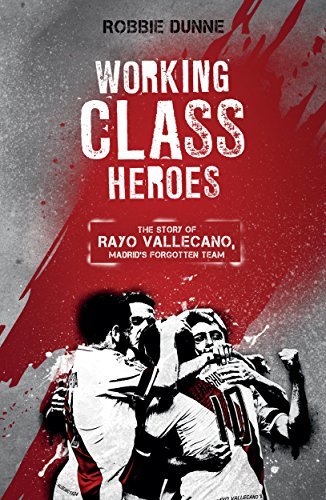
Working Class Heroes is much more than the story of a football club. This is the tale of a working-class neighbourhood, its people's relationship with both their team and the outside world, and how they co-exist. Founded in 1924, Rayo Vallecano recently achieved their highest ever position in the Spanish football league, though shortly after this feat they were brought back down to earth with relegation to the second tier of Spanish football - an outcome wholly in keeping with the historical ups and downs of the club. Madrid is a city overwhelmed by the existence of Real Madrid, though out in Vallecas, just a short metro ride from the city centre, Rayo Vallecano are the only team for the local people. While they accept their role as Madrid's third team, they wear their fandom like a badge of honour, and the club's fan group pride themselves on being anti-fascist. Working Class Heroes is the story of a writer who followed Los Vallecanos around for a year, learning from the fans about the football club and its chequered past.
It feels like this book couldn't decide between being a history of the club, a retelling of each game in the 16/17 season, or a romp through the various managers and administrators Rayo Vallecano have seen in recent years. The book ends up mediocre at all three; a blog by an undergrad who took a gap year in Madrid.
"At what point does your rejection of any form of politics become, in fact, political? For the left-wing ultra groups, apoliticism is a political act. If fascism is the dirtiest word for a political ideology, socialism might be second or third on the list after only communism. The apolitical groups, they believe, don't want to be associated with the fight against racism and xenophobia because that might inherently tie them into a left-leaning group." Ik wist oprecht niet dat ultras ook links kunnen zijn en kunnen staan voor antifascisme, antiracisme en antiseksisme.
5 sterren voor Rayo, 5 sterren voor de Bukaneros en 4 sterren voor Robbie Dunne voor het vertellen van dit verhaal (-1 ster omdat de volgorde van de verhaaltjes soms wat verwarrend is)
I’ve always had an infatuation and love for Rayo Vallecano, perhaps because they hold beliefs which resonate with me and what I believe. But, it was a thoroughly enjoyable ride experiencing the highs and the lows (and there were many lows), the trials and tribulations, the euphoria and the frustration of what it is like to be a Rayo fan and to follow the club. I found myself living vicariously through Dunne and his experiences of the match day, whilst also getting a flavour for the clubs history, background, status, philosophy and deep stories. I already wanted to attend a game at the Campo de Fútbol de Vallecas, but after reading this I’m already looking at flights and a hotel
Nice read about a lesser known club in Spain who stands for something more than football. Really enjoyed the match day writing and interactions with both the Rayo fans as a foreigner and the away fans. The culture comes across well in this book.
The author does a decent job of providing some interesting history of the club as well as what makes their club unique, their left wing, anti establishment ideals. I felt like I was right there with them for much of this book, on the terraces, supporting the same cause as them. It built naturally from game to game as we read on. Then the author got a bit preachy and redundant and harping on this and it took me out of the fight on the terraces completely and turned me off a bit. The book is about Rayo not the author. Aside from this and a surprising number of spelling and grammar errors this book was a solid read that gave me a good insight into the club Rayo Vallencano. Presa vete ya!
Such a great subject for a book. Such an fascinating story of the club and the area, and such a fantastic opportunity to be the one to chronicle it. All this book needs is a good editor to correct the typos and factual errors, to strip out the boring bits and to put in some rough order, and it would be four or five stars.
Rayo, their fans and their values are incredibly interesting, but unfortunately this book just doesn’t go into enough detail to do them justice.
The author often goes into too much depth about the mundane while missing out key details on more interesting topics. The structure of the book doesn’t work, which leads to a lot of needless repetition.
The author clearly enjoyed his time in Vallecas, and that does come through in his writing. Rayo and their culture are fascinating. But the author needed an editor to remove all the bizarre turns of phrase and cliches from his match reports and cut down on the hyperbole. Comparing an away fan, correctly, not being allowed in to the home section of a stadium to the atrocities committed under Franco’s dictatorship in Spain was particularly crass.
the content in the book is engaging and insightful, the story of Rayo is beautiful albeit told in an unconventional way in the book. left leaning clubs tend to grab my attention and this book had me committed. my only real criticism is that the book lacked semblance, chapters would go off on tangents and would be undercut with interviews spliced throughout.
Almost a good book! Great idea, well researched and in parts really interesting but let down by structure, poor editing and repetition which led to it being a bit confused. Shame, could have been really excellent and it did make me want to find out more/follow the adventures of this ‘barrio’ team.
An incredible must-read on one of Spain's most unique and much loved teams. From the fans and club fighting fascism, racism, homophobia and more, to their on-field successes and failures.
Not a bad book, on a very fascinating football club, just would've liked more match detail, and less jumping from point to point in history. There's a lot to be said for a lineal history.
Tried to do three separate things at the same time (club history, social and class history and season review) and didn't really succeed at achieving any of them.
Robbie Dunne’s debut book is endearing, a story which I found enjoyable on the whole. Books on specific football teams during specific seasons always interest me and Dunne’s effort is about Rayo Vallecano, a small team based in the barrio of Vallecano, south Madrid.
Although he emphasised his love for Rayo and their fans’ politics a bit too often for my liking, they are nonetheless a distinctive football club. There is clearly a mystique surrounding Rayo and by and large, Dunne captures this well.
A general flaw was the lack of overarching and meaningful narrative that I have been appealed by in other books about individual clubs. Some facts and anecdotes are repeated twice or more and aside from the focus on specific matches (which I did overall enjoy), the book reads more as a collection of essays/articles.
An isolated problem I have is that Dunne tells us the score of each match before describing the events. This means we have no real suspense and it comes across as merely a personal match report. If there was an actual story to tell (of triumph or adversity), it would undoubtedly benefit the narrative.
Overall, aside from these issues, I found Dunne a capable narrator, and at the very least, his passion for Rayo shines throughout, for better or for worse.