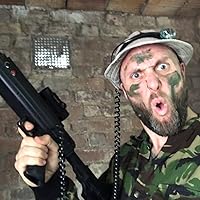
In today's increasingly hostile climate people are anxious about how to keep themselves safe. Chris Ryan served in the SAS for seven years and in several war zones throughout the world. During this time he was the Regiment's top striker and in 1991 during the infamous Bravo Two Zero mission behind Iraqi lines he was the only member of the team to evade capture and fight his way to safety, for which he was awarded the Military Medal - his CO said he had 'made Regiment history'. He is the author of bestselling fiction based on his own experiences and is an expert in dangerous situations. Here he tells you how to keep yourself and your family safe from the perils of modern urban life. He leads you through a variety of situations including what to do You are walking down the street and think you are being followed- You find yourself confronted by a threatening group of people or a gang- You find yourself caught in the middle of a riot- You hear gunfire or explosions in a crowed place (e.g. shopping centre)- You hear on the radio that Russia has launched nuclear missiles that will land in the centre of London in two hours.
Colin Armstrong (b. 1961), usually known by the pen-name Chris Ryan, is a British author, television presenter, security consultant and former Special Air Service sergeant. After the publication of fellow patrol member Andy McNab's Bravo Two Zero in 1993, Ryan published his own account of his experiences during the Bravo Two Zero mission in 1995, entitled The One That Got Away. Since retiring from the British Army Ryan has published several fiction and non-fiction books, including Strike Back, which was subsequently adapted into a television series for Sky 1, and co-created the ITV action series Ultimate Force. He has also presented or appeared in numerous television documentaries connected to the military or law enforcement.
You will learn a few things if you read this book. The first is that Chris Ryan is a manly man. He’s a strong, masculine man, much stronger and fitter than you, a better fighter and an all round top bloke. This book drips testosterone so be careful where you put it down. Being a manly man, Chris is prone to anger with weaker dimmer people (probably like you) and when angered he’ll often report that he “ripped then a second arsehole“. So if you don’t want two anuses (or is that anii?) don’t annoy him and just read book in as manly a fashion as you can muster.
The second this you will learn is that Chris Ryan was in the SAS. Every chapter starts with a recollection from jungle or desert escapades and his time in the SAS. In case you forget he was in the SAS (and remember you don’t want to annoy him) he will remind you of this every second or third page just make sure that you remember. The chapter may be about how to avoid being scammed on-line but you are going to have to read a story about exciting times in the desert before we get into this.
The information is basic, sensible stuff. You could summarise it as ‘be careful, be aware, and don’t do anything stupid’. It seems this is good jungle advice also. From this jungle experience we learn that mugging is more likely at night in dark streets in red-light districts where drug dealers operate, than in daytime in a country churchyard. Who would have thought it? Most of the information you may already guess or know.
There are tutorials on how to do a handbrake turn or a ‘J turn’ to avoid masked robbers or car jackers. I am not sure how useful these will be. Trying to remember when presented with a masked robbery ahead of you, while driving, “Is it right hand at 9 o’clock and left hand on the handbrake ? What about the pedals ?" – best to keep a copy of the book open at that page on the dashboard, just in case. But then you might not have the copy with you when you need the information about being in a riot, or a hostage situation, or a stampede – better buy two copies and keep one with you at all times. You can put it with your decoy wallet and phone, spare door jam and baseball bat and ball. If you bulk yourself out like this, then you will not only be safer but also understand why there is a section about people staring at you.
If you are an anxious person fearful of the world there may be tips here for you. Many you will know but there are also lists of threats you had never even considered. My fear is you may be more frightened at the end than you were at the beginning. If reading the book leaves you trying to learn handbrake turns in an empty supermarket car park at night then you might be less safe than you started.
The information in this book can be divided into four categories: - Sensible personal safety advice. - Information on dealing with situations you are likely never to be in. - Swing-the-lamp-pull-up-a-sandbag. - Wrong.
To be honest, I think the ‘sensible personal safety advice’ is the most valuable part. Much of it is common sense, but, let’s be honest, common sense is actually pretty rare. And besides, how often do you do the sensible thing, especially if it’s just a bit more trouble? For instance, do you drive around with the car doors locked? No, because it will take a whole extra second to get out when you reach your destination. Do you walk with your bag shoulder strap cross-body or just over your shoulder? The latter, because the former looks a bit weird, and you definitely wouldn’t want to look weird.
I say you, but actually I mean we.
This book’s main value lies in making the reader actually think about their personal safety, and what adjustments they might make to increase that level of safety. Not weird paranoid stuff - just re-evaluating a few things and making minor changes. Yes, it’s tempting to ‘check in’ on Facebook so everyone in your ‘friends’ list (and possibly their friends) knows you’re at a rock concert and they’re not... but is it really such a stretch to wait and post after you’ve come back, and so avoid telling a friend-of-a-friend that it’s OK to burgle your house this weekend?
So, from that point of view, as a list of things to re-think, money well spent.
The sections on terrorist, hostage situations, and biological/nuclear attack are less immediately useful, although they are interesting (and the advice seems sensible).
The swing-the-lamp-pull-up-a-sandbag reminiscences are interesting, but also inevitable. What’s the point of having a celebrity SAS chap write a book unless he’s going to drop in a few anecdotes? I did, at some points, find myself thinking, “Yes, mate, I know you did.” But fair play to him, he’s written a pretty good book and the anecdotes spice it up a bit and make the advice less theoretical.
As for the ‘wrong’... I only spotted one thing. In the UK, one can hold a three-shot (one in the chamber, two in the magazine) semiautomatic shotgun on a shotgun certificate. Ryan states that the maximum capacity is five shots (“count on three, be prepared for five”); actually, for Section 1 shotguns held on a firearms licence (or, of course, if you are a criminal and haven’t bothered to apply for a licence), there is no maximum capacity stated in law.
I was already a big fan of Chris Ryan's fiction, but it turns out his Non-fiction is actually what sets him apart from his ex-servicemen contemporaries. I was worried this might be a bit "Soldier-y" but in actual fact, Chris Ryan demonstrates more humility and more no-ego street wisdom than most others do. What I really want to stress is that this is a must read for anyone with a general level of anxiety who worries about being out in public spaces/flying/personal safety or any of the other chapter headings. This isn't directly marketed as a self-help book yet it's the most effective of that kind which I've ever come across. I honestly feel less anxious than I used to. The chapter about Airplane safety genuinely aided my concerns about flying. I have seen negative reviews accusing Ryan of simply stating the obvious but I disagree because the simplicity of his advice is what makes this such a clever book. All the advice given is practical, easy to remember/apply, as well as being presented in a confident way by someone who knows a thing or two about the subject matter, all while refraining from talking about himself too much (unless it contributes to the points). The final few chapters CAN move in to territory of being unnecessary, especially the chapter about surviving nuclear attacks which I'm surprised was considered important enough to make the final edit. Segments could arguably be EXcluded, but in terms of what's INcluded, I don't know how it could be improved, so it has to be five stars.
The key here is "situational awareness", which the author reiterates over and over again in the book. Something which most of us lack, especially when we come from a country that is extremely safe. A lot of the tips are common sense and sound very simple but when an incident hits, usually we are in shock and unable to react fast enough and correctly. A good reminder on how I personally take a lot of things for granted in my home country and when I travel.
Had high expectations for this book. In reality, it seems nothing more than a rushed effort to take advantage of the current fear of terrorism. Alarmingly straightforward advice that gives little insight or opportunity to learn. Will no doubt sell a lot of copies off the back of the author’s stature. Oh well. On to the next book!
The irony is I often read it face down in my phone in my commute nearly missing my stop a number of times, cearly lacking situational awareness. I hope never to have to need some of the advice in this book but the awareness required to avoid dangerous situations is just as important. A factual page turner.
Safe by Chris Ryan reads like a how-to guide when facing all the dangers that you might come across in your everyday life. It’s incredibly straightforward and useful information that I found fascinating. I actually learnt so much from reading this book and I highly recommend it to everyone.
In the book, Chris tells you how to keep yourself and your family safe from the perils of modern urban life. He leads you through a variety of situations including what to do if: - You are walking down the street and think you are being followed - You find yourself confronted by a threatening group of people or a gang - You find yourself caught in the middle of a riot - You hear gunfire or explosions in a crowed place (e.g. shopping centre) - You hear on the radio that Russia has launched nuclear missiles that will land in the centre of London in two hours.
“Firstly, don’t look over your shoulder. This will alert the person following you and cause them to drop back, so it’ll become harder for you to identify them. Make use of reflective surfaces to see what’s going on behind you. In practice, this means the wing mirrors of parked cars and shop windows.”
In case you haven’t heard of Chris Ryan, he’s a former SAS corporal and the only man to escape death or capture during the Bravo Two Zero operation in the 1991 Gulf War. In this book, he often begins a chapter by telling a story from his days in the SAS. He’ll talk about a poor choice one of his fellow soldiers made (and how it resulted in their death) or he’ll talk about a mistake that someone made (and why it could’ve ended in multiple deaths). Even though Chris’ experience in the SAS is very different from our own, he is able to adapt his knowledge for the everyday reader and give us advice that is actually useful.
“If you’re on holiday, it’s easy for your child to get separated from you. Always make sure they have a card with your name, phone number and the address of your hotel or wherever you’re staying.”
Sometimes he gives advice that seems a little too obvious, but it’s probably something that is so simple people don’t actually do it. And so it needs to be said.
I found this book really interesting. There are a lot of situations that you’ll (hopefully) never find yourself in — like what to do admit a mass terror attack — but it’s helpful and reassuring to read his advice regardless.
“Most break-ins are not sophisticated. They know which doors are easy to break down and which aren’t. So should you. If a door only has a single cylinder lock (like a Yale lock), it’s easy to break in. I could pick a pock like that in seconds and kick the door down in not much longer. Trust me: it’s a thief magnet.”
I really enjoyed reading this book, and would happily recommend it to any adult reader. Anyone who owns their own home will be interested in reading the chapters on theft and robbery, and there are a ton of other scenarios that will be quite informative to readers.
Thank you to the publisher for sending me a review copy in exchange for an honest review.
The book begins with an overly tense description of the Police warning him that his daughter has been identified as a target, Ryan suspects this was ISIS related and named the chapter Chris Ryan vs ISIS. After a year which I'm sure was incredibly stressful and no one should have to go through, the police contacted them saying that the threat was considered to be over. He described it as a "year of wanting to use all my knowledge and skills to help and protect her, of wanting to take the fight to these wannabe killers, but being unable to do a damn thing" and concluding that "that's why I had to write this book." Which us an odd conclusion to draw when your own experience wasn't relevant.
There are a few overview passages on everything from dealing with Aircraft Hijackings to Offensive driving and whilst on occasions the book says that this will require practice it doesn't really emphasis how important it is to do practice on everything from counter surveillance to First Aid to be proficient. Especially one saying to practice J Turns on an abandoned airfield, but check for anti skid material because you can roll a car. How to check for that I have no idea.
There are some stories in there that are interesting "I'd spent thirty-one days in one in Pontrilas, when I was an eighteen-year-old in the territorial SAS (23 SAS) and desper- ate for a day's wage. The Regiment wanted to know whether a six-man unit would create any kind of thermal imaging splash from above if they were in an underground shelter for this period of time. None of the lads from 22 SAS were prepared to take part in the experiment so, keen as mustard, I volunteered.
My job was to turn on and off a bank of about forty light- bulbs at various times of the day to simulate the body heat of a Regiment unit. Otherwise, I established an eight-hour on, eight-hour off stag system, lived off MREs and passed the time reading or sleeping. I was obliged to shit into plastic bags and map, before ist into empty jerrycans. You can imagine that, after a month of that, conditions in my underground bunker were foul. And day thirty-one, as the thermal imaging aircraft flew over the led, a farmer decided to let his sheep graze on the land, mpletely messing up the heat signature pattern and rendering the entire exercise a total waste of time." But I'd guess the book is not much good without the practice to back it up.
Also recommending punching someone with a knuckle out to do more damage to the kidneys seems a bit more theory than practice.
Where this book excels, is in its potential to heighten the personal awareness of the reader to the world around them. There are some people who naturally have little-to-no awareness of the world around them and potential threats, and those that do. Those that already have that awareness, are the person likely to be drawn to this book. I feel that those who could do with reading it, are unlikely to be drawn to it however.
The message is clear throughout - always be aware, don't be habitually distracted, remove yourself from danger if you can and be extremely violent if conflict is unavoidable.
I probably enjoy Chris Ryan's non-fiction writing more than his fiction (but possibly only because I've indoctrinated myself to the first person POV in the genre with the Andy McNab / Nick Stone series)
"It’s far better to make a mistake on the training field than on the battlefield." Be aware of your surroundings and always be one step ahead. Situational awareness is the key takeaway from here. Having your head in the clouds (or on your phone) and you'll be a victim of the danger before you're even aware of it.
I enjoyed this. A lot of good tips and advice. Where advice was given that I already thought was common sense, instead of feeling cheated, I felt reassured.
A quick read that I would recommend to anyone interested and are new to survival safety tips.
Not really a book in the technical sense of the word. It is useful compilation of potential danger situations in the 21st century world with concise advice on what to do faced with such eventualities. Chris collates all situations ranging from personal safety, online security, hijack situations and terrorist incidents ( and much more) and comes up a useful list of safety measures and countermeasures - some obviously are commonsense whilst some are novel- good it is all put together.
Interesting book. Some good hints and tips in there for people who may not be as clued up on situational awareness or what to do in an emergency. Good read to brush up on my skills as with time you naturally become complacent.
Amazing game read, a lot of common sense stuff in hear but I can honestly say that despite it being common sense, there are things I do that I shouldn’t be doing. An educational read on safety and staying safe, this book should be in everyone’s arsenal!
+ if someone has eyes like a shithouse rat, they're probably up to no good + if you keep a baseball bat in your house, have a baseball ball too for plausible deniability wink wink + violence should be a last resort... unless you're chris ryan
This is a must read for even a trained person as some the things we tend to forget and need to do a recap. It’s simple and packed with information that is relevant and vert much applicable in today’s life. Great book overall.
book I’ve read in a long time. In all honesty, I have to say it was a mistake to buy. I relied on the author’s name and expected the normal action packed SAS type of drama, sadly it was full of safety measures. Not a complete waste of time as the content may prove useful at some time.
This book has all sorts of useful info on staying safe in our everyday lives, much of which we probably overlook. It doesn’t dawdle, gets straight to the point and gives comprehensive tips on security and protection.