

What do you think?

The Books of the Wars #1
Lords of the Starship
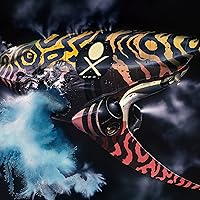
The ship was to be seven miles long, a third of a mile in diameter and was to have a wingspan of three and a half miles, It would take two and a half centuries to construct. Once built it would take Mankind away from a ruined world.
It was humanity's last hope a means of escape from a world dying in its own poisonous atmosphere, peopled by mutants and monsters.
But did the starship represent salvation or final victory from the hideous forces of Salasar?
It was humanity's last hope a means of escape from a world dying in its own poisonous atmosphere, peopled by mutants and monsters.
But did the starship represent salvation or final victory from the hideous forces of Salasar?
160 pages, Paperback
First published January 1, 1967
Ratings & Reviews
Friends & Following
Create a free account to discover what your friends think of this book!
Community Reviews
Displaying 1 - 30 of 34 reviews

August 13, 2011
I like to find 'lost classics'--those books, usually published as disposable genre quickies, that really have an impact on people yet are never on the '100 Best' lists. This one has poked its head up from time to time and I finally read it.
It's the story of a devastated future, where humanity seems to be on its last legs. A leader of a country that knows both machine guns and horse-drawn carriages reveals that there is a distant place called the yards where not only the plans, but the components of a seven-mile-long starship are hidden, from the forgotten past. The leader's idea is to use the building of this ship as a rallying-point for the rebuilding of the nation. The decades-long story of the starship's construction fills up the rest of this slim (<160 pages) book.
Written in the 60's, this could easily be read as a distorted view of the space program as a diversion from other issues, or as how such an inspirational idea as going into space really can pull a nation together.
Instead of one Heinelin-esque hero being the center of the story, we see a series of characters move across the stage of history as the building of the starship leads to political infighting, sacrificial battles waged for propaganda purposes, and foreign fears of what the starship's completion might mean for others. A character who we've been following for pages may suddenly be dead off-stage as we leap years or decades ahead, with the starship being the main 'character.'
Will the starship be completed? If so, what happens then?
I flew through this book because it is an original, an epic told in a chamber-group style. The descriptions are succinct yet vivid (a tower in the yards is briefly described in a way that made me a little woozy). This is not for those who like their epics at phone book-length, but for those who like a story with a point, a message, well-told.
I have only one real complaint about the book, which is that there are some logic issues and the ultimate 'big picture' we see at the very end. But these are indeed minor issues. This was just an absorbing, fun and thought-provoking read--that's what I expect from a book and this one gave me all that (plus a simple but evocative John Schoenherr cover).
This was reprinted a few years ago but it still seems to have been lost in the tangle of SF adventures. I look forward to reading Geston's other books, and hope others will pick up on this one--it deserves to be better-known.
It's the story of a devastated future, where humanity seems to be on its last legs. A leader of a country that knows both machine guns and horse-drawn carriages reveals that there is a distant place called the yards where not only the plans, but the components of a seven-mile-long starship are hidden, from the forgotten past. The leader's idea is to use the building of this ship as a rallying-point for the rebuilding of the nation. The decades-long story of the starship's construction fills up the rest of this slim (<160 pages) book.
Written in the 60's, this could easily be read as a distorted view of the space program as a diversion from other issues, or as how such an inspirational idea as going into space really can pull a nation together.
Instead of one Heinelin-esque hero being the center of the story, we see a series of characters move across the stage of history as the building of the starship leads to political infighting, sacrificial battles waged for propaganda purposes, and foreign fears of what the starship's completion might mean for others. A character who we've been following for pages may suddenly be dead off-stage as we leap years or decades ahead, with the starship being the main 'character.'
Will the starship be completed? If so, what happens then?
I flew through this book because it is an original, an epic told in a chamber-group style. The descriptions are succinct yet vivid (a tower in the yards is briefly described in a way that made me a little woozy). This is not for those who like their epics at phone book-length, but for those who like a story with a point, a message, well-told.
I have only one real complaint about the book, which is that there are some logic issues and the ultimate 'big picture' we see at the very end. But these are indeed minor issues. This was just an absorbing, fun and thought-provoking read--that's what I expect from a book and this one gave me all that (plus a simple but evocative John Schoenherr cover).
This was reprinted a few years ago but it still seems to have been lost in the tangle of SF adventures. I look forward to reading Geston's other books, and hope others will pick up on this one--it deserves to be better-known.

July 12, 2023
There's a lot that recalls the classics: Foundation's generational plan set down by a genius and buttressed by a secret elite, Childhood's End's depleted future humanity that are just tired of existing and lost their purpose. The story lurches to where Out of the Mouth of the Dragon starts, and the sum of it is laced with the same depressing view of an exhausted World and a humanity whose greatest achievements all end in ruin. These ruins litter the planet with vast, incomprehensible edifices.
The imagery is specific in its depiction of decay and loss. Even the most advanced society with First World ships outfit the missile carriages with muzzle-loading cannon and rip out nonfunctional radar assemblies and use sextants. Nothing produced is of the quality of a thousand years ago, not as much due to loss of knowledge, but because of pure apathy.
The entire ideal of the Starship itself is a series of blinds and deception pointing at the concept that we can't have something nice.
The imagery is specific in its depiction of decay and loss. Even the most advanced society with First World ships outfit the missile carriages with muzzle-loading cannon and rip out nonfunctional radar assemblies and use sextants. Nothing produced is of the quality of a thousand years ago, not as much due to loss of knowledge, but because of pure apathy.
The entire ideal of the Starship itself is a series of blinds and deception pointing at the concept that we can't have something nice.

December 2, 2024
I bought this book for the sweet John Schoenherr (Dune) cover, and was hooked by an ambitious, well written generational spaceship story (in a left-handed way). Dark, conniving, threatening and dense.

June 9, 2016
A really short novel that nonetheless manages to tell a story that is epic in scope and spans multiple generations of characters.
Part of the way it does this is by using a really impersonal narrative technique, having no single viewpoint character and following each character for only a short time, as long as their part in the central narrative lasts.
It begins with a civil servant named Henry Limpkin going to visit a retired general named Toriman, who is famous for his heroics in some long-ago war and who now lives a luxurious life in a castle where he apparently spends his time pondering the future of humanity. This Toriman proposes an unfathomably ambitious idea to Limpkin: that Limpkin's government devote as much manpower and resources as they can to building a vast spaceship big enough to carry all the people away to some fresh world where their pioneering spirit can be invigorated and they can build a civilization the likes of which now only exist in memory. At first this should be done in secret, but once enough headway has been made the project should be made public, with every citizen invited to help build The Ship, which Toriman intends to be a symbol of the national pride and ambition he hopes to reawaken through this unimaginably large-scale public works project.
At first Limpkin is skeptical, but he does not dismiss the idea outright because he has also observed the thing Toriman hopes to overcome through the Ship-building project: a sort of deeply ingrained fatalism that Toriman blames on the World itself. He describes a sense that the World is too old, that the memory of all the civilizations that have ever existed, and the knowledge that all of them have ultimately fallen, that works against any present-day efforts to build anything that lasts.
This is his real objective: not to escape the World, really, but to show the people that they can build something that will endure. The Ship, he explains, will never actually blast off (he is not sure it will even be spaceworthy), but will serve solely as a morale-building exercise, and as soon as it looks like the people are beginning to take heart, he intends to divert their labor and materiel towards rebuilding the country's terrestrial infrastructure, which is in a long-standing state of decrepitude.
The rest of the book follows a rotating cast of characters through the various stages of the Ship's construction, which takes place at a suitably inspiring, though hard-to-reach, locale: a derelict staging area and launch site called the Yards that was last used by one of the ancient spacefaring civilizations, some of whose abandoned watchtowers (equipped with automated laser cannons) still stand along its perimeter.
Getting to the Yards is difficult and dangerous, requiring the workers and their military escort to cross a large expanse of territory that belongs to no nation because it's full of wild and aggressive mutants, who attack any stranger they see. The mutants are a fantastical array of human-animal hybrids and other posthuman monsters; they include fliers with big bat wings, lizard-men with scales and claws, people with compound eyes and chitinous body plating, people with more than two arms, and hooded and cloaked warlocks who can conjure fireballs out of thin air and shoot them like projectiles at the intruding riverboats.
A great battle is fought between the would-be Ship builders and these mutants, the Battle of the Bloody Ford, which we witness through the eyes of a young civil engineer named Philip Rome. Rome is terrified out of his wits by the horrible appearance of the mutants, and by the devastation they wreak with their fireballs, and he's certain his expedition is going to be overwhelmed and that he, and his entire escort, is going to die when a mysterious figure appears to rescue them and lead them to victory. He disappears as soon as the battle is over, and later when stories are told of this battle people decide the mysterious person must have been the ghost of Miolnor IV, the commander responsible for the last human victory over the mutants, which left the mutants' homeland in its desolate state (it had been a lush jungle).
Anyway, people take this fortuitous apparition as an auspicious omen of the Ship project's success, and they begin to take heart, just like Toriman predicted. More and more people flock to the Yards, and a big, bustling, prosperous city is built to house them. And year after year, generation after generation, the Ship takes shape.
All is not exactly well with the project, though; instead of unifying everyone, the Ship project has given rise to a hierarchy: a laboring caste (to which most of the people belong) and a managerial, technocrat caste (who make all the decisions about labor and resource allocation). What's more, not all of the Technos are on the same page with each other about what the real purpose of the Ship is! There is tension between the Technos who want to keep their resources and efforts focused on their own city-state at the Yards (if not on the Ship itself) and the Admiralty bureaucrats back home who want some return on their investment in the form of some repair and rebuilding of their own aging infrastructure (which was what they understood the ultimate purpose of the Ship to be -- a catalyst to reanimate the people's will to build, which once awakened would be turned back homeward). A cold war arises between these factions, complete with espionage, sabotage and the occasional assassination.
At the same time, a demagogue is arising among the People, urging them not to trust the Technos and to seize the Ship for themselves. I'm going to stop summarizing the plot now to avoid spoilers, but this conflict is very important and the ultimate fate of the Ship is wrapped up in it.
I was a child the first time I read this book, so I was excited to revisit it again after all these years.
I found I had quite a few questions that didn't occur to me the first time I read it -- mostly worldbuilding questions, like how to reconcile the opulence of Toriman's castle with what we are later told about general conditions of scarcity, and about the shoddy construction and poor maintenance of the built environment, or where the mutants come from and why their numbers keep growing, or why, in a world with such a long history that spacefaring civilizations existed in what the characters think of as the ancient past, there are still nation-states at all, much less nation-states governed by aristocracy or monarchy!
I was also hunting furiously for any indication that The World might be a future Earth: looking for clues in place names, geography, or any potentially identifying details about the ancient civilization that built the Yards. I didn't find any, but that doesn't mean it's not Earth -- with the kind of timescales Geston is working with, and the cataclysmic nature of some of the past events he alludes to, it's entirely believable that none of the geography, place names or national borders would be recognizable. (Unfortunately, this also makes it all the more jarring when some aspect of 19th- or 20th-century Western culture -- like the nation-state, or the military and civil-service bureaucracies, or horse-drawn carriages driven by servants wearing livery, or ... you get the idea -- does surface in this ostensibly alien far-future setting.)
That discrepancy between how alien this setting should be and how familiar it is never stopped troubling me. I won't go so far as to say it ruined the book for me, but it did mean I wasn't transported in wonder by it this time, as I remember being when I read it the first time, long ago.
I also kept wanting to know more about the mutants. Not just logistical questions like how are they supporting such a huge population in what's described as a blasted waste of an environment, or where they come from, but also things like what they want, what the source of their animus towards the rest of the World's people is, and whether and how they all communicate with one another. I also wanted to know who the Dark Powers were, beyond that name -- who were they, what did they do that was so bad, what were the reasons for their war against their neighboring countries -- and I kept finding it odd that a book whose main plot focuses so much on ordinary human foibles would also include this kind of ultimate Big Bad, declared by authorial fiat to be evil incarnate, lurking in the background. I don't want to talk more about the Dark Powers because of spoilers, but in general it felt like they belonged in a different book and shouldn't be in this one.
There is one aspect of it I do like, that had stayed with me from my first reading of it and that likely will stay with me well into the future: it's this theme of the World itself being malevolent, and draining the imagination and resolve of the people who live in it. I find it compelling on both the literal and metaphorical levels; literally because I live in a sort of buffer zone between the semi-arid prairie biome of the Great Plains and the wetter, greener Eastern deciduous forest biome and I feel like I'm watching the border between those biomes move eastward, and the area around my house growing drier, so during the summer it really does feel like the land wants everything you plant to die; and metaphorically because I have depression and this is a good way to describe what the hopelessness characteristic of depression feels like to someone who has never felt it for themselves.
Part of the way it does this is by using a really impersonal narrative technique, having no single viewpoint character and following each character for only a short time, as long as their part in the central narrative lasts.
It begins with a civil servant named Henry Limpkin going to visit a retired general named Toriman, who is famous for his heroics in some long-ago war and who now lives a luxurious life in a castle where he apparently spends his time pondering the future of humanity. This Toriman proposes an unfathomably ambitious idea to Limpkin: that Limpkin's government devote as much manpower and resources as they can to building a vast spaceship big enough to carry all the people away to some fresh world where their pioneering spirit can be invigorated and they can build a civilization the likes of which now only exist in memory. At first this should be done in secret, but once enough headway has been made the project should be made public, with every citizen invited to help build The Ship, which Toriman intends to be a symbol of the national pride and ambition he hopes to reawaken through this unimaginably large-scale public works project.
At first Limpkin is skeptical, but he does not dismiss the idea outright because he has also observed the thing Toriman hopes to overcome through the Ship-building project: a sort of deeply ingrained fatalism that Toriman blames on the World itself. He describes a sense that the World is too old, that the memory of all the civilizations that have ever existed, and the knowledge that all of them have ultimately fallen, that works against any present-day efforts to build anything that lasts.
This is his real objective: not to escape the World, really, but to show the people that they can build something that will endure. The Ship, he explains, will never actually blast off (he is not sure it will even be spaceworthy), but will serve solely as a morale-building exercise, and as soon as it looks like the people are beginning to take heart, he intends to divert their labor and materiel towards rebuilding the country's terrestrial infrastructure, which is in a long-standing state of decrepitude.
The rest of the book follows a rotating cast of characters through the various stages of the Ship's construction, which takes place at a suitably inspiring, though hard-to-reach, locale: a derelict staging area and launch site called the Yards that was last used by one of the ancient spacefaring civilizations, some of whose abandoned watchtowers (equipped with automated laser cannons) still stand along its perimeter.
Getting to the Yards is difficult and dangerous, requiring the workers and their military escort to cross a large expanse of territory that belongs to no nation because it's full of wild and aggressive mutants, who attack any stranger they see. The mutants are a fantastical array of human-animal hybrids and other posthuman monsters; they include fliers with big bat wings, lizard-men with scales and claws, people with compound eyes and chitinous body plating, people with more than two arms, and hooded and cloaked warlocks who can conjure fireballs out of thin air and shoot them like projectiles at the intruding riverboats.
A great battle is fought between the would-be Ship builders and these mutants, the Battle of the Bloody Ford, which we witness through the eyes of a young civil engineer named Philip Rome. Rome is terrified out of his wits by the horrible appearance of the mutants, and by the devastation they wreak with their fireballs, and he's certain his expedition is going to be overwhelmed and that he, and his entire escort, is going to die when a mysterious figure appears to rescue them and lead them to victory. He disappears as soon as the battle is over, and later when stories are told of this battle people decide the mysterious person must have been the ghost of Miolnor IV, the commander responsible for the last human victory over the mutants, which left the mutants' homeland in its desolate state (it had been a lush jungle).
Anyway, people take this fortuitous apparition as an auspicious omen of the Ship project's success, and they begin to take heart, just like Toriman predicted. More and more people flock to the Yards, and a big, bustling, prosperous city is built to house them. And year after year, generation after generation, the Ship takes shape.
All is not exactly well with the project, though; instead of unifying everyone, the Ship project has given rise to a hierarchy: a laboring caste (to which most of the people belong) and a managerial, technocrat caste (who make all the decisions about labor and resource allocation). What's more, not all of the Technos are on the same page with each other about what the real purpose of the Ship is! There is tension between the Technos who want to keep their resources and efforts focused on their own city-state at the Yards (if not on the Ship itself) and the Admiralty bureaucrats back home who want some return on their investment in the form of some repair and rebuilding of their own aging infrastructure (which was what they understood the ultimate purpose of the Ship to be -- a catalyst to reanimate the people's will to build, which once awakened would be turned back homeward). A cold war arises between these factions, complete with espionage, sabotage and the occasional assassination.
At the same time, a demagogue is arising among the People, urging them not to trust the Technos and to seize the Ship for themselves. I'm going to stop summarizing the plot now to avoid spoilers, but this conflict is very important and the ultimate fate of the Ship is wrapped up in it.
I was a child the first time I read this book, so I was excited to revisit it again after all these years.
I found I had quite a few questions that didn't occur to me the first time I read it -- mostly worldbuilding questions, like how to reconcile the opulence of Toriman's castle with what we are later told about general conditions of scarcity, and about the shoddy construction and poor maintenance of the built environment, or where the mutants come from and why their numbers keep growing, or why, in a world with such a long history that spacefaring civilizations existed in what the characters think of as the ancient past, there are still nation-states at all, much less nation-states governed by aristocracy or monarchy!
I was also hunting furiously for any indication that The World might be a future Earth: looking for clues in place names, geography, or any potentially identifying details about the ancient civilization that built the Yards. I didn't find any, but that doesn't mean it's not Earth -- with the kind of timescales Geston is working with, and the cataclysmic nature of some of the past events he alludes to, it's entirely believable that none of the geography, place names or national borders would be recognizable. (Unfortunately, this also makes it all the more jarring when some aspect of 19th- or 20th-century Western culture -- like the nation-state, or the military and civil-service bureaucracies, or horse-drawn carriages driven by servants wearing livery, or ... you get the idea -- does surface in this ostensibly alien far-future setting.)
That discrepancy between how alien this setting should be and how familiar it is never stopped troubling me. I won't go so far as to say it ruined the book for me, but it did mean I wasn't transported in wonder by it this time, as I remember being when I read it the first time, long ago.
I also kept wanting to know more about the mutants. Not just logistical questions like how are they supporting such a huge population in what's described as a blasted waste of an environment, or where they come from, but also things like what they want, what the source of their animus towards the rest of the World's people is, and whether and how they all communicate with one another. I also wanted to know who the Dark Powers were, beyond that name -- who were they, what did they do that was so bad, what were the reasons for their war against their neighboring countries -- and I kept finding it odd that a book whose main plot focuses so much on ordinary human foibles would also include this kind of ultimate Big Bad, declared by authorial fiat to be evil incarnate, lurking in the background. I don't want to talk more about the Dark Powers because of spoilers, but in general it felt like they belonged in a different book and shouldn't be in this one.
There is one aspect of it I do like, that had stayed with me from my first reading of it and that likely will stay with me well into the future: it's this theme of the World itself being malevolent, and draining the imagination and resolve of the people who live in it. I find it compelling on both the literal and metaphorical levels; literally because I live in a sort of buffer zone between the semi-arid prairie biome of the Great Plains and the wetter, greener Eastern deciduous forest biome and I feel like I'm watching the border between those biomes move eastward, and the area around my house growing drier, so during the summer it really does feel like the land wants everything you plant to die; and metaphorically because I have depression and this is a good way to describe what the hopelessness characteristic of depression feels like to someone who has never felt it for themselves.

July 15, 2020
I've long thought that a book about the construction of a generation ship could be as or more interesting than the myriad stories actually set on one. This book isn't that book. At least, not entirely. It is about the construction of a generation ship, but that's a small part of a double-layered conspiracy story, set on a dying earth thousands of years in the future, with a sprinkling of Manichean struggle. It reminds me most, of all things, of a prototype for the Warhammer 40,000 setting (back when it was good). It has the same cynical outlook, the same massive disconnect between the top and bottom of society, the same pervasive lies and conspiracies holding up the status quo, the same incongruity that sees tanks, swordsmen and magic together on the battlefield, the same influence of vast cosmic powers over the fates of helpless humans. It's certainly not the first story to have any one of those elements, but all together it seems very suggestive. It even uses the term "black libraries" to refer to caches of ancient knowledge. I couldn't find any evidence that there was such direct inspiration, but it's historically plausible that it could have been.
It's also told in the same style as the best parts of Warhammer were, in small vignettes about specific people, battles and movements. The single longest segment of the novel is a meeting between two men that starts the massive gears of the plot moving. Thereafter, decades may be passed over in a paragraph. The entire story takes place over about 150 years, even though it is a very short novel. There are a few points I would have preferred the book be extended a bit, but overall it told its story with enough economy that I didn't feel it was too thin for the scale it was going for. I wasn't aware it was part of a series before reading, and while the ending isn't an ending in the ultimate sense, it does resolve the story it set out to tell, while suggesting the direction of the future.
It's also told in the same style as the best parts of Warhammer were, in small vignettes about specific people, battles and movements. The single longest segment of the novel is a meeting between two men that starts the massive gears of the plot moving. Thereafter, decades may be passed over in a paragraph. The entire story takes place over about 150 years, even though it is a very short novel. There are a few points I would have preferred the book be extended a bit, but overall it told its story with enough economy that I didn't feel it was too thin for the scale it was going for. I wasn't aware it was part of a series before reading, and while the ending isn't an ending in the ultimate sense, it does resolve the story it set out to tell, while suggesting the direction of the future.

February 13, 2019
I initially found this book via a review in the back of an old pulp mag that I found in a used book store. I vowed then and there that I would only read books that were long out of print written by someone I had never heard of. Believe it or not, it is going well so far!
Lords of the Starship (Gregg Press Science Fiction Series) is a cautionary tale of post apocalypsism. A collection of stories of a benevolent force (maybe) working to restore man to its former glory. Sounds cool, but it goes off the rails at some point. If you like a dab of fantasy in your science fiction this might be the obscure tome for you!
It was a fun read and surprisingly well written considering that the author was 19 years when he wrote it. Imagine if Robert E. Howard had written the Foundation Series when he was 19.
Lords of the Starship (Gregg Press Science Fiction Series) is a cautionary tale of post apocalypsism. A collection of stories of a benevolent force (maybe) working to restore man to its former glory. Sounds cool, but it goes off the rails at some point. If you like a dab of fantasy in your science fiction this might be the obscure tome for you!
It was a fun read and surprisingly well written considering that the author was 19 years when he wrote it. Imagine if Robert E. Howard had written the Foundation Series when he was 19.

September 12, 2015
For a book written by a 21-year-old student in the Summer of Love, this is a deeply cynical and dark little novel.
Set in a fantasy land that is slowly devolving technologically and spiritually, it details the 250-year-long construction of a vast starship – not to escape the world’s problems (its ostensible purpose), but to resurrect “the spirit of the people" (its covert purpose) and reverse the inexorable slide towards entropy and decay. Through a series of vignettes, the novel chronicles the building of the ship and the plots surrounding it – gradually becoming darker, more fantastical, and more frenetic as it builds towards a train-crash conclusion.
I first read the book years ago and it is both memorable and distinctive. The early chapters paint a picture of stasis, decay, and gloom that oddly reminds me of The Radetzky March, set in the final years of the Austrian-Hungarian Empire (probably the first and last time Mark Geston and Joseph Roth will ever be bracketed together). Geston’s world is haunted by an unattainably superior but forgotten past. “[The castle] was a place of great antiquity, where the inherited relics of a thousand defeated nations lay, where crossbowmen...patrolled over stone-filled shafts housing the rusting shells of ballistic missiles six centuries old.”
The concept of building a seven-mile-long starship under these conditions remains startling even after we are introduced to the idea in the first few pages. Whether the ship is a metaphor for religion (it has its own black-clad technocratic priests) or just a Big Dumb Object, the novel and the novel’s world revolves around it. Approaching the end, the chapters get shorter (one is just three lines long), the writing more aggressive, and events more chaotic. The finale is apocalyptic. Lords of the Starship is flawed in many ways, but it still has a vitality and individuality lacking in most genre novels.
Set in a fantasy land that is slowly devolving technologically and spiritually, it details the 250-year-long construction of a vast starship – not to escape the world’s problems (its ostensible purpose), but to resurrect “the spirit of the people" (its covert purpose) and reverse the inexorable slide towards entropy and decay. Through a series of vignettes, the novel chronicles the building of the ship and the plots surrounding it – gradually becoming darker, more fantastical, and more frenetic as it builds towards a train-crash conclusion.
I first read the book years ago and it is both memorable and distinctive. The early chapters paint a picture of stasis, decay, and gloom that oddly reminds me of The Radetzky March, set in the final years of the Austrian-Hungarian Empire (probably the first and last time Mark Geston and Joseph Roth will ever be bracketed together). Geston’s world is haunted by an unattainably superior but forgotten past. “[The castle] was a place of great antiquity, where the inherited relics of a thousand defeated nations lay, where crossbowmen...patrolled over stone-filled shafts housing the rusting shells of ballistic missiles six centuries old.”
The concept of building a seven-mile-long starship under these conditions remains startling even after we are introduced to the idea in the first few pages. Whether the ship is a metaphor for religion (it has its own black-clad technocratic priests) or just a Big Dumb Object, the novel and the novel’s world revolves around it. Approaching the end, the chapters get shorter (one is just three lines long), the writing more aggressive, and events more chaotic. The finale is apocalyptic. Lords of the Starship is flawed in many ways, but it still has a vitality and individuality lacking in most genre novels.

October 5, 2020
A small forgotten gem from the late 60. The story was clearly inspired by all the effort and resources used by the US for the "moonshot", but it goes well beyond that. At some point truly dark, and generally satisfyingly bizarre.

December 4, 2013
Written when the author was only 21, this is both short and epic. I've now read it several times over the years and it still interests me. This time I became painfully aware of some of its (actually quite obvious) failings: utter lack of characterisation, some clumsy writing, hysterical (in both senses) fight sequences, a smattering of brash pretentious pontification that tries to pass for political philosophy and so on.
But it still moves.
It represents the most awesome (in the traditional sense) aspect of evil I've ever read: a deliberate, centuries-long and ridiculously elaborate plan to annihilate most of the human race and bring about yet another version of Armageddon in order to take over what's left of the world, a plan that is entirely successful. The deliberate immolation of the millions on board the ship by the end still comes as a shock every time: a reversal of fortune George RR Martin could only dream of.
And when he does write well it has an elegiac historical distance that resonates.
"The black light stained the sky and spread cancerously over the sun." Cheerful eh?
But it still moves.
It represents the most awesome (in the traditional sense) aspect of evil I've ever read: a deliberate, centuries-long and ridiculously elaborate plan to annihilate most of the human race and bring about yet another version of Armageddon in order to take over what's left of the world, a plan that is entirely successful. The deliberate immolation of the millions on board the ship by the end still comes as a shock every time: a reversal of fortune George RR Martin could only dream of.
And when he does write well it has an elegiac historical distance that resonates.
"The black light stained the sky and spread cancerously over the sun." Cheerful eh?
This entire review has been hidden because of spoilers.

March 15, 2020
Full review: https://sciencefictionruminations.com...
"Mark S. Geston’s first novel Lords of the Starship (1967), written at the age of 21 while he was an undergraduate history student, revolves around a fascinating premise: The construction of a massive (fake) spaceship intended to lift a society out of a crippling malaise. The narrative covers hundreds of years and seemingly innumerable characters. The lack [...]"
"Mark S. Geston’s first novel Lords of the Starship (1967), written at the age of 21 while he was an undergraduate history student, revolves around a fascinating premise: The construction of a massive (fake) spaceship intended to lift a society out of a crippling malaise. The narrative covers hundreds of years and seemingly innumerable characters. The lack [...]"

October 6, 2017
I wanted to love this more than I did. I loved the premise of the book. However, I didn't enjoy the style of how the story was told. It was dry, and felt like a history book. I found myself picking up and setting the book down several times and it took me three months to finish reading it.

September 20, 2017
I've had this book for years and finally got around to reading it - loved it. Was acquainted with the author and am impressed - excellent writing.

May 13, 2018
I think this novel wants to be A Canticle for Leibowitz, or maybe Ozymandias. But it is not up to it.

January 4, 2020
A dry fantastical history book without much character development. It read like D&D instructions to a dungeon master - this happened, then that...

January 17, 2021
Very odd subject and plot line. All and all the story held my interest to the very end. Even if the ending was somewhat dark.

May 20, 2024
Another strange little book from Geston.
It is thousands of years in the future, and the world has gone to the dogs. Mental faculties fail, mutants rule the wastelands betwixt the few remaining cities, technology teeters on falling bellow the attainments of the Victorians. Without inspiration, Humanity is quite doomed.
... and so inspiration is manufactured: the Ship, miles long, miles wide, is constructed in order to unite humans once again - to inflame their minds toward actually achieving something worthwhile, to resurrect long-dead Dreams and Hopes for a journey to another star. But a few know the truth: the Ship was never meant fly... still, what matter that when, ultimately, predictably, all humanity can do is fight over the bloody thing?
Geston is not in the business of fluffy reassurance in his fiction; he's in the business of blackly humorous, world-weary, knowing, quirky, unpredictable SF. But that's not to say he doesn't have an eye for spectacle, too: the final battle for the Ship, involving gigantic tanks, gigantic aircraft, gigantic battleships, gigantic fortresses, and gigantic gun batteries, is vividly -and gigantically- portrayed.
This is his first published novel, and it shows in the lack of real flow to the story, but -like The Day Star (the only other novel of his I've so far read)- it nevertheless brims with an originality of thought and outlook I've never encountered before. He sees the world differently than other folk. Perhaps he sees a kind of truth. If he does, it's not a happy one.
It is thousands of years in the future, and the world has gone to the dogs. Mental faculties fail, mutants rule the wastelands betwixt the few remaining cities, technology teeters on falling bellow the attainments of the Victorians. Without inspiration, Humanity is quite doomed.
... and so inspiration is manufactured: the Ship, miles long, miles wide, is constructed in order to unite humans once again - to inflame their minds toward actually achieving something worthwhile, to resurrect long-dead Dreams and Hopes for a journey to another star. But a few know the truth: the Ship was never meant fly... still, what matter that when, ultimately, predictably, all humanity can do is fight over the bloody thing?
Geston is not in the business of fluffy reassurance in his fiction; he's in the business of blackly humorous, world-weary, knowing, quirky, unpredictable SF. But that's not to say he doesn't have an eye for spectacle, too: the final battle for the Ship, involving gigantic tanks, gigantic aircraft, gigantic battleships, gigantic fortresses, and gigantic gun batteries, is vividly -and gigantically- portrayed.
This is his first published novel, and it shows in the lack of real flow to the story, but -like The Day Star (the only other novel of his I've so far read)- it nevertheless brims with an originality of thought and outlook I've never encountered before. He sees the world differently than other folk. Perhaps he sees a kind of truth. If he does, it's not a happy one.

June 3, 2020
Just read this book, though I've had a copy since it was published around 1967. My High School PE teacher was the author's dad, and my copy of the book is autographed by the author, though I can't remember the circumstances of how I got the book and the autograph. This is a strange novel, difficult to follow at times, and in the end rather depressing. The protagonists live in a post-technological world, that may be Earth of the future, but I rather think is probably a colonized planet cut off from Earth. There are names reminiscent of Earth (the River Tyne, the Caroline), but the map doesn't look anything like Earth. In any case the book is about a project to build a giant starship as a means to raise the spirits of people and improve the infrastructure using spinoff technology. However the true motivations behind the construction of the ship are not revealed until the end of the book. Overall I say not bad for a first novel, with some writing that is poetic at times and violent at other times. Certainly a dystopian work. I have a copy of his second novel (also autographed) and will tackle that next.

May 11, 2026
I really enjoyed this - it is kind of Foundation-esque in scope, except set on a single planet in the millennia after an apocalypse. It is rol across several hundred years, with charcaters for the most part making only brief appearances to move the plot along while generations live and die. Philosophicaly it is about decay and evil and machination. It is not terribly descriptive - when people are fighting Geston prefers poetic kind of summary to the nitty gritty. There is a lot that feels like could have beern significantly expanded - this could be a series without difficulty, and would make a good TV show with the right writers. Still, it feels a bit detached from the events and is written from kind of high up, if thay makes sense. Very few of the characters have the space for personality to develop. It is an ambitious and surprisingly short story, but well worth the read.
April 14, 2021
In spite of it's size, the story spans over two hundred years and several generations. Characters quickly come in and out in accordance to their relevance to the creation of the ship. Sometimes, a character will live and die within the space of a page. The book sometimes reads almost like a history book. One could say it is the ship which is the main character. While by no means bad, the impersonal style was not my cup of tea and were it not for the brief length of the book, I'm not certain I would have finished it and I found my attention and interest wanning towards the end. It does, however, have one of the most epic climaxes I've read for a while.

September 7, 2023
I dnf'ed this at 94%. I should just mark it as read but I can't commit to the final 6%. I feel like this is a fascinating concept and world, but the cast of characters, how quickly they just cycled out of the story, and my desire to know more of the people so I could have a firmer grasp on them. Maybe I missed the point of the book but this form of narrative doesn't work for me.
I do find the idea of a portion of the government looking at the state of it's world and deciding to form a conspiracy and outright lie to it's people to eventually better their lives. The willful and careful crafting of the mythology surrounding the starship is very interesting .
I do find the idea of a portion of the government looking at the state of it's world and deciding to form a conspiracy and outright lie to it's people to eventually better their lives. The willful and careful crafting of the mythology surrounding the starship is very interesting .

August 11, 2024
One of the more accomplished “tell don’t show” novels, which, although generally a mode I enjoy, has more duds than standouts, given the thin line between purposeful Big Picture Narrativization (BPN) and “I don’t know how to actually write” blundering. It’s additionally notable because Geston was, as I take it, hardly out of his teens at the time he completed the thing, usually a big, fat, correct red flag. That age and immaturity is noticeable in spots (ie, getting immediately horny over the very first female character he creates), although only with advance knowledge of his age. Otherwise, he moves fluidly in and out of BPN and more patient lived-in scenes every now and then (most regularly the battle scenes), which do a bit to leaven the Chronicle-like tone of the thing.
Did Not Finish
June 1, 2026idk if its the author’s bad writing style or my inhibited intellact but I don’t really understand it. The book is very vague about the description of the characters and the plot and it took all my effort to continue reading it
May 21, 2025
A fun read, through also depressing and bleak view of the future.

August 3, 2015
I first read this 7 years ago and, at the time, was pretty impressed with what this short novel pulled off on such a grand scale. I like to pick up these kinds of classic sci-fi and fantasy pockets in search of new authors and lost treasures. Wanting to re-read it now for a light in-between book (and to give it a review to highlight a presumed hidden gem) I was quite disappointed by it.
The premise, grand ideas and approach are all commendable, but it’s the writing style, drab world and uninteresting characters that hamper it in major ways.
Set in a post-apocalyptic fantasy world with Great Powers and a Good vs Evil theme it mixes in some sci-fi tropes but mainly remains on the fantastical side, safe for the technological progression throughout the story. I am a big fan of Vance's Dying Earth, but this story had little of its charm.
The author was 19 when he started working on this and it shows in many places, impressive as it might be for a first published work. The prose is all over the place, though it often can be quite good and visually strong, the dry, historical narration (often describing time leaps in years and decades) mars most immersion into the world.
It’s also quite dated, and while I generally try to keep an open mind for this kind of golden age sci-fi/fantasy, I just was way to frustrated with the story’s impersonal fixation of ‘Great Men’ and their great deeds. In many ways it reminds me a lot of an abbreviated Asimov’s Foundation : an enigmatic old man designs grand plans for centuries to come, .
It’s a man’s world history with no named female characters and the only plot-relevant woman being robbed of her agency and forced to have sex in payment for her rescue.
On multiple occasions greying, elitist men share drinks and cigars over a fireplace and brusque conversation. It’s just not appealing.
The writing style and the world are interestingly thoroughly British, with a stratified imperial class society, dry humour and posh vocabulary; even though Geston is from New Jersey. While impressive to denote the grand scale of things like the structures surrounding the Yards and the Ship itself, the writer, at least for the first half of the book, has a fixation on noting the exact dimensions of most locations and objects.
It adheres to a mythological (some of it Christian, some of it its own creation) way of capitalised symbolic themes and appears to have things to say about class struggle, religion and mob mentality, though it fails to make points. The clearest criticism is on human nature and its fixation on war. The narration seems to glorify it, but the horrors, destruction and futility of conflict are evident; something very fitting for a story written in 1969. The characters, save for a certain archetype, are all quite flat and have pretty much no development.
Generally, the narration is distant and objective with a focus on more personal interactions and events at certain times where the prose becomes more detailed, then, during action and battles the narration becomes vivid, lyrical and visceral as it turns into a Warhammer-esque Grim-dark style of glorified war and killing. Indeed, I can see this being an inspiration for that setting, complete with the use of Black Libraries in the story.
So, the major plot beats are interesting, the premise original and it’s packaged in a short volume. The ending, though disjointed, is exiting and bewildering.
In spite of that, I was hard pressed to enjoy or even make progression in the readthrough. Maybe it’s just me, having grown to expect more diverse and vibrant settings with deep characters, if so, I will mourn my diminished ability to enjoy classic sci-fi. Maybe I’m just coming off a high of having read four incredible novels in the past months.
The end resulting disappointment is there either way.
The premise, grand ideas and approach are all commendable, but it’s the writing style, drab world and uninteresting characters that hamper it in major ways.
Set in a post-apocalyptic fantasy world with Great Powers and a Good vs Evil theme it mixes in some sci-fi tropes but mainly remains on the fantastical side, safe for the technological progression throughout the story. I am a big fan of Vance's Dying Earth, but this story had little of its charm.
The author was 19 when he started working on this and it shows in many places, impressive as it might be for a first published work. The prose is all over the place, though it often can be quite good and visually strong, the dry, historical narration (often describing time leaps in years and decades) mars most immersion into the world.
It’s also quite dated, and while I generally try to keep an open mind for this kind of golden age sci-fi/fantasy, I just was way to frustrated with the story’s impersonal fixation of ‘Great Men’ and their great deeds. In many ways it reminds me a lot of an abbreviated Asimov’s Foundation : an enigmatic old man designs grand plans for centuries to come, .
It’s a man’s world history with no named female characters and the only plot-relevant woman being robbed of her agency and forced to have sex in payment for her rescue.
On multiple occasions greying, elitist men share drinks and cigars over a fireplace and brusque conversation. It’s just not appealing.
The writing style and the world are interestingly thoroughly British, with a stratified imperial class society, dry humour and posh vocabulary; even though Geston is from New Jersey. While impressive to denote the grand scale of things like the structures surrounding the Yards and the Ship itself, the writer, at least for the first half of the book, has a fixation on noting the exact dimensions of most locations and objects.
It adheres to a mythological (some of it Christian, some of it its own creation) way of capitalised symbolic themes and appears to have things to say about class struggle, religion and mob mentality, though it fails to make points. The clearest criticism is on human nature and its fixation on war. The narration seems to glorify it, but the horrors, destruction and futility of conflict are evident; something very fitting for a story written in 1969. The characters, save for a certain archetype, are all quite flat and have pretty much no development.
Generally, the narration is distant and objective with a focus on more personal interactions and events at certain times where the prose becomes more detailed, then, during action and battles the narration becomes vivid, lyrical and visceral as it turns into a Warhammer-esque Grim-dark style of glorified war and killing. Indeed, I can see this being an inspiration for that setting, complete with the use of Black Libraries in the story.
So, the major plot beats are interesting, the premise original and it’s packaged in a short volume. The ending, though disjointed, is exiting and bewildering.
In spite of that, I was hard pressed to enjoy or even make progression in the readthrough. Maybe it’s just me, having grown to expect more diverse and vibrant settings with deep characters, if so, I will mourn my diminished ability to enjoy classic sci-fi. Maybe I’m just coming off a high of having read four incredible novels in the past months.
The end resulting disappointment is there either way.

February 17, 2014
A work that possibly serves as an excellent beginning to a trilogy, but which still functions as an interesting standalone work for the most part. The book opens with a plan being set forth to renew the human spirit which has atrophied in the hellish setting of the book. Though at first we are only told that the setting is hellish, later chapters show that this is the case. Grand ruins of lost civilizations, mutants, and mysterious powers inhabit this landscape and manipulate it to their own ends. The ending raises a potential spiritual element to the world as well, though not with much clarity. At first it seemed that the book was illustrating the maxim that man is its own worst enemy, but the ending does not bear that interpretation out.
In general this book was good at letting the reader piece together what is going on instead of hitting him over the head with it, but by the end of this volume I do not believe that it is possible to say with certainty what was going on at the macro level and which side, if either, was in the right.
A weakness of the story was that characters were introduced solely to move the plot forward, and so they felt insubstantial and not particularly sympathetic. To see a book manage to pull off characters more adeptly in a similar narrative structure check out The Carpet Makers by Eschbach.
A decent read, although being the first of a trilogy means that it feels only somewhat complete.
In general this book was good at letting the reader piece together what is going on instead of hitting him over the head with it, but by the end of this volume I do not believe that it is possible to say with certainty what was going on at the macro level and which side, if either, was in the right.
A weakness of the story was that characters were introduced solely to move the plot forward, and so they felt insubstantial and not particularly sympathetic. To see a book manage to pull off characters more adeptly in a similar narrative structure check out The Carpet Makers by Eschbach.
A decent read, although being the first of a trilogy means that it feels only somewhat complete.

June 12, 2021
I forgot to review this at the time of reading, but it’s stuck in my mind long enough to warrant a few words. This book was a bit of a surprise, as it was much deeper and thought-provoking than I was expecting. It’s the type of narrative I don’t typically get on with, one that spans many generations (think Follett’s “The Pillars of the Earth”). However, due to the geographical scale and the focus on creating a giant starship to the detriment of virtually all else, this story effectively and succinctly illustrates humanity’s hubris. It’s well written and captured my attention throughout. As such, I can’t justify anything lower than five stars.

August 10, 2016
This novel about the manipulation of the masses by forces both well-meaning and totalitarian, by means of a project to build a massive starship, is well-written and fascinating, but will only appeal to a limited audience; the long span of time involved, and the subsequent (though necessary) focus on plot over characters makes it a story that geeks -- he said affectionately -- will like, and casual readers will ignore. Heavily praised by some professional science fiction critics, this certainly is one of the better SF novels of the 1960's, if not truly worthy of "classic" status.
June 5, 2020
This is a well written novel that i've been meaning to read for a long time. It's set in the distant future on a bleak earth that is in catastrophic shape. It covers hundreds of years, numerous characters and reads more like a historical novel. Not a read for everyone but one I enjoyed. A very smart book that has a message to tell. Hard to believe that it was written by the author at such a young age. Well done.

June 11, 2013
Sadly overlooked saga of the building of a starship over multiple generations, ala the way cathedrals were built in the Middle Ages. An unfortunate title (not Geston's own) for a breathtaking debut from a college aged young writer. The ending is as doomy as anything you will ever read. The final paragraphs are hopeless and heartbreaking.

October 26, 2012
Things are pretty fucked up on earth and everyone wants off. See what happens when they try.
Displaying 1 - 30 of 34 reviews