Oh no! The Romans have captured Caconofix as a gift for Caesar—and the Emperor plans to throw him to the lions. There’s only one way for Asterix and Obelix to rescue their bard: they have to become gladiators themselves.
René Goscinny (1926 - 1977) was a French author, editor and humorist, who is best known for the comic book Asterix, which he created with illustrator Albert Uderzo, and for his work on the comic series Lucky Luke with Morris (considered the series' golden age).
Este volume talvez seja o mais divertido que li, até agora. Os nossos amigos partem para Roma para tentarem salvar o bardo da aldeia. Cacofonix canta muito mal, mas é um excelente camarada e não merece ser levado para a arena como presente para César. Talvez nem César merecesse um presente tão desafinado. ah ah ah Haja salsa! ah ah ah E haja portas! ah ah ah
Asterix was one of my childhood comic book heroes, so I thought it would be fun to go through him again, this time chronologically.
In 1964 the fourth book in the series was published. As with the previous three this was done by René Goscinny and Albert Uderzo. The Romans kidnap Cacofonix to present Ceasar with him as a present. At first the villagers are glad the bard is no longer their problem, but once they realise the Romans have him, saving the bard becomes a must. Asterix and Obelix are on the case, they go to Rome and join the gladiators to get close to Cacofonix to save him.
Book two and three are directly connected and I was thinking about if this one would be connected to book three in the same way, but it’s not. Still it’s thematically connected as it is the third book out of four to feature kidnapping, so one could view these four being loosely connected. The form of the series is by now fully formed. It’s a good book, quite comparable to book three in my view, funny and with a decent adventure.
When I was reading it as a kid I noticed that there were few female characters in the series, but I hadn’t realised just how male centric it was. This is the fourth book, there are no female characters in the first one, the can be seen in book two and three, and here in the fourth book a female character finally speaks, or perhaps more accurately, argues at the top of her lungs. So perhaps there is some progression in the way women are portrayed. We’ll see.
There is also an interesting progression in the way Cacofonix is portrayed. He does get to play his music in the first book, but here one of the main jokes is how everyone and everything just runs the other way when he begins his singing. Still, he does get a chance to perform at the colosseum to a large crowd of romans which is a step in the right direction for the artist. This is also the first book where he is a main character and not just a side character.
All in all, a great addition to the series, though there are a few things that do make me think a bit about how this is built up.
Der römische Präfekt des eroberten Galliens besucht mal wieder Rom und möchte Julius Cäsar als Geschenk etwas ganz besonderes mitbringen: einen dieser unbeugsamen Gallier! Der einzige aus dem Dorf der Unbeugsamen, der dafür in Frage kommt, ist der Barde Troubadix, der manchmal alleine im Wald spazieren geht.
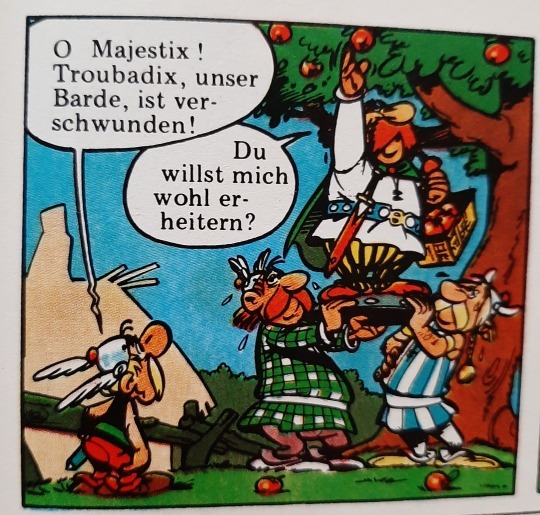
Gesagt – getan. Doch Troubadix‘ Verschwinden bleibt nicht lange unbemerkt.
Trotz aller Unzufriedenheit mit dem krächzenden Barden ist klar, dass Troubadix schnell befreit werden muss. Und so brechen Asterix und Obelix zu ihrer ersten Reise ins ferne Rom auf.
Per Anhalter reisen sie mit dem Schiff des phönizischen Händlers Epidemais, der den Kapitalismus im Blut hat und unsere Helden beinahe im nächsten Hafen als Sklaven verkaufen will. Ein Geschäftsmann durch und durch!
Schließlich kommen Asterix und Obelix dann doch noch in Rom an und lassen sich kurzerhand selbst zu Gladiatoren ausbilden, um ihren Barden zu befreien.
_______________________
Interessant, ich hatte nur wenige Erinnerungen an diesen Band. War recht spaßig, auch wenn die Zeichnungen noch etwas vom späteren Standard abweichen und die Farbgebung nicht so gelungen ist.
How many books, movies, records, etc. can affect you deeply when you're ten and then, in different but just as genuine ways, be as profound or more five decades later? Well, if you're in my generation with some Europeans roots, I'd bet most of you would agree with me that Asterix comics would be an obvious consensus choice. All the hype about the new Gladiator movie (I have no intention of seeing it) must have subliminally directed me to pick this up today, the first time in probably thirty years. I am overwhelmed by how good it is. Still. How it still appeals to both my nostalgia thinking back to being a ten-year-old, my crusty, cynical sensibilities of today, and will be welcome to revisit any time it wants.
After focusing mostly on Asterix, Obelix, and Miraculix (using German names) in the first three editions, this fourth episode (third in German publication) is the first of three storylines to revolve greatly around the out-of-tune bard, Troubadix. When he is kidnapped by one of the Roman garrisons surrounding the Gauls' indomitable village to be presented to Julius Caesar in Rome as a gift, it sets off a rescue mission for Asterix and Obelix.
After being sent off by Majestix, the chief, they encounter the hapless pirates for the first of many times in volumes to come. The incompetent group is based on characters first seen in Émile Zola's penultimate of twenty Rougon-Macquart novels, The Debacle, which is about the French loss of the Franco-Prussian War. In the novel, a gang, who are anything but funny, of malcontent bandits roam the woods around Sedan after it falls to the Prussians. Goscinny transforms them into one of the most beloved group of characters in comics history, right down to the old man who spews phrases in Latin.
This is also the volume that introduces us to Julius Caesar, who we'll encounter many more times over the course of the stories ahead. It's his first taste of Asterix, Obelix, and the effects of the magic potion that makes them invincible. We only see Troubadix at the center of the story a few times in coming volumes, as with the Normans or in the destruction of a Roman apartment house built outside the village walls, but we see him in just about every edition's concluding frame, usually tied up while the rest of the men in the village celebrate a banquet and a happy end.
Asterix the Gladiator was the very first Asterix book I owned. This is by far one of my favourite Asterix stories.
It continues the growth of the scope of the stories, and introduces a few characters that will recur on-and-off as the series progresses. Notably: “The Pirates” of Captain Redbeard, and Ekonomikrisis, the Phoenician merchant. It’s another kidnapping (a theme that is becoming a staple of the series at this stage). This time Cacophonix the Bard has been whisked away by the romans to be presented as a gift to Julius Caesar. This takes Asterix and Obelix all the way to Rome, where Cacophonix is to be thrown to the lions at the Circus Maximus. As you may already have surmised from the title, they end up becoming gladiators in an effort to infiltrate the Arena prison and rescue their fellow countryman. Things (obviously) don’t go according to plan and the story is followed through to the inevitable conclusion where the trio of Gauls have their day in the Arena.
There are many misconceptions about gladiators, mostly thanks to their portrayal in popular culture. Obviously, the authors capitalize heavily on it here, alternately exploiting and deconstructing the gladiatorial mythos. Given the fact that the Circus Maximus is in general a bloody and distasteful business, it speaks volumes for the talents of the creative team that they manage to pull this one off.
Cacophonix is on top form here, and the focal point for many of the comedic aspects of the story. Speaking of comedy, there are some more examples here of how Uderzo was able to depict emotion in a hilarious fashion: watch out for an apoplectic Julius Caesar when the Gauls try his patience at the circus.
The indifference of the Gauls toward the might of Rome is at the heart of every Asterix book, and possibly nowhere more so than here, in the heart of the Roman Empire, as they wander the streets of Rome with impunity.
And now, I don’t suppose it’s much of a spoiler that all ends well, but the following might be considered somewhat of one, so stop reading right now if you are concerned. It is probably the greatest irony of all that, at the banquet that closes the book (as it usually does), Cacophonix is bound and gagged again, after just being rescued.
In this fourth book, the Roman prefect kidnaps Cacofonix to give as a gift to Caesar, unaware of his special powers. Despite their annoyance with Cacofonix's singing, the Gauls are not backward in defending one of them and set out to rescue the bard and avenge the insult to their village. But Cacofonix is already in Rome (and doing quite well with getting his way through singing) and Asterix and Obelix must now go there.
This book was superlative! The jokes were hilarious, and I really enjoyed how easily the two managed to change the bloodthirsty gladiators and set them to playing parlour games. The punning of names provides endless entertainment in Asterix comics, and this one was no different. Ekonomikcrisis was my favourite - a Phoenician merchant who takes Asterix and Obelix on board.
We get to see Rome in this one a lot, which is great fun. All in all, one of the great ones of the series.
বের্নার্ডিন এভারিস্টো'র The Emperor's Babe পড়ার পর থেকেই আবার অ্যাস্টেরিক্সের কাছে ফিরে যাবার প্রবল ইচ্ছা হচ্ছিল। জুলেইকার জগতের সাথে মিল রাখতে হলে অ্যাস্টেরিক্স ইন ব্রিটেন গল্পটা পড়া উচিৎ ছিল, কিন্তু ওটা যেহেতু হাতের কাছে নেই, গ্ল্যাডিয়েটর-ই তুলে নিলাম। ছোটকালে খুব সম্ভবত এইটাই আমার পড়া প্রথম অ্যাস্টেরিক্স ছিল। সেই ক্লাস সেভেনে পড়া একটা কমিক যে এতো বছর পরেও এতো আনন্দ দিতে পারে, কে জানতো!
ঢাকার বালকের ইংরেজি জ্ঞান তথা সামগ্রিক সাংস্কৃতিক জ্ঞান সীমিত ছিল, তাই অনেক সূক্ষ্ণ ডিটেইল অথবা ইনসাইড জোক সেই সময় ধরতে পারিনি। আজকে আবার তুলে নিয়ে সেগুলো একটু বুঝতে পারছি। রোমের রেস্তোরাঁ মালিক ইন্সট্যান্টমিক্স ওর ফ্ল্যাটের বর্ণনা দিতে গিয়ে বলে GLC flat - Greater Latin Council। বিলেতি দুই অনুবাদক বেল আর হক্রিজ অবধারিতভাবেই ইঙ্গিতটা করেছেন ৭০ আর ৮০-র দশকের বহুল বিতর্কিত GLC বা Greater London Council এর দিকে। গ্ল্যাডিয়েটর মঞ্চে বিজ্ঞাপন বিরতি নিয়েও চমৎকার তীর্যক কটাক্ষ আছে। আর অত্যন্ত অশ্লীল একটি জোকও আছে ৩৬ পৃষ্ঠায় যেটি এখানে পুনরাবৃত্তি না করলেই না!
My first is a hundred, my second is a sign of the zodiac, my third is a Hibernian [আইরিশম্যান], my fourth is the Egyptian god of the sun, and Julius Caesar loves my (w)hole! Who am I?
উত্তর অবশ্যই C, LEO, PAT, RA কিন্তু খাচ্চর জোকটা কার কারসাজি জানি না - অরিজিনাল লেখকদের নাকি অনুবাদকদের? হাসতে হাসতে হতভম্ব!
PS জুলেইকাও লন্ডিনিয়ামের একটি গ্ল্যাডিয়েটর অনুষ্ঠানে উপস্থিত ছিল - বের্নার্ডিন এভারিস্টো কল্পনা করার চেষ্টা করেছেন তার মর্মান্তিক বাস্তবতা। অ্যাস্টেরিক্সের লঘু হাস্যরস একদমই ভিন্ন ক্যাটেগরির বস্তু - তবে দুটো পাশাপাশি পড়া একটা ইন্টারেস্টিং অভিজ্ঞতা ঠেকলো।
PPS অনুবাদক-রত্ন অ্যান্থিয়া বেল মারা গেছেন অল্প কয়দিন আগে। তার প্রতি শ্রদ্ধা ও কৃতজ্ঞতা বলে শেষ হবে না। ভালো থাকুন, বেল, যেখানেই।
Asterix The Gladiator was first published in French in 1964 as "Astérix Gladiateur " and in English in 1969.Asterix and Obelix set out for Rome to rescue the Bard Cacofonix who has been captured by the Romans as a gift idea by Prefect Odius Asparagus for Julius Caesar. This will be their first visit to Rome , they meet the unscrupulous Phoenician merchant Economikrisis who will feature again in later Astrix albums and for the first time they run into the Pirates (to the Pirate's great cost) as they will time and time again! In order to find Cacofonix they become Gladiators and soon drive the slave driver Cauis Fatuous crazy . Cacofonix however is quite able to look after himself as his singing drives the Romans even crazier... As usual their mission is successfully accomplished to everyone's satisfaction (except Cauis Fatuous who gets his comeuppance).
The Prefect to Gaul decides to gift Caesar an indomitable Gaul to fight as a gladiator on his birthday and hoping in return to be covered in gold. Get this, they kidnap Cacofonix, the village bard 🤣. Plugging their ears with broccoli, they reach Rome with Asterix and Obelix soon following suit. Asterix and Obelix cause a bit of chaos here and there as they try to find the bard.
A great and funny edition. I didn't know what was funnier, Obelix unable to "knock" or Cacofonix scaring the Romans with his songs! 🤣 A must read.
… heißt „Petersilie“, und ich weiß noch genau, daß ich das damals aus diesem Asterix-Abenteuer im Lateinunterricht lernte. Sonst hatte ich in den zwischen damals und heute liegenden Jahren fast alles über dieses Album vergessen – bis auf eines: Nämlich, daß zu Beginn der Geschichte der anstrengende Troubadix von den Römern entführt wurde und daß die Gallier trotz seiner musikalischen Fähigkeiten – im Englischen heißt er ja bezeichnenderweise Cacofonix – keinen Augenblick lang zögern, ihn zurückzuholen, einfach deshalb, weil er ihnen freundschaftlich verbunden ist.
So reisen denn Asterix und Obelix per Schiffsanhalter auf einem phönizischen Handelsschiff nach Italien, wobei ihnen unterwegs zum ersten Mal die Piraten unter Kapitän Rotbart begegnen, und von dort aus marschieren die beiden Freunde nach Rom, um sich auf die Suche nach dem entführten Barden zu machen, der, wie sie bald erfahren, im Circus von den Löwen zerrissen werden soll. Asterix und Obelix werden daraufhin freiwillig selbst zu Gladiatoren, doch damit handelt sich Gaius Obtus, der die Kämpfe ausrichtet, mehr Ärger ein, als er gedacht hat, denn den Gladiatoren ist gar nicht wirklich nach gegenseitigem Abschlachten zumute, und in Asterix finden sie jemanden, der ihnen einen Ausweg aus ihrer mißlichen Situation zeigt.
Asterix als Gladiator ist definitiv ein Album, das allenthalben nach oben gereckte Daumen verdient, denn es strotzt nur so vor komischen Szenen und Figuren: Sei es der geschäftstüchtige Phönizier Epidemais, dessen Ruderer allesamt Geschäftspartner sind, die ihren Kontrakt nicht sorgfältig genug gelesen haben, seien es die schreienden und streitenden Nachbarn im Treppenhaus einer typischen römischen Insula oder auch die Neigung der Römer, sich in Troubadix‘ Gegenwart die Ohren mit Petersilie zu wappnen: Hier stimmt einfach alles so sehr wie die von Cäsar gemachte Bemerkung, daß es mit seinem Adoptivsohn Brutus wohl nicht gut ausgehen werde. Neben den Piraten wartet das Album mit zwei weiteren Premieren auf, wenn zum einen zum ersten Mal meine persönliche Lieblingsfigur Methusalix, allerdings noch ungenannt, als Obelix‘ Vertreter im Hinkelsteinausliefern erscheint (und Obelix ihn ermahnt, er solle am Anfang immer nur einen einzigen Hinkelstein gleichzeitig tragen), und zum anderen Obelix das berühmte Helmsammelspiel für sich entdeckt, das er noch so manches Mal spielen wird. Auch der sonst eher für einen einzigen running gag herhaltende Troubadix hat hier endlich einmal die Chance, ein wenig als Löwenbändiger oder als Motivator der Ruderer zu glänzen, bevor er wieder unbarmherzig zum Schweigen gebracht wird und dem Festbankett anläßlich seiner sicheren Rückkehr von seinem gewohnten Ehrenplatz aus zusehen darf.
Mein Lieblingspanel: Gaius Obtus zeigt Asterix und Obelix das belebte Forum Romanum, auf dem eine Gruppe ägyptischer Touristen zu sehen ist, die in ihrer typischen Profilansicht in einer Reihe gehend die Stadt erkunden. Zwei Panels später wird dann auch noch einer der Ägypter von einem Römer brüsk zurechtgewiesen, als dieser ihn dabei ertappt, wie er in Hieroglyphen seinen Namen auf einer Säule verewigt, was mich an eine der köstlichsten Szenen aus Life of Brian erinnerte.
I bought this back in1975 and I have read and reread it many times. It brings back very happy memories of my childhood when I would read this with my nephews whilst translating it into Polish as we went. I'm happy to say that I still found it funny on the latest rereading, and as always, I LOVE looking at the fantastic pictures by Uderzo. Who else loves the bit where Asterix asks Obelix to knock on a door only to find he smashes it in because to Obelix the two things are one and the same?! Or when Obelix discovers that he can make a fight with an opponent last a tad longer if he shakes them rather than simply hits them? All innocent, juvenile fun!
Second hand book stores in my place tend to lump oversized European graphic novel albums with the children's books because they don't know better. Sometimes, when the mood strikes me, I go over those dusty bins to find hidden treasure like Asterix albums. This was just my latest find, Asterix the Gladiator, and it may be the best Asteriz I've ever read.
Asterix is from a village of indomitable Gauls who are among the few holdouts of Roman rule. This small village is surrounded by three garrisons but they haven't been overwhelmed. This village has a secret weapon in a potion brewed by the village druid which gives them super-strength and indestructibility. Asterix has a best friend in Obelix and they share a favorite pastime in beating up the hapless Romans.
I enjoyed this story because it feels different from the other Asterix tales I've read. The two friends actually have a legitimate quest; to rescue the village bard who was shanghaied to Rome. On the road to Rome, they encountered other ancient people who were their contemporaries like Phoenician traders and pirates. In Rome, they find a countryman who runs a Gaulish restaurant, and they got to experience the public Roman baths. This story is different from the other I've read because the root of the quest is based on honor, and not just to beat up Romans for fun, although they did that too. The duo even chastised a boatful of pirates, which would referenced as a gag in later volumes. In Rome, they even freed several gladiators and taught their trainer a lesson.
The story is paced well and it is never boring. I wished the later Asterix are like this, although there is still hope because I still have many gaps in my Asterix readings.
The village bard Cacofonix is captured by the Roman Prefect for Gaul. The prefect needs a unique present to offer in Rome to Caesar. Cacofonix's singing is indeed unique (happily so--he is quite terrible) and the villagers aren't so worried when he's disappeared. As soon as they discover he's been kidnapped by the Romans, they start a rescue mission. The mission will take Asterix and Obelix all the way to the Circus Maximus in Rome to save their fellow villager.
The story is the standard mix of puns and jokes along with the mild, ridiculous violence that comes from an ancient tribe with a potion of undefeatable strength. This provides the standard good fun of an Asterix comic.
Read it a long time ago but still can remember how funny it was. Bloody hilarious. Our beloved Cacofonix getting kidnapped by Romans. They really are crazy to kidnap Cacofonix.. And all those drama with lions and gladiators. There's Obelix Romans, his favorite hobby is beat the fuck out of you guys.. Ah looking back, I can't help but be thankful how much history dug up and learnt cos of our bunch of happy Gauls.
Αυτοί οι Γαλάτες! Αιώνες μετά μας δίνουν χαρά και γέλιο. Κλασικό κόμικς που διαβάζεται διαχρονικά από μικρούς και μεγάλους. Κι ειδικά αυτή η περιπέτεια είναι από τις καλύτερες
Mi s-a părut excepțională. Traducerea mi s-a părut bună
Pentru a intra în grațile lui Cezar, un înalt funcționar roman vrea să-i dăruiască unul dintre galii nesupuși. Însă, pentru a nu fi nevoit să înfrunte teribilii luptători ce pun pe fugă legiunile romane, îl alege pe cel mai inofensiv dintre ei – bardul Cacofonix. Cezar nu e foarte încântat de cadou, așa încât cere ca bardul să fie trimis în arenă, alturi de lei și gladiatori. Și, deși „talentul” său muzical e suficient pentru a pune pe fugă orice inamic, Cacofonix are parte și de ajutorul prietenilor săi, Asterix și Obelix, veniți la Roma la bordul unei galere feniciene, pentru a-l salva.
Deja banda desenată capătă elementele definitorii ce au făcut din ea un fenomen. Cacofonix apare deja mai aproape de versiunea lui finală. Întâlnim, pentru prima oară, pirații ale căror corăbii le tot scufundă Asterix și Obelix. Roma e prezentată printr-o paralelă superbă cu stilul de viață din orașele moderne, iar spectacolul din Circus Maximus are toate elementele specifice marilor evenimente actuale. Echipajul galerei feniciene e echivalentul unei societăți pe acțiuni. Umorul e la cote maxime, cu gladiatorii care înlocuiesc luptele din arenă cu jocuri de societate. Superb!
Asterix takes his talent to the arena 19 June 2012
As a kid I would read and reread the Asterix (and Tintin) comics over and over again. My primary school library (and local council library) had quite a collection of both, and at least with regards to Asterix, between them had pretty much all of them (with Tintin I had to go and persuade my parents to purchase the ones that were not available, so with the exception of the first two, I had read all of the Tintin comics, and the Asterix comics that had been released at the time).
However, after a very long hiatus, I borrowed a collection of Asterix comics from my friend and reread them and found them amusing. That was about fifteen years ago. Now, being a 'young' adult and working fulltime (as well as having access to the internet which means that I can get copies of the albums at least half of what I would be paying at a bookstore in Adelaide) I have now managed to collect and read all of the Tintin comics and I am slowly obtaining the Asterix comics as well (for some reason I seem to have moved away from borrowing books from the library, I guess because if I purchase them, not only can I then give them to by Dad, but I can take my time reading them).
I must admit that this one had me in stitches. This is number four in the series but we are seeing the development of the characters and the albums continuing. We saw that with the Tintin comics as well with Herge continuing to develop the characters and their friends as more and more albums were produced, and it is good to read them in order to see this development. In this album see Obelix begin his little game of counting the number of Romans he beats up by collecting their helmets. After every fight Obelix walks away with a pile of helmets in his hands, and of course in the final combat in the arena, we see a huge pile of helmets stacked in the corner. Also in this one we meet the pirates, who end up being another one of those groups that Obelix loves beating up.
Ceaser's birthday is coming up and the prefect of Gaul decides that he was to get Ceaser a special present, namely one of the indominable Gauls for the arena, so they decide to capture the weakest link, Cacofonix the Bard. Despite the fact that absolutely nobody likes his singing (probably because he has absolutely no musical talent whatsoever) he is still a Gaul and still a member of the village, so Asterix and Obelix go on a quest to Rome to rescue him. Along the way they meet up with the arena boss, who also happens to be the main villain of the peace.
There are some really amusing anecdotes in this album, particularly where Obelix looks for somebody to take care of his menhir delivery business while he is away (and I am still puzzled as to why the village actually needs all those menhirs), and then you see Obelix passing it on to Geriatrix, the village old person (elder would be an inappropriate word as Vitalstatistix is actually the leader of the village, Geriatrix is just an old guy with a very young wife) who looks at him oddly and says 'I don't think this is the right job for me'.
What is also amusing (but as I said this one had me on the floor in stitches) is how they just seem to wonder through Rome with impunity. If there is one thing that does not bother Asterix and Obelix and that is Roman legions, and in fact Romans. It is interesting how they painted Rome in the book because while historical accuracy is limited to an extent (Ceaser, in reality, was fighting a civil war when he returned from Gaul and then he was assassinated, so I suspect that the entire period of the Asterix comics is actually set over a period of only a few years). Oh, and the Latin that they throw around is actually heaps amusing, particularly when the entire Circus Maximus (the Collesseum hadn't been built at this stage, so kudos to the authors for at least being somewhat accurate here) is applauding Ceaser with the exception of Marcus Brutus, who sits behind Ceaser with a sour look on his face, and Ceaser then turns around to him and says 'et tu brutae'.
El bardo cantor Asurancetourix es secuestrado por los romanos para ser llevado Julio Cesar como regalo. Asterix y Obelix en su rescate llegan a Roma donde terminan compitiendo en el gran coliseo. Excelente tomo repleto de humor e ironías.
No one's favorite bard Cacofonix has been captured, and our Gaelic duo Asterix and Obelisk have to follow him to Rome and rescue him, lest Caesar in a foul mood not throw him to the lions. Even though the story focuses on the duo's journey and adventures, the real hero is the out of tune bard.
His voice is something that is one of kind; in the sense that if there were more of his kind, the Earth would split apart in sheer agony at having to hear them sing a duet.
I'm not kidding. It seems no one else but the impious bard thinks of his singing as anything fit for mortal ears. It could might as well be an incantation to summon some eldritch gods, that is, those that are brave hearted, or deaf enough to endure his singing.
Roman Legionnaires, slave traders, pirates, gladiators, no one can stand for more than a moment in the presence of his voice, which can be categorized as 'telum exstinctionis' (look it up). Something that should be banned as per the Helvetica convention . I mean, the guy made slaves, SLAVES grateful for being enslaved and not being made to listen to his songs.
You could throw him to a horde of ravenous beasts, and they would flee in mortal agony at having to endure it. Which, incidentally is what transpires.
All of his antics made me almost not want our heroes to save him. Cause, Rome might not have been built in a day, but with Cacofonix there, it might just fall to ruination in just one.
You could say that the bard was such a breakout character in this story, that every other piece of humor was lost in his out of tune melody. And there is quite a lot going on otherwise. The first appearance of the Barba Rouge pirates. Asterix & Obelisk posing as gladiators and spreading their trademark chaos all across the colosseum, all the Romanized modern stereotypes, in Rome herself.
Let's not forget the Hurricane of puns, which seeing as how the story is largely focused on Cacofonix's antics is rather slim : Ekonomikrisis & Instantmix.
Lastly, Holy Blackface Batman! That's some Disney level disturbing s**t
This has got to be the best Asterix story (0f the 3) that I've read so far. Let's see if it keeps that position the more I read. A Solid 5 out of 5
As ever the action is quick moving, the detail is nice and the colouring is lovely. To think that this was first published away back in the 60s and yet it still stands up so well today. Asterix is so funny, clever and so far ahead of its time you can see why it was successful and has remained such an enduring pleasure for so many around the world.
Asterix and Obelix travel to Rome to save Cacofonix, who has been taken by the Romans to be fed to the Lions at the Roman Circus... After a long trip and a new encounter with the Pirates (for their misfortune) everything turns up well with a little help of the Magic Potion.
این جلد نیز مانند سایر جلدهای مجموعه جالب و سرگرمکننده بود، اما با این حال به پای جلد سوم یعنی آستریکس و گوتها نمیرسید. ابلیکس در دو جلد اخیر تقریباً نقش خود را در بار طنز ماجرا به دست آورده است و در کنار آستریکس که سیر داستان را به پیش میبرد، او بخش بیشتری از طنز داستان را حمل میکند.