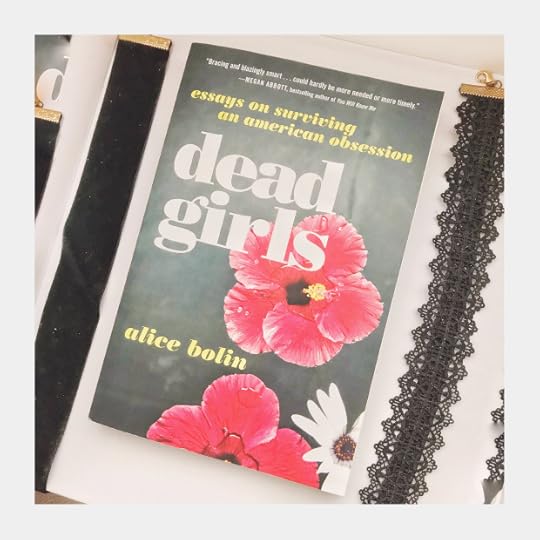
A collection of poignant, perceptive essays that expertly blends the personal and political in an exploration of American culture through the lens of our obsession with dead women.
In her debut collection, Alice Bolin turns a critical eye to literature and pop culture, the way media consumption reflects American society, and her own place within it. From essays on Joan Didion and James Baldwin to Twin Peaks, Britney Spears, and Serial, Bolin illuminates our widespread obsession with women who are abused, killed, and disenfranchised, and whose bodies (dead and alive) are used as props to bolster a man’s story.
From chronicling life in Los Angeles to dissecting the “Dead Girl Show” to analyzing literary witches and werewolves, this collection challenges the narratives we create and tell ourselves, delving into the hazards of toxic masculinity and those of white womanhood. Beginning with the problem of dead women in fiction, it expands to the larger problems of living women—both the persistent injustices they suffer and the oppression that white women help perpetrate.
Sharp, incisive, and revelatory, Dead Girls is a much-needed dialogue on women’s role in the media and in our culture.
Toward a theory of a dead girl show -- Black hole -- The husband did it -- The daughter as detective -- There there -- Los Angeles diary -- Lonely heart -- This place makes everyone a gambler -- The dream -- A teen witch's guide to staying alive -- And so it is -- My hypochondria -- Just us girls -- Accomplices
I wanted to read Dead Girls based off the part of its blurb that said: "From essays on Joan Didion and James Baldwin to Twin Peaks, Britney Spears, and Serial, Bolin illuminates our widespread obsession with women who are abused, killed, and disenfranchised, and whose bodies (dead and alive) are used as props to bolster a man’s story."
Unfortunately, only about 25% of the book is actually about that. And that's being generous.
The other three quarters of the book are about the author's experience of moving to Los Angeles, her various LA roommates, and her love for Joan Didion. Seriously, this woman loves Joan Didion. I knew she'd be mentioned somewhere from the book's summary, but I didn't imagine she, as well as her essays and writings and opinions, would be mentioned so frequently throughout the entire book. At one point, in one chapter in particular, I couldn't find a single word about the 'widespread obsession with women who are abused, killed, and disenfranchised, and whose bodies (dead and alive) are used as props to bolster a man’s story', but you can bet that every other page mentioned or quoted Joan Didion.
I will say that the few instances of passages discussing the Dead Girl subject were absolutely on point and extremely interesting. But it just wasn't enough. I wish I could've cared about the author's personal life, but I didn't sign up for a memoir.
If you're wanting to read this for the same reason I did, I feel like you, as I was, will be terribly disappointed with what you actually get.
I received this book for free as part of an Instagram tour (TLC Book Tours specifically) I did to promote the book.
Despite the title, this isn’t really a book about dead girls. It’s more a book about girls in pop culture, but also a book about the author’s experiences in LA. However, even that doesn’t seem to adequately describe this book. It’s kind of just a collection of essays that are very loosely connected.
Basically, I felt a bit confused by this collection. The essays themselves were sometimes very interesting, but there just wasn’t a strong enough theme to connect them all together.
Also, some of the essays themselves were a little disjointed. For example, “The Daughter as Detective,” started out as an essay about a book series her dad liked, then ended up discussing whether her father could possibly have Asperger’s syndrome. Not at all where I thought it was going to go.
I did like some of the essays, like “Lonely Heart” which explores Britney Spears. I was also happy to see Lana Del Rey mentioned, since she alludes to the dead girl trope a lot in her music. However, I wish the book went deeper into her. The 3 page analysis of her was not sufficient.
Lastly, the final essay, “Accomplices,” was a mess. I was ready to give this book 3 stars and then I read this essay and had to drop it to 2. I just didn’t get it. It was very long, seemed to try to cover too much, and didn’t really touch upon dead girls at all. It felt more like an afterthought.
Overall, a few well-written essays can’t save this jumbled collection.
I thought this would be a convicting critique of a genre I really like, but the real reasons I had to stop reading was:
a.) she appeared to have watched/read at least two of the subjects she was critiquing maybe one time and her analysis shows it. She talks about Twin Peaks’ typical centering of the male narrative and she’s totally right. But she didn’t bring in the panned, unpopular film follow-up Fire Walk with Me, which tells the story of Laura Palmer’s death entirely from her POV. The fact that she completely disregarded this piece makes her complicit in her own criticism—why even talk about an attempt to reframe a male centric narrative? Why did nobody want to see that? What were the shortcomings of a man’s attempt to tell a story from the “dead girl” viewpoint? What a waste.
Also she writes a fiveish page essay about how The Big Lebowski is kinda like a Raymond Chandler book and she quotes ITS WIKIPEDIA PAGE. She can’t even be bothered to click the reference link at the bottom of the page to see the original interview source of the quote she uses. What kind of advance did she get for this amateurish “research?”
b.) She used a quote from Christopher Hitchens, a notorious misogynist, to criticize the professed feminism of Stieg Larsson. Couldn’t have found a better critique from, oh I don’t know, a lower profile woman scholar who doesn’t reveal your antiquated cultural snobbery?
c.) She outs her dad as “autistic” after a very long and uncomfortable essay where she calls him “manic pixie dream dad.” She does this after telling the reader that her father is not interested or served well by discussing his diagnosis. She uses his love and defense of Swedish crime novels as a way of proving he is non-neurotypical. I see no indication that he consented to having this information shared—quite the opposite.
Normally I prefer to show authors some grace, but I read almost half this book before calling it. The feminist critiques were glaringly obvious to any woman who enjoys the genre, and that says to me that she’s writing it not for us, but for women who want to feel superior to us. I’m also genuinely offended by that essay about her dad. Disgusting.
Even though this book didn’t examine the dead girl trope as much as I wanted it to, it’s still an incredible examination of the forces that create an environment that allows the dead girl trope to thrive. She also looks at the ways white women and white feminism are both trapped by, perpetuators, and by-products of the male gaze. Honestly, it’s one of the most critically interrogative essay collections I’ve read in a while. She even points out and examines the inherent problems of the personal essay. I’ll definitely be re-reading this one and marking it up as I go.
i don't understand how she ended up with the title of this book. i'd say about 40 pages are dedicated to the american obsession of the "dead girl" trope and then the rest segues into bolin's self indulgent memoir that truly has no direction. she writes about her father, then her move to LA, her boring white girl problems, AND THEN throws in basically every piece joan didion has every written, seeming to idolize her, then drags her for being classist, which actually made me laugh out loud because this woman truly has some spectacular blinders on it she thinks she is better than joan. not to say a criticism of joan has no merit, but seriously, the irony.
this book is 20% dead girls (if that), 50% dull memoir, 20% joan didion musings, and 10% "throwing in some POC writers so i don't seem racist."
3.5/5. Alice Bolin is undoubtedly a very talented literary critic and writer and I enjoyed reading this overall, but I can’t help but feel misled by the marketing of this book. The subtitle and blurb promise a thorough exploration of the Dead Girl trope so prevalent in (pop) culture, but only a couple of essays actually focus on this. Most of the other texts are about Los Angeles and depictions of L.A. (and the lifestyle it suggests) in literature (most predominantly, Joan Didion’s writing – she mentions Joan Didion a lot). Some essays also focus on literary and cultural representations of teenage girlhood, and these were definitely my favourites (for example, there's a chapter that talks about one of my favourite books, We Have Always Lived in the Castle). Ultimately however, this book uses the same marketing it tries to critique (using the eponymous Dead Girl to lure in readers), which Bolin seems to be aware of because she mentions it in the beginning, but which I still feel a bit cheated by. I’d recommend this essay collection, because it made me question and reconsider aspects of American culture I had never even thought of to question before, but beware that what you see isn’t exactly what you get.
The blurb on the back of the book explains that the book will take you through dead women in fiction and the larger problems of living women. And I suppose it does, kind of, do that, starting by dipping its toes in the waters of “Dead Girl Shows” like True Detective and Twin Peaks, then devolving into dissections of books, movies, and songs where women have some sort of troubling presence--all loosely tied to the writer’s life/background--then devolving into anecdotes of the writer’s loneliness in LA. But, to be honest, I didn’t actually get anything enlightening about abused/killed/disenfranchised women out of these essays, as the blurb intimates I would. There were some interesting correlations, some interesting anecdotes. But when I closed the book at the end, I basically felt like I had just read a disjointed collection of women’s studies term papers rather than a “Sharp, incisive, and revelatory...much-needed dialogue on the woman’s role in the media and our culture.”
First of all, I want to say that Bolin is quite a talented writer. My review is in no way a condemnation of how she's written but rather what she has written.
That disclaimer out of the way, this book is boldly, ingeniously mismarketed. To people browsing Goodreads reviews before picking this up (as I sadly did not), this is NOT a book about faddish obsession with true crime and how that reflects back on our society when we covet the crime but ignore or, worse, fetishize the victims. These are essays about moving to LA, being broke in LA with weird roommates, obsessing over Joan Didion and Susan Sontag, and relating everything back to herself. This wouldn't be a cardinal writing sin if the book weren't sold the way it was, but as it stands, I feel incredibly cheated.
Bolin is still interesting at times, but there are essays about movies I haven't seen and books that I haven't read, so hello, spoilers! I'm sorry, but there are times that the self-confessional essay style comes across as incredibly vapid, such as when she cuts down her father's taste in crime fiction or how she used her former best friend and then dumped her.
Also, as a New Yorker, I have a real problem with this sentence: "I remember a particularly long and hangry journey deep into Brooklyn to get an inexpensive breakfast I had read about on the Internet, the insane amount we spent on subway fare neutralizing any savings from the cheap diner." The subway only costs $2.75 each way now, and given that this is set years after the fact, it was no doubt cheaper then. My eyes, they roll at this self-indulgence.
This isn’t quite the meditation on dead girls and women as a particular obsession of our culture that I wanted. There are a handful of essays that touch on it, but this is mostly the navel-gazing of a privileged white girl who read too much Joan Didion, moved to Los Angeles on a whim, and how it made her Very Sad.
The essays on the female body in American film, literature and television, or “The Dead Girl”, were very insightful. As someone who often analyzes (too much according to more than one annoyed friend) the images and words that flicker in front of my eyes, I had never really thought about what the author writes here about why the “dead girl” plot device is so popular. She argues that it is because it becomes a tableau for predominately men to work out their own issues:
“There can be no redemption for the Dead Girl, but it is available to the person who is solving her murder. Just as for the murderers, for the detectives in True Detective and Twin Peaks, the victim’s body is a neutral arena on which to work out male problems….Clearly Dead Girls help us work out our complicated feelings about the privileged status of white women in our culture. The paradox of the perfect victim, effacing the deaths of leagues of nonwhite or poor or ugly or disabled or immigrant or drug-addicted or gay or trans victims, encapsulates the combination of worshipful covetousness and violent rage that drives the Dead Girl Show.”
I don’t agree with all of her argument here, however she makes her point quite eloquently and does raise some disturbing issues as to why this trope has the popularity it does. I would have in fact liked her to explore this concept further however the other essays meander a bit into areas that I personally didn’t find particularly interesting. A good part of the book is taken up with her analyzing Joan Didion’s essays about Los Angeles as the author intersperses her own stories go moving from Idaho, Nebraska and Los Angeles. After a certain amount of time, the writing about Didion feels like a bridge the author uses to talk about her own relationships and experiences in Los Angeles. In and of itself there is nothing wrong with that, but when your experiences revolve around a string of meaningless relationships (its telling or perhaps intentional that she identifies them only by their first initials) being broke, or how proud you are to have never been in an Ikea when your friends take you there, you start to wonder how we got so far away from the dead girls. By the time she gloats about how her friend taught her to steal bags of coffee from her job, I had pretty much ceased having sympathy or any positive feelings about her at all. Narcissism and amorality will usually have that effect on me. To sum up, there is some very strong and interesting writing to be found here in the book’s initial essays. However the further away we get from the premise of the book and into the author’s vanity, the book suffers.
I have mixed feelings about Dead Girls - it starts amazing but sadly I had trouble getting all the way to the end.
I do want to be clear - the first part, about the titular women American culture obsesses over, is incredible. Bolin talks about "Dead Girl Shows" that use the memory of women-who-were to tell stories about the men who killed them or seek to revenge their deaths. Instead of looking at the impulse some men have to prey on young women the narrative of these shows concentrates on the killer's psychology and methods, making the practice seem inevitable and beyond the man's control. I highlighted many, many passages from this section and will be revisiting the essays so I can chew over them more.
That's only part one of four, though. The second section takes a step away and examines women who are living but have been used to sell a story in a related way. I like Lonely Heart, about the contradictions and tragedy in Britney Spears' fame, but otherwise my interest started to wane.
If the book were a tire that's where the slow leak started, with a more steady whooosh becoming apparent over the last two parts. Bolin gets deep into her experience of being lonely after moving to the West coast and I couldn't get on board. It's an amalgamation of things I have a hard time caring about or connecting with (LA, Joan Didion, accounts of roommates and boyfriends) with books that we are assumed to know but oftentimes I did not. If you love so-called "Hello to All That/Goodbye to All That" essays, worship Didion, and don't mind a jumble of thought, you'll do better here than I.
It's hard for me to rate Dead Girls because it went from a compulsively readable, fascinating ride to a flat tire I had trouble rolling over the finish line. I thought it would be a great fit for my Serial Killer Summer but sadly only the first quarter or so fit the bill.
Thanks to William Morrow and Edelweiss for providing a review copy.
IN the beginning, as the title suggest, it is a look at the use of the dead girl in various media. But the bulk of the book are personal essays, mostly about California, that are somewhat interesting, but not all that interesting. In short, you wish it had more media driven and less personal.
Her reading of Joan Didion is sound, but if the book is being marketed about the use of Dead girls in the media, there should be more about the dead girls in the media. Joan Didion should be in another book or at the very least, rename the collection.
The best part of the book is Bolin’s look at Gone Girl. Her dealing with Nordic Noir is good, but one does wonder why Liza Marklund is not mentioned. And when she discusses True Detective and Twin Peaks, one wonders why shows such as Criminal Minds are conveniently ignored.
And then she keeps writing about her time in CA, which is fine, but not really what the title suggests.
RATING: 2 STARS 2018; William Morrow Paperbacks/HarperCollins Canada (Review Not on Blog)
I was expecting more of feminism in true crime than just feminism and memoir-style in these essays. The essays were okay, but as it was not what I expected I was a bit disappointed. I enjoy feminist writing, and agree with some of what Bolin says in the book I would recommend you read other reviews as they may be better at saying if this book is for you because I was expecting something different.
To put it bluntly, this needs more Dead Girls. The opening essay on our obsession with the dead girl trope is great. The rest of the essays are in strong need of an editor.
This was the quote that caused me to throw in the towel: “Paul texted me ‘do you ever feel that your level of intelligence dooms you to be alone.’ My reply began, “My answer is I think sort of obviously yes.” PUUUUH-LEASE.
So ⭐️⭐️⭐️ for Dead Girls essay but -⭐️ for remaining #MillennialSadness
I enjoyed reading this book. Bolin is great at personal essays and cultural criticism. She left some questions unanswered though. My review for Broadly digs into that: https://broadly.vice.com/en_us/articl...
So, this is one of the few times I'm SUPER excited about a book. "Dead Girls: Essays on Surviving an American Obsession." There's just something about her lyrical, elegant prose, filled with popular culture references, dark humor, and truth that really resonates with me. I grew up in NW Portland in the early 1970's and the specter of forest park and all the dead girls found there was a constant reminder of my place in the world. I lived in fear, I grew up in fear, learning early to fight for myself, and to fight for my survival. This book is one of the best I've ever read. Its such a truthful book and puts a name to so many things I always knew but remained nameless. Alice Bolin is a FINE, FINE writer. I'm thrilled that she's out there, sharing her gifts with us. Read this book, it will expand your awareness of so much regarding the dangerous, shifting landscape women and girls find themselves in, every day. I absolutely loved this important and thought provoking book!
This is the best essay collection I have read in years. It's true, as others have noted, that the dead girl trope is addressed most directly in the first few essays, but the trope threads throughout the entire collection. The reader will think that they are reading an essay about Britney Spears, and there the dead girl is. Or the reader will think that they are reading an essay about Los Angeles, or Joan Didion, or female friendships, or reality TV, and there the dead girl is again. I love how discursive these essays are. They wander. They meander. They move. In other words, they are alive. Bolin weaves meticulous research with her own personal experiences; the essays move between her own life and the larger issues the book explores. These essays are deeply intelligent, deeply feminist. Bolin's sentences wowed me throughout the book. Here are some of my favorites, though I underlined so much more: "Heterosexual relationships are dangerous: one must balance the necessity of sex with the impossibility of trust," "[The] belief in the falsehood of narrative and the truth of fragmentation is another story we tell ourselves," "[In] True Detective and Twin Peaks, the victim's body is a neutral arena on which to work out male problems."
"the woods are shadowy, uncertain places, sympathetic to secrets, magic, transformations, and cruelty." (takes me back to an essay i wrote about cecelia condit, meditating on the geographical transcendence of the woods and how 'the psychological realms of our minds are very much linked' through art that embodies nature as a perverse homely place)
"growing up with such bizarre splendor and danger implanted in me a kind of comfort with the sublime that can't have been healthy. everyone knows the american west embodies the twin ideals of beauty and terror - the intersection of the awful and the awesome - but growing up in a homely little town set against a lush and extreme landscape is freakier than that. (...) no one is watching, the uncanny countryside seems to say. anything is possible."
"that women are problems to be solved, and the problem of absence, a disappearance or a murder, is generally easier to deal with than the problem of a woman's presence." (see: maggie nelson's quote about wanting to ask her professor if 'women were somehow always dead, or, conversely, had somehow not yet begun to exist...")
"los angeles is a land of iterations, versions of versions, a swimming pool's endless refractions, a city that sprawls forever."
& a description of myself: "i got too good at isolating myself, which was not intelligence but more likely the clichéd coexistence of self-hatred and self-obsession."
My favourites in this collection were definitely "Toward a Theory of a Dead Girl Show," "The Husband Did It," and "A Teen Witch's Guide to Staying Alive." I also loved Bolin's writing about general pop culture, The Girl With the Dragon Tattoo, Twin Peaks, and Lana Del Rey, and I fell particularly in love with her musings about LA and her focus on Joan Didion. This book is somewhat falsely marketed as most of it past the first essay strays from a cultural criticism of the "dead girl" trope, although it is a topic that reoccurs from time to time throughout. I would recommend this for fans of Leslie Jamieson or Rebecca Solnit.
So approximately 50 pages of this 288 page book dealt with Dead Girls--and the author made some excellent points and gave me a lot to consider as I consume pop culture. Those chapters read like the best essays from Bitch Magazine. Consume your pop culture, but be very aware of what we're actually hearing/watching/reading.
However.
Everything else was disappointing. If I wanted to read a book about how someone moved to LA and didn't like it, or loved to talk about Joan Didion's take on California, I would have expected the title to reflect that. Once I realized the author was going to keep going back to the LA/Didion well, I started skimming (this was around page 120) and stopped here and there when it looked like we might get back to the "American Obsession" but we never did.
I would love to read more from this author, as what I did read was usually insightful and at times humorous. That said, I think the publisher needs to more accurately title/blurb/edit these collections in future.
Based on the title and first few chapters, I assumed the essays in the book were all related to the media’s obsession with the victimization of women...in real life, true crime, crime fiction, or crime series on TV. Instead, the essays became random, veering off into unrelated territory, making the book feel disjointed, without a clear theme.
This was a unique essay collection blending the author's personal life with society's obsession with the female mystique (specifically her death). I enjoyed some sections more than others and my favorite was Part 3. Bolin is certainly a rich storyteller, if sometimes too rich, most of the time great.
Dead Girls is a book of essays with the subtitle Essays on Surviving an American Obsession and rarely have a title and subtitle served a book less well. Alice Bolin's book opens with an introduction about the fetishization of pretty dead young women and the first essays are fantastic, taking on the way dead girls are used in both fiction and in the media as special objects of fascination. She looks at a journalist from Spokane, WA's work about a serial killer targeting prostitutes and how that part of the world has been a perceived refuge for those who don't want to live in society, from the previously mentioned serial killer to Randy Weaver of Ruby Ridge. Then she examines two Scandinavian crime series, the Martin Beck series of police procedurals, where the first novel involves a drowned woman, and the Millennium trilogy where, despite the author's avowed feminism, women are stalked, bludgeoned and tortured in increasingly violent ways.
But from there, this topic is abandoned in favor of the story of the author's difficulties in transitioning to adulthood, as exemplified by her attempt to move to Los Angeles, where she wanders directionless but read a lot of Joan Didion. While the writing in this two thirds of the book is fine, the expectations raised by the title, as well as the beginning chapters don't leave a lot of room to be charmed by a series of random essays, which include everything from a survey of the cemeteries of Los Angeles to a look at literary werewolves and vampires, all peppered with references to Joan Didion's work.
There was a good start at a cohesive book here. It's too bad that Bolin chose to pad it out with earlier essays instead of taking on the larger, teased at subject. I can't help but think that she was ill-served by whoever felt that this collection was publication-ready and whoever thought a misleading title would be just fine.
Like all essay collections, some will resonate more than others. For me, Bolin really soars when she writes about pop culture and more specifically, about the ways "dead girls" become impetus for character development of men. She critically explores girlhood and race, without making sweeping statements about the status of girlhood -- she breaks it down, exploring what white girlhood to us culturally. What that says about who we are and what we care about (hint: it's not the dead girl, but it's a pretty way to start the story).
My favorite essays in here were the ones on Britney Spears. This could be read really well alongside Sady Doyle's Trainwreck: The Women We Love to Hate, Mock, and Fear... and Why. I also felt like her piece on the (brilliant!) movie GINGER SNAPS gave what is a badass feminist horror flick some of the credit it deserves.
I found her pieces on Los Angeles to be pretty boring, though. I don't harbor an interest in the "Hello from all of this"/"Goodbye to all of this" essays. I don't care about Los Angeles or New York City or finding yourself as an artist in either. The Didion stuff was especially uninteresting to me as someone who hasn't read Didion. That said -- I see who those pieces are for and suspect they're well done. I looked forward to more pop culture pieces instead.
Don't go in expecting the book to be entirely about Dead Girls. Bolin addresses this pretty early on, and we all fall for it. We want the pieces to be about the dead girls, about that trope, and they are. But not all of them. It's that promise which draws you in and keeps you. It's kind of brilliant how she uses that for her own character assessment.
There is one interesting essay in here on our obsession with dead girl shows and even that is totally unsatisfying. She brings up a super interesting question, but fails to answer it or really even grapple with it. The rest is her navel gazing and telling us how much she loves Joan Didion (and also Baldwin because she's not just a random white girl). I saw this on the NYTs notable book list and I was already mad at the list and now I'm really mad.
One of my GR friends complained about books that infantilize women and call them girls, girls who, though talented, focus on their lipstick and romances. Alice Bolin uses the word "girls" in an ironic way, documenting the tropes that our culture uses to keep girls women in their place.
Dead Girls is one part feminist critique of pop culture and literature and one part memoir. She looks at crime TV, pop music, teen witch books, werewolf movies, and, incessantly, at her naval, which is NOT the source of all Truth, as she would clearly observe. Joan Didion and James Baldwin repeatedly revisit her essays.
Read Dead Girls for her critiques of women's role in pop culture. These aren't new or surprising, but they reminded me to be outraged by artistic choices and the tropes we are stuck on. She called the focus/not focus on beautiful, sexy, dead girls women the Dead Girls Show. Girls Women are both the wellspring of sexual wickedness and attract it. Men Boys, on the other hand, are wolves, only doing what wolves must do. Men's Boys' "grievances are born out of a conviction of their personal righteousness and innocence: they are never the instigators; they are only righting what has been done to them. This shit-eating innocence is crucial to the fantasy of American masculinity" (p. 9).
Pretty dead white girls women are people to grieve – when not blaming them for what they were wearing or where they were. What if the Central Park jogger had been homeless rather than an investment banker? I don't know what she looked like, but we could easily imagine her as fit and attractive, with her ponytail swinging with her stride.
"Clearly Dead Girls help us work out our complicated feelings about the privileged status of white women in our culture. The paradox of the perfect victim, effacing the deaths of leagues of nonwhite or poor or ugly or disabled or immigrant or drug-addicted or gay or trans victims, encapsulates the combination of worshipful covetousness and violent rage that drives the Dead Girl Show." (pp. 22-23)
She also observes "...the ways that white female victims become the mascots of campaigns against “crime,” which can almost always be read as campaigns against a city’s poor and nonwhite residents." (p. 257)
Bolin is smart – "At sixteen, I sent the University of Nebraska my GED letter and an essay I wrote about a book I hadn’t read, and they let me into the honors program" (p. 112) – and sassy. Her smartness, however, is mostly limited to criticism and beautiful, thoughtful writing, as she is an emotional mess: the mind of an adult and the emotional intelligence of a tween (at least when turned on herself).
I admire writing that takes twists and turns, that pulls together ideas from numerous sources. I like it when that writing lets me see the path I'm following. Bolin's first essays in this collection do that, although Accomplices, her last essay, left me confused. I still highlighted sentences, but I felt like I was searching for something along a blind alley.
Ein Dead Girl ist die unbekannte Tote am Anfang eines Krimis oder eines Films. Der Ermittler ist von ihrer Unschuld/ Schönheit berührt und verspricht sich und ihr, ihren Mord aufzuklären. Eines der bekanntesten Dead Girls der letzten Jahrzehnte ist Laura Palmer, die tote Protagonistin aus der 1990er Serie Twin Peaks, um die sich ein regelrechter Kult entwickelte.
Vor der Lektüre ist mir das Phänomen nie bewusst aufgefallen, danach habe ich direkt in meinem nächsten Buch ein Dead Girl entdeckt. Die Ausflüge in verschiedene Romane, bekannte und unbekannte, haben mir gut gefallen, weil ich durch Alice Bolin einen anderen Blickwinkel auf bekannte Charaktere bekommen habe. Allerdings hat die Autorin stellenweise doch viel gespoilert, was zur Erklärung hilfreich war, aber für jemand, der die entsprechenden Romane noch lesen will, ungünstig ist.
Die Autorin bezieht sich auch auf die Realität außerhalb von Buch und Film. Hier geht es eher um Personen, denen die Öffentlichkeit bei ihrem Abstieg zusieht. Britney Spears ist ein gutes, aber auch oft beschriebenes Beispiel, bei dem sie nicht viel Neues erzählen, sondern auch hier nur einen anderen Blickwinkel geben konnte.
Bolin erzählt anhand der Bücher und Filme auch aus ihrem Leben: von ihrem Vater, der ihr die Liebe zu skandinavischen Krimis näherbrachte, von ihrem Freund und vom Leben in Los Angeles, das sie wie ein realitätgewordenes Klischee beschreibt.
Anfangs hat mir das Buch gut gefallen. Aber dann hat sich Alice Bolin für mein Gefühl (zu) weit vom Thema entfernt. Es gab immer wieder Abschnitte, die mich angesprochen haben, aber leider auch solche, die das nicht getan haben. Insgesamt ok, aber von Titel und Inhaltsangabe hätte ich mehr erwartet.
I am abandoning this unfortunately. There is nothing wrong with the book, it just isn't what I thought it would be. Also it is kind of boring and she jumps from topic to topic too much. I would probably enjoy her essays in a magazine or anthology, but reading these back to back is too much for me.