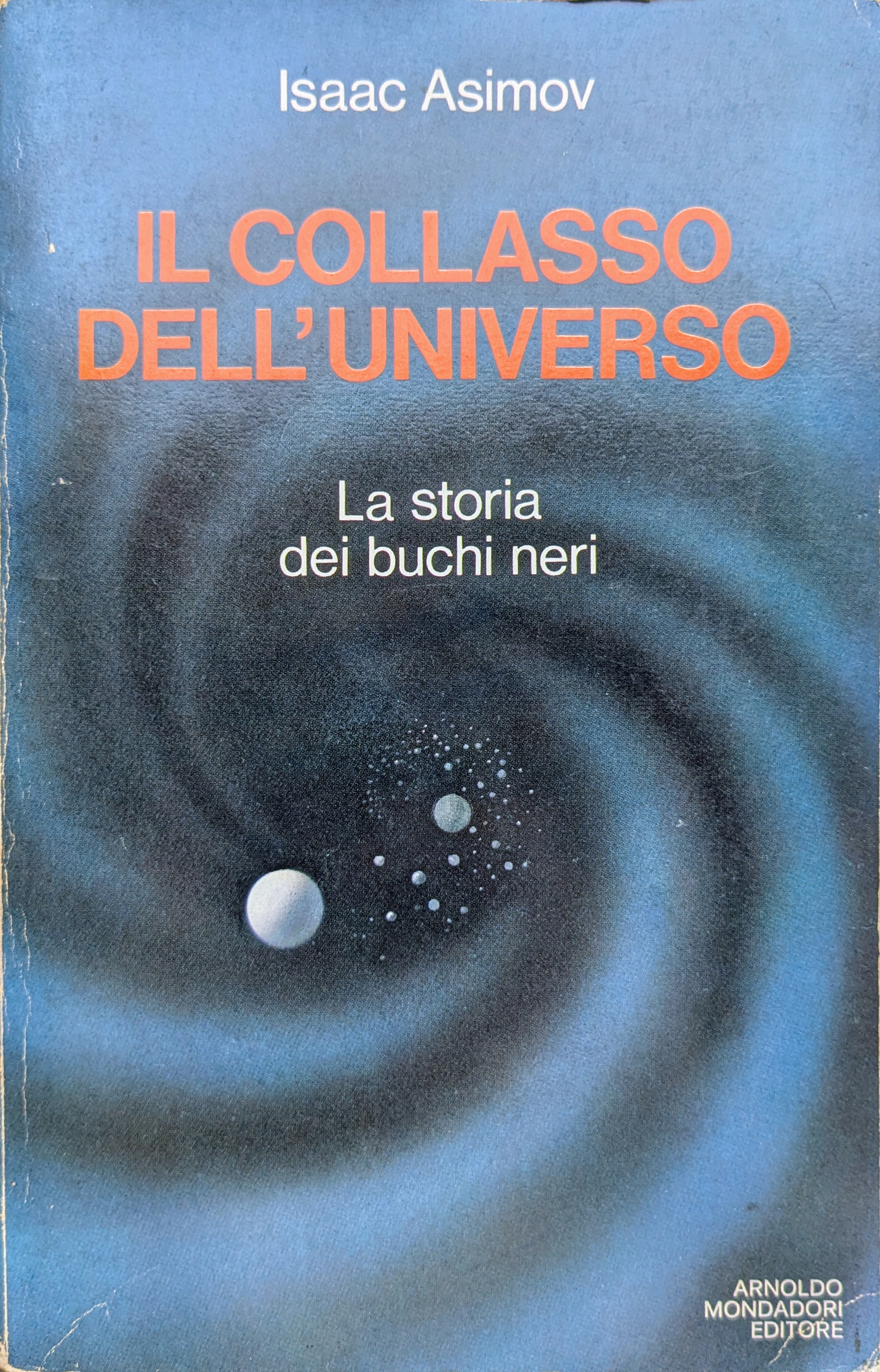
La conquista della Luna, l'esplorazione dei pianeti più vicini, ma soprattutto di Marte, ci hanno presentato, con la nitidezza di immagini fotografiche perfette, i particolari più minuti della superficie di corpi celesti per molti aspetti simili alla Terra, anche se per altri molto diversi. Ma il volo spaziale, l'esplorazione del nostro sistema planetario, questo antico sogno di poeti e di filosofi, oltre che di astronomi, è relegato oggi in una posizione quasi marginale nel quadro dell'astronomia. Nuovi affascinanti orizzonti si stanno aprendo a un settore più sofisticato, impegnato in uno sviluppo impetuoso: l'astrofisica. Di pari passo con lo sviluppo della fisica delle parti-celle elementari, questo settore sta gettando vigorosi colpi di sonda nel mistero dell'universo: un mistero che diventa sempre più imponente e inquietante man mano che vanno prendendo forma frammenti sempre più articolati della sua storia. Negli ultimi decenni l'astronomia ha mutato completamente volto; oggetti nuovi e misteriosi pulsar, nebulose planetarie, giganti rosse, nane bianche, stelle di neutroni, galassie di Seyfert, buchi neri, quasar si accalcano sulla scena di un universo violento e scon-certante, un universo in cui, sullo sfondo di una gigantesca esplosione pmoriale che ha lacerato le strutture di un passato ignoto, le fragili certezze e i labili riferimenti del nostro mondo cedono di schianto all'azione di forze che obbediscono solo a una necessità incondizionata. Sottoposta alla pressione incontrastata dell'interazione gravitazionale, alla quale nessun'altra forza è in grado di opporre resistenza, l'architettura stessa dell'atomo si sgretola, e in un mondo ridotto ormai a materia degenerata tutto diventa possibile, le ipotesi più sorprendenti possono assumere l'aspetto della realtà.
Oltre che un grande divulgatore scientifico, con una passione particolare per l'astronomia, Asimov è anche, come è noto, uno fra i più apprezzati autori di fantascienza. Le sue qualità vengono in luce anche in questo libro, nel-la chiarezza dell'esposizione, nella semplicità dello stile, nell'articolazione del discorso generale. Con un'argomentazione che prende l'avvio dalle nozioni più elementari le forze operanti nell'universo e la struttura dell'atomo, Asimov conduce per mano il suo lettore fino alle ipotesi più nuove e sconvolgenti sulla realtà e il futuro dell'universo.
Works of prolific Russian-American writer Isaac Asimov include popular explanations of scientific principles, The Foundation Trilogy (1951-1953), and other volumes of fiction.
Isaac Asimov, a professor of biochemistry, wrote as a highly successful author, best known for his books.
Asimov, professor, generally considered of all time, edited more than five hundred books and ninety thousand letters and postcards. He published in nine of the ten major categories of the Dewey decimal classification but lacked only an entry in the category of philosophy (100).
People widely considered Asimov, a master of the genre alongside Robert Anson Heinlein and Arthur Charles Clarke as the "big three" during his lifetime. He later tied Galactic Empire and the Robot into the same universe as his most famous series to create a unified "future history" for his stories much like those that Heinlein pioneered and Cordwainer Smith and Poul Anderson previously produced. He penned "Nightfall," voted in 1964 as the best short story of all time; many persons still honor this title. He also produced well mysteries, fantasy, and a great quantity of nonfiction. Asimov used Paul French, the pen name, for the Lucky Starr, series of juvenile novels.
Most books of Asimov in a historical way go as far back to a time with possible question or concept at its simplest stage. He often provides and mentions well nationalities, birth, and death dates for persons and etymologies and pronunciation guides for technical terms. Guide to Science, the tripartite set Understanding Physics, and Chronology of Science and Discovery exemplify these books.
Asimov, a long-time member, reluctantly served as vice president of Mensa international and described some members of that organization as "brain-proud and aggressive about their IQs." He took more pleasure as president of the humanist association. The asteroid 5020 Asimov, the magazine Asimov's Science Fiction, an elementary school in Brooklyn in New York, and two different awards honor his name.
When I started reading Asimov's book this week, written over 30 years ago, I figured I'd be the better-informed, having absorbed current scientific knowledge in over a decade of technical education and more so for being a geek in general.
Turns out I was wrong.
Asimov writes about cosmic phenomena with heavy emphasis on basic concepts, without ever going over the head of the layman, while imparting new knowledge in almost every page. I learned so many things about the Earth, planets, the solar system, stars and the Universe in general that I feel humbled. None of this material should be new to a well-informed denizen of the 21st century but, surprisingly, is.
This book is an absolute gem for every person, whether amateur astronomer, geek or just the kind who likes to stare at the night sky and wonder about the sparkly bits.
On a side-note, the first chapter talks about atomic and nuclear structure and forces and can seem a bit dry to start with. Persist! It's worth it!
It's been three decades since I first read this book. I decided to read it again after having just read Origins: Fourteen Billion Years of Cosmic Evolution by Neil deGrasse Tyson because it seemed that Asimov had told a similar story, but in the opposite order in terms of mass. That is, the latter books starts with the universe and works its way down to planets, and Asimov's starts with the smallest objects, working its way progressively up to the most massive and the universe as a whole.
Asimov explains the difference between planets, stars, white dwarfs, neutron stars, black holes, etc. in such a clear and logical manner that it puts the whole range of states of matter in a context that even lay persons like myself can understand. The differences in densities of the various celestial bodies alone is truly amazing, as is the eventual triumph of the weakest of the four forces, gravity, over the other three.
At the time of the book's publication Dark Matter and Dark Energy had yet to be proposed or confirmed, Inflation Theory had not been proposed, Black Holes were still theoretical, and Pluto was still one of the major planets with an estimated mass double that of Mercury and 50 times its current estimate. But still, even today with all that has been learned since the book was published, I feel it is still a worthwhile and enjoyable read for anyone wanting to understand the universe and our unique place in it.
Тази малка книжка е препрочитам периодично , Азимов майсторски ни разкрива светът който ни заобикаля в галактиката .Черните дупки, вселената и нейният живот.
Прегледах “Гравитационната гибел на Вселената” с цел да си припомня някои факти относно Вселената, така че да ми е по-лесно за по-сложните четива на тази тематика, които по определени причини бях оставил на заден план.
Азимов, като един от най-известните фантасти, е оставил дълбока следа върху тази книга, насочена към учениците от горен курс или просто любителите астрономи. Като начало стилът е много увлекателен (Азимов все пак), описанията са пределно ясни и формулирани по изключително разбираем начин. С радост мога да отбележа, че уводните теми за физичните сили бяха почти дословно предадени на е една презентация за гравитационните вълни от фестивала на науката, което за мен е показателно за тяхната разбираемост, но и акуратност. Разбира се, тъй като е писана доста отдавна, част от информацията не е актуална или теориите са вече доказани или оборени, но фундаменталната и неотменима структура на вселената е описана особено подходящо за любители.
Като един от най-големите фантасти Азимов не пропуска да се впусне в кратки пътешествия отвъд доказаните теории и да разглежда от собствен поглед различните им интерпретации, което за мен беше любопитно и интригуващо. Общо взето това е едно увлекателно четиво за всеки, който се интересува от това, което се случва извън границите на нашата планета.
As someone slowly introducing myself to the world of astrophysics and cosmology, this book had all the basic information to learn about from particles to black holes. Asimov has a way of writing that is super straightforward and easy to understand, given that one takes the time to break down some of his more complex ideas. Even though this book is almost 50 years old now, I feel like it was a great way to learn about what makes up our universe. I rated it 4 stars because some sections, like the chapter about neutron stars for example, went on in depth for pages about comparing the sizes and measurements of large bodies and their escape velocities, which I found to be of no interest to me. Personal preferences aside, I'd recommend this book to anyone like me who has the desire to explore scientific ideas about the universe. thanks :)
The Good Doctor once again explains Cosmology in lucid terms. He starts off with simple premises, known facts, composes and slowly leads up to higher concepts, ultimately leading to the concept of "Black Hole". The book had a "trill" factor to it, as we discover the nature of black holes and what constitutes a black hole and how the universe might have formed.
I like this book because it provides a nice and simple view of physics, astronomy, and quantum mechanics. Simple to read and pretty simple to understand. An easy read.
Weak. I suppose this book may have been relevant for the average layperson when it was published and it even foresaw some things that would be generally confirmed just a couple of decades later, but he was also wrong on some things and while I've enjoyed some of his sci fi - naturally - I've always viewed him as a very inconsistent writer (some books in a series might be worth 5 stars while others will be worth 2), not that great of an original sci fi author (example: In the Foundation series, after a character flies a spaceship a very long way to the universe's capital city/planet, when he gets off, he goes and picks up a PAPER newspaper to read on a bench, and since this is supposed to be taking place a million years or so in the future, the fact that Asimov could envision starships - which seems rather rudimentary to me for sci fi writers - but couldn't imagine a universe a million years from now where reading is done in other ways and formats than mid-1900s Earth newspapers? Philip K Dick, a contemporary of his, seems to have been far more vivid in his imagination, far more creative, and if this doesn't sound too absurd, far more "realistic" in imagining a sci fi-type world off in the future...), and a rather tepid "scientist," certainly not an original thinker or researcher, better equipped to teach high school science courses than to be taken seriously such as a Planck, a Niels Bohr, or any serious researcher of significance. It's not that he wasn't intelligent. It's merely that he was overrated, at least in terms of his originality and any perceived brilliance, which his more "scientific" writings don't seem to bear out. Well, if you're an Asimov fan, I suppose you might like this book, or if you want to read old, outdated and in some cases, simply wrong cosmology texts, this is the book for you. Otherwise, not recommended.
Este libro consiste en ensayos que van guiando al lector hacia el conocimiento acerca de cuál es el ciclo de vida de una estrella. El camino hacia el "Agujero Negro" comienza con una introducción que, en mi opinión, hace un muy buen trabajo de nivelar los conocimientos de distintos lectores hablando sobre densidades y los distintos tipos de fuerzas que se encuentran en nuestro universo junto con donde se encuentra cada una y cual es más fuerte. Una vez pasado ese estadio, Asimov comienza a hablar sobre estrellas, descubrimientos notables y relaciona las masas con las fuerzas involucradas y su luminiscencia / color. Y es ahora donde el libro se vuelve altamente científico. Los temas abarcados a partir de este momento se relacionan con los procesos que ocurren dentro de una estrella y que factores afectan su ciclo de vida. Esta parte es sumamente interesante, pero a la vez se vuelve muy técnica, resultando en que por momentos se torne tediosa y hasta difícil de leer. Pero no todo es malo, esta última sección entra en detalle sobre los últimos estadios de una estrella, partiendo desde su nacimiento y pasando por gigantes rojas, enanas blancas y terminando en supernovas, estrellas de neutrones o unos agujeros negros. En verdad es un viaje increíble de la mano de Asimov, pero por partes se vuelve un poco pesado. Si tenemos en cuenta que se trata de un libro de menos de 300 hojas, la cantidad de información contenida en él es suficiente para dejar hasta el más ávido lector un poco aturdido.
Wow! I came away from this book with what feels like a deep intuitive understanding of what black holes really, potentially are and what they potentially aren’t. Also along the way I learned so much about the movement of celestial objects and forces it was incredible. Things that never made sense before to me were so lucidly explained I can’t believe I was so perplexed by them before. I think I was really more perplexed by the explanation I was given instead of the actual material. That all of this could be done in so short a book makes it even more amazing! For example some things that I now know I did not understand very well are how black holes are actually formed, what they are composed of, how they are able to shoot off radiation, and what evidence for their existence consists of.
Yes the library has Isaac Asimov books. About Black Holes. And some people love to read science/history from back in the day. It's a little like time travel because you know how it came out! This book has a relatively no name publisher and it shows. If I can find typos in a book about physics, it's bad. Other than that, his knowledge and writing and especially readability is on par as always. He's so plain spoken, he makes even difficult subjects easy to digest. I'm not sure which one of the literally hundreds of books he read this is, but it was published in 1977 and there are a dozen science books listed on the front pages and another dozen for children. Readable
In The Collapsing Universe, Isaac Asimov presents one of the earliest accessible scientific works dedicated to explaining black holes and the fate of the cosmos. Written in the 1970s, the book explores ideas that were, at the time, still emerging and largely unfamiliar to general readers. Asimov adopts his characteristic clarity and logical progression, guiding the reader from basic astronomical concepts to some of the most complex theories in astrophysics.
Despite its age, the book remains significant—both as an educational text and as a historical document that reflects how scientists of that era understood the universe before many of today’s major discoveries.
Incredibile testo di divulgazione capace di rendere argomenti impegnativi accessibili a tutti, anche a chi non ne sa nulla, soprattutto grazie ad una dettagliatissima e minuziosa ricostruzione del contesto in cui “nascono” i buchi neri, che parte da uno studio attento delle particelle primordiali fino ad arrivare anche a questioni più speculative come i buchi bianchi e teorie lato-alternative al Big Bang. Consigliatissimo a qualsiasi lettore e soprattutto a chi desidera un testo introduttivo ma completo delle basi del tema cosmico.
Most people know Isaac Asimov, for the work "I, ROBOT". My first contact with the author was during pre-adolescence through this book. And even with little knowledge of Physics at the time, I managed to understand how the Universe gears work. Its four fundamental forces, the planetary formation, the birth of a star, the White Dwarfs, the Neutron Stars, the Pulsars and, of course, the Black Holes. Isaac Asimov exposes in a simple way concepts that are very complicated.
Really interesting to read this book from years back (1977) about black holes and supernova. It is amazing how far we have come in understanding, and yet how much also hasn't changed. I grew up on Asimov and read nearly everything he wrote, so was fun to revisit his style. However dn't use it as a reference!
آسیموف در این کتاب به خاطر توانایی اش در داستان نویسی مطالب حتی بعضا پیچیده رو به سادگی و بسیار قابل فهم توضیح داده
نکته دیگه ای که توجه مو جلب کرد این بود که چقدر خوب عمر کرده این کتاب چون با وجود گذشتن تقریبا نیم قرن از انتشار اون هنوز درصد قابل توجهی از مطالب کاملا درست هستن و صدق میکنن و این نشون میده که آسیموف چقدر در دوره خودش به علم روز دنیا مسلط بوده
I gave it four stars because the book was very dry and had no depth in it. This book would appeal to kids who like science, math and who are into leaning about black holes and are good with equations. I would recommend this book to people who are really into science books and into space science. After the first couple of chapters you start to get into it and it's a very good book.
This book blew my mind, even though I'm not on speaking terms with physics most of the time I understood everything and I am left a little speechless by some of the ideas explored here. I think when we got to the wormholes I was already gone. Loved the writing style. Would recommend.
I just wish we could have another Isaac Asimov in our time, to explain with such clarity and simplicity the advancetments of cosmology as he does in this book. Marvellous!
I've always loved black holes and I've always wanted to read Asimov, but I never realized how well the two would go together.
It's extremely approachable, for the content concerned. He writes a lot like Sagan in that -even though astronomy requires a ton of math- he simplifies it and mostly states it in comparative terms like "1.4 times the mass of the Sun" rather than "2.7846 × 1030 kg".
The best part about this book, for me, wasn't even the black holes themselves -it was everything else leading up to it. I learned so much about the elemental forces, the formation of stars, and every different type of step of ending a star can have. And what I love most it got down to the subatomic level and was still completely understandable.
The only thing that was a slight disappointment was that the book became less and less sure as it went on. Really almost all of it was known fact until you got to the topic of black holes where it became much more of a "what if?" game. I can't blame Asimov, however, as he's just reporting the science and it was still entertaining and informative to read.
Maybe it's because it is a subject matter that interests me but I couldn't put this book down. Asimov is on par with Sagan for making science fun but informative. Even though I'm sure there's been more discovered on the matter, I think this book makes a fine introduction to astronomy.
I learned more about general science from this one book than I ever did in classes growing up. An absolutely fascinating read by an even more fascinating man. Please read this all the way through. It can be very technical at some points, but even not understanding half the calculations, Asimov makes the reader feel included and knowledgeable throughout.
I read this book in high school to learn about black holes. Much theory about astronomy has been advanced since this book was written probably without contradicting the very clear explanation of different stellar bodies in space this book gives. The progressive discussion Asimov uses in this book is very easy to follow and I went away from it having learned much that I was able to recount again to others. I do not personally know if scientists agree today that the universe is collapsing, there is more knowledge about black holes in space where some local collapsing occurs, but a lot of new thinking about the universe its past, and its future.
Interesting enough but it does drag in parts. This (subjectively) suffers in comparison, I think, simply because I recently read Davies' The Last Three Minutes, which covered much the same ground and was really enjoyable.
In general, I've read a handful of Asimov's science books now, and sometimes it does feel a bit repetitive. I understand that in popular science you've got to start from the basics to ground your audience, but I feel like I've read something like the first chapter several times from him. And he does delight in explaining exponents, but at least here that's confined to an appendix.