Horror has taken hold upon me because of the wicked that forsake thy law – Psalm 119:53
Updated, Modern English. Illustrated.
The life of Mr. Badman forms a third part to The Pilgrim’s Progress, but it is not a delightful pilgrimage to heaven. On the contrary, it is a wretched downward journey to the infernal realms. The author’s goal is to warn poor, thoughtless sinners, not with smooth words they can ignore, but with words that thunder against their consciences regarding the danger of their souls and the increasing wretchedness into which they are madly hurrying. The one who is in imminent but unseen danger will bless the warning voice if it reaches his ears, however rough and startling it sounds.
The life of Badman was written in an age when abandonment of moral principles, vice, gluttony, intemperance, habitual lewdness, and the excessive unlawful indulgence of lust marched like a ravaging army through our land, headed by the king, along with officers from his polluted peers. Are we not seeing the same thing, in every way? It is as if this book was written for us who are alive today.
John Bunyan, a Christian writer and preacher, was born at Harrowden (one mile south-east of Bedford), in the Parish of Elstow, England. He wrote The Pilgrim's Progress, arguably the most famous published Christian allegory. In the Church of England he is remembered with a Lesser Festival on 30 August.
John Bunyan didn't think like many people in his day, nor in ours. The truth he tells in this book isn't popular. It isn't fun or entertaining. But it is truth. And many, like the subject of the book, just don't want to hear it or can't seem to understand.
This book really helped me with striving. Each chapter of Mr Badman's life covered the importance of a different sin and its consequences. Most of Mr Badman's sins are considered typical in today's standards.
This is John Bunyan's "counterpart" to the more famous "Pilgrim's Progress". Yet, unlike Pilgrim's Progress which depicts the path of the Christian on the way to the Celestial City (what right looks like), "The Life and Death of Mr. Badman" shows the entirely different path of the wicked on the way to hell (what wrong looks like).
As the author writes in the preface, "Bunyan is clearly presenting a warning to unrepentant sinners of the judgment to come in a much more direct way than his previous attempt with the Pilgrim's Progress ... I don't suppose Bunyan would have cared in which order we read the books. He would probably just want you to read them."
Bunyan's method here is in stark contrast to the modern evangelical approach that boasts Christ whilst avoiding hell or denying it altogether. Even as I write this book review, renowned evangelist Kirk Cameron just announced his theological belief that there is no hell or eternal state of torment, rather an ultimate annihilation of the soul.
Which brings me to my side tangent that we as modern Christians need to not just get back to solid biblical Christianity but leverage the writings and creeds of the early church fathers and Puritans who came before us. To not do so is sheer intellectual and spiritual pride and can lead to discussions like the one between Kirk and his son who never once mentioned the beliefs of godly men who came before them. This would deter allowing our emotions and flawed logic to determine our theology. As Bunyan writes in this book, “Our opinions value little when compared with the truth of God’s Word.”
It is noteworthy that while the dialogue between Wise and Attentive is fiction, Bunyan writes in his preface that ALL THINGS mentioned in this “book are factual and have been played out on the world’s stage – even before my own eyes.” That’s a bold statement because some wild things are discussed in this book that one would think were conjured up in Bunyan’s imagination. Reader discretion is advised! (if you thought Pilgrim’s Progress had some tough parts for young readers this one takes it to another level).
So why the 3 stars? (Those who follow me know I rarely give anything written by a Puritan anything below 5 stars). My problem with this book is that Mr. Badman was simply too much of a “bad man”. Like over the top bad, starting from infancy all the way to the grave. A self-righteous Pharisee could easily read this book and agree with Bunyan’s assertion that this man deserved to end up in eternal torment.
Yet, I think what would have been much more compelling (and particularly convicting to American “Christians”) is if Bunyan had chronicled the life of the man Ignorance from Pilgrim’s Progress. This man by his own righteousness made it all the way to the very gates of the Celestial City, but fell short in the end, causing Bunyan to famously conclude: “then I saw that there was a Way to Hell, even from the Gates of Heaven, as well as from the City of Destruction…”
In conclusion, I love Bunyan’s pastoral exhortation to the reader in the preface when he writes: “I have done so by tracing his [Badman’s] life from childhood to death so you may see with your own eyes, as if through a mirror, the steps leading to hell. Perhaps as you read about Badman’s death, it will help you discern whether you, too, are treading the same path … seriously investigate for yourself … how many will my aim kill who are following Badman’s course, and how many will it make alive who are following the pilgrim’s progress?”
Final note before a few quotes, since this was the last one on my list, below is my personal ranking of all of Bunyan’s fictional books:
1. Pilgrim’s Progress (1678) 2. The Holy War (1682) 3. Pilgrim’s Progress Part 2 (1684) 4. The Life and Death of Mr. Badman (1680)
Some Quotes:
- “A lie, then … is to commit spiritual adultery with the devil … every lie has only one father and one mother: the devil and the heart.”
- “The question isn’t what we believe concerning our sin, but what God’s Word says about it.”
- “Sins don’t walk alone but follow one another like the links of a chain.”
- Pride begins “with allowing yourself to be led by your heart rather than by God’s Word.”
- “It was amazing how many times God would demonstrate His care and compassion for Badman’s soul.”
- “His unmerited, ever-loving, never-ceasing pursuit of our souls. There was no question Badman was an evil, sinful man completely undeserving of God’s grace, but God pursued him anyway.”
Wasn't aware of this book. It's the opposite of Pilgrim's Progress, in a sense, as it follows the life and death of a wicked man, but it is not an allegory. Classic Bunyan, really.
Another banger by Bunyan. It’s not comforting. It’s not warm. But it’s necessary. Mr. Badman is a solid warning, not of harsh evil, but of ordinary sin left unchecked. Very sober reminder to repent.
A stern look at living with sin. Each chapter tells of another sin that Mr. Badman lived and why sin is bad and a person should strive not to live with it. Mr. Badman started as a lying, swearing child and ended in extortion, atheism and fornication. In some ways an interesting look at religious life & thought in the 1600s. In other ways, a very harsh God and a life with no room for errors.
Read as part of reading The Novel: A Biograghpy; Chapter 4.
Bunyan is probing and convicting of sin. Badman is a real devil in that there is nothing real about him except his deceit. A warning against pride and lying and vanity.
The book lacks some of the excellence of other works because Bunyan is gifted in symbolic writing and this is a purely dialogical format. Would have been enlightening to see Badman walking the way of Christian and make consciously different decisions along the way as the conclusion to the trilogy.
This guy didn't stand a chance. Mr. Badman that is. How can you end up being a fine, upstanding citizen when you have the name "Badman"? I don't know how you can because in following Mr. Badman through his life he never managed to do anything that was even close to fine or upstanding. He was just bad. Mr. Badman came out of the novel with the obvious name, The Life and Death of Mr. Badman written in 1680 by John Bunyan. In case you want to know the original title, I skipped some of it, the original title is, The Life and Death of Mr. Badman: An Analysis of a Wicked Man's Life, as a Warning For Others, Presented to the World in a Familiar Dialogue Between Mr. Wiseman and Mr. Attentive. Just that title tells you what is going to happen in the book.
Before we even begin the story we have Bunyan telling us in his preface that Mr. Badman is a pseudonym for a real man now dead. But, according to the author, his relatives and offspring continue to live on Earth, I'm not sure where else they would live, but at the time, they were on earth. He says there are four themes that are commonly part of a funeral for a great man. I never noticed this at any of the funerals I played for, but maybe they weren't great enough. Or I just wasn't paying attention at the time. They are, first, there will be no image that will serve as a memorial, so this work will have to suffice. The next is that he died without honor, so he earned no badges and scutcheons, whatever they are. Third, he didn't merit a sermon. I would think his life would have been perfect material for a sermon. And finally, no one will mourn his death. I hope no one mourns my death, I would be sad thinking I am leaving behind people who are sad because I'm gone. I want them to think about all the Christmases they had with me and smile. I guess no one smiled at Mr. Badman's funeral. Or cried for that matter. And Bunyan winds up by telling us he is publishing this to address the wickedness and debauchery that had corrupted England, it was his duty as a Christian, in hopes of delivering himself from the ruins of them that perish. I wonder if it worked.
So I finally get past the preface, I was beginning to wonder if I would, we have Mr. Wiseman and Mr. Attentive. I find these two people annoying, of course I find most people annoying. We begin with this:
Mr. Wiseman.
Good morrow my good Neighbour, Mr. Attentive; whither are you walking so early this morning? methinks you look as if you were concerned about something more than ordinary. Have you lost any of your Cattel, or what is the matter?
Mr. Attentive. Good Sir, Good morrow to you, I have not as yet lost ought, but yet you give a right ghess of me, for I am, as you say, concerned in my heart, but ’tis because of the badness of the times. And Sir, you, as all our Neighbours know, are a very observing man, pray therefore what do you think of them?
Mr. Wise. Why? I think, as you say, to wit, that they are bad times, and bad they will be, until men are better: for they are bad men that make bad times; if men therefore would mend, so would the times. ’Tis a folly to look for good dayes, so long as sin is so high, and those that study its nourishment so many. God bring it down, and those that nourish it to Repentance, and then my good Neighbor, you will be concerned, not as you are now: Now you are concerned because times are so bad; but then you will be so, ’cause times are so good: Now you are concerned so as to be perplexed, but then you will be concerned so as to lift up your voice with shouting; for I dare say, could you see such days they would make you shout.
So, times are bad I guess. But that's not the only reason Mr. Wiseman has for the great sigh he gives.
Wise. I am concerned with you, for the badness of the times; but that was not the cause of that sigh, of the which, as I see, you take notice. I sighed at the remembrance of the death of that man for whom the Bell tolled at our Town yesterday.
Atten. Why? I trow, Mr. Goodman your Neighbour is not dead. Indeed I did hear that he had been sick.
Wise. No, no, it is not he. Had it been he, I could not but have been concerned, but yet not as I am concerned now. If he had died, I should only have been concerned for that the world had lost a Light: but the man that I am concerned for now, was one that never was good, therefore such an one who is not dead only, but damned. He died that he might die, he went from Life to Death, and then from Death to Death, from Death Natural to death Eternal. And as he spake this, the water stood in his eyes.
Atten. Indeed, to goe from a death-bed to Hell is a fearful thing to think on. But good Neighbour Wiseman, be pleased to tell me who this man was, and why you conclude him so miserable in his death?
Wise. Well, if you can stay, I will tell you who he was, and why I conclude thus concerning him.
Atten. My leisure will admit me to stay, and I am willing to hear you out. And I pray God your discourse may take hold on my heart, that I may be bettered thereby. So they agreed to sit down under a tree: Then Mr. Wiseman proceeded as followeth.
Wise. The man that I mean, is one Mr. Badman; he has lived in our Town a great while, and now, as I said, he is dead. But the reason of my being so concerned at his death, is, not for that he was at all related to me, or for that any good conditions died with him, for he was far from them, but for that, as I greatly fear, he hath, as was hinted before, died two deaths at once.
Atten. I perceive what you mean by two deaths at once; and to speak truth, ’tis a fearfull thing thus to have ground to think of any: for although the death of the ungodly and sinners is laid to heart but of few, yet to die in such a state, is more dreadful and fearful than any man can imagine. Indeed if a man had no Soul, if his state was not truely Immortal, the matter would not be so much; but for a man to be so disposed of by his Maker, as to be appointed a sensible being for ever, and for him too to fall into the hands of revenging Justice, that will be always, to the utmost extremity that his sin deserveth, punishing of him in the dismal dungeon of Hell, this must needs be unutterably sad, and lamentable.
There is an amazing amount of words here that my computer is just dying to change the spelling on. It seems though that there are many Badmans. A great many according to our Wiseman, both brothers and sisters. The eldest, the oldest in years and in sin, according to Mr. Wiseman, is the one who has just died. So Mr. Atten. asks Wise. to tell him an account of his life, but to be brief, for he longs to hear of the manner of his death. Rather a morbid sort of guy I think. Well according to our wiseman our dead guy was bad from when he was a child, very bad that showed no good end. When he was with others as a child, he would be the inventor of bad words and an example in bad actions. He was the ring-leader and master-sinner from a child. According to our narrator he was polluted with original corruption. He says a lot of stuff like that while I'm sitting here wishing he would just name the sin and get it over with without that original sin, original corruption stuff thrown in. He says that he believes that some children come polluted with sin when they are born, and when very young the sins they commit are not from example, but by indwelling sin. "The root is sin within, for from within, out of the heart of man proceedeth sin."
The first sin he committed, at least the first one we hear the most about is lying. He tells lies all the time. It doesn't matter if his parents correct him or tell him that liars should have their part in the Lake that burns with fire and brimstone, he just keeps lying. When the occasion to lie came, he did tell it and stand with it. But not only that, he was also a thief. As a child whether it were things of his fellow children, something from a neighbors house, from his parents, he would take it. As he grew older he stole things of more value, and finally as a man took great pleasure from robbing.
Then there is the Lord's day and what Mr. Badman as a child would do to get out of going to church which he thought of as worse than going to prison. Since so far he hadn't been in prison I don't know how he would know this. He couldn't abide to keep one day holy to God which was proof that he was a unsanctified man. Or child at the time I suppose. Then there is swearing. He was greatly given to grievous swearing and cursing. He counted it a glory to swear and curse, it was as natural to him as to eat and drink and sleep. According to the Wise one anyway. Terrible things may happen if you swear or curse, as the Wiseman tells us:
Dorothy Mately was noted by the people of the Town to be a great Swearer, and Curser, and Lier, and Thief; (just like Mr. Badman.) And the labour that she did usually follow, was to wash the Rubbish that came forth of the Lead Mines, and there to get sparks of Lead-Ore; and her usual way of asserting of things, was with these kind of Imprecations: I would I might sink into the earth if it be not so, or I would God would make the earth open and swallow me up. Now upon the 23. of March, 1660. this Dorothy was washing of Ore upon the top of a steep Hill, about a quarter of a mile from Ashover, and was there taxed by a Lad for taking of two single Pence out of his Pocket, (for he had laid his Breeches by, and was at work in his Drawers;) but she violently denyed it, wishing, That the ground might swallow her up if she had them: She also used the same wicked words on several other occasions that day.
Now one George Hodgkinson of Ashover, a man of good report there, came accidentally by where this Dorothy was, and stood still a while to talk with her, as she was washing her Ore; there stood also a little Child by her Tub-side, and another a distance from her, calling aloud to her to come away; wherefore the said George took the Girle by the hand to lead her away to her that called her: But behold, they had not gone above ten yards from Dorothy, but they heard her crying out for help; so looking back, he saw the Woman, and her Tub, and Sive, twirling round, and sinking into the ground. Then said the man, Pray to God to pardon thy sin, for thou art never like to be seen alive any longer. So she and her Tub twirled round, and round, till they sunk about three yards into the Earth, and then for a while staid. Then she called for help again, thinking, as she said, that she should stay there. Now the man though greatly amazed, did begin to think which way to help her, but immediately a great stone which appeared in the Earth, fell upon her head, and brake her Skull, and then the Earth fell in upon her and covered her. She was afterwards digged up, and found about four yards within ground, with the Boys two single Pence in her pocket, but her Tub and Sive could not be found.
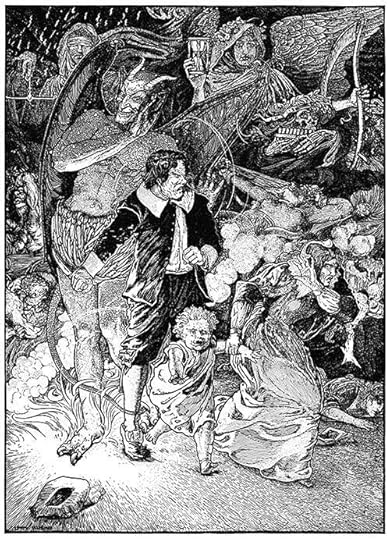
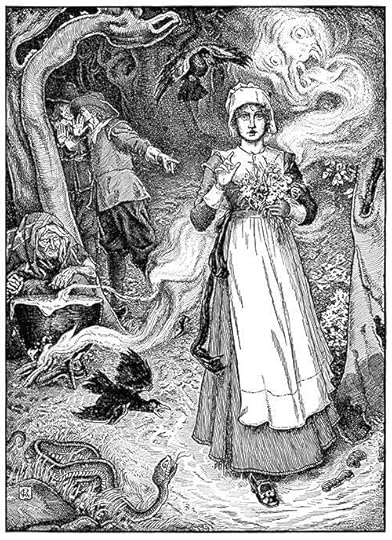
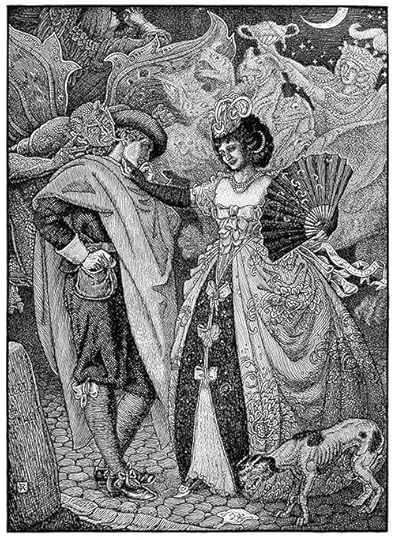
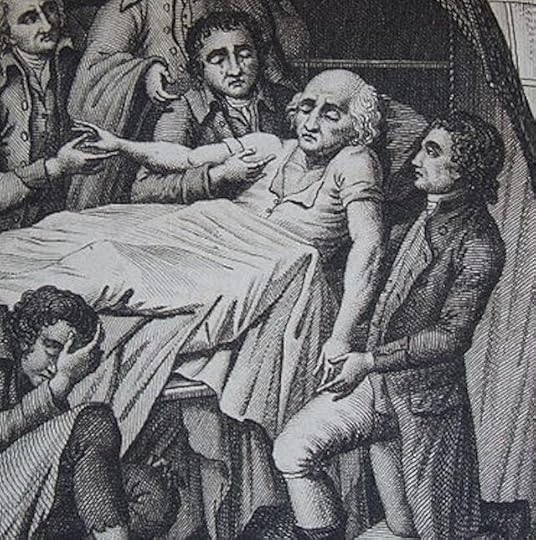
In other words don't swear or curse. And on we go, any sin you can think of Mr. Badman has done it, and liked doing it. It was like one really long sermon that Mr. Attentive or whatever his name is was allowed to ask questions in the middle of. If you like that sort of thing then go ahead and read the book. It was interesting. For poor Mr. Badman it doesn't turn out all that well. The illustrations were really cool, I love books with illustrations. And with that I'm on to the next book.
There is nothing like a book from a few centuries ago to help you think about things more clearly, since it takes you out of the box our culture offers us in this day and age.
http://nhw.livejournal.com/201820.html[return][return]Huckleberry Finn says of this book that "The statements was interesting, but tough", which I think is fair. Several things struck me - the unattractiveness of the main character, Christian, who wilfully abandons his family, and having lost his first travelling companion Faithful by gruesome means then becomes a know-all to his new friend Hopeful; the fact that the metaphors and allegory are about as subtle as a brick (actually, a brick is more subtle - perhaps "as subtle as a Vogon Constructor Fleet" is the simile I am looking for); the fact that when you think you're finished the book it then turns out that his wife Christiana and four sons are going to do the same journey; the repeated use of prisons (as Anne said, write about what you know) and capital punishment; and the fact that the main characters are happy to drink wine without threat of eternal damnation, something that many of the book's greatest fans today would probably disagree with.[return][return]I don't think many people actually do finish the book. Perhaps its most best known image is the Slough of Despond, which is actually described in less than a page in its first appearance (page 31 in my edition). Vanity Fair, while a great name for a town, seems to change out of all recognition between Christian's visit and Christiana's. And their children get married off with rather indecent haste.
Help fire and brimstone has been the way to God for years! Or to ride in on grandma's cost tail. It is interesting to note the changes thru the centuries vocabulary from Mr. Bunyan to current ministers of faith. I am appalled to see the few folks who have chair brains at the door of our Fathers House. I am not sure if they could hold up under His sorrow at the.loss of their knowledge of OHis Wprd. I can joyfully say oK personally have knowledge of Mr. Badman. I have had the proper being in the celebrated winners as well. Thank you Mr Bunyan for the timely warning in the choice fates. Thank you for sending me the book to read.
This was an absolutely outstanding book concerning Christians life, Christian living, and Christian morals as told concerning a man who had rejected them all. There are a couple of places where I think the author's assertions are incorrect, but where he's spot on more than makes up for it. It's an extremely well done work with Scripture proofs to boot.
This is a classic that can give you fresh insight into how the wicked live and die. Bunyan furnished real life examples how the wicked left this Earth.
There are few books that can be both depressing and uplifting at the same time, but this book is one of them. John Bunyon was a minister of the gospel, and in this updated version, made easier to read by the use of modern English, he gives a vivid description of a man who is an unrepentant sinner in the eyes of God. As he goes through the man's life, from birth to death, we are not only given the kinds of sins committed, but also where these sins are spoken of in the Bible. Chapter and verse from the Word of God are give throughout so that no one to illustrate the message that Bunyon wishes to convey. I don't think I have ever read a book that helps the reader in rightly "dividing the word of truth" (2 Timothy 2:15). This book would make a wonderful teaching tool. If you are a preacher (or know one), this book will provide years of sermon outlines. Is it worth your time? That's up to you, but I believe you would be passing up a chance to receive a great blessing.
This book is well written for today's reading pleasure. The story of Wise and Attentive discusses the choices we make, the rebellion or submission to the prompting of God on our souls. The story of Badman who makes bad choices. What I enjoyed the most was how Wise used scripture to explain many excuses Badman chose to use against the truth in rebellion. I believe our generation is falling into the same unbiblical excuses for rebellion. Absolutely loved this book and will read it again and share it with all my Christian-professing brothers and sisters, it's a good evaluation of where we are in our walk with the Lord.
Overall, "The Life and Death of Mr. Badman" is a great book for new Christians or young adults seeking to comprehend the concept of sin and its consequences. The writing style is unique in that it fallows 2 characters talking back and forth. Despite the occasional repetitiveness in the , added writing, as one chapter had wise sip on his coffee way to many time making it a bit distracting, the book's ability to impart important moral lessons outweighs this minor flaw. Therefore, I rate it 4 out of 5 stars, acknowledging its significance in guiding young readers towards a better understanding of the moral choices they make.
It's actually quite a hard read, since it isn't broken into chapters, but is one long dialogue. Many of the issues discussed in the book are also less pertinent to today, and the language is obviously much older than the regular English we use today, so that added an extra level of concentration. I was also disappointed that the main focus was on what Bunyan classified as "sinful living" without much comment on living a life that brings God glory, though with a title like this, I guess that can be expected.
Everyone can gain a lot of godly wisdom through this book. It is easily accessible and a fairly quick read. Bunyan speaks very candidly. In fact, some of the true examples that he cites are shocking and disturbing. Yet, that is the point. This is not a fantasy book even though it is written as an allegory. It is as serious a matter as life and death and the judgment of God deserve
Absolutely incredible allegory for the life of the reprobate. Bunyan's use of metaphor, story building, and overall mastery of the art of allegory is something to be admired. I cannot begin to sing enough praise for this book and its overall importance. Every Christian from every background and every stage of their spiritual journey would benefit from reading this book. Simply put, this book is truly spectacular.
a conversation between wiseman and his neighbor, attentive. mr wiseman narrate a story about badman, his life as prodigal son, his life in married with godly woman but keep his life in sinfullness, until his death. for some reason, the dialogue here was good, reminding me of mitch albom style in some of his works.
I enjoyed this one. It's really easy to read and serves as a warning to us all about the dangers of rejecting the Creator Who made us. It's basically a conversation between two people, Wiseman and Attentive who discuss the life and death of Mr Badman and how he lived his life rejecting God. I'm not a great reader so if I can easily read it then so can you.
Should be read by all in preparation for life and death
All of this knowledge and wisdom are freely available in scripture. However, this common dialog brings the message home such that it sinks into heart and soul and bones.