

What do you think?
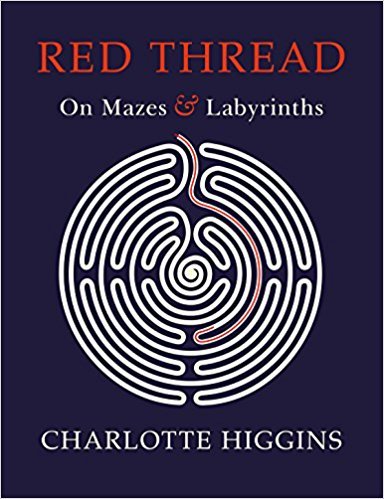
Red Thread: On Mazes and Labyrinths
The tale of how the hero Theseus killed the Minotaur, finding his way out of the labyrinth using Ariadne’s ball of red thread, is one of the most intriguing, suggestive and persistent of all myths, and the labyrinth – the beautiful, confounding and terrifying building created for the half-man, half-bull monster – is one of the foundational symbols of human ingenuity and artistry.
Charlotte Higgins, author of the Baillie Gifford-shortlisted Under Another Sky, tracks the origins of the story of the labyrinth in the poems of Homer, Catullus, Virgil and Ovid, and with them builds an ingenious edifice of her own. She follows the idea of the labyrinth through the Cretan excavations of Sir Arthur Evans, the mysterious turf labyrinths of northern Europe, the church labyrinths of medieval French cathedrals and the hedge mazes of Renaissance gardens. Along the way, she traces the labyrinthine ideas of writers from Dante and Borges to George Eliot and Conan Doyle, and of artists from Titian and Velázquez to Picasso and Eva Hesse.
Her intricately constructed narrative asks what it is to be lost, what it is to find one’s way, and what it is to travel the confusing and circuitous path of a lived life. Red Thread is, above all, a winding and unpredictable route through the byways of the author’s imagination – one that leads the reader on a strange and intriguing journey, full of unexpected connections and surprising pleasures.
Charlotte Higgins, author of the Baillie Gifford-shortlisted Under Another Sky, tracks the origins of the story of the labyrinth in the poems of Homer, Catullus, Virgil and Ovid, and with them builds an ingenious edifice of her own. She follows the idea of the labyrinth through the Cretan excavations of Sir Arthur Evans, the mysterious turf labyrinths of northern Europe, the church labyrinths of medieval French cathedrals and the hedge mazes of Renaissance gardens. Along the way, she traces the labyrinthine ideas of writers from Dante and Borges to George Eliot and Conan Doyle, and of artists from Titian and Velázquez to Picasso and Eva Hesse.
Her intricately constructed narrative asks what it is to be lost, what it is to find one’s way, and what it is to travel the confusing and circuitous path of a lived life. Red Thread is, above all, a winding and unpredictable route through the byways of the author’s imagination – one that leads the reader on a strange and intriguing journey, full of unexpected connections and surprising pleasures.
224 pages, Hardcover
Published September 25, 2018
About the author
Charlotte Higgins
13 books61 followersCharlotte Higgins is the author of three books on aspects of the ancient world. Under Another Sky: Journeys in Roman Britain (Vintage, 2014), was shortlisted for the Samuel Johnson prize for non-fiction, the Thwaites Wainwright prize for nature writing, the Dolman travel-writing prize and the Hessell-Tiltman history prize. In 2010, she won the Classical Association prize. Her most recent book Red Thread: On Mazes and Labyrinths (Cape, 2018) was BBC Radio 4 Book of the Week.
As chief culture writer of the Guardian, she contributes to the Long Read, culture and comment sections; and writes editorials, book reviews and essays. This New Noise, a book based on her nine-part series of reports on the BBC, was published by Guardian-Faber in 2015.
Higgins began her career in journalism on Vogue magazine in 1995 and moved to the Guardian in 1997, for which she has served as classical music editor and arts correspondent.
She has served as a judge for the Art Fund museums prize, the Contemporary Art Society award, and the Royal Philharmonic Society awards. As a broadcaster, she has appeared regularly on BBC Radios 3 and 4. She has also written for the New Yorker, the New Statesman and Prospect.
She is an associate member of the Centre for the Study of Greek and Roman Antiquity at Corpus Christi College, Oxford and is on the board of the Henry Barber Trust. She is a keen amateur violinist.
As chief culture writer of the Guardian, she contributes to the Long Read, culture and comment sections; and writes editorials, book reviews and essays. This New Noise, a book based on her nine-part series of reports on the BBC, was published by Guardian-Faber in 2015.
Higgins began her career in journalism on Vogue magazine in 1995 and moved to the Guardian in 1997, for which she has served as classical music editor and arts correspondent.
She has served as a judge for the Art Fund museums prize, the Contemporary Art Society award, and the Royal Philharmonic Society awards. As a broadcaster, she has appeared regularly on BBC Radios 3 and 4. She has also written for the New Yorker, the New Statesman and Prospect.
She is an associate member of the Centre for the Study of Greek and Roman Antiquity at Corpus Christi College, Oxford and is on the board of the Henry Barber Trust. She is a keen amateur violinist.
Ratings & Reviews
Friends & Following
Create a free account to discover what your friends think of this book!
Community Reviews
Displaying 1 - 30 of 40 reviews

March 24, 2019
I love rambling, well-researched, personal books by smart people. The sort of thing that says it'll talk about one thing (eg. labyrinths) and ends up wandering labyrinth-like through several other topics connected to the author's life and interests (eg. Greek myth, the English Midlands, the colour red, the anatomy of the inner ear, the London Underground, Borges, the brothers Grimm, forests) while actually telling you a lot about labyrinths too. I'd read Charlotte Higgins on basically any topic.

July 27, 2018
From BBC Radio 4 - Book of the week:
Author and journalist Charlotte Higgins explores our ancient fascination with mazes and labyrinths, and reflects on their significance - in art and in mythology, in literature and in life.
Her own interest was inspired by a childhood visit to the palace of Knossos on the island of Crete - where, according to legend, King Minos ordered the construction of a labyrinth to house the half-bull, half-man Minotaur. The monstrous creature was slain by the hero Theseus, who famously managed to escape from the labyrinth with the help of a ball of red thread supplied by Minos's daughter, Ariadne.
"This is where it began," writes Higgins, "my longing for the labyrinth..."
It was also the beginning of her career as a classicist: "I tried to learn my way back there," she says, going on to study Greek and Latin at school and then at Oxford.
As for her own sense of direction: "I have never been able to find my way. Turn me loose in a city without a map and panic rises, as if I were a child who had lost the grip of a parent's hand in a crowd."
And in life? "What frightens me more than the wrong turns I have taken ... are the right turns, the ones I so nearly didn't take...."
Charlotte Higgins is the chief culture writer of the Guardian and the author of three previous books on the ancient world, including Under Another Sky: Journeys in Roman Britain, short-listed for the Baillie Gifford prize for non-fiction. She is also the author of This New Noise: the Extraordinary Birth and Troubled Life of the BBC.
Red Thread is written and read by Charlotte Higgins.
The book is abridged and produced by David Jackson Young.
https://www.bbc.co.uk/programmes/b0bc...
See review @Guardian: https://www.theguardian.com/books/201...
Author and journalist Charlotte Higgins explores our ancient fascination with mazes and labyrinths, and reflects on their significance - in art and in mythology, in literature and in life.
Her own interest was inspired by a childhood visit to the palace of Knossos on the island of Crete - where, according to legend, King Minos ordered the construction of a labyrinth to house the half-bull, half-man Minotaur. The monstrous creature was slain by the hero Theseus, who famously managed to escape from the labyrinth with the help of a ball of red thread supplied by Minos's daughter, Ariadne.
"This is where it began," writes Higgins, "my longing for the labyrinth..."
It was also the beginning of her career as a classicist: "I tried to learn my way back there," she says, going on to study Greek and Latin at school and then at Oxford.
As for her own sense of direction: "I have never been able to find my way. Turn me loose in a city without a map and panic rises, as if I were a child who had lost the grip of a parent's hand in a crowd."
And in life? "What frightens me more than the wrong turns I have taken ... are the right turns, the ones I so nearly didn't take...."
Charlotte Higgins is the chief culture writer of the Guardian and the author of three previous books on the ancient world, including Under Another Sky: Journeys in Roman Britain, short-listed for the Baillie Gifford prize for non-fiction. She is also the author of This New Noise: the Extraordinary Birth and Troubled Life of the BBC.
Red Thread is written and read by Charlotte Higgins.
The book is abridged and produced by David Jackson Young.
https://www.bbc.co.uk/programmes/b0bc...
See review @Guardian: https://www.theguardian.com/books/201...

August 13, 2021
I’ve been dipping in and out of this fascinating book on mazes and labyrinths for quite a while now, sometimes reading pages and pages, sometimes only a few lines. That is because this book does not have standard-sized chapters and a strong taut narrative thread, but is instead a winding convoluted exploration of the history and meaning of labyrinths through history, myth, art, psychology and literature.
It begins with her own visit to the Palace of Knossos on the island of Crete as a child, a place that I have just been. According to the myth, King Minos ordered the construction of a labyrinth at Knossos to house his wife’s monstrous illegitimate child, the Minotaur. Born with a man’s body and a bull’s head, he feeds in the darkness on the blood of sacrificed youths and maidens. One day, a prince named Theseus comes to Knossos. The Minotaur’s half-sister, Ariadne, gives him a sword and a spool of red thread so that Theseus can kill the monster and escape the labyrinth. It’s a myth with a great many layers of meaning and interpretation, and one that I am now working on myself in a novel-in-progress called The Crimson Thread.
Like Charlotte Higgins, I have always been fascinated by mazes and labyrinths, and by the Minotaur story. I loved this book, which ranges from Dante to Freud to Picasso, and it sparked many new ideas for me. A truly intriguing and informative book.
It begins with her own visit to the Palace of Knossos on the island of Crete as a child, a place that I have just been. According to the myth, King Minos ordered the construction of a labyrinth at Knossos to house his wife’s monstrous illegitimate child, the Minotaur. Born with a man’s body and a bull’s head, he feeds in the darkness on the blood of sacrificed youths and maidens. One day, a prince named Theseus comes to Knossos. The Minotaur’s half-sister, Ariadne, gives him a sword and a spool of red thread so that Theseus can kill the monster and escape the labyrinth. It’s a myth with a great many layers of meaning and interpretation, and one that I am now working on myself in a novel-in-progress called The Crimson Thread.
Like Charlotte Higgins, I have always been fascinated by mazes and labyrinths, and by the Minotaur story. I loved this book, which ranges from Dante to Freud to Picasso, and it sparked many new ideas for me. A truly intriguing and informative book.

July 29, 2018
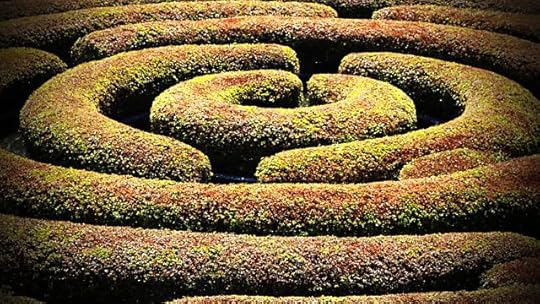 BOTW
BOTW https://www.bbc.co.uk/programmes/b0bc...
CLUE: late Middle English: variant of clew. The original sense was ‘a ball of thread’; hence one used to guide a person out of a labyrinth.
Description: Author and journalist Charlotte Higgins explores our ancient fascination with mazes and labyrinths, and reflects on their significance - in art and in mythology, in literature and in life.
Her own interest was inspired by a childhood visit to the palace of Knossos on the island of Crete - where, according to legend, King Minos ordered the construction of a labyrinth to house the half-bull, half-man Minotaur. The monstrous creature was slain by the hero Theseus, who famously managed to escape from the labyrinth with the help of a ball of red thread supplied by Minos's daughter, Ariadne. "This is where it began," writes Higgins, "my longing for the labyrinth..." It was also the beginning of her career as a classicist: "I tried to learn my way back there," she says, going on to study Greek and Latin at school and then at Oxford.
As for her own sense of direction: "I have never been able to find my way. Turn me loose in a city without a map and panic rises, as if I were a child who had lost the grip of a parent's hand in a crowd." And in life? "What frightens me more than the wrong turns I have taken ... are the right turns, the ones I so nearly didn't take...."
Charlotte Higgins is the chief culture writer of the Guardian and the author of three previous books on the ancient world, including Under Another Sky: Journeys in Roman Britain, short-listed for the Baillie Gifford prize for non-fiction. She is also the author of This New Noise: the Extraordinary Birth and Troubled Life of the BBC.
Guardian review

October 2, 2018
I wanted to love this book, and with a strong beginning, a tale of contact with an old tour guide who offers philosophical reflections and advice (calling to mind the wise guide in a fairy tale, which, without spoiling the rather obvious end note, is, I’m sure, the intention), and a close look at the Knossos mythology, I was convinced I was going to. However, it quickly began to slip into a meandering examination of objects that were tenuously linked to mazes and labyrinths, with the odd section tucked in that deals directly with the topic, almost as though it were an afterthought. I get it, the author wished to explore not only literal labyrinths but those of the mind, body and soul, and that this was a deeply personal book, as much about her journey as anything else. However, the blurb did not make this clear enough, and for someone hoping for a study of mazes and labyrinths, it felt disjointed and heavily navel-gazing, with tangents that had little to do with the main theme. Beautiful writing, but ultimately lacking in substance.
October 16, 2018
Wow!! What a labyrinth of a book.
It starts with Ariadne's ball of Red Thread and then winds it way through history taking in the poems of Homer, Catull, Virgil and Ovid, who all mention in one way or another the Minotaur myth. To the idea of the labyrinth in Europe; church labyrinths and the hedge mazes of Renaissance gardens, to the London Underground. There is also discussions on the idea of the labyrinth in the writings of Dante, Borges and George Eliot to artists like Titian and Picasso who used the idea in their art.
There is no in-depth analysis on any one area but rather there is vignettes that make you (well me) want to take up Ariadne's ball of Red Thread and find out more about labyrinths and mazes.
It starts with Ariadne's ball of Red Thread and then winds it way through history taking in the poems of Homer, Catull, Virgil and Ovid, who all mention in one way or another the Minotaur myth. To the idea of the labyrinth in Europe; church labyrinths and the hedge mazes of Renaissance gardens, to the London Underground. There is also discussions on the idea of the labyrinth in the writings of Dante, Borges and George Eliot to artists like Titian and Picasso who used the idea in their art.
There is no in-depth analysis on any one area but rather there is vignettes that make you (well me) want to take up Ariadne's ball of Red Thread and find out more about labyrinths and mazes.

July 27, 2021
I started reading this because I wanted to learn about the history of mazes and maybe a little bit about their use in mythology. But this is like someone dared the author to write as many college essays as possible on things and relate them back to mazes. We’re referencing Freud but as a historian, there’s Stanley Kubrick’s “The Shining”, we’re referencing personal correspondence and friends as pseudo experts. The language is flowery and overflowing. Everything has a haze of ‘...as if this too was a maze...” and it’s just not what I wanted to read.
It also didn’t feel very knowledgable. I don’t know if it’s the short sections or the topic but everything felt like simple English Wikipedia pages but instead of simple English is college thesaurus English.
It also didn’t feel very knowledgable. I don’t know if it’s the short sections or the topic but everything felt like simple English Wikipedia pages but instead of simple English is college thesaurus English.

August 15, 2022
I liked the book on the whole, but the first third of it was hard to go through. The story reads like a labirynth itself, going closer than further from the subject.
Also, the title is misleading, as the book is very little about labyrinths and mazes and very much about (Greek) mythology. Which was ok, I like the topic, but I was disapointed that it didn't go deeper into the topic, about the maze's significance across time and space, about its meaning for different groups of people. Regarding all this, I found it to be quite superficial.
Also, the title is misleading, as the book is very little about labyrinths and mazes and very much about (Greek) mythology. Which was ok, I like the topic, but I was disapointed that it didn't go deeper into the topic, about the maze's significance across time and space, about its meaning for different groups of people. Regarding all this, I found it to be quite superficial.

January 19, 2020
Mazes and labyrinths have always fascinated me, not just because of the ability to get very lost in a contained area, but their form and function I find a thing of beauty. They have been fascinating others for millennia too.
Charlotte Higgins is another who is captivated by them and has been since a trip to Knossos as a child and this book is a wander around the mazes of her mind. More than that though it is a history of physical and literary mazes. Most have heard of the Minotaur and how he died at the hands of Theseus in his labyrinth and how he found his way out by following a red thread.
As well as ancient history, mazes and labyrinths have appeared in a variety of cultures, there are the turf mazes of which there were about sixty in England at one point as well as there being more in as Germany. There are very few of these mazes left now and they are extremely difficult to date. Churches sometimes have mazes and the most spectacular is the famous winding walk at Chartres Cathedral and it is steeped in mystery and myth.
Hedge mazes have been around since the Renaissance, but it is people like Adrian Fisher, internationally acclaimed maze designer, who have been bringing them back and putting a modern spin on it with the use of modern materials and deception with mirrors. One nice discovery in this book was finding that each underground station has a small labyrinth somewhere inside.
I really enjoyed Under Another Sky that Higgins had written about Roman Britain so was really looking forward to this. And there were parts of this book that I really liked, however, there were far too much on the classics for my liking. That said, it is a beautifully produced book, full of colour images and nice touches in the book in that it was bound with red thread and the bookmark included is a red ribbon.
Charlotte Higgins is another who is captivated by them and has been since a trip to Knossos as a child and this book is a wander around the mazes of her mind. More than that though it is a history of physical and literary mazes. Most have heard of the Minotaur and how he died at the hands of Theseus in his labyrinth and how he found his way out by following a red thread.
As well as ancient history, mazes and labyrinths have appeared in a variety of cultures, there are the turf mazes of which there were about sixty in England at one point as well as there being more in as Germany. There are very few of these mazes left now and they are extremely difficult to date. Churches sometimes have mazes and the most spectacular is the famous winding walk at Chartres Cathedral and it is steeped in mystery and myth.
Hedge mazes have been around since the Renaissance, but it is people like Adrian Fisher, internationally acclaimed maze designer, who have been bringing them back and putting a modern spin on it with the use of modern materials and deception with mirrors. One nice discovery in this book was finding that each underground station has a small labyrinth somewhere inside.
I really enjoyed Under Another Sky that Higgins had written about Roman Britain so was really looking forward to this. And there were parts of this book that I really liked, however, there were far too much on the classics for my liking. That said, it is a beautifully produced book, full of colour images and nice touches in the book in that it was bound with red thread and the bookmark included is a red ribbon.

February 7, 2023
This book is a fascinating look at the history of Labyrinths & Mazes - not just in the physical - but also in a psychological, mythological, archaeological, art and literature sense. I found this book hard to put down, absolutely unique in its study and one that I will reference heavily in my studies. It captured a feeling which is hard to describe, one of those as sensations which compels you to keep going deep into the rabbit hole of obscure knowledge; although a little voice inside your head is telling you that danger lies ahead. What you find in the labyrinth may change you forever. I highly recommend this book to anyone interested in exploring strange deeply cyclical thoughts.

January 3, 2024
This book was a delightful, accessible and multilayered art history book (although annoying that the images were in a different section rather than directly under or with the Chapter about said work of art!). It was filled with personal anecdotes, retelling of Ancient myths and beautiful unravelling of art works particularly from the Mediterranean. It inspired me but mainly made me want to go to Crete, Greece and of course wander the museums and streets of Roma especially on wet miserable January day in Manchester.
October 26, 2025
Felt like I was personally given a tour of the author's mind.
January 17, 2023
This was a well-researched, personal insight into labyrinths, mazes, and the way they reflect the constantly twisting human condition. Rife with trivia, anecdotes, personal characters, poetry, surreal purposeful turns in the prose, tense, and points of view. The photographs were all exceptional quality and well sourced. I also love the hardcover design in an era of lazy hardcover early releases.
Though, I should add I wanted more. As someone who has likewise dedicated a lot of their life on the subject, I wish I could have seen even more literary and artistic influences that weren't so Greco-Roman and European influenced, but understand. She wrote the book she wanted to write, one focusing heavily on Ariadne (hence the title) and, towards the end, the Minotaur Asterion himself. I wanted to see House of Leaves, Annihilation, more Kafkaesque, Japanese elements. There are a myriad of mazes around us. Again, I understand the scope - it's not myopic but centered.
What an achievement!
---
Notes:
- Brilliant, sentimental beginning about the links between labyrinths and life. I really hope Charlotte has read House of Leaves, as I too experience similar dreams of mazes and shifting psychogeometry and felt distinctly recognised by aspects of that book.
- I've never EVER noticed the labyrinthian qualities to Oliver Twist. It's even in the name!
- Evans and his involvement with the restructuring of Crete, and the fabricating of the culture - and Minoan culture as a whole. Odysseus as a liar, spinner of yarn. Snake Goddess and the Ring of Nestor.
- Perfectly segued into a discussion on psychoanalysis as a form of archaeology, digging up latent concepts beneath stratified barriers. I loved the sentiment expressed to Stefan Zweig (a personal favourite): ‘read more archaeology than psychology’. This then proceeds onto an incredible recounting of Freud's interpretation of Michelangelo's Moses - ‘the riddle of that knot in the beard.'
- Drifting onto the parallels between narratives (particularly mystery or detective novels) and labyrinths, using Umberto Eco as the middleman for the conversation.
- She recognises the labyrinthine qualities of The Shining before proceeding onto a discussion of snakes. "The snakes are a kind of living labyrinth: a trapping, coiling, deadly device."
- Definitely a kindred spirit; her interpretations of snakes, particularly in Paradise Lost, reflect my own. "So is to wander (and to wonder)," reminded me exactly of my debut book, Deliriums, which titles the reader and protagonist as a 'W-nderer.'
- Also, Michelangelo was a fraud of ancient artefacts! I never knew.
- Cognitive maps, mice in mazes, and the hippo(horse/hippos)campus(monster/kampos).
- The Arms of Laocoöns is one of the best chapters yet.
- Incredible meditation on spirals, the cochlea of the ear, and a portrait of Joyce.
- Then Charlotte discusses Ariadne (particularly the Cleopatra mistaken statue) and Arachne. Her prose is wonderful, her points profound and connecting. I love her enthusiasm. Her connecting of Ariadne to the internet via French etymology of the word 'file' and 'queue' was astounding.
- Living in Manchester, her writings on Middlemarch and Bennett were brilliant, and funny, and sad. "'[...] Stoke ‘the town I mustn’t name’. It was ‘that place you stop at on the way to Manchester – the one where you look out of the train window when it’s slowing down, and think, “Well, at least I don’t live here.”’"
- The Borges segment concerning his grandmother, Stoke-on-Trent, and Bennett's works, was magnificent. Some of the best parts, yet. I've said that a few times. Her connection of Fenton from 'Forking Paths' with Bennett's Fenton-omission... Just brilliant research and deduction.
- Next time I go to the London Underground, I'll see it through a new lens.
- Really glad she's touching on Dante, as I've also felt the labyrinthine qualities enough to include it in my Invisible Cities twine adaptation via quotes and allusions.
- BEYOND happy that she mentioned The Magician's Nephew, as that was my introduction to 'the multiverse' conceptually as a child, and I feel it's a wonderful labyrinth.
- ‘I sometimes imagine that Daedalus, when he designed his labyrinth, must have re-created the ridges and convoluted folds of his own brain in the form of a building, as if it were a self-portrait. Do you not find that an image of the human brain resembles a labyrinth?' I studied neurocognitive science for 4 years precisely, among other reasons, because the gyri and sulci of the cerebral cortex thrills me, fills me with dread.
---
Quotes:
> "And yet the labyrinth is never so terrifying. A maze or a labyrinth has always been designed by a person. This means that another person has always the possibility of breaking its code. To be inside a maze or a labyrinth is to be bewildered, confused or afraid. But it is, nonetheless, also to be inside a structure. It is to be lost, but only up to a point. It is also to be held within a design and a pattern.’"
> "To feel trapped within the labyrinth’s intestinal coils ushers in thoughts of entrails, of the strange unremembered red tunnels out of which we all, once, emerged. With thoughts of sex and birth come intimations of death: there is something crypt-like about its dark, catacombish twists. The labyrinth is, then, both a symbol of the body and its fragile mysteries, and a gesture of optimism that a corner of the universe can be mastered and given pattern and order by the human mind."
> "In a letter he sent in 1931 to his friend the writer Stefan Zweig, Sigmund Freud confessed that he had ‘read more archaeology than psychology’."
> "It is the subject of one of his most memorable descriptions of the nature of the mind: in Civilisation and Its Discontents (1930), he summoned up a vision of the city in which all of its multiple pasts – from the earliest settlements on the Palatine Hill onwards – are simultaneously present. According to this impossible vision, Nero’s lavish palace, the Domus Aurea, would coexist with the later Colosseum; the footprint of the church of Maria sopra Minerva would be occupied by both the church and the temple over which it was built; the renaissance Palazzo Caffarelli (which is now part of the Capitoline museums) would share its space with the temple of Jupiter Capitolinus, which would ‘be seen not only in its later form, which it assumed during the imperial age, but also in its earlier, when it still had Etruscan elements and was decorated with terracotta antefixes’. It would be an impossible collage of the ages. This city, this fantastical city containing all former versions of itself, would be like the mind, Freud suggested, in which ‘everything is somehow preserved and can be retrieved under the right circumstances’. If a city is a labyrinth in space, Freud invented a city that was a labyrinth in both time and space, truly an ‘eternal city’. This universal and impossible Rome reminds me of Borges’s story ‘Funes the Memorious’, in which the character remembers absolutely everything he has ever experienced, so that he can relive, for example, the complete and precise details of a long-ago day, in real time – his mind an infinite palimpsest."
> "The snakes are a kind of living labyrinth: a trapping, coiling, deadly device."
> "In The Hippocampus as a Cognitive Map, the book O’Keefe and his collaborator Lynn Nadel published in 1978, the pair posited that humans had developed Euclidean geometry precisely because the hippocampus itself provided them with ‘an a priori Euclidean spatial framework’."
> "I fear that my hippocampus is, in contrast to those of London cabbies, small and etiolated. I fear that my limited capacities to navigate will be in the process of withering yet more completely as I come to rely on the safe blue thread of my Google Map directions."
> "Visiting the ruins now – known as the Cretto di Burri, the ‘Crack of Burri’, or the Grande Cretto, the ‘Great Crack’ – is to enter an impossible world. Above a valley otherwise occupied by olive trees, vines and stubble, was a town that looked as if it had absconded from an Italo Calvino story: a city of silent, doorless walls and empty grey streets."
> "In ancient Greek, the word for such a shell is labyrinthos. Another is cochlis, which gives us the word cochlea, the beautiful spiralling cavern (which really does resemble a shell) within the bony labyrinth of the ear, certain disorders of which, affecting balance and causing nausea, are called labyrinthitis."
> "She wrote: ‘What is a drawing? It is a secretion, like a thread in a spider’s web.’59 The spider makes a web that is also her dwelling and her art. She sits at the centre, she traps and consumes. She is feared. She is Daedalus, she is the Minotaur."
> "Overheard snatches of conversation in French. The French word queue means tail. The Italian for queue, for standing in line in single file, is fila, from the Latin filum, a strand, a yarn, a thread. Italian filo means thread. There is also a verb, filare. Il tuo discorso fila means ‘your argument makes sense’, for another’s thought is a line to be grasped, or a thread to be lost. The English word ‘enfilade’, meaning rooms threaded together, leading one from another, also comes from the Latin filum. And the English word ‘file’ derives from the thread or wire on which papers were once strung to keep them in order. Ariadne becomes, then, the unlikely patron of digital orderliness, keeping the bestial depths of the internet at bay."
> "Later, when I learned of Borges’s admiration for Arnold Bennett, and of his Potteries grandmother, it occurred to me how pointed the choice of Fenton was: it was Bennett’s non-town, the one he expelled from his fiction when he chose to write about five rather than six Potteries towns. A suburb of Fenton, then, is a nowhere of a nowhere. Ashgrove does not exist on the real map of north Staffordshire. In his story ‘Tlön, Uqbar, Orbis Tertius’ Borges has a character called Herbert Ashe, an Englishman, supposedly an intimate of his father’s, who ‘suffered from unreality’."
> "In Flann O’Brien’s novel The Third Policeman, de Selby, the savant to whose learnings the narrator of the story devotes so many footnotes, is said to have formulated the notion that it would be possible, if one were possessed of sufficiently keen eyesight, to perceive our younger selves – as children, or babies even – when staring at our own reflections in parallel mirrors, since light takes a certain time to travel between the reflective surface and the eye. "
> "There is an odd play between intimacy and distance in the way travellers ride the Tube. We very often face each other, but we hardly ever acknowledge that we are not alone, and stare through our fellow passengers as if they were ghosts circling Hades."
> "Borges once said, of Henry James and Kafka, ‘I think that they both thought of the world as being at the same time complex and meaningless.’"
Though, I should add I wanted more. As someone who has likewise dedicated a lot of their life on the subject, I wish I could have seen even more literary and artistic influences that weren't so Greco-Roman and European influenced, but understand. She wrote the book she wanted to write, one focusing heavily on Ariadne (hence the title) and, towards the end, the Minotaur Asterion himself. I wanted to see House of Leaves, Annihilation, more Kafkaesque, Japanese elements. There are a myriad of mazes around us. Again, I understand the scope - it's not myopic but centered.
What an achievement!
---
Notes:
- Brilliant, sentimental beginning about the links between labyrinths and life. I really hope Charlotte has read House of Leaves, as I too experience similar dreams of mazes and shifting psychogeometry and felt distinctly recognised by aspects of that book.
- I've never EVER noticed the labyrinthian qualities to Oliver Twist. It's even in the name!
- Evans and his involvement with the restructuring of Crete, and the fabricating of the culture - and Minoan culture as a whole. Odysseus as a liar, spinner of yarn. Snake Goddess and the Ring of Nestor.
- Perfectly segued into a discussion on psychoanalysis as a form of archaeology, digging up latent concepts beneath stratified barriers. I loved the sentiment expressed to Stefan Zweig (a personal favourite): ‘read more archaeology than psychology’. This then proceeds onto an incredible recounting of Freud's interpretation of Michelangelo's Moses - ‘the riddle of that knot in the beard.'
- Drifting onto the parallels between narratives (particularly mystery or detective novels) and labyrinths, using Umberto Eco as the middleman for the conversation.
- She recognises the labyrinthine qualities of The Shining before proceeding onto a discussion of snakes. "The snakes are a kind of living labyrinth: a trapping, coiling, deadly device."
- Definitely a kindred spirit; her interpretations of snakes, particularly in Paradise Lost, reflect my own. "So is to wander (and to wonder)," reminded me exactly of my debut book, Deliriums, which titles the reader and protagonist as a 'W-nderer.'
- Also, Michelangelo was a fraud of ancient artefacts! I never knew.
- Cognitive maps, mice in mazes, and the hippo(horse/hippos)campus(monster/kampos).
- The Arms of Laocoöns is one of the best chapters yet.
- Incredible meditation on spirals, the cochlea of the ear, and a portrait of Joyce.
- Then Charlotte discusses Ariadne (particularly the Cleopatra mistaken statue) and Arachne. Her prose is wonderful, her points profound and connecting. I love her enthusiasm. Her connecting of Ariadne to the internet via French etymology of the word 'file' and 'queue' was astounding.
- Living in Manchester, her writings on Middlemarch and Bennett were brilliant, and funny, and sad. "'[...] Stoke ‘the town I mustn’t name’. It was ‘that place you stop at on the way to Manchester – the one where you look out of the train window when it’s slowing down, and think, “Well, at least I don’t live here.”’"
- The Borges segment concerning his grandmother, Stoke-on-Trent, and Bennett's works, was magnificent. Some of the best parts, yet. I've said that a few times. Her connection of Fenton from 'Forking Paths' with Bennett's Fenton-omission... Just brilliant research and deduction.
- Next time I go to the London Underground, I'll see it through a new lens.
- Really glad she's touching on Dante, as I've also felt the labyrinthine qualities enough to include it in my Invisible Cities twine adaptation via quotes and allusions.
- BEYOND happy that she mentioned The Magician's Nephew, as that was my introduction to 'the multiverse' conceptually as a child, and I feel it's a wonderful labyrinth.
- ‘I sometimes imagine that Daedalus, when he designed his labyrinth, must have re-created the ridges and convoluted folds of his own brain in the form of a building, as if it were a self-portrait. Do you not find that an image of the human brain resembles a labyrinth?' I studied neurocognitive science for 4 years precisely, among other reasons, because the gyri and sulci of the cerebral cortex thrills me, fills me with dread.
---
Quotes:
> "And yet the labyrinth is never so terrifying. A maze or a labyrinth has always been designed by a person. This means that another person has always the possibility of breaking its code. To be inside a maze or a labyrinth is to be bewildered, confused or afraid. But it is, nonetheless, also to be inside a structure. It is to be lost, but only up to a point. It is also to be held within a design and a pattern.’"
> "To feel trapped within the labyrinth’s intestinal coils ushers in thoughts of entrails, of the strange unremembered red tunnels out of which we all, once, emerged. With thoughts of sex and birth come intimations of death: there is something crypt-like about its dark, catacombish twists. The labyrinth is, then, both a symbol of the body and its fragile mysteries, and a gesture of optimism that a corner of the universe can be mastered and given pattern and order by the human mind."
> "In a letter he sent in 1931 to his friend the writer Stefan Zweig, Sigmund Freud confessed that he had ‘read more archaeology than psychology’."
> "It is the subject of one of his most memorable descriptions of the nature of the mind: in Civilisation and Its Discontents (1930), he summoned up a vision of the city in which all of its multiple pasts – from the earliest settlements on the Palatine Hill onwards – are simultaneously present. According to this impossible vision, Nero’s lavish palace, the Domus Aurea, would coexist with the later Colosseum; the footprint of the church of Maria sopra Minerva would be occupied by both the church and the temple over which it was built; the renaissance Palazzo Caffarelli (which is now part of the Capitoline museums) would share its space with the temple of Jupiter Capitolinus, which would ‘be seen not only in its later form, which it assumed during the imperial age, but also in its earlier, when it still had Etruscan elements and was decorated with terracotta antefixes’. It would be an impossible collage of the ages. This city, this fantastical city containing all former versions of itself, would be like the mind, Freud suggested, in which ‘everything is somehow preserved and can be retrieved under the right circumstances’. If a city is a labyrinth in space, Freud invented a city that was a labyrinth in both time and space, truly an ‘eternal city’. This universal and impossible Rome reminds me of Borges’s story ‘Funes the Memorious’, in which the character remembers absolutely everything he has ever experienced, so that he can relive, for example, the complete and precise details of a long-ago day, in real time – his mind an infinite palimpsest."
> "The snakes are a kind of living labyrinth: a trapping, coiling, deadly device."
> "In The Hippocampus as a Cognitive Map, the book O’Keefe and his collaborator Lynn Nadel published in 1978, the pair posited that humans had developed Euclidean geometry precisely because the hippocampus itself provided them with ‘an a priori Euclidean spatial framework’."
> "I fear that my hippocampus is, in contrast to those of London cabbies, small and etiolated. I fear that my limited capacities to navigate will be in the process of withering yet more completely as I come to rely on the safe blue thread of my Google Map directions."
> "Visiting the ruins now – known as the Cretto di Burri, the ‘Crack of Burri’, or the Grande Cretto, the ‘Great Crack’ – is to enter an impossible world. Above a valley otherwise occupied by olive trees, vines and stubble, was a town that looked as if it had absconded from an Italo Calvino story: a city of silent, doorless walls and empty grey streets."
> "In ancient Greek, the word for such a shell is labyrinthos. Another is cochlis, which gives us the word cochlea, the beautiful spiralling cavern (which really does resemble a shell) within the bony labyrinth of the ear, certain disorders of which, affecting balance and causing nausea, are called labyrinthitis."
> "She wrote: ‘What is a drawing? It is a secretion, like a thread in a spider’s web.’59 The spider makes a web that is also her dwelling and her art. She sits at the centre, she traps and consumes. She is feared. She is Daedalus, she is the Minotaur."
> "Overheard snatches of conversation in French. The French word queue means tail. The Italian for queue, for standing in line in single file, is fila, from the Latin filum, a strand, a yarn, a thread. Italian filo means thread. There is also a verb, filare. Il tuo discorso fila means ‘your argument makes sense’, for another’s thought is a line to be grasped, or a thread to be lost. The English word ‘enfilade’, meaning rooms threaded together, leading one from another, also comes from the Latin filum. And the English word ‘file’ derives from the thread or wire on which papers were once strung to keep them in order. Ariadne becomes, then, the unlikely patron of digital orderliness, keeping the bestial depths of the internet at bay."
> "Later, when I learned of Borges’s admiration for Arnold Bennett, and of his Potteries grandmother, it occurred to me how pointed the choice of Fenton was: it was Bennett’s non-town, the one he expelled from his fiction when he chose to write about five rather than six Potteries towns. A suburb of Fenton, then, is a nowhere of a nowhere. Ashgrove does not exist on the real map of north Staffordshire. In his story ‘Tlön, Uqbar, Orbis Tertius’ Borges has a character called Herbert Ashe, an Englishman, supposedly an intimate of his father’s, who ‘suffered from unreality’."
> "In Flann O’Brien’s novel The Third Policeman, de Selby, the savant to whose learnings the narrator of the story devotes so many footnotes, is said to have formulated the notion that it would be possible, if one were possessed of sufficiently keen eyesight, to perceive our younger selves – as children, or babies even – when staring at our own reflections in parallel mirrors, since light takes a certain time to travel between the reflective surface and the eye. "
> "There is an odd play between intimacy and distance in the way travellers ride the Tube. We very often face each other, but we hardly ever acknowledge that we are not alone, and stare through our fellow passengers as if they were ghosts circling Hades."
> "Borges once said, of Henry James and Kafka, ‘I think that they both thought of the world as being at the same time complex and meaningless.’"

October 4, 2023
Charlotte Higgins visited Knossos with her parents on holiday when she was a child. Their docent spoke so compellingly that Higgins was captivated by the stories, and the myths, and by the postcard the docent gave her for being such a well-behaved child, that she decided, right then, to study the Classics at University. This childhood trip also ignited her fascination with mazes and labyrinths, and led her to writing this book-about these in real life, and art and literature. There’s an interesting chapter where she uses the metaphor of the labyrinth to analyse books-‘The name of the rose’, where William of Baskerville can only properly get a sense of the labyrinthine monastery when he’s outside it-much like life itself! Mystery stories are a sort of maze as well, with the author leading you down twists and turns, taking you down possible alleys that are dead ends-it works very well as a metaphor! Higgins returns to the site that fired her childhood imagination, to give us the origins of the word ‘clue’-old English for thread, used by Ariadne to help Theseus find his way back out of the labyrinth. The possible historical truth to the fascinating story of Minotaur were apparently discovered by a local businessman,Kalokairinos, who found ancient remains at Knossos. He didn’t excavate, because he didn’t want any finds to be taken by the Ottoman Empire to Istanbul. Arthur Evans, head of the Ashmolean Museum, journalist, amateur archaeologist, history buff, traveler through the Balkan and Greek states of the Ottoman Empire, decided to throw his hat into the ring. He used funds from the Cretan Exploration Fund to put down a sort of deposit on the land, with the proviso from the local Cretan government that any excavation would begin only once independence had been declared ( the Ottoman Empire had given the
region some autonomy, and with it slow decline, it was only a matter of time for that). Independence was declared, and a horde of archaeologists descended on the site, but Evans had stolen a march on all of them. The excavations showed proof of a Bronze Age civilization, the existence of something resembling a palace and more excitingly, a labyrinth and multiple frescoes and pieces of pottery, all depicting bulls, and the sport of bull-leaping, clearly indicative of a culture that worshipped the bull. Evans called them the Minoans, and was convinced he had found the site that the myth originated from( maybe not, but to borrow from another work of literature, isn’t it pretty to think so? )Higgins’ methods have aroused some controversy-one of his major additions was that he chose to build a reconstruction of a part of the site-the location of one of the largest throne rooms of Bronze Age Europe, andcommissioned painters to fresco the walls, taking the existing fragments of pottery, mosaic and paintin gas a guide. In later years, he poured in concrete to reinforce the crumbling foundations. All these actions have turned Knossos into the second most visited site in Greece, and earned him the lasting gratitude of the Greek government where he’s hailed as a hero, but modern day conservationists are horrified!
Freud was apparently very interested in archaeology, and had a large collection of artefacts he was
proud of, and prominently displayed Arthur Evans’ book on archaeology on his table. He tended to view psychoanalysis akin to excavating layers of detritus to get at what lay beneath. Early experiments on rats in mazes posited connections between environment and behaviour. This was further refined on by John O’Keefe’s Nobel Prize winning studies, that showed that at specific areas of a maze, a rat’s hippocampus lit up, and further research showed that the brain tends to map emotions to places, to create a map in your head: a dark place, for instance, would be instantly associated with fear, and the appropriate part of the brain would light up. So the next time you visualized it, you would know to avoid that. Studies done on London cabbies show an enlarged hippocampus. For the famed London cabbie, their training, and what they are required to know, are the quickest ways to get to places, within a 6 mile radius around Charing Cross. Their driving test includes an oral component-where without the aid of their Blue Book guide, they have to visualize and narrate 3 ways of getting to a specified destination, while also pointing out landmarks along the way. Similar enlarged hippocampi are not observed in London bus drivers, because they needed to learn only their routes, with their specified bus stops, that wouldn’t vary. The memory palace technique, used and popularized by Cicero and other Roman rhetoricians, was similar-associate facts with memories, to quickly retrieve it from your brain when called upon to do so.
This technique of the brain also has some sad side effects-spatial awareness is the first to go, when you get Alzheimers, which quickly exacerbates the loss of memories, when your brain just isn’t able to place them and display them for you, in the order you want. Walter Benjamin said of cities , “Not to find one’s way around a city does not mean much. But to lose one’s way in a city, as one loses one’s way in a forest, requires some schooling. Street names must speak to the urban wanderer like the snapping ofdry twigs, and little streets in the heart of the city must reflect the times of day, for him, as clearly as a mountain valley. This art I acquired rather late in life; it fulfilled a dream, of which the first traces were labyrinths on the blotting papers in my school notebooks.” Both my husband and father are very much from this Walter Benjamin school of thought, and are (justifiably) proud of their immense skill at finding their way around the parts of Bombay they know really well, on foot, and I love listening to them discuss their days as flaneurs, and lamenting the loss of familiar landmarks, and rejoicing when they come across something that’s still there. This part of the book made me realise, however, that they always associate where something is with particular memories-a basketball court that saw some of my husband’s most exciting wins (or losses), a little restaurant that my dad frequented that would fit his meagre undergrad budget, the record store where both of them spent many happy hours at their listening booths (separated by more than 2 decades, but listening to the same 70s rock, I think!).
The book’s part memoir as well, and Higgins managed to get in touch with the docent who so influenced her , and she writes of their lovely correspondence over the years. While this was lovely to read, it feels like a bit of a stretch when she tries to engage with her basic conceit of mazes as life-its fine as a starting point, but practically anything can be a metaphor for life, and she doesn’t quite make it work. Her writing otherwise, though, and all the associations she writes of, are so compelling, that I would still recommend this book.
region some autonomy, and with it slow decline, it was only a matter of time for that). Independence was declared, and a horde of archaeologists descended on the site, but Evans had stolen a march on all of them. The excavations showed proof of a Bronze Age civilization, the existence of something resembling a palace and more excitingly, a labyrinth and multiple frescoes and pieces of pottery, all depicting bulls, and the sport of bull-leaping, clearly indicative of a culture that worshipped the bull. Evans called them the Minoans, and was convinced he had found the site that the myth originated from( maybe not, but to borrow from another work of literature, isn’t it pretty to think so? )Higgins’ methods have aroused some controversy-one of his major additions was that he chose to build a reconstruction of a part of the site-the location of one of the largest throne rooms of Bronze Age Europe, andcommissioned painters to fresco the walls, taking the existing fragments of pottery, mosaic and paintin gas a guide. In later years, he poured in concrete to reinforce the crumbling foundations. All these actions have turned Knossos into the second most visited site in Greece, and earned him the lasting gratitude of the Greek government where he’s hailed as a hero, but modern day conservationists are horrified!
Freud was apparently very interested in archaeology, and had a large collection of artefacts he was
proud of, and prominently displayed Arthur Evans’ book on archaeology on his table. He tended to view psychoanalysis akin to excavating layers of detritus to get at what lay beneath. Early experiments on rats in mazes posited connections between environment and behaviour. This was further refined on by John O’Keefe’s Nobel Prize winning studies, that showed that at specific areas of a maze, a rat’s hippocampus lit up, and further research showed that the brain tends to map emotions to places, to create a map in your head: a dark place, for instance, would be instantly associated with fear, and the appropriate part of the brain would light up. So the next time you visualized it, you would know to avoid that. Studies done on London cabbies show an enlarged hippocampus. For the famed London cabbie, their training, and what they are required to know, are the quickest ways to get to places, within a 6 mile radius around Charing Cross. Their driving test includes an oral component-where without the aid of their Blue Book guide, they have to visualize and narrate 3 ways of getting to a specified destination, while also pointing out landmarks along the way. Similar enlarged hippocampi are not observed in London bus drivers, because they needed to learn only their routes, with their specified bus stops, that wouldn’t vary. The memory palace technique, used and popularized by Cicero and other Roman rhetoricians, was similar-associate facts with memories, to quickly retrieve it from your brain when called upon to do so.
This technique of the brain also has some sad side effects-spatial awareness is the first to go, when you get Alzheimers, which quickly exacerbates the loss of memories, when your brain just isn’t able to place them and display them for you, in the order you want. Walter Benjamin said of cities , “Not to find one’s way around a city does not mean much. But to lose one’s way in a city, as one loses one’s way in a forest, requires some schooling. Street names must speak to the urban wanderer like the snapping ofdry twigs, and little streets in the heart of the city must reflect the times of day, for him, as clearly as a mountain valley. This art I acquired rather late in life; it fulfilled a dream, of which the first traces were labyrinths on the blotting papers in my school notebooks.” Both my husband and father are very much from this Walter Benjamin school of thought, and are (justifiably) proud of their immense skill at finding their way around the parts of Bombay they know really well, on foot, and I love listening to them discuss their days as flaneurs, and lamenting the loss of familiar landmarks, and rejoicing when they come across something that’s still there. This part of the book made me realise, however, that they always associate where something is with particular memories-a basketball court that saw some of my husband’s most exciting wins (or losses), a little restaurant that my dad frequented that would fit his meagre undergrad budget, the record store where both of them spent many happy hours at their listening booths (separated by more than 2 decades, but listening to the same 70s rock, I think!).
The book’s part memoir as well, and Higgins managed to get in touch with the docent who so influenced her , and she writes of their lovely correspondence over the years. While this was lovely to read, it feels like a bit of a stretch when she tries to engage with her basic conceit of mazes as life-its fine as a starting point, but practically anything can be a metaphor for life, and she doesn’t quite make it work. Her writing otherwise, though, and all the associations she writes of, are so compelling, that I would still recommend this book.
September 22, 2022
I love it when a book forces me to read slowly, because it's constantly making connections and causing me to wander off, making my own.
So, this winds you through a sacred dance of topics on and around mazes, labyrinths, mythology, psychology, classics, literature, weaving, personal history, art, religion, love, loss, getting lost, mystery, bits of string, and interconnected ideas large and small.
I strongly suspect, but haven't made the necessary survey to confirm, that the short chapters more or less spiral you in toward a central point, then back out again. Have fun finding that. I did.
Read this book if:
* you're happy to nature-ramble around the topic and the author's personal selection of related ones
* you're happy for a bit of personal narrative to be wound in among the history, art, mythology etc (not a huge amount, just a bit of a thread through the text, as it were)
* you enjoy good NF writing for its own sake
* you have an inquiring mind
And get the hardcover if you enjoy a beautiful book. The stitching is red. I mean, seriously. That's attention to detail.
Maybe don't bother with this book if:
* you want a straight answer on anything and will be annoyed by the lack of one
* you just want a history, survey, or gazetteer of labyrinths or mazes
* you really like a clear sequence in chapters and would be annoyed by topics being half discussed, then coming up again several chapters later (no, this didn't annoy me in the slightest, it was fascinating, but some people might hate it)
* you're not willing to follow the author down some winding paths of tenuous relevance.
December 30, 2021
Charlotte Higgins would probably love me describing this book as like being lost in a maze, but that doesn't make it a pleasant experience to read.
Be warned. It's not really about mazes and labyrinths at all. It seems to be a collection of about fifty or so short essays which are only loosely connected to each other. The overall theme is so maddeningly obscure ('life is like a labyrinth'?) that trying to wade through it is a frustrating and tiresome experience. It reads like she wrote a load of things about various artists and poets, then at a late stage shoehorned a spurious 'mazes and labyrinths' label into the mix to make it seem she was saying sonething unified and profound.
About two thirds of the way through I got it: it's an art book.
I gave it two stars instead of one because some of the essays on their own are quite interesting and readable. I liked the one about the Mappa Mundi, and the bit where she interviews a maze designer.
Be warned. It's not really about mazes and labyrinths at all. It seems to be a collection of about fifty or so short essays which are only loosely connected to each other. The overall theme is so maddeningly obscure ('life is like a labyrinth'?) that trying to wade through it is a frustrating and tiresome experience. It reads like she wrote a load of things about various artists and poets, then at a late stage shoehorned a spurious 'mazes and labyrinths' label into the mix to make it seem she was saying sonething unified and profound.
About two thirds of the way through I got it: it's an art book.
I gave it two stars instead of one because some of the essays on their own are quite interesting and readable. I liked the one about the Mappa Mundi, and the bit where she interviews a maze designer.

May 8, 2022
i think this book and i simply had different ideas about what it was meant to be. it is no one's fault but it made for a poor reading experience.
regardless, on a technical note, i think it would have benefitted from being more focused and slightly restructured. i suspect it takes the format it does to create an impression of a labyrinth, a single thread, on its own but - as the text itself says - labyrinths are also designed. this book (structurally) lacked exactly that.
regardless, on a technical note, i think it would have benefitted from being more focused and slightly restructured. i suspect it takes the format it does to create an impression of a labyrinth, a single thread, on its own but - as the text itself says - labyrinths are also designed. this book (structurally) lacked exactly that.

January 16, 2023
A labyrinthine book about labyrinths, based mostly on the author's own recollections about encounters with classical and classical-inspired art and literature, generally around the topic of labyrinths, and her own musings on those topics. Fun, and quirky - not your typical classics tome (and that can be a very good thing) . . .
November 1, 2022
love. love. love. so cool, such a journey

June 4, 2023
Book Review: "Red Thread: On Mazes and Labyrinths" by Charlotte Higgins
"Red Thread: On Mazes and Labyrinths" is a fascinating exploration of the history, symbolism, and allure of mazes and labyrinths. Written by Charlotte Higgins, a renowned classicist and cultural writer, this book delves into the complex and multifaceted world of these intricate structures, taking readers on a captivating journey through time and across various cultures.
Higgins weaves together a rich tapestry of mythology, archaeology, literature, and personal anecdotes to create an engaging narrative that effortlessly draws readers into the enigmatic realm of mazes and labyrinths. Her prose is elegant, evocative, and filled with vivid descriptions, making it a pleasure to delve into the subject matter.
One of the book's strengths lies in its comprehensive examination of mazes and labyrinths throughout history. From ancient Greek myths to medieval cathedrals, from Renaissance gardens to contemporary art installations, Higgins explores how these structures have served as powerful metaphors for the human experience, embodying ideas of journey, challenge, and self-discovery.
The author's research is meticulous, and she expertly combines academic knowledge with a genuine passion for the topic. Her writing is accessible, even for readers with no prior knowledge of the subject, making it an excellent introduction to the world of mazes and labyrinths. At the same time, Higgins offers fresh insights and thought-provoking analysis that will captivate even the most knowledgeable enthusiasts.
In addition to its intellectual depth, "Red Thread" is also visually stunning. The book is beautifully designed, with numerous illustrations, photographs, and diagrams that enhance the reading experience and bring the intricacies of mazes and labyrinths to life. The inclusion of these visual elements adds an extra layer of immersion and makes the book a joy to peruse.
While "Red Thread" excels in many aspects, some readers might find certain sections to be more engaging than others. The book occasionally meanders into tangential topics or delves into minute details that may not resonate with every reader. Nevertheless, these minor detours do not detract significantly from the overall quality of the book and are overshadowed by its myriad strengths.
In conclusion, "Red Thread: On Mazes and Labyrinths" is an enthralling exploration of a subject that has fascinated humanity for centuries. Charlotte Higgins' masterful blend of history, symbolism, and personal reflection makes for an engrossing read. Whether you are intrigued by the mythology behind labyrinths, interested in their architectural evolution, or simply seeking a book that will transport you into the realms of wonder and contemplation, this book is a must-read. "Red Thread" is a testament to the enduring power and allure of mazes and labyrinths, and it will leave readers with a newfound appreciation for these timeless and enigmatic structures.
"Red Thread: On Mazes and Labyrinths" is a fascinating exploration of the history, symbolism, and allure of mazes and labyrinths. Written by Charlotte Higgins, a renowned classicist and cultural writer, this book delves into the complex and multifaceted world of these intricate structures, taking readers on a captivating journey through time and across various cultures.
Higgins weaves together a rich tapestry of mythology, archaeology, literature, and personal anecdotes to create an engaging narrative that effortlessly draws readers into the enigmatic realm of mazes and labyrinths. Her prose is elegant, evocative, and filled with vivid descriptions, making it a pleasure to delve into the subject matter.
One of the book's strengths lies in its comprehensive examination of mazes and labyrinths throughout history. From ancient Greek myths to medieval cathedrals, from Renaissance gardens to contemporary art installations, Higgins explores how these structures have served as powerful metaphors for the human experience, embodying ideas of journey, challenge, and self-discovery.
The author's research is meticulous, and she expertly combines academic knowledge with a genuine passion for the topic. Her writing is accessible, even for readers with no prior knowledge of the subject, making it an excellent introduction to the world of mazes and labyrinths. At the same time, Higgins offers fresh insights and thought-provoking analysis that will captivate even the most knowledgeable enthusiasts.
In addition to its intellectual depth, "Red Thread" is also visually stunning. The book is beautifully designed, with numerous illustrations, photographs, and diagrams that enhance the reading experience and bring the intricacies of mazes and labyrinths to life. The inclusion of these visual elements adds an extra layer of immersion and makes the book a joy to peruse.
While "Red Thread" excels in many aspects, some readers might find certain sections to be more engaging than others. The book occasionally meanders into tangential topics or delves into minute details that may not resonate with every reader. Nevertheless, these minor detours do not detract significantly from the overall quality of the book and are overshadowed by its myriad strengths.
In conclusion, "Red Thread: On Mazes and Labyrinths" is an enthralling exploration of a subject that has fascinated humanity for centuries. Charlotte Higgins' masterful blend of history, symbolism, and personal reflection makes for an engrossing read. Whether you are intrigued by the mythology behind labyrinths, interested in their architectural evolution, or simply seeking a book that will transport you into the realms of wonder and contemplation, this book is a must-read. "Red Thread" is a testament to the enduring power and allure of mazes and labyrinths, and it will leave readers with a newfound appreciation for these timeless and enigmatic structures.

April 30, 2023
Astonishing book. I recommend it to anyone, but especially to anyone interested in Greek mythology and the story of Ariadne-Thesues-the Minotaur-Daedalus and the labyrinth and how elements of the story can be traced across lands and time through history to the present day. The geographical scope of the book is breathtaking - even for me who travelled a lot in my 20s and 30s. This breadth shows how stories have affected different people and artists in different countries and cultures over large spans of time, and Charlotte Higgins takes us quietly and devastatingly through her own personal labyrinth, always fascinating, always thought-provoking, a feast on every page. What is most astonishing is how closely she has paid attention to the detail she references in her work and how diligently and accurately and consistently she intertwines those references and makes them bond together with Ariadne's red thread.
Even though Higgins is a journalist for the Guardian she doesn't write from any political/gender political stance. For example, when retelling the end of the Odyssey, she mentions the suitors' murders, but not the hanging of the maids, which in light of Margaret Atwood's Penelopiad and various female-oriented retellings that have flooded the market recently is a clanging omission. However, Higgin's book is not a place for such debate. Instead, she uses only the parts of the wealth of material that she references that are relevant to the point she's making, which is the creation of a labyrinth of stories and artwork that she effortlessly weaves together and loses the reader in. Much to the reader's delight. With the gender war raging on, it's quite refreshing, if a little dry.
I particularly liked the Borges quotes and am itching to read more if his works.
I borrowed this book from the library in hardback, but would very much like my own copy because I would like to reread it and it contains lovely glossy reproductions of some great works of art.
I'm looking forward to reading her Greek Myth retellings. I might even dip into her other title on Roman Britain. Under Another Sky: Journeys in Roman Britain.
Even though Higgins is a journalist for the Guardian she doesn't write from any political/gender political stance. For example, when retelling the end of the Odyssey, she mentions the suitors' murders, but not the hanging of the maids, which in light of Margaret Atwood's Penelopiad and various female-oriented retellings that have flooded the market recently is a clanging omission. However, Higgin's book is not a place for such debate. Instead, she uses only the parts of the wealth of material that she references that are relevant to the point she's making, which is the creation of a labyrinth of stories and artwork that she effortlessly weaves together and loses the reader in. Much to the reader's delight. With the gender war raging on, it's quite refreshing, if a little dry.
I particularly liked the Borges quotes and am itching to read more if his works.
I borrowed this book from the library in hardback, but would very much like my own copy because I would like to reread it and it contains lovely glossy reproductions of some great works of art.
I'm looking forward to reading her Greek Myth retellings. I might even dip into her other title on Roman Britain. Under Another Sky: Journeys in Roman Britain.

June 22, 2024
This was a serendipitous library pick; I had to go print something out, was wandering around for a few, and spotted a still-new copy of this on the nonfiction shelf. Being a longtime Borges aficionado, but fan of House of Leaves, etc etc (and given the other book I had already decided to take out, coming out next), this just seemed like a natural pick after leafing through it.
I'm not sure what I expected, structurally, but I am delighted what I actually found. Higgins talks of the labyrinth as a collision of the ordered and the chaotic, of nature and human invention, and as being both terrifying and comforting. You may be lost, but you are lost in something someone made. The winding thread of this book felt similar at times; whether we are in personal reflections, history, social commentary, art analysis, or all the places where those elements shade into each other, I felt wonderfully caught up in the middle of something I wouldn't really understand until I had the chance to look at the whole thing from above (err, in this case by finishing reading it!).
I deeply appreciated the well-chosen images in the two sets of inserts, which saved me from looking up a number of paintings and statues, and overall think Higgins made consistently good choices in terms of her focus, pathing, and thinking. A delight of a book, and one I think I'll go back to in the future. At the very least, I'll be thinking of this bit for a long time (not least because I felt moved to write it down):
I'm not sure what I expected, structurally, but I am delighted what I actually found. Higgins talks of the labyrinth as a collision of the ordered and the chaotic, of nature and human invention, and as being both terrifying and comforting. You may be lost, but you are lost in something someone made. The winding thread of this book felt similar at times; whether we are in personal reflections, history, social commentary, art analysis, or all the places where those elements shade into each other, I felt wonderfully caught up in the middle of something I wouldn't really understand until I had the chance to look at the whole thing from above (err, in this case by finishing reading it!).
I deeply appreciated the well-chosen images in the two sets of inserts, which saved me from looking up a number of paintings and statues, and overall think Higgins made consistently good choices in terms of her focus, pathing, and thinking. A delight of a book, and one I think I'll go back to in the future. At the very least, I'll be thinking of this bit for a long time (not least because I felt moved to write it down):
On the path of my life, in the middle of my life, what do I know about where I have been, and where I might go? Everything is the woods, everything is the ocean, everything is the desert. I can see no shape. I am lost; in the middle of my life I am lost.

January 15, 2019
A book to take time and care over, a book to admire, this intriguing and delightful exploration of myth and image, art and literature starts us off with the great story of Crete; with Europa and the Bull, and how Ariadne, the daughter of the King, leads Theseus to destroy the Minotaur, only ot be abandoned on Naxos. From these first pages we are already in the archetypal labyrinth, being “bewildered, confused…” but also “inside a structure:” Charlotte Higgins might let us be mystified, and this is a hard read, but she is a sure-footed writer (if that image works), and at every turn she maintains the pace even when she changes direction. There are walks into art history and forgery. There are bleak visions of queues at passport control. There are imaginative re-writes of the myth of Ariadne which segue into (or out of) self-revelation and self-help:
“I have, at times, over-identified with Ariadne, thinking myself the abandoned lover waiting for rescue on a rocky shoreline… Turn your back on the ship and the trackless wastes of the sea, Ariadne, and walk inland. There are farms, and fields and houses and people.”
From the guide to the Heraklion museum, Sofia Grammatiki, through the more monumental (i.e. less in-your-face rude) poetry of Catullus, to Michelangelo, to Chartres and Ravenna and Stoke on Trent, Higgins leads the reader from one cultural “Wow!” moment to another. Yes, of course Jorge Luis Borges is there, and Umberto Eco - and Frances Hodgson Burnett’s Secret Garden. This book is - intentionally, I think - a meander through galleries of cultural understanding, a model in book form of the labyrinths and mazes she is discussing. And highly recommended.
“I have, at times, over-identified with Ariadne, thinking myself the abandoned lover waiting for rescue on a rocky shoreline… Turn your back on the ship and the trackless wastes of the sea, Ariadne, and walk inland. There are farms, and fields and houses and people.”
From the guide to the Heraklion museum, Sofia Grammatiki, through the more monumental (i.e. less in-your-face rude) poetry of Catullus, to Michelangelo, to Chartres and Ravenna and Stoke on Trent, Higgins leads the reader from one cultural “Wow!” moment to another. Yes, of course Jorge Luis Borges is there, and Umberto Eco - and Frances Hodgson Burnett’s Secret Garden. This book is - intentionally, I think - a meander through galleries of cultural understanding, a model in book form of the labyrinths and mazes she is discussing. And highly recommended.

September 7, 2022
The labour: 'hic labor est.' In the Middle Ages, writers would make much of a speculative etymology for the Latin for labyrinth, 'laborintus', connecting it to the phrase 'labor intus', which means 'labour inside'. The labyrinth became a proxy for the labour of life; the work of knowing the self; and the struggle to tread the labyrinth of the world.
Oh, I really needed this. I needed to love a book the way I loved this one.
Higgins' writing flows, she is poetic and funny and stupidly clever. She takes you by the hand and says 'trust me' while pulling you along. And I did. And I'm so glad.
I've been meaning to read this book almost since it came out, had it on my shelf, ready. But I guess I needed to be ready. So grateful this was the right time. I'm a sucker for this kind of intertextual narrative - a person speaking really well about their passions. It makes me excited to learn and to see.
Oh, I really needed this. I needed to love a book the way I loved this one.
Higgins' writing flows, she is poetic and funny and stupidly clever. She takes you by the hand and says 'trust me' while pulling you along. And I did. And I'm so glad.
I've been meaning to read this book almost since it came out, had it on my shelf, ready. But I guess I needed to be ready. So grateful this was the right time. I'm a sucker for this kind of intertextual narrative - a person speaking really well about their passions. It makes me excited to learn and to see.
June 4, 2022
I loved the premise of this book: weaving together labyrinths from mythology, art and life, and how the labyrinthine form plays such a pivotal role in so much of our lives. However, I found that the structure very much reflected the source material (no bad thing, just not quite my cup of tea). Overall, the book had some lovely musings and references throughout, on the nature of being human and how art works, which I really took to heart, but I did have to discard some components of the book. Perhaps it is one that I will simply need to reread in the future, as I did appreciate her narrative voice and references to Greek mythology, artists like Picasso and especially one comment she made as to how ‘there are terrors within the labyrinth but there is also love.’ Some very powerful moments, just a few gaps personally.

March 14, 2023
If you go to Knossos, there are a few explanatory plaques where Arthur Evans has attempted to rebuild parts of the palace in a romantic view of what may have been. Evans is picturing Ariadne helping Theseus out of the maze, but it's not that historically accurate. This book takes you through a world of art and culture where maybe Evans was right after all, the maze linking Crete to Troy to British Hedge mazes via the cathedrals of France and Renaissance Art. One of those non-fiction books that takes you on a journey and you feel richer for having read. Especially if you really like mazes (like me).
Plus bonus points for comparing Kings Cross Underground station to a modern day labyrinth.
Plus bonus points for comparing Kings Cross Underground station to a modern day labyrinth.

December 15, 2024
A whirlwind adventure through history, mythology, and the authors own experiences. I am someone who hasn’t read a lot of the classics, and so for me this kind of book acts as inspiration to go on further and read some of the texts mentioned. I did find it very interesting how she connected so many things back to the idea of the labyrinth, and how it has been a central component of western mythology, from which a great deal of art and cultural inheritance derives. Unfortunately I don’t think I am qualified to understand the full extent of the nuanced themes and connections she makes due to my lack of reading, but that only makes me more curious to start.
September 10, 2023
It was pretty hard to rate this book. The format of the book is of a series of loosely connected essays which vary from mythology retelling, art criticism, and personal travelogue. The essays go back and forth between different eras, often returning to the story of Theseus, the Minotaur, and Ariadne, but in a meandering way that often touches upon the labyrinth as a metaphor for the way we experience life has twists and turns (both in fictional and non-fictional narratives). So, it’s a very particular kind of book, but it’s well done for those looking for reflection
July 17, 2022
I returned to this after a break, and found it all the more rewarding when I picked it back up again. Higgins is writing at a generic intersection, drawing variously on history, criticism, autobiography, and fiction to weave a narrative which is by turns informative and thought-provoking, and richly soaked in three thousand years of art and culture. Once I'd worked out what she was trying to do (big fan of the structural and tonal shifts!!), I was entirely absorbed. A truly labyrinthine text.
August 19, 2022
What a fabulously fascinating book this was!! It was about the significance and semiotics of labyrinth and mazes but it also extended the metaphors into all human life, existence and storytelling. It was infused with classical myths but also with personal memories and fables of the author, enlivened with interesting people, enigmatic incidences..
Displaying 1 - 30 of 40 reviews