Jump to ratings and reviews
Rate this book

De mörka vattnen stiger

Rate this book
Fran må vara till åren kommen, men tänker inte ge sig utan en fajt. Hon njuter av vin, gillar att köra bil i hög fart och bor kvar i huset som alla tjatar om är hälsovådligt. Hennes ex Claude, en före detta läkare som skriver ut läkemedel till sig själv och är besatt av Maria Callas, hennes gamla bästa vän Jo, den flamboyante sonen Christopher och den allvarsamma dottern Poppet - alla hennes nära och kära söker lyckan, var och en på sitt sätt. Men vad kommer att bli deras hälsning till världen? Vem kommer att vinka, vem kommer att drunkna, när slutet är nära?
Margaret Drabbles senaste roman Den mörka floden stiger är en bok som tar sig an de stora frågorna: Vad skapar ett gott liv? Och en god död? Ömsom lycklig, djupt inkännande, ömsom mörkt sardonisk och gripande. En triumfatorisk, virtuos roman om kärleken, döden, soldränkta öar, poesi, Maria Callas, tidvatten, oväntade slut och pånyttfödelser.
Den mörka floden stiger [2017] hyllas som ett mästerverk i den engelskspråkiga världen. Nu utkommer den på svenska, i översättning av Alva Dahl.

»Historien är mästerligt berättad, vackert sammanfogad och klädd i en utmärkt svensk språkdräkt.« Betyg 5 av 5 | Michael Nyhaga, BTJ

»Mänskligt. Mästerligt. Av en av Storbritanniens mest bländande författare. En hyllningssång till mänsklighetens tragiska predikament och till jorden, vårt dödliga hus.« | The New York Times

»En meditation över ålderdomen, med ekon av Simone de Beauvoir och Samuel Beckett, sjudande av apokalyptiska motiv.« | The Guardian

333 pages, Hardcover

First published November 3, 2016

420 people are currently reading
3711 people want to read

About the author

Margaret Drabble

160 books508 followers
Dame Margaret Drabble was born in Sheffield in 1939 and was educated at Newnham College, Cambridge. She is the author of eighteen novels including A Summer Bird-Cage, The Millstone, The Peppered Moth, The Red Queen, The Sea Lady and most recently, the highly acclaimed The Pure Gold Baby. She has also written biographies, screenplays and was the editor of the Oxford Companion to English Literature. She was appointed CBE in 1980, and made DBE in the 2008 Honours list. She was also awarded the 2011 Golden PEN Award for a Lifetime's Distinguished Service to Literature. She is married to the biographer Michael Holroyd.

Drabble famously has a long-running feud with her novelist sister, A.S. Byatt. The pair seldom see each other, and each does not read the books of the other.

Ratings & Reviews

What do you think?
Rate this book

Friends & Following

Create a free account to discover what your friends think of this book!

Community Reviews

5 stars
559 (19%)
4 stars
1,041 (36%)
3 stars
837 (29%)
2 stars
321 (11%)
1 star
121 (4%)
Displaying 1 - 30 of 540 reviews
Profile Image for Paromjit.
3,080 reviews26.3k followers
October 15, 2016
This is a novel that is a meditation and rumination on death and dying. However, this is not dark nor depressing. In true Drabble style, it has a low key, clinical and dispassionate feel with a gentle wit. This is not a book driven by action or plot, it feels more like a meander through the lives of a family and friends. Francesca Stubbs is in her seventies, and working for an elder care charity. She is enjoying her conference in the Midlands on the elderly and the issues that surround them. She has the chance to meet colleagues and listen to talks on the latest gadgets aimed to improve life for the old. Despite having a brief and fractious marriage with Claude, she now finds herself having come full circle, having become his carer and in charge of his meals, over which a lot of time is expended. She has two children, Christopher and Poppet. Christopher is coming to terms with a death by going to the Canaries and finding solace in the company of a gay couple, Bennett and Ivor.

The narrative switches from person to person, we learn their thoughts and lives. Each character in turn analyses the others, with a lack of sentimentality. Death and dying touches all of them. Poppet is in the west country facing rising waters. Conditions facing the elderly are explored such as dementia and strokes. The important function of memory is a key issue. The dark flood is reference to what could a number of scenarios in the novel. The influx of immigrants into the Canaries. The rising tide claiming the dead, and returning for the dying. Rising waters in the west country. Where the novel really excels is in the characterisation and insights into their lives, the everyday, history, relationships, politics etc. The process of reflection on life and death has a redemptive quality. At one point, Fran refers to ageing as a fascinating journey into the unknown, which might well be the way some see it. This is a book that I feel I need to spend time thinking over. A highly recommended read. Thanks to Canongate for an ARC.
Profile Image for Fionnuala.
887 reviews
Read
November 10, 2024
When we first meet Fran, the main character of this book, she's pondering her life-long fascination with famous people's last words, though interestingly enough, she suspects her own last words will be quite banal, some version of 'You fucking idiot!' as her car hits a tree.
Unlikely as it may seem, Fran, at seventy-something, already too old to die young, is still careering madly up and down the motorways of Britain in her role as an inspector of housing schemes for the elderly, and as she switches lanes to overtake a large truck, while continuing to reminisce about 'dying sayings', the reader wonders if indeed she mightn't meet her death at the wheel of her car.

Coincidently, one of the poems Margaret Drabble has chosen as an epigraph to Fran's story is 'The Wheel' by WB Yeats. Yeats' wheel is not a steering wheel of course, but a metaphorical wheel, steering, as it were, the ship of life towards death:
Through winter-time we call on spring,
And through the spring on summer call,
And when abounding hedges ring
Declare that winter’s best of all;
And after that there’s nothing good
Because the spring-time has not come
–Nor know that what disturbs our blood
Is but its longing for the tomb.

The other epigraph Drabble has chosen is two lines from 'The Ship of Death' by DH Lawrence:
Piecemeal the body dies, and the timid soul
has her footing washed away, as the dark flood rises.

I hadn't heard of Lawrence's poem so I looked it up and discovered some fine images that helped me understand Drabble's themes better. This one for instance is particularly relevant:
Oh build your ship of death, your little ark
and furnish it with food, with little cakes, and wine
for the dark flight down oblivion.

Fran, whether she's examining the suitability of facilities for the elderly, or taking meals to bedridden friends and relatives, is always deeply preoccupied with the building and the provisioning of 'arks for everyone'. The irony of the situation is that Fran hasn't made provision for herself — she hasn't built her own ark. In creating the character of Fran, Margaret Drabble has combined the desire to face up to approaching death with the refusal to do the same, and she's done it with a surprisingly light touch.

Yes, this book manages to be entertaining in spite of the main theme — and in spite of a certain rambling quality as the author moves between Fran's memories and the memories of a host of other characters, some of whom live far from the motorway inns of Britain in which Fran spends a lot of time sipping cheap wine and reminiscing about her life.

One of the sub stories takes place on the Canarian island of Lanzarote, that paradise where many Britons have built their own 'arks'. At first, when we find ourselves suddenly transported from bleak Britain to sunny Lanzarote, and with so many new characters to deal with, we wonder if perhaps we've skipped a chapter, the one where those characters might have been previously mentioned. Then we begin to suspect that this slightly muddled narrative — along with a certain amount of repetition — might have been an intentional strategy on Margaret Drabble's part, an attempt to make us understand what it is like to be seventy-six, the age at which she wrote this novel. If so, it worked. Having said that, I'd like to also emphasise how well Drabble eventually works the large cast of characters into a coherent whole — everything links back perfectly to Fran in the end.

Many of the links are made through art and literature so the book offers an extra layer of pleasure to those who appreciate such references. I particularly enjoyed the fact that one of the two characters who happened to be reading José Saramago's The Stone Raft, was reading it in Lanzarote — itself a kind of stone raft that has drifted away from Africa.
In fact I enjoyed all the very many literary references, and while those references linked the various sections nicely, it was probably the art references that provided the main framework of links between the separate groups of characters. One character will be looking at a painting by a particular artist, for example, and then another character in a different section will mention the same artist, or find a photo in a book of the painting referred to earlier. And behind those surface serendipities, strong real-life connections emerge little by little.
As I read, I began to look up some of the artists mentioned — Stanley Spencer, Pauline Boty, and particularly Giorgio de Chirico because one of the minor characters owns a painting by de Chirico that sounds a lot like this one, now in a private collection coincidently:

The painting portrays a pale golden sandy beach with two horses, rose and gold and grey and muscular horses, arrested in movement, their nostrils flared, their thick curled carved heroic manes as solid as stone. Behind them, the orderly white ruins of a classical temple and at their feet a broken fluted column...

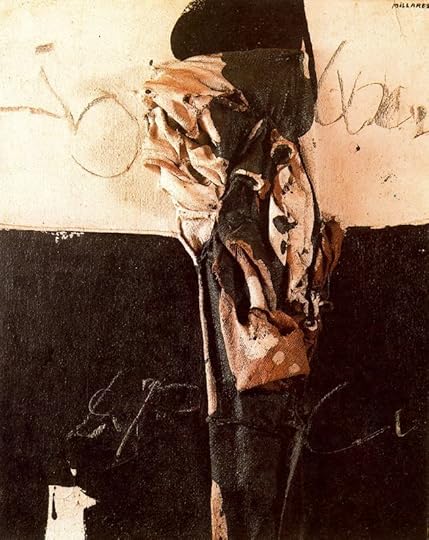
The same character also owns a work by Canarian-born artist, Manolo Millares, a collage made of burlap and sackcloth and twine and tar, with stains as of rust or old blood...it’s one of what he called his 'arpilleras', his cloths of memory.


Margaret Drabble's novel is like a collage made up of scraps of lives containing their quota of rust and old blood — and around them all is wrapped Fran's personal 'arpilleras', her own very distinctive cloths of memory.
Profile Image for LA.
488 reviews586 followers
April 9, 2017
By God, this lady is GOOD! Tag me as a middle aged fan girl of this wry, clever, and hugely talented 77 year old writer! Ive got to get my hands on her other works.

The Dark Flood ripples around a central character named Fran, a woman who travels around the country (England) inspecting, appraising, and innovating on care homes for the aging. She is the oldest of her colleagues, but has more energy than most of them and is a well respected speaker at the various conferences she attends. In her travels, Fran is a little bit like that kid in the movie The Sixth Sense. She sees old people.

The dark flood, of course, is the approach of death. Oddly enough, this story is not a dark one at all. We meet incredibly interesting people with great stories to tell, and not all all of them are elderly. Beyond the people that she intersects with through work, we meet her two best friends, her ex-husband upon whom she dotes, her adult children, and various mutual friends living in the Canary Islands.

There is a dark flood alluded to in the islands, and those are the refugees from the African continent. We also get a taste of life in the westerly marshes of England where the term flood is not metaphorical but real. Volcanic magma, ever causing shifts in the geologic plates below us, oozes its way into the story in a slow, imperceptible way as well.

This novel is a linkage of life stories from people who love one another. If we were to write about your life, it might be important for us to meet the love of your life or your child or your old college roommate with whom you have lost touch but now have recently found. Who is it that is important to you? When that flood reaches your door who is it that you will most remember?

Outstanding.
Profile Image for Hugh.
1,294 reviews49 followers
December 12, 2017
This is a complex tapestry that combines a thoughtful meditation on ageing, coping strategies and the effects of our ageing population on society with a family story and various floods both literal and metaphorical. There are no chapters or sections, but the focus shifts between the various protagonists in a way that is cleverly plotted and makes many intriguing connections, perhaps with slightly too many convenient coincidences.

At the start of the book we meet Fran, twice married and recently widowed, whose work takes her round the country inspecting care home developments and attending conferences. She cares for her largely bedridden ex-husband Claude, and the plot also revolves around their two children and her two contemporary female friends.

Fran's daughter lives in the flood-hit Somerset levels, and a large part of the story is set in Lanzarote, which conveniently allows Drabble to talk about two other kinds of flooding - the tide of immigration from west Africa to Europe and the threat of a volcanic eruption in the Canaries that is believed to be capable of creating a cataclysmic tsunami. There are also subplots on art and the Spanish Civil War and the nature of academic research.

The whole is reflective, moving, easy to read and very satisfying, if a little gloomy. Drabble is clearly still in fine form in her late 70s.
Profile Image for Cecily.
1,322 reviews5,343 followers
did-not-finish
November 10, 2019
Life is too short to read a bad book.” James Joyce
Perhaps this isn’t bad, but I vehemently disliked it and cast it aside after 50 pages (hence no rating).

What’s it about?

Her relentless broodings on ageing, death and the last things.

That’s a little unfair, but only a little. Fran Stubbs is “too old to die young” (late 60s or early 70s), an expert in and advocate for social housing and elderly care. She is “in love with England” and enjoys travelling for work, especially staying in Premier Inns. She also cooks for and supports her housebound first husband, Claude, the father of her children, Christopher and Poppet.

It’s told in easy, third-person, mostly present-tense prose. It flits between the points of view of different characters: Fran, her family, and some friends and colleagues. As well as concerns about ageing and mortality, it explores climate change and the migrant crisis. (Published in 2016, it was just too soon to include bloody Brexit.)

What I liked

The cover is gorgeous.


It led me to DH Lawrence’s poem, The Ship of Death which then reminded me of Ecclesiastes 3 1:8, and then The Byrds’ Turn, Turn, Turn (see below).

What I disliked

In some respects, I think it’s objectively bad, but in others, it’s just not to my taste right now. Drabble is esteemed and successful enough that a few harsh words from me won’t matter:

The writing is leaden, using simple words and short sentences, like an early reading book. It’s feels narrated by and for those with short attention spans, as it jumps around from thought to thought, like the description of a dementia patient, and, a few pages earlier, of Fran herself:
She’s not very good at concentrating on one subject at a time… Her mind wanders in an endless stream of consciousness.

The tone doesn’t really change for the different characters’ points of view, so they didn’t feel real and I couldn’t summon much interest in any of them.

Name-dropping authors and books is fair enough. Brands and products not so much. It can date a book too specifically (a new DVD player - in 2016?!), and feel clunky and pointless. Most egregious was the frequent mention of the details of Fran’s love of Premier Inns (a purple-themed low-to-middling UK hotel chain). Flicking through the pages after I gave up, I think it lessened, but it was still excessive and annoying.

There is something robust and cheering about the sight of the Premier Inn Full English Breakfast and those who are devouring it.


Image: Premier Inn breakfast (Source.)

I just hope Drabble is being sponsored for all the product placement - unlike the producers of the original The Italian Job, who had to buy the Minis!

I think it was meant to be somewhat funny/satirical, but it left me almost as cold in that respect as Atwood’s dreadful The Heart Goes Last (see my review HERE).

In the 50 pages I read properly, there were some jarring phrases, “the doctors had done her in” (wrong dialect for the character), “his long-term wife”, and some characters’ names were odd (Jo or Josephine couldn’t decide, and why does Fran use her first husband’s surname?). Had I been enjoying the book, I doubt I’d have minded - or even noticed.

Why did I read (some of) it?

I was beguiled by the beautiful cover, emblazoned with the name of an author I enjoyed in my 20s, but have rarely read since.

It was only £2 second-hand, so I didn’t pay much attention to the blurb. If I had, I might still have bought it, but I wouldn’t have read it just now: the theme and some of the locations are too freshly pertinent.

Quotes

• “Ageing… a fascinating journey into the unknown.”

• "She has often suspected that her last words to herself and in this world will prove to be 'You bloody old fool' or, perhaps, depending on the mood of the day or the time of the night, 'you fucking idiot.'"

• “One wouldn’t want to be responsible for the end, but one might like to be there and know it was all over, the whole bang stupid pointless unnecessarily painful experiment”

• “The dining area of the Premier Inn is geared to dispel elderly apprehensions, not to reinforce them. It is noisy and colourful and full of large busy middle-era middle England middle-aged people talking loudly and cheerfully and eating highly coloured meals, most of them from the hot red end of the spectrum.”

The Title

The frontispiece quotes a couple of lines of DH Lawrence’s poem, The Ship of Death. There, “the dark flood rises” relates to death, whereas early on in this novel, Fran refers to “the dark flood” (from an inadequate tampon!) as “the blood of life”, and later, it transpires that her environmentalist daughter lives in an area that frequently floods. Anyway, here are excerpts of the poem:

Now it is autumn and the falling fruit
and the long journey towards oblivion…

Build then the ship of death, for you must take
the longest journey, to oblivion.
And die the death, the long and painful death
that lies between the old self and the new...

Piecemeal the body dies, and the timid soul
has her footing washed away, as the dark flood rises.
We are dying, we are dying, we are all of us dying
and nothing will stay the death-flood rising within us
and soon it will rise on the world, on the outside world.
We are dying, we are dying, piecemeal our bodies are dying
and our strength leaves us,
and our soul cowers naked in the dark rain over the flood,
cowering in the last branches of the tree of our life...

Ah peace, ah lovely peace, most lovely lapsing
of this my soul into the plasm of peace.
Oh lovely last, last lapse of death, into pure oblivion
at the end of the longest journey
peace, complete peace!
But can it be that also it is procreation?
Oh build your ship of death
oh build it!
Oh, nothing matters but the longest journey.
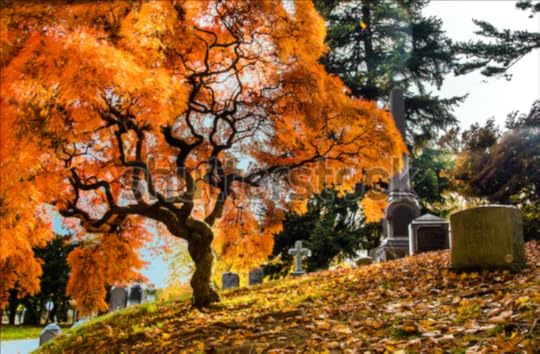


Image: Autumnal graveyard in Brooklyn (Source.)

That reminded of comforting words I heard so often in church as a child and teen, Ecclesiastes 3 1:8:

To every thing there is a season, and a time to every purpose under the heaven:
A time to be born, and a time to die; a time to plant, and a time to pluck up that which is planted;
A time to kill, and a time to heal; a time to break down, and a time to build up;
A time to weep, and a time to laugh; a time to mourn, and a time to dance;
A time to cast away stones, and a time to gather stones together; a time to embrace, and a time to refrain from embracing;
A time to get, and a time to lose; a time to keep, and a time to cast away;
A time to rend, and a time to sew; a time to keep silence, and a time to speak;
A time to love, and a time to hate; a time of war, and a time of peace.


And those verses were made famous in the year of my birth (when Fran would have been early 20s) set to music as Turn, Turn, Turn, sung by The Byrds. Hear it HERE.
Profile Image for Phrynne.
4,035 reviews2,728 followers
March 18, 2017
It has been years since I read a book by Margaret Drabble and I am not sure why I stopped because she writes so beautifully. The Dark Flood Rises is a book about death and dying which seems a little macabre but in the hands of this author it becomes mostly just a gentle trip down memory lane.
Drabble is a very well educated woman and her literary knowledge is everywhere in this story and I like that! I usually find my vocabulary holds up to most books but I had to look up a couple of words in this one and I intend to seek out some of the poems she quotes as well. She also has a lovely dry wit which helps transcend the rather dark topic of death.
This is not an exciting book rather it is a discussion about the normal patterns of life and death. Very, very readable and I enjoyed it very much.
Profile Image for Heidi Wiechert.
1,399 reviews1,525 followers
April 26, 2018
Half a dozen characters live lives focused on death, aging or managing the same. The Dark Flood Rises is an unflinching examination of end-of-life issues.

This book has very little action but plenty of details for book clubs to unpack, if you can get through it. I was only one of three, in a club of a dozen or so members, who managed to finish the read.

Readers may only want to tackle this one if they have plenty of patience and interest in complex allusions to art, history and literature.

The leader of my group, who likes to research every little thing related to the book club picks, found much to enjoy in The Dark Flood Rises. I, like the majority, didn't really care for it.

It's funny, book club leaders picked this read because they thought it had something to do with an actual flood.

The title is actually a poetic way to describe death. Don't be fooled :) like we were.
Profile Image for Hanneke.
395 reviews488 followers
August 25, 2017
How could I have forgotten Margaret Drabble? I have not read her for a long time, which is remarkable because she was one of my favorite authors decades ago. I used to read all her novels immediately upon publication and the older ones collected in a great pile. I now read her last one, The Dark Flood Rises, because I saw it beckoning me and thought I should read her again. I was not prepared for the fact that the novel would shake me to the core, but then I remembered she did that quite a lot with her previous novels. Although it is about old age, illness and death, it is not morose. It just relayed to me how Drabble feels now she is getting older. The novel portrays a group of families and friends who all deal with old age in quite different ways. The novel is comforting and sad in various degrees. Excellently written, erudite, moving and funny. I loved it, although it made me gloomy now and then which, I am sure, was not Drabble’s intention.
Profile Image for Jenny (Reading Envy).
3,876 reviews3,712 followers
did-not-finish
May 9, 2017
Why I did not finish: I only gave it 50 pages but those 50 were a struggle. There are no chapters so I felt trapped by the narrator, picture Maggie Smith looking at you sternly every time you try to leave. I tried to be polite and to stay but I slipped under the table and ran out the back door.

The narrator, Fran, is an older woman with a cold inner dialogue. I didn't enjoy her perspective and felt judged, as did everyone else in her life, I imagine. While her character is not one more of the dottering old people so popular in literature these days (to my great chagrin), I still felt the author was using a character like this either to say what she wanted to about society without having any consequences, or to simply have a character who does so without the typical social consequences. What consequences could there be, for she is old and nobody expects her to change. Etc.

I wonder if all of this author's books would feel this way to me or if this is a unique experience. Would you recommend any others?

(And dear Thomas-from-the-Readers, sorry... I tried this because I had you on my podcast and you had it to talk about and we veered off into talking about the author herself and never came back. I was planning to redeem that with a shimmering review but whoops. I know you like/love this author, and am happy to say this might be another reader's positive reading experience, but it was not for me.)
Profile Image for Paul Fulcher.
Author 2 books1,961 followers
October 15, 2020
"Untimely death is intermittently on Fran's mind, alongside housing for the refusing-to-die elderly and her more-or-less bedridden ex-husband's dinners."

Margaret Drabble's new novel, her 20th, takes as its subject, ageing, particularly the practicalities of old-age living, and death, with Simone de Beauvoir's La Vieillesse (The Coming of Age) a key touch point.

The main character, Francesca Stubbs, works for a housing charity, and drives herself (at times a tad recklessly) around the country visiting and writing reports on sheltered housing developments, and, despite her highly cultured background, most enjoying drinking cheap wine in Premier Inns while watching regional TV.

The novel's opening, setting up Fran's character, provides a good taster for the mixture of dry humour, pathos and erudition that characterises the novel:

She has often suspected that her last words to herself and in this world will prove to be "You bloody old fool' or, perhaps, depending on the mood of the day or the time of the night, 'you fucking idiot'. As the speeding car hits the tree, or the unserviced boiler explodes, or the smoke and flames fill the hallway, or the grip on the high guttering gives way, those will be her last words. She isn't to know for sure that it will be so, but she suspects it. In her latter years, she's becomes deeply interested in the phrase 'Call no man happy until he is dead'. Or no woman, come to that. 'Call no woman happy until she is dead.' Fair enough, and the ancient world had known woman as well as men who had met unfortunate ends: Clytemnestra, Dido, Hecuba, Antigone. Though of course Antigone, one must remember, had rejoiced to die young, and in a good (if to us pointless) cause, thereby avoiding all the inconveniences of old age.

Fran herself is already too old to die young, and too old to avoid bunions and arthritis, moles and blebs, weakening wrists, incipient but not yet treatable cataracts and encroaching weariness. She can see that in time (and perhaps not in a very long time) all these annoyances will become so annoying that she will be willing to embark on one of those acts of reckless folly that will bring the whole thing to a rapid, perhaps a sensational ending. But would the rapid ending cancel out and negate the intermittent happiness of the earlier years, the long struggle to some kind of maturity, the modest successes, the hard work? What would the balance sheet look like, at the last reckoning?

It was the obituaries of Stella Hartleap that set her thoughts in this actuarial direction, as she drove along the M1 toward Birmingham, at only three or four miles above the speed limit.

The print obituaries had been annoying, piously annoying in a sexist, ageist, hypocritical, mealy-mouthed manner, reeking of Schadenfreude [...] So Stella had died of smoke inhalation, having set her bedclothes on fire while smoking in bed on her remote farmstead in the Black Mountains, and having just polished off a tumbler of Famous Grouse. So what? A better exit than dying in a hospital corridor in a wheelchair while waiting for another dose of poisonous chemotherapy, which had recently been her good friend Birgit's dismal fate. At least Stella had nobody to blame but herself, and although the last minutes couldn't have been pleasant, neither had Birgit's. Not at all pleasant, by all accounts, and without any complimentary frisson of autonomy.


Although Fran is at the novel's centre, Drabble introduces us to a range of memorably drawn characters. Drabble's third person narrator flits in and out of their minds, and rather oddly with varying degrees of omniscience, so that while seeing things entirely from a certain character's perspective we are suddenly told we can probe no further in one particular topic ("We don't know what happened to Poppet in that most important and disastrous relationship. Maybe one day she will tell us.", "We don't want to be privy to Ivor's thoughts about this omen."). Perhaps this is Drabble's way to modernise what is otherwise a rather dated approach to narration - the selectively-omniscient narrator.

These characters also have the disadvantage of all rather sounding alike in the tone if not the content of their thoughts, so that one sees Drabble speaking through each of them. In part this reflects that they are are all drawn from a rather narrow social set of affluent upper-middle class and mostly students of the humanities. [At one point Fran's husband reflects on his relief that his children had proper occupations, an environmental activist and a TV producer of art programs, and hadn't become bankers, politician, cosmetic surgeons, property developers or comedians, causing me to reflect that I would wish exactly the opposite for my own.]

There is an even wider, and at times slightly bewildering, cast of background characters and artistic references where Drabble freely mixes the real-world (e.g. the great José Saramago who ended his days on Lanzarote), the fictional (both an activist for the Western Sahara independence movement and the novelist Alice Studdert Meades, studied by one of Fran's friends as a leading exponent in the genre of Deceased Wife's Sister novels, are drawn in such detail I initially assumed they must really exist) and characters from her own past novels (Maroussia Darling from her last novel The Pure Gold Baby makes another cameo appearance). I found myself googling many a reference - often simply to find out whether an artist or historical figure was a product of Drabble's erudition or of her imagination, both of which are prodigious.

Interesting also to see a reference to Pauline Boty, who plays a key role in Ali Smith's Autumn, and indeed thoughts of Autumn link in with the novel's title taken from a line in DH Lawrence's poem The Ship of Death, which starts "Now it is autumn and the falling fruit and the long journey towards oblivion."
Piecemeal the body dies, and the timid soul has her footing washed away, as the dark flood rises.
In Drabble's novel she extends the range of her concerns to include more apocalyptic Dark Floods, including the flood of refugees from North Africa, at that time, seeking land in Lanzarote where much of the novel is set, global warming and the floods in rural England, and also the mega-tsuanami that might, indeed will, one day be caused by the eruption of Cumbre Vieja in the Canary Island (albeit scientists have more recently debunked that theory).

But Drabble's main focus is on longevity and ageing as a problem for society. As an actuary myself I was pleased to see actuarial references:

"Fran found this statistic, true or false, intimidating. Longevity has fucked-up out pensions, our work-life balance, out health service, our housing, our happiness. It’s fucked-up old age itself.
...
The shape of the bell curve is a disaster. It’s a dystopian science fiction scenario, a disaster movie."


However, a by-product of Drabble's focus on one particular social set is that her desire to speak to the difficulties of old-age living is focused on a rather narrow, and actually extremely advantaged, cohort. There is very little in this novel for those whose meagre pensions have been exhausted, who cannot afford expensive care homes and companions, and who rely on State provision.

Overall, very far from a page turner, but a thought-provoking novel, both on the topic matter itself and via the wide range of cultural references.
Profile Image for Ron Charles.
1,166 reviews50.9k followers
February 14, 2017
Margaret Drabble has written a novel about aging and death, which for American readers should make it as popular as a colostomy bag. That’s a pity because Drabble, 77, is as clear-eyed and witty a guide to the undiscovered country as you’ll find.

The ominous title of her new book, “The Dark Flood Rises ,” comes from a poem by D.H. Lawrence that you mustn’t post on the community bulletin board at Grandma’s retirement home. Among its menacing stanzas is this bit of advice:

Have you built your ship of death, O have you?

O build your ship of death, for you will need it.


Drabble’s feisty heroine, Francesca Stubbs, knows that ship is on its way, but she has no intention of waiting at the pier for its arrival. And don’t think “heroine” is too lofty a honorific for Fran. “Old age itself is a theme for heroism,” she insists. “It calls upon courage.” Newly single — again — and in her 70s, Fran has developed a survival plan that depends on. . . .

To read the rest of this review, go to The Washington Post:
https://www.washingtonpost.com/entert...
Profile Image for Marc Lamot.
3,466 reviews1,984 followers
October 10, 2019
The end is nigh, but she'll keep trying. It's not too late "
Perhaps you'd better not read this if you are approaching the age of 60, 70 or 80. And maybe you should not read this if you are younger. Because the dark sides of aging and approaching death are omnipresent in this book. Margaret Drabble was 76 when she wrote this. She has woven a whole network of characters around the 70 year old Fran Stubbs, both in the United Kingdom and on the Canary Islands, because those islands apparently have become the Florida of the older Brit.

Protagonist Fran is an interesting figure: she is a very active senior, one who continues to tour through the UK as a prospector of housing facilities for older people. So both professionally as personally she constantly muses about the physical and mental decline of people and the different ways in which her peers deal with it. “Inspection of evolving models or residential care and care homes for the elderly have made aware of the infinitely clever and complex and inhumane delays and devices we create to avoid and deny death, to avoid fulfilling our destiny and arriving at our destination. And the result, in so many cases, has been that we arrive in good spirits, as we say our last farewells and greet the afterlife, but senseless, incontinent, demented, medicated into amnesia, aphasia, indignity. Old fools, who didn't have the courage to have that last whiskey and set their bed on fire with a last cigarette.” Beware: this book is not really drenched in gloom; the tone regularly is very light-hearted, even ironic-sarcastic.

Drabble does not deliver a story with a plot: she jumps back and forth between the characters, lets them experience all kinds of rather unpleasant things, and makes them constantly worry about more or less the same concerns. The characters throughout the novel sometimes literally formulate the same reflections over and over again, as if Drabble wanted to give us a realistic view of the repetitive in older life. It is only at the very end that a few, rather tragic developments follow shortly after each other. Also stylistically Drabble offers a lot of variation with sometimes nice dialogues, some long descriptive passages, a few action scenes, a lot of musings full of worries, and occasional passages in which the author addresses the reader directly. And then there is of course the geographical jumping back and forth between the UK and the Canary Islands, with even a short digression to the Western Sahara.

That’s the great downside of this novel: it’s too wide-ranging and lacks some editing; Drabble constantly introduces new characters, gives extensive tourist and historical information on places in the UK and on the Canary Islands, and she also repeatedly refers to very current issues such as global warming and the refugee crisis. In my opinion, with that very diverse cocktail she drowns her central theme. I also noticed that all her characters have a background in the academic, artistic and literary world; that naturally limits the scope of this novel a lot.

Yet the character of Fran, with her many contradictory feelings, really appeals: she still lives as if she was 20 years younger (she drives recklessly with her car, and intentionally moves into a residential tower in a marginal neighbourhood), but at the same time she increasingly has fits of desperation ("let there be light, oh Lord, let there be light"). Throughout the novel, the reality of inexorably aging confronts her with the facts of reality, but she continues to fight against it. “She's got to keep going. There is nothing else to do. You keep going until you can go any further. And you can't count on the perfect death, at the end of the run.” And she hopes to put down a great final show: “Maybe, at the end, what we need most, in order to make a good exit, is applause. Applause, in a showy part. Going out bravely”. All this makes Fran into a very humane, but tragic character.

In short, even though this novel drowns in just a little too many storylines and elaborations, it still contains quite a lot of valuable stuff to consider on aging and approaching death. So maybe it IS good that you read this when you’re near 60, 70 or 80, or maybe even before. And try to cope with it.
(rating 2.5 stars)
Profile Image for Rebecca.
4,190 reviews3,450 followers
January 4, 2017
(3.5) The “dark flood” is D.H. Lawrence’s metaphor for death, and here it corresponds to busy seventy-something Fran’s obsession with last words, obituaries and the search for the good death as many of her friends and acquaintances succumb – but also to literal flooding in the west of England and (dubious, this) to mass immigration of Asians and Africans into Europe. This is my favorite of the five Drabble books that I’ve read – it’s closest in style and tone to her sister A.S. Byatt as well as to Tessa Hadley, and the themes of old age and life’s randomness are strong – even though there seem to be too many characters and the Canary Islands subplot mostly feels like an unnecessary distraction.
Profile Image for Julie.
561 reviews310 followers
Read
November 16, 2019
8.5/10

It doth appear that Margaret Drabble and I share a common trait or idiosyncrasy ... Name names, name as many as you can, don't worry that it might suggest a burgeoning OCD in one's personality.

As her dark flood rises, Fran reflects on her life; on the lives of those near and dear to her, and somehow manages to evoke the entire pantheon of those greats in mythology, music, literature, the arts ... and beyond. Naming names: at the drop of a hat, Fran can flick you a moniker as easily as Nancy Drew can unravel a clue, and maybe even faster, all the while giving you context, substance, relevance.

I ended up getting lost in the bodies Drabble left behind: amazed that for each one she named, she made a relevant point; and it wasn't, in the end, just to drop the name, but to actually pick up a thread and weave it into the fabric of the story, so seamlessly, one didn't know what was being spun into gold, until one stood back ten metres from the tapestry, and gazed in awe ....

What an encyclopedic, enthralling, exhaustive (and exhausting) intellect she possesses.

Admittedly, at first, I was a bit annoyed at what seemed pointless name dropping. Then, contrary to my usual state of late -- of discarding everything that doesn't make immediate sense -- I persevered. Surely, such a mind as this doesn't drop a stitch without picking up the needle, ...

Metaphor is built on metaphor, as each flood rises, in different seasons, for different people, not the least of which is Fran's own dark flood which will soon erode her.

I was taken, mesmerized, captivated.

I'm still mulling this one over, so can't give her a full 10 stars until I know why.

But out of sheer curiosity, and obtuseness, and my own little OCD, I recorded the names that she mentions at least once ... Don't ask me why. It seemed important at the time. I think, though, that I didn't manage to get them all, as I finally threw in the towel on naming names, about 3/4 through the book. The ellipses speak for themselves ...

Clytemnestra, Dido, Hecuba, Antigone, Calypso, Odysseus, ...

Arts

Maria Callas, Leonard Cohen, Brahms, Rimsky-Korsakov, Mahler, Chopin, Berlioz, Gounod, Bernstein, Alan Titchmarsh, John Suchet, Barenboim, Mehuhin, Nigel Kennedy, Pablo Picasso, Cesar Manrique, Omar Sharif, Francis Bacon, David Hockney, William Tyler, Joe Tilson, Francisco Goya, Antoni Tapies, Edgar Degas, Piet Mondrian, Vincent Van Gogh, Augustus John, Rembrandt, Beethoven, Paul Klee, Gordon Craig, Giorgio di Chirico, Manolo Millares, Jacopo da Pontorma, Mozart, ...

Letters

Walter Raleigh, Harriet Martineau, Pliny, Aeschylus, Shakespeare, Jane Grigson, Samuel Beckett, W. B. Yeats, Federico Garcia Lorca, Miguel de Unamuno, P.C. Wren, A. E. Housman, Stephen Spender, Hugh Kingsmill, Edward Gibbon, William Wordsworth, Iris Murdoch, Simone de Beauvoir, Robert Blair, Joseph Conrad, Thomas Hardy, T. F. Powys, John Cowper Powys, F. R. Leavis, Elizabeth Taylor, Barabara Pym, Geoge Eliot, Matthew Arnold, D. H. Lawrence, V. S. Naipaul, Doris Lessing, Charles Baudelaire, Arthur Rimbaud, Ernest Hemingway, Lewis Carroll, E.M. Forster, Dadie Rylands, Anne Barton, Gerard Manley Hopkins, Yves Bonnefoy, Dylan Thomas, Peter Redgrove, Robert Nye, George Orwell, Tom Wintringham, Esmond Romilly, Julian Bell, John Cornford, Jessica Mitford, Jules Verne, Plutarch, Edward Said, Theodor Adorno, Michel de Montaigne, Leo Tolstoy, Anton Chekhov, ...

And then some ...

Georges Danton, Francisco Franco, Louis Hubert Gonzalve Lyautey, Charles de Gaulle, Quintus Sertorius, Gaius Marius, Lucius Cornelius Cinna, Lucius Cornelius Sulla, Thor Heyerdahl, Christopher Columbus, Wilhelm and Alexander von Humboldt, Sabin Berthelot, ...
Profile Image for Elaine.
964 reviews487 followers
June 3, 2017
Long overdue for a review on this. Will be brief rather than let it go unreviewed. Margaret Drabble is the best. Wait, was that not enough? Ok, this meditation on aging and mortality (our own, our climate's, our mores', those of yesteryear) is exquisitely written and bitingly heartwrenchingly perceptive. This book spoke to me, on the cusp of 50, with the same immediacy and power as did Drabble's Gates of Ivory trilogy when she, and I, were both a few decades younger. Be forewarned- this book has literally no plot. It is about character, and feeling, and setting, and rumination. But see if you are not dying to visit the Canary Islands when you finish - I'll meet you there.
Profile Image for João Barradas.
275 reviews31 followers
June 11, 2019
“À barca, à barca”… subam essa âncora porque a viagem está próxima! Imbuído por um espírito de Gil Vicente, relembrando uma malfadada Barca do Inferno, pergunto-me se será esta a exclamação proferida por alguém quando se depara com os momentos finais de uma existência sofrida.

O tema da morte é transversal a várias formas de arte – quer pelo tabu ainda incrustado em nós, quer pelo facto de ser comum a todos os seres. E como é a viagem até esses reinos de Hades?
O envelhecimento é tido como um tempo de esquecimento, em que paradoxalmente as memórias são lembradas de uma forma bastante vincada. Na luta constante contra estas antíteses de vida, tão difíceis de compreender para o próprio e para os que o rodeiam, implanta-se uma vontade ígnea de adiar a todo o custo que a linha de meta seja vislumbrada. Nasce assim um querer constante de fulminar um embotamento perene e atrasar a hora de vigília pelo eterno descanso, entrando-se numa espiral de uma vida de peregrinação, sem um altar de adoração definido.

Fran sempre viveu em função dos outros, num deambular permanente sem fim atingível. Compromete-se a visitar vários locais para fundar possíveis casas do “Eterno Descanso até ao descanso final”. Nessas deambulações - fugindo da morte mas enredada nela -, são apresentadas vidas perdidas no passado à espera de redenção; vidas enredadas no enfermiço manto da depressão; vidas entregues à fé, ao álcool e à comida; vidas em busca de objectivos, absolvições e artes – pinturas, esculturas e literatura, nomeadamente com Samuel Beckett e Simone de Beauvoir.
Confusos!? Também eu fiquei, por vezes, confuso enquanto degustava a leitura, pela frequente fuga de ideias, alinhavada com retalhos de episódios de diferentes vidas aparentemente desconexas (quiçá aquela com que mais empatizei terá sido Claude, por algum defeito profissional), envolvidas por descrições desconcertantes, plenas de vírgulas, escassas em pontos finais.

Num humor tipicamente inglês, são relatados pensamentos que passam pela mente de todos mas raramente são emitidos em voz alta, sorrindo interiormente da desgraça alheia. Mantendo o fito no avistamento de um legado, trata-se uma batalha contra possíveis maremotos - negros ou de outras cores... a paleta é opção de cada um!

"A sua vida foi cheia de fracasso, de derrota e de trivialidade, de pequenas preocupações, e por vezes teme que esteja a terminar tristemente. Começa a faltar-lhe a coragem, começa a faltar-lhe a energia. Viveu por procuração, nas pequenas preocupações dos outros. Os temas mais amplos estão a abandoná-la." (pág. 350)
Profile Image for Anni.
558 reviews92 followers
March 19, 2018
The title refers to encroaching old age and death but could also be seen as a more ominous warning about the ending of western civilisation - or am I reading too much into it? In any case, it is not a depressing read and Drabble writes like a dream. For a much more in-depth review and analysis, I refer you to my good friends of this parrish: Fionnuala and Paromjit.
Profile Image for Gumble's Yard - Golden Reviewer.
2,204 reviews1,797 followers
July 19, 2017
Francesca Stubbs is on her way to a conference on sheltered housing for the elderly, a subject pertinent to her train of thought …. Fran is something of an expert in the field, and is employed by a charitable trust which devotes generous research funds to examining and improving the living arrangements of the elderly


Francesca is the central character of this novel which is very explicitly about ageing, in the first page we learn that:

Fran herself is already too old to die young, and too old to avoid bunions and arthritis, moles and blebs, weakening wrists, incipient but not yet treatable cataracts, and encroaching weariness. She can see that in time (and perhaps in not a very long time) all these annoyances will become so annoying that she will be willing to embark on .. [an] act of reckless folly that will bring the whole thing to a rapid perhaps a sensational ending. But would the rapid ending cancel out and negate the intermittent happiness of the earlier years, the long struggle towards some kind of maturity, the modest success, the hard work? What would the balance sheet look like, at the last reckoning.


Later she reflects in a passage which encapsulates one of the book’s key messages:

She cannot help but see her lifespan as a journey, indeed as a pilgrimage. This isn’t fashionable these days, but it’s her way of seeing. A life has a destination, an ending, a last saying. She is perplexed and exercised by the way that now, in the twenty-first century, we seem to be inventing innumerable ways of postponing the sense of arrival, the sense of arriving at a proper ending. Her inspections of evolving models of residential care and care homes for the elderly have made her aware of the infinitely clever and complex and inhumane delays and devices we create to avoid and deny death, to avoid fulfilling our destiny and arrive at our destination. And the result, in some many cases, has been that we arrive there not in good spirits, as we say our last farewells and greet the afterlife, but senseless, incontinent, demented, medicated into amnesia, aphasia, indignity.


The various characters in the book are all connected in some way via Francesca – and include her first husband Claude (now largely bedridden, but still leching after his care assistant and who somehow Fran now cooks for regularly), two old friends of hers (one dying from Meso, the other living in sheltered accommodation in Cambridge), her son Christopher (whose documentary making girlfriend died unexpectedly when preparing to film African refugees landing in the Canary Islands), an ageing art historian Bennett and his companion Ivor living in Lanzarote in a beautiful house carved from volcanic rock but in which they are largely trapped by the collapse in Spanish house prices, her environmentalist daughter Poppet (who has not recovered from some romantic trauma in her early twenties).

All are grappling in one way or another (in many cases professionally as well as personally) with mortality and ageing. However all of them are also well off, and from a humanities/academic background and this was for me by far the weakest part of the book in a number of senses.

- Firstly for the narrowness of the characters featured – I far preferred the early scenes when Fran is attending her conference, staying in a Premier Inn and mixing with her fellow delegates who are from more varied backgrounds.
- Secondly there were various passages around literary or art history (sometimes real history and sometimes artists or novelists Drabble has invented) which I simply found myself skipping
- Thirdly the book concentrates too much on people ageing in relative luxury and plenty and so fails to capture the different and more common issues of those struggling not just mentally and physically but also financially and practically in their old age.

I felt these issues were epitomised in a late scene where Fran and Christopher muse on ageing over a meal of bisque and Dover Sole in an expensive fish restaurant and Fran tells of a woman in a Hospice
who kept crying out that she could see a black man’s face in her bathroom mirror, and could only be cured of this illusion when told … that it was a Jungian archetype. An Oxford academic by trade she had been satisfied by this explanation


Drabble has fun playing with the concept of a semi–omniescent narrator, privy to Fran’s thoughts but only partly aware of those of others. For example

As we have said it is not a good idea to look too closely at Ivor. He wouldn’t like it, and we do not have the right to get close to him. We have no permitted access to the inwardness of him

We don’t know what happened to Poppet in that most important and most disastorous relationship. Maybe one day she will tell us.


Another aspect which works well is when we follow each character after some interaction and get some insight into (often mild) misunderstandings that have arisen between them.

The book’s title is taken from a line in DH Lawrence’s “The Ship of Death” which line forms an epigraph to the book “Piecemeal the body dies, and the timid soul has her footing washed away, as the dark flood rises” but the flood theme is a persistent one in the narrative: the Cumbre Vieja catastrophe scenario (of a landslide causing tsumani’s to destroy the East Coast of the US); the UK flooding; the flood of African immigrants into the Canary Islands (ahead of the later flood of refugees from Syria).

The Canary Islands are another key theme of the book: the exile to the Islands of those who had offended the Spanish authorities (and in later years the voluntary exile of José Saramago who features as a friend of Bennett and whose The Stone Raft which features the Iberian peninsular floating away from Europe, is read by some of the characters); the early history of the Islands inhabitants, including (before the Spanish arrived) there complete lack of any ability to either sail or swim; its art and culture (or largely lack thereof); the volcanic landscape of Lanzarote; Churchill’s plans to use the Islands as a base if the German’s captured Gibraltar.

One of the fascinating aspects for me was the link with a number of other recently published books.

- Fran mentions a Leonard Cohen DVD on The Tibetan Book of the Dead (and Drabble herself thanks in the acknowlegements the person who introduced it to her, clearly implying it was an important part of her inspiration for the book) and explicitly mentions the Way of the Bardo which of course is very explicitly the inspiration for Lincoln in the Bardo

- Pauline Boty is referenced in the book – Boty is of course a key character in Autumna book whose two main characters are an arts lecturer and a elderly man dying in a care home

- The desolate landscape and brilliant sunshine of Lanzarote, the visits to a hospital there and the Bennett/Ivor dependency relationship reminded me of Hot Milk

Overall a fascinating book, one which was not always engrossing to read but which will stay with me for a long time.

I was somewhere between 3* and 4* but any book which on only the second page says "that set her thoughts in this actuarial direction" deserves the fourth star.
Profile Image for Katya.
485 reviews
Read
September 10, 2023
(...)Fran tem já idade bastante para não morrer nova e demasiados anos para escapar aos joanetes e à artrite, aos sinais e às bolhas, ao adelgaçar dos pulsos, às cataratas incipientes mas ainda não tratáveis, ao desgaste instalado. Sabe que, com o tempo (e talvez não falte muito tempo), todos estes incómodos se tornarão tão incomodativos que ela vai embarcar num desses atos de loucura imprudente que leve tudo a um fim rápido, talvez sensacional. Mas poderá o fim rápido eliminar e negar a felicidade intermitente dos anos anteriores, a prolongada luta por uma certa maturidade, os sucessos modestos, o trabalho árduo? Como seria a folha de balanço na última verificação?

Apesar de Margaret Drabble se ver como uma escritora que escreve para pessoas mais velhas (como ela própria), e de ter aqui criado uma personagem principal (e, na verdade, quase todas as restantes) que, uma vez mais, como ela própria, dista de mim em idade cerca de 40 anos - uma vida! -, nem mesmo assim, creio poder dizer, me escapou o encanto da longa reflexão que Sobe a Maré Negra representa no mundo das letras europeias contemporâneas.
Escrito de forma ambiciosa, erudita, obriga a uma leitura em várias camadas que integram elementos simbólicos e apocalípticos como o são a ideia de "maré negra" que ao longo do livro se pode traduzir como a ideia de morte; da perigosidade das alterações climáticas; dos desastres naturais e dos êxodos humanos...

(...)pensa muitas vezes que seria divertido assistir ao fim, sem culpas associadas. Ninguém quer ser responsável pelo fim, mas poder-se-ia gostar de estar lá, de saber como acaba tudo, toda a experiência estúpida, inútil, desnecessariamente dolorosa do bang. Um asteróide serviria, ou um terramoto, ou qualquer outro ato imparcial, não humano, violento, da terra ou do universo. Fran não compreende o desejo da raça humana de perpetuar-se, de continuar a viver a todo o custo. Nunca foi capaz de compreender.

Mas Sobe a Maré Negra também inicia um debate menos filosófico e mais prático - o do envelhecimento como problemática social:

Há quem pense que as nossas emoções encolhem à medida que envelhecemos, que ficamos reduzidos ao osso, à pedra de siba do egoísmo. É uma teoria da velhice geralmente aceite.

...como estereótipo...

Liga a televisão e espera pacientemente que ela decida fazer alguma coisa, devia haver o noticiário das seis, se o televisor tivesse a bondade de a deixar vê-lo. Sente-se um pouco incomodada por entrar na categoria das mulheres-sem-jeito-para-o-dinheiro, mulheres-sem-jeito-para-a-tecnologia, mas só um pouco. Mas essa merda, como diria Fran, importa para alguma coisa? Jo já está em diversas categorias nada honrosas, sendo a pior delas ser idosa, e mais uma ou duas não fará diferença.

.... como fenómeno de diferenciação de género...

As mulheres vivem demasiado tempo (...). Precisamos de um plano para nos vermos livres de nós. Uma pastilha mágica.

...ou como experiência limítrofe individual:

Por vezes Fran aplica-se a tentar recordar as emoções apaixonadas e ridículas da sua juventude e meia-idade, a despesa do espírito num desperdício de vergonha. Ou num desperdício de embaraço, ou de inveja, ou de ansiedade, ou de vaidade ferida. A tentativa de fazer batota na corrida de sacos, a mancha vermelha de sangue na parte de trás da saia, o traque no pódio, a confusão com a nota de dez libras, a chegada ao aeroporto demasiado cedo, o erro no visto, a mesa onde não havia lugar com o nome dela, a observação ouvida sobre o inadequado casaco de malha, o esquecimento imperdoável de um nome significativo. Não se preocupa com algumas das coisas com que se preocupava antes (não precisa de se preocupar com manchas de sangue na saia, embora se preocupe agora com nódoas de sopa no seu casaco de malha, gema de ovo na lapela do roupão), mas o certo é que não atingiu nada de semelhante à paz de espírito.

Num intricado desenrolar onde nenhuma personagem se perde, se esgota ou se nomeia em vão, Drabble expõe opiniões fortes e politicamente incorretas, e aponta diretamente ao tabu:

A velhice guina para o impróprio.

Sem enredo, são as personagens quem carrega a história e a faz fluir de forma humana, honesta, sem fogo de artifício:

Foram dois meses muito longos. Ela era muito mais nova, há dois meses. Pisou com firmeza um patamar durante anos, dos sessentas aos setentas, mas agora desceu de repente um degrau. Foi o que aconteceu. Fran sabe tudo sobre o assunto. Foi muitas vezes avisada acerca deste degrau descendente, desta prateleira de baixo. Não é um rochedo da queda, é a descida para um novo tipo de patamar, para um nível inferior. Tem-se a esperança de ficar ali mais uns quantos anos, mas pode não se ter essa sorte.
Nas décadas do meio, está-se numa montanha russa. Sobe e desce, por vezes sem aviso prévio. Aos setenta, já não é bem assim.


De certa forma, este é um daqueles raros livros que são autênticos indutores de tanatofobia - não porque fala na morte, mas porque fala na vida, fala no caminho percorrido e a percorrer, aquele caminho, ao contrário da última paragem, que nos foge completamente do controlo, deixando-nos sujeitos ao jugo, à ironia e ao capricho de um destino com um sentido de humor questionável face ao qual nos salvaguardamos guinando o foco de fora para dentro:

À medida que envelhecemos, sim, é verdade, é verdade, tornamo-nos cada vez mais egoístas. Vivemos para os nossos apetites. Ou então esta é uma maneira de encarar o envelhecimento. Os velhos são muito egoístas, muito gulosos.

Para ajudar na tarefa hercúlea que é refletir as últimas etapas de vida sem ceder ao macabro, Drabble cita Beckett, Beauvoir, Callas, Yeats (e umas vintenas de outros nomes que aqui ocupariam várias linhas) com cuja obra, vida e filosofias traça paralelos brilhantes:

É melhor levantar-me, diz Fran, alto, para si própria. Mas não se mexe. Sente que o bocado do cérebro que instrui o corpo para que se mexa não está a funcionar como deve. Tenta levantá-la, mas não consegue. Agita-se para passar à ação e pára de novo. Fran não está tão presa como Winnie no seu monte de areia, mas quase. Tens de creditar isso ao Beckett, é uma imagem boa como tudo, uma metáfora do camandro, aquele monte de areia.

Sob a Maré Negra não é um livro cujas páginas voam, mas um que se saboreia e reflete, que se amadurece e se degusta - um livro daqueles que normalmente se recomendam a velhos e que eu recomendo a novos: um livro delicioso sobre a coragem de viver em plena consciência de que cada minuto é precioso e sempre insuficiente, e que, embora o final seja o que tiver de ser, o dia de hoje é uma uma outra etapa de uma maratona que devemos correr, com mentalidade de vencedores, para alhures:

Tem de continuar. Não há outra coisa a fazer. Continua-se a andar até já não se poder mais. E não se pode contar com a morte perfeita no fim do caminho.

(...)

Talvez, no fim, aquilo de que mais precisamos para fazer uma boa saída de cena sejam os aplausos. Aplausos num papel espetacular. Sair com valentia.
Profile Image for Gill.
330 reviews128 followers
October 27, 2016

'The Dark Flood Rises' by Margaret Drabble

4 stars/ 8 out of 10

Margaret Drabble's novels formed the backdrop to my teen and university years, then to my adult family life, and, in her latest novel 'The Dark Flood Rises', she approaches issues relating to ageing.

The book consists of the interlocking histories of several characters (many of whom are elderly) and some of their friends and relatives. As the book progresses, Drabble subtly reveals more and more information about each character.

Fortuitously, several of the locations where this novel takes place are ones that I know. This added an additional layer of interest for me. There were a lot of current and 'historical' references and comments that I enjoyed, though I wonder whether younger readers may find them less pertinent.

One of the aspects of Drabble's writing style in this book, is the use of the omniscient narrator. This is not very fashionable nowadays, but it is put to good use by her and adds greatly to the story.

There were times whilst reading this that I laughed out loud; there were also many poignant and thought provoking moments. It was definitely a 'Good Read'.

Thank you to Canongate Books and to NetGalley for an ARC.
Profile Image for Leah.
1,733 reviews290 followers
December 8, 2019
Yet another in the long list of abandoned fiction books this year, and for pretty much the same reason as all the rest - this fashion for plotless musings simply isn't for me. As usual, my 1-star rating reflects my personal reaction to the book rather than a quality judgement. I'm quite sure this will work better for other people. It's well enough written and has some mildly wicked humour, but is deeply pretentious in parts and, while it's quite insightful about the ageing process, for me, that's not enough to call it a novel. Abandoned at 22%.
Profile Image for Anna.
273 reviews91 followers
July 31, 2017
Margaret Drabble's novels need to be savored. Not swallowed and devoured, or rushed through in search for action and new events. Here, time flows in a different pace. They ‘taste’ best, when sentences are carefully considered, chewed slowly, to extract all the juices, aromas and flavours. She paints her pictures thoughtfully, her characters don’t rush, and the story instead of rushing forward, meanders slowly through places, characters and time.

I used to love those novels, many years ago, for their almost meditative quality. I read a few of them and then, for some reason just stopped, don't really know why. Perhaps it was my life, that started rushing and I just couldn’t adjust the speed? But now I am enchanted anew, although this story is different. Margaret Drabble is now well in her seventies and so are her characters. And the story is about aging, and about people who have aged. Yet there is nothing dark, depressive, desperate or hopeless about it. It is just about the last phase of life.

The first quote that has arrested me was:
‘A life has a destination, an ending (..) but now, in the twenty-first century, we seem to be inventing innumerable ways of postponing the sense of arrival, the sense of arriving at a proper ending. (…) And the result, in so many cases, has been that we arrive there not in good spirits, as we say our last farewells and greet the afterlife, but senseless, incontinent, demented, medicated into amnesia, aphasia, indignity.’

And that’s what it is all about. About proper ending. About giving dignity and appreciation to the last stage of life. Because life doesn't end when we retire or when we lose our full capacity. It goes on until the end and in order to give the life story a proper appreciation, to arrive at the end in good spirits it is important to keep living.

So, that’s what they all do. There is Fran, who is driven, active, busy living her life, working for improvement of the conditions for the elderly. ‘The Vikings hadn’t approved of dying quietly and comfortably in bed.’ she says.
There is her ex-husband, Claude, former surgeon,‘currently making himself as comfortable as possible.’ committed to his apartment, but well looked after and apparently not missing anything.
Then there is Bennett and his much younger partner Ivor, who live in their beautiful, exceptional house on Fuerteventura. ‘A man could die even here.’ says Bennett
And Josephine, Fran's friend, teaches an adult education literature classes but decided to meet the old age half way, and moved into - into kind of a ‘student campus for the elderly’ in Cambridge.

They all consider the end, they make themselves comfortable, but for that, they do not stop living. I am grateful to Margaret Drabble for this vision and for the glimpse of a world where I have not yet been but where I can not avoid being sooner or later. I am grateful for a vision of arriving in good spirits, as we say our last farewells and greet the afterlife.
Profile Image for Diane Barnes.
1,618 reviews446 followers
August 16, 2024
I enjoyed this at the beginning, but as it went on I decided it was too intellectual for my tastes. Full of references to obscure authors and artists and classicism, lots of French quotes that were not translated. Still, I wanted to know what became of these characters. This is a book about aging in all its different ways; the ones who fight it and refuse to give in, the ones who succumb and just give up, the ones who have no choice, and some who age gracefully and make themselves comfortable enough to enjoy the rest of their life. I hope I am among that last type of person, Carpe diem all the way, although in my case that's not as wild as it sounds.

I have two more Margaret Drabble books on my shelf, and I still plan to read them, so my 3 stars is indicative of approval despite the hard to fathom intellectual gobbledy-gook parts I dealt with here.
Profile Image for CanadianReader.
1,304 reviews183 followers
June 12, 2017
After completing this clear-eyed novelistic meditation on the inevitability of death, I can't help but think that Drabble knows this will be her last work. The central character, or linchpin, of this fairly sombre novel is Francesca Stubbs. In her seventies, she continues to work, driving about England to inspect old-age/retirement/care facilities for a charity. She maintains contact with a number of friends. She cooks and drops off meals for her ex-husband, former surgeon and continuing lecher, Claude, who is apparently terminally ill with an unidentified disease, but in no great pain. Drabble includes several points of view in the novel. Two of Fran's friends, Teresa Quinn and Jo Drummond, figure prominently, and Fran's son (Christopher) and environmentalist doomsayer daughter (Poppet) are also given the stage at times. A narrative strand that competes with Fran's concerns an aging gay couple, Bennett Carpenter (a former scholar in his nineties who is declining rapidly--both physically and mentally) and his partner. These two are contacts of Fran's son. Christopher has cause to visit them in their lovely and unusual Canary-Island abode as he attends to matters associated with the entirely sudden death of his romantic partner, a documentary film maker committed to human rights causes, who died on one of the islands a month or so before.

There is some lovely writing in Drabble's book, but I'll admit that every time the story turned to the Canary Islands, I groaned. Apparently Drabble has a fascination with the place, as well as with the Spanish Civil War, and the modern visual arts. It's probably not true to say there were endless disquisitions on these subjects, but it certainly felt like it to me. I could hardly wait to be done with them. I'm not clear on Drabble's objective in including them because as far as I could see they added little to the narrative and its overarching theme of the dark flood rising for (us) all. These inserted expository pieces sometimes tied characters in England and the Canaries together in terms of intellectual interests, but I can't say they did more than that.

Drabble occasionally takes on a nineteenth-century omniscient narrator's voice to comment on her characters, but, really, in the end, the only thing that narrator can be certain about is that it will all end for all of us. A novel whose theme is death is obviously not everyone's cup of tea! However, it is not always grim, and, as one would expect (given who the author is), there is some fine writing here.
Profile Image for Marica.
413 reviews210 followers
October 13, 2018
Balene spiaggiate
Margaret Drabble ha una prosa fluida e avvolgente, riesce sempre piacevolissima anche quando parla di argomenti poco amabili, come l’inevitabile declino della terza età verso la quarta età, quella della non autosufficienza oppure la morte. La stessa protagonista, una arzilla signora anziana, lavora per un ente governativo che valuta la qualità delle case di riposo e non si ferma un momento, andando a trovare l’ex marito infermo assistito da una splendida fanciulla caraibica e le sue amiche malandate ma sempre alquanto positive.
Leggendo ci si fa anche una cultura sulle Canarie, buen retiro di un amico di Frances e del suo più giovane compagno. E’ una soluzione sempre più frequentata dai pensionati benestanti del Nord Europa, quella di trascorrere la vecchiaia al Sud, dove il clima è mite e il costo della vita basso: Cipro, Spagna, Grecia. Non è una cattiva idea, anche se fa un po’ balena spiaggiata. Credo poi che si ritrovino in ambienti ristretti, senza socializzare con la gente del posto, un po’ da esiliati senza motivo.
Comunque gli amici di Frances vivono in una splendida dimora altamente panoramica e si godono la vita, frequentando altri residenti di lusso e ospitando amici in visita dall’estero. Ho guardato le Canarie sul web, uno dei primi reportage è di Giovanni Boccaccio che ci era arrivato al seguito di qualche navigatore: a quei tempi gli italiani erano avventurosi più degli inglesi. Confermo che sono bei posti, anche se mi affascinano di più le Azzorre.
Vorrei precisare che non divago più di Margaret Drabble. Una delle soluzioni che mi ha colpito è quella di una residenza assistita a Oxford, che riprende in tutto la struttura dei celebri collegi, col giardino interno e il prato, biblioteca eccetera. Magari quando si comincia a essere un po’ rintronati oppure si è dormito male ci si alza di furia s’ingoia un caffè e ci si scaraventa fuori cercando l’aula nella quale 50 anni prima si faceva lezione o abbiamo incontrato il compagno della nostra vita : )
Profile Image for Joy D.
3,140 reviews331 followers
March 12, 2023
This is a story about aging. The “dark flood” of the title refers to flood waters being dealt with by one of the characters as well as approaching death. Protagonist Fran helps her ex-husband, Claude, preparing and delivering his meals, as he is no longer able to fend for himself. We learn about their past as well as the life of their adult son, Christopher. Fran travels around England visiting the aged. There is no specific plot. It is a novel of friendship and caring for ordinary people with their own fears and foibles. I particularly enjoyed the many literary references. This is the first time I have read Margaret Drabble. Her writing style appeals to me, and her characterizations are top rate. I will be looking into her back catalogue.
Profile Image for Antoinette.
1,051 reviews241 followers
Read
May 15, 2021
When I read the opening line : “ She has often suspected that her last words to herself and in this world will prove to be “You bloody old fool” or, perhaps depending on the mood of the day or the time of the night, “you fucking idiot,”
I thought for sure I would fall right into this book.

Sadly, I just cannot go on. I find myself drifting off as I am reading- never a good sign. I am closing this book unfinished, with a sigh of relief, at 75 pages read.
Profile Image for Gabril.
1,045 reviews256 followers
February 3, 2018
Un libro che riflette sulla vecchiaia, il tempo scaduto, la fine dei giorni e lo fa attraverso diversi (troppi) personaggi, tutti molto british.
Al centro troviamo Fran, caparbiamente vitale, che visita case di riposo per lavoro (con annesse e connesse svariate comparse) ; l’ex marito Cristopher, invece, è invalido e ha deciso di farsi accudire sia dalla ex moglie che gli cucina manicaretti, sia da una procace badante nera che lo erotizza quanto basta (ma dai...); le amiche storiche Jo e Teresa non arriveranno vive a fine racconto (ma l’epilogo è uguale per tutti, sia chiaro); c’è poi la coppia gay Bennett e Ivor che ha deciso di invecchiare alle Canarie, ma non c’è da stare allegri nemmeno là.
La giostra dei personaggi è complicata dai figli di Fran: uno ha un nome normale, e sembra anche abbastanza normale: Claude; l’altra invece no; si chiama Poppet , e se ne sa poco: quando c’è la famosa piena a cui il titolo allude, la madre è costretta controvoglia a fermarsi da lei. I rapporti fra le due sono sempre stati tesi e controversi, il perché non è dato sapere.
Tutti i personaggi appartengono alla high class inglese: sono colti, hanno dialoghi e pensieri da intellettuali, ovvero hanno sempre in mente Yeats o Keats.
Insomma mrs. Drabble...che noia sopraffina!

(Forse la talentuosa sorella Byatt che si rifiuta di leggere i suoi libri non ha poi tutti i torti...fra le due non corre buon sangue, si sa, però in questo caso Antonia è giustificata).
Profile Image for Lesley Moseley.
Author 9 books38 followers
April 20, 2017
4 1/2 would be nearer. I loved this book for so many reasons. The contemporary time frame, the contemporary age groups, and so often 'taking the words right out of my mouth'. This happened to me, yesterday, before I had read the almost same sentence. " I was worried that having been so 'flat' for weeks , that this was my next downward level "... I also thought the fading ending very apt. The conceit of the "English"/ "England" surname, sort of makes sense.

Perhaps mostly relevant and enjoyable to 70 + year olds.
Profile Image for Beth Bonini.
1,416 reviews326 followers
October 9, 2017
I had the hardest time remembering the title of this book - which was (1) embarrassing, because I kept wanting to discuss it with people as I was reading it, and (2) appropriate, because the book mainly concerns itself with the inevitable hazards and decrepitude of ageing. Memory loss, the inability to pin down the words that one wants . . . oh dear.

Actually, the title has a lot of resonance: firstly, it refers to some lines from 'The Ship of Death' by D.H. Lawrence. 'Piecemeal the body dies, and the timid soul has her footing washed away, as the dark flood rises.' Secondly, it refers to the rising flood waters of the Somerset Levels during a particularly wet February - which makes up, along with London and the Canary Islands, one of the settings of the book.

The protagonist, of sorts, is a woman called Francesca 'Fran' Stubbs - who is so far having a 'good' and active old age. She keeps busy, almost frantically so, driving around England for the purpose of examining 'living arrangements for the elderly' and crisscrossing London with food and conversation for her elderly friends and relations who aren't doing so well. In terms of the structure of the storyline, Fran is like the hub of a wheel, and the various spokes are her friends, family and acquaintances. Not all of the characters in this book are old, but the subject of ageing occupies this book on nearly every level. One of the author's points is that there are many ways of ageing - some of them quite useful and active - but ultimately there is nowhere to go but in decline.

And yet this is not exactly a sad book . . . Drabble's intelligently wry voice keeps it from being so. In a sense, Drabble as a writer complicates the message of her own book. Her mind is still so obviously sharp, so capable of perceptive commentary - not to mention the wealth of references, cultural and academic, that she sprinkles here and there - well, it's impressive.

I heard Drabble speak about this book at a talk at the Keats Library (September 28, 2017) and she joked about plot not being one of her strong points. This book does have quite a meandering quality, and there are no chapters, so one vignette flows into the next without pause or break. It's best to read it without a lot of interruptions, because it can be easy to lose the thread of the various characters if you are not paying close attention. It had so much to say, though, and I finished it thinking it was a book I wanted to share with several people in my life.
Displaying 1 - 30 of 540 reviews

Can't find what you're looking for?

Get help and learn more about the design.