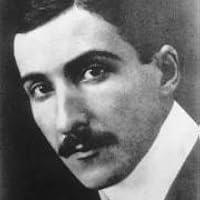
Millosh Gjergj Nikolla was an Albanian poet and writer. He is better known under his pen name Migjeni. He was born in Shkodër, Albania (then Ottoman Empire) in 1911, into a family of Serbo-Croatian-speakers. His father, Gjeorgje Nikolic (alb. Gjergj Nikolla; 1872–1924), came from an Orthodox family of Slavic origin and owned a bar in Shkodër. Millosh's father was a very respected member of the community. Notably he was chosen among the orthodox community of the city to represent Shkodër in the Berat Congress in 1922 (where the Orthodox Autocephalous Church of Albania was proclaimed independent by Fan Noli). Millosh Gjergj Nikolla had married Sofia Kokoshi (Migjeni's mother) in 1900. She died in 1916 leaving behind six children (two boys and four daughters). Like her husband, Sofia Kokoshi also enjoyed a good reputation among the city's community. She had been educated at the catholic seminary of Shkodra, run by Italian nuns.
The surname Nikolla (originally Nikolić) derived from his grandfather Nikolla Dibrani (d. 1876) who hailed from the region of Reka (present-day Republic of Macedonia) and was a member of the tiny Albanian Orthodox community in the region (the same community that gave birth to another Albanian poet, Josif Jovan Begeri).[citation needed] Nikolla left the region during the late 19th century and moved to Shkodra where he practiced the trade of a bricklayer and later married Stake Milani, from Kuči, Montenegro, with whom he had two sons: Gjergj (Migjeni's father) and Krsto. Among the six children, Millosh and his youngest sister, Ollga, were the only ones in the family to attend the Serbian elementary school in Shkodra. From 1923 to 1925, Millosh was enrolled at a secondary school in Bar (Tivar) on the Montenegrin coast, where his eldest sister, Lenka, had moved.
In the autumn of 1925, the 14 years old Millosh obtained a scholarship to attend a secondary school in Monastir (Bitola), Macedonia. In Monastir he studied Old Church Slavonic, Russian, Greek, Latin and French. He graduated in 1927, and at the same year, he entered the Orthodox Seminary of St. John the Theologian, also in Monastir, where, despite incipient health problems, he continued his training and studies until June 1932. On 23 April 1933, he was appointed teacher of Albanian at a school in village of Vraka, seven kilometres from Shkodra. It was during this period that he also began writing prose sketches and verse that reflected the life and anguish of an intellectual.
In May 1934 his first short prose piece, Sokrat i vuejtun apo derr i kënaqun (Suffering Socrates or the satisfied pig), was published in the periodical Illyria, under his new pen name Migjeni, an acronym of Millosh Gjergj Nikolla. Soon though, in the summer of 1935, the twenty-three-year-old Migjeni fell seriously ill with tuberculosis, which he had contracted earlier. He journeyed to Athens, Greece in July of that year in hope of obtaining treatment for the disease which was endemic on the marshy coastal plains of Albania at the time, but returned to Shkodra a month later with no improvement in his condition. In the autumn of 1935, he transferred for a year to a school in Shkodra itself and, again in the periodical Illyria, began publishing his first epoch-making poems.
In a letter of 12 January 1936 written to translator Skënder Luarasi (1900–1982) in Tirana, Migjeni announced, "I am about to send my songs to press. Since, while you were here, you promised that you would take charge of speaking to some publisher, 'Gutemberg' for instance, I would now like to remind you of this promise, informing you that I am ready." Two days later, Migjeni received the transfer he had earlier requested to the mountain village of Puka and on 18 April 1936 began his activities as the headmaster of the run-down school there.
The clear mountain air did him some good, but the poverty and misery of the mountain people in and around Puka were even more overwhelming than that which he had
I watch all the ratings, but no comments! How come? Oh, how little you understood, of his great heart and humble pride. I despise you not, but deserving of some is he or what? I read his poems on and on and every inch of me moves in pieces of heaven that I've never recognized. To my life, his poems dark have brought only illuminating lights. Enlightenments so bright, in his readings you shall strive But ohhh shame on you, ignorant you are a word of honor to find Just how he predicted, it's not the poverty that threatens, but growing empty minds in times to come For I adore, worship and still kneel in whatever he writes
Some Pulitzer Price in Post-mortum to be given, the most deserving are you not Oh My Migjen, what a pity that, this world more and more to hear you should abide No worries my dear brother, I'll raise all my voices and tell them how Your Free Verse are only small diamonds, but spread all over the earth around Big, Large, Wide and like milky ways shall explode someday on all of us
Migjeni, described as the destroyer of the myth of the legendary hero in Albanian literature, comes as the inventor of other myths, which generally characterize the development of the European Belles Letter: 1- The myth of the west as a new modern spirit, the emancipation of mentality and the development that had geographically started from the western; as a movement that destroyed the rooted systems of thought and belief, otherwise as an expression of the will to secede from the "rule" and the influence of the Christian religion on the Western European mentality and as a danger to the new modern myths in which the poet foresaw the fall, are present in a triple form in the cycle named The Western Songs / Kangët e Përndimit. 2- The myth of the tower of Babylon as an expression of man's intention to rule the world in the vertical movement earth-sky/heaven has been exploited in most of Migjen's works aiming a new system of thought that the new era was dictating. In reference to the biblical story of the tower of Babylon about a dispute between people to whom the biblical God confused languages to not reach heaven, the poem Preface of prefaces / Parathânja e parathânjeve illuminates the Migjenian poetic thought, according to which, it is time for a human agreement to touch and possess the heaven, now without god. 3- The myth of the Messiah in Migjeni's work structures the twentieth-century European mentality in research of an alienated concept for the rescue from the dehumanization risk. The Migjenian hero is identified with the figure of a man where biblical messianic features merge with those of a modern figure of the superman. The figure of Migjen's hero approaches the Nietzschean concept of the power of change through the Superman, but distances himself from the approach of his imagination, in order to be more like the human features of the biblical Messiah. The Messianic feature of Migjen, identified in both forms in two different levels of textual meaning as disguise and disclosure, has created a complex relationship with the Scriptures, where the latter, as intertext, has changed the code in order for the metatext (the literary text) to create a reconstructed image of human being in the modern era of major changes and new developments of the XX century. In order to create a qualitative relationship of the literary work with the critics and today's readers, it is proposed the "demystification" that the critics created about the Migjenian myth under the influence of Socialist realism dogma during the communist rule; also, the intertextual reading, as a qualitative type of communication between the reader, the work and the author. Challenge: What about you, the reader who know how to enjoy the literature, how do you introduce yourself in terms of understanding the Migjenian work as "a loving and not facile reader”?
Very few English translations of Migjeni's work exist on the internet, which is such a shame. I am forced to attempt to compile the few translations that do exist.
In the few of his works that I have had the pleasure of reading, grimness, and desolation, and pain remain the common theme throughout his poetry. Migjeni takes a realist approach within his works, not sugarcoating his pain. I found myself resonating deeply with his words, his anxieties, his pessimism, disillusionments, and his deep resentment for the world we live in, which he calls a tomb in the universe.
My picks:
In 'The Themes,' Migjeni is reminiscent of being a youth, ignorant and oblivious to how unpleasant reality is. He expresses his sympathies to prostitutes he sees on the streets, who're forced by circumstances to loiter, noting the sadness written on their faces. The fantasy of a world ripe for dreams fade as memories of his youth do the same, and he's left to face grim reality.
In 'Poem of Poverty,' his resentment towards poverty almost reads as disgust. But upon further reading, it's understood that Migjeni is expressing his disgust for the suffering that poverty creates. Poverty hinders dreams, it knows nothing but creating pain and misery. It is clear Migjeni speaks of his own experiences in poverty, and of the pain experienced by the people who surrounded him.
Lastly, in 'Prefaces of Prefaces,' Migjeni expresses his resentment towards what he sees a cold an unresponsive God. He ends the poem by calling out 'Oh God! Where are you?'
Migjeni was a nihilist, his poems rarely showing a hint of optimism. He vividly paints pictures of raw human misery.
He lived to be 26. A seriously underrated artist.
'A sleepless night Suffering Luckless inspiration Incomprehensible song Solitude Under the banners of melancholy' - Migjeni.