

What do you think?

Modern Korean Literature #3
Sun-i Samchon
Bi-lingual Edition Modern Korean Literature 003
Kindle Edition
First published January 1, 1978
About the author
Ki-young Hyun
7 books1 followerHyun Ki-young was born on Jeju Island in 1941 and graduated from Seoul National University. He has served as the Managing Director of the National Literary Writers Association and as the President of the Korean Arts & Culture Foundation (2003). Hyun was also the director of the Committee for the Investigation of the April 3rd Jeju Uprising as well as the President of the Jeju Institute for the Investigation of Social Problems.
Ratings & Reviews
Friends & Following
Create a free account to discover what your friends think of this book!
Community Reviews
Displaying 1 - 9 of 9 reviews
February 21, 2019
I read this novella as it was briefly mentioned in Lisa See's "The Island of Sea Women." Both works deal with the painful history of Jeju Island, South Korea.
The novella was published in 1978, almost thirty years after a tragic massacre occurred when the police and the military killed civilians in terms of getting rid of resources for mountain guerillas (communist rebels). However as this novella mentions, those guerillas were mainly unarmed refugees struck between the US backed military and the communist movement that wanted recently liberated Korea to be totally independent.
This book exposed what the police and the military did to civilians thirty years ago but it took 20 more years for the government to look into this incident properly. The writer went through arrest and torture and the novella was banned for 10 years.
Sang-su, the narrator who lives in Seoul, now goes back to Jeju Island for the memorial services for his grandfather and hears about Sun-i's suicide, the lady that once he hired to help take care of the household. Sun-i showed some mental issues, which turns out to be deeply rooted in the traumatic experience from the Bukchon-ri massacre in early 1949 (December 1948 in the lunar calendar). Sang-su's relatives share their memory of the massacre, still wondering why truth has not been addressed. Interestingly, one of the relative is an uncle who came from North Korea and would have sided with the anti-communist military.
Sun-i committed suicide at the "sunken patch of the land" where the massacre happened. Sang-su says that it is "an old death that had happened thirty years ago."
I read this novella in Korean and English. It is beautifully written and the Korean version includes Jeju dialects. The interesting part is 'Sun-i Samchon' the title. 'Samchon' means a male uncle in standard Korean but in Jeju island, it refers some older acquaintances, male or female, not necessarily related in blood. As it is a family gathering, several 'uncles' attend the memorial service. Unfortunately the English translation is not clear in terms of who's who, though for Korean readers it will be quite obvious who is speaking what because Koreans differentiates 'uncles'. For example, the person who is from North Korea is 'Go-mu-bu' in Korean (the narrator's father's sister's husband) and in this story there is also father's older brother ('keun-a-beo-ji') and father's two cousins ('dang-suk'), who can be easily translated as 'uncle' in English. There is a real 'Samchon' in this story (that refers to an unmarried younger brother of the person's father in standard Korean).
The novella was published in 1978, almost thirty years after a tragic massacre occurred when the police and the military killed civilians in terms of getting rid of resources for mountain guerillas (communist rebels). However as this novella mentions, those guerillas were mainly unarmed refugees struck between the US backed military and the communist movement that wanted recently liberated Korea to be totally independent.
This book exposed what the police and the military did to civilians thirty years ago but it took 20 more years for the government to look into this incident properly. The writer went through arrest and torture and the novella was banned for 10 years.
Sang-su, the narrator who lives in Seoul, now goes back to Jeju Island for the memorial services for his grandfather and hears about Sun-i's suicide, the lady that once he hired to help take care of the household. Sun-i showed some mental issues, which turns out to be deeply rooted in the traumatic experience from the Bukchon-ri massacre in early 1949 (December 1948 in the lunar calendar). Sang-su's relatives share their memory of the massacre, still wondering why truth has not been addressed. Interestingly, one of the relative is an uncle who came from North Korea and would have sided with the anti-communist military.
Sun-i committed suicide at the "sunken patch of the land" where the massacre happened. Sang-su says that it is "an old death that had happened thirty years ago."
I read this novella in Korean and English. It is beautifully written and the Korean version includes Jeju dialects. The interesting part is 'Sun-i Samchon' the title. 'Samchon' means a male uncle in standard Korean but in Jeju island, it refers some older acquaintances, male or female, not necessarily related in blood. As it is a family gathering, several 'uncles' attend the memorial service. Unfortunately the English translation is not clear in terms of who's who, though for Korean readers it will be quite obvious who is speaking what because Koreans differentiates 'uncles'. For example, the person who is from North Korea is 'Go-mu-bu' in Korean (the narrator's father's sister's husband) and in this story there is also father's older brother ('keun-a-beo-ji') and father's two cousins ('dang-suk'), who can be easily translated as 'uncle' in English. There is a real 'Samchon' in this story (that refers to an unmarried younger brother of the person's father in standard Korean).

June 1, 2025
Her death wasn’t a month-old event. It was an old death that had happened thirty years ago. She had been dead ever since. The bullet that left the muzzle of a ‘99-style’ rifle thirty years ago had finally penetrated her heart a month ago, after having slowly traced its tortuous thirty-year trajectory.
그 죽음은 한달 전의 죽음이 아니라 이미 삼십년 전의 해묵은 죽음이었다. 당신은 그때 이미 죽은 사람이었다. 다만 삼십년 전 그 옴팡밭에서 구구식 총구에서 나간 총알이 삼십년의 우여곡절한 유예를 보내고 오늘에야 당신의 가슴 한복판을 꿰뚫었을 뿐이었다.
Sun-i Samch'on is the translation by Jung-he Lee of the 1978 novella 순이삼촌 by 현기영 (Hyun Ki-young).
I had previously read this in a different, earlier (2008) translation, which the Ktlit website described as "in contention for the worst translation from Korean to English in the last decade" - and my only quibble might be that I'm not sure there was any real competition for the title. More of the review here. (I'll spare the translator's name).
This is a far superior rendition into English. A warning though for anyone looking to buy the Kindle edition - the physical book being hard to buy in the UK - for some reason this excludes the original Korean text which is a feature of the Asia Publishers Bilingual Edition, and the breves in the McCune–Reischauer Romanization (a system which is already hard to read) are printed separately rather than over the letter, so 철 becomes not Ch’ŏl but rather Ch’˘ol (c.f. Cheol in the form used in Korea and in most modern translations).
That earlier translation was titled, quite reasonably, Aunt Suni - the title of this a Romanization of the Korean 순이삼촌. 삼촌 (which is variously Romanized as Samch'on, Samcheon, or Samchun) typically is used in Korea for Uncle, but in Jeju can be used for Auntie, or indeed any elder. Indeed as per Han Kang's Jeju-based 작별하지 않는다, translated as We Do Not Part by e. yaewon and Paige Aniyah Morris: Inseon had told me to address older people here as samchun. Only outsiders say ajossi or aju-moni, halmoni or haraboji, she said. If you start off by calling them samchun, even if you can't string together a sentence in Jeju-mal, they're likely to be less guarded, thinking you've lived on the island for a good while. Here the narrator comments of 'Aunt' Suni, We would call her Samch’on since it was customary in our village to designate distant but friendly relatives by this unisex title.
And it was We Do Not Part that prompted be to revisit the book in this translation, and, in particular fascinating comments made by Goodreader Peter on a thread at the The RAS Korean Literature Club forum on the many links between the two books.
The novel centres around the 제주 4·3 사건, the Jeju uprising in 1948-49, which was ultimately put down by the American-backed Syngman Rhee-led regime in South Korea, resulting in a massacre and mass exodus - per Wikipedia: between 14,000 and 30,000 people (10 percent of Jeju's population) were killed, and 40,000 fled to Japan.
The novel was perhaps the first publication to document and question what happened, the true story censored under the then military regime with the official story that a communist uprising was suppressed. And its publication was initially censored, and the author subject to arrest and beating, as he explains here.
The story opens with the main character, now a corporate executive in Seoul, returning to his native Jeju, a tourist paradise (even more so in 2025), but for him one an island with a dark past:
What did my hometown mean to me? It had given me nothing but profound depression and intractable poverty. The island itself may be a tourist destination, but the effects of tourism were uneven. In West Village, my birthplace, there were few if any tourist attractions. It was a desolate place where even tangerine trees, ubiquitous elsewhere on the island, couldn't grow because of the whipping west wind. At least in my mind it had always been lifeless. That is, I always remembered it as the piles of ash to which it had been reduced after the mandatory evacuation by the military thirty years ago. I should have realized that the way back to that place and time, after eight years of avoidance, after eight years of drifting in self-imposed exile, would require great care and caution on my part.
[...]
The sky, overcast with low-hanging clouds, looked melancholy, and heavy clusters of cumulus gathered around the peak of Mt. Halla. There was that familiar winter climate, distinctive of the island. There were the same ominous and persistent clouds that never peeled off my childhood sky. The cloudy sky made the stone walls look darker and harder than usual and caused the snow on the marshy meadow around the base of Mt. Halla to appear dull. The howling of the west wind clung to the rims of my ears. Strands of hair were murmuring incessantly across my forehead. All of a sudden I felt heaviness in my chest. I was back to the dismal winters of my childhood.
(as an aside on the translation - in the earlier version the last two sentences are rendered: "Abruptly, I felt frustated. The winter weather which I had experienced visited me again.")
The return, his first for 8 years, is a short two-day vacation to take in the memorial day for his grandfather, who had died c30 years ago in a massacre in the village where the family still live. The narrator was a young child at the time - and his father was one of those who fled to Japan, where he still lives.
After his initial rather gloomy reaction on arriving on Jeju, as he travels by bus around the island to his home village, he increasingly feels at home with his memories of the scene and of the local terms used to describe it:
A pitch-black whinstone promontory was sinking its sharp teeth into the charcoal-colored sea. Such a formation was called k’oji in our dialect. Those heaping piles of auburn seaweed on the broad tolbillae rocks on the shore must be t˘umbungnul, and what looked like bubbles of foam floating on the winter sea were the t’aewak of women divers. The red blazing from cracks in the dark whinstone was a bonfire of millet straw, and the fireplace where women divers would warm themselves when they emerged from the water was called pult’˘ok. I gave a silent cheer each time a forgotten word burst from the depths of my subconsciousness. The deeper I dug into the core of my memories, the more my mind bustled with the scenery and dialect of my native home.
But what causes the narrator particular angst when he arrives at his home village is to learn of the death, by suicide, of the titular Sun-i Samch'on, a distant relative, who around a year earlier had come to stay with him and his wife in Seoul as a housekeeper, returning to Jeju-do only a couple of months earlier. She died, after ingesting cyanide pills, in the field where the massacre had taken place, a field she inherited, and a massacre of which she was the sole survivor, buried under the mound of the slaughtered. Talking to his remaining relatives the narrator recalls the story of the massacre, but also internally reflects on the troubled relationship between Sun-i Samch'on, with her strong Jeju dialect and traditional customs, and his wife, a modern Seoulite.
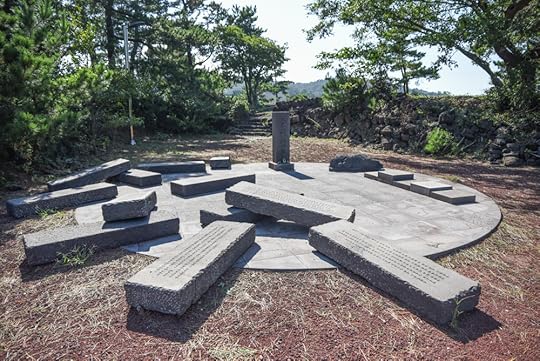
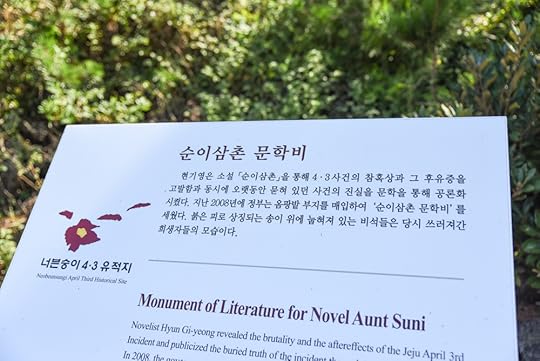
The story of the massacre is based closely on a real-life event in 북촌리 (the village of Bukchon), and there is now a memorial to both the event and to this novel in the area:
The novel sets up a tension between: one member of the family by marriage, not from Jeju and actually part of the occupying Youth-Corps, a branch of which conducted the massacre, who argues this was an isolated incident and best buried in the past; and another, who alongside the narrator witnessed what happened as a child, but who has remained on Jeju-do, and argues this needs investigation, even 30 years later, while there are still those who remember:
“In any case, we can’t just leave this incident behind and move on. Whatever it takes, we should find out exactly what happened. The truth must be brought to light, to prevent something like this from ever happening again, if for no other reason.
[...]
If we leave things as they are, this incident will be buried and forgotten forever. In another decade or two, there will be no one left to put on trial, no witnesses like my father and his cousin. It will all be over, just a village legend.”
In practice, it wasn't till 2000 that an official commission was established. The National Committee for Investigation of the Truth about the Jeju 4.3 Events, although as noted above this novel played a key role in the journey to that point.
And as a historical document, this book deserves 5 stars. However, here I'm judging on literary merit, and, even in this revised translation, the book scores less well, the more novelistic elements quickly veering into exposition. 3.5 stars
그 죽음은 한달 전의 죽음이 아니라 이미 삼십년 전의 해묵은 죽음이었다. 당신은 그때 이미 죽은 사람이었다. 다만 삼십년 전 그 옴팡밭에서 구구식 총구에서 나간 총알이 삼십년의 우여곡절한 유예를 보내고 오늘에야 당신의 가슴 한복판을 꿰뚫었을 뿐이었다.
Sun-i Samch'on is the translation by Jung-he Lee of the 1978 novella 순이삼촌 by 현기영 (Hyun Ki-young).
I had previously read this in a different, earlier (2008) translation, which the Ktlit website described as "in contention for the worst translation from Korean to English in the last decade" - and my only quibble might be that I'm not sure there was any real competition for the title. More of the review here. (I'll spare the translator's name).
This is a far superior rendition into English. A warning though for anyone looking to buy the Kindle edition - the physical book being hard to buy in the UK - for some reason this excludes the original Korean text which is a feature of the Asia Publishers Bilingual Edition, and the breves in the McCune–Reischauer Romanization (a system which is already hard to read) are printed separately rather than over the letter, so 철 becomes not Ch’ŏl but rather Ch’˘ol (c.f. Cheol in the form used in Korea and in most modern translations).
That earlier translation was titled, quite reasonably, Aunt Suni - the title of this a Romanization of the Korean 순이삼촌. 삼촌 (which is variously Romanized as Samch'on, Samcheon, or Samchun) typically is used in Korea for Uncle, but in Jeju can be used for Auntie, or indeed any elder. Indeed as per Han Kang's Jeju-based 작별하지 않는다, translated as We Do Not Part by e. yaewon and Paige Aniyah Morris: Inseon had told me to address older people here as samchun. Only outsiders say ajossi or aju-moni, halmoni or haraboji, she said. If you start off by calling them samchun, even if you can't string together a sentence in Jeju-mal, they're likely to be less guarded, thinking you've lived on the island for a good while. Here the narrator comments of 'Aunt' Suni, We would call her Samch’on since it was customary in our village to designate distant but friendly relatives by this unisex title.
And it was We Do Not Part that prompted be to revisit the book in this translation, and, in particular fascinating comments made by Goodreader Peter on a thread at the The RAS Korean Literature Club forum on the many links between the two books.
The novel centres around the 제주 4·3 사건, the Jeju uprising in 1948-49, which was ultimately put down by the American-backed Syngman Rhee-led regime in South Korea, resulting in a massacre and mass exodus - per Wikipedia: between 14,000 and 30,000 people (10 percent of Jeju's population) were killed, and 40,000 fled to Japan.
The novel was perhaps the first publication to document and question what happened, the true story censored under the then military regime with the official story that a communist uprising was suppressed. And its publication was initially censored, and the author subject to arrest and beating, as he explains here.
The story opens with the main character, now a corporate executive in Seoul, returning to his native Jeju, a tourist paradise (even more so in 2025), but for him one an island with a dark past:
What did my hometown mean to me? It had given me nothing but profound depression and intractable poverty. The island itself may be a tourist destination, but the effects of tourism were uneven. In West Village, my birthplace, there were few if any tourist attractions. It was a desolate place where even tangerine trees, ubiquitous elsewhere on the island, couldn't grow because of the whipping west wind. At least in my mind it had always been lifeless. That is, I always remembered it as the piles of ash to which it had been reduced after the mandatory evacuation by the military thirty years ago. I should have realized that the way back to that place and time, after eight years of avoidance, after eight years of drifting in self-imposed exile, would require great care and caution on my part.
[...]
The sky, overcast with low-hanging clouds, looked melancholy, and heavy clusters of cumulus gathered around the peak of Mt. Halla. There was that familiar winter climate, distinctive of the island. There were the same ominous and persistent clouds that never peeled off my childhood sky. The cloudy sky made the stone walls look darker and harder than usual and caused the snow on the marshy meadow around the base of Mt. Halla to appear dull. The howling of the west wind clung to the rims of my ears. Strands of hair were murmuring incessantly across my forehead. All of a sudden I felt heaviness in my chest. I was back to the dismal winters of my childhood.
(as an aside on the translation - in the earlier version the last two sentences are rendered: "Abruptly, I felt frustated. The winter weather which I had experienced visited me again.")
The return, his first for 8 years, is a short two-day vacation to take in the memorial day for his grandfather, who had died c30 years ago in a massacre in the village where the family still live. The narrator was a young child at the time - and his father was one of those who fled to Japan, where he still lives.
After his initial rather gloomy reaction on arriving on Jeju, as he travels by bus around the island to his home village, he increasingly feels at home with his memories of the scene and of the local terms used to describe it:
A pitch-black whinstone promontory was sinking its sharp teeth into the charcoal-colored sea. Such a formation was called k’oji in our dialect. Those heaping piles of auburn seaweed on the broad tolbillae rocks on the shore must be t˘umbungnul, and what looked like bubbles of foam floating on the winter sea were the t’aewak of women divers. The red blazing from cracks in the dark whinstone was a bonfire of millet straw, and the fireplace where women divers would warm themselves when they emerged from the water was called pult’˘ok. I gave a silent cheer each time a forgotten word burst from the depths of my subconsciousness. The deeper I dug into the core of my memories, the more my mind bustled with the scenery and dialect of my native home.
But what causes the narrator particular angst when he arrives at his home village is to learn of the death, by suicide, of the titular Sun-i Samch'on, a distant relative, who around a year earlier had come to stay with him and his wife in Seoul as a housekeeper, returning to Jeju-do only a couple of months earlier. She died, after ingesting cyanide pills, in the field where the massacre had taken place, a field she inherited, and a massacre of which she was the sole survivor, buried under the mound of the slaughtered. Talking to his remaining relatives the narrator recalls the story of the massacre, but also internally reflects on the troubled relationship between Sun-i Samch'on, with her strong Jeju dialect and traditional customs, and his wife, a modern Seoulite.
The story of the massacre is based closely on a real-life event in 북촌리 (the village of Bukchon), and there is now a memorial to both the event and to this novel in the area:
The novel sets up a tension between: one member of the family by marriage, not from Jeju and actually part of the occupying Youth-Corps, a branch of which conducted the massacre, who argues this was an isolated incident and best buried in the past; and another, who alongside the narrator witnessed what happened as a child, but who has remained on Jeju-do, and argues this needs investigation, even 30 years later, while there are still those who remember:
“In any case, we can’t just leave this incident behind and move on. Whatever it takes, we should find out exactly what happened. The truth must be brought to light, to prevent something like this from ever happening again, if for no other reason.
[...]
If we leave things as they are, this incident will be buried and forgotten forever. In another decade or two, there will be no one left to put on trial, no witnesses like my father and his cousin. It will all be over, just a village legend.”
In practice, it wasn't till 2000 that an official commission was established. The National Committee for Investigation of the Truth about the Jeju 4.3 Events, although as noted above this novel played a key role in the journey to that point.
And as a historical document, this book deserves 5 stars. However, here I'm judging on literary merit, and, even in this revised translation, the book scores less well, the more novelistic elements quickly veering into exposition. 3.5 stars
December 5, 2024
I read a different translation, but this was an evocative and intense short read. It prompted me to revisit sources on the U.S.-backed massacres that took place in Jeju. This work is the earliest published story (in South Korea) about the massacres and was met with severe state repression. Its focus on familial conversations is what really provides insight into collective memory, it would be great to read this again in its original form.
August 13, 2016
I read this in 2010 im the previous translation. The authorative Ktlit website described it as "in contention for the worst translation from Korean to English in the last decade" - and my only quibble might be that I'm not sure there was any real competition for the title. More of the review here.
However, I understand this retranslation is much better and will be revisiting that in 2025.
However, I understand this retranslation is much better and will be revisiting that in 2025.
February 15, 2018
Wonderful, devastating take on the Jeju Massacre (4.3 Incident) that underlines the persistence of trauma.

May 29, 2019
i was amazed to see that this came out in the 70s, and I can't imagine what the author had to have gone through to publish it. good to read alongside choi yun's there a petal silently falls.
July 17, 2025
Rly good and this is the perfect size of book (little larger than pocket)
April 5, 2026
ziauriai gera knyga not very kpop kawaii jeju atostogos, o labiau real
January 3, 2019
Very vivid portrayal of a story about the April 3rd Scorched earth incident and how it affected the lives of the people living on the island.
Displaying 1 - 9 of 9 reviews