What is the difference between fear and excitement and how can you tell them apart? How do the mind and body make emotions? When can anxiety be good? This science-based graphic book addresses these questions and more, revealing just how strange anxiety is, but also how to unravel its mysteries and relieve its effects.
Understanding how anxiety is created by our nervous system trying to protect us, and how our fight-or-flight mechanisms can get stuck, can significantly lessen the fear experienced during anxiety attacks. In this guide, anxiety is explained in an easy-to-understand, engaging graphic format with tips and strategies to relieve its symptoms, and change the mind's habits for a more positive outlook.
Anxiety is Really Strange. Is it ever! Yet it is also common, with 28.8% of people being seriously affected by an anxiety disorder at some point in their adult lives. Anxiety disorders include Generalised Anxiety Disorder, panic disorder, Obsessive Compulsive Disorder (OCD), social anxiety and other phobias, and Post Traumatic Stress Disorder (PTSD).
This graphic novel outlines some possible causes of anxiety, outlines philosophical ideas along with a really interesting experiment dealing with mouse poo (of all things), how the body reacts in anxiety mode and some tools for managing symptoms.
I went into this book thinking it would be a really good introduction to anxiety for someone who’s just been diagnosed and while I still think it will be useful for some people in this situation, there will be others who will be most likely wanting more advice on helpful tools rather than the thoughts of philosophers.
Now, I’m a proud nerd so I enjoyed all of the sciency, philosophical bits and pieces, and I’ve found some studies I’m interested in looking into further. People with a general interest in anxiety should get enough from this graphic novel to come away with a better understanding of the roles the mind and body play in exacerbating and easing anxiety. Hopefully Anxiety is Really Strange will make it into the hands of some friends and family members of those affected by anxiety and will result in greater empathy and better support systems.
Quote that made me chuckle: “Anxiety is a good thing because psychopaths don’t have any.” (page 18). I loved Jon Ronson’s quote. My brain automatically made this into a bizarre TV commercial ... “Got anxiety? Take heart. At least you’re not a psychopath!”
While books about anxiety are useful I believe there’s really no substitute for getting professional help. Anxiety can be extraordinarily daunting to deal with by yourself and a doctor and/or therapist who can provide much needed support and tools can make the world of difference to your quality of life.
I received a copy of this book from NetGalley (thank you so much to NetGalley and Singing Dragon, an imprint of Jessica Kingsley Publishers for the opportunity) in exchange for honest feedback.
If someone in your life doesn't understand your anxiety and why you act the way that you do, just hand them this great little book. This book offers a great introduction into the why's and how's of anxiety disorders and the art is really simple, yet aesthetically pleasing. The first half of the book is sort of an explanation/guide for anxiety and the second half is tips to help manage your anxiety. At first I thought the tips would be kinda stupid and would make me roll my eyes, but they were actually pretty good - some of them I've even used in the past! The main thing I didn't like about this book is the little paragraphs at the bottom of each page. It was like references in an essay just chucked at the bottom of the page with no context. They didn't really serve a purpose.
Thanks to netgalley for providing a copy to review! Anxiety is Really Strange is out January 18th!
I think this book is stranger than anxiety is. I can’t say I garnered any new information from this, and felt that it read more like a tri-fold pamphlet from the doctor’s office than a graphic novel. I would dare to say that if you are looking to get information on anxiety, you could find everything for free online that’s in this book. I also don’t feel like the graphics did anything for the story, and rather just allowed for a higher page count.
Received via Netgalley in exchange for an honest review.
The concept behind this book is interesting — trying to make people understand what anxiety is — and yet I think it could have been done a lot better.
It's definitely not something I'd recommend for children, it's too complex. Even I, someone who studied biology for three years after High School, found it not simple enough at times. It's supposed to be a way to better understand anxiety, so I think it should have been even less complex.
I liked the art work, it was simple but nice to look at.
I'm a bit disappointed with the way anxiety was portrayed, especially at the end with the exercises given. The way this book presents anxiety makes it seems like it's easy to get rid of it, but it's not, some people struggle their entire life with it.
2.75
Thank you Netgalley for providing me an e-arc in exchange for an honest review.
It has taken me about 3 days to process how I feel about this book and yet I am still conflicted. There is so much potential here, however I feel as though it is a jumble.
Having suffered with anxiety for the better part of a decade, I don't think I am the target audience for this book. It may be better suited to someone who is newly diagnosed or just learning about anxiety itself. I feel as though the book skirted over much of the critical information and focused too much on quotes and excerpts from the work and research of others. This weighed down the narrative and I readily admit that I skipped over much of that, focusing myself on the passages written by the author himself. Being a graphic novel was really the only saving grace for this work. The illustrations were interesting, but were overrun by the dense amount of irrelevant information. The author clearly knows the subject, but the content could have been refined.
It was difficult to connect with the material in this book and I'm not sure that I would recommend this to anyone I know who is suffering with anxiety.
* Many thanks to the author and publisher for providing an ARC of this title via NetGalley in exchange for an honest review.
I really appreciated reading this infographic about anxiety. Is it the most in-depth information that is available out there? Probably not. But it's accessible, a quick-and-easy introduction to anxiety theories. And, as someone with generalised anxiety disorder, I wouldn't want to read something too detailed about anxiety, so I think that this is the perfect length. I also appreciate that suggestions are given for ways to combat feeling anxious.
Really brilliant comprehensive guide to understanding anxiety and learning little coping strategies to help not feel too overwhelmed. Will be recommending this to a lot of people!
A small comic for big feelings. If you want some help understanding anxiety, this is a good introduction. Steve Haines cites a lot of different sources in this short book if you want to take a deeper dive. I also recommend Trauma Is Really Strange from this series of graphic guides.
An illustrated book, comic book like, that try to explain what anxiety is about. Not great but could be and interesting way to approach anxiety with teenagers, not kids, because even if it's a graphic book, it contains explanations maybe a little bit too complex for kids, but for teenagers who have anxiety to help them understand how they feel and to see that they're not alone, it could be a helpful book.
A BIG Thank You to NetGalley and Singing Dragon for providing me a copy of “Anxiety is Really Strange” by Steve Haines in exchange for my honest review.
This was a fun and informative book. It gives a high level overview as to what anxiety is, the symptoms causing it, researches done in the area, followed by the methods to overcome and control it. All of these areas are described in a graphic novel manner with cute illustrations.
I consider myself as someone who gets highly anxious at times and tends to react rather than act during tough situations. Not my best trait, I admit, but this book really made me feel positive after finishing it. I found the whole section of nature vs nurture particularly fascinating. It is the age old question which we ask of ‘is someone born a hero or is it an attribute they acquire?’ The author has provided facts and listed experiments done by various researchers to support both sides, but I personally feel that our environment and other external factors adapt us to who we are.
Anyway, I digress. The main reason I liked this book was because it is told in a simple and concise manner with the information organized perfectly. I am not a researcher or a scientist who is going to take a 500+ page information book on anxiety and read about its cause and effect. Providing a “dummy” version of the same in a graphic novel format is a very creative way of sharing the same views to everyone.
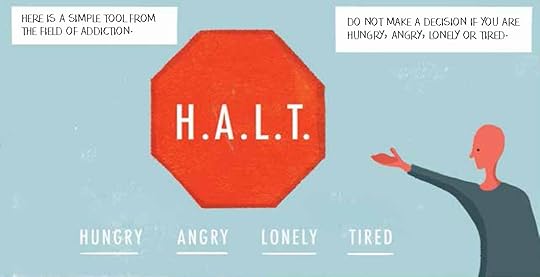
Another reason I enjoyed the book was because it covers various forms of anxiety, such as the one that a person would face after encountering physical abuse, or someone who is stressed at home or in the workplace. The author also provides various pointers to overcome each of them specifically. Some of the notes are very simple yet effective, and one of my favorite ones is the below phrase:
I also loved the selection of color palette used for the visuals. They are not glaring to the eye, but at the same time make the messages stand out, and give the simple illustrations a vibrant spark.
The only reason I gave it 4 stars and not 5 is because at times it got too descriptive for me to understand, especially the part about existentialists (my new word for the day) and how they studied behavior during the Second World War. However, for the most part, it is useful for a layman like myself to learn about the symptoms of anxiety and how to overcome it.
I hope the author decides to release these kind of books for other symptoms such as depression, anger etc.
'Anxiety is Really Strange' by Steve Haines is the second book I've read in this series. I find these an interesting ways of conveying information of the topics.
The book starts with setting out the types of questions it will answer like a definition of anxiety and the differences between cake and bread. Cake and bread differences become important as anxiety is defined and dissected. Along with the illustrations, most pages have footnotes that go into a bit more detail. Coping mechanisms, like grounding, are discussed. At the end of the book there is a list of references used in the book that can be used for further reading.
The first book I read was about trauma and I liked that one a bit more, but this one still offers help for those who suffer from anxiety as well as the folks caring for them. The illustration style fits the book very well. This would be a very good resource.
I received a review copy of this graphic novel from Singing Dragon, Jessica Kingsely Publishers, and NetGalley in exchange for an honest review. Thank you for allowing me to review this graphic novel.
I got an ARC in return for an honest review from NetGalley.
I am a total psych nerd. I have a degree in it, so I would hope that I enjoy it and want to read more. This book seemed like a perfect book for me. I love graphic novels, I have an anxiety disorder, and I am fascinated by psychological research. How could this book be better for me?
Well that is an easy answer: pretty much in every way. The book had a lot of interesting references, but then they were breezed over in a way that just made this book read like a Psychology Today article, but less informative. Quoting Ann Hathaway to make a psychological point is not effective. She is not an expert or representative of the population.
The methods of helping to face your anxiety are also either ineffective (for me personally, so I didn’t count that against the book) or they are potentially dangerous. If you are in a panic attack, which the book does discuss, then squatting may not be the best option as the blood is rushing around you body. Standing up after can make you dizzy, unstable, or cause you to faint as the blood has been limited in its movements (I discussed this with my therapist and this was her opinion). The idea of looking around your surroundings for something to focus on that is nice is not effective if you issue is crowds or, in my case, PTSD from violent trauma. While none of this would have lowered the score of the book if the book had focused on general anxiety disorder specifically. The book mentions everything from general anxiety disorder, PTSD, and OCD. None of the methods talked about for handling your anxiety would be recommended from me or my therapist if you have PTSD, OCD, or if you are not seeing a therapist (this is mostly in reference to the forcing yourself to live in the bad thoughts and explore them if they are related to trauma).
So I really wanted to like this book and there were a few passages that I did enjoy, but they didn’t go far enough. So if you already have a basic understanding of anxiety, skip this book. If you have anxiety that is from trauma, skip this book. If you are new to anxiety or someone you know has anxiety, then this book might help you learn some quirky and cool things about anxiety.
Anxiety is Really Strange is the latest in this series of comics from Steve Haines and Sophie Standing tackling complex mind/body conditions. It follows the same trend as the prior two, though I find this one a little less well laid out. Some of the references to Philosophers past felt out of place. Meant to serve as a brief introduction to anxiety - both for those who find themselves living with it and those around those living with it - there is a nice balance of necessary and "oh that's interesting" information.
The illustrations provide helpful opportunity to imagine the metaphoric imagery people with anxiety develop. For example, as someone with chronic pain, I have different metaphors for describing it depending on what kind of day it is. The same is often true for those with anxiety. These images add to the story of anxiety and make more clear what the experience of it is like. Ultimately, that's what I come to comics like this for - not just for factual information, but as a window into the world of someone living with something I cannot fully comprehend.
Despite some hiccups, this is a worthwhile addition to not only the Strange series, but to the broader graphic medicine cannon. I'd love to see this - and the entire series - become a regular part of library holdings (particularly in school libraries).
The concept and format of Anxiety is Really Strange by Steve Haines are both quite appealing; however, the sequence of the book is a bit confusing. Haines uses a graphic novel format to explore the causes of anxiety and suggest methods for treatment. He also includes a paragraph at the end of each page, which is informative for readers who want to know more, but distracts from the overall visual appeal.
As a secondary Language Arts teacher, I'm thinking this could be an interesting text to pair with John Green's novel, Turtles All the Way Down, whose protagonist struggles with anxiety.
It's an interesting format and there was some really good information (and a surprising inclusion of existential philosophers) though it was a little difficult to figure out when to read the footnotes on the bottom of the pages. I did enjoy reading it and the format worked for me, overall.
As a rule, I don’t enjoy books with more footnotes than actual writing and this turned out to be true for Anxiety is Really Strange. While the footnotes are very good, it lends to a disjointed, frenetic reading experience. The art is technically excellent but did not resonate with me in any substantial way, although I really liked the cover.
This book is so amazingly simple - it is really good at distilling these complicated ideas down to their basics and making them easy to understand. I’m really impressed. Especially as someone who struggles with anxiety.
I know there’s an interaction between physiological and the psychological - but some of the stuff in here is eye-opening and fascinating.
Interesting discussions on Kierkegaard and Simone de Beauvoir!
I had no idea existential philosophy had so much to say about anxiety.
And listen to this quote from Maya Angelou!
History, despite its wrenching pain, cannot be unlived, but if faced with courage, need not be lived again.
What a quote for our times!
And this gets into framing - an interesting political thing I’ve been studying right now - about how we “frame” a message or idea. We can make it sound bad or good, based on the way we talk about it. The same is true of our experiences.
As short as this book is - it even gives tools to help with anxiety.
Highly, highly, highly recommended - for it’s practicality, simpleness, usefulness. If you don’t deal with anxiety issues, it will help you understand the people in your life that deal with them. And if you do? Some excellent info to understand it better, and some great tools to deal with it.
Thanks to NetGalley and Jessica Kingsley Publishers for a copy in return for an honest review.
Well written and informative, it serves in a similar vein of a brochure as opposed to that of a true novel but does it's job well enough.
Good art, sympathetic writing with a fairly progressive view of mental health that provides access to introspection and self-analysis. Could have been longer in some sections but it does trigger the spark towards some other pieces of developed literature that could serve the reader.
2.5/5 upgraded to 3 stars for it's approachability.
One of the coolest "graphic novels" I've ever read. I learned more from this 32 page "book" than I ever did from my introduction to Psychology and Behavioral Psychology Classes. Brilliant!
Being someone who suffers from high Anxiety on a daily basis, I found the concept of this graphic novel appealing. I mean, an educational piece of work that also includes graphics. Sounds fun, right? Wish I could say that I found this to be the case. However, I just didn't.
There was so much potential here. A great effort was made in way of the graphics but everything else just ruined it for me. The "science" of Anxiety seemed to be more citations & quotations from others than original content. I would have loved to have seen the studies explained in more of a fresher/simpler way. Meaning, I wished it had felt more enjoyable than like I was reading something for my psychology class.
In conclusion, I believe the intentions of this graphic novel were great but, sadly, the execution fell terrible short.
I'm not really sure what to make of this book. The drawings are nice, but I felt like the book didn't necessarily do justice to the complexity of the subject. A lot of things were mentioned but not really developed (i.e. the microbiota) and I feel like it might be a nice introductory text for young people but that it lacks the depth to really answer any questions on its own.
Anxiety Is Really Strange is a look at the nature of anxiety and its diverse manifestations in people.
WHO WOULD ENJOY READING IT? Anyone who suffering anxiety (chronic or not) or anyone living close to someone who suffers from such. Professionals who deal with anxiety-prone people might benefit from the illustrated medium used by the author to examine the subject.
WHAT I LOVE ABOUT IT I love the graphic novel format. There is a way illustration bring a new life to a topic that is sometimes difficult to pin down and this book does that well. The author gives detailed explanations and references are done in a way that does not interfere with the enjoyment of the book.
Anxiety is Really Strange by Steve Haines is available to buy on all major online bookstores.
Many thanks to Singing Dragon (Jessica Kingsley Publishers) for review copy.
Thanks to Netgalley I had a chance to read and learn more about anxiety.
I personally don't struggle with anxiety but I wanted to understand what anxiety is. The books is brilliant it talks not only to what anxiety is and it's physiological reason but also shows few ways of dealing with it. There are few techniques that help people to take control over their anxiety attacks.
Anxiety is something no one should be ashamed of. Some people are more prone to it than others. The book helped me to understand that we all have the anxiety 'ingredients'.
The guide is simple told in pictures but at the bottom of almost every page there is short support material to the grapic part above it.
super accessible and helpful in understanding anxiety and how to manage it! it’s especially helpful if you love someone with anxiety and want to have more empathy for them!
helpful quotes:
“we can be more than our anxiety.”
“‘anxiety is a good thing because psychopaths don’t have any.’ jon ronson”
“anxiety can be good. it helps us prepare and not be overconfident.”
“in anxiety we are always ready with the finger on the big red button. the button that should be preserved for life-or-death situations.”
“with skill, understanding and practice we can catch the alarm systems in action. we can negotiate, orient to what is actually happening and act out a new possibility.”
“when was the last time you looked at the sunset or checked out the stars or simply appreciated your aliveness?”
“note the nuances and details of the sensations inside you. try ‘where do i feel that in my body right now?’ not ‘why do i feel anxious?’”
“what’s the worst think i think could happen?”
“if you are full of catastrophic thoughts, explore them, but do not trust them. know your primitive brain is mistakenly predicting life-or-death scenarios. ground yourself and change the context.”
“anxiety is an over-protective feeling. have self-compassion towards the cautious, fearful parts of you, but do not feed the flames.”
“research shows saying ‘you’ in self-talk is better than ‘i’—weird but true: ‘altogether, the current research showed that second-person self-talk strengthens both actual behavior performance and prospective behavioral intentions more than first-person self-talk.’”
“to overcome anxiety you do not need to remember or understand the cause. the goal is to self-regulate in the present moment…body-based tools for managing intense sensations: orient, move, ground.”
“anxiety is much more than faulty emotion circuits. we can learn to reframe sensations and be free to respond differently.”
“with skill, practice and the right context we can reset the primitive parts of the brain to work from the present moment. the do not always have to preside the worst-case scenario.”
When I first saw the cover art for this book, along with the title, I was intrigued and excited to read it. As someone who has anxiety, I was interested to see how this book would portray anxiety and what it's like for people who suffer from it on a daily basis.
Unfortunately, I felt that this book fell short. It definitely has potential, and some of the information in the book is helpful, but it needs more. This book wouldn't be suitable for young children, but would be best suited for teenagers and young adults, especially if they've recently been diagnosed with anxiety or would like to know more about it, though there were times when the content was a little overwhelming in terms of being difficult to understand. Anxiety is very complex, and the complexities of it were, in my opinion, often glossed over or not discussed at all, which almost makes it seem as if anxiety is something that will eventually go away. As I said, it has potential, but it really does fall short.
I did, however, really enjoy the artwork in this book and I would definitely recommend it to young people wanting to know a little more about anxiety. If it weren't so complex in places, I would have given the book three stars.
Thank you to NetGalley for providing me with an early copy of this book in exchange for my own honest review.
(Note: I received an advanced electronic copy of this book courtesy of NetGalley)
This work is quite an interesting way to try and approach the subject of anxiety. As someone who has dealt with anxiety for the majority of their life (and continues to do so), I find that it's not without its flaws. Clarity definitely could have been improved upon, as I ran into several pages and panels took a few re-reads in order for the message to sink in. Also, while most likely not the author's intent at all, the ending seems to imply that anxiety is something that can be relatively easy to manage with just the right strategies. I can and will personally attest that even when armed with solid strategies, the battle with one's own anxiety can still feel anything but manageable.
Still, "Anxiety Is Really Strange" clearly strives hard to try and address how complex anxiety is, and takes care to repeat and reiterate that very message quite plainly. I would consider it a good introduction on the topic (and something I'd like to have on hand for every person I meet who thinks "stop being anxious" is an actual thing one can do as easily as flipping a light switch).