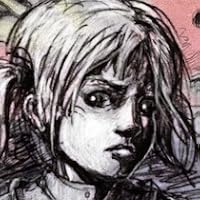
Two males meet in a Nazi labour camp: half-Jewish teenager Tyl von Pankow, saved from the gas-chambers by the influence of his Prussian grandfather, and Johannes von Svestrom, war-wounded veteran of the Afrika Korps, now sentenced by Hitler to a terrible command. They are trapped together in a nightmare devised to destroy them both, which demands that they relate to each other only as oppressor and victim. But as the insanity of their situation increases and the world around them collapses, they find themselves occupying the most untenable place of all: Middle Ground.
Born 1931 in Karlsruhe, Germany Died 2015 in Seatlle, WA, USA
Ursula Zilinsky (née Greissemer or Griessemer) was born in 1931 in the German city of Karlsruhe. After being raised in Munich by her parents, Otto (Tom) and Winifred Greissemer, she was educated at the International School of Geneva (Switzerland) before emigrating to New York together with her parents in 1949.
In New York, Ursula went to University, where she met her later husband, Pieter Zilinsky.
According to the 1969 German edition hardback jacket of "Before the Glory Ended", the couple had two children.
According to Pieter's obituary, the two retired to Seattle, where they were active in several poets society's as well as the Seatlle Arts Museum and Asian Arts museum before Ursula's passing in 2015.
Gay love in a concentration camp. Great premise. SJWs relax, stop that immediately outraged rush to your keyboards--this book is too literary (so far) so find any complaint about at all. Personally, I wouldn't have cared if the MC had been a true Nazi (Stalinist, ISIS, IRA, or any other objectionable creed--love can find a way to redeem us all), but he's not. The author sets this up with a damaged war-veteran hero who is as much a prisoner of the labour camp as the boy he takes up with. Did I forget to mention the paedophilia? Okay, Tyl is 16, but he's still a schoolboy. He was 14 when he came to the camp, so he's emotionally immature, in a very dependent position and extremely vulnerable. Then, as I said, it's ... literary. Coy to the extreme. I know a little about gay sex, one way or another, and even I can't work out what the heck is going on between them. It's an easy read, so I'll persevere, but it is frustrating. The character development is utterly dependent upon the physical that is evolving between them, so without being able to decipher that, it's hard to get an emotional tie to either of them. I'll update when done. Finished. Ack, I have to come clean. I was biased against this novel because it was first published in 1968. That, to me, says doomed love. It was sort of okay to write about 'homosexual' relations, but authors had to make them tragic to make the story acceptable. I was fairly sure the love between a German labour camp commandant and one of the prisoners wasn't going to end happily. I don't like investing time or emotional commitment on things that depress me. Hence the very edgy, hesitant start to this review. Now I've finished, however, I'm happy to say that this book is superb. It's beautifully written - almost every page has parts which are quotable. The love story is achingly wonderful. To be honest, I cannot understand why this book isn't better known. I've read pretty much all gay literature from the 1960s on, but hadn't even heard of this until I ran across a reference to it the other day. It knocks the socks of Brokeback Mountain for a start. Basically, I can't recommend this novel too highly enough. Gorgeous use of the English language on every page and an heart-rending love story that will take you through the wringer and back again.
Me ha gustado, mucho. Siempre que me topo con un libro que me hace pensar sobre mis límites éticos o morales, o mis creencias personales, disfruto como lectora, y señores, si esta relación entre un menor confinado en un campo de trabajo en la Alemania nazi con el comandante del campo no pone a prueba ninguno de los suyos, mal vamos ;)
La única pega que le encuentro al libro es que se le nota la edad (es de 1968) y que quizás peca de ser un poco "happy" en ciertos momentos, pero compensa exponiendo los matices de gris que hay entre el blanco y el negro. La autora ha vivido esos tiempos (parece ser que fue una huérfana de la IIWW) y su aproximación al tema es interesante.
Una pequeña sorpresa, estoy contenta de haberle dado una oportunidad, pero no lo recomiendo para cualquier lector.
It was a struggle deciding what to rate this because it’s a great piece of historical fiction and the coming-of-age aspect was also done well, but I didn’t enjoy the romance. To its credit, this book was published during a time when giving gay couples an HEA was still frowned upon and the story does end with a very clear and solid HEA. The only problem is that I didn’t really believe in the HEA because the setup of the romance didn’t work for me.
The writing of the story is superb with the author doing a great job of writing from the first person perspective of Tyl, a spoiled, surly teenager who is forced to go from his privileged boarding school to a Nazi labor camp at the age of 14, due to his mother being Jewish. The other MC is Johannes, a wounded war vet whose age is never specified but he had to be in his late 20s/early 30s. Johannes had spent time fighting in Africa but was given an administrative role after being wounded. After being suspected by some of having been involved in an attempted assassination attempt on Hitler but opinions on his guilt being split, he’s punished by being assigned the Commandant role at the labor camp where Tyl is imprisoned. By that point, Tyl has been in the camp for 2 years and he’s 16 years old.
The structure of the story is laid out in a very clever way, which includes two timelines. The story begins after Tyl is liberated from the labor camp, before going back in time to show how Tyl ended up going to the camp and his experiences there during the 3 years he spent as a prisoner. Then readers are shown one year of Tyl’s life after liberation, which catches us up to the present timeline. I loved this setup because there are a lot of throwaway lines and references included in the present timeline by Tyl which tell us what to expect in the past timeline and some of those revelations were intriguing mysteries that I was eager to see solved (ex. why does Tyl refuse to part with an old, tattered Afrika Korps military jacket when he’s had nothing to do with the fighting in Africa?) and other revelations were heartbreaking, such as learning that certain characters are dead in the present timeline so going back into the past and spending time with them was emotionally difficult.
In addition to the narrative structure being great, the writing was also fantastic. Tyl is a hot-tempered, sarcastic teenage boy with a bad attitude and even the miserable conditions of being in a forced labor camp didn’t change him overnight. He matured in some ways but remained an immature teenage boy in other ways, which fit the character and situation perfectly. The author did a fantastic job with that.
I also appreciate that the author didn’t sanitize any of the horrors that took place at the labor camp. While such labor camps weren’t death camps such as Auschwitz, Dachau or Buchenwald, conditions were still inhumane. There was very little food available, what food was available was terrible quality, dozens of inmates lived in cramped quarters consisting of nothing more than wooden bunks and thin blankets and they spent their days working in an ammunitions factory, making bullets for the Nazis. In addition, the first camp Commandant had a proactive disciplinary policy, which included hanging random inmates whenever he wanted to assert is authority. The living conditions were horrid with inmates constantly battling starvation, disease, cold, exhaustion or being singled by the guards for tiny infractions that could result in beatings or worse. In addition to portraying the day-to-day living conditions accurately, I also liked how realistic the interpersonal relationships between the inmates were presented. The inmates separated into groups based on pre-existing divisions between them (political, religious) and there was very little mixing between the groups. Tyl attaches himself to a group of young Communists but except for Karel, Tyl never gets attached to any of them and despite spending several years with the group, he never cares enough to learn anything about the rest of them and he easily parts ways with them when life takes them in separate directions after the liberation.
While all of the above made this a great piece of historical fiction and I liked Tyl, I didn’t care for the romance between him and Johannes. I felt there was no chemistry between the characters and everything about their relationship fell flat for me. Surprisingly, I wasn’t as creeped out by the age gap as I thought I’d be, but that’s because I never felt either of the characters were truly committed to their relationship.
Tyl is the one to initiate the ‘relationship’ with Johannes when Johannes singles Tyl out to do easy chores at Johannes’ home and Karel convinces Tyl to offer Johannes sexual favors in exchange for getting food/smokes/etc that he can bring back to his little group. Tyl hates this idea but Karel has drilled it into his head for 2 years by this point that they all have to work together in order to survive, even if they don’t like each other and even if they don’t like what they have to do. So Tyl agrees to prostitute himself for the greater good and that’s the mentality he enters the relationship with. In addition, he’s constantly conflicted over his supposedly growing feelings for Johannes while also knowing that these feelings are a direct betrayal to the other inmates and everything Tyl has suffered. Suffice it to say that when Tyl declares at 50% that he’s in love with Johannes, I didn’t believe a word of it.
As a quick aside, the story provides a bit of background about another guard/inmate relationship that takes place throughout the book: Martin (the inmate) and Jasper (the guard). We know they’re together for the majority of the story and Jasper often helps Tyl’s group with certain projects but it’s not until the end that we find out how they got together. The details aren’t relevant but I found myself believing in Martin and Jasper’s romance and I genuinely got upset that they never got their HEA . Unfortunately, that isn’t the case for Tyl and Johannes.
On Johannes’ end, I really disliked how his character was handled. The guy is dealing with a lot of trauma – depression and grief from having lost his lover recently during the war, having lost an eye and the use of one arm due to his injuries, constant pain from his badly healing arm etc. He doesn’t want to have anything to do with a Nazi labor camp and while he does his best to make things better for the inmates by constantly going into town and trying to barter for more food/clothes/supplies, I still found his woe-is-me attitude irritating due to the greater situation that was happening. If this story had focused on Tyl being a random young guy who met Johannes after the war and the focus is on Johannes healing, I would have been fine with it. But having the author emphasize over and over how much I should pity Johannes really irritated me because no matter how you look at it, the guy is still living in much better conditions in a much better situation than the other inmates. Even Tyl pities him and spends loads of time focused on trying to make Johannes feel better – WHILE TYL IS A 16 YEAR OLD CHILD LIVING IN A NAZI LABOR CAMP. I couldn’t get over this and it made me dislike Johannes on principle.
Then there’s the other massive problem that I had with his relationship with Tyl. So like with Tyl, when Johannes randomly starts talking about being in love with Tyl, I didn’t believe it at all.
As a result of these factors, I ended up not enjoying their romance or believing in it. In addition, I couldn’t get over that the author had the perfect romantic partner for Tyl throughout most of the book (Karel), but then decided to . Tyl and Karel had fantastic chemistry, they loved each other like brothers and they spent years literally dragging each other away from death’s door by sharing whatever little bit of warmth, food, laughter or conversation they could muster up.
If I had to guess, I think the author chose not to go with a Tyl/Karel pairing because the whole concept of the story was supposed to be an enemies-to-lovers situation where two enemies come together at ‘middle ground’ for the sake of love. Unfortunately, this attempt fell flat because the story didn’t really present them as enemies and it didn’t show a believable progression to them getting past being enemies and becoming lovers. The setup with Martin and Jasper did, but it didn’t work with the main pairing.
Overall, I think this story is best enjoyed if you keep in mind that it was published long before writing MM romance was socially accepted (making this story something unique) and way before the common romance plot formulas/tropes were cemented into place. Unfortunately, I’m too accustomed to modern romances and that’s the lens I judged this story through and I think that’s why the romance didn’t work for me. But the fact that this book was published in 1968 and the author went out of her way to give the characters an explicit, stamped-on-the-page HEA made me bump my rating from 2 to 2.5 stars, even though I wasn't rooting for this couple.
Disclaimer: I am German. All Nazis are bad. Germany is fully to blame for the atrocities committed by the Nazi regime, in and outside of Germany.
This is a typical Bildungsroman. The protagonist and narrator, Tyl von Pankow, is young, Prussian, noble and blond in a time where you have to picture those young boys as the elite Nazi boy scouts. Unfortunately his mother is a (converted) Jew, who leaves Prussia on the last train out to Stockholm, leaving Tyl stuck in a boarding school in Austria.
Tyl really resents that. In the real fashion of other notable Bildungsromane like Demian by Hermann Hesse or Törless by Robert Musil, Tyl is less a piece of art and more a piece of work.
He doesn't feel like a Jew, so when he arrives, at 14, in what was one of the better concentration camps, he bands up with the Reds (the Communist prisoners) right away, despite knowing nothing about Communism at all.
Karel, the Red leader in Tyl's dormitory, is happy to school Tyl (who couldn't care less) on the finer points of Marxism.
While concentration camps are infamous for killing millions of Jewish people (and also people with disabilities or a Cinti/Roma background, as well as LGBT people), the first concentration camps during the Nazi Regime were for the political enemies of the regime: Communists.
My grandfather (a Prussian rich boi obsessed with parties, girls and booze) used to tell us stories about his childhood in then-Danzig, where Nazis and Reds would meet up every night to beat each other senseless in the early 1930s, before the Nazi party had really established itself and started winning real elections. Obviously the end result was mass murder and genocide, but to many people it just looked like extremist hooligans going at each other.
So, the first concentration camps were designed to shut the Communists up, because they had become quite vocal and organized during the Weimar Republic.
While many Communists were later murdered in Death Camps like Dachau, Auschwitz and Buchenwald, some remained in the "better" concentration camps, where the prisoners were used to manufacture stuff. In Tyl's case, ammunition.
Even with the support of the Reds in camp (who share every cigarette they manage to barter for) life there is tough. And of course, Tyll manages to get on the bad side of Colonel Shit, the horrible and sadistic SS camp leader, who promptly sends Tyll to the infamous Quarry, where inmates either go crazy from hitting rocks and carting them from left to right or they collapse from exhaustion.
Karel hatches a plan for Tyll to get out of the Quarry, but Colonel Shit is in the way.
But when Colonel Shit is replaced by an injured Wehrmacht General, things look up for Tyll, who thinks that maybe not all the food will be rotten now, and maybe there will even be less executions in the camp.
Karel knows better. All Germans are bad!
For all the book being so, so short (less than 200 pages, and it's not even small print), this is actually quite the prism of different perspectives on the war.
Colonel Shit is the awful Nazi guard. Tyll is the young with great expectations who ends up on the wrong side of a family tree. Karel is a survivalist who will do anything to spite the Nazis by staying alive. Johannes had the time of his life at the Afrika front but came home a wreck, only to land himself the most undignified job a General of the Wehrmacht can get: concentration camp overseer.
Tyll and Johannes are creepy on paper. Tyll is a minor, and half-Jewish, and, worst of all, a prisoner.
Johannes, though he tries to improve conditions, is no saint either.
What saves this in my eyes is the fact that Johannes really knows what a stellar fuck-up he is and he never forgets it either. He also allows Tyll a lot of room to grow and learn, and despite the iffy power dynamics, there is never any force, blackmail, bribe or other form of compulsion. So no borderline rape! Which ... good, because while I read some questionable stuff, I really would not want to read any kind of love story that goes there.
Because the book is short, and there are lots of characters to go over, the narration plays an important part.
I loved the narration. It was calm and flowing and beautiful and I loved to be in the stream of consciousness that was Tyll's head. The character development, and every feeling Tyll had, was clearly visible though his adolescent attitude. The little space that the author has to develop the author characters as well is used to perfection.
I felt at the end that I knew these people, which is amazing.
I will be tracking down the other books that Ursula Zilinsky wrote because I loved the prose so much.
Maybe if this boo had been published later or the setting had been less iffy, this would have been a crazy bestseller like "Call me by your name". I certainly won't be throwing the paperback out.
I corrected some mistakes but changed nothing in tone or meaning to this review in March 2024.
I highly recommend this woefully overlooked book - it is a very fine novel, well written, thoughtful and has somehow fallen between the cracks - perhaps its original publication date, 1968, meant that its subject matter was considered 'difficult' (a term which at the time meant that reviewers and other who might have drawn readers attention to the work did not do so because of rampant homophobic prejudice and distaste). By the time attitudes had changed the very delicacy with which its 'difficult' subject matter was handled might have been seen as prudish and out-of-date.
The book poses two main challenges - the sexual aspects of the relationship between the camp commandant and the young prisoner is handled is to acknowledge, but not describe or even really expressed - there is barely the mention of,, let alone the description of a kiss and certainly nothing more detailed (if this was a film it would be very much one of those Alexander Selkirk overwrought epochs where on the suggestion of anything interesting crops up cameras move quickly to crashing waves and soaring classical music) - it is not even stated the the participants remove any items of clothing (as one of them is a prisoner in a Nazi work/concentration camp clothing, for prisoners, was not exactly extensive). But it is absolutely true to the reality of the relationship and does not pretend to hide it. That the heroes in the story are queers and communists probably didn't earn the work a lot of points either. The fact that the author does not realize that there were significant differences between work camps, concentration camps and extermination camps and that those difference varied over the course of the Reich's history and territory, is obvious to a reader today but would not have been at the time of publication which was before the vast understanding that we now have of how the whole German apparatus of punishments worked and how different types of prisoners were sent to different camps etc. (None of this is to suggest that any of the camps were anything but ghastly).
I mention these points only to be honest, I actually found the discretion in sexual terms charming, like an old black and white film were there is no nudity or overt sex, but not in anyway insulting or distracting from the power of the book.
I strongly recommend that you give this book a try.
I'm always a bit surprised when, digging around for cheap thrills in the bowels of the M/M lit world, I stumble on something of actual quality.
This was one of those times. I don't know what I was expecting. I've had some experience with holocaust erotica, and let me tell you, they weren't exactly stellar offerings. However, in my daylight reading world I'm a big fan of wartime literature. I especially like the dry wit, the black comedy present in many of the best works. There's just something about laughing in the face of truly horrible circumstances.
Middle Ground is well written. Exceedingly well written. It's funny, it's disturbing, its first person narrative drips with style and sarcastic wit. Hell, Zilinsky's writing is right up there with the masters. It's not erotica, either, which is probably worth mentioning before someone gets the wrong idea.
If only she could have reined in the "romance" part of the story, this would have been five stars, easily. But oh, the ROMANCE. Shit. The utter skeeviness of the "romance" turned me off, big time.
I mean, what the fuck? Svestrom might've been a great guy with the best intentions, but that kind of took a backseat to his taking advantage of the 16 year old protagonist. Sixteen! And then they fall in love. A sappy and fairly disgusting turn of events, all told.
I guess people have fallen in love during worse circumstances (age difference or no), but trying to spin a gritty tale of underage wartime prostitution into a full-blown romance didn't really invoke any romantic sentiments with me.
Tl;dr: Great writing, (very) questionable content.
Written in 1968, this is the story of Tyl von Pankow, ripped from his Prussian military academy and sent to a labor camp for being half Jewish. Tyl survives, and despite his terror and his cynicism, falls in love with the most unlikely person possible: the commandant of the camp. What happens to them and to the other inhabitants of the camp during the war and the Allied Occupation is a great story. As usual, this book has been sidelined as 'queer lit'. It's worth tracking down, trust me.
Devoured this one practically in a single sitting. Why is it that some of the best gay novels (I'm thinking of Mary Renault or Gillian Freeman's books, for example) are written by women?
3.5 or 3.75 might be better. Wasn't so impactful, but offered some insight in the author being closer to the time of the events they drew from. I still enjoyed it even with some stumbling blocks of this being an older book a product of its time in dealing--albeit very progressively for its time--with queerness and the interactions of gay (or otherwise in intimacy with other men) men in the concentration camps of the holocaust. Shame on the fates of what seem some of the better, more "open to complexity" people in the book, but at least the ending is not a tragedy. The relationship between Tyl and Johannes was... decent if a bit quirked and troubled by the contextual layers of power dynamics, age, pressure from peers, and social aspects.
Despite the shorter length, I think this a very good encapsulation of the complexity of the sides and perspectives within WWII and the Holocaust. Even if not all can be properly captured as there still seems some slight--if respecting if that can even be said to be a true thing--antisemitism layering the presence of any orthodox Jews or those identifying as Jewish. However, this did shine a light on a rarely covered aspect of the Holocaust and concentration camps.
Of course, the main setting being a labor camp rather than one of the more infamous ones, bear in mind that a lot of aspects of those other camps are missing--no mention of markings is made. No stars. No triangles. And no experiments. Nor any death chambers. But there's still a level of heavy content since even the labor camps weren't beyond gruesome death either as punishment or resulting from neglect.
The narration was good--especially for providing a good idea of the characters outside the First Person MC. Although I do kind of wish we got some of Johannes' perspective, I thought the choice of a diary of sorts a decent choice. (Even if [bit spoilery] the ending with a postscript follows a point where what is on the page can't possibly be in the implied notebooks left behind to have that postscript added.)
I got this book quite a long time ago, in what we call 'opportunity' table' in our bookshops, meaning, books that are cheap because they aren't easy to sell :P
I sat on it for a while, because reading about a kid on a nazi camp is hard enough without adding the relationship with the commander. I was a fool.
And yes, this is a hard book to qualify. The characters, the place, the time, everything contributes to mixed feelings.
Strangely enough, Tyl's age was the less bothering of the issues to me. Probably because he never seems to be such a young kid. If I'm going to be completely honest, it was his relationship with Karel what really bothers me. And even that is floored with ambivalence because I know that it was he who kept Tyl alive.
Svestrom is an easy to understand character: broken in every sense, disillusioned and trying to do his best in a doomed situation. Except, when it comes to Tyl. You see, he always does the honourable thing, but then, he goes and has a sexual relationship with a boy, the nephew of his dead lover, someone whose life depends on him. Yes, you can't help to sympathize with him, because he is, ar his core, a good man, but I don't think that what he and Tyl had was love. They certainly care about each other, very much, indeed. But love? No, I don't think so.
Because this doesn't really happen in the middle ground, they are never in the middle ground. They are in no man's land, never totally themselves, always, as Svestrom says, sharing with ghosts.
Nevertheless, I adore Tyl. He is resilient and strong, he is smart and independent and he will fight with all he has to survive.
And the writing! The writing is simply gorgeous. Even when the end felt a lot like cheating.
What a find ! I am so happy I discovered this absolute gem. The publishing date put me off a bit at first, I thought it would be dated and heavy handed, but not at all. The writing is exquisite fresh and vivid. You never leave the mind of Tyl, a concentration camp prisoner and a fair amount of time is first spent on describing his life and the dreadful place with a dry sense of humour, which does not take the horror away but helps reading it as I imagine it helps the prisoner survive it... The book takes a new turn with the arrival of the new camp commandant. And from then on you are on a different emotional roller coaster. The very direct writing style, does not leave you time to move on slowly from one scene to another, it's fast and hard and some time can be confusing, but don't let that put you off... read it until the very last word and you will be rewarded. That story will stay with me for a long time... I will most definitely get myself a proper copy of the book.
An interesting premise, concentration camp prisoner reluctantly falls for sympathetic new camp general, however, the story just didn't deliver for me. Maybe it was the time this book was written (1968). After the liberation of the camp I grew bored with the ending leaving the last eight pages unread.