

What do you think?

The Cleave Trilogy #2
Shroud
Axel Vander is an old man, in ill health, recently widowed, a scholar renowned for both his unquestionable authority and the ferocity and violence that often mark his conduct. He is known to be Belgian by birth, to have had a privileged upbringing, to have made a perilous escape from World War II–torn Europe—his blind eye and dead leg are indelible reminders of that time. But Vander is also a master liar (“I lied to lie”), his true identity shrouded under countless layers of intricately connected falsehoods. Now a young woman he doesn’t know, and whom he has dubbed “Miss Nemesis,” has threatened to expose the most fundamental and damaging of these lies. Vander has agreed to travel from California to meet her in Italy—in Turin, city of the most mysterious shroud—believing that he will have no difficulty rendering her harmless.
But he is wrong. This woman—at once mad and brilliant, generous and demanding—will be the catalyst for Vander’s reluctant journey through his past toward the truths he has hidden, and toward others even he will be shocked to discover.
In Shroud—as in all of his acclaimed previous novels—John Banville gives us an emotionally resonant tale, exceptionally rich in language and image, dazzling in its narrative invention. It is a work of uncommon power.
But he is wrong. This woman—at once mad and brilliant, generous and demanding—will be the catalyst for Vander’s reluctant journey through his past toward the truths he has hidden, and toward others even he will be shocked to discover.
In Shroud—as in all of his acclaimed previous novels—John Banville gives us an emotionally resonant tale, exceptionally rich in language and image, dazzling in its narrative invention. It is a work of uncommon power.
257 pages, Paperback
First published January 1, 2002
About the author
John Banville
151 books2,566 followersWilliam John Banville is an Irish novelist, short story writer, adapter of dramas and screenwriter. Though he has been described as "the heir to Proust, via Nabokov", Banville himself maintains that W.B. Yeats and Henry James are the two real influences on his work.
Banville has won the 1976 James Tait Black Memorial Prize, the 2003 International Nonino Prize, the 2005 Booker Prize, the 2011 Franz Kafka Prize, the 2013 Austrian State Prize for European Literature and the 2014 Prince of Asturias Award for Literature. He was elected a Fellow of the Royal Society of Literature in 2007. Italy made him a Cavaliere of the Ordine della Stella d'Italia (essentially a knighthood) in 2017. He is a former member of Aosdána, having voluntarily relinquished the financial stipend in 2001 to another, more impoverished, writer.
Banville was born and grew up in Wexford town in south-east Ireland. He published his first novel, Nightspawn, in 1971. A second, Birchwood, followed two years later. "The Revolutions Trilogy", published between 1976 and 1982, comprises three works, each named in reference to a renowned scientist: Doctor Copernicus, Kepler and The Newton Letter. His next work, Mefisto, had a mathematical theme. His 1989 novel The Book of Evidence, shortlisted for the Booker Prize and winner of that year's Guinness Peat Aviation award, heralded a second trilogy, three works which deal in common with the work of art. "The Frames Trilogy" is completed by Ghosts and Athena, both published during the 1990s. Banville's thirteenth novel, The Sea, won the Booker Prize in 2005. In addition, he publishes crime novels as Benjamin Black — most of these feature the character of Quirke, an Irish pathologist based in Dublin.
Banville is considered a contender for the Nobel Prize in Literature. He lives in Dublin.
Banville has won the 1976 James Tait Black Memorial Prize, the 2003 International Nonino Prize, the 2005 Booker Prize, the 2011 Franz Kafka Prize, the 2013 Austrian State Prize for European Literature and the 2014 Prince of Asturias Award for Literature. He was elected a Fellow of the Royal Society of Literature in 2007. Italy made him a Cavaliere of the Ordine della Stella d'Italia (essentially a knighthood) in 2017. He is a former member of Aosdána, having voluntarily relinquished the financial stipend in 2001 to another, more impoverished, writer.
Banville was born and grew up in Wexford town in south-east Ireland. He published his first novel, Nightspawn, in 1971. A second, Birchwood, followed two years later. "The Revolutions Trilogy", published between 1976 and 1982, comprises three works, each named in reference to a renowned scientist: Doctor Copernicus, Kepler and The Newton Letter. His next work, Mefisto, had a mathematical theme. His 1989 novel The Book of Evidence, shortlisted for the Booker Prize and winner of that year's Guinness Peat Aviation award, heralded a second trilogy, three works which deal in common with the work of art. "The Frames Trilogy" is completed by Ghosts and Athena, both published during the 1990s. Banville's thirteenth novel, The Sea, won the Booker Prize in 2005. In addition, he publishes crime novels as Benjamin Black — most of these feature the character of Quirke, an Irish pathologist based in Dublin.
Banville is considered a contender for the Nobel Prize in Literature. He lives in Dublin.
Ratings & Reviews
Friends & Following
Create a free account to discover what your friends think of this book!
Community Reviews
Displaying 1 - 30 of 179 reviews

June 19, 2016
The title Shroud is a reference to the famous sacred relic known as the Shroud of Turin…
Shroud is a tale about identity and mentality…
Do we ourselves know who we are?
Or are we just a sum of lies that we tell the others and the others tell about us?
Shroud is the strangest and excruciating love story…
Does love make us happy?
And similar to this famous relic human identity may be true or it may be false but any individuality is, after all, an enigma.
History is a hotchpotch of anecdotes, neither true nor false, and what does it matter where it is supposed to have taken place?
Shroud is a tale about identity and mentality…
Do we ourselves know who we are?
The voices in her head started up then, as she had known they would, as they always did when she was uncertain or nervous, seizing their chance. It was as if a motley and curious crowd had fallen into step behind her, hard on her heels, and were discussing her and her plight among themselves in excited, fast, unintelligible whispers. She stopped for a moment and leaned against a shuttered shop window with a hand over her eyes, but with the world blacked out the din of voices only intensified. She took a deep breath and went on.
Or are we just a sum of lies that we tell the others and the others tell about us?
When she came out into the sun she felt fluttery and light, and the air seemed to have turned into another medium, a kind of bright, viscous fluid that both sustained and hindered her. It was always like this after an attack, the sense of everything around her being different, as though she had stepped through a looking-glass into the other, gleaming world that it contained.
Shroud is the strangest and excruciating love story…
Does love make us happy?
The object of my true regard was not her, the so-called loved one, but myself, the one who loved, so-called. Is it not always thus? Is not love the mirror of burnished gold in which we contemplate our shining selves?
And similar to this famous relic human identity may be true or it may be false but any individuality is, after all, an enigma.

October 29, 2017
I read this without realizing it is the middle book in the Cleave Trilogy. No problem; it can stand alone. The trilogy follows Alexander Cleave, 60-ish, about ten years after the death of his daughter. The three books are Eclipse, Shroud and Ancient Light.
Banville likes to write about people with identity issues. I recently read his The Untouchable about a British spy in the Cold War who is secretly gay.
In this book we have an academic scholar, a specialist on Nietzsche. He’s an old man, recently widowed. He’s in ill health and he has secrets. This late in life, a young woman has discovered some? all? of his secrets and threatens to expose him. He agrees to fly from California to Turin to meet with her. He wonders: does it even matter at this point if his secrets are exposed?

Supposedly he grew up in Belgium during WW II. There are hints of his family being carried away in trucks when he was a youth. Although we don’t know at the time if this is his real background or his made-up one. You can’t say he doesn’t warn us: “All this I remembered, even though it never happened.”
He’s a misogynist and downright rude to waiters, hotel people and colleagues. He’s rude to the young woman as well especially since she has seizures and he considers her crazy. Of course they have an affair and maybe even fall in love.
He’s a self-admitted fraud in terms of his academic expertise: “I could discourse with convincing familiarity on texts I had not got round to reading, philosophies I had not yet studied, great men I had never met.”
Like Calvino and others, he rails against the pomposity of academic proceedings with phrases like honeyed bitterness; elegantly humorous conceits; sphere of precocities and trivial arcana.
Other passages I liked:
“Body: that was a word she did not like, the sound of it, the bubbled b, the d’s soft thud, the nasal, whining y.”
“America was emptiness. In my image of it the country had no people anywhere, only great, stark, silent buildings, and gleaming machinery, and endless, desolate spaces. Even the name seemed a nonce-word, or an unsolvable anagram, with too many vowels in it.”
“How would one detect the encroachment of senility, when what is being attacked is the very faculty of detection itself?”
Of his late wife: “Only in death has she begun to live fully, for me…My life with her was a special way of being alone. It was like living on intimate terms with a creature from another species; she was to me as remote and inaccessible as some large, harmless herbivore.”

A lot of people are dying in this novel: he’s old and ill and his colleagues and old flames are old. The title is a play on the Shroud that is kept in Turin, and Turin was also home for a while to Nietzsche. It a very dense work structured in page-long paragraphs without any dialog. A good read but I still prefer his The Sea and the Untouchable.
John Banville is a prolific author; by my count 36 novels and a couple of non-fiction books. Many are in series and some were written under pseudonyms. I still like his Booker Prize winner, The Sea, the best. Here are links to ones I have reviewed:
The Sea
The Untouchable
Mrs Osmond
The Blue Guitar
The Infinities
Snow (#2 in the St. John Strafford detective series)
April in Spain (#3 in the St. John Strafford detective series)
Kepler: The Revolutions Trilogy (fictionalized biographies. The other two are Copernicus and Newton.)
photo of Turin from booking.com/city/it
photo of Shroud from dailymail.co.uk

November 18, 2016
Proper Names
The smoothest prose in the business. One does not so much read Banville as float luxuriously in his velvet sentences. And he shows himself in Shroud as a master at the slow reveal. It's like hearing Bolero or Nina Simone in Little Girl Blue, ever so gradually approaching a climax that you do and don't want to arrive. Every detail and slight reversal coming at just the right moment so the beat is never missed even as it becomes more forceful and impulsive. A story of the complex, long-term effects of survivor-guilt. A man tries to escape his identity and finds it in a woman who has no knowable identity at all, but is merely a collection of historical anecdotes. With the usual handful of handy new theological, medical and culinary additions to one’s vocabulary: estaminet, crepitant, pococurantish, blastula, and gallimaufry among them. Banville at his best.
The smoothest prose in the business. One does not so much read Banville as float luxuriously in his velvet sentences. And he shows himself in Shroud as a master at the slow reveal. It's like hearing Bolero or Nina Simone in Little Girl Blue, ever so gradually approaching a climax that you do and don't want to arrive. Every detail and slight reversal coming at just the right moment so the beat is never missed even as it becomes more forceful and impulsive. A story of the complex, long-term effects of survivor-guilt. A man tries to escape his identity and finds it in a woman who has no knowable identity at all, but is merely a collection of historical anecdotes. With the usual handful of handy new theological, medical and culinary additions to one’s vocabulary: estaminet, crepitant, pococurantish, blastula, and gallimaufry among them. Banville at his best.

June 3, 2013
Banville keeps playing with words and intention. He teases and probes, mocks and beguiles, baffles and enlightens with his darkly pleasant wordplay. A pattern of recurrent symbols drenched with double entendres, the deliberate use of anagrams, of menacing coincidences, of literary connections.
What is fiction and what is reality?
Nietzsche affirms that “there exists neither “spirit”, nor reason, nor thinking, nor consciousness, nor soul, nor will, nor truth: all are fictions.”
What is hallucination and what is remembrance?
Banville is of the opinion that“what is remarkable is not that we remember, but that we forget”.
Banville shrouds his story in mystery and drags the reader through the nooks and crannies of his antihero’s mind, the highly acclaimed literary critic Axel Vander who is also an irascible old man, recently widowed and haunted by the ghost of his docile wife, who bears the cross of a fraudulent identity and a diffused past in the Antwerp of WWII.
Threatened by a letter from an enigmatic woman called Cassandra Cleave, an uncommon femme fatale, that reveals secrets that would disrupt Axel’s staged life, he leaves the comfortable impersonality of Arcady, the rural paradise of California, to meet her in Turin.
Once again, the Irish artist paints his characters using the sfumato technique, wrapping them in a sort of haze that blurs the contours of their figures. The unreliable narration shifts from Axel’s first person narrative to Cass’ third person without warning and in both cases, the more the characters explore their psyches, their pasts and their memories, the more undefined they become. Reflection and identity serve as settings where the “non-action” gradually unfolds.
This novel is part of a trilogy, and so it is no accident that the actor Alexander Cleave, protagonist of the sequel Ancient Light who is also Cassandra’s father, and the writer Axel Vander, Alex and Axel, are both impostors who lie with eloquence and without the slightest shred of shame about their pasts. Their monologues, almost soliloquies with Shakespearean ascendancy, dissolve the distinctness of their features in the askew labyrinth of their consciences, leaving only an indistinct shade of their separate beings in the mirror of Banville’s prose.
It is not fortuitous either that the downfall of the nihilistic protagonist takes place in Turin, where the mad philosopher lost his last vestiges of sanity, or that Axel’s first essay was about Shelley who drowned his poetry in the surly ocean in the Gulf of La Spezia. Every intellectual reference or choice of expression is intentional and contributes into creating a dazzling masquerade ball where the reader swirls and the characters dance to the rhythm of Banville’s elastic, atemporal narration, making of fallacious simulation an artistic genre on its own.
But Banville’s genius doesn’t stop there. The pregnant imagery and plot twists are not the most fundamental aspects of his novels. It is the superb portrayal of such a disturbing emotional landscape that reveals the true “beauty of the monster”, of the irredeemable villain, Harlequin and Prince at once, that provides a voice for those who vacillate between life and death, light and shadow, fear and cynicism, and possesses the exceptional quality of awakening tenderness for the loathsome hero who is incapable of loving someone else, for he can only love himself in nauseating self-disgust.
Nevertheless, once the dead have found their voice, not even the Holy Shroud of Turin can save them from being crucified in performance, they are beyond redemption because, as Macbeth envisioned, “life’s but a walking shadow, a poor placer that struts and frets his hour upon the stage and then is heard no more”. So yes, maybe Nietzsche and Axel Vander were right and there is no God, but there will always be Shakespeare… and Banville.
What is fiction and what is reality?
Nietzsche affirms that “there exists neither “spirit”, nor reason, nor thinking, nor consciousness, nor soul, nor will, nor truth: all are fictions.”
What is hallucination and what is remembrance?
Banville is of the opinion that“what is remarkable is not that we remember, but that we forget”.
Banville shrouds his story in mystery and drags the reader through the nooks and crannies of his antihero’s mind, the highly acclaimed literary critic Axel Vander who is also an irascible old man, recently widowed and haunted by the ghost of his docile wife, who bears the cross of a fraudulent identity and a diffused past in the Antwerp of WWII.
Threatened by a letter from an enigmatic woman called Cassandra Cleave, an uncommon femme fatale, that reveals secrets that would disrupt Axel’s staged life, he leaves the comfortable impersonality of Arcady, the rural paradise of California, to meet her in Turin.
Once again, the Irish artist paints his characters using the sfumato technique, wrapping them in a sort of haze that blurs the contours of their figures. The unreliable narration shifts from Axel’s first person narrative to Cass’ third person without warning and in both cases, the more the characters explore their psyches, their pasts and their memories, the more undefined they become. Reflection and identity serve as settings where the “non-action” gradually unfolds.
This novel is part of a trilogy, and so it is no accident that the actor Alexander Cleave, protagonist of the sequel Ancient Light who is also Cassandra’s father, and the writer Axel Vander, Alex and Axel, are both impostors who lie with eloquence and without the slightest shred of shame about their pasts. Their monologues, almost soliloquies with Shakespearean ascendancy, dissolve the distinctness of their features in the askew labyrinth of their consciences, leaving only an indistinct shade of their separate beings in the mirror of Banville’s prose.
It is not fortuitous either that the downfall of the nihilistic protagonist takes place in Turin, where the mad philosopher lost his last vestiges of sanity, or that Axel’s first essay was about Shelley who drowned his poetry in the surly ocean in the Gulf of La Spezia. Every intellectual reference or choice of expression is intentional and contributes into creating a dazzling masquerade ball where the reader swirls and the characters dance to the rhythm of Banville’s elastic, atemporal narration, making of fallacious simulation an artistic genre on its own.
But Banville’s genius doesn’t stop there. The pregnant imagery and plot twists are not the most fundamental aspects of his novels. It is the superb portrayal of such a disturbing emotional landscape that reveals the true “beauty of the monster”, of the irredeemable villain, Harlequin and Prince at once, that provides a voice for those who vacillate between life and death, light and shadow, fear and cynicism, and possesses the exceptional quality of awakening tenderness for the loathsome hero who is incapable of loving someone else, for he can only love himself in nauseating self-disgust.
Nevertheless, once the dead have found their voice, not even the Holy Shroud of Turin can save them from being crucified in performance, they are beyond redemption because, as Macbeth envisioned, “life’s but a walking shadow, a poor placer that struts and frets his hour upon the stage and then is heard no more”. So yes, maybe Nietzsche and Axel Vander were right and there is no God, but there will always be Shakespeare… and Banville.

June 1, 2015
Often a writer will express with sculptured eloquence an idea or an impression one has had oneself but never clearly formulated. Twice, early on, Banville did the opposite. He took an idea and an impression I have and got it completely wrong! This is a descriptive passage of a night-time train journey across Europe - “The train kept stopping at deserted stations and would stand for long minutes, creaking and sighing in the night-deep, desolate silence.” Desolate? No! I often get the Paris to Florence night train and the silence when the train stops at stations in the middle of the night is anything but desolate; it’s like the silence that arrives after a fresh covering of snow when you have the illusory impression that all can be begun again from scratch. Then he compares hotels to hospitals. No! Hospitals are scary; hotels are exciting!
This is a tough one. I really should have enjoyed this – it’s set in Italy and it’s written by a novelist who treats sentence writing as an artistic discipline in itself. And yet I was often bored by it and couldn’t help feeling that he was striving so hard to be Nabokov that at times it read like fan fiction. It’s a clever novel but it’s also a bit crass – it was obvious from the start we were going to get a kind of Scrooge like redemption tale. Was the (Turin) shroud a clever stroke as a metaphor for an inward truth making an outward appearance or was that a bit crass too? Was it clever or was it crass to call the female keeper of Vander’s secret Cassandra?
“Banville's protagonist, and the narrator of most of the book, is Axel Vander, a European intellectual with an international reputation. Vander has achieved eminence by reading texts against their grain and rubbing people up the wrong way. He has spent his time 'trying to drum into those who would listen among the general mob of resistant sentimentalists surrounding me the simple lesson that there is no self.”
I especially struggled with the first half of this novel. The unrelenting melodramatic interior life of both characters was exhausting, as if they both continually ingested huge amounts of peyote to sustain their ongoing relationship with external life. Ideas of identity, selfhood play a big part in the novel’s central charge but, like almost everything else in this novel, were often unfurled in exaggerated and blustering forms. Vander is possibly one of the most wilfully obnoxious characters in literature (and I suppose Banville deserves some credit for this achievement). Problem for me was that there was too much strain and panting in Banville’s stylised prose and as a result rarely did Vander seem credible in his monstrous lack of generosity; rarely did Cassandra seem credible in her bottomless misery. Also it just went on too long. The first two hundred pages are essentially given over to creating Vander’s character which involved a relentless fusillade of showing us just how obnoxious he is. Banville was clearly enjoying himself and probably got carried away.
The novel all hinges on Vander’s wartime secret. Without giving away what the secret is I didn’t really buy the supposedly massive import of this secret. Vander was a Jew in occupied Belgium. In the circumstances who’s going to blame him for telling fibs to elude capture? I enjoyed the war section much more because the tension and tragedy of war was much better able to sustain the high melodrama of Banville’s stylised prose.
I also enjoyed the Shelley motif – the wide-eyed idealism of Shelley the polar opposite of Vander’s caustic misanthropy. Ultimately Cassandra will align herself to Shelley.
It’s a dangerous game trying to write a Nabokovian novel. So often I was reminded while reading this how infinitely better were Pale Fire and Pnin. Quite possibly it would have been a much better novel had it been shorn of about 100 pages. I remember The Sea being a better novel though.
This is a tough one. I really should have enjoyed this – it’s set in Italy and it’s written by a novelist who treats sentence writing as an artistic discipline in itself. And yet I was often bored by it and couldn’t help feeling that he was striving so hard to be Nabokov that at times it read like fan fiction. It’s a clever novel but it’s also a bit crass – it was obvious from the start we were going to get a kind of Scrooge like redemption tale. Was the (Turin) shroud a clever stroke as a metaphor for an inward truth making an outward appearance or was that a bit crass too? Was it clever or was it crass to call the female keeper of Vander’s secret Cassandra?
“Banville's protagonist, and the narrator of most of the book, is Axel Vander, a European intellectual with an international reputation. Vander has achieved eminence by reading texts against their grain and rubbing people up the wrong way. He has spent his time 'trying to drum into those who would listen among the general mob of resistant sentimentalists surrounding me the simple lesson that there is no self.”
I especially struggled with the first half of this novel. The unrelenting melodramatic interior life of both characters was exhausting, as if they both continually ingested huge amounts of peyote to sustain their ongoing relationship with external life. Ideas of identity, selfhood play a big part in the novel’s central charge but, like almost everything else in this novel, were often unfurled in exaggerated and blustering forms. Vander is possibly one of the most wilfully obnoxious characters in literature (and I suppose Banville deserves some credit for this achievement). Problem for me was that there was too much strain and panting in Banville’s stylised prose and as a result rarely did Vander seem credible in his monstrous lack of generosity; rarely did Cassandra seem credible in her bottomless misery. Also it just went on too long. The first two hundred pages are essentially given over to creating Vander’s character which involved a relentless fusillade of showing us just how obnoxious he is. Banville was clearly enjoying himself and probably got carried away.
The novel all hinges on Vander’s wartime secret. Without giving away what the secret is I didn’t really buy the supposedly massive import of this secret. Vander was a Jew in occupied Belgium. In the circumstances who’s going to blame him for telling fibs to elude capture? I enjoyed the war section much more because the tension and tragedy of war was much better able to sustain the high melodrama of Banville’s stylised prose.
I also enjoyed the Shelley motif – the wide-eyed idealism of Shelley the polar opposite of Vander’s caustic misanthropy. Ultimately Cassandra will align herself to Shelley.
It’s a dangerous game trying to write a Nabokovian novel. So often I was reminded while reading this how infinitely better were Pale Fire and Pnin. Quite possibly it would have been a much better novel had it been shorn of about 100 pages. I remember The Sea being a better novel though.

April 20, 2015

“Media vita in morte sumus”
Shroud. White and pristine. Or soiled with blood and other bodily secretions.
Shroud. Perhaps a bed-sheet, on which life has been created, delivered, or ended.
Shroud. For binding, putting away, and death.
Shroud. Separation or disguise: everything hazy, faded, muffled, and detached.
Cass Cleave often detaches - from Axel Vander, from her father, and from reality.
The main narrative is set in Turin, home of the famous Shroud, and site of Shelley’s drowning. It is the second of Banville’s trio about the Cleaves (see the final section of this review), but despite overlaps and similarities, it pushes the boundaries of the recurring themes harder, challenging the reader to find some sympathy for Vander, some redeeming qualities. I found little of either, and think Banville takes it too far - even down to the blind eye and dodgy leg of a comedy villain, on top of heavy drinking, .
Masks
“Rip the mask from his face to find - another mask. Father father father.”
“Verisimilitude is in the details. She had learned at the knee of a master.”
Shrouds are not just for the dead; the living adopt masks of various kinds: for deliberate deception, anonymity, social convention, or because they cannot help it.
Cass is the daughter of an actor: a man of many faces, roles, and voices. She hears voices. And Vander…? He plays more than one role: “I wanted to be him. And yet, I despised him.”
That is the crux of this story: an elderly literature professor is contacted by a young amateur researcher who may unmask unsavoury secrets about his past.
Unreliable Confession
“All this I remembered, even though it never happened.”
Vander narrates his past and present in explicitly confessional and increasingly self-serving terms, often distancing himself from the causes and consequences of his actions.
“There is not a sincere bone in the entire body of my text.”
After initially claiming to “speak only of what I know, or what I can vouch for”, Vander rambles, fully aware of the inadequacy of his memory, his flights of imagination, and that “all my life I have lied… even when there was no need”
Regular, shorter passages are described from Cass’s point of view, but why should we trust them, plausible though they are? Her delusions make her inherently confused, and Vander's motives and thus inferences can't be trusted either.
“History is a hopscotch of anecdotes, neither true nor false, and what does it matter where it is supposed to have taken place?”
Mental Health and Identity
“So often the train of her thoughts carried her far beyond herself, or went off on its own way, without her. Did she think, or was she thought? She could get no steady hold on things.”
Cass has the fictitious Mandelbaum’s Syndrome: since childhood she’s heard voices and been prone to seizures and blackouts. She is “fully conscious, but… conscious somewhere else”. Afterwards, she retains a sensation “of being afloat, dulled and motionless… while everything rushed past her on all sides, the world itself and all that was in it, dense, clear and swift.”
At other times, her attention to minutiae is akin to hyperaesthesia, akin to the narrator of Nicholson Baker’s Mezzanine (my review HERE). She sees the details, but struggles to connect them into the portents she craves.
“In her version of the world everything was connected; she could trace the dissolution of empires to the bending of a blade of grass, with herself at the fulcrum of the process. All things attended her. The farthest-off events had a direct effect on her, or she had an effect on them. The force of her will, and all her considerable intellect, were fixed upon the necessity of keeping reality in order. This was her task, and hers alone.”
Vander is a WW2 refugee now living in Arcady, California, where “everyone had been someone else”. He has written about the “inexistence of self” and views identity as fragmentary and mouldable. “Am I not, like everyone… thrown together from a legion of selves?”. But that is no excuse.
Names
“To name another is somehow to unname oneself.”
Banville plays with names, as is his wont. We have a trio of alliterative women: Cass Cleave, Kristina Kovacs, and Lady Laura. Meanwhile, Axel Vander, (grand)father figure, is a near acronym of Alexander, the actual father of Cass, who is properly Catherine, although Cass, redolent of sign-seeking prophetess, Cassandra, is more apt.
The distinction between Axel Vander and just Vander echoes the issue of identity and selfhood. The first . Similarly, there is Cass and Cass Cleave. The former is used in Vander’s first person narration. The second is used in the third person sections told from her point of view.
Cleave is ripe with contradictory meanings, exploited to the full, and various forms of the word recur, not just as a surname. A symbolic vase spontaneously cleaves when its owner dies, triggering the analogy that Cass is “another tall, tense, fissile vessel waiting to be cloven in two”, but meanwhile, she clings.
Sacred and Profane
There are many nods to holy ritual and iconography, often soiled by sin: a pen is a “sacred sceptre… with its profane relics wrapped safely inside”; a waiter proffers a drink as if it were a chalice; a couple stand like an altarpiece; a doctor gives a blessing, and a protruding lower lip is “in permanent expectation of receiving some drop of sacred distillate from above”. And until Cass finds the key that unlocks the connections and meaning in everything she studies so meticulously, “she must simply perform the rites”. When Vander is unwell, she nurses him with “an almost sanctified sense of purpose… He was her vocation now”.
Vander’s distancing from events hints at a visceral desire for excuse, if not expiation. “Everything had been taken from me, therefore everything was to be permitted.”
And sex, of course, can be both, though Vander makes it sound ugly: “To thrust a limb of one’s living flesh into the living flesh of another, how can that be other than a sacred or sacrilegious act?”
Fathers and Daughters
Banville’s obsession. Lines are blurred, and dark things implied. Is it better to keep such things wrapped and buried?
Cass tells someone that Vander is her father, though he’s actually old enough to be her grandfather. It is strongly, regularly hinted here, and in the other two books, that
Quotes about Light
As with all the Banvilles I’ve read, there are many beautiful descriptions of light. (There are also numerous mentions of smells and stinks, and in this story, Cass’s blackouts are preceded by the smell of almonds - which is also (though it's not mentioned) the smell of cyanide.)
Hidden for brevity; no plot spoilers.
Quotes About Relationships
Hidden for brevity; no plot spoilers.
Miscellaneous Quotes
Hidden for brevity; no plot spoilers.
Vander at his Vilest
Hidden for brevity, good taste, and minor plot spoilers.
Image and Latin Sources
Hidden for brevity; no plot spoilers.
The Cleave Trilogy
The ancient light of the past illuminates the present and future.
The publication order of the Alex and Cass Cleave father/daughter trilogy is Eclipse, then Shroud, and finally, Ancient Light.
However, there’s no need to read them in sequence, as they all have a current storyline intertwined with reflections of earlier events. (My reading order was 3, 1, 2.) The middle one is more about Cass, and the other two focus on Alex.
Hidden for brevity.
Oedipus, meet Humbert.

April 18, 2017
I read this as part of The Mookse and the Gripes group's project to revisit the 2002 Man Booker longlist. This was one of the longlisted books that missed the cut. It is also the second part of a trilogy that includes Eclipse and Ancient Light, which are both books I have read, but too long ago to remember clearly.
This one is a complex story full of allusions, and I suspect I missed many of them. Most of the book is narrated by "Axel Vander", an elderly widowed academic who was born in Belgium and has spent most of his life working in America. He travels to Turin, where he meets and falls in love with Cass Cleave, a much younger Irish woman who has been researching his life and work. His past is shrouded in secrecy - Axel Vander was actually the name of the narrator's dead friend, and he assumed it as part of his escape plan when his family were arrested by the Nazis. From time to time the focus shifts to Cass's perspective, and these sections are told in the third person.
As always Banville's writing is fluent, but he does use a lot of obscure words (the most memorable of which is pococurantish), and his paragraphs can be very long, so it is a book that demands concentration, but it is ultimately quite a rewarding read and it does have plenty of lighter moments, even as it builds towards a tragic conclusion.
This one is a complex story full of allusions, and I suspect I missed many of them. Most of the book is narrated by "Axel Vander", an elderly widowed academic who was born in Belgium and has spent most of his life working in America. He travels to Turin, where he meets and falls in love with Cass Cleave, a much younger Irish woman who has been researching his life and work. His past is shrouded in secrecy - Axel Vander was actually the name of the narrator's dead friend, and he assumed it as part of his escape plan when his family were arrested by the Nazis. From time to time the focus shifts to Cass's perspective, and these sections are told in the third person.
As always Banville's writing is fluent, but he does use a lot of obscure words (the most memorable of which is pococurantish), and his paragraphs can be very long, so it is a book that demands concentration, but it is ultimately quite a rewarding read and it does have plenty of lighter moments, even as it builds towards a tragic conclusion.

November 15, 2019
Πρόκειται για ένα συναρπαστικό και προκλητικό μυθιστόρημα, πολύ όμορφα και τόσο λεπτομερώς σχεδιασμένο ώστε ανταμείβει τον αναγνώστη σε κάθε επίπεδο.
Το «Σάβανο» είναι το δεύτερο μέρος της άτυπης μα ουσιαστικής τριλογίας του Μπάνβιλ.
Ξεκινώντας απο το βιβλίο
«Η έκλειψη» και ρίχνοντας τίτλους τέλους με το
«Αρχαίο φως».
Αδιαμφισβήτητα, και τα τρία μυθιστορήματα διαβάζονται και ανεξάρτητα χωρίς να επηρεάζεται
η εξαιρετική πεζογραφία του Μπάνβιλ σε κάποιο επίπεδο προσληπτικής ικανότητας ως προς την πλοκή και την εξέλιξη.
Μα αν διαβαστούν ως τριλογία, τα έργα αυτά είναι επιεικώς εξαιρετικά, καθώς δένει γύρω τους μια αόρατη χορδή θανάτου, μια βιωματική ψυχωτική νεκρολογία,
μια εκστατική έκλειψη ολοκληρωμένων αισθήσεων
και παραισθήσεων, σε όλα τα τμηματικά παραλειπόμενα των χαρακτήρων και των καταστάσεων, δημιουργώντας ένα περίτεχνο λογοτέχνημα.
Ένα σάβανο αποτρόπαιας και αθώας αυτοχειρίας,
για τις συναισθηματικά διαταραγμένες ψυχές αντιπαρατίθεται και εξομοιώνεται συμβολικά με το ταφικό ύφασμα του Ιησού.
Παραλληλισμοί αλήθειας ή ψεύτικες αντιφάσεις αφθονούν σε κάθε σκηνή της τραγωδίας, της σταύρωσης, της λύτρωσης, της μεταθανάτιας υστεροφημίας, που τείνει να γίνεται εμμονή,
ειδικά για όσους υπάρχουν με κλεμμένες αναπνοές,
απο μπουκάλες οξυγόνου στερημένης αυτοσυνείδησης.
Πως μπορούν να ζουν στην σκοτεινή μορφή μιας εξαπατημενης κοινωνίας, με την επίφαση της διανόησης πίσω απο τον όγκο της πνευματικής ανεπάρκειας, συγκριτικά με αυτό που υποδύονται, μα περιστασιακά και επίπονα κι αυτό
τους αρνείται.
Η πανοπλία μιας άλλης υπόστασης, μιας ζωής που μετρούσε τους χτύπους της καρδιάς
με κάθε προσδοκία επιτυχίας.
Και όταν αυτή εκπληρώθηκε, ίσως, σταμάτησε να χτυπά, απο την άρνηση της ζωής να επιτρέψει την μυστικά κοσμική καταξίωση του Χάροντα,
να αντιπαρατίθεται σε ξένο σώμα, και όχι σε αυτό,
που όρισε η φύση της ατομικής ταυτότητας,
ίσως και όχι.
Στο «Σάβανο», ο διαβόητα και μεθοδευμένα δυαδικός
Άξελ Βάντερ είναι ένας καθηγητής, ένας αξιόπιστος μελετητής σε κάποιο κολέγιο στην Καλιφόρνια. Δημιουργώντας μια ευαίσθητη και γεμάτη εντάσεις μελέτη σχετικά με την ταυτότητα του ατόμου, έχοντας γράψει φιλοσοφικά βιβλία ειδικά, για την φύση της ταυτότητας, σαν βετεράνος του ψεύδους και της προδοσίας, σαν χλευαστής των ακλόνητων θεσμών και αξιών περί οικογενειακής τιμής, ηθικής πιστότητας, φιλίας, πατρίδας και αξιοπιστίας, άγεται και φέρεται απο την κακόβουλη συναισθηματική κενότητα και πετυχαίνει.
Αναγνωρίζεται παγκοσμίως ως βαθυστόχαστος ακαδημαϊκός ερευνητής της ύπαρξης και σαν αδίστακτος τρομοκράτης κάνει απαλλοτρίωση αιματηρών ιστορικών παραδόσεων
για να καπηλευτεί ιερά και όσια
και να εκμεταλλευτεί ευχερώς οποιεσδήποτε συνθήκες προκύψουν.
Ένας άρρωστος, εκδικητικά ερωτευμένος και διαταραγμένος ψυχικά άγγελος , ένας αποτρόπαιος αγνός και αθώος ανταποκριτής καταρρακωμένης ευφυΐας, με την μορφή μιας νεαρής γυναίκας η οποία παίζει τον σπουδαιότερο ρόλο και στα τρία βιβλία, παραδόξως, βουβά και αθόρυβα, κατειλημμένη απο τους μεθυσμένους δαίμονες του μυαλού της
και της σπάνιας λατρευτικής μανίας που καταφέρνει να αποσπάσει τις στιγμές που εικονικά και επικοινωνιακά, ζει, ερωτεύεται τον καθηγητή του ψεύδους,
ενώ έχει εντρυφήσει στις συνθήκες της ζωής του και γνωρίζει ποιον υποδύεται και ποιος είναι στην πραγματικότητα.
Οι ασυμπτωματικοί χαρακτήρες του Μπάνβιλ,
και τα γεγονότα που συνταράσσουν εσωτερικές διαδικασίες σύμπλευσης, δεν θυσιάζονται ποτέ για χάρη της πλοκής και της γρήγορης εξελιξης.
Ενώνονται παραδόξως,
και αναλύουν τα σκοτεινά κομμάτια του παρελθόντος,
με τις φωτεινές συναισθηματικά
και συνειδησιακά σπασμένες απάτες που διαιωνίζονται στο όνομα της ανθρωπότητας.
Ένα αριστουργηματικά τραγικό και πολύ μελαγχολικό βιβλίο με ισχυρή δύναμη γραφής που αναστέλλει τις δυσπιστίες και εμφορείται απο όλα τα χρώματα και τα αρώματα, της πίστης, της τέχνης και της κατάθλιψης.
🤎🤎🤎
Καλή ανάγνωση.
Πολλούς ασπασμούς.
Το «Σάβανο» είναι το δεύτερο μέρος της άτυπης μα ουσιαστικής τριλογίας του Μπάνβιλ.
Ξεκινώντας απο το βιβλίο
«Η έκλειψη» και ρίχνοντας τίτλους τέλους με το
«Αρχαίο φως».
Αδιαμφισβήτητα, και τα τρία μυθιστορήματα διαβάζονται και ανεξάρτητα χωρίς να επηρεάζεται
η εξαιρετική πεζογραφία του Μπάνβιλ σε κάποιο επίπεδο προσληπτικής ικανότητας ως προς την πλοκή και την εξέλιξη.
Μα αν διαβαστούν ως τριλογία, τα έργα αυτά είναι επιεικώς εξαιρετικά, καθώς δένει γύρω τους μια αόρατη χορδή θανάτου, μια βιωματική ψυχωτική νεκρολογία,
μια εκστατική έκλειψη ολοκληρωμένων αισθήσεων
και παραισθήσεων, σε όλα τα τμηματικά παραλειπόμενα των χαρακτήρων και των καταστάσεων, δημιουργώντας ένα περίτεχνο λογοτέχνημα.
Ένα σάβανο αποτρόπαιας και αθώας αυτοχειρίας,
για τις συναισθηματικά διαταραγμένες ψυχές αντιπαρατίθεται και εξομοιώνεται συμβολικά με το ταφικό ύφασμα του Ιησού.
Παραλληλισμοί αλήθειας ή ψεύτικες αντιφάσεις αφθονούν σε κάθε σκηνή της τραγωδίας, της σταύρωσης, της λύτρωσης, της μεταθανάτιας υστεροφημίας, που τείνει να γίνεται εμμονή,
ειδικά για όσους υπάρχουν με κλεμμένες αναπνοές,
απο μπουκάλες οξυγόνου στερημένης αυτοσυνείδησης.
Πως μπορούν να ζουν στην σκοτεινή μορφή μιας εξαπατημενης κοινωνίας, με την επίφαση της διανόησης πίσω απο τον όγκο της πνευματικής ανεπάρκειας, συγκριτικά με αυτό που υποδύονται, μα περιστασιακά και επίπονα κι αυτό
τους αρνείται.
Η πανοπλία μιας άλλης υπόστασης, μιας ζωής που μετρούσε τους χτύπους της καρδιάς
με κάθε προσδοκία επιτυχίας.
Και όταν αυτή εκπληρώθηκε, ίσως, σταμάτησε να χτυπά, απο την άρνηση της ζωής να επιτρέψει την μυστικά κοσμική καταξίωση του Χάροντα,
να αντιπαρατίθεται σε ξένο σώμα, και όχι σε αυτό,
που όρισε η φύση της ατομικής ταυτότητας,
ίσως και όχι.
Στο «Σάβανο», ο διαβόητα και μεθοδευμένα δυαδικός
Άξελ Βάντερ είναι ένας καθηγητής, ένας αξιόπιστος μελετητής σε κάποιο κολέγιο στην Καλιφόρνια. Δημιουργώντας μια ευαίσθητη και γεμάτη εντάσεις μελέτη σχετικά με την ταυτότητα του ατόμου, έχοντας γράψει φιλοσοφικά βιβλία ειδικά, για την φύση της ταυτότητας, σαν βετεράνος του ψεύδους και της προδοσίας, σαν χλευαστής των ακλόνητων θεσμών και αξιών περί οικογενειακής τιμής, ηθικής πιστότητας, φιλίας, πατρίδας και αξιοπιστίας, άγεται και φέρεται απο την κακόβουλη συναισθηματική κενότητα και πετυχαίνει.
Αναγνωρίζεται παγκοσμίως ως βαθυστόχαστος ακαδημαϊκός ερευνητής της ύπαρξης και σαν αδίστακτος τρομοκράτης κάνει απαλλοτρίωση αιματηρών ιστορικών παραδόσεων
για να καπηλευτεί ιερά και όσια
και να εκμεταλλευτεί ευχερώς οποιεσδήποτε συνθήκες προκύψουν.
Ένας άρρωστος, εκδικητικά ερωτευμένος και διαταραγμένος ψυχικά άγγελος , ένας αποτρόπαιος αγνός και αθώος ανταποκριτής καταρρακωμένης ευφυΐας, με την μορφή μιας νεαρής γυναίκας η οποία παίζει τον σπουδαιότερο ρόλο και στα τρία βιβλία, παραδόξως, βουβά και αθόρυβα, κατειλημμένη απο τους μεθυσμένους δαίμονες του μυαλού της
και της σπάνιας λατρευτικής μανίας που καταφέρνει να αποσπάσει τις στιγμές που εικονικά και επικοινωνιακά, ζει, ερωτεύεται τον καθηγητή του ψεύδους,
ενώ έχει εντρυφήσει στις συνθήκες της ζωής του και γνωρίζει ποιον υποδύεται και ποιος είναι στην πραγματικότητα.
Οι ασυμπτωματικοί χαρακτήρες του Μπάνβιλ,
και τα γεγονότα που συνταράσσουν εσωτερικές διαδικασίες σύμπλευσης, δεν θυσιάζονται ποτέ για χάρη της πλοκής και της γρήγορης εξελιξης.
Ενώνονται παραδόξως,
και αναλύουν τα σκοτεινά κομμάτια του παρελθόντος,
με τις φωτεινές συναισθηματικά
και συνειδησιακά σπασμένες απάτες που διαιωνίζονται στο όνομα της ανθρωπότητας.
Ένα αριστουργηματικά τραγικό και πολύ μελαγχολικό βιβλίο με ισχυρή δύναμη γραφής που αναστέλλει τις δυσπιστίες και εμφορείται απο όλα τα χρώματα και τα αρώματα, της πίστης, της τέχνης και της κατάθλιψης.
🤎🤎🤎
Καλή ανάγνωση.
Πολλούς ασπασμούς.

January 30, 2023
El término “imposturas” es demasiado elocuente, considero errónea la elección del título para la edición en castellano. En el original en inglés el título es Shroud (Sudario), que hace referencia al Santo Sudario de Turín, y trasluce una vinculación con cuestiones de autenticidad, a la vez que sugiere la existencia de un lienzo que cubre como un velo la realidad.
El título Imposturas es casi un spoiler. Podría haber restado suspenso a la lectura si no fuera porque Banville se mueve bien en zonas pantanosas y yo soy medio dormida y, cuando sueño, sueño pesadillas.
Esta novela forma parte de la trilogía The Cleave, de la cual el año pasado leí y reseñé Eclipse, un libro lleno de sombras; ahora bien, la oscuridad en Imposturas es más agobiante, el miedo y las dudas se intensifican y los personajes bordean la locura.
Axel Vander, el protagonista y narrador, recibe una carta que lo perturba:
“No tengo un talante apocalíptico, pues he visto muchos mundos que parecían acabar y acababan sobreviviendo, pero aquella mañana tuve la certeza de haber cruzado, de haberme visto obligado a cruzar, una frontera invisible, y de hallarme en un estado de que ya sería por siempre post-algo”.
Ese mal presentimiento y el ambiente enrarecido me llevaron a creer que se trataba de una amenaza del doppelgänger. Pero no, eran cosas mías. Soy fantasiosa.
Alguien cita a Vander en Turín, la ciudad donde ocurrió la transfiguración de Nietzsche. Allí conoce a una chica que parece salida de una pintura renacentista, es Catherine Cleave, apodada Cass, la hija del protagonista de Eclipse. En Eclipse, Cass apenas es mencionada, ahora, en Imposturas, vamos a presenciar su inestabilidad y conocer su endeble identidad:
“Había visto antes esa expresión, caía sobre ella siempre que la intolerable dificultad de ser única e ineludiblemente ella misma la dejaba en una inmovilidad perpleja en medio de alguna acción necesaria de la vida, perfectamente vulgar y trivial. Para ella, un par de zapatos, derecho e izquierdo, podía ser algo tan insoluble como cualquier acertijo que el mundo pudiera proponerle”.
¿Qué relación pueden entablar estas personas? ¿Acaso pueden crear algún vínculo?
Cada historia de la trilogía es independiente, pero están habitadas por personajes que se repiten y por el vértigo que les da la existencia a ellos y al lector que va a compartir instantes ”en los que todo se vuelve de pronto laxo y vacío, como si el aire hubiera huido de las cosas, y las personas atrapadas en ese momento vacilaran, se sintieran desplazadas, se empujaran a un lado de sí mismas”.
Es una novela magistral pero no es para el lector ansioso ni para el que busque sobresaltos. Es una escritura cuidada que cuenta de a poco una historia donde más importantes que los sucesos son los pensamientos y personalidades de los personajes. Pero no es que no pase nada, pasan cosas, muchísimas. Es un libro fascinante.
El título Imposturas es casi un spoiler. Podría haber restado suspenso a la lectura si no fuera porque Banville se mueve bien en zonas pantanosas y yo soy medio dormida y, cuando sueño, sueño pesadillas.
Esta novela forma parte de la trilogía The Cleave, de la cual el año pasado leí y reseñé Eclipse, un libro lleno de sombras; ahora bien, la oscuridad en Imposturas es más agobiante, el miedo y las dudas se intensifican y los personajes bordean la locura.
Axel Vander, el protagonista y narrador, recibe una carta que lo perturba:
“No tengo un talante apocalíptico, pues he visto muchos mundos que parecían acabar y acababan sobreviviendo, pero aquella mañana tuve la certeza de haber cruzado, de haberme visto obligado a cruzar, una frontera invisible, y de hallarme en un estado de que ya sería por siempre post-algo”.
Ese mal presentimiento y el ambiente enrarecido me llevaron a creer que se trataba de una amenaza del doppelgänger. Pero no, eran cosas mías. Soy fantasiosa.
Alguien cita a Vander en Turín, la ciudad donde ocurrió la transfiguración de Nietzsche. Allí conoce a una chica que parece salida de una pintura renacentista, es Catherine Cleave, apodada Cass, la hija del protagonista de Eclipse. En Eclipse, Cass apenas es mencionada, ahora, en Imposturas, vamos a presenciar su inestabilidad y conocer su endeble identidad:
“Había visto antes esa expresión, caía sobre ella siempre que la intolerable dificultad de ser única e ineludiblemente ella misma la dejaba en una inmovilidad perpleja en medio de alguna acción necesaria de la vida, perfectamente vulgar y trivial. Para ella, un par de zapatos, derecho e izquierdo, podía ser algo tan insoluble como cualquier acertijo que el mundo pudiera proponerle”.
¿Qué relación pueden entablar estas personas? ¿Acaso pueden crear algún vínculo?
Cada historia de la trilogía es independiente, pero están habitadas por personajes que se repiten y por el vértigo que les da la existencia a ellos y al lector que va a compartir instantes ”en los que todo se vuelve de pronto laxo y vacío, como si el aire hubiera huido de las cosas, y las personas atrapadas en ese momento vacilaran, se sintieran desplazadas, se empujaran a un lado de sí mismas”.
Es una novela magistral pero no es para el lector ansioso ni para el que busque sobresaltos. Es una escritura cuidada que cuenta de a poco una historia donde más importantes que los sucesos son los pensamientos y personalidades de los personajes. Pero no es que no pase nada, pasan cosas, muchísimas. Es un libro fascinante.

October 27, 2014
Senility, the sickness of old age that most have yet to worry about, and yet those who do need to worry, avoid it like the plague it is. I can't relate to Axel Vander's age and celebrity, nor can I relate to his place of childhood, and yet I was lured by this exquisite story that seemingly drags along in lengthy paragraphs and conscious thought, with Proustian references to Swann's Way and memory. I don't even like Vander, still he manages to keep me intrigued; in fact at some point, I even find both he and his indomitable cane humorous. He is a man "thrown together by a legion of selves," a man who has led a double life which started with his quest for survival.
Vander, a Holocaust orphan who is saved by a mysterious note, is linked to four women: Cassandra Cleave, his wife Magda, Lady Laura, and Kristina Kovacs. I liked the former less, the latter three I found intriguing. Cassandra Cleave is unhinged and unreachable and so in need of love and attention, that she is willing to cast her love to a man old enough to be her father--or, oddly enough, because she views him as her father. Cass is so intellectually inclined, she is one step away from being a scholar, if only she didn't have an ailing mind: "she was one of those creatures who exist on a median plane between the inanimate and the super-animate, between clay and angels." Lady Laura is Vander's rich, former lover during his younger days, the woman much like Vander, and who is responsible for his stiff leg and one eye. Kristina Kovacs is the woman who Vander possibly loved; his one-night stand who was too much of his intellectual equal, and possibly because of this, never his significant other.
I preferred Vander to Cleave not only because he is a Holocaust survivor who'd spent most of his life pretending that he wasn't Jewish, but because he is also a self-aware scoundrel. He uses everyone with whom he comes into contact; he is unapologetic and ruthless. Vander is the bad guy in your favorite thriller movie, the one whose actions you don't side with, yet become addicted to watching (think Denzel Washington in Training Day).
Banville seems to have his niche: a blend of past and present intermingled with thought, themes embedded in memory, and elegant prose. Whenever I seek an author who can give me words uniquely wound in a lyrical waltz, I know I can look to Banville, especially when time constraints and convoluted work readings set my mind ablaze. His sentence structures are cooling streams for the mind, and even his titles are symbolic: the Shroud of the Crucifixion; the shroud who is Axel Vander. I only wish I'd read this before reading Ancient Light, so I could have had this backstory of Cass Cleave, this daughter of the infamous protagonist in Ancient Light.
I desired to escape my own individuality, the hereness of my self, not the thereness of my world, the world of my lost, poor people…I can scarcely remember what it was like to be the one that I once was…I pause in uncertainty, losing my way in this welter of personal, impersonal, impersonating, pronouns.
Vander, a Holocaust orphan who is saved by a mysterious note, is linked to four women: Cassandra Cleave, his wife Magda, Lady Laura, and Kristina Kovacs. I liked the former less, the latter three I found intriguing. Cassandra Cleave is unhinged and unreachable and so in need of love and attention, that she is willing to cast her love to a man old enough to be her father--or, oddly enough, because she views him as her father. Cass is so intellectually inclined, she is one step away from being a scholar, if only she didn't have an ailing mind: "she was one of those creatures who exist on a median plane between the inanimate and the super-animate, between clay and angels." Lady Laura is Vander's rich, former lover during his younger days, the woman much like Vander, and who is responsible for his stiff leg and one eye. Kristina Kovacs is the woman who Vander possibly loved; his one-night stand who was too much of his intellectual equal, and possibly because of this, never his significant other.
I preferred Vander to Cleave not only because he is a Holocaust survivor who'd spent most of his life pretending that he wasn't Jewish, but because he is also a self-aware scoundrel. He uses everyone with whom he comes into contact; he is unapologetic and ruthless. Vander is the bad guy in your favorite thriller movie, the one whose actions you don't side with, yet become addicted to watching (think Denzel Washington in Training Day).
The past, my own past, the past of all the others, is still there, a secret chamber inside me, like one of those sealed rooms, behind a false wall, where a whole family might live in hiding for years. In the silence, in solitude, I close my eyes and hear them in there, the mouse-scuffles of the little ones, the grown-ups' murmurings, their sighs.
Banville seems to have his niche: a blend of past and present intermingled with thought, themes embedded in memory, and elegant prose. Whenever I seek an author who can give me words uniquely wound in a lyrical waltz, I know I can look to Banville, especially when time constraints and convoluted work readings set my mind ablaze. His sentence structures are cooling streams for the mind, and even his titles are symbolic: the Shroud of the Crucifixion; the shroud who is Axel Vander. I only wish I'd read this before reading Ancient Light, so I could have had this backstory of Cass Cleave, this daughter of the infamous protagonist in Ancient Light.

April 20, 2015
sorry, this is a stub review without quotes, as I managed once again to lose my electronic footnotes and bookmarks in the text. e-ink is a wonderful technology, but it still has some kinks left to straighten up. I am especially peeved this happened with my first John Banville novel, as I was both enthusiastic and baffled by the text.
The title is an oblique reference to the famous holy / faked image of Christ captured in blood on an ancient piece of fabric and stored in a shrine in Turin, Italy. Alex Vander and Cassandra Cleave wander the streets of the ancient city, looking more inward than outward, attempting in vain at one point of the journey to see the celebrated shroud. They are forced to confront instead the ghosts of their past, the misunderstandings and the missteps of the present, the true faces that they hide from the world behind the masks they wear for public consumption.
Alex and Cass as a couple are about as incompatible as you can get in a relationship. He is a cranky old intellectual with a volcanic temperament and a lifelong habit of lies and dissimulation. A lion in winter, is how I picture him, thinking of a famous movie with Peter O'Toole. He is in his seventies, crippled in one leg and blind in one eye, allegedly as a result of torture in Occupied Europe during WW II. His physical illness is not helped along by his heavy drinking and aggravating disposition. she is very young and very shy, an introvert who is fighting a crippling secret mental condition (revealed as Mandelbaum's syndrome later in the book). What brings them together is again connected with the events in Belgium before and during the German Occupation. Alex Vander is brought out of his California retirement from a very successful academic career in letters by a short phone message from Cass, who has information about the past he has been trying all his life to hide. They arrange to meet in a hotel in Turin, and Alex does his worst to dominate, disgust and drive away Cass . Perversely, he is also hugging her close, delving into his past like worrying over a broken tooth, relishing the pain and the horror he reveals to the young girl and to the readers.
If I mentioned the words plot and action in the context of this novel, it's better to ignore them. The focus is on higher concepts, mainly the idea of 'self' as an elusive, misleading and inconstant element. It starts easy, Vander doing what all of us have probably done at one point or another in our lives: reinventing ourselves to fit into our environment, putting on masks that eventually become our 'true' personality, telling lies about our past and about our emotions in order to gain prestige or to be accepted socially.
In Alex Vander's particular case, the lies that Cass Cleave is forcing him to confront relate to his youth in Belgium, his friendship with an intelligent and relatively rich Jewish young man , and his early efforts at writing for a newspaper some strongly anti-semitic articles that can still ruin the older Vander's reputation. In a deeper sense, Alex Vander is still lying to the reader and to himself, hiding behind his brilliant way with words, alternately showing us a sensitive, caring side of his personality that will be contradicted a couple of pages later with gleeful callousness.
The whole novel long interior monologue is a veritable tour de force of literary excellence, playing with the reader's expectation like an expert angle fisherman patiently bringing to shore a difficult catch. The few reviews I browsed in compensation for my missing bookmarks are all comparing John Banville with Nabokov, and there is a strong case to be made, both regarding the unpleasant, even disgusting protagonist, and the literary sparkle of the text. In an interview, the autor claimed what he is trying to do with his prose is to achieve the density and the intensity of poetry, and I must admit that he is succesful here, in the first but probably not the last of his books that I read. On a personal level, I felt like I have wandered into a Michelangelo Antonioni movie, a space of silences and anxieties where everything happens behind the mirrors of the actors' eyes, and the viewer is experiencing everything on a very subjective and emotional level.
I wil end my improvised review with the only word that has survived my electronic bookmark fiasco:
apocatastasis as in reconstitution, restitution, or restoration to the original or primordial condition. Is the whole literary exercise of Alex Vander's confessions an effort to win redemption for his past sins? Can this be done by making new sins against an innocent soul, like Cass Cleave?
Questions that will probably need a more careful re-read in order for me to find some pertinent answers.

October 18, 2012
While I think I enjoyed this book more than the only other Banville I've read so far, Eclipse, and I recognize its merits, as I did with Eclipse, I still can't say I really like it (4 stars) as opposed to just liking it.
I recognized, and enjoyed, the allusions to mythological gods and oracles and shrouds of all kinds, and the musing on the nature of identity(-ies), but I still felt as if I missed a lot, especially after reading the acknowledgments (at the end of the book) to Althusser and Paul De Man, writers I don't know.
I suppose the book does stand on its own without one knowing all the references, but I'm still not sure what to make of it all. In many ways, I feel about Banville the same way I feel about Peter Carey -- I'll try him again, but I'm not sure he's for me.
*
Addendum: I went back to Eclipse and reread all the parts mentioning Cass Cleave (amazing what you forget in only 2 years, though also amazing how it comes back as you read mere phrases), as she is a common denominator. In Eclipse, she's seen through the eyes of her father Alex; here, it's Axel Vander, who is old enough to be her great-grandfather, as he says.
Not sure if it means anything, but here Axel mocks a colleague who's written a work on Rousseau's (abandoned) children and in Eclipse, Cass attempts and abandons such a work, with Alex not thinking highly of such an endeavor.
I recognized, and enjoyed, the allusions to mythological gods and oracles and shrouds of all kinds, and the musing on the nature of identity(-ies), but I still felt as if I missed a lot, especially after reading the acknowledgments (at the end of the book) to Althusser and Paul De Man, writers I don't know.
I suppose the book does stand on its own without one knowing all the references, but I'm still not sure what to make of it all. In many ways, I feel about Banville the same way I feel about Peter Carey -- I'll try him again, but I'm not sure he's for me.
*
Addendum: I went back to Eclipse and reread all the parts mentioning Cass Cleave (amazing what you forget in only 2 years, though also amazing how it comes back as you read mere phrases), as she is a common denominator. In Eclipse, she's seen through the eyes of her father Alex; here, it's Axel Vander, who is old enough to be her great-grandfather, as he says.
Not sure if it means anything, but here Axel mocks a colleague who's written a work on Rousseau's (abandoned) children and in Eclipse, Cass attempts and abandons such a work, with Alex not thinking highly of such an endeavor.

August 4, 2023
CRITIQUE:
Playing with (the) Fire (of Language and Identity)
This is a wondrous achievement, a novel that wraps you in its sly embrace and seduces you with its rapturous prose, like an illicit lover.
A "Shroud" Contiguous with "The Untouchable"
While the novel was written as the second volume of the Cleave Trilogy, it has much in common with John Banville's earlier novel, "The Untouchable".
The earlier novel concerned a protagonist and narrator (Victor Maskell) who had assumed a false identity, in order to spy for the Soviet Union. A writer and contemporary historian (Serena Vandeleur) had exposed his long-term spying activities in a book that was about to be published, and the newspapers had got onto the story.
What would Maskell do? Defect? Commit suicide? Confess? Make a fool of himself? Disgrace himself?
No, he sat down at his desk to write a version of the events. He doesn't necessarily seek to make himself look good or to add "yet another burnished mask" to the collection he has already assembled:
Inevitably, he laughs at his pretence, so that, as beautifully written as that work is, we don't know whether it is genuine or whether it is the product of a truly unreliable narrator.
"Like the Sound of the Sea Deep within a Shell" (1)
"Shroud" has a similar design and construction. The protagonist and sometime narrator is Axel Vander, an academic, who spent his childhood and youth in Antwerp, Belgium and now teaches at a university in Arcady, California.
However, Vander is not the real Axel Vander. The real Vander was a childhood friend, who died early in World War II. The fake Vander was a Jew who assumed the identity of his friend after his death. His motive was not necessarily to obtain some material benefit from the assumption of identity. Instead, it's likely that he was simply trying to avoid becoming a victim of the Holocaust, like the rest of his family.
A Lifetime of Dissembling
He actually had to fabricate a whole new identity for Axel Vander, one that the real Vander had not yet constructed at the time of his death:
In effect, the fake Vander had become an Other (i.e., his own Other), and was now two.
The Appearance of Cass and Her Research
Meanwhile, a postgraduate literature student (Catherine/ Cass Cleave, the daughter of Alexander Cleave from "Eclipse") has discovered that Axel Vander had written a number of anti-Semitic articles for a collaborationist Belgian newspaper at the beginning of World War II.
She writes a letter to Vander to reveal that she has discovered his back story, and he agrees to meet her in Turin, where he had planned to deliver a speech to an informal conference of academics (he calls the attendees an "influential coterie of savants"):
He fears meeting Cass, because he's concerned she might wish to blackmail him or destroy his reputation:
A Novel Inspired by a Trilogy of Philosophers
This aspect of the novel is based on the wartime life of the deconstructionist literary critic, Paul de Man, whose own newspaper articles were discovered by a research student only in 1987 after his death (in 1983). The implications of this discovery are still resonating in the corridors of academies of literary theory.
While in Turin, the organiser of the conference, Franco Bartoli, accuses Vander of having murdered his wife, Magda, who has recently died, after a short struggle with an unidentified "malady" ("I know you killed your wife"). Vander says only that he's unsure whether he has been "widowed" or "widowered". He confides, nevertheless, that:
While this accusation isn't explored in detail in the novel, it is based on Louis Althusser's 1980 killing of his wife, Hélène Rytmann, for which "crime" Althusser was declared unfit to stand trial due to insanity.
There is also an echo of Friedrich Nietzsche's shouting "You, inhuman slaughterer of this steed!" at the Turin horseman who was whipping his horse in the street, which preceded Nietzche's degeneration into madness:
These philosophers are like the sound of the sea deep within the shell of Banville's character or Vander's identity.
Disarming Cass
Vander soon learns that Cass (who suffers from seizures) is not well:
This triggers the fake Vander to sit down and write his own story, a la Victor Maskell:
His story becomes the novel we read. Consistently with Vander's philosophy, his story tempts us to infer that:
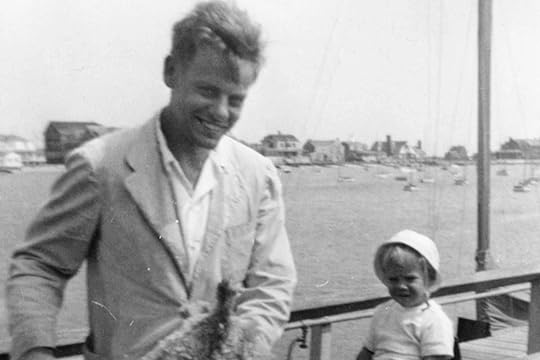
Paul de Man (with his son, Michael) (Source)
The Manufacture of Identity
Vander says of his past:
Then again, perhaps, the question ought to be, what an unreliable narrator? (But if he concedes that he has lied or dissembled, is his story nevertheless/ still unreliable?)(2)
Harlequin in His Half-Mask
In her journal, Cass describes the fake Vander as "Harlequin in his half-mask":
She associates Vander (the academic) with her father (the actor) or, perhaps, the paternalist God (i.e., the "bearded patriarch in the sky"). She also shares some kind of love for them both (or all three?).
Only in death has Cass begun to live fully, for Vander, if only through his story, this novel, as if he had invented his love (and her death).
Caveat Lector
For anybody about to embark on reading the Cleave Trilogy, I highly recommend that you start with "Eclipse" and read "Shroud" second.
"Shroud" actually ends at the same point in time as "Eclipse", and clarifies the questions I had about the fate of Cass, and therefore was intimidated by the risk of spoilers in my review of the first volume. In a sense, "Shroud" itself would be a spoiler, if read before "Eclipse".
FOOTNOTES:
(1) This heading is the title of an essay Jacques Derrida wrote about Paul de Man's experience of World War II.
(2) Is this a case of the liar's paradox?
VERSE:
"Legion of Selves"
[Partly in the Words
Of John Banville]
I am, dear reader,
A legion of selves
Assembled out of
A multitude of
Characters from the
Books upon my shelves.
"Life and Death"
[In the Words of John Banville]
Why should I
Have life, and
She have none?
SOUNDTRACK:
Playing with (the) Fire (of Language and Identity)
This is a wondrous achievement, a novel that wraps you in its sly embrace and seduces you with its rapturous prose, like an illicit lover.
A "Shroud" Contiguous with "The Untouchable"
While the novel was written as the second volume of the Cleave Trilogy, it has much in common with John Banville's earlier novel, "The Untouchable".
The earlier novel concerned a protagonist and narrator (Victor Maskell) who had assumed a false identity, in order to spy for the Soviet Union. A writer and contemporary historian (Serena Vandeleur) had exposed his long-term spying activities in a book that was about to be published, and the newspapers had got onto the story.
What would Maskell do? Defect? Commit suicide? Confess? Make a fool of himself? Disgrace himself?
No, he sat down at his desk to write a version of the events. He doesn't necessarily seek to make himself look good or to add "yet another burnished mask" to the collection he has already assembled:
"I shall strip away layer after layer of grime - the toffee-coloured varnish and caked soot left by a lifetime of dissembling - until I come to the very thing itself and know it for what it is. My soul. My self."
Inevitably, he laughs at his pretence, so that, as beautifully written as that work is, we don't know whether it is genuine or whether it is the product of a truly unreliable narrator.
"Like the Sound of the Sea Deep within a Shell" (1)
"Shroud" has a similar design and construction. The protagonist and sometime narrator is Axel Vander, an academic, who spent his childhood and youth in Antwerp, Belgium and now teaches at a university in Arcady, California.
However, Vander is not the real Axel Vander. The real Vander was a childhood friend, who died early in World War II. The fake Vander was a Jew who assumed the identity of his friend after his death. His motive was not necessarily to obtain some material benefit from the assumption of identity. Instead, it's likely that he was simply trying to avoid becoming a victim of the Holocaust, like the rest of his family.
A Lifetime of Dissembling
He actually had to fabricate a whole new identity for Axel Vander, one that the real Vander had not yet constructed at the time of his death:
"It was not so much that I wanted to be him - although I did, I did want to be him - but that I wanted so much more not to be me. That is to say, I desired to escape my own individuality, the hereness of my self, not the thereness of my world, the world of my lost, poor people.
"I took, or borrowed, rather, nothing except his identity...
"Axel Vander's reputation in the world is of my making. It was I who clawed my way to this high place."
In effect, the fake Vander had become an Other (i.e., his own Other), and was now two.
The Appearance of Cass and Her Research
Meanwhile, a postgraduate literature student (Catherine/ Cass Cleave, the daughter of Alexander Cleave from "Eclipse") has discovered that Axel Vander had written a number of anti-Semitic articles for a collaborationist Belgian newspaper at the beginning of World War II.
She writes a letter to Vander to reveal that she has discovered his back story, and he agrees to meet her in Turin, where he had planned to deliver a speech to an informal conference of academics (he calls the attendees an "influential coterie of savants"):
"That letter, of course, was the crossing point. Now I was cloven in two more thoroughly than ever, I who was always more than myself. On one side there was the I I had been before the letter arrived, and now there was this new I, a singular capital standing at a tilt to all the known things that had suddenly become unfamiliar."
He fears meeting Cass, because he's concerned she might wish to blackmail him or destroy his reputation:
"...what could there be here for me except confrontation, exposure, humiliation...
"[What did she know] about me and my shady, not to say shrouded, past?
A Novel Inspired by a Trilogy of Philosophers
This aspect of the novel is based on the wartime life of the deconstructionist literary critic, Paul de Man, whose own newspaper articles were discovered by a research student only in 1987 after his death (in 1983). The implications of this discovery are still resonating in the corridors of academies of literary theory.
While in Turin, the organiser of the conference, Franco Bartoli, accuses Vander of having murdered his wife, Magda, who has recently died, after a short struggle with an unidentified "malady" ("I know you killed your wife"). Vander says only that he's unsure whether he has been "widowed" or "widowered". He confides, nevertheless, that:
"Only in death has she begun to live fully, for me."
While this accusation isn't explored in detail in the novel, it is based on Louis Althusser's 1980 killing of his wife, Hélène Rytmann, for which "crime" Althusser was declared unfit to stand trial due to insanity.
There is also an echo of Friedrich Nietzsche's shouting "You, inhuman slaughterer of this steed!" at the Turin horseman who was whipping his horse in the street, which preceded Nietzche's degeneration into madness:
"I must have shouted out something, her name, perhaps, for suddenly everyone in the crowded place was looking at me, as they do here, not in alarm or disapproval but simple curiosity."
These philosophers are like the sound of the sea deep within the shell of Banville's character or Vander's identity.
Disarming Cass
Vander soon learns that Cass (who suffers from seizures) is not well:
"I knew that Cass Cleave was mad. Well, not mad, exactly, but not sane either."
This triggers the fake Vander to sit down and write his own story, a la Victor Maskell:
"I shall speak only of what I know, of what I can vouch for."
His story becomes the novel we read. Consistently with Vander's philosophy, his story tempts us to infer that:
"...every text conceals a shameful secret..."
Paul de Man (with his son, Michael) (Source)
The Manufacture of Identity
Vander says of his past:
"I have manufactured a voice, as once I manufactured a reputation, from material filched from others...
"I spent the best part of what I suppose I must call my career trying to drum into those who would listen among the general mob of resistant sentimentalists surrounding me the simple lesson that there is no self: no ego, no precious individual spark breathed into each one of us by a bearded patriarch in the sky, who does not exist either..."
"I had made myself adept at appearing deeply learned in a range of subjects by the skilful employment of certain key concepts gleaned from the work of others, but to which I was able to give a personal twist of mordancy or insight...
"I was fashioning a new methodology of thinking modelled on the crossings and conflicts of my own intricate and, in large part, fabricated past...
"I could not but admire my own performance. What a fabulist I was; what an artist!"
Then again, perhaps, the question ought to be, what an unreliable narrator? (But if he concedes that he has lied or dissembled, is his story nevertheless/ still unreliable?)(2)
Harlequin in His Half-Mask
In her journal, Cass describes the fake Vander as "Harlequin in his half-mask":
"His black half-mask completes the impression of something savage and fiendish, suggesting a cat, a satyr, and executioner..."
"Rip the mask from his face to find - another mask. Father father father."
She associates Vander (the academic) with her father (the actor) or, perhaps, the paternalist God (i.e., the "bearded patriarch in the sky"). She also shares some kind of love for them both (or all three?).
Only in death has Cass begun to live fully, for Vander, if only through his story, this novel, as if he had invented his love (and her death).
Caveat Lector
For anybody about to embark on reading the Cleave Trilogy, I highly recommend that you start with "Eclipse" and read "Shroud" second.
"Shroud" actually ends at the same point in time as "Eclipse", and clarifies the questions I had about the fate of Cass, and therefore was intimidated by the risk of spoilers in my review of the first volume. In a sense, "Shroud" itself would be a spoiler, if read before "Eclipse".
FOOTNOTES:
(1) This heading is the title of an essay Jacques Derrida wrote about Paul de Man's experience of World War II.
(2) Is this a case of the liar's paradox?
VERSE:
"Legion of Selves"
[Partly in the Words
Of John Banville]
I am, dear reader,
A legion of selves
Assembled out of
A multitude of
Characters from the
Books upon my shelves.
"Life and Death"
[In the Words of John Banville]
Why should I
Have life, and
She have none?
SOUNDTRACK:
March 25, 2011
This book is incredibly powerful and moving. It’s a fiction about Paul de Man, who prolifically wrote pro-Nazi and anti-Semitic tracts during World War II, yet who later went on in the U.S. to enjoy a prestigious academic career in which he was known as a major literary critic.
This is from Wikipedia: “Paul de Man (December 6, 1919 – December 21, 1983), born Paul Adolph Michel Deman, was a Belgian-born literary critic and literary theorist. At the time of his death, de Man was one of the most prominent literary critics in the United States—known particularly for his importation of German and French philosophical approaches into Anglo-American literary studies and critical theory. Along with Jacques Derrida, he was part of an influential critical movement that went beyond traditional interpretation of literary texts to reflect on the epistemological difficulties inherent in any textual, literary, or critical activity. This approach aroused considerable opposition, which de Man attributed to ‘resistance’ inherent in the difficult enterprise of literary interpretation itself.”
So de Man was invested in the idea of texts as inherently corrupt, etc, and the rest of the post-modernist dogma, which Banville contrasts with his earlier fascist beliefs. Absolutely stunning.
This is from Wikipedia: “Paul de Man (December 6, 1919 – December 21, 1983), born Paul Adolph Michel Deman, was a Belgian-born literary critic and literary theorist. At the time of his death, de Man was one of the most prominent literary critics in the United States—known particularly for his importation of German and French philosophical approaches into Anglo-American literary studies and critical theory. Along with Jacques Derrida, he was part of an influential critical movement that went beyond traditional interpretation of literary texts to reflect on the epistemological difficulties inherent in any textual, literary, or critical activity. This approach aroused considerable opposition, which de Man attributed to ‘resistance’ inherent in the difficult enterprise of literary interpretation itself.”
So de Man was invested in the idea of texts as inherently corrupt, etc, and the rest of the post-modernist dogma, which Banville contrasts with his earlier fascist beliefs. Absolutely stunning.

September 16, 2025
Una vez estaba en un café con mi amigo Albert cuando se nos acercó una chica sonriente y lo llamó Néstor. Se dieron un par de besos, hablamos unos minutos, y quedaron en llamarse. “¿Néstor?” —le pregunté extrañado cuando la chica se fue—. “Es mi alias de Tinder”, me confesó entre risas. “Ni de coña doy mi nombre verdadero en esos sitios”. Y ahí me quedé, mirándolo, pensando: ¿cuánto de nosotros dejamos atrás cuando nos presentamos así, aunque sea solo en un perfil? ¿Qué perderíamos, qué ganaríamos, si un día decidiéramos dejar de ser quienes somos y vivir para siempre bajo el nombre de otro?
No como un juego de máscaras, no como un alias provisional, sino como una segunda piel que nunca se quita. Esa es la condena de Axel Vander, protagonista de Imposturas, una de las novelas más venenosas y brillantes de John Banville. De esas novelas suyas donde se sumerge en lo que más le gusta: la culpa, la identidad como máscara y la imposibilidad de escapar del propio pasado. Aquí construye un protagonista fascinante y repulsivo a la vez, Axel Vander, un anciano intelectual que carga con un secreto monumental, y toda la trama gira en torno a ese peso, a cómo se puede vivir una vida entera sosteniendo una impostura.
Pero lo más inquietante es que Vander no es un estafador barato: su talento académico, su prestigio intelectual, todo eso es auténtico, un tipo tan brillante como insoportable. El fraude está en la base misma, en el nombre, en la biografía que no le pertenece y que convirtió en suya hasta las últimas consecuencias.
La trama arranca con un viaje a Turín, donde Vander acude convocado por Cass Cleave, hija del Alexander Cleave que conocimos en Eclipse . Esa llamada desde Amberes y el encuentro con la joven funcionan como detonante, pero lo que sigue no es un misterio clásico, sino un suspense psicológico en toda regla. Lo interesante de Vander es cómo se nos presenta: un hombre cargado de prestigio y saber académico, pero con una sombra que se intuye desde el principio. Turín se convierte en un escenario incómodo, casi hostil, donde sus defensas empiezan a resquebrajarse; un lugar tan cargado de tensión que hasta las piedras parecen arrugar el ceño. Aquí la verdadera intriga no es “qué pasará”, sino “qué demonios esconde este hombre y cómo piensa justificarse”.
Pero Banville no construye “sagas” al uso, sino espejos deformantes entre novelas: en Eclipse asistíamos a la descomposición de un actor atrapado en sus fantasmas; en Imposturas vemos a su hija encarnando al pasado que vuelve a ajustar cuentas con otro hombre. Si en la primera veíamos cómo se desmoronaba un actor, aquí tenemos a un académico que jamás se retira: ni de hablar, ni de escribir, ni de mirar a Cass con una intensidad que roza lo perturbador. Es fascinante cómo ambas novelas dialogan sin necesidad de cronologías estrictas: personajes que parecen cruzar un umbral para perseguirse entre libros, como si Banville quisiera recordarnos que sus historias no son tanto relatos aislados como ecos dentro de un mismo túnel oscuro. Vamos, que lees una y ya quieres lanzarte a la otra, porque sospechas que los fantasmas no respetan las fronteras entre libros.
La voz de Vander es el espectáculo central. Su narración es un monólogo sinuoso, cargado de arrogancia, brillantez y un cinismo que resulta tan magnético como, a veces, repulsivo. No falsea sus logros, pero lo impregna todo de un tono teatral que hace que cada página suene como una confesión a medias, un soliloquio donde la verdad y la autocomplacencia se mezclan. Banville logra que nos convirtamos en su público cautivo: sabemos que el hombre nos manipula, pero seguimos escuchando porque su retórica deslumbra. Es el tipo que monopoliza la mesa del café con sus historias y, aunque exagera, nadie se levanta porque da gusto escucharlo. En esto Banville recuerda al Nabokov de Pnin o incluso al Bernhard de El malogrado : retratar al intelectual como una construcción frágil, ridícula y grandiosa al mismo tiempo.
Cass, por su parte, funciona como un espejo invertido: joven, herida, obsesiva, con una mente inestable, es la encarnación de esa memoria que se niega a ser sepultada. La clásica persona que aparece en tu vida y te recuerda lo que intentabas enterrar debajo de la alfombra. Su presencia en la novela no es la de una simple antagonista, sino la fuerza que obliga a Vander a enfrentarse al vacío bajo sus cimientos. Pero lo fascinante no es su relación concreta —que también, aunque no hace falta entrar en detalles—. El choque entre ambos no se resuelve en escenas de acción ni en misterios de manual, sino en algo mucho más perturbador: el enfrentamiento entre el recuerdo que exige su lugar y la identidad que no puede sostenerse sin fisuras.
Pero si algo merece mención aparte es la prosa: barroca, elegante, a ratos irritante en su exceso, pero también deliciosa en su capacidad de crear atmósferas. El estilo es la máscara aquí. No es una escritura que busque la transparencia; si conoces a Banville ya lo sabes: quiere que sientas cada palabra como un golpe de cincel. Pero siempre con ese aire de "soy consciente de estar escribiendo literatura con mayúscula". Para algunos lectores —entre los que me incluyo— es un festín, para otros, lo reconozco, una tortura. Banville escribe como si las palabras le hubieran costado un dineral y quisiera exprimir cada sílaba. Puede cansar, sí, pero es ese exceso lo que convierte la lectura en un placer perverso: irritante y adictivo a la vez. A veces incluso parece que se ría de la idea de “avanzar la trama”, como si nos dijera: “¿Trama? Esto va de escuchar cómo un impostor se hunde en su propio teatro”. Y funciona, porque Vander es tan repelente como adictivo.
Y, mientras nos deslumbra con su teatralidad, no podemos dejar de ver los temas que laten bajo el exceso: la culpa que no prescribe, la fragilidad de la identidad, la decrepitud física enfrentada a un ego que se resiste a ceder. No es casual pensar en Roth y La mancha humana , en cómo un secreto enterrado puede dinamitar la respetabilidad más sólida; o en Sebald con sus obsesiones por los silencios de la historia europea. Pero Banville introduce un matiz irónico y cruel: Vander es talentoso, sí, pero también grotesco, un hombre que triunfó en la academia bajo un nombre robado y que ahora, en su vejez, descubre que ni la elocuencia ni el prestigio bastan para sostener el disfraz.
Cerrar Imposturas deja una sensación ambigua y brillante: la de haber asistido a una confesión que nunca lo es del todo, a un derrumbe narrado con tanto talento que casi parece un triunfo. En un momento, Cass pronuncia algo que me encantó: “nunca vimos la sábana santa”, recordando cómo, una y otra vez, los intentos de acercarse a algo revelador acabaron frustrados. Banville no quiere que admiremos a Vander ni que lo despreciemos sin más; quiere que lo reconozcamos. Y lo peor es que lo hacemos: detrás de la máscara del académico se esconde algo demasiado familiar, esa vocecita que todos tenemos y que dice: “Que no se note la mentira, que no se corra el maquillaje”. Porque en el fondo todos llevamos máscaras, aunque no sean tan grandilocuentes como la suya, aunque solo sea un alias en Tinder. Y ese es el golpe final: la sospecha de que la impostura no es la excepción, sino la norma.
Y sí, cinco estrellas para Imposturas. Porque pocos libros consiguen hacerte sentir al mismo tiempo fascinación y repulsión por su protagonista, deslumbrarte con la prosa y dejarte con esa sensación incómoda de que algo de esa impostura nos toca a todos. Leerlo es asistir a un espectáculo literario que no se anda con medias tintas. Y, sobre todo, porque cuando cierras la última página sigues escuchando la voz de Vander, tan irritante como adictiva, recordándote que incluso la mentira más personal puede convertirse en arte.
En definitiva, una segunda pieza de la trilogía Cleave que funciona como una novela independiente, pero que gana densidad en su diálogo con Eclipse . Una novela venenosa pero bellísima. Una lectura hipnótica, incómoda y brutalmente elegante, que confirma a Banville como uno de esos autores capaces de transformar la mentira más íntima en literatura de altura. Y sí, la farsa es monumental, pero el espectáculo merece la entrada. Aunque, eso sí, que nadie espere palomitas: Banville sirve whisky sin hielo y que cada uno lo aguante como pueda.
No como un juego de máscaras, no como un alias provisional, sino como una segunda piel que nunca se quita. Esa es la condena de Axel Vander, protagonista de Imposturas, una de las novelas más venenosas y brillantes de John Banville. De esas novelas suyas donde se sumerge en lo que más le gusta: la culpa, la identidad como máscara y la imposibilidad de escapar del propio pasado. Aquí construye un protagonista fascinante y repulsivo a la vez, Axel Vander, un anciano intelectual que carga con un secreto monumental, y toda la trama gira en torno a ese peso, a cómo se puede vivir una vida entera sosteniendo una impostura.
Pero lo más inquietante es que Vander no es un estafador barato: su talento académico, su prestigio intelectual, todo eso es auténtico, un tipo tan brillante como insoportable. El fraude está en la base misma, en el nombre, en la biografía que no le pertenece y que convirtió en suya hasta las últimas consecuencias.
La trama arranca con un viaje a Turín, donde Vander acude convocado por Cass Cleave, hija del Alexander Cleave que conocimos en Eclipse . Esa llamada desde Amberes y el encuentro con la joven funcionan como detonante, pero lo que sigue no es un misterio clásico, sino un suspense psicológico en toda regla. Lo interesante de Vander es cómo se nos presenta: un hombre cargado de prestigio y saber académico, pero con una sombra que se intuye desde el principio. Turín se convierte en un escenario incómodo, casi hostil, donde sus defensas empiezan a resquebrajarse; un lugar tan cargado de tensión que hasta las piedras parecen arrugar el ceño. Aquí la verdadera intriga no es “qué pasará”, sino “qué demonios esconde este hombre y cómo piensa justificarse”.
Pero Banville no construye “sagas” al uso, sino espejos deformantes entre novelas: en Eclipse asistíamos a la descomposición de un actor atrapado en sus fantasmas; en Imposturas vemos a su hija encarnando al pasado que vuelve a ajustar cuentas con otro hombre. Si en la primera veíamos cómo se desmoronaba un actor, aquí tenemos a un académico que jamás se retira: ni de hablar, ni de escribir, ni de mirar a Cass con una intensidad que roza lo perturbador. Es fascinante cómo ambas novelas dialogan sin necesidad de cronologías estrictas: personajes que parecen cruzar un umbral para perseguirse entre libros, como si Banville quisiera recordarnos que sus historias no son tanto relatos aislados como ecos dentro de un mismo túnel oscuro. Vamos, que lees una y ya quieres lanzarte a la otra, porque sospechas que los fantasmas no respetan las fronteras entre libros.
La voz de Vander es el espectáculo central. Su narración es un monólogo sinuoso, cargado de arrogancia, brillantez y un cinismo que resulta tan magnético como, a veces, repulsivo. No falsea sus logros, pero lo impregna todo de un tono teatral que hace que cada página suene como una confesión a medias, un soliloquio donde la verdad y la autocomplacencia se mezclan. Banville logra que nos convirtamos en su público cautivo: sabemos que el hombre nos manipula, pero seguimos escuchando porque su retórica deslumbra. Es el tipo que monopoliza la mesa del café con sus historias y, aunque exagera, nadie se levanta porque da gusto escucharlo. En esto Banville recuerda al Nabokov de Pnin o incluso al Bernhard de El malogrado : retratar al intelectual como una construcción frágil, ridícula y grandiosa al mismo tiempo.
Cass, por su parte, funciona como un espejo invertido: joven, herida, obsesiva, con una mente inestable, es la encarnación de esa memoria que se niega a ser sepultada. La clásica persona que aparece en tu vida y te recuerda lo que intentabas enterrar debajo de la alfombra. Su presencia en la novela no es la de una simple antagonista, sino la fuerza que obliga a Vander a enfrentarse al vacío bajo sus cimientos. Pero lo fascinante no es su relación concreta —que también, aunque no hace falta entrar en detalles—. El choque entre ambos no se resuelve en escenas de acción ni en misterios de manual, sino en algo mucho más perturbador: el enfrentamiento entre el recuerdo que exige su lugar y la identidad que no puede sostenerse sin fisuras.
Pero si algo merece mención aparte es la prosa: barroca, elegante, a ratos irritante en su exceso, pero también deliciosa en su capacidad de crear atmósferas. El estilo es la máscara aquí. No es una escritura que busque la transparencia; si conoces a Banville ya lo sabes: quiere que sientas cada palabra como un golpe de cincel. Pero siempre con ese aire de "soy consciente de estar escribiendo literatura con mayúscula". Para algunos lectores —entre los que me incluyo— es un festín, para otros, lo reconozco, una tortura. Banville escribe como si las palabras le hubieran costado un dineral y quisiera exprimir cada sílaba. Puede cansar, sí, pero es ese exceso lo que convierte la lectura en un placer perverso: irritante y adictivo a la vez. A veces incluso parece que se ría de la idea de “avanzar la trama”, como si nos dijera: “¿Trama? Esto va de escuchar cómo un impostor se hunde en su propio teatro”. Y funciona, porque Vander es tan repelente como adictivo.
Y, mientras nos deslumbra con su teatralidad, no podemos dejar de ver los temas que laten bajo el exceso: la culpa que no prescribe, la fragilidad de la identidad, la decrepitud física enfrentada a un ego que se resiste a ceder. No es casual pensar en Roth y La mancha humana , en cómo un secreto enterrado puede dinamitar la respetabilidad más sólida; o en Sebald con sus obsesiones por los silencios de la historia europea. Pero Banville introduce un matiz irónico y cruel: Vander es talentoso, sí, pero también grotesco, un hombre que triunfó en la academia bajo un nombre robado y que ahora, en su vejez, descubre que ni la elocuencia ni el prestigio bastan para sostener el disfraz.
Cerrar Imposturas deja una sensación ambigua y brillante: la de haber asistido a una confesión que nunca lo es del todo, a un derrumbe narrado con tanto talento que casi parece un triunfo. En un momento, Cass pronuncia algo que me encantó: “nunca vimos la sábana santa”, recordando cómo, una y otra vez, los intentos de acercarse a algo revelador acabaron frustrados. Banville no quiere que admiremos a Vander ni que lo despreciemos sin más; quiere que lo reconozcamos. Y lo peor es que lo hacemos: detrás de la máscara del académico se esconde algo demasiado familiar, esa vocecita que todos tenemos y que dice: “Que no se note la mentira, que no se corra el maquillaje”. Porque en el fondo todos llevamos máscaras, aunque no sean tan grandilocuentes como la suya, aunque solo sea un alias en Tinder. Y ese es el golpe final: la sospecha de que la impostura no es la excepción, sino la norma.
Y sí, cinco estrellas para Imposturas. Porque pocos libros consiguen hacerte sentir al mismo tiempo fascinación y repulsión por su protagonista, deslumbrarte con la prosa y dejarte con esa sensación incómoda de que algo de esa impostura nos toca a todos. Leerlo es asistir a un espectáculo literario que no se anda con medias tintas. Y, sobre todo, porque cuando cierras la última página sigues escuchando la voz de Vander, tan irritante como adictiva, recordándote que incluso la mentira más personal puede convertirse en arte.
En definitiva, una segunda pieza de la trilogía Cleave que funciona como una novela independiente, pero que gana densidad en su diálogo con Eclipse . Una novela venenosa pero bellísima. Una lectura hipnótica, incómoda y brutalmente elegante, que confirma a Banville como uno de esos autores capaces de transformar la mentira más íntima en literatura de altura. Y sí, la farsa es monumental, pero el espectáculo merece la entrada. Aunque, eso sí, que nadie espere palomitas: Banville sirve whisky sin hielo y que cada uno lo aguante como pueda.

January 22, 2009
John Banville raya a gran altura en este libro. Con una escritura hipnótica y sofisticada, en 'Imposturas' nos ofrece una historia inteligente, ingeniosa, con momentos crudos y de desesperación, en la que disecciona dos mentes, las de los dos protagonistas, Alex Vander y Cass Cleave. De manera muy habilidosa, Banville crea una nueva novela dándonos a conocer a Cass Cleave, la hija de Alex Cleave, el protagonista de su anterior novela, 'Eclipse'; pero esto no supone que se tenga que leer necesariamente una novela antes que otra, son de lectura totalmente independiente. Es como si las dos novelas hubiesen sido escritas al mismo tiempo, y cuyos argumentos también transcurriesen paralelamente, para desembocar en un mismo final.
En 'Importuras' hay dos voces narrativas. Una es la de Alex Vander, un anciano filósofo de origen europeo afincando en California, cuyos libros lo han hecho célebre. Su mal genio y acritud son habituales en él. Un buen día recibe una carta de una desconocida. Dice que está en Amberes, ciudad natal del escritor, y asegura haber descubierto su verdadera indentidad. En la carta dice que quiere encontrarse con él, y, aprovechando una conferencia que ha de impartir en Turín, acepta. No cabe duda de que está preocupado; oculta secretos que no quiere que salgan a la luz. Vander espera encontrarse a alguien que desea vengarse de él, pero le espera una sorpresa...
La otra voz narrativa del libro es la de Cass Cleave, cuyo padre (que curiosamente también se llama Alex, al igual que Vander), ya conocimos en 'Eclipse', una joven que está de viaje por Europa recabando información para su tesina. Es una chica compleja e inteligente, pero con problemas mentales: oye voces en su cabeza que intenta no escuchar y sufre ataques de vez en cuando. Decir que mantiene una relación difícil con su padre, es quedarse corto. Y también es una ferviente lectora de los libros de Alex Vander...
Como comentaba en la reseña de 'Eclipse', la crítica adora a John Banville, comparándolo con Navokov, Beckett o Roth. Pienso que tienen, salvando las distancias, algo de razón, y el personaje de Vander tiene ciertas similitudes con el Humbert Humbert de 'Lolita', en las pasiones y en ese querer huir de sí mismos.
'Imposturas' es una novela que te arrastra a los oscuros abismos del alma humana, en un viaje de dolor, desesperación y humanidad.
"[...] soy un ser hecho completamente de poses. Es posible que en esto no sea único, puede que le pase lo mismo a todo el mundo, no lo sé ni me importa. Lo que sé es que tras haber vivido en la conciencia, o aunque fuera sólo en la ilusión, de estar constantemente bajo la observación, soy todo fachada; mirad detrás de mí y sólo encontraréis un poco de serrín, unos cuantos pavoneos y una confusión de cables. No hay un hueso sincero en todo el cuerpo de mi texto. [...]"
En 'Importuras' hay dos voces narrativas. Una es la de Alex Vander, un anciano filósofo de origen europeo afincando en California, cuyos libros lo han hecho célebre. Su mal genio y acritud son habituales en él. Un buen día recibe una carta de una desconocida. Dice que está en Amberes, ciudad natal del escritor, y asegura haber descubierto su verdadera indentidad. En la carta dice que quiere encontrarse con él, y, aprovechando una conferencia que ha de impartir en Turín, acepta. No cabe duda de que está preocupado; oculta secretos que no quiere que salgan a la luz. Vander espera encontrarse a alguien que desea vengarse de él, pero le espera una sorpresa...
La otra voz narrativa del libro es la de Cass Cleave, cuyo padre (que curiosamente también se llama Alex, al igual que Vander), ya conocimos en 'Eclipse', una joven que está de viaje por Europa recabando información para su tesina. Es una chica compleja e inteligente, pero con problemas mentales: oye voces en su cabeza que intenta no escuchar y sufre ataques de vez en cuando. Decir que mantiene una relación difícil con su padre, es quedarse corto. Y también es una ferviente lectora de los libros de Alex Vander...
Como comentaba en la reseña de 'Eclipse', la crítica adora a John Banville, comparándolo con Navokov, Beckett o Roth. Pienso que tienen, salvando las distancias, algo de razón, y el personaje de Vander tiene ciertas similitudes con el Humbert Humbert de 'Lolita', en las pasiones y en ese querer huir de sí mismos.
'Imposturas' es una novela que te arrastra a los oscuros abismos del alma humana, en un viaje de dolor, desesperación y humanidad.
"[...] soy un ser hecho completamente de poses. Es posible que en esto no sea único, puede que le pase lo mismo a todo el mundo, no lo sé ni me importa. Lo que sé es que tras haber vivido en la conciencia, o aunque fuera sólo en la ilusión, de estar constantemente bajo la observación, soy todo fachada; mirad detrás de mí y sólo encontraréis un poco de serrín, unos cuantos pavoneos y una confusión de cables. No hay un hueso sincero en todo el cuerpo de mi texto. [...]"

November 12, 2014
I had no idea while reading this book that it was part of a trilogy, together with "Ancient Light" and "Eclipse". I read "Ancient Light" a while ago and although the characters' names from "Shroud" seemed somehow familiar, I thought that it was just my memory playing tricks on me. I was amazed to find out that Cass Cleave here is the daughter of the main character from "Ancient Light" and that Axel Vander is the Axel Vander from "Ancient Light". However, it does not matter much: the story there doesn't influence much the story here and although reading about Cass Cleave here is like understanding somehow the mystery of the Cass Cleave's story narrated there, reading this novel is experiencing a whole new world than the one created in "Ancient Light".
The main character from this story seems to be a highly abominable person. He is certainly not a character that is popular among readers, but rather the opposite. He has however a sad history and his lies are somehow motivated by his history. His story is the story of one of the few Jews that are scarred by the Nazi, but manages to somehow escape and while struggling to survive, he commits the deeds of a common delinquent and he seems to be transformed in the very image of a monster, both his inner side and his outer side developing such an ugliness that he ends up terrifying people around him. However, like most people, he is just a refuge of innumerable and contradictory selves. He commits one of the most abominable sin: he steals from the person who helps him most to survive and he is physically scarred forever for this act and has to live with this print of the past on his body for the rest of his life. He doesn't do this out of lowness of character, but because he wants to fulfill a dream (or is it to escape and forget the awful fate of his people?): he wants to go to Arcady (America), which in his mind is the place where he would be able to be "pure existence", "an affectless point moving through time, nihilism's silver bullet, penetrating clean through every obstacle, shooting holes in the flanks of every moth-eaten monument of so-called civilization." In other words, he wants to start over in a land where the history of his people doesn't hinder him to do so. Axel Vander is one of his friends, a person who, with the raise of the Nazi, starts to show him bit by bit his lowness of character. I don't think that taking his identity after his death is such an awful fact as the author sees here. From the list of his deeds, this would be the least negative one, in my opinion.
We all are, Banville says, like a plane which is able to "hold on to the engines". We are the planes and our minds are the jet engines trying to speed away from them. We are however held together. Cass Cleave who has a mental disease is however barely held together. "The slightest jolt might make her fly apart into a million pieces. Everything was like that, the particles all fused together and trying to pull asunder. One instant of imbalance...and it will all explode." The story here seems to be the same: made of stories fused together which at times seem to lack focus. And this makes me wonder: what do I appreciate most in a book, the story or the style? The story here has shortcomings and it seems unfocused. But the writing! The writing is a delight, every line cast a spell on me. I loved this book: its style is so lyrical, the words seem like woven with grace, with delicacy, with the talent of an artist. This is yet another confirmation of how great a writer Banville is! So, it seems I have my answer: the story might be common...the writing however conquers souls...or at least my soul.
Banville should be better known and appraised at a worldwide scale: he is one of the best contemporary writers Europe has!
The main character from this story seems to be a highly abominable person. He is certainly not a character that is popular among readers, but rather the opposite. He has however a sad history and his lies are somehow motivated by his history. His story is the story of one of the few Jews that are scarred by the Nazi, but manages to somehow escape and while struggling to survive, he commits the deeds of a common delinquent and he seems to be transformed in the very image of a monster, both his inner side and his outer side developing such an ugliness that he ends up terrifying people around him. However, like most people, he is just a refuge of innumerable and contradictory selves. He commits one of the most abominable sin: he steals from the person who helps him most to survive and he is physically scarred forever for this act and has to live with this print of the past on his body for the rest of his life. He doesn't do this out of lowness of character, but because he wants to fulfill a dream (or is it to escape and forget the awful fate of his people?): he wants to go to Arcady (America), which in his mind is the place where he would be able to be "pure existence", "an affectless point moving through time, nihilism's silver bullet, penetrating clean through every obstacle, shooting holes in the flanks of every moth-eaten monument of so-called civilization." In other words, he wants to start over in a land where the history of his people doesn't hinder him to do so. Axel Vander is one of his friends, a person who, with the raise of the Nazi, starts to show him bit by bit his lowness of character. I don't think that taking his identity after his death is such an awful fact as the author sees here. From the list of his deeds, this would be the least negative one, in my opinion.
We all are, Banville says, like a plane which is able to "hold on to the engines". We are the planes and our minds are the jet engines trying to speed away from them. We are however held together. Cass Cleave who has a mental disease is however barely held together. "The slightest jolt might make her fly apart into a million pieces. Everything was like that, the particles all fused together and trying to pull asunder. One instant of imbalance...and it will all explode." The story here seems to be the same: made of stories fused together which at times seem to lack focus. And this makes me wonder: what do I appreciate most in a book, the story or the style? The story here has shortcomings and it seems unfocused. But the writing! The writing is a delight, every line cast a spell on me. I loved this book: its style is so lyrical, the words seem like woven with grace, with delicacy, with the talent of an artist. This is yet another confirmation of how great a writer Banville is! So, it seems I have my answer: the story might be common...the writing however conquers souls...or at least my soul.
Banville should be better known and appraised at a worldwide scale: he is one of the best contemporary writers Europe has!

October 13, 2015
Shroud is the second novel in John Banville's father-and-daughter trilogy involving Alexander and Cassandra Cleave, and can be read as a companion to Banville's novel, Eclipse. (Ancient Light is the third novel in the trilogy.) Whereas Cassandra appeared in Eclipse through her father's melancholy reflections of his estranged and possibly schizophrenic daughter, she appears in Shroud through the dreamlike reflections of her lover, Axel Vander, an aging European intellectual. Much of the novel tells the story of their troubled love affair in Turin, ending with the events described in the final pages of Eclipse. The story resonates with issues of identity, duplicity, and loss. Although Banville has described Shroud as "a dark, hard, cruel book," his writing in Shroud is luminous.

July 9, 2016
Sandwiched between Eclipse and Ancient Light this masterfully crafted tale that tells the story of Axel Vander, the pivotal character of the trilogy. Vander is a real cad; boozer, womanizer and vain beyond belief but he has a secret. Yet under Banville’s skillful words, my disgust for Vander turns as the tale unravels. But so are his characters, all who are flawed but so very interesting as well.
All three books operate like separate stories but are very much intertwined. Having said this, once you read Eclipse, one needs to read Shroud and both books make more sense of Ancient Light, which I read first and is the last of the so-called trilogy.
Sadly one can’t say much without revealing too much about Shroud. Believe me, there is a pack-full story line here and the book is a page turner. Like Shroud, the words are evocative, mesmerizing and wondrous. A master storyteller that can’t be missed.
Weirdly, there is an eclipse in Shroud, an reference to ancient light in both Eclipse and Shroud, and the shroud is the famous Shroud of Turin.
Banville is a master writer and if you are new to him, try this “trilogy” out. Very worth the read.
All three books operate like separate stories but are very much intertwined. Having said this, once you read Eclipse, one needs to read Shroud and both books make more sense of Ancient Light, which I read first and is the last of the so-called trilogy.
Sadly one can’t say much without revealing too much about Shroud. Believe me, there is a pack-full story line here and the book is a page turner. Like Shroud, the words are evocative, mesmerizing and wondrous. A master storyteller that can’t be missed.
Weirdly, there is an eclipse in Shroud, an reference to ancient light in both Eclipse and Shroud, and the shroud is the famous Shroud of Turin.
Banville is a master writer and if you are new to him, try this “trilogy” out. Very worth the read.

December 3, 2020
Beautiful sentences, as in Eclipse, but a much more interesting story, hence a better score. For more details: see this review, or this one.

May 20, 2018
Šta ti je ovo trebalo, mili moj Banvile?
Da mi već dva puta nije pokazao da je stilski otmen, pametan i odmeren, popljuvala bi ga na pasja kola, crnje nego Makjuana onomad.
O, kakvi izlivi saharinske otužnosti, sveto nebo!
Redom, stvari stoje ovako: priča je množina živopisnih scena, uzbudljiva, napisana dinamično (sve sa pojedinostima o koitusima i felacijima), čak kao i misteriozna (iako predvidljiva). Uz to je i Banvilova leksika prilično raspojasana, ne smara ni za trenutak nekakvim eksursima, pa bi trebalo da se dopadne onima koji čitaju pre svega zbog radnje i obrta (dakle, kome se sviđa Makjuanovo "Iskupljenje", na primer ili Išigurov "Zakopani džin" - tu vrstu mučnine mi je izazivao ovaj roman).
Protagonista je odurna ličnost, grozomorna matora drtina, prevarant i lažnjak u svakom smislu, koji se, zahvaljujući drskosti i beskropuloznosti, ozbiljno nabludeo i naprovodio u životu, silno prosperirao svakoraznim malverzacijama, pa i čak izašao na glas uglednog profesora književnosti (recimo). Protagonistkinja je luđakinja, triput mlađa, opsednuta njegovim delom, te, zahvaljujući revnošću fanatične obožavateljke (i malo odurno mističnih okolnosti koje Banvil dodaje) uspeva da prokljuvi pojedinosti koje je ovaj tajio pola veka. I tako se oni, gomilom detalja razrađivani od korice do korice knjige, no ipak neubedljivi – sretnu. Zovu se Kes i Aksel što mi je došlo kao dodatna bljutavost.
E onda Banvil doda a p s o l u t n o s v e što bi teško moglo pasti na pamet i najnaloženijem scenaristi C produkcije, pa samo kita i svatovi fale.
Međutim, koliko god „Pokrov“ ličio na pokušaj da se izađe u bestselerje, a ja bila na ivici šinem u venu špricinu insulina, iz drugog plana (petog, ako ćemo pošteno) nije baš tako i to je jedini razlog što ću i dalje tvrditi da je Džon Banvil dobar pisac i nastaviti da ga čitam. Glavni lik je, zapravo, Hambert, lujka je evropejski obzirnija Lolita i ovo je, uz sve aluzije na Šelija, Bajrona, Petrarku, komediju del arte i svakakva čuda – omaž Nabokovu (za početak i najočiglednije). Ima se još koješta tu istresti – poigrava se formom, smisleno likove oslovljava čas ovako čas onako, planski menja naratore i prepliće događaje, krati ili duži rečenice, namerno patetiše, prilično često mu bljesne sjajna metafora ili stilska bravurica i tako redom, pa bi pregrubo bilo reći da je u pitanju trećerazredni filozofski roman koji palamudi na temu identiteta. Al’ po mnogo tankoj ivici hoda. Što se mene tiče, preko ga strovaljuje pitanje ljubavi koje je suvišno, neuklopivo i trebalo je da ga se mane.
Da smirim savest, još jednom ću istaći da nema ni cele dve smarajuće rečenice, pa je u tom smislu idealna za neko dugačko dosadno putovanje ili čekanje, ali da bi, uprkos tome, sve ispalo mnogo bolje da je kraće za (najmanje!) polovinu. Ovo je deo neke trilogije, mislim drugi, i moguće je da bih promenila utisak kada bih sastavila celinu, ali mi to ne pada na pamet. Ostaću uverena da Banvil ima kapaciteta za poduhvat koga se latio, pa ću mu dati tri, ali da - iz već nekog razloga - stvar nije uspela.
Sad idem da nađem nekog Nemca da me detoksikuje.
Da mi već dva puta nije pokazao da je stilski otmen, pametan i odmeren, popljuvala bi ga na pasja kola, crnje nego Makjuana onomad.
O, kakvi izlivi saharinske otužnosti, sveto nebo!
Redom, stvari stoje ovako: priča je množina živopisnih scena, uzbudljiva, napisana dinamično (sve sa pojedinostima o koitusima i felacijima), čak kao i misteriozna (iako predvidljiva). Uz to je i Banvilova leksika prilično raspojasana, ne smara ni za trenutak nekakvim eksursima, pa bi trebalo da se dopadne onima koji čitaju pre svega zbog radnje i obrta (dakle, kome se sviđa Makjuanovo "Iskupljenje", na primer ili Išigurov "Zakopani džin" - tu vrstu mučnine mi je izazivao ovaj roman).
Protagonista je odurna ličnost, grozomorna matora drtina, prevarant i lažnjak u svakom smislu, koji se, zahvaljujući drskosti i beskropuloznosti, ozbiljno nabludeo i naprovodio u životu, silno prosperirao svakoraznim malverzacijama, pa i čak izašao na glas uglednog profesora književnosti (recimo). Protagonistkinja je luđakinja, triput mlađa, opsednuta njegovim delom, te, zahvaljujući revnošću fanatične obožavateljke (i malo odurno mističnih okolnosti koje Banvil dodaje) uspeva da prokljuvi pojedinosti koje je ovaj tajio pola veka. I tako se oni, gomilom detalja razrađivani od korice do korice knjige, no ipak neubedljivi – sretnu. Zovu se Kes i Aksel što mi je došlo kao dodatna bljutavost.
E onda Banvil doda a p s o l u t n o s v e što bi teško moglo pasti na pamet i najnaloženijem scenaristi C produkcije, pa samo kita i svatovi fale.
Međutim, koliko god „Pokrov“ ličio na pokušaj da se izađe u bestselerje, a ja bila na ivici šinem u venu špricinu insulina, iz drugog plana (petog, ako ćemo pošteno) nije baš tako i to je jedini razlog što ću i dalje tvrditi da je Džon Banvil dobar pisac i nastaviti da ga čitam. Glavni lik je, zapravo, Hambert, lujka je evropejski obzirnija Lolita i ovo je, uz sve aluzije na Šelija, Bajrona, Petrarku, komediju del arte i svakakva čuda – omaž Nabokovu (za početak i najočiglednije). Ima se još koješta tu istresti – poigrava se formom, smisleno likove oslovljava čas ovako čas onako, planski menja naratore i prepliće događaje, krati ili duži rečenice, namerno patetiše, prilično često mu bljesne sjajna metafora ili stilska bravurica i tako redom, pa bi pregrubo bilo reći da je u pitanju trećerazredni filozofski roman koji palamudi na temu identiteta. Al’ po mnogo tankoj ivici hoda. Što se mene tiče, preko ga strovaljuje pitanje ljubavi koje je suvišno, neuklopivo i trebalo je da ga se mane.
Da smirim savest, još jednom ću istaći da nema ni cele dve smarajuće rečenice, pa je u tom smislu idealna za neko dugačko dosadno putovanje ili čekanje, ali da bi, uprkos tome, sve ispalo mnogo bolje da je kraće za (najmanje!) polovinu. Ovo je deo neke trilogije, mislim drugi, i moguće je da bih promenila utisak kada bih sastavila celinu, ali mi to ne pada na pamet. Ostaću uverena da Banvil ima kapaciteta za poduhvat koga se latio, pa ću mu dati tri, ali da - iz već nekog razloga - stvar nije uspela.
Sad idem da nađem nekog Nemca da me detoksikuje.

July 14, 2017
"Quando um nobre pensamento
conduz um coração jovem para além da morada mortal
e a vida e o amor lutam para assim decidir
qual era o seu destino terrestre, ali, vivem os mortos
e, nas noites tempestuosas, chegam como ventos de luz."
— Percy Shelley
THE CLEAVE TRILOGY - Livro II
O Impostor

(Francisco Goya, The Madness Of Fear)
Personagens principais
Axel Vander
Catherine Cleave (filha de Alex e Lydia)
Magda (mulher de Axel)
Pequeno resumo
Axel Vander (o narrador) é um conceituado professor e escritor, com um passado obscuro, que se desloca a Itália para se encontrar com Catherine Cleave que lhe diz conhecer o seu segredo. Entre a jovem e o idoso desenvolve-se uma dramática e complexa relação.
Nota: não dou muita importância às capas dos livros, mas a desta edição incomoda-me por ser completamente inadequada ao conteúdo deste livro. Quem a seleccionou não o pode ter lido, pois não é um romance cor-de-rosa, nem uma história amorosa entre dois jovens, como sugere a foto.
conduz um coração jovem para além da morada mortal
e a vida e o amor lutam para assim decidir
qual era o seu destino terrestre, ali, vivem os mortos
e, nas noites tempestuosas, chegam como ventos de luz."
— Percy Shelley
THE CLEAVE TRILOGY - Livro II
O Impostor
(Francisco Goya, The Madness Of Fear)
Personagens principais
Axel Vander
Catherine Cleave (filha de Alex e Lydia)
Magda (mulher de Axel)
Pequeno resumo
Axel Vander (o narrador) é um conceituado professor e escritor, com um passado obscuro, que se desloca a Itália para se encontrar com Catherine Cleave que lhe diz conhecer o seu segredo. Entre a jovem e o idoso desenvolve-se uma dramática e complexa relação.
"O tempo e a idade não me trouxeram a esperada sabedoria, mas confusão e uma incompreensão cada vez maior, traçando de ano para ano um novo círculo de ignorância. Que sei eu?"
Nota: não dou muita importância às capas dos livros, mas a desta edição incomoda-me por ser completamente inadequada ao conteúdo deste livro. Quem a seleccionou não o pode ter lido, pois não é um romance cor-de-rosa, nem uma história amorosa entre dois jovens, como sugere a foto.

November 17, 2019
An old renown writer going by the name of Axel Vander receives an anonymous letter, someone has found his secret, which is, he is not what he purports to be. It is from here, that the unfolding of the protagonist begins.
This being the first book I have read by John Banville, I am impressed by his skill and ability to craft such a brilliant unreliable narrator as his protagonist is. Axel Vander, is a rude, self-absorbed, self-important, selfish individual who for the most part talks and thinks solely of himself, everything and everyone else simply being complementary to his needs, wants, whims and thoughts. His narration going on and on—he truly does not shut up—provides an examination of self, which is the main theme of the story. To sum it up: what is the genuine self and the layers we form to create and mask our identities.
It is a fascinating read, fascinating enough to interest me in the writer and more of his books, Axel however just bored me with the continuous rambling.
This being the first book I have read by John Banville, I am impressed by his skill and ability to craft such a brilliant unreliable narrator as his protagonist is. Axel Vander, is a rude, self-absorbed, self-important, selfish individual who for the most part talks and thinks solely of himself, everything and everyone else simply being complementary to his needs, wants, whims and thoughts. His narration going on and on—he truly does not shut up—provides an examination of self, which is the main theme of the story. To sum it up: what is the genuine self and the layers we form to create and mask our identities.
It is a fascinating read, fascinating enough to interest me in the writer and more of his books, Axel however just bored me with the continuous rambling.

July 13, 2020
"Σάβανο"
Ένα σάβανο που καλύπτει χαρακτήρες κ ανθρώπινες υποστάσεις.
Ήρωες με κρυμμένα μυστικά, άνθρωποι με δυαδικές συμπεριφορές. Ψυχικές διαταραχές κατατρύχουν τις ψυχές τους κ τους μεταλλάσσουν σε ψεύτες απογυμνώνοντάς τους από κάθε ηθική αξία.
Γυναίκες κατακλύζουν τη ζωή του Άξελ Βάντερ, ενός καθηγητή που ως στόχο έχει να κατακτήσει τη φύση του κ να αποκωδικοποιήσει την ταυτότητά του.
Το ανάγνωσμα βρίθει από χιμαιρικές εικόνες, σκηνές ψεύδους, λαβυρινθώδεις αναζητήσεις της αλήθειας.
Τα μυστικά που δεξιοτεχνικά απέκρυψε ο συγγραφέας στο πρώτο βιβλίο αποκαλύπτονται στον αναγνώστη στο δεύτερο μέρος με σιβυλλικό τρόπο δίνοντάς του συνεχώς νέα στοιχεία. Με αυτόν τον τρόπο ο αναγνώστης συλλέγει τα τεκμήρια, συνθέτει κ πλάθει ολοκληρωτικά την υπόσταση των ιδιαίτερων προσωπικοτήτων αυτού του μυστηριακού έργου.
Ένα σάβανο που καλύπτει χαρακτήρες κ ανθρώπινες υποστάσεις.
Ήρωες με κρυμμένα μυστικά, άνθρωποι με δυαδικές συμπεριφορές. Ψυχικές διαταραχές κατατρύχουν τις ψυχές τους κ τους μεταλλάσσουν σε ψεύτες απογυμνώνοντάς τους από κάθε ηθική αξία.
Γυναίκες κατακλύζουν τη ζωή του Άξελ Βάντερ, ενός καθηγητή που ως στόχο έχει να κατακτήσει τη φύση του κ να αποκωδικοποιήσει την ταυτότητά του.
Το ανάγνωσμα βρίθει από χιμαιρικές εικόνες, σκηνές ψεύδους, λαβυρινθώδεις αναζητήσεις της αλήθειας.
Τα μυστικά που δεξιοτεχνικά απέκρυψε ο συγγραφέας στο πρώτο βιβλίο αποκαλύπτονται στον αναγνώστη στο δεύτερο μέρος με σιβυλλικό τρόπο δίνοντάς του συνεχώς νέα στοιχεία. Με αυτόν τον τρόπο ο αναγνώστης συλλέγει τα τεκμήρια, συνθέτει κ πλάθει ολοκληρωτικά την υπόσταση των ιδιαίτερων προσωπικοτήτων αυτού του μυστηριακού έργου.

August 20, 2008
I have a hard time assigning stars to this review. Whereas I was mesmerized by Banville's writing, I found this story and the characters dismal. Axel Vander evoked by pity and revulsion and had not one redeeming quality that I can recall. "Miss Nemesis" was pathetic and cruel. Even the gracious setting of Turin (thus, the most obvious reference in the title "Shroud") couldn't lift the oppressive cloud of lethargy and depression that permeated this novel.
But there is a twist that kept me turning the pages. That, and Banville's astonishing power as a writer. I will read more, if only to immerse myself in his fierce style.
But there is a twist that kept me turning the pages. That, and Banville's astonishing power as a writer. I will read more, if only to immerse myself in his fierce style.

September 18, 2009
I love Irish fiction and John Banville is not only one of Ireland’s best prose stylists, he’s one of the best prose stylists writing today. He’s not a well-known author, and unfortunately, I doubt that he’ll ever be on the top of the bestseller list (unless as Benjamin Black), though he certainly deserves to be. His books are masterpieces of style; they are highly introspective, character driven stories of men who have attempted to build lives on the basis of fraud and deceit, only to see those lives eventually come tumbling down around them like the flimsiest house of cards. In The Untouchable, Banville introduced us to the art critic and Soviet agent, Anthony Blunt. In Eclipse, it was the embittered actor, Alex Cleave. In Shroud, it’s Axel Vander, virtuoso of the lie, who takes center stage, for Banville lets us know almost immediately, Axel Vander is not really Axel Vander, although Vander, himself says he is at the beginning of his tale:
My name is Axel Vander, on that much I insist. That much, if no more.
We first encounter Axel Vander in his home in quaint Arcady, California (a very thinly disguised Berkeley). Vander’s a Belgian born intellectual, a professor and internationally known literary scholar. But, as in all of Banville’s works, nothing is at it really seems, and we soon find out that Vander has much he’s been hiding. As Vander says:
All my life I have lied. I lied to escape, I lied to be loved, I lied for placement and power; I lied to lie.
It’s quite clear that Banville, who likes to base his novels on the lives of historical persons, has based the character of Axel Vander on Paul de Man, a Belgian born Yale scholar and founder of deconstrutivism. Although de Man was revered when he died in 1983, in 1987 it was discovered that as a young man in Belgium, he’d written several very anti-Semitic articles for the Flemish newspaper, Le Soir. Vander’s dead wife, Magda, even shares her name with de Man’s wife. Vander also seems to have been drawn, to a lesser degree, from French Marxist philosopher, Louis Althusser, a man who, like de Man, was revered as a cult figure, and a man who, like Vander, murdered his own wife.
Although Vander seems proud of his lies, and proud that he’s gotten away with them, this decidedly misanthropic, elderly widower doesn’t like himself any more than he likes others. He’ll chase people away from him with his walking stick, he’s almost always drunk and he describes himself as a man with:
that gnarled leg, that crazily skewed dead eye, and all that sagging flesh, the pot belly and the shrunken acorn below and its bag suspended by an attenuated string of yellowed skin like the head of garlic on its stalk.
Axel Vander doesn’t spare others, but to his credit, he doesn’t spare himself, either.
The day we meet Axel, he’s just received a letter from a woman in Belgium, a researcher who's stumbled upon the truth of Axel’s past quite by accident and now, for reasons unknown, is threatening to unmask him. Axel is determined not to put up with any such thing, especially not so late in his life, when he has but little life left. He arranges to meet his nemesis in Turin, that northern Italian city whose claim to fame is that it is the home of the once revered Shroud of Turin, a shroud that has been shown to be as fake as is Axel Vander, himself.
Vander, a Nietzsche scholar, with "a passionate and all-consuming belief in nothing" plans on attending a seminar on Nietzsche at the university in Turin (the city where Nietzsche had his final breakdown), and he also plans on doing away with his would-be unmasker.
When Vander, who could hardly be a less sympathetic character, arrives in Turin, however, his nemesis is not who and what he thought she would be. When Vander meets Cass Cleave, a fair, fragile, red-haired Irish beauty, rather than feeling the murderous rage he was prepared to feel he felt:
…as if I had come face-to-face on a forest path with a rare and high-strung creature of the wild that had paused a second in quivering curiosity and would in another second be gone with a crash of leaves. I knew the type. They always sat at the highest tier of the lecture hall, fixed on me hungrily, never speaking a word unbidden.
Cass Cleave, it would seem, is certainly no match for Axel Vander. In addition to being frail and fragile, she suffers from Mandelbaum’s Syndrome, a syndrome that causes her to have seizures and aural hallucinations despite the fact that she’s tried several different kinds of medication, all with very allusive sounding names: Oread, Empusa, various Lemures and Lamia.
Shockingly, Vander and Cass embark upon an affair, and Vander says:
I loved her. I have allowed I hope a decent interval for the laughter, the jeers and the catcalls to subside.
In fact, Vander and Cass spend three months in Turin, making love, visiting castles and cemeteries and trying, in vain, to view the notorious shroud. As this unlikely duo makes its way around Turin, we are told most of the story in the first person, from Axel’s point of view, though at times, Banville switches to the third person and gives us Cass’s thoughts as well. Cass, we learn, is a woman fighting demons of her own, but just what those demons are, other than the syndrome to which she’s subject, is never made completely clear. Like Axel’s identity Cass’s demons, as well as her motives in contacting Axel Vander, are quite opaque and misty.
Axel Vander seems to be searching for "one last chance" in the person of Cass Cleave. He seems to see her as his redemption, and for that reason, his desire for her knows no bounds.
Cass doesn’t have quite the same passion for Axel, though she does feel much for him. She does, however, have a passion for death and she wishes to be:
Gone like that without a sound, like slipping out of a room and turning and quietly closing the door; in her mind she saw a hand, it was hers, slowly relinquish the polished knob and her miniature, curved reflection on it shrink to a dot of darkness and disappear.
Vander and Cass are, of course, both headed for tragedy on a grand scale. That’s not a spoiler; that’s something that’s obvious from page one.
As in all of John Banville’s books, ghosts and specters flit through Shroud. In particular, is a red-haired man who is always following Axel Vander. Whether this man is real or is simply a product of Vander’s fevered imagination is never made known, but one thing that is clear is that he is based on the red-haired man who shadowed von Aschenbach through much of Thomas Mann’s gorgeous novella, Death in Venice. And Vander and Cass eventually come to be seen as something of a King Lear and a Cordelia, though on a much less grand scale. Banville loves allusions and so do I, but Shroud, I think, may suffer from a few too many. The problem is, that while Banville’s languidly exquisite prose is still very much in evidence, the story, itself simply can’t support all the allusions Banville heaps upon it. And Axel Vander and Cass Cleave eventually come to be seen, not as Lear and Cordelia, but as Harlequin and Columbine.
I think it goes without saying that Axel Vander is a very unsympathetic figure, but Cass Cleave, despite her many problems...perhaps because of her many problems…is not a sympathetic figure, either. She’s barely more than a shadow, a wisp of a human being. While it’s difficult to understand what would entice her to enter into a sexual relationship with someone as unsavory as Vander, it’s even more of a mystery how someone so frail and fragile could endure Vander’s sexual predilections. It was also not believable to me that someone like Axel Vander, who had spent his entire adult life building and maintaining a lie, would see, in the very thinly drawn Cass Cleave, a chance for redemption. Indeed, it strains credibility to even think that Axel Vander would even consider redemption to be something he should seek.
The book begins wonderfully and I could see that Banville was going to explore one of his favorite themes: the uncertainty of identity and the fragility of the self, but about halfway through the book, at the point where Axel and Cass begin their love affair, all verisimilitude, for me, at least, was lost. Axel Vander committed his crimes so he could come to the United States because there he says he would not be required to be or do anything. He could be pure existence, itself. And now he is risking throwing it all away.
Cass Cleave just wasn’t a strong enough character to cause this kind of change in anyone, although Vander says:
I seized on her to be my authenticity….She was my last chance to be me.
Okay, fine. But Axel Vander has spent the last sixty years obliterating "me. I just couldn’t buy his sudden turn around simply because Cass Cleave discovered his real identity. And that brings me to yet another problem with this book.
Shroud is an extremely atmospheric book, drenched in death and decay. Some of the descriptions of rain-soaked Turin are gorgeous in the extreme and the book is almost worth reading for those descriptions alone. But, Banville has filled Shroud with mystery. He’s set his readers up for a huge revelation that never comes. And what little does come is pretty inconsequential, in the grand scheme of things. Certainly nothing worthy of the demons both Vander and Cass are attempting to elude.
I’m not sorry I read Shroud. I did thoroughly enjoy it, more than some better written books, and I am an admitted "Banville junkie." I want to read everything he writes, if not for the story, then simply for the gorgeous prose. Perhaps Edna O’Brien, a fellow countryman of Banville’s is the only author writing today who can string words together as beautifully as does Banville.
Although gorgeously written in Banville’s exquisitely voluptuous prose, and to the author’s credit, eschewing all sentimentality, in the end, Shroud just doesn’t pull it together. Still, I would recommend it, as long as the reader knows he won’t be entirely satisfied in the end.
My name is Axel Vander, on that much I insist. That much, if no more.
We first encounter Axel Vander in his home in quaint Arcady, California (a very thinly disguised Berkeley). Vander’s a Belgian born intellectual, a professor and internationally known literary scholar. But, as in all of Banville’s works, nothing is at it really seems, and we soon find out that Vander has much he’s been hiding. As Vander says:
All my life I have lied. I lied to escape, I lied to be loved, I lied for placement and power; I lied to lie.
It’s quite clear that Banville, who likes to base his novels on the lives of historical persons, has based the character of Axel Vander on Paul de Man, a Belgian born Yale scholar and founder of deconstrutivism. Although de Man was revered when he died in 1983, in 1987 it was discovered that as a young man in Belgium, he’d written several very anti-Semitic articles for the Flemish newspaper, Le Soir. Vander’s dead wife, Magda, even shares her name with de Man’s wife. Vander also seems to have been drawn, to a lesser degree, from French Marxist philosopher, Louis Althusser, a man who, like de Man, was revered as a cult figure, and a man who, like Vander, murdered his own wife.
Although Vander seems proud of his lies, and proud that he’s gotten away with them, this decidedly misanthropic, elderly widower doesn’t like himself any more than he likes others. He’ll chase people away from him with his walking stick, he’s almost always drunk and he describes himself as a man with:
that gnarled leg, that crazily skewed dead eye, and all that sagging flesh, the pot belly and the shrunken acorn below and its bag suspended by an attenuated string of yellowed skin like the head of garlic on its stalk.
Axel Vander doesn’t spare others, but to his credit, he doesn’t spare himself, either.
The day we meet Axel, he’s just received a letter from a woman in Belgium, a researcher who's stumbled upon the truth of Axel’s past quite by accident and now, for reasons unknown, is threatening to unmask him. Axel is determined not to put up with any such thing, especially not so late in his life, when he has but little life left. He arranges to meet his nemesis in Turin, that northern Italian city whose claim to fame is that it is the home of the once revered Shroud of Turin, a shroud that has been shown to be as fake as is Axel Vander, himself.
Vander, a Nietzsche scholar, with "a passionate and all-consuming belief in nothing" plans on attending a seminar on Nietzsche at the university in Turin (the city where Nietzsche had his final breakdown), and he also plans on doing away with his would-be unmasker.
When Vander, who could hardly be a less sympathetic character, arrives in Turin, however, his nemesis is not who and what he thought she would be. When Vander meets Cass Cleave, a fair, fragile, red-haired Irish beauty, rather than feeling the murderous rage he was prepared to feel he felt:
…as if I had come face-to-face on a forest path with a rare and high-strung creature of the wild that had paused a second in quivering curiosity and would in another second be gone with a crash of leaves. I knew the type. They always sat at the highest tier of the lecture hall, fixed on me hungrily, never speaking a word unbidden.
Cass Cleave, it would seem, is certainly no match for Axel Vander. In addition to being frail and fragile, she suffers from Mandelbaum’s Syndrome, a syndrome that causes her to have seizures and aural hallucinations despite the fact that she’s tried several different kinds of medication, all with very allusive sounding names: Oread, Empusa, various Lemures and Lamia.
Shockingly, Vander and Cass embark upon an affair, and Vander says:
I loved her. I have allowed I hope a decent interval for the laughter, the jeers and the catcalls to subside.
In fact, Vander and Cass spend three months in Turin, making love, visiting castles and cemeteries and trying, in vain, to view the notorious shroud. As this unlikely duo makes its way around Turin, we are told most of the story in the first person, from Axel’s point of view, though at times, Banville switches to the third person and gives us Cass’s thoughts as well. Cass, we learn, is a woman fighting demons of her own, but just what those demons are, other than the syndrome to which she’s subject, is never made completely clear. Like Axel’s identity Cass’s demons, as well as her motives in contacting Axel Vander, are quite opaque and misty.
Axel Vander seems to be searching for "one last chance" in the person of Cass Cleave. He seems to see her as his redemption, and for that reason, his desire for her knows no bounds.
Cass doesn’t have quite the same passion for Axel, though she does feel much for him. She does, however, have a passion for death and she wishes to be:
Gone like that without a sound, like slipping out of a room and turning and quietly closing the door; in her mind she saw a hand, it was hers, slowly relinquish the polished knob and her miniature, curved reflection on it shrink to a dot of darkness and disappear.
Vander and Cass are, of course, both headed for tragedy on a grand scale. That’s not a spoiler; that’s something that’s obvious from page one.
As in all of John Banville’s books, ghosts and specters flit through Shroud. In particular, is a red-haired man who is always following Axel Vander. Whether this man is real or is simply a product of Vander’s fevered imagination is never made known, but one thing that is clear is that he is based on the red-haired man who shadowed von Aschenbach through much of Thomas Mann’s gorgeous novella, Death in Venice. And Vander and Cass eventually come to be seen as something of a King Lear and a Cordelia, though on a much less grand scale. Banville loves allusions and so do I, but Shroud, I think, may suffer from a few too many. The problem is, that while Banville’s languidly exquisite prose is still very much in evidence, the story, itself simply can’t support all the allusions Banville heaps upon it. And Axel Vander and Cass Cleave eventually come to be seen, not as Lear and Cordelia, but as Harlequin and Columbine.
I think it goes without saying that Axel Vander is a very unsympathetic figure, but Cass Cleave, despite her many problems...perhaps because of her many problems…is not a sympathetic figure, either. She’s barely more than a shadow, a wisp of a human being. While it’s difficult to understand what would entice her to enter into a sexual relationship with someone as unsavory as Vander, it’s even more of a mystery how someone so frail and fragile could endure Vander’s sexual predilections. It was also not believable to me that someone like Axel Vander, who had spent his entire adult life building and maintaining a lie, would see, in the very thinly drawn Cass Cleave, a chance for redemption. Indeed, it strains credibility to even think that Axel Vander would even consider redemption to be something he should seek.
The book begins wonderfully and I could see that Banville was going to explore one of his favorite themes: the uncertainty of identity and the fragility of the self, but about halfway through the book, at the point where Axel and Cass begin their love affair, all verisimilitude, for me, at least, was lost. Axel Vander committed his crimes so he could come to the United States because there he says he would not be required to be or do anything. He could be pure existence, itself. And now he is risking throwing it all away.
Cass Cleave just wasn’t a strong enough character to cause this kind of change in anyone, although Vander says:
I seized on her to be my authenticity….She was my last chance to be me.
Okay, fine. But Axel Vander has spent the last sixty years obliterating "me. I just couldn’t buy his sudden turn around simply because Cass Cleave discovered his real identity. And that brings me to yet another problem with this book.
Shroud is an extremely atmospheric book, drenched in death and decay. Some of the descriptions of rain-soaked Turin are gorgeous in the extreme and the book is almost worth reading for those descriptions alone. But, Banville has filled Shroud with mystery. He’s set his readers up for a huge revelation that never comes. And what little does come is pretty inconsequential, in the grand scheme of things. Certainly nothing worthy of the demons both Vander and Cass are attempting to elude.
I’m not sorry I read Shroud. I did thoroughly enjoy it, more than some better written books, and I am an admitted "Banville junkie." I want to read everything he writes, if not for the story, then simply for the gorgeous prose. Perhaps Edna O’Brien, a fellow countryman of Banville’s is the only author writing today who can string words together as beautifully as does Banville.
Although gorgeously written in Banville’s exquisitely voluptuous prose, and to the author’s credit, eschewing all sentimentality, in the end, Shroud just doesn’t pull it together. Still, I would recommend it, as long as the reader knows he won’t be entirely satisfied in the end.

June 5, 2015
Shroud has possibly the most obnoxious narrator I can remember encountering. This alone made it difficult to warm to this novel. The rather pretentious prose irritated me as well. Considering how little happens in the story the writing is unrelentingly melodramatic. Not for me I’m afraid.

June 22, 2019
...that was certainly my least favourite Banville!

May 6, 2009
This is a book in three parts. It started horribly slow for me in the first part, picked up in the second part and finished very well in the last; in fact, it was the last that saved it. What happened? The first part displayed the typical Banville love of words and language over story and meaning, flowery expressions and intricate phrasing that lead nowhere in particular except to show his command of vocabulary and an ability to hint at things to come without inciting much interest in what those things might be, nobody particularly sympathetic, nothing but a pile of words. The second part had a familiar story of Nazi-occupied Belgium, although it could have been anywhere since there's nothing particularly Belgian in this and I suspect Belgium was chosen just to be different, followed by a switch of identities, all broadly signaled in the first part and carried out in the second. Nothing special yet. However the third part's story of love and loss was where Banville's talent shows as his talented weave of subtle language and emotion beyond words really moved me and made the book worthwhile. This is my third Banville book and I wonder if he ever moves off old men looking back in wistfulness and suffering but it works here at last if you have the patience for it.

September 24, 2021
Another masterpiece by John Banville.
4* The Book of Evidence
4* O mar
3* Shroud (The Cleave Trilogy #2)
2* Ancient Light (The Cleave Trilogy #3)
2*Bowen and Betjeman
4* Kepler (The Revolutions Trilogy #2)
4* The Untouchable
TR Mrs Osmond
TR Athena (The Freddie Montgomery Trilogy #3)
TR The Blue Guitar
TR Imagens de Praga
TR Doctor Copernicus (The Revolutions Trilogy #1)
TR The Newton Letter (The Revolutions Trilogy #3)
4* The Book of Evidence
4* O mar
3* Shroud (The Cleave Trilogy #2)
2* Ancient Light (The Cleave Trilogy #3)
2*Bowen and Betjeman
4* Kepler (The Revolutions Trilogy #2)
4* The Untouchable
TR Mrs Osmond
TR Athena (The Freddie Montgomery Trilogy #3)
TR The Blue Guitar
TR Imagens de Praga
TR Doctor Copernicus (The Revolutions Trilogy #1)
TR The Newton Letter (The Revolutions Trilogy #3)
Displaying 1 - 30 of 179 reviews