Юрий Мамлеев — родоначальник жанра метафизического реализма, основатель литературно-философской школы. Сверхзадача метафизика — раскрытие внутренних бездн, которые таятся в душе человека. Самое афористичное определение прозы Мамлеева — Литература конца света. Жизнь довольно кошмарна: она коротка... Настоящая литература обладает эффектом катарсиса – который безусловен в прозе Юрия Мамлеева – ее исход таинственное очищение, даже если жизнь описана в ней как грязь. Главная цель писателя – сохранить или разбудить духовное начало в человеке, осознав существование великой метафизической тайны Бытия. В 1 том Собрания сочинений вошли знаменитый роман "Шатуны", не менее знаменитый "Южинский цикл" и нашумевшие рассказы 60-70-х годов.
Born in 1931 in Moscow, Yuri Mamleyev began writing in the 1960s. During that time, the author led a “double life.” By day, he taught mathematics, but in the evenings he hosted a secret circle of intellectuals. Discussing Indian and German philosophy, theosophy and psychoanalysis, the members of this undercover literary and philosophical circle called themselves “sexual mystics.”
Mamleyev’s works could only be sold in Russia through Samizdat and in the 1980s began to appear in the West. In 1974, Mamleyev emigrated to the U.S., and later lived in Paris. He returned to Russia in 1993 and, today, alternates between Moscow and Paris. Younger Moscow writers such as Vladimir Sorokin or Victor Yerofeyev venerate him as “the heir to both Gogol and Dostoyevsky.”
In 2000, Mamleyev was awarded the Pushkin Prize by the Alfred Toepfe Foundation and the International PEN Club, and he was a scholar at the German Foundation, Preußische Seehandlung.
Mamleyev is considered the “most Russian” writer in Russia today. He founded a new literary current called “metaphysical realism.” Vladimir Spakov wrote of Mamleyev in The Petersburg Book Journal:
“His prose is devoid of actual events… but it holds something else instead: an eternal thing that has forever been part of man, but which nobody likes to be confronted with. The mirror he holds up to us has turned black, reflecting our dark side. To do so, it needed a writer capable of standing at the abyss without falling and of telling the more frightful among us who pretend to be ‘civilized': There are monsters hiding in you!”
Mamleyev’s heroes are often characterized as “idiots”, “feeble-minded”, or “dopes” – but in fact they are all in love with being and dream of immortality. They want to understand the incomprehensible, and find answers to questions beyond the realm of human reason. They have entered a prohibited area. While Mamleyev’s figures seem to emerge from a grotesque and evil fairy tale, he places them into a realistic context. And that is why his prose is both unbelievably credible and merciless.
Ben Hooyman, who teaches at Columbia University, has a keen interest in the writings of the Russian author Yuri Mamleyev. Ben was kind enough to share with me a Mamleyev story that had not been previously published in English. Now, I would like to share it with you.
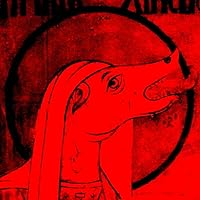
Yuri Mamleyev was a writer who could shock and outrage a reader, an author who was a prime influence for many younger writers such as Vladimir Sorokin and Victor Pelevin. And since Yuri Mamleyev's writing touches on the grotesque and surreal, I've included the above art by Russian artist Geliy Korzhev.
I'm sure you'll agree - Gunfire is quite the tale. Enjoy!
GUNFIRE
What did Fyodor Kuzmich do with his life?
Answer: He chased rats. He did not know himself why he was preordained for such an activity. He remembered nothing of his childhood, nor anything of his previous incarnation.
He did not even think that he slept, went to work, or lunched in the dark cafeteria. Though he really did perform all these actions and, owing to that, apparently, he existed.
Could one call him a practical man?
Hardly. But for “the main event,” for catching rats, in other words, he demonstrated the requisite acuity and sanity of mind. It is enough to say that he exchanged his sunny, independently-owned apartment for a dirty room in a basement, where, if the rumors are true, rats lived in abundance. His little room was located somewhere in the corner of an old house. It had a special entrance, frighteningly isolated from the other rooms by a never-ending series of stairways, pigeonholes, walls, and a kind of eternal darkness.
Fyodor Kuzmich was then only a young man of about twenty with a tousled jaw and almost invisible little eyes. He flatly refused to acknowledge his own parentage by the two respectable citizens who brought him into the world.
One self-assured, though self-absorbed girl proposed to him. Fyodor inexplicably sent her to a pipe sticking up far into a field where a factory had fallen into disrepair. No one else ever tried proposing to him. And his life flowed by in astonishing monotony and in great isolation. He never drank away his earnings, and, feeding himself on little better than pig slop, he stashed all his money away in a little bank he kept hidden in a doghouse… Once Fyodor bought a hunting rifle, but that was the only serious purchase he ever made.
“The main event” unfolded like this. Fyodor would wake up at night on his half-bed from a kind of inner prayer. He would then light his lamp, though there were no icons around to be illuminated by it. The whole floor already looked like it was alive: it was covered with a horde of rats, and mice, too. And Fyodor would scatter food for them to eat each night.
Then, in nothing but his underwear, Fyodor would mentally press himself against the wavering flame of the lamp and unload his rifle into the rats with great abandon. Thunder shook the room. For that reason, all the glass in it was usually broken.
Ten years passed just like that.
In spite of the outlandish abundance of rats in the area, Fyodor began to notice that far fewer gathered around him at night. Even though, in all those ten years, he had not killed a single one of them. But, perhaps, such impetuous gunfire had traumatized them.
Then Fyodor decided to catch the rats with his bare hands. It never occurred to him that they might bite, and they really never did – a reflection of how trans-biological his relationship was with them.
Waking in the middle of the night – not from inner prayer anymore, but from a beautiful, imagistic, almost childlike dream, – Fyodor would hastily light his trusty lamp that had nevertheless become colder and closer to death. The strange absence of icons beside the source of light, the emptiness of the naked wall, was an indication of the lamp’s transubstantiation.
Half-naked, performing several ridiculous, almost clinical hops up and sideways, Fyodor threw himself into the thick of the creatures scurrying across his floor. Now that he was unarmed, they stopped fearing him completely, slipping out from between his fingers. And, getting down on all fours, Fyodor jumped after them as they darted from side to side.
Could it be that the rats intuited an ulterior motive at play, divined that Fyodor had no intention of hunting them? But what was motivating him? In the first five years, he only managed to catch four rats by the tail. But Fyodor could not remember what he did with them afterwards.
In truth, no one knew that Fyodor chased rats. His longtime habit of firing his rifle was interpreted as defensive training. And, in recent years, he had become a generally quiet man, getting by with only his quasi-hopping.
Ten years passed just like that.
Promising changes developed in the same space he had always occupied, inside of that closed structure of his, the structure giving him the means to achieve a stable existence. Now Fyodor did not merely chase after rats, he chased rat phantoms, too. He would start chasing ‘them’ in the afternoon, jumping after them in all directions, though ‘in truth’ the rats were not there at all at that time of day. The pursuit of unreal rats made his life easier right away somehow. Life became more lucid, more poetic, for the demanding, gloomy, daily obligation that had once plagued him – the need to wake up in the middle of the night – was no longer necessary. These interruptions of his sleep were the only reason why Fyodor perceived his occupation as hard, serious work.
From then on, Fyodor became lighter, more agile, and, without going anywhere, he could spend hours jumping around his little room after phantom rats!
Levity, an airy levity took hold of him!
And ten more years passed just like that!
In Fyodor’s mind, the world had a rigid structure, was closed off and completely aligned with his conscious mind. He could have not wished for anything more. Fyodor was happy, especially if happiness means nothing more than the absence of sorrow. And no one knew where he derived his resilience.
One day he was walking alongside a small coppice, returning, it seemed, from town to the small neighboring city.
Suddenly, a massive figure emerged from the trees. Formally, the figure was a man, though he was entirely overgrown. When he approached, Fyodor looked him in the face. It was a bristly, rust-colored creature with eyes like steel, as if they had been nailed into his face for eternity.
And Fyodor was overcome with a dead chill that shattered his soul. For the first time in his life, he felt a mortal fear overcome him. Because the most frightening thing Fyodor saw in the lifeless, soporific face of the new creature was: that man was outside of his, Fyodor’s, conception of being, outside of everything that he could create.
Perhaps it was a non-man – Fyodor had never seen such a face – or, at the very least, it was a man from another world.
You’re not going to chase after rats anymore, - the being snarled into Fyodor’s face and thrust a knife into his chest with great force…
“How does he know?!” – was the last thought that managed to crawl through Fyodor’s mind. And that thought did him in more than the thrust of the knife.