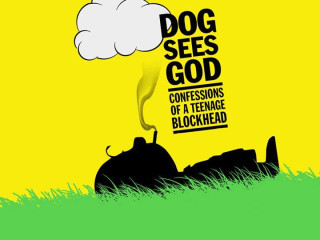
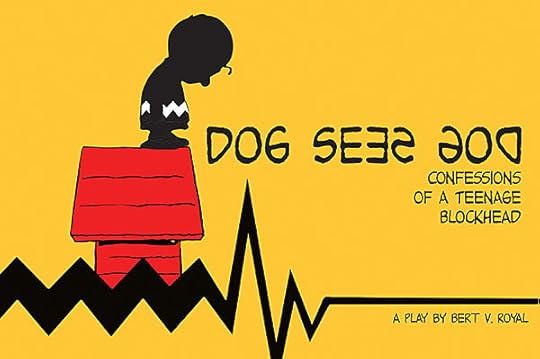
When CB's dog dies from rabies, CB begins to question the existence of an afterlife. His best friend is too burnt out to provide any coherent speculation; his sister has gone goth; his ex-girlfriend has recently been institutionalized; and his other friends are too inebriated to give him any sort of solace. But a chance meeting with an artistic kid, the target of this group's bullying, offers CB a peace of mind and sets in motion a friendship that will push teen angst to the very limits. Drug use, suicide, eating disorders, teen violence, rebellion and sexual identity collide and careen toward an ending that's both haunting and hopeful.
"Do you ever feel like you're not a real person? That you're the product of someone's imagination and you can't think for yourself because you're really just like some creation and that somewhere there's people laughing every time you fall?" Dog Sees God ~~~ Bert V. Royal
Have you ever wondered what would happen to the Peanuts Gang if they grew up? Seriously, you have to have given it a thought ~~ would Charlie Brown kick that football? Would he ever change out that yellow shirt? Would Lucy go on to become a world renowned psychiatrist? Would Schroeder become a classical pianist, or does he end up playing in a piano bar for tips? Do Patti and Marcie enter into wedded bliss? Maybe there never was a Peanuts Gang ~~ maybe it all took place in the over active imagination of Linus.
Well wonder no more; your questions have been answered. In Bert V. Royal's Dog Meets God, 10 years have passed ~~ and oh how the world has changed ~~ Snoopy has been put to sleep after killing Woodstock. Linus has become Van, a stoner who smoked the burned remains of his security blanket. Pigpen has cleaned up into a violent jock. Lucy, known only as Van's sister, is a lithium-addled pyromaniac who has slept with, believe it or not, Charlie Brown, or CB, as he's now known, a popular kid with a mean streak ~~ and that's just the tip of the iceberg.
Dog Sees God is 22 scenes of darkness, grit, ugliness, and hilarity ~~ but it is not the feel good comedy of the year. We view the lives of these characters in events at happen in their daily existence, and thru letters CB writes alone in his room, as he tries to revive correspondence with the pen pal of his youth. CB desperately hopes that somebody ~~ anybody ~~ understands why he’s shaken his core ~~ and a shaky core it is.
Van, is a harmless marijuana enthusiast in his stoner poncho. His sister ~~ formerly known as Lucy ~~ was recently labeled a threat to society, and spends most of her time in solitary confinement in a psych ward. The unequal power distribution within the Peppermint Patty-- Marcy relationship shows no signs of changing: Marcy still plays second fiddle to her “best friend” Trish. These four, along with a very alpha guy ~~ the former Pig Pen ~~ now known as Matt, are top dogs in high school. Sally is too ridiculous with her near-daily persona changes to be tolerated in the upper echelons of high school society, so she’s on the outskirts. Her life is lived on the fringe of the world she inhabits. Sadly, the same cannot be said of Schroeder. The child prodigy has become a social pariah because of something horrific that was inflicted upon him. Each day is an endurance test for the boy now known as Beethoven; the only solace to be found is in the music room during lunch.
It is in the music room where Beethoven and ex-friend CB intersect again ~~ each identifying with the pain in Chopin’s music. After a touchy start ~~ and I do mean touchy ~~ their connection rekindles, and a whole new world opens up to CB.
Dog Sees God is an incredibly difficult show to pull off. I've seen it several times and the actors have fallen into the trap of playing a stock character rather than being the character. And poor CB ~~ it’s so easy for the him to seem ill-defined against the backdrop of all those dynamic characters smoking up, having threesomes, trying to mount a one-woman show, setting hair on fire. But isn't that what Charles Schulz had in mind all along? Charlie Brown reacted to the world going on around him, he never drove the action of that world. In this telling of the Peanuts Gang, Royal achieves the same dynamic in CB's world.
And whether you love or hate this exploration of what became of Charlie Brown and company, there's no denying Bert V. Royal creates some undeniably emotion-packed moments in Dog Sees God.
2024 reread: the thing about this play is that it absolutely should not work. "the peanuts strip but they're all horrible high schoolers who do drugs and call each other slurs" is a concept on the same level as "the rugrats... but they were ALL DEAD THE WHOLE TIME." unrelatedly, one time i remembered literally just the last scene of this play and immediately burst into tears
There are things that I like about this play and it led to some interesting conversations among my students. That being said, I found it somewhat shallow and ultimately offensive in its simplistic portrayals of teenagers and their problems. But what bothered me most was the fact that it seems to make a statement about the danger of aggression and homophobia while ultimately promoting the status quo that only the "strong" survive, especially if he happens to be straight.
If this were written and performed by a bunch of 15-year olds I might give it 4*. Unfortunately, it's not. Maybe reading a play script doesn't do it justice, but the whole thing lacked depth and felt forced.
Watching A Charlie Brown Christmas this holiday season reminded me of an off-Broadway play called Dog Sees God -- an unauthorized and very dark parody of what happened to the Peanuts characters when they became teenagers -- that I saw in the city years back that featured a cast including Eddie Kaye Thomas, America Ferrera and Eliza Dushku.
I wanted to watch it again, but there didn't seem to be a recorded performance, so I did the next best thing and hunted down a copy of the script. Not only was it just as good as I remember, it's social commentary -- including topics of bullying, homosexuality, mental illness, drug use, suicide and violence in schools -- is possibly even more relevant today than it was when this was written almost a decade ago. On top of that, it's ending, a pinnacle of meta-ness, is perfect.
I highly recommend reading it, even if it is not the easiest thing to get your hands on.
At first, the concept comes across as crass: the characters from the Peanuts comic strip are in their teens and they are living dysfunctional lives of debauchery. Van (originally Linus) is a pot-head that used his blanket as a skeet rag, Beethoven (originally Schroeder) is a lonely homosexual that spends lunch time in the piano lab practicing his playing, Tricia (originally Peppermint Patty) is still obnoxious and has promiscuous sex and organizes ridiculous parties.
My concern at the outset was that the choices made would be strictly for shock value and that the play would have nothing to say about these characters put in this adult context. At the beginning, CB (you can guess who that is) is writing a letter to his pen pal talking about how his dog caught rabies and mangled a yellow bird in his dog house.
This event forces CB to confront death directly and think about his own life and the lives of those around him.
The genius of the writing, the brilliance of the concept is that it takes the characters that we originally know and points them out as they are: naive. The characters have echoes of how we originally knew them but the one thing that remains the same is that they don't exactly understand how the world works.
In the strip and in the movies, the characters didn't understand the world and would make quiet philosophical observations that a child would. But, if these characters grew older and they were exposed to sex, drugs and violence, how would they respond? The play postulates that they would respond as any of us would: we either accept it or we don't but rarely do we think further than that.
The author, Bert Royal, takes these characters in a shocking fashion at the beginning but quickly, it becomes his own story and comes to conclusions that you may anticipate but makes it no less compelling, painful and beautiful. At the start of the play, we as an audience are moved by the deconstruction of boys and girls that we look at with nostalgia. By the end, we are moved by the events and the growth of the characters, by the reconstruction if you will.
The final scene is one of the moving scenes in the entire play and turns the concept on its own head but effortlessly moving the piece from parody and satire to an homage.
One last thought to share: there was a special kind of mind at work to slightly alter the characters to make them recognizable without copyright infringement.
It would have been so easy for Bert V. Royal to make a cynical, dark take on Peanuts and just call it a day. But no. Royal is far too skilled of a writer and far too respectful of these characters (both the original versions and his interpretations) to make them walking hollow shells consisting of old hat cliches to do that. These are truly messed up, pathetic people who really instill fear into you as far as forcing you to wonder if they'll ever lead productive lives in the future. But the biggest difference between what a journeyman quality writer would do with these characters versus him, is that Royal imbues a necessary amount of sympathy into them such that your heart bleeds for all of them. All of these interpretations of the characters are ludicrous on the surface, but a closer look makes you realize that they are not unfounded and are actually well-observed takes which make sense within the context of each individual character. This is a play that has a lot to say about the hell of puberty, the effects of hatred you project on to others, self-hatred you might carry within you, being true to your nature, not being afraid of embracing your true nature, the destructiveness of prejudice, and asks a lot of questions about what forgiveness truly is and what does it mean to survive in a world that is cruel to you and how you process that.
If you have vices and they cause you shame and/or anger, this play will put those feelings into perspective and show you how personally destructive it is for you to hold on to those feelings. If you can't forgive yourself for mistakes you make long after the world does, how do you expect to move on and live a happy life?
I adore this play and I must commend Bert V. Royal for making a play that has so much more emotional impact and meaning than appears to be on the surface. That's the greatest gift of Dog Sees God; its a reminder of how things are not always what they appear to be.
My. This was a stunning play in...in all aspects. I just completed reading it only seconds ago, and I find it even difficult to report the feelings I have right now. One thing which has not happened in a very long time in books with me was a cried while reading this. I was only reading the script and I was crying. The characters are so cruel, so harmful, so painfully realistic. There is so much blocking in the script (though most of it impossible) as an actor while reading it, I felt a need to put the scene on.
Please, please read this. I recommend it from the (recently touched) bottom of my heart.
I can't believe I just read an age-up, angst ridden Peanuts AU.
But you know what? I totally dig it. The concept, not the actual play. The actual play was just a trauma conga line for our beloved characters. Maybe it was supposed to feel rushed and overdramatized. Maybe that's the point. Either way, the story fell short for me. The relationships didn't feel very real, I wasn't invested in anyone...as I said, a cool idea but a train wreck nonetheless.
My university did a one-night staged reading of this a few years ago and it absolutely blew my mind. Two of my best friends played CB and Van, and it was incredible to see the emotions they tugged out of each other and the audience simply by reading the scripts in their hands. The ending is especially powerful.
That got dark really fast, but I liked the progression of the narrative and the ending. My question is, would this work without the “Peanuts” context? I couldn’t say — the subversion of the innocent is a key element of the narrative, but it can stand on its own, plot-wise, too.
Wow, who knew Charlie Brown could get so dark. This is an exceptionally sad coming of age story that has its moments of hilarity, brilliance, insight, pontification, and it's chock-full of philosophical questioning. You know amongst all the poor life choices, terrible situations, bigotry, hypocrisy, and homophobia. Royal does a damn fine job of imagining a bleak future for the cast of Charlie Brown, and whose to say he's not right?
I'm sorry but teenagers in real life don't talk like they are in a cheap high school movie. Also, he somehow managed to put all cliche plot points into one play. I'm disappointed because this had a really cool premise.
really good! i wish i was a boy so i could do the Charlie Brown monologues :( sometimes it felt like the action was escalated a lot and it didn’t get enough time to develop, but i still really enjoyed it!
Oh boy don’t even get me started This play was a wild ride to say the least 😭 umm I really like CBs character development and stuff he is me and I loved the monologues I thought the ending was a tad rushed but whatever 4.5
Okay, so, this might have just changed my outlook on life. The ending? Actual tears in my eyes. If I saw this live, I would sob. Really excited to be doing a monologue for class from this book.
Read this with a theatre group of friends called “Off Book Club” and it was so good. An emotional story with deep relationships and revelations. Hope to see it live someday.
screw this play fr. it's good, i recommend it, but oh my GOD screw this PLAY. it's not perfect; sometimes the vulgarity teeters on the edge of gross and a little too much, but i'm willing to let it slide because a) i tend toward leniency when it comes to things like that and b) it made up for it by being really very poignant in a lot of ways.