Ο Τράγκυ βλέπει τον εαυτό του σαν έναν που τον ξέχασαν, κι αρχίζει, χωρίς να το θέλει, να κινείται, να φωνάζει, για να τον προσέξουν γράφει γράμματα: στο σπίτι του, στον κύριο φον Κραντς, σ' όλους αυτούς που τυχαία γνώρισε, στέλνει μάλιστα κάνα-δυο συστημένα γράμματα, που τα είχε φέρει από το σπίτι, χωρίς να τα χρησιμοποιήσει ως τώρα, και περιμένει, να δει που θα του απαντήσουν με προσκλήσεις. Του κάκου. Τον ξέχασαν, θέλει να φωνάξει και να δώσει σημεία ζωής. Η φωνή του δεν φτάνει πουθενά...
A mystic lyricism and precise imagery often marked verse of German poet Rainer Maria Rilke, whose collections profoundly influenced 20th-century German literature and include The Book of Hours (1905) and The Duino Elegies (1923).
People consider him of the greatest 20th century users of the language.
His haunting images tend to focus on the difficulty of communion with the ineffable in an age of disbelief, solitude, and profound anxiety — themes that tend to position him as a transitional figure between the traditional and the modernist poets.
"Noch ist es Zeit -" schreibt er, "noch bin ich weich und kann wie Wachs sein in Deinen Händen. Nimm mich, gib mir eine Form, mach mich fertig..." ()
According to Peter Demetz' book on Rilke's early life, René Rilkes Prager Jahre, René Karl Wilhelm Johann Josef Maria Rilke's parents were lamentable. His father had dreams of military glory but was tossed out early and found a poorly paid position as a railway bureaucrat only through the influence of his very successful brother. Rilke's mother had dreams of nobility and fine living, even court life, but it soon became clear that they would never become reality, resulting in an embittered woman struggling to maintain a false front and retreating into her fantasies when the struggle became too difficult. Both parents tried to live vicariously through their only surviving child - he by pushing his son into a military education (that ended unsuccessfully before a real career could commence), and she by filling his mind with her dreams of noblesse and pushing him to become a prince of letters.(*)
The teenaged Rilke became a veritable tornado of literary activity, playing all sides of the sharply circumscribed German-speaking literary world of his hometown Prague with a certain amount of panache. The Germans were beginning to lose hold of the instruments of power in Prague as the Czechs asserted themselves with ever more success. And though the German-language literary life in Prague was surprisingly rich up until 1939, Demetz (and Beda Allemann in Rilke's Werke) assert that Prague's German - spoken as native tongue by a relatively small number of the city's inhabitants - was becoming vitiated by a disappearance of active vocabulary and osmosis from the surrounding sea of Czech and Yiddish. Rilke had good reasons to escape both his family and Prague's increasingly malformed literary culture.
In 1896 Rilke left Prague for the first stage of his henceforth rootless life - Munich - where he fell in love with Lou Andreas-Salomé (it was upon her instigation that he changed his name) and tried to shake off the effects of both Prague and his family.(**) The novella Ewald Tragy, written around the turn of the century and placed in a drawer to be published posthumously, was surely a component of his attempt to leave family and hometown behind.
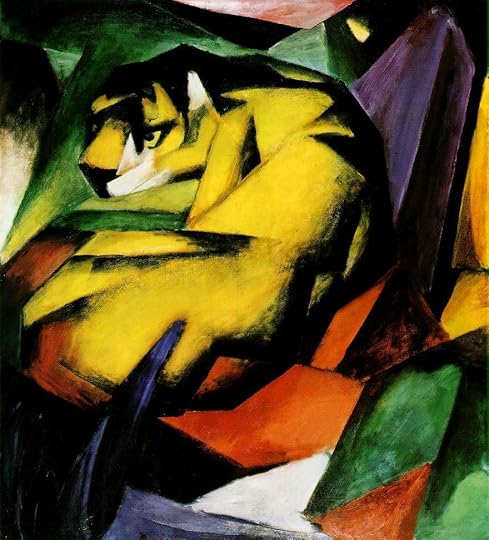
Franz Marc, The Tiger (1912)
In fact, Ewald Tragy is extremely thinly disguised autobiography: In the first part the eponymous protagonist is in the midst of his extended family the day before he departs for Munich. Only his father knows he is leaving, and he cannot bring himself to tell the others, only the French au pair girl. One could well imagine that a young artist who believes himself misunderstood by his family would present that family in satire or parody, bitterly, but not Rilke. Though he wrote the text only a few years after the events, if he is critical of anyone, it is himself. Without a hint of sentimentality, the love within the family is made manifest.
The second part takes place in Munich, where the young and unsure Ewald doesn't know a soul (such was not the case for Rilke himself). In thirty pages Rilke takes Ewald through a course of self-discovery that leaves me admirative; there isn't a false note, nothing is forced.
Up to this point my impression of the young Rilke has been of a supercilious, self-obsessed young man of great ambition, if extremely gifted; but in this text he shows himself to be empathetic and insightful. Just the sort of author I enjoy reading.
() "There is still time -" he writes, "I am still soft and can be like wax in your hands. Take me, give me form, make me complete."
(*) Demetz reports that Rilke was crushed when he disappointed his father, but his mother was the real molder of his virgin clay. Their first child, a girl, died very early, and René (the "reborn") became her surrogate; his mother raised him as a girl until he was six years of age, when his father finally put his foot down. The marriage ended soon afterwards, but Sophie's influence was immanent throughout the rest of Rilke's life.
(**) He was only moderately successful in the latter, and though he returned to Prague only for visits, for most of his later life he lived in places where German was not the native tongue. Demetz quotes a letter by Rilke in which he claims he doesn't want to hear German being butchered by the common speech. I expect a bit more was going on.
Tragy is Rilke. A Portrait of the Artist as a Young Man, to quote Joice.
This novel is part of posthumous publishings. The neatly written manuscript was found to have no title nor date. Analysis of the writing makes the dating likely to be in the second half of 1898.
In the first half, the story speaks about the traditional father and son Sunday promenade on the Korso in Prag. About the conflictual but affectionate behaviours of the two. It is the young Tragy’s last Sunday before leaving to Munich. The traditional Sunday lunch surrounded by family. The atmosphere is cordial, even amusing. Young Tragy is disappointed. Nobody seems to take his departure seriously.
The second half of the story takes place in Munich. After an initial positive start, slowly the young artist becomes lonely and prone to be victimised by other literature newcomers. He evolves in a festive community not suited to him. He falls ill and is left alone again.
Tragy/ Rilke must have lived in a sort of permanent depression.
The story ends without ending with the young man in a sort of delirium writing a long letter to his ever-absent mother. Expressing his longing for motherly love, but ends up burning the letter. Quote of a sentence in this letter:
“Noch ist es Zeit—“ schreibt er, „noch bin ich weich und kann wie Wachs sein in Deinen Händen. Nimm mich, gib mir eine Form, mach mich fertig…“
There is the strange feeling of “déja vue.” Recently read this expression. But where?
Rilke may have refused to publish this work for the characters involved too closely resemble actual living family and people in his time.
It is a pleasure to rediscover Rilke’s works after having read his poetry. There is so much more out there from this genius.
"Quem é que assim nos virou, de tal forma que, em tudo o que façamos, estamos sempre na atitude de alguém que parte? Como esse que parte, no alto da última colina que mais uma vez lhe mostra o seu vale, se volta, pára, se demora —, assim vivemos nós, sempre a despedir-nos." Rainer Maria Rilke, As Elegias de Duíno
Ewald Tragy é um jovem poeta que sai de casa dos seus pais, em Praga, e parte para Munique para se tornar independente. Trata-se de um conto autobiográfico, publicado postumamente, que Rilke sempre menosprezou.
"Edward Tragy" es una miniatura de particular belleza. Rilke regala en este relato un breve tratado sobre la soledad y la identidad, y dialoga con su obra poética. No la mejor versión del poeta pero no por eso menos conmovedora. Vale la pena hacer un par de comentarios sobre la edición de Navona: 1) El libro es bastante lindo pero 2) las notas al pie estorban la lectura y más parecen demostrar la erudición de la traductora que contribuir en algo (lo cual es verdaderamente molesto).
Rilke no es que fuera la alegría de la huerta, ya lo sabía, pero este librito con tintes autobiográficos casi me quita las ganas de vivir. Un aprobado justito por un principio prometedor y por las pequeñas pinceladas sobre Wassermann, que me han parecido muy acertadas.
A poco a poco si rende conto che è stato un sogno, soltanto un sogno, quindi nulla. Ciò non gli dà requie. «Quando sono sogni?» si chiede ad alta voce. E racconta al signor von Kranz, che lo visita verso sera: «La vita è così grande e dentro ci sono così poche cose, sempre le stesse, una ogni eternità. Questi trapassi impauriscono e stancano. Una volta, da bambino, andai in Italia. Non ne so molto. Ma laggiù, quando in campagna si chiede a un contadino: “Quant’è lontano il paese?”. “Una mezz’ora” dice quello. Il successivo dice lo stesso e lo stesso il terzo, come se si fossero messi d’accordo. Si cammina tutto il giorno, senza essere arrivati al paese. Lo stesso è nella vita. Ma in sogno tutto è vicinissimo. Non abbiamo nessuna paura. Noi siamo fatti per il sogno, non abbiamo gli organi per la vita, ma siamo pesci che vogliono volare. Che fare?».
This reminds me of someone I know and I can imagine Tragy right in front of me... Not to be too psychoanalysis brained about this, but the figure of the mother and father here (or the absence thereof) is so stark. At the same time, there is a personality factor to it, a tendency to be spiteful instead of calculating, an impulsivity when it comes to emotion that I, because I can imagine Tragy so clearly, have no patience for in real life. So it was interesting to read this and exercise compassion for him. See things his way.
"Sono piccoli fatti, che toccano il giovane più di quanto non creda. Gli dànno la sensazione di essere escluso, di adattarsi ai costumi di un paese straniero, tra tutti quegli uomini che s'intendono di passata, con un sorriso. Vorrebbe essere uno di loro, uno nella corrente, e a volte quasi lo crede. Finché non succede un fatto da nulla, a provare che il rapporto è rimasto immutato: lui è da una parte e il mondo dall'altra. Provatevi dunque a vivere."
L'insolubile dilemma tra ciò che si è costretti ad essere e ciò che si vorrebbe essere, l'inquietudine che origina dal sentire dentro se stessi qualcosa che non comprendiamo ma che sentiamo potrebbe guidarci lungo l'impervia strada della vita, il dubbio e l'insicurezza che da ciò consegue: in ogni riga di questo breve racconto molto autobiografico si legge di queste passioni.Un valzer con i propri spettri interiori.
2.7 Bardzo króciutka i językowo niewyróżniająca się forma. Nie jestem pewna czy od tego warto zaczynać podróż z Rilkiem ale co zrobisz. Jest to autobiograficzna nowelka opowiadająca o jego młodości i tym, jak łatwo było mu przekonywać światopogląd od w gruncie rzeczy przypadkowych ludzi. Niestety temat bycia chorągiewka na wietrze nie mógł być jakoś szczególnie rozwinięty. Ale no zobaczymy jak się bronią jego popularniejsze dzieła.
El principio se me hizo bastante ornamentado , lleno de un paisaje innecesario pero conforme avanzas la recta final cada palabra se queda clavada,y te deja pensando en la vida del autor , me quedo con esto: Aun estamos a tiempo; aun soy labil, y puedo ser como cera en tus manos. Tómame, moldéame, termíname
Questo racconto è un’importante testimonianza biografica di un giovane Rilke non ancora fattosi Rainer. A rigor di logica il passo successivo sono i quaderni di Malte. Illuminante la nota finale di Giorgio Zampa.
Rainer Maria Rilke - Sessiz Refakat Birbirinden nefret eden iki insan gibi birbirinizden çekip gidiyorsunuz, rastgele bir yerlere. Her birinizin bir evi var ve sanki çok uzaklardaki bir şeyi düşünüyorsunuz sessizce
(Auto-) ritratto dell'artista da giovane, anzi, da giovanissimo. Rilke racconta in diretta i timori, i sogni, le vergogne, le infatuazioni di chi ha deciso di votarsi interamente alla letteratura.
"Man muss eben verstehen sich das Leben reich zu machen - irgendwie." (S. 13)
"Vielleicht will er so, in dieser wohligen Wärme, die Ereignisse empfangen? Er wartet noch eine halbe Stunde, aber das Leben kommt nicht. Da steht er denn auf und beschließt, im entgegenzugehen. Und dass man dies müsse, ist die Erkenntnis des ersten Morgens. " (S. 28)
">Nein, es stört mich nicht. Aber wenn Sie gern lesen, will ich Ihnen geben, was ich mithabe. Es ist nicht vieles, aber viel. < Und er reichte ihr einen Band Goethe. " (S. 36)
Qué fascinante juego de espejos… Espejos o sombras, sombras ligeramente deformes, como aquellos espejos de feria. Ewald Tragy es Rainer Maria Rilke, de eso no hay duda. Es su historia. Un relato de juventud, de esa juventud que busca la madurez. En este caso, la poesía. El escritor apenas tenía algo más de veinte años cuando lo escribió y su protagonista, también. Pero el libro no apareció hasta un año después de su muerte. Seguramente contra su voluntad. Pero ¿por qué? La respuesta quizás es demasiado sencilla. Quedó inconclusa y él debía ir demasiado deprisa, en otra cosa. Seguramente quedó inconclusa porque a esa edad todo está inconcluso, todo está por construirse, por hacer. O porque tampoco hay mucho que contar, por mucho que uno experimente cualquier cosa como un acto supremo. La juventud es el tiempo de los héroes enfrascados en heroicidades.
El acto heroico de Ewald Tragy es abandonar al padre. Huir del ambiente burgués en el que se flota tristemente, sobre aguas-tiempos grises. Él quiere ser poeta y eso solo se puede ser rompiendo los hilos invisibles que han tejido alrededor de él y le retienen. Le atontan dulcemente. Se marchará a Munich. Está decidido. Solo allí, lejos, podrá saber si su poesía vale algo. Solo allí, lejos, podrá saber si vale algo él mismo. Y perder. Perder algo importante para encontrar algo importante. El padre. Tras el abandono de la madre, el padre lo ha sido todo y lo sigue siendo. Tiene otros planes para él, como buen padre. No confía demasiado en que la literatura nos puede salvar de algo. Se marchará el próximo domingo.
Antes estará la última reunión, en la que nadie parece saber nada, pero no, todos los saben. Piensan que se arrepentirá, que su cabeza abandonará esas nubes y bajará hasta ellos. Arrepentido, será uno más de ellos. El joven Rilke escribe admirablemente. Su escritura coge el tono de atardeceres infinitos que preceden el sueño de una primavera. Tragy se despide de su infancia tardía y en la cabeza de Rilke el tiempo, la timidez de los gestos, la decisión de los pensamientos, se convierte en palabra.
En Munich se encontrará con la vida. La vida incómoda pero feliz. Cualquier cosa es un paso en ese camino hacia la poesía. Hasta lo más frágil, hasta lo más tonto. Una habitación destartalada será el palacio de algo por el simple motivo de contener un escritorio abandonado. En una edad necesitada de señales, cualquier cosa es el símbolo de algo. Cualquier encuentro, decisivo. Tragy se encontrará con dos poetas. El indolente Kranz y el misterioso Thalmann. Kranz será un amigo con el que compartir sueños o tiempos muertos, con el que frecuentar cafés. Thalmann es algo más. Pobre de solemnidad, es lo inalcanzable. Kranz es el tiempo muerto compartido, las esperanzas, la ilusión. Thalmann es la escritura.
Ewald Tragy puede ser un texto de juventud, inacabado y olvidado por su propio autor, pero no es un texto menor, porque nada en Rilke es menor. Su fuerza, los momentos de estremecedora belleza, están ahí. Momentos líquidos que corren por nuestras manos, escritura fresca, libre. La búsqueda de una razón de ser.
El protagonista de este relato del autor de las famosas Cartas a un joven poeta es un joven poeta que no está muy a gusto, ni con su familia ni con su Praga natal. Se siente ignorado; le gusta la monotonía pero se aburre durante los almuerzos dominicales con su familia. Admira y respeta a su papá, quien corresponde al joven hasta donde puede: sabe que su hijo es capaz de impresionar a sus familiares, por ejemplo, pero no comprende su afán de irse a vivir a Múnich (“¡Como si aquí no pudieras trabajar!”) ni tampoco sabe muy bien lo que significa ser poeta: “Pero la gente le pregunta: «¿A qué se dedica su hijo?» Y entonces, se avergüenza y se retrae. ¿Qué va a decir? ¿Sólo poeta? Es simplemente ridículo. Aunque eso fuera posible, no es una posición. No implica nada, no se pertenece a ninguna clase social, no se tiene derecho a jubilación, resumiendo: uno no está vinculado con el mundo”.
Some of the stories are excellent written. I distinguisehed the apostole, aunt babet and of course the main story Ewald Tragy. The stories dive into the psychology foundation of the characters.
Rilke expresses in a non-superficial way the emotional state of Ewald and reveals society's pain points. In Ewald tragy's story, loneliness is the context of the story and pieces from social and family life complete the puzzle.
No he acabado de disfrutar el libro, a veces me perdía, me liaba. En alguna parte si he disfrutado de él. Pero en general no ha sido un libro de esos que te llevas de recuerdo. También puede influir que llevo unas semanas que no tengo tiempo para casi nada, y este libro hay que leerlo un poco reposado.