In the cities along the river Ihil, the nomad tribes of the Middle Desert are almost as legendary as the gods. Sardeet is the youngest daughter of the Bandit Queen of the Oclaresh, but her father was a man of the city, and after her husband's death, he brings her to her uncle to recover from her grief.
She walks veiled and silent, as befits one who is rumoured to be the widow of a god, and the people of the city whisper about how beautiful she must be for those rumours to be abroad. They generally dismiss the other part of the story, that the reason her husband is dead is because her sister killed him.
Sardeet's sister Pali, however, knows that this is true--and that there are consequences.
The Warrior of the Third Veil is the second story of those about the Sisters Avramapul. It takes place after The Bride of the Blue Wind. While you do not need to have read The Bride of the Blue Wind, you will probably enjoy this one better having done so.
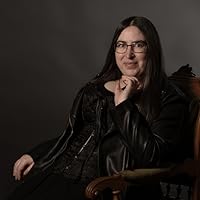
I walked across England in 2013, fulfilling a long-held dream. I'm currently the sexton of an Anglican church in Nova Scotia, which means I am keeper of the keys and opener of doors (and shutter-off of alarms). I have a PhD in medieval studies from the University of Toronto, looking at poetry and philosophy in the works of Dante and Boethius -- both the poetry and the philosophy come into my stories a great deal (and occasionally the Dante and the Boethius).
I like writing about the ordinary lives of magical people on the other side of the looking glass ... and the extraordinary deeds of ordinary folk, too. Three of my favourite authors are Patricia McKillip (especially 'The Riddle-Master of Hed' trilogy and 'The Bell at Sealy Head'), Connie Willis ('Bellwether' and 'To Say Nothing of the Dog,' which latter would make my top-ten books on a desert island), and Lois McMaster Bujold ('The Curse of Chalion' and its sequels).
It's really hard to decide how to rate a book sometimes. There is, according to the author's website, a third book due in this series. I strongly suspect that that third book will make me decide how I feel about this book, because right now the series feels - well, it feels like one incomplete story.
The first book was gorgeous and lush and fairy talesque and very thin on characterization. It feels like all the characterization that wasn't addressed in the first book got pushed to this book, instead. It's the emotional aftermath of the first - Sardeet is reeling from her experiences in the first book and deciding what her path will be after that, Pali is protective and looking for her own career growth as an adventurer. It's a pause and regroup, character focused story, and while I like that, and I like the characters, it's definitely a big change from the first. The focus on character is something I thought was very much missing from the first, but it feels like it has second book of a trilogy issues without a strong sense of the third book's destination, which usually pulls a second book along, in my opinion.
I like the characters, I like the prose, but while the first book was strong on plot and thin on characterization, this book is thin on plot and strong on characterization. The third book could pull it together to make for a really great combination! There's a lot of potential there! But right now the potential feels a little lost.
This title has swiftly become one of my favorites in the constellation of supporting novellas that seem to make up the bulk of author Victoria Goddard's sprawling Nine Worlds fantasy saga. It's a direct sequel to The Bride of the Blue Wind, which told a fairy tale journey of two daughters from a desert nomad tribe striving to save their younger sister from a Bluebeard-esque fate in her divine husband's house. This volume relates the aftermath of that quest, with much richer characterization for its two protagonists, Pali the conquering warrior and Sardeet the new widow. (The eldest child Arzu, magician and heir to their mother's crown, is here for a few scenes too, but it's not really her story anymore. And unlike her siblings, she doesn't have a future ahead of her as part of the legendary Red Company.)
For the first half of the book, the girls are mostly resting in their uncle's home and coming to terms with their recent ordeal. As returning readers will know, that's the type of quiet and cozy atmosphere that Goddard writes best, turning what could easily be an interminable interlude in someone else's hands into a soft space for keenly-observed introspection and healing of trauma amid the reassuring familiarity of domestic routine. One heroine is trying to sort through her confusing emotions and figure out what the rest of her life will look like now that she's been unexpectedly returned to the mortal realm, while the other is worried that by killing the abusive demigod, she's broken the code of her order, which had sent her out to correct an injustice nonviolently.
After her sister chooses a new path forward, Paliammë-ivanar Avramapul approaches the domain of her reclusive teachers to present herself for their judgment. As we learn more about the meaning of the hierarchy of the veils that they wear, she describes not only the events of the rescue we've already read, but also how she subsequently took the time to travel to far-off lands, carrying the remains of the first six wives her opponent slew to respectfully return them to their peoples. The name of the work pretty much gives away the verdict, but I suppose it's not surprising that for this writer, kind choices are ultimately rewarded instead of punished.
A third installment of this sub-series about the young sisters, tentatively to be called The Weaver of the Middle Desert, is mentioned in an afterword as forthcoming in 2018. Six years later, it has yet to materialize, though Goddard has gone on to write more about the characters' adult exploits in works like The Redoubtable Pali Avramapul. Luckily this one ends in such a way that the plot feels relatively complete, for the moment.
Četla jsem to ve špatném pořadí (až po The Redoubtable Pali Avramapul, která se odehrává o mnoho let později) a vůbec mi to nevadilo. Výše zmíněný román je klasická high fantasy a Pali v něm je postava, která působí skutečně a živě a je mi hrozně sympatická. Kdežto tohle je spíš pohádka nebo pověst, jeden z těch starodávných magických žánrů, kde hrdinové vracejí ukradené slunce na nebe a bohové unášejí smrtelné krásky jako své nevěsty. Nejkrásnější na tom je, že Pali působí stejně přirozeně v obou žánrech. Také se mi líbí, že jsem se dozvěděla víc o Kaphyrnu - měla jsem jej za převážně pouštní svět, ale pochopitelně: je to svět a je velký a má oceány a severské země a spoustu dalších míst a podnebí. Je to kratičká knížka, spíš novela než román. Tak na jedno odpoledne. Zanechala ve mně pocit spokojenosti a touhu po světě, kde hrdinky dědí meče po prababičkách a putují světem na létajících kobercích.
Having just spent a day on an exceedingly dark and grim fantasy, I needed a mind cleanser before bed. This lovely fable was exactly right. Returning to the world of Bride of the Blue Wind (which you must read first to understand the nuances here), we once again go on a slow ramble with two sisters full of magic, sorrow, and healing. Much is said about the power of choices both given and denied to women in many cultures, but all in such a subtle way that if you are not reading intently, you may miss it. Which is the joy of Goddard's books. On the surface, they present a rather pastoral take on fantasy. No huge battles (such often occur off the page) but huge consequences if characters don't make the right decisions. Luckily Goddard's characters are inherently decent and generally do select the correct path to reach the next stage in their adventures.
A beautiful novella about the Avramapul sisters! I adored this once again, all three sisters are such vivid characters and getting to see more of the worldbuilding is just lovely. I've heard some say that the book doesn't feel much finished by the end, and I do agree that if it would have stopped before Pali went home at the end it would have felt less open-ended, but I also think that would have been an injustice to the character - for Pali Avramapul is not meant for closed endings, as the kind of person I imagine ever riding onwards into the sunset.
sofreu da síndrome do livro do meio, mais desenvolvimento de personagem do que a enredo, mas continua com a narrativa charmosa e o universo maravilhoso
"May my sister's son, Arvoliin the Flame of the Fire of Love, grant you a warm heart and a welcoming hearth", she said, "and joy in the morning when you wake in the light you returned to the world, and rest in the night that is no longer dread."
This story flew by. Lots of layered meanings tucked into the dialogue. How do you know you are on the right path? The conscious choice makes it the right path. That isn't to say there won't be detours or wrong turns. Misinformation and inattention will cost you.
I love how all the little back stories to the larger works exist -- like stars in a constellation. I don't want to read them all at once, but I'm enjoying them. I particularly love how the women in this story forge their own path once fate is done with them, and it's exciting to see where they will go next.
It's a shame that the promised third book in this series hasn't appeared, since this novella has BIG 'middle book' mood. I felt like little plot happened, but the character developments were satisfying.
I liked this one much better than the first one, but I still find it really icky and gross that it’s treated as totally normal and good and happy that Sardeet was married off to an immortal guy when she was 14. don’t like that at all.
This novella continues on from Sardeet's story, and continues that, while giving us background on Pali - whose fighting skills I am familiar with from a number of stories, but now I understand her family and how she began to become the Pali we meet later.
This had a bit more characterization and some important moments for Pali, so this series is looking up. It's weird to read about the promised third book that definitely doesn't exist.
I enjoyed this story and how it dealt with family, grief and the complex what happens after when dealing with gods and a world similar to fairy tales. I love this world and how much Goddard's books dig deep into those ideas of who we think we are meant to be versus who other people think we should be. The Sister's Avramapul novellas are shorter and they both feel like fairy tales.