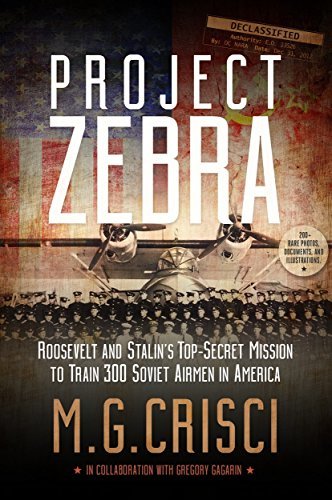
ONE OF THE LAST GREAT UNTOLD STORIES FROM WORLD WAR II.Elizabeth City, North Carolina. 1942-1944. Declassified 2013. Project Zebra was a top-secret mission created by Franklin Roosevelt and Joseph Stalin. And it would be the only time in history, America would build 185 huge, state-of-the-art warplanes hand-painted with Red Army stars in the Philadelphia Naval Yard.Once built, the planes were ferried to the sleepy, patriotic town of Elizabeth City, North Carolina. There a select group of US Naval officers trained 300+ Soviet airmen during a period of 18 months before dispatching a Soviet squadron at a time to the Atlantic and Pacific battle theaters.Project Zebra was far more than just a bold military mission; it was a historic human event. Despite language barriers, cultural differences, and the subsequent Cold War, the Soviet and American Zebras built life-long friendships based on mutual respect and trust--something that might serve us well to remember during today's turbulent times.(Contains 213 rare documents and vintage photographs).
M. G. Crisci Stories that entertain. People you’ll remember. Literature that matters.
Manhattan-born M.G. Crisci is the critically-acclaimed author of 16 books inspired by real events, a former Fortune 500 senior executive, an internationally-recognized brand-building expert, a thought-provoking East-West social commentator, and an award-winning journalist.
M.G. has been elected to Who’s Who in the World 23 times for his business, literary, and cultural contributions, and received several lifetime achievement awards.
[Note: This book was provided free of charge by Books Go Social. All thoughts and opinions are my own.]
Although I do not read books about World War II all that often [1], I tend to be greatly fond of unknown and obscure stories, and this was certainly an excellent book about an effort by the United States to train some 300 Soviet airmen in how to fly the Nomad, a large seaplane that was designed to help improve the logistics of the Allied War effort in the Arctic front. This book is the sort of book that is filled with personal reminisces on the part of the lone survivor among the leaders of this effort, and while that makes the book a bit scattered and not entirely chronological in its basis, this is a book about a long-forgotten effort that deserves to be remembered and that demonstrates the abilities of ordinary soldiers (and extraordinary ones in the case of the princely Gagarin) to get along with those who are uncertain allies and future enemies in the recognition of common humanity and the way that governments (especially the Soviet one) have lied about others in an attempt to maintain social control.
This book tells a series of tales about how the Soviet Union faced extinction from Hitler and how the United States saved them, not only through supplying them with planes, tanks, and other materials but also through training. Most of the book consists of a group of Americans and Russians in the small town of Elizabeth City, North Carolina, engaging in a delicate act of cultural communication. We this effort through a variety of perspectives, from the point of view of squabbling political elites who want to help the war effort but are engaged in a lot of political gamesmanship, officers seeking advancement and supporting a hierarchical relationship with often nameless enlisted men, the lure of American consumerism and the intense productivity of the American economy when compared with the Soviet one, and a struggle for communication and understanding and well-being that ends up working remarkably well despite some tragedies. The author uncovers a lot of material that somehow makes the Soviet Union look particularly poor for being unable to accept its need for help, and yet this particular story may have had a great deal more importance than is often recognized, because the ability of America to succeed at providing guns and butter may have deterred the Soviets during the long years of the Cold War.
Whether or not that is the case, this story was kept hidden for far too long, and the book has a deeply bittersweet feeling about it, showing Russians engaged in an almost religious fervor at Kitty Hawk, showing a love of sexy Hollywood starlets in musicials, and trying to bring as much french perfume and other luxury goods to profit on the Soviet black market. The book has at its core a set of people that includes a Russian officer looking to recover his reputation after having been a victim of Stalin's brutal gulag archipelago, a Russian prince turned American naval officer and translator, and some resourceful Americans and talented Russians. The book is good at showing the military significance of the efforts of trainers, translators, and logistics in the course of World War II, and the book does a good job at presenting Elizabeth City as a friendly town that was surprisingly discreet about the Soviet airmen that it hosted for several years. The genuinely touching stories of romance, of family, of patriotism, of ambition, survival, tragedy, and friendship are framed in a sense of loss over the passage of the time and the way that the memorable sites discussed often no longer survive and neither do the people who trained here and learned that they had friends on the other side of the nascent iron curtain that was about to descend over the world.
MG Crisci paints a vivid time in history in this book. The content is clearly researched and written in an erudite way that still keeps the reader in mind.
References, along with photographs and anecdotes, strengthened this text.
It is interesting that even 70 years after the end of the second world war there are still stories out there which have yet to come to light. Project Zebra is one of those stories, involving an operation to build seaplanes, and train their Soviet crews, as an extension of the lend-lease program.
I guess this is one of those human interest stories, more than it is about the larger war which was going on at the time. There were certainly political and social implications for the participants in the program, but the net effect on the war as a whole seems to have been minimal. There are a lot of small stories in this book, the experiences of both the Americans and Russians who were tasked with working together.
While the seaplanes they were working on are alleged to have gone on to have a great impact on the war as a whole, I really didn't get any of that story from this book. It is not that this is a boring book, but it is more of a slow-burning tale that just sort of ultimately peters out.
This is a book aimed at people with an interest in shining a light into the forgotten corners of history, but this is not exactly an action-packed tale as some might imagine. This is regular people going about their regular lives.
I received a copy from the publisher through NetGalley in exchange for an honest review.
This book deals with events that happened in my local community. In the light of current events and the world's strained relationship with Russia, it's amazing that for a brief period of time, Russian pilots and crews lived and trained in a small NC town on the Pasquotank River. Even that that time, however, there were tensions between the US and the Soviet Union because of mutual distrust between Roosevelt and Stalin. The Russians came to the US with a great deal of misinformation about the US but none appeared interested in staying here. They all wanted to return home to fight for the Motherland. There were intriguing individuals involved in this story, including a Navy translator whose family was part of Russian nobility.
Fascinating factual and inspiring that in the midst of a horrific world war there was a partnership between Stalin's Russia and the US. The author did a great job of capturing the stories from each side that made me chuckle or make me read in wonder how all this was successfully pulled off. At this time of great negative tension between Russia and the US, we're given the example that we can work together for a greater good.
Woohoo... I have never heard this story before. I have read extensively about WWII. However, this new information Unlike a lot of the books I read about World War II. I've usually already heard the story. I'm just getting a different version. This is a completely different story I've never heard. I had no idea we trained Rusdion Airman and gave them plains.
This entire review has been hidden because of spoilers.
I really enjoyed this true story. Interesting to see how three nations came together for one cause. The stories of the Russian soldiers learning American ways were classic.
For readers interested in World War II aviation and military history, this is a must read. Very well-written and hard to put down. You will learn about one of the most significant acts of cooperation between the US and Russian.
This was such an intriguing & entertaining read. And a new author for me. Great book. I got a copy of the book. And am voluntarily leaving my honest review.
A unique World War II story, Project Zebra: Roosevelt and Stalin’s Top Secret Mission to Train 300 Soviet Airmen in America by M.G. Crisci, is the non-fiction account of a rather recently de-classified mission that was launched to help end World War II. The project was a collaboration of President Roosevelt and the Kremlin of Russia, Stalin. Russia knew Hitler would eventually engage in war with Russia because they did not support his efforts. They were not prepared to deal with the German army and it came sooner than they were able. In a historical moment, given Russia’s dislike of America and America’s dislike of Russia, the two decided to work together against a worse situation; Hitler’s Germany. The Russians saw the Catalina, a war plane able to land on water owned by the U.S. and saw this as potential to win the war. The book details how that plan went into effect, how Russian aviators were sent to America to learn to fly these planes, and how these planes did help Russia to effectively aid in winning the war against the Axis Powers. This is such a unique account and the author has done a tremendous job with finding information and talking to those who have first or second hand accounts of what the project was really like. The book is beautifully written and details small pieces of information such as the Russian soldiers going to get ice cream or shopping in a meaningful way that was engaging to read. I enjoyed the way that the book started at the beginning of the project and told how it was brought into existence and that the author discussed the lives of the soldiers after the war as well. The personalities of the soldiers also came through very clearly so it was easy to picture them and develop an interest in their characters, which is often hard in a non-fiction war account. The writing is very professionally done as an excellent research source and well edited as well. I would have loved to have seen more pictures or even some of the de-classified files on this project. There’s not much else to criticize with this book. In a time when all eyes in our nation seem to be turned to Russia, this book is a very intriguing read. Even at the time of this book there was distrust of Russia, yet the account stands as witness that we are able to put aside our differences to work through things and that we may not be as different as we believe. Since this is a more recently de-classified project that is not well known, this is a very informative and well written account of how America and Russia were able to work together during World War II and succeed. Not overly technical in nature, yet very factual, readers should enjoy the pace of the story and find it easy to follow as well be able to use it as a resource material. To sum it up, the book is well written and serves as a groundbreaking resource for this particular account of history.