"Ze was niet in staat enig verband te zien tussen haarzelf zoals ze vroeger was en zoals ze nu was, en ze kon niet begrijpen hoe ze eenzaam en bang kon zijn met een man en twee kinderen in huis. Ze stond daar tegen de kinderen te praten over de heerlijke dag die ze morgen zouden hebben, en ze was zich volledig bewust dat ze zich steeds somberder voelde worden.' (Uit "Kerstavond')
Maeve Brennans belangrijkste onderwerpen zijn eenzaamheid, kwetsbaarheid, wanhoop, spijt en angst. Ze schreef vaak over ongelukkige, liefdeloze huwelijken, en over bekrompen en teleurgestelde mensen met treurige levens. Haar ‘studies’ van hun relaties hebben vaak een navrante ondertoon. Veel van het verdriet wordt veroorzaakt doordat de rigide katholiek-Ierse samenleving het individu restricties oplegt waaraan niet te ontkomen valt.
Toch zijn haar verhalen ook hoopvol, eenvoudigweg omdat zij ze opschrijft, waarmee ze een daad van verzet pleegt tegen de verstikkende wereld waarin haar hoofdpersonen leven.
Maeve Brennan (January 6, 1917-1993) was an Irish short story writer and journalist. She moved to the United States in 1934 when her father was appointed to the Irish Legation in Washington. She was an important figure in both Irish diaspora writing and in Irish writing itself. Collections of her articles, short stories, and a novella have been published.
However I intended to read Ingeborg Bachmann for the ‘B’ in the alphabetical list of women authors I hope to read in 2018, Patrizia’s fine review of The Springs of Affection, a short story collection by the Irish writer Maeve Brennan (1917-1993), together with this recently published Dutch translation of a selection of that collection which smiled at me from the counter with newly purchased books in the library decided otherwise. Maeve Brennan turned out an enthralling, delightfully elegant and melancholic ‘B’.
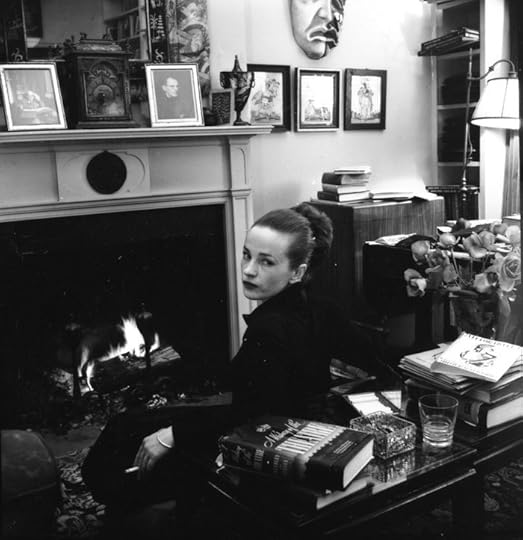
(Maeve Brennan photographed by Karl Bissinger)
This collection contains seven stories at the core of which is the history of the Bagot family – the married couple Delia and Martin Bagot, their young daughters Lily and Margaret and Martin’s twin sister, Min Bagot. United in a set these stories read like a non-chronological novel in fragments, each story casting a light on the characters and the marriage of Delia and Martin from different perspectives, offering snippets of information which mostly focus on Delia’s inner life and thoughts, through interior monologues. In the closing story ‘The Springs of Affection’, the rancorous reminiscences of Martin’s twin sister Min, having outlived both Delia and Martin, fill in some more blank spaces about the lives and family backgrounds of Delia and Martin, while she renders her views on the role of her brother in the family, the couple’s initial pride and happiness, their wedding and Martin’s remembrances of his late wife.
When I was growing up, vigorously reading books on feminism and observing the lives of aunts and some mothers of friends, housewifery to me seemed the ultimate horror, to avoid at any price later in life. A life ‘merely’ filled with caring for the home and family, the flowers in the garden, curtain talks, finding fulfilment in a cleaned carpet and the decoration of the interior and depending on a husband for livelihood, to me seemed a shadowy existence devoid of meaning. I confess never having aspired to become a domestic goddess. And in some respects, even if now older and wiser and hopefully being slightly more nuanced in opinions since acquainted with more than enough counterexamples of women who seem happy enough in their homes, those teenager assumptions oddly rooted so firmly I cannot deny I am still wary of staying at home in one’s prime, anxious it leads inherently to atrophy, the obliteration of one’s identity and to precisely the kind of dreary life Delia Bagot has, as depicted by Maeve Brennan – not that Brennan allots Delia’s husband Martin a more fortunate role to play.
Brennan paints an crushing picture of the boundaries of domestic life in a Dublin suburb, where a woman’s life is confined to the house and garden, in which flowers feature as a substitute for love, the delivery of a new sofa is a major event, in which a walk through the neighbourhood is almost an act of preposterous rebellion and the thought of a short lie-down day-dreaming away while cleaning the carpet with the big pink roses fills one with potential shame and fear what the neighbours might think of such frivolous behaviour. In such life, the house claims a central role, almost like a character in itself, at once offering protection and imposing isolation, turning gradually into a cage, as Delia takes care of making herself and the children unseen and unheard for Martin, almost demarking no-gone zones for her and the children and the pets, not to irritate him – while her unyielding occupancy with the perfection of the interior unintentionally sets in motion a dynamics of pushing Martin out and away from her. Her domestic efforts, instead of getting the couple closer, alienate Martin who flees into long walks in the weekends and holidays spent in solitude, away from her and the children and the house and so resulting in a perpetuum mobile of inflicting mutual suffering.
Self-effacing, internalising Martin’s patronizing thoughts about her, Delia starts living inside her own head, withdrawing into dreams and memories of brighter moments, finding comfort in her own shadow, her love and affection only welcomed by her lively and bright little children and the stray animals she has adopted – as a rare act of resistance to her husband Martin – the fat orange cat Rupert, the thin black-furred cat Minnie and the rough haired white terrier Bennie, which she smuggles with her at night to her bed, as Martin prefers no longer to share a bedroom with Delia.
(Illustration by Charlotte Schrameijer)
Particularly gripping and emotionally intense is the opening story, ‘The Twelfth Wedding Anniversary’ which sets the tone of tranquilly endured unhappiness, condition which is likely to surface more sharply at such occasions like a wedding anniversary and of which the painfulness reminded me of the poem ‘On a Wedding Anniversary’ by Dylan Thomas.
On a Wedding Anniversary
The sky is torn across This ragged anniversary of two Who moved for three years in tune Down the long walks of their vows.
Now their love lies a loss And Love and his patients roar on a chain; From every tune or crater Carrying cloud, Death strikes their house.
Too late in the wrong rain They come together whom their love parted: The windows pour into their heart And the doors burn in their brain.
Perhaps such moments of reflection on what could have been mutually cherished rituals are among the most hideous ones in the life of a couple which is living together while drifting apart, incapable to change or stop the ship from sinking, seeing no way to break that oppressive stillness, a silence which, like in Max Frisch’s I'm Not Stiller eventually is proliferating, a silence that is worse than quarrelling:
And you ended up building a wall that went on forever and that would never come to an end, because you made it stronger every day, without wanting to and without being able to stop yourself.
One might think that taking into account the place, context and times in which these stories are set, changed gender roles and more gender equality in the meantime might have made things easier between men and women, but through these poignant and at times searing stories on loneliness, grief, motherhood and the weight of original family ties shimmers a rendition of the human condition which seems still relatable today. Evoking the impossibility of communication, of drawing up closer to each other in love, of finding each other in shared experiences of loss, illustrating the wrecking effect of silence in relationships, Maeve Brennan with her craftily constructed Bagot stories touches on the essence of love and how difficult to express it is, if only thinking of the numerous couples seeing a marriage counsellor basically to learn how to listen and talk to each other.
Nonetheless, when alone, Delia and Martin experience moments of inner harmony, even if they don’t live through such rare moments at the same time, neither do they together. And yet in this house, in which the adults feel often downright miserable, the children are playing and living cheerfully, not affected by their parents’ wretchedness and heartbreak. This house and family will be the cradle of a happy and warm childhood, in which Delia, although she didn’t mean so much to others, will be remembered as a good and loving mother – a place which, from the perspective of the children, was a true home:
The hall was quite narrow, and was covered with linoleum, and it served its purpose very well, both as an entrance to the house and as a vantage point from which the house could be viewed and seen for what it was – a small, plain, family place that had a compartmented look now in winter because of all the doors being closed to keep whatever heat there was inside the rooms. In the hall there was a rack with hooks on it for coats, and there was an umbrella stand, and a chair nobody ever sat on. Nobody ever sat on the chair and nobody ever stood long in the hall. It was a passageway – not to fame and not to fortune but only to the common practices of family life, those practices, habits, and ordinary customs that are the only true realities most of us ever know, and that in some of us form a memory strong enough to give us something to hold onto to the end of our days. It is a matter of love, and whether the love finds daily, hourly expression in warm embraces, and in the instinctive kind of attentiveness animals give to their young, or whether it is largely unexpressed, as it was among the Bagots, does not really matter very much in the very long run. It is the solid existence of love that gives life and strength to memory, and if in some cases childhood memories lack the soft and tender colours given by demonstrativeness, the child grown old and in the dark knows only that what is under his hand is a rock that will never give way.
Sometimes the solid existence of love, against all odds, and against one’s better judgement, can be found where we might not expect it.
De eerste verhalen over Delia vond ik aangrijpend en invoelbaar, ik zou ze zonder twijfel vijf sterren geven. Helaas greep het laatste (en veruit langste verhaal) over haar schoonzus me beduidend minder aan, waardoor de magie uit Delia's verhalen wegviel.
‘De twaalfjarige bruiloft’ van Maeve Brennan is een subtiel gecomponeerde verhalenbundel. Je kunt ieder verhaal afzonderlijk lezen maar eigenlijk zijn het stuk voor stuk hoofdstukken binnen het grote geheel van een roman. In alle verhalen zijn we ooggetuige van het gezin Bagot. Delia Bagot is de toegewijde moeder van Lily en Margaret en vrouw van Martin. Dat er ook een dood broertje is, wordt nauwelijks genoemd maar hangt als een zware sluier in het gezin. Delia doet er alles aan om haar man gunstig te stemmen. Hij gaat ‘s morgens vroeg weg en komt ‘s avonds laat thuis. Hij slaapt in het achterkamertje om vrouw en kinderen vooral maar niet te storen.
Eenzaamheid, onvermogen, kwetsbaar zijn, spijt en wanhoop zijn de onuitgesproken thema’s in deze familie. Brennan beschrijft de moeilijke gevoelens subtiel aan de hand van de handelingen van Delia Bagot, zoals het schikken van bloemen, het uitkloppen van een tapijt, het sluiten van een venster of haar zorg om de poezen en de hond Benny, zodat ze Martin niet in de weg zullen lopen.
Werkelijk een prachtig boekje. Prachtig vormgegeven in de Nederlandse vertaling (van Rosalien van Witsen), met hele passende illustraties van Charlotte Schrameijer. De eerste zes verhalen betoverden me echt. Het laatste lange verhaal was wat minder aan mij besteed, maar over het geheel genomen was het een hele prettige ervaring om een week met dit boekje te leven. Mooi vertaald en mooi geschreven.
A really strong collection of stories that elevate the stakes of interpersonal interaction. Whether it's in a New York country home or an Irish condo, every word between people can be used as an expression of power, identity, and submission.
I tended to prefer the lighter touch of the New York stories, but they're all very strong. I regularly found myself almost despairing over a perfect sentence that I hadn't believed it was possible to construct. I have to hand it to the Backlisted podcast for bringing my attention to this author who I'd be unlikely to have found otherwise.
I was looking for some holiday reading and picked this one from a display at the library. Only two of the 13 stories had anything to do with Christmas and most of them were a bit depressing. Maeve Brennan's writing seems of its time (1950s and 60s) and I can see why these tales were popular when published in The New Yorker magazine. One recurring character, Charles Runyan, was my favorite part and I would read an entire book about him. Otherwise, meh.