‘In the first NC meeting after AAP’s creation, Arvind had “This party is not the property of 300 founding members but of the lakhs and crores of people in this country.” This refreshing stance shifted over time, got corrupted by power . . . till, one day, Arvind told I do not want intellectuals in the party, just people who say “ Bharat Mata ki Jai”. ’
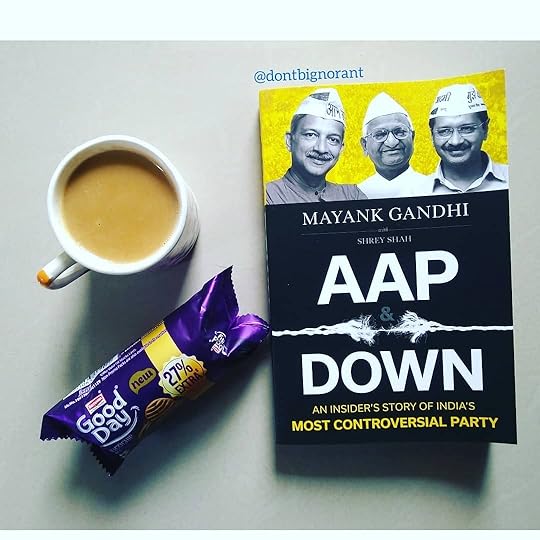
Authored by a former member of the Aam Aadmi Party’s (AAP) National Executive, AAP & Down is an in-depth account of the emergence and sudden unspooling of one of India’s most closely watched parties.
The story of AAP is one of troughs and crests. After capturing the imagination of over a billion Indians, and winning a landslide victory in the 2015 Delhi elections, a seemingly indestructible party began to dangerously teeter. What just happened? How did a party—born of the idealistic India Against Corruption (IAC) movement—get ravaged by in-fighting and accusations of wrongdoing? What provoked the abrupt ouster of two party veterans, Yogendra Yadav and Prashant Bhushan? What accounted for the wave of ignoble defeats across not just Punjab and Goa but also AAP’s own home, Delhi?
Here is a book that reveals all—from the clashes and intrigues that beset the IAC movement to the goings-on during the closed-door meetings of AAP. But beyond chronicling events, thus far undisclosed, AAP & Down analyzes the dispositions of the leaders who had once promised a better India—from a volatile Anna Hazare to an autocratic Arvind Kejriwal—to highlight how the party’s undoing was linked to the flaws of its leading men.
Even while recounting the true story of a party, here is a book that presents the story of India—of how a country, plagued by scams and scandals, dared to unite under IAC and overthrow the corrupt. In this, there is a lesson for AAP—the book emphatically reminds the party that its best chance of revival lies in reinvesting faith in this nation’s citizens.
I found this book very interesting as I was personally very disappointed with the fall of the Aam Aadmi Party (AAP). Mayank Gandhi gives an insider’s perspective about how and why AAP inspired the masses as also analyses what went wrong.
An upright and idealistic social activist who took to politics when AAP kindled hope in him, Gandhi was disillusioned to find that Arvind Kejriwal seemed to suffer from the very same effects of power, that AAP had hitherto criticised in other parties. Equally interesting is how AAP’s leadership had to contend with the charismatic and yet eccentric icon, Anna Hazare.
Gandhi tries to be objective by portraying the strengths of Kejriwal and also expresses hope in the end that the ideals and principles on which AAP was built, could be revived even now.
The book provides an insight into the sorry state of the human mind, ever vulnerable to the lure of power and its trappings. It is rather intriguing as to how Kejriwal who has an exemplary track record of sacrifice and idealism, could fall from grace so easily. To be fair to him, the book does not really give his perspective and in that sense is one individual’s view on what happened.
Although this book is not stylishly written, it is certainly worth reading for anyone interested in India’s democracy and political system
The transformation of AAP (Aam Aadami Party) into AKP (Arvind ke Party) :- ---------------------------------------------------------------
'This Party will not be a party but a movement. A movement outside parliament as well as inside. There will be no high command and candidates will not be selected by the leadership but by the people themselves'. - Arvind Kejriwal
This one statement is enough to justify the hypocrite nature of Arvind Kejriwal.The party which was born out of the anti-corruption movement, slowly and steadily transformed itself into a leadership cult party, where the party supremo is like a demigod. Infact the lust for the power is so much, that it blinded the top leadership of AAP, to such a extent that they happily compromised the principles on which their party claimed to be formed.
AAP & Down, an insider's story of India's most controversial party, is a brilliantly written book with complete honesty by Mayank Gandhi, and latter is the former founding member of the AAP and a renowned social activist.
In this book the Author shared with us that how he met kejriwal and later joined and worked with him in the India against corruption (IAC) movement. Here he also revealed the battle of supremacy between the Gandhian Anna Hazare and his disciple kejriwal, and because of the conflict between these two self-centred personalities, the movement itself got divided into the various factions.
Although Mayank praised the hard work and dedication of Arvind Kejriwal, but here he also revealed that how after winning the 2013 and later 2015, New Delhi, assembly elections, kejriwal became dictatorial in nature and intolerant towards criticism, and the best example of this, is how badly he humiliated and expelled both Prashan Bhushan and Yogendra Yadav, from the party. And established himself as the supremo in the party whom no one can dare to question.
Mayank also revealed that why he quitted AAP and politics. And he also said that he hopes that one day AAP will return to their founding principles of transparency, accountability and zero tolerance towards corruption.
The language of this book is very easy to be read, and I strongly recommend readers to read this book thoroughly and analysis that how political parties are becoming family parties or a leader centric parties, which is very harmful for the world's largest democracy.
My Ratings : ⭐⭐⭐⭐⭐ (5/5)
I hope you like the Review, thanks for reading, Jai Hind.
The IAC movement of around 2011 was something historic for this generation. There were innumerable people who thought that it was their duty to support the movement - people left their jobs, moved back to India from abroad to volunteer, donated from their savings etc. The founding of the political party out of IAC movement was a wonderful event in the journey. It was so because the AAP promised the alternate politics that our society needs. A few of the core reasons, as the books details out, for the party appearing promising were the very principles - internal democracy, internal lokpal, transparency in decisions, transparency in funding, meritocracy - that it laid down at the beginning. You could see from outside that all of that was slowly ignored once the top leader tasted power and thought that he could get more of it even by compromising on those principles. The book helps you connect all the dots of information and events that we have seen as citizens from media.
Thousands of volunteers and people like me who had voted for AAP, had invested time, money and hope, would be thankful to the authors for talking to us through the book about why and how it all has transpired. The authors have given a detailed chronological account of growth and fall of the party. Extensive list references for the facts isgiven. While being critical about many decisions/people, authors have also mentioned the positives of the same people where it was due, and have also expressed a hope that the party would amend its ways to again become what it was expected to be.
A lot of what is in the book is already in the public domain and recounts fairly recent events and developments that are still fresh in the public's mind. It is interesting because it details from an insider's perspective, the rapid rise and equally rather rapid fall of AAP, a party that rode to victory on the back of a concerned citizenry's disillusionment with the then ruling dispensation. It is a vivid account of many of the founding members who had grouped together because they had ideals and an idea. Evident in the narrative is the sad depletion of those ideals due to disagreements within the party, largely due to Arvind Kejriwal's autocratic bent of mind and summary dismissals of close supporters, a lack of organisational structure and most of all his sheer inability to handle power.
An absorbing and objective account of the Aam Aadmi Party's rise to its unravelling under Arvind Kejriwal and his sycophant's autocrat style of functioning. The author provides his perspective on prominent personalities and events including Anna Hazare, the IAC Movement, 2013 & 2015 Delhi Assembly Elections, and AAP's failed campaigns for Goa, Punjab, and the DMC. Appreciated that the author makes suggestions on ways for the current leadership to bring AAP back to its true roots.
Much insider confirmation of what is available in public domain. Only quarrel - Mayank Gandhi’s refusal let go of his own fan-boy status of Kejriwal, which seems at odds with the general leaning of the book.
A seemingly honest account of AAP but still felt there were many things going around. Easy to point out few turns, hard to know the full picture from view of other agents. But a good read none the less.
Good quick read. Puts out some new insights into how the movement built up into political party and later got derailed. It uncovers some interesting character profiles of people in the movement, shines some light on the tradeoffs of politics, and how power is wielded and how that changes people.
But more like a compilation of what all happened during the Anna movement and formation of AAP. For then AAP fans, who were glued at every news about the party, it might come across as repetitive. But if you were an AAP fan or were curious about the party, its a good one-time read.
This is quite a pompous, faux-Gandhian chronicle of events associated with the IAC movement and the AAP that finally ends in a tedious, self-important and self-obsessed note.
The positives have to do with Mayank's portrayal of contradictory perspectives existing within the AAP and attempting to coexist with one another -- Kejriwal, the drama queen and the non-socialist, Prashant Bhushan, the legal activist, Yogendra Yadav, the psephologist and Lohia socialist (although this is not referred to), Mayank, the pro-enterprise businessman and self-righteous "spiritualist," Kumar Vishwas, the "Hindi poet" offering nothing and so on. Moreover, although there is a denial, one could infer from the narrative that the AAP has turned out to be a B-team of the BJP, with its "anti-corruption" volunteers and fans perhaps voting for the BJP in national elections and state elections (Delhi is still not a state) because of Modi -- in stark contrast to the "movement's" alleged hatred for personality cults. And all this was before the manifestations of Kejriwal's dictatorial instincts through actions that held the movement to ransom. Anna, as always, was and is a hilarious camper.
The liberal space toothlessly conceded by the Congress cannot be occupied by the AAP. Better alternatives have to be sought instead of the terribly populistic, anti-democratic solutions and strategies attempted by the AAP. Mayank doesn't castigate the PM or the BJP much, except toward the end where he bemoans the fact that achche din haven't arrived in India. A "soft" merit-based (the word "merit" carries a lot of anti-minority and anti-backward caste sentiments) party with corruption elimination as the sole election agenda goes straight into The Who's Won't Get Fooled Again. And I feel better for never having been fooled by the AAP.
This book is about Mayank Gandhi's rant against Kejriwal for being ignored by him. An interesting fact that Mayank Gandhi mentions in this book is that Kejriwal was focussed on getting things done while Mayank Gandhi, Yogendra Yadav, Prashant Bhushan etc. were more focussed on ensuring purity of ideology.
The first half of book is good. One gets to learn about India Against Corruption movement, the psychology of the leaders, how they strategized the movement, etc. The second half is mostly about the conflicts happening within AAP. How the party and few leaders deviated from the initial values they preached
For anyone who was even remotely sympathetic to the IAC movement, this book is a must read. It documents the entire history of the events leading to the formation of AAP, its electoral successes and its subsequent moral failings.
A benchmark reading for "Absolute power corrupts absolutely"
Fascinating insider account. Tells you how & why AAP, a party that had so much moral credibility when it started out, squandered it for mere political gains.
Quite an honest take by Mayank on the history of AAP! It doesn’t seem to be so biased. Would love to read more about the recent developments post Mayank’s exit.
As someone with limited knowledge of Indian politics, I was pleasantly surprised by how easy it was to read AAP and Down. It effortlessly bridged the knowledge gap by providing essential context and background information for a newbie like me. It was great to see the author's ability to strike a perfect balance between their emotions and factual accuracy adding more depth and authenticity. This book is a must-read for beginners seeking a comprehensive understanding of the political landscape around the time of AAP.