Jump to ratings and reviews
Rate this book

Period Power: A Manifesto for the Menstrual Movement

Rate this book
PERIOD founder and Harvard College student Nadya Okamoto offers a manifesto on menstruation and why we can no longer silence those who bleed—and how to engage in youth activism.

Throughout history, periods have been hidden from the public. They’re taboo. They’re embarrassing. They’re gross. And due to a crumbling or nonexistent national sex ed program, they are misunderstood. Because of these stigmas, a status quo has been established to exclude people who menstruate from the seat at the decision-making table, creating discriminations like the tampon tax, medicines that favor male biology, and more.

Power to the Period aims to explain what menstruation is, shed light on the stigmas and resulting biases, and create a strategy to end the silence and prompt conversation about periods.

256 pages, Hardcover

First published October 16, 2018

150 people are currently reading
4330 people want to read

About the author

Nadya Okamoto

1 book38 followers

Ratings & Reviews

What do you think?
Rate this book

Friends & Following

Create a free account to discover what your friends think of this book!

Community Reviews

5 stars
498 (30%)
4 stars
654 (39%)
3 stars
402 (24%)
2 stars
75 (4%)
1 star
21 (1%)
Displaying 1 - 30 of 318 reviews
Profile Image for Emily B.
491 reviews536 followers
May 1, 2022
This is definitely worth reading and not just by people who menstruate. It’s very accessible while being full of important information. Although as others have already noticed there was no mention of Polycystic ovary syndrome.

This book is aimed at people younger than I am so at times it was somewhat too simplistic for me or reminded me that I wasn’t exactly the target audience
Profile Image for Kelly.
Author 6 books1,221 followers
Read
October 21, 2018
My single criticism of this book is worth addressing before highlighting all of the good. This book begins by talking about some of the menstrual/uterine-related challenges those with those reproductive organs may experience. But...PCOS is never mentioned. PCOS impacts as many people as endometriosis -- its sister challenge -- and that it's never missing was a huge disappointment and missed opportunity.

THAT SAID.

This is a phenomenal book from the founder of PERIOD, which aims to break down stigma about menstruation and change the conversation around it. It's gender-inclusive, and digs into some of the challenges that exist in period havers' lives that aren't always covered. There are issues of poverty, menstruation in incarceration and homelessness, and more. A look at the history of menstrual education and discussion in American culture is fascinating and could be its own book, too. Okamoto is young and energetic, and this passion for menstruation education is clear. The book ends with a series of ways to get involved with the change and is super encouraging for young activists.

Extensive notes and resources in the back will make for excellent next reading.
Profile Image for Ashley Holstrom.
Author 1 book128 followers
March 6, 2022
Give this book to every menstruator in the world! Nadya opens with her own story of her first period, because the goal of the book is to dispel all discomfort surrounding menstruation, and she CRUSHES it. She also is intentional about removing gender from menstruation: let’s say people who menstruate, not women. Menstrual products, not “feminine hygiene products.” This is a perfect book for young people who menstruate, and really, also young people who don’t menstruate. Period Power is an accessible book chock full o’ information about the culture, history, and privilege that goes along with this most basic of bodily functions.

From Get Your Bleed on: 5 Important Books about Periods and the Best Books We Read in August 2018 at Book Riot. Also Erase This Month, Please at Crooked Reads.
Profile Image for honeybean.
415 reviews7 followers
April 1, 2019
Great read. This book has easily consumable language (as opposed to many non-fiction books filled with too many facts/figures or poorly written stories) and a strong message. I really appreciate that Okamoto highlighted homeless, LGBTQ+, and incarcerated populations and their struggles with access . A few poignant quotes:

"Menstrual pads have their source all the way back in "the 10th century in Ancient Greece, where a woman is said to have thrown one of her used menstrual rags at an admirer in an attempt to get rid of him."

...[New York City Dept] correction officers throwing tampons into the air and watching as inmates "dove to the ground to retrieve them, because they didn't know when they would next be able to get tampons."

"In 2015 fifteen states treated candy as a necessity, counting it as a tax-exempt grocery. Ten of these states didn't tax soda or candy but did tax tampons."

Just in general learning about #periodsforpence and the whole bit about Indiana and Mike Pence - especially interesting since I currently live in IN, and many of his restrictive policies are in effect directly around.

Also learning about the Robin Danielson act, which has been rejected 10 times, despite being founded by menstuators who got TSS and named after a menstruator who died after getting TSS after tampon use. Insane that the bill keeps getting rejected when all it asks is tampon corporations to reveal what they put in the damn things.
662 reviews30 followers
April 15, 2019
3.75 ⭐️

I picked up this book on impulse as I was walking past the new books section at the library. I was deeply in pain from my period, in a reading slump, and in terrible need of something to keep depression away. I figured something like this would be distracting enough, and I wasn't wrong.

I enjoyed the first part more than the second. Even though I am slightly older than the author, there were things I did not know about periods, and I even learned a thing or two about tampons! I appreciated the conversational stance she took, as if she were talking to her friends - text messaging typography included. It might put off a lot of older readers, but I believe this is better to interest younger readers who might not want to read a long, heavy book that reads like college material. Okamoto keeps it simple - sometimes a bit too much - and understandable even for those who have never had the period talk before.

That said, it's not all perfect (hence my 3.75 rating).

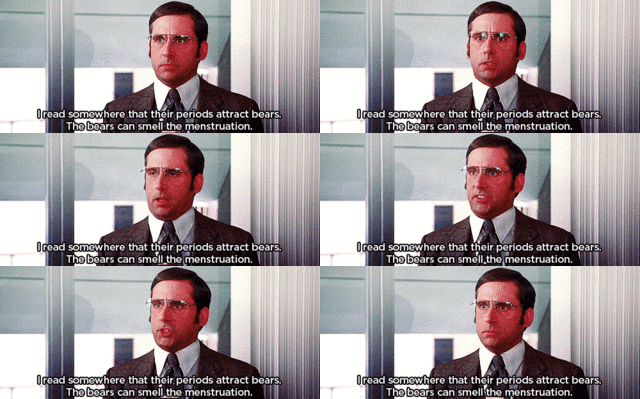
It is quite clear in her book that Nadya Okamoto is a fan of menstrual cups. She advocates for them numerous times, to the point where they don't seem to have any downside. And up until a few weeks ago, I might have thought the same thing. But I then saw an episode of "The Bold Type" where a young entrepreneur gives away one cup for each cup sold to homeless shelters for women. And I did a little research. Turns out that homeless people who menstruate rarely have access to restrooms with a sink to wash said cup two or three times a day.
"Gabby Edlin, the founder of Bloodygoodperiod, which provides sanitary protection products to women in Britain, said: “While everyone wants to be eco-friendly, there is a need to look at what people require first of all, and a lot of the women [our organization] supports do not have any washing facilities to wash the menstrual cup or places to dry the reusable sanitary products.”"
(https://www.passblue.com/2017/11/30/p...)
Hell, even I don't have access to single bathrooms with sinks near the toilet where I work and at university, which would make cleaning a cup complicated when I'm not home. But the only time Okamoto talks about this downside to menstrual cups is when she mentions young Indian menstruators. While I admire her dedication to reusable products, she needs to acknowledge the downsides as well as the upsides (such as the price of period panties like thinx, which can be as expensive as a whole year-worth of disposable products for 2 pairs).

I also realized Okamoto started with inclusive language, using 'menstruators' or 'menstruating people' from the start of her book. Unfortunately, with all the studies using the word 'women' instead, she gradually reverted to equating 'menstruators' with 'women', which isn't true. She tried, but I think more editing could have helped in this regard to make sure she kept the language inclusive throughout her more research-filled page.

My last problem was that, in her last chapter, "Take Action", some of her responses to critics are not really ones you can use when people use those critics. Some people who advocate against period equity won't change their minds, no matter what you answer them. They'll just keep screaming their ideas into the void in a way to shut you up. But telling your readers that a critic makes no sense (I'm oversimplifying here) won't help them answer when someone uses that critic to push back against their fight for period equity...

As I said, it's not perfect. But it's a good start, and it does give ideas for everyone to do their part, even those - like me - who can't jump in the fight all guns blazing. Whether it's contributing to a hashtag or giving menstrual hygiene products around for free, you've got what you need to start making period equity a thing.
Profile Image for janeee :D.
405 reviews89 followers
May 14, 2023
this was good and okamotos unwavering passion and drive for whats Right is something we should all strive to emulate but ultimately , shes an american , and as a non american i dont really think this book is supppeeeerr helpful on unearthing large scale moves in support of the period movement in contexts of da global south
Profile Image for Lee.
1,125 reviews36 followers
June 4, 2020
This book is hit or miss. In some parts, it is great, while in others, the immaturity of the writer comes through.

What I loved about this book was the way that the book addresses subjects related to periods that are mysteries to me but should not be. I read about how periods actually work, a lot of the medical risks associated with periods and other issues related to them. As a man, there was so much that I had to learn, stuff that my wife and I had never talked about but that I really needed to know. These parts of the book are excellent, the kind of thing that I could hand my daughter in the future to help her understand the mechanics of the period.

That part of this book was done well, but the book had a lot of other issues that nagged, most of which related to the author's immaturity.

First, the writing in this book is pretty lackluster. At times, it felt more like a 200 page-long text message rather than a book. I know she wrote this when she was 20 years old. Still, an editor could have tightened up the writing quite a bit.

Second, she seems to waffle a good bit. For much of the book, she is talking about how bad jokes about periods are, how, growing up, those jokes made her feel like a period was something bad. Then, she talks about a period joke from Michael Stipes and laments that this world is lacking in period jokes.

And third, she often times writes things that seem to be playing fast and loose with the truth. In one place she says that the US is, year by year, doing worse in terms of representing women as a part of its democracy, saying that countries like Rwanda are far ahead of the US... That is something that could only be said by someone who has not been alive very long. Of course, things for women in the US are improving. By most metrics, women occupy more places in elected office and more spots in the C-Suites. Even if it is not enough, it is foolish to say that things are getting worse. And, her suggestion that the US is getting worse compared to other democracies like Rwanda is off because Rwanda is not a democracy. Rather it is a high-functioning dictatorship run by Paul Kagame who places women in the weak legislature because he is trying to game international rankings and legitimize his rule.

All of that is to say, this book could be split into two parts: Period Primer and Period Power. I loved the parts from the Primer, the parts where she talked about those aspects of women's biology that men are blind about. But the other parts of the book were poorly written and not very interesting.
Profile Image for Reads With Rachel.
352 reviews5,846 followers
Read
September 17, 2022
This book was informative, however, the author has been called out for being anti-Black and silencing Black voices in her menstrual activism and because of this I can’t in good conscious recommend this book to anyone.

Discussed this here: Plagiarism in the menstrual justice space | Nadya Okamoto
https://youtu.be/zddOX7ZhuYk
Profile Image for Megin.
130 reviews3 followers
May 12, 2020
Great, we need books about periods. Good stuff. Bless her for writing it.

But my goodness so much repetition. This all could have been wrapped up in less than half the current pages. The editor could really have meant a big deal here but did not.

The book is VERY united states oriented, makes sense ofc. But own up to it. You can't just throw some UK numbers in and then add entire chapters dedicated to US legislation. That's cherry picking.
Also the family guy critique struck me as whiny. That show is over the top. It's job is to do just that. It does not need to carry the responsibility to educate about periods.

Btw, where are the men (or non-menstruators?) in this book? Do we not start at home, one by one? What about birth control to regulate periods?

Again. Love the hearth. We need more heart. But I can't read the words 'empowering menstruators' ever again without being annoyed (sidenote: not because it's inclusive, that's great, but there are more words to describe people with periods, see what i did there?).
Profile Image for Shazia.
269 reviews14 followers
August 7, 2020
Not a bad book but also not amazing. There were some interesting bits in it such as the section on the history of period products and how they were advertised, etc. What really stuck out to me was the section on period poverty and how there are so many women who can't afford or who don't have access to period products.

Right after I submitted this I decided to google Nadya Okamoto, the author of this book, because I previously hadn't heard of her or her nonprofit but decided to look more into it. After a 20 second read of her Wikipedia page I see that last month she resigned from her position after "allegations of exploitation and lies." Which...kind of doesn't surprise me cause the personal bits in this book about her being homeless did kind of stand out and seem off to me? Now I'm way less interested in looking into her nonprofit, sorry, but I know there are others when it comes to menstruation education and accessibility to products.
Profile Image for Fern.
639 reviews50 followers
December 19, 2018
This book is awesome. It made me angry for all the right reasons and has actually spurred little ol' me into action!

I am working on getting a grant through the library I work at to purchase some free pad/tampon dispensers for our public bathrooms at the library. I am also planning on trying to get a drive going for pads/tampons to distribute to our local homeless shelters.

Thank you Nadya for providing me with a tool and the knowledge to support me and for getting me riled up to do something good for my community!
Profile Image for Mariana Afonso | Books Of My Own.
225 reviews102 followers
November 5, 2021
(3.5)
A book that is a call to arms; as the title indicates, it’s a manifesto for a movement, the menstrual movement which aims to raise awareness on period poverty and inequality, and create openness when talking about menstruation.

The first part serves as an introduction to periods and menstrual and reproductive health. It talks about the first time you get your period, about the health matters that relate to menstruation, how to be careful and take care of yourself and also what are the symptoms you must look for if you’re a menstruator. It also goes in detail about period products, the available options today and how they came to be.

And then comes the second part, which was much better for me (as someone who already had all the aforementioned information, because I really believe the first part is super important and necessary to educate many). The author goes on to talk about period poverty, period policy, period representation in the media and the way each person can take action. This was really poignant and insightful, and added a lot of value.

The author exposed and analyzed many facts, research and situations in a clever way, highlighting how this is inequality deeply affects all menstruators, how interconnected period inequality is to gender, class and race prejudice and how much it would benefit all if periods stopped being a taboo, and instead something widely accepted as the most human nature (AS IT IS!!!). When tampons and pads become as normalized as candy or paper toilet, we will finally be on the right path.
Profile Image for Maggie Carr.
1,365 reviews43 followers
December 18, 2019
Read Harder Challenge 2019: A Book Published Prior to January 1, 2019 With Fewer Than 100 Reviews on Goodreads

I'm gonna be quite frank and say not many books have made me as mad as Period Power. It took me over two months to read because I was so angry I almost didn't want to finish, yet most was from a perspective I had never considered before. Why does the pink tax still exist when Rogaine & Viagra are tax exempt? Why aren't menstrual products ever listed as needs for homeless shelters? Pads & tampons should be readily available for all in need, just as toilet paper is in offices, public buildings and shopping centers. If we all started talking about menstruation the taboo would be taken from the dialogue and we could finally get somewhere with change. I'm all in for improving my surrounding in 2019. Now, what are you going to do to help me?
Profile Image for Hattie Lotz.
42 reviews
February 27, 2025
Clearly written, inclusive, and incredibly informative. I breezed through this book in a day and really enjoyed it. I have done a lot of research about menstruation and the issues surrounding it in culture, but this opened my eyes specifically to the struggles of women in prison and who are unhoused. Too often we fail to recognise some of the awful realities about living without access to period products.

This would be a really good book for a young woman starting to learn more about her body as well, as it details some of the most common complications that come with getting your period. I also jokingly told a friend "this would be a great beginner book for a guy who wants to learn more about women's rights" but honestly, jokes aside, it's just that thorough!
Profile Image for Kap.
436 reviews15 followers
September 5, 2019
Okamoto is a passionate young activist. While her book, Period Power, discusses the important topic of menstruation, I found it too simplistic. For me, the organization was scattered and writing style was grating. At times, the book read like a social media post, insisting that you should feel this way or that. I wish there had been more nuance and thoughtful exploration. For example, at times it felt like Okamoto was shaming those who use disposable hygiene products. While reusable products like menstrual cups and period underwear are more eco-friendly, they're expensive and impractical/uncomfortable for some.

That said, Okamoto's discussion of period poverty, particularly among people who are homeless or incarcerated (in the U.S.) was extremely important. I also enjoyed when the book focused on history and (American) politics. It was interesting and I wish there had been even more written on these topics.

In the end, while I think Okamoto is doing a great thing and I hope that this book can be helpful for others, for me, it was a disappointment. Instead of drawing me into the menstrual movement, it left me feeling a bit ostracized. It's important that we talk about menstruation more openly and shine light on period poverty. But I don't think this book succeeded in disentangling periods from traditional ideas of "womanhood".
Profile Image for Monique.
709 reviews90 followers
April 1, 2021
It was ok, but a bit repetitive... and honestly I thought I was reading another book with the same title so I was a bit confused lol. The message is important, but comes along as a bit preachy, and while she tries to include everyone, she forgot one important group: disabled menstruators. Also I think she missed a few things in the medical chapter, there are more illnesses besides endometriosis.
Profile Image for Catarina | cat literary world.
630 reviews
March 6, 2022
I felt this as a very informative read. Let me go step by step into this review because, despite the fact that I liked it a lot, I had some issues as well.

"Period Power" is really what it promises: a book about periods and it can be read by a very large audience, from those who mestruate to those who don't, from young people to old. The book starts by explaining what is a period. Is a simple explanation but I felt it might be useful to start the conversation with young children/pre teens, making them more aware of body changes. The book is very US based, reason why I ended up skipping part of two chapters, which I usually don't do. Chapter 6 and 9 were the ones, 6 being very focused on state policy on periods that doesn't really apply to my reality here in Europe and 9 being very focused on US activism on periods (I end up skipping parts for the same reason).

I felt very privileged while reading about homeless women and incarcerated women. For me, this was the most educational part of the book and for this alone I would totally recommend reading.

The book also addresses some important topics like the difficulty in accessing period products and the necessity in making them free. I believe it already is done in some countries, but again, very US based so we don't get that sense.

The author is really inclusive towards people who menstruate, which I felt very important. However, I felt the narrative was not always very inclusive towards all of menstruation experiences. There are some mentions of period pain, for sure, but the majority of the book makes us think that the main issue is the access to period products. I won't say it isn't. I can't even begin to imagine the day to day life of people who lack the access to these necessity itens. Nevertheless, every menstruation experience is different and pain can truly be a pain in the ass (pun intended!). Pain and discomfort during periods are real and people should not have to carry on with their daily lives as if nothing is wrong. I would have liked to see more discussion on menstrual leaves, which some companies already have. I have mixed feelings on those, so I would have liked to see them deeper explored.

Finally, I could not end without mentioning some wrongs in the book: female cycles don't synchronize! I just wanted to roll my eyes at this! I mean, I'm not a trained professional on the subject, but, from what I've been reading, this is just bullshit (pardon my french!). The cycle is not 28 days for everyone. It can be longer, it can be shorter and it's dangerous to continuing spreading this idea that is 28 days (thankfully, it didn't say that ovulation occurs at day 14! which, as a matter of a fact, doesn't for everyone). Then, there is no such thing as "chemical free materials" as everything is made of atoms (as I chemist, I just couldn't let this one slide trough).
Profile Image for Rachel.
429 reviews264 followers
Read
September 6, 2023
not rated due to it being non-fiction

Educational book, I say mainly targetting the younger audience as it explore everything from getting your first period, what collection methods are out there. To wider topics such as period poverty and gender inclusivity when it comes to talking about periods.

I did learn a fair amount in this book that made me think about the way we represent periods in the media but it was also a lot of basic info I already knew which makes me feel like this book would be great for younger readers, who may have just started their period or are wanting to learn more. However, by the last 100 ish pages it started to sound very preachy and told a bit like I would write an essay for school 🫢 lots of resources, quotes etc. Also near end, it got very repetitive.

Side note// I actually went into this book thinking it was Period Power by Maisie Hill, all about harnessing your hormones and understanding your cycle more deeply. With both books having the same title, I got confused. Period Power: A Manifesto for the Menstrual Movement was still a good read, and glad I've read it but I did go into it with a different understanding to what I thought the book was.
Profile Image for Lucie Pelcakova.
193 reviews
August 1, 2020
Skvělá kniha o tom, proč mluvit o periodě je důležité. Osobně mi kniha neskutečně sedla a vyvolala ve mě mnoho reakcí - což je dle mého i účel této knihy. Moc moc moc skvělé bylo to, že Okamoto také nemluví o "ženách co mají menstruaci" ale o "lidech, kteří menstruují", což bourá ještě další taboo o tom, že perioda se týká pouze žen. Hodně mě také zaujala debata o periodě a bezdomovcích, či o tom, jak často vězení odmítají vydávat menstruační pomůcky - i když mají dostatečné zásoby. Sama neustále slýchám, jak jsou "ženy a jejich periody trapné" a také neustále vídám to, jak si především muži myslí, že perioda znamená čůrat krev, proto mne kniha neskutečně oslovila a zanechala ve mne mnoho pocitů, názorů a myšlenek.
Profile Image for Karlee.
35 reviews2 followers
Read
June 6, 2019
This book covers the basics of periods, the history of period products, the stigma around periods, period poverty and what can be done. The author herself founded a non profit related to the menstrual movement at a young age and I think this book will especially speak to young people who are interested in activism and ways to make a difference, not just in this particular movement, but anything that calls to them.

Bonus: very inclusive language
Profile Image for Arisha (Free Palestine 🇵🇸).
466 reviews43 followers
August 14, 2024
This was so educational and informational! I learned so much about period poverty and the importance of removing the stigma around menstruation. While I didn’t agree with everything stated in the book, it did radicalize me. I didn’t understand how much privilege I had until I realized I have always had access to period products. I’ve never had to use cardboard or mushed cotton balls as a pad. This is a must read for everyone.
Profile Image for Patb.
331 reviews5 followers
March 29, 2019
This was a fantastic book. I have been poor, but not so poor as to not have money to buy pads or tampons. This is a book that everyone who menstruates should read. Great ideas at the end of the book on ways to help with actively working on getting period products into the hands of the people who need them.
Profile Image for Hannah.
107 reviews22 followers
June 22, 2020
I found this book really interesting. I enjoyed learning about the efforts in period advocacy and what still needs to happen. I especially liked how the author shared her own experiences with housing disparities in order to connect about homelessness and periods.
Profile Image for Jolene.
Author 1 book35 followers
October 3, 2021
Guys, Nadya Okamoto sounds like such a nerd when she presents. But it's not her fault! She's only 23! She's very cute and earnest and is doing excellent work! She should be passionate and excited! I wish more young people were as passionate and excited!

But when she uses the anecdote about how her high school peers thought she was kind of uncool, I was like, yeah. That tracks. 🤷🏼‍♀️

This book though, and her organization, Period, which I follow on Insta now, are very cool. And important. And honestly, I'm probably just jealous that I wasn't doing work like this ten years ago. I want to give his book to every young person I know. And to all my millennial new parent friends who will someday need to talk about all of this with their kids.

Period Power's structure threw me for a bit of a loop, though, because it's half sociopolitical history about socialized gender roles and half self-help guide for new menstruators. Like, what-is-a-tampon-and-how-do-you-insert-it kind of material. Which is all fine and good, but I'm not the audience for that part. And it feels like twelve-year-olds maybe aren't the target audience for the sociopolitical parts.

That said, it's undoubtedly better than whatever American Girl-style guide I read when I was a kid.

The last thing I'll say is that on multiple occasions I panicked and started yelling aloud and had to skip ahead in the audiobook because whatever menstruation-connected illness she was describing was so upsetting. So just, fair warning.

Wait, no, the actual last thing I'll say is that this book made me search through my drawers for the Diva Cup I had back in 2010. I didn't find it. But wow, does she make a compelling case for buying a new one.
Profile Image for Reema Zaman.
Author 4 books61 followers
October 28, 2018
Nadya Okamoto has written a quintessential manifesto for the leader in all of us. Her infectious passion, wit, and piercing intelligence will inspire you to rise into your bravest self. Moreover, this book and her voice have the power to help us learn self-love and respect, in a deep, authentic, lasting way. Not only will this book change your life, it will change the world. Nadya Okamoto is a revolution.

Reema Zaman, author of I AM YOURS
2,415 reviews12 followers
December 19, 2018
An interesting nonfiction title that addresses equity and period policy. Not one that will appeal to the masses, but still well written.
Profile Image for Autumn.
1,024 reviews28 followers
January 29, 2019
I've been getting my period for over 30 years (Jesus...) and I still learned stuff from this super woke book. A wonderful alternative to B/S 'what's happening to my body book for girls' shamefests. Okamoto's background as an activist against period poverty (ie. providing equal, non-capitalist access to period products) adds heft. A must for all libraries.
Profile Image for Noel نوال .
776 reviews41 followers
August 12, 2021
description

Six years ago my father rushed me to the emergency room when I was anemic from so much blood loss and in excruciating pain. Several tests, doctor visits, multiple misdiagnosis, and prescriptions and treatments later I was diagnosed with endometriosis. It had taken 7+ years and an emergency visit for me to finally get diagnosed. I had endured years of doctors dismissing my pain, especially as a woman of color in the United States, and being told that exercise and cutting out sugar would fix all of my problems.
I have an extremely high pain tolerance due to the chronic pain I've been enduring with my endometriosis for well over a decade and a half. It is a lifelong debilitating disorder that 50% of the time leads to infertility, and sometimes requires a complete hysterectomy to prevent further damage and improve the quality of and potentially save the person's life. However, you have to find a doctor willing to perform the surgery first because to many doctors the infinitesimal chance you could conceive a baby or want to biologically birth one in the future is far more important to consider than your own wellbeing and health. Many endometriosis sufferers have died due to their pain being dismissed only to have their autopsies show that their abdomen, and sometimes chest cavities, were full of endometrial adhesions and scar tissue that led to slow and painful deaths.
All of this to say that from a very young age I have always been deeply passionate about periods and eliminating the taboo. I come from a family that likes to pretend periods do not exist; you do not discuss them EVER to cater to everyone's discomfort, to the point that the word 'period' has always been a big no-no word and instead you have to say "woman thing". Perhaps it's my personality, or maybe it's the pivotal part the familial period shame played in my delayed endometriosis diagnosis, but I have always been excited to talk about periods and have always challenged the family taboo of the word 'period'. It even got to the point that when my family and I would watch vampire movies they just knew I was going to ask the most obvious question ever; "why do they show vampires going nuts at the drop of blood from that person's cut when guaranteed at least one person in that entire place has got to be on their period?" I even lovingly call my period 'shark week', not the least bit out of shame, but because I LOVE sharks and I love the beauty of periods even if my uterus has some slight glitches.
In society and everyday life so much about periods is considered taboo despite men in the government thinking they own and have complete control over our uteri. This book is a magnificent manifesto for the menstrual movement discussing destigmatization of periods, period products (some of which I never heard of such as the use of sea sponges which was so exciting!), the history of the menstrual movement, menstrual legislation, menstruation and homelessness, period poverty, menstrual disorders, intersectionality and inclusive terminology, and so much more. I truly enjoyed this book and learned so much. My only two qualms with Period Power are that PCOS is never mentioned despite it being one of the most prevalent menstruation disorders, and Okamoto also takes a verse from the Quran completely out of context to insinuate that Islam sees menstruation as making women dirty and untouchable. A couple of diplomatic lines were added after this statement, but it would really have been beneficial for Okamoto to have studied the entirety of Islam's teachings regarding menstruation before cherry-picking out a verse and making an ignorant and harmful implication like that.
A woman from the Blackfoot tribe I met many years ago talked to me about her culture's beliefs and teachings about menstruation, or moon cycle, and the reverie her people held towards one observing menstruation was one of the most beautiful cultural practices I've ever learned about. For all of the taboo and shame so many of our cultures, including here in the US, have created and stigmatized about periods there are cultures across the globe that celebrate menstruation. We all could learn a great deal from them.
One of my favorite take-aways from this book has got to be the mention of the first time the use of a pad being documented in history. A woman in ancient Greece had an "admirer" AKA stalker and she threw her period soaked pad at him to get him to leave her alone. ICONIC.
Profile Image for Becky.
1,644 reviews1,947 followers
December 29, 2023
This was good. Informative in the first half (though not comprehensively so - if you want that, read The Vagina Bible: The Vulva and the Vagina—Separating the Myth from the Medicine instead, or rather, first.), and inspirational in the second half. I was impressed with Okamoto's openness and her desire to actually effect change when it comes to people's menstrual cycles and attitudes and resources around them.

I have had my period since I was 12 (nearly 30 years already *sob*) and I unfortunately lived suffering with period-related issues for most of that time, thinking that it was "normal" to be in debilitating pain every month, so severe that I throw up, can't move or function, and sometimes so severe that I actually think I might need to go to the ER, or to be bleeding so heavily that I am exhausted and don't have the energy to move, even if it wasn't too painful to do so. I switched to reusable cups about 10 years ago (mainly because of the environmental benefit of reusables over disposables), but an unexpected benefit was realizing that tampons aggravated my body, and switching to the cup helped a little bit - at first.

It's only in the last few years that I even thought to question any of my issues being not normal. I am VERY thankful for those people who are trying to bring awareness to the fact that this is NOT normal, to counter the taboo on discussing menstruation and related issues with each other. Because of that, I actually advocated for myself with a new doctor, and she listened to me and took them seriously, resulting in my being diagnosed with uterine fibroids and having some procedures done which have GREATLY improved my quality of life. I still have issues, but they are now manageable. Honestly, besides hysterectomy, I don't think anything will completely work in that regard, and that likely comes with a set of different issues to deal with.

The other main issue that Okamoto raises here is period poverty, and policies that make it very difficult for low-income or institutionalized people to reliably access menstrual products. This was eye-opening for me, simply because I never thought much about it. But the information presented here about period poverty, and the way that menstrual products are treated as a "luxury" item and not a necessity item, was really... unsurprising but disappointing. We need to do better.

Anyway, I'm glad that I read this, and I'm glad that it was written. I'm happy that people are advocating for change in this area and doing something to actually help.
Displaying 1 - 30 of 318 reviews

Can't find what you're looking for?

Get help and learn more about the design.