

What do you think?

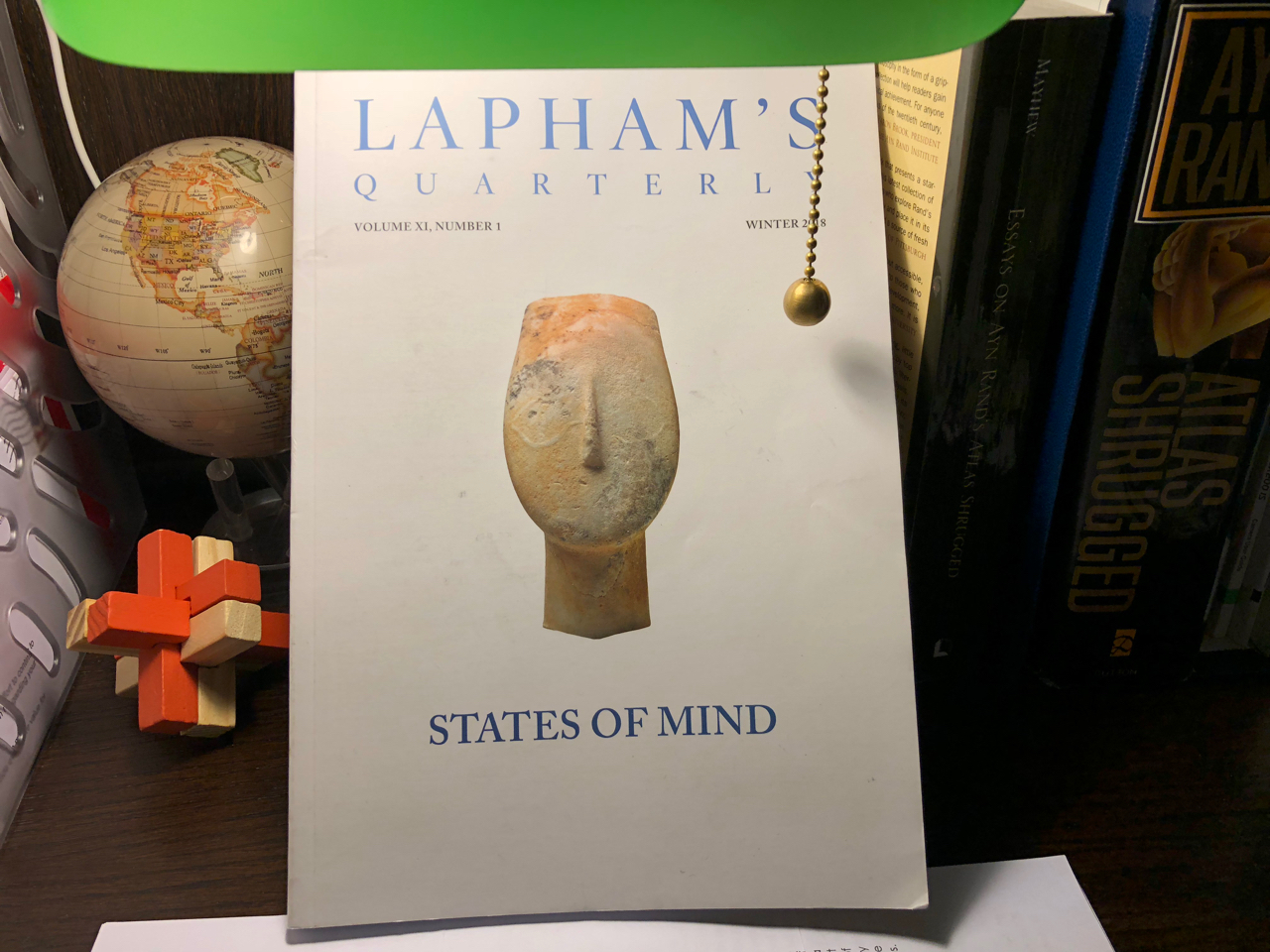
Lapham's Quarterly: States of Mind
- GenresNonfiction
224 pages, Paperback
First published December 1, 2017
About the author
Lewis H. Lapham
181 books134 followersLewis Henry Lapham was the editor of Harper's Magazine from 1976 until 1981, and again from 1983 until 2006. He is the founder and current editor of Lapham's Quarterly, featuring a wide range of famous authors devoted to a single topic in each issue. Lapham has also written numerous books on politics and current affairs.
Lapham's Quarterly
http://www.laphamsquarterly.org/
Lapham's Quarterly
http://www.laphamsquarterly.org/
Ratings & Reviews
Friends & Following
Create a free account to discover what your friends think of this book!
Community Reviews
Displaying 1 - 5 of 5 reviews

December 9, 2017
I’m mystified, as I often am when reading Lewis Lapham’s Preamble. What was that old elementary school course, or grade on the course? Reading Comprehension. I suspect mine would now be a ‘C’ or a ‘D’, on a descending scale of A, B, C, D, E or F being a Fail, for those of you in other-worldly academic environs.
The preamble title is The Enchanted Loom. States of Mind? Loom? The convoluted and complex brain weaving an abstract tapestry of thought? Perhaps I missed the analogy.
Mr. Lapham has never failed to hurl vocabulary and sentencing I had difficulty grasping. That could be a good thing. The exercise of reaching for meaning and understanding, at whatever comprehension level one happens to be. You grasp what you can.
As a preface to the rest of the issue he does put forward ideas worth pondering. Do we still think, or are we striving and succeeding in abrogating our thinking to machines and Artificial Intelligence? Of course we think, but do we think well, or hard? I’ve often mused that if I were the tribal sage, charged with passing on an ancient oral history to subsequent generations, that the story would be sadly scrambled in my interpretive telling, altering history in one swell foop.
That’s more of a memory issue I suppose. Per St. Augustine in the preamble:
“The power of the memory is prodigious, my God. It is a vast, immeasurable sanctuary. Who can plumb its depths? And yet it is a faculty of my soul. Although it is part of my nature, I cannot understand all that I am…I am lost in wonder when I consider this problem. It bewilders me.” (p. 15)
Mr. Lapham notes that even non-oral history is interpretive:
“History is not what happened two hundred or two thousand years ago. It is a story about what happened two hundred or two thousand years ago. The stories change, as do the sight lines available to the tellers of the tales. To read three histories of the British Empire, one of them published in 1800, the others in 1900 and 2000, is to discover three different British Empires on which the sun eventually sets.” (p. 14)
Oddly, I think, Stephen Hawking, Elon Musk, and Steve Wozniak have spoken out against AI or forms of it, but none of them are included in this issue.
Examples:
http://www.bbc.com/news/technology-30...
http://www.businessinsider.com/stephe...
I do question a couple of premises.
One: “Mind is consciousness, and although a fundamental fact of human existence, consciousness is subjective experience as opposed to objective reality…” (p. 14) There may be more assertions than words there but I most take issue with ‘consciousness is subjective experience as opposed to objective reality’. Whose subjective experience defines objective reality? As an Ayn Rand reader I’d put it ‘consciousness is awareness of objective reality’. When you want to argue that a rock is not a rock then you are creating a subjective experience. Be careful someone doesn’t hit you with it to improve your clarity and make an impression on your mind.
We did make the whole thing up didn’t we, but how could we not? Being around for millennia with eyes wide open we were bound to name the things we saw, touched, heard. That didn’t change the things of objective reality, it just gave them names. It’s when we got ‘smart’ and wanted to argue about it that we got subjective. I digress.
Two: “We all live in a great reef of collective experience, past and present, that we receive and preserve and modify.” (p. 15, Marilynne Robinson.) Collective experience (-mind, -psyche, -behavior,) all grate on my (subjectively?) individual point of view. We are separate, individual, (sometimes) thinking human beings. We are not some amorphous mass ‘collective’ of connected minds, though Eric Hoffer (True Believers) or Elias Canetti (Crowds) can enlighten us on, as Hoffer put it, The Nature of Mass Movements. We just don’t think well, or hard, often enough. I know this as I’ve had a lot of experience not doing so.
There are many lines in the Preamble that struck a chord:
RE: AI:
“Watson and Alexa can access the libraries of Harvard, Yale, and Congress, but they can’t read the books. They process the words as objects, not as subjects. Not knowing what the words mean, they don’t hack into the vast cloud of human consciousness… …that is the making of once and future beings.” (p. 14)
“America’s democratic republic was founded on the meaning and value of words. So is the structure of what goes by the name of civilization.
Silicon Valley’s data-mining engineers have no use for the meaning and value of words; they come to bury civilization, not to praise it” (p. 17)
On Man as a material thing:
“In digitally enhanced America these days, who among us thinks it shameful to be no different from a material thing? … Not only is being no different from a material thing not shameful, it is the consummation devoutly to be wished–to be minted into the coin of celebrity, become a corporation, a best-selling logo or brand, a product in place of a person.” (p. 18)
The Kardashians? Ellen’s 12 Days of Christmas giveaways? Now there is some bizarre behavior to observe. Objectively of course. Lapham’s issue on Celebrity, Winter 2011, related how celebrity branding has always been with us. Today we have gone beyond the pale, if any longer there are boundaries on acceptable behavior.
“On screen and off, our world grows increasingly crowded with machines of whom we ask what the rich ask of their servants (comfort us, tell us what to do) and on whom we depend to so arrange the world that we can avoid the trouble of having to experience it.” (p. 18)
Robot toys with which children can interact. Ever more realistic inflatables for the lovelorn and disconnected adults, or so I’m told. (We must keep our sense of humor.) Shudder to think people should converse with other people. I lost perhaps the two greatest conversationalists in my life last summer. Others lost these two also. The world is poorer now, trust me.
I don’t feel I’ve moved States of Mind forward yet. But I’m thinking, thinking.
“…it isn’t with machines that men make their immortality. They do so with the powers of mind acquired on the immense journey up and out of the prehistoric mud, drawing on the immense wealth of subjective human consciousness…” (p. 19)
“Our technologies produce wonder-working weapons and information systems, but they don’t know at whom or at what they point the digital enhancements. Unless we find words with which to place them in the protective custody of the humanities–languages that hold a common store of human value and therefore the hope of a future fit for human beings–we surely will succeed in murdering ourselves with our shiny new windup toys.” (p. 21)
Amen Lewis.
[I just received an email notice about this issue. “In States of Mind, Lapham’s Quarterly explores the brain, the soul, and consciousness itself—how they connect and where they diverge.” “The Enchanted Loom On the mind’s ability to reinterpret the past and the tenth anniversary of Lapham’s Quarterly.” Ah, that explains it better. Forget everything I just said.]
The Preamble is available online at LaphamsQuarterly.Org. You’re invited to read a tidbit or two and express your thoughts in a comment here.
States of Mind.
States of Thinking.
That strange phenomena, thinking. It is strange, don't you think?
As a commenter of pt. 1 noted, "Aren’t we fortunate to have the leisure to just “think"." That thought had occurred to me also, independently. Hmm.
It would appear that pondering one's existence through most of the ages has been the luxury of philosophers, kings, and queens, though no doubt the slave, soldier, and peon, wiping sweat from fevered brow, wondered what sort of existence he had stumbled into.
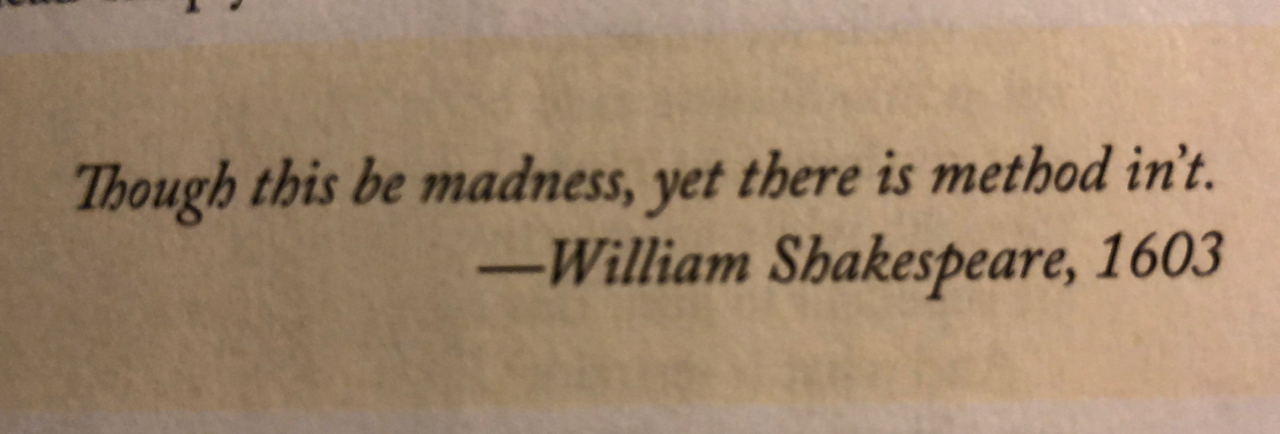
Paraphrasing, when a young Alan Greenspan posited to Ayn Rand that "I don't know if I exist", she replied "Who is it that is thinking that?'
If I had to choose a singular fact from this issue to highlight, it would be "...we do know there are around 86 billion neurons in the brain. Each neuron has on average seven thousand synaptic connections. That makes the brain the most complex object in the universe, as it is often said." (Noga Arikha, p. 194) (Compare to computer chips, both CPUs and GPUs: https://en.wikipedia.org/wiki/Transis... ) (Want to know more? Try Neuroscience For Kids.)
Not only are we connected, however that works, but we created and evolved languages to express our thought and imagery. Were it not for shared symbolism we wouldn't 'think'. If you google "the number of languages in the world" you can find references such as:
"The Ethnologue catalogue of world languages, which is one of the best linguistic resources, currently lists 6909 living languages. About 6% of them have more than a million speakers each, and collectively account for 94% of the world population. On the other hand, about half of the languages are spoken by fewer than ten thousand people, and about quarter have fewer than one thousand speakers." http://www.education.rec.ri.cmu.edu/f...
and:
The top 100 languages account for about 5.6 billion people.
https://en.wikipedia.org/wiki/List_of...
Don't get me started on creativity and how ideas seem to pop into our head like little bubbles rising to the surface of a liquid and popping into the air.
Speaking of metaphors, George Eliot (Mary Anne Evans) notes, rather insightfully I think:
"O Aristotle! If you had had
the advantage of being “the freshest modern”
instead of the greatest ancient, would you not
have mingled your praise of metaphorical
speech, as a sign of high intelligence, with a
lamentation that intelligence so rarely shows
itself in speech without metaphor—that we
can so seldom declare what a thing is, except
by saying it is something else?" (p. 44)
'...we can so seldom declare what a thing is, except by saying it is something else?' Food for thought. (A metaphor?)
I found another comment of hers more self-applicable:
"...a man might observe the display of various or special knowledge made by irregularly educated people with a pitying smile; all that sort of thing was very well, but it was impossible these people could form sound opinions." (p. 43)
I often feel like a random-generated fact machine, spouting answers, or questions as it where, like I was responding to the Jeopardy game on tv. "Who was Leonard Sly?!" (What was Roy Rogers' given name.) Can I expound on theory and concepts? No better than "..."the masses," who are now understood to have the monopoly of mental darkness..." (p. 44)
As always, Wikipedia beckons and enlightens on Ms. Eliot/Evans and her novels such as The Mill on the Floss and Silas Marner. Her brief extract is this issue is generously available online at LaphamsQuarterly.org as:
Styles of Learning
c. 1840 | St. Ogg’s
Seek. Find.
The three sections of Voices In Time this issue are:
Cognition
(The mental process of knowing. Acquiring knowledge and understanding through thought, experience, and the senses.)
Cogitation
(Thoughtful consideration, contemplation, concerted thought or reflection.)
Consciousness
(A sense of one's personal identity. Being aware. Awareness by the mind of itself and the world.)
(Definitions are my dictionary paraphrasing.)
As always the extracts, 80 this issue, are thoughtful, insightful, contemplative, provoking inquiry, inviting inquisition. Not as many earned my coveted double- or triple-asterisk annotation, but to find the nuggets one must sift a lot of creek sand, and it is good quality sand, the kind that will make you THINK as it flows past all those neuronal synapses.
A few of my favorites:
Allow Me to Enlighten You
1897 | Washington, DC
by Alexander Crummell (free online)
This is a 19th century plea for recognition of intellect in black people, written by a black man. Well said. Will we ever understand Man's alienation or cruelty of other men? One can only hope.
In 1641 Descartes is thinking, deeply thinking. He doesn't quite say "Je pense, donc je suis" as he did in the 1633 French-written Discourse on the Method, or "ego cogito, ergo sum" as he did in the 1644 Latin-written Principles of Philosophy, (thank you Wikipedia) but he's close.
"So after considering everything very thoroughly, I must finally conclude that this proposition, "I am, I exist," is necessarily true whenever it is put forward by me or conceived in my mind."
"...I know that I exist; the question is, What is this "I" that I know?" (p. 51)
Regardless of how it is said, when you say it, who is it that is saying that?
Lucian, c. 166, is superb on writing impartial history.
"Thucydides laid down this law very well: he
distinguished virtue and vice in historical writ-
ing, when he saw Herodotus greatly admired to
the point where his books were named after the
Muses. For Thucydides says that he is writing
a possession for evermore rather than a prize
essay for the occasion, that he does not wel-
come fiction but is leaving to posterity the true
account of what happened. He brings in, too,
the question of usefulness and what is, surely,
the purpose of sound history: that if ever again
men find themselves in a like situation, they
may be able, he says, from a consideration of
the records of the past to handle rightly what
now confronts them." (p. 55)
Other than 1,850 years or so, the following doesn't seem far removed: from p. 284 of George Santayana's 1905-1906 The Life of Reason, Vol. I, Reason in Common Sense, Chapter XII, Flux And Constancy In Human Nature: ..."when experience is not retained, ... infancy is perpetual. Those who cannot remember the past are condemned to repeat it." (Project Gutenberg)
Katsuki Sekida's piece from Zen Training is superb. He notes that our absorption into a task can result in our loss of the sense of time, similar to absolute samadhi in which "...there is no time. "No time" means there is only the present time." ... "Present, present, present. This present time is interrupted if a reflecting action of consciousness occurs. You reflect on your thought and recognize the difference between the moment ago and this moment." (p. 67)
Isaac Asimov is superb also, with an extract from his short story The Last Question and characters such as Zee Prime and Dee Sub Wun. Humor me, and muse yourself. Read this, starting with Chapter 4, in a reproduction of the pulp magazine version here:
https://archive.org/stream/Science_Fi...
Sy Montgomery has an excellent piece on the sentience of octopuses. (NOT octopi!) It's not available online but there is a portion that can be read here:
http://symontgomery.com/the-soul-of-a...
Well worth it!
Octopuses, whales, elephants, dolphins. What are they thinking? I think they are thinking something.
Daniel Ellsberg is here, giving advice to Henry Kissinger. Coincidentally I recently saw the movie The Post, about the publishing of The Pentagon Papers stolen by Ellsberg. Excellent movie, at least for an American audience and others familiar with the Vietnam era incident.
A couple of thought-provoking extracts are available online:
All four complete concluding essays are available online, of which I particularly recommend The Person In The Ape by Ferris Jabr.
"Members of all species apart from our own are typically regarded as property--as things." (p. 188)
"Looming beneath the legalities is a more profound philosophical question with urgent moral implications: What does it really mean to be a person?" (p. 189)
I conclude with a few side-quotes, of which many are notable this issue.
"Brain, n. An apparatus with which we think that we think." --Ambrose Bierce, 1906 (p. 190)
"What the brain does by itself is infinitely more fascinating and complex that any response it can make to chemical stimulation." --Ursula K. Le Guin, 1971 (p. 176)
The End.
[I received an email notice about this issue. "In States of Mind , Lapham’s Quarterly explores the brain, the soul, and consciousness itself—how they connect and where they diverge." That explains it better. Forget everything I just said.]
The standard notes:
1. Since L.Q.’s inception with the Winter 2008 issue its size is always 7″ x 10″ x 1/2-17/32″. It is white-covered, printed on high quality paper throughout, with richly printed reproductions of fine art from time immemorial, and 221 pages up to a page or two of addenda at the back.
2. Each issue contains extracts about the title topic from great authors and thinkers spanning all recorded history. It begins with an eloquent, to a fault, preamble/introduction by editor Lewis Lapham. The main body is called Voices In Time and contains 3 or 4 subcategories of the topic with about 25 extracts per section. Noteworthy sidebars, side quotes, and depictions of appropriate art from the ages are liberally distributed throughout. Several extended contemporary essays bring up the rear. There are several other small sections every issue (Among the Contributors, Conversations, Miscellany, ‘The Graphic’).
3. Per the L.Q. website:
“Lapham’s Quarterly embodies the belief that history is the root of all education, scientific and literary as well as political and economic. Each issue addresses a topic of current interest and concern—war, religion, money, medicine, nature, crime—by bringing up to the microphone of the present the advice and counsel of the past.”
4. I encourage all to subscribe to this fine publication. It is a rich supplement to anyone’s reading.

July 23, 2018
Lapham's Quarterly is a lifeline for your mind during these troubled times!
December 27, 2017
B+. I liked the material in this issue. The study of consciousness has always been at the top of my interests. I especially liked the excerpt from Daniel Ellsberg's book about what is known by some and not known by others.

June 7, 2023
One of the better ones. Likely because of the wide range of the chosen topic. You really get to explore the entire emotional state of humanity, cross-referenced by varying degrees of physical or drug-induced impairment or enhancement of the thinking process.
June 19, 2021
An insightfully deep yet practical experience as always when reading this excellent publication, great work.
Displaying 1 - 5 of 5 reviews