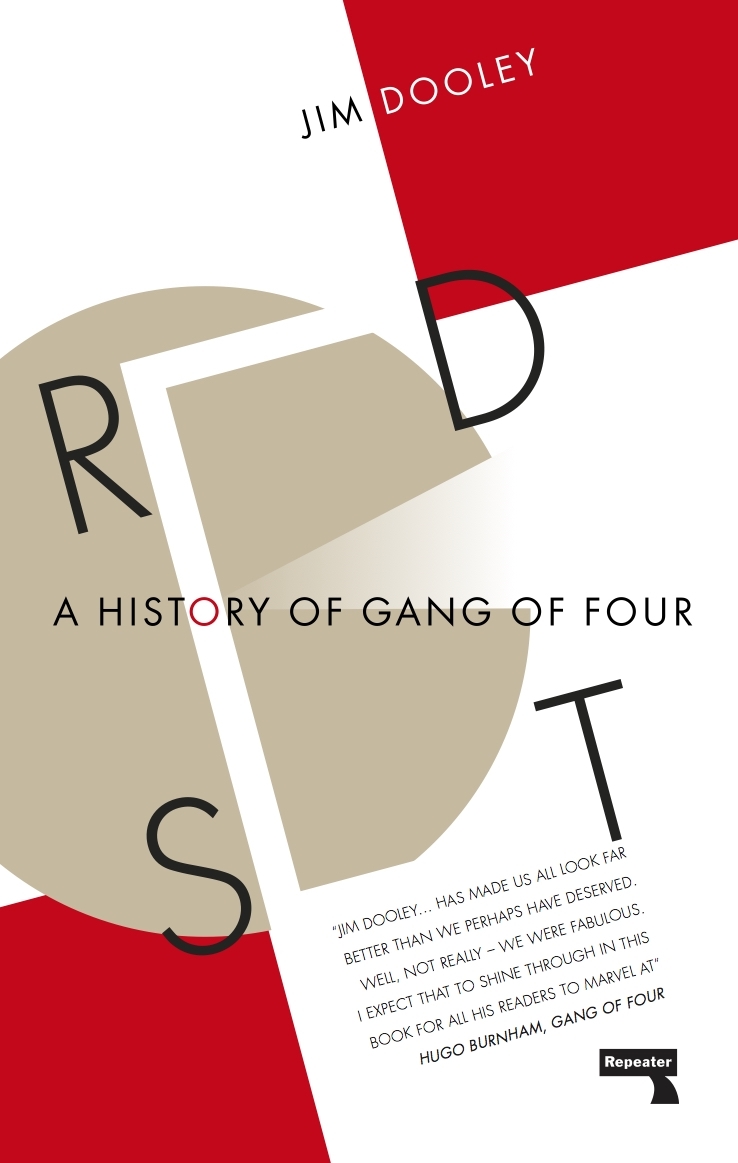
In the autumn of 1976, two young British Fine Arts students travelled to New York on a university grant, but instead of merely studying ended up staying with one of the city’s pioneering punk journalists, visiting the Museum of Modern Art by day and hanging out in punk epicentre CBGBs by night. It is from this trip that Gang of Four emerged.
Blending revelations from interviews with the band conducted by the author with snippets from newspaper articles and record reviews, Jim Dooley tells the history of Gang of Four as they remember it. From their days at art school through countless tours, records and reunions, Red Set is the definitive history of one of Britain’s greatest and most influential bands.
A bit of an anomaly as far as rock 'n' roll writing goes, Red Set: A History of Gang of Four is more of an intellectual biography than anything else. Where musician biographers typically focus on the proverbial sex, drugs, and rock 'n' roll — even where such putatively anti-rock 'n' roll movements as punk and hardcore are concerned (cf. McNeil and McCain's Please Kill Me: The Uncensored Oral History of Punk) — Jim Dooley prefers to delve into the artistic antecedents, conceptual backdrop, and political significance of Gang of Four's work. He explicitly brings out this dimension of his project in the opening chapter: his concern, he says, is not merely with the musicians' lives, but with the group's output, both in relation to the music industry and, more generally, to our times. This involves him in tracing the various elements of Gang of Four's approach — their themes, their musical style, their approach to performance — back to their roots not only in other musicians' work, but also in the intellectual, economic, and artistic milieu of Leeds University where Jon King, Andy Gill, Dave Allen, and Hugo Burnham met and formed the band.
Dooley begins with a brief overview of each member's life before their time at Leeds: King and Gill's early experiences at Sevenoaks School in Kent, their early contact with reggae music and with 60s rock 'n' roll, and their interest in activist art; Allen's childhood and teenage years in Kendal, his learning to play bass by playing along to classic rock records; and Burnham's schooldays in Cranbrook, his drumming in the school band and buying his first drum kit, and his early interest in rugby. Most important, perhaps, is the trip King and Gill took to New York, where they stayed with filmmaker-to-be Mary Harron and visited CBGBs, taking in the performances of such early punk acts as the Ramones, Blondie, Richard Hell and the Voidoids, John Cale, and Television.
Next are a couple of chapter on Leeds the city and Leeds the school. Dooley stresses the poor economy in Leeds in the mid-to-late 1970s, with the concomitant rise of the nationalist, socially conservative, and anti-immigrationist Nationalist Front — all in sharp contrast with the liberal atmosphere enjoyed by students at Leeds University. The result, as he has it, was to turn the city into the site of a culture war between, on the one hand, the predominantly working-class far-right, and on the other, often student-centred left-wing communist and feminist groups. In particular, Dooley narrows in on the atmosphere of the art department, where three of the members of Gang of Four studied: under the leadership of the art historian T.J. Clark, the department at Leeds gained a distinctively left-wing bent, leaving a lasting structuralist, feminist, and, of course, Marxist influence on the artistic and intellectual tendencies of the young King, Gill, and Burnham.
Having traced both these musical and intellectual influences and the social motivations that underpinned them, Dooley goes on to show how these shaped Gang of Four's early approach to music: their desire — common to several groups that came to be labelled as "post-punk" — to overcome the sharp divide between "black music" and "white" music by incorporating funk and dub influences, their attempt to avoid the trappings of strict avant-gardism while at the same time challenging their audience both artistically and intellectually, and their tongue-in-cheek back-and-forth vocal delivery. He traces their development from their first EP, Damaged Goods (1979) to their latest LP, What Happens Next (2015) with all of the touring, controversy, lineup changes, vacillations in popularity and reception, stylistic modifications, and managerial difficulties in between.
Broad in scope, meticulously researched, and surprisingly rich in philosophical or theoretical content, Red Set provides an engaging overview of the career of one of the most interesting groups to emerge from the punk and post-punk scenes of the mid-to-late 1970s. Leagues ahead of Paul Lester's earlier biography, Damaged Gods (2008), and much wider-ranging than Kevin Dettmar's short book on Entertainment! (2014), the book in its entirely is essential reading for the die-hard Gang of Four band. On the other hand, more casual fans of the band (and fans of punk, post-punk, or even popular music in general) may be more interested in the first 225 pages — which contain the bulk of the reconstruction of the group's intellectual, artistic, and biographical background, as well as an account of the composition and recording of their now-universally acclaimed debut and sophomore albums, Entertainment! (1979) and Solid Gold (1981) — than in the remainder of the book, in which the author chronicles the band's subsequent career.
An excellent, very thorough survey of the band's history, with an informed focus on their roots in leftist theory. My interest in their albums ends with SONGS OF THE FREE - I listened to HARD for the first time while reading this book, and it lived down to its reputation - but Dooley makes a modest case for albums like MALL & SHRINKWRAPPED. It's too bad it was published a few years before Andy Gill's death, the release of a Go4 box set, and their latest reunion.
Dooley's well-researched and amply interviewed book is a perfect combination of band history and a breakdown of the political antecedents and philosophies that inform the music of the Gang of Four. Dooley makes clear is how through the songwriting they balance didacticism with a jangled angular pop music sound.
Like many rockers of the late 60’s and 70’s, Jon King, Andy Gill were art students. Hugo Burnham had been involved with theater, and Dave Allen was into the music of artists like Captain Beefheart. But they put ideas and backgrounds into practice both lyrically and in the production of the records as well as in the performances. The album artwork - Jon King is a visual artist - is also on point with references to history and philosophy.
“Gang of Four juxtaposes images and text in an effort to expand on the ideas contained within the songs and an interesting question becomes: how do the bits of text counter or alternatively reinforce the images and songs? There is a line backward in time to the Situationist International ... In the case of Gang of Four, visual art and music come together as one continuous idea or perhaps as a spectrum of ideas. (120)
Of particular interest to me is the band’s informed discussions of the Situationists and Guy Debord and of Jean Baudrillard’s ideas on simulated realities and the social/political formation of identity. Gramsci, Leotard, Jameson, and the Frankfort school of social theorists are direct influences on the way the band’s lyrics inform and generate ideas but don’t advocate action or direct engagement other than for individuals to be more aware of, as King asserts: “We’re taught to think about ourselves individualistically; we think we’re unique, even when everything we do is the product of ideological conditioning“ (P 116)
There are regular quotes from Greil Marcus who is particularly insightful on the band's mission and music:
“Marcus points out that if Gang of Four songs are about resistance, it is the type of fury that is directed inward, then rather than at external targets. If we are ensnared within traps, they are traps of our own making or at the very least tied to our complicity. Grill rates, “the Gang of Four act it out and add onto into records, a picture of an individual who discovered the ordinary life – the gestures of affectation and resentment, the catchphrases one spoke every day as if one had invented them – is in fact sold and bought as grease for shopping and silence, for the accumulation of capital and passivity. “. What is most remarkable for Marcus is that even when one can’t make out the lyrics this combination of energy and doubt is captured within the band sound and stage presentation. (282).
Charles Shaar Murray writes in the liner notes of a Gang of Four anthology:
“their subject was the roots and origins of the assumptions and received ideas which constitute common sense notions of politics, economics and sexuality; their music a high octane blend of punk-funk (Supplied by Allen's wiry base crumbles and Burnham’s muscular, slamming drums) and British R&B without the B (Gill’s unique guitar attack, loosely derived from Wilco Johnson splintery rhythmic assault chews up sheet metal and spits razor blades).“ Greil Marcus adds “the most exciting account available of the discovery that everything we understand as natural is someone else’s project.“
Jim Rooney breaks down the band’s approach to music and politics along with a clearheaded job of dissecting the personnel changes that happened through the years.
I had the opportunity to interview John King for a documentary that I made which is also written about on page 357. The film, called Radical Jesters , “looks at various forms of political activism conducted via media pranks, culture jamming and street theater. Appropriately, John is in a section that examines the present-day inheritors of the Situationist International.
Drummer Hugo Burnham is also a personal friend, which is why I have the book in the first place. But I am pleasantly surprised by the clarity, flow, and thoroughness of Red Set. As a filmmaker who embraces the ideas expressed by the band, and as a drummer myself, I found this book an engaging read with a valuable perspective on a group that has an important place in popular music history.