In this classic travel narrative, journalist Paul Williams Roberts visits the Middle East to trace the Magi's legendary journey through Iran, Iraq, Syria, and Jordan to Bethlehem. Chasing clues from Marco Polo's Travels and the Dead Sea Scrolls to the stories of King Solomon and the Crusader Knights, Roberts seeks the historical truth behind Matthew's account in the New Testament. Filled with encounters with eclectic characters, from smugglers to Zoroastrian priests, Journey of the Magi is the story of an extraordinary adventure and an illuminating voyage of discovery into the truth behind the Magi and the birth of Jesus. This latest edition includes a new introduction by Roberts.
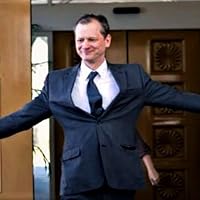
Paul William Roberts (1950 – May 17, 2019) was a Canadian writer who spent many years in Toronto before moving to the Laurentians in Quebec upon losing his vision.
Born in Wales and educated at Exeter College, Oxford, where he gained a second in English Language and Literature, Roberts moved permanently to Canada in 1980. He lived for several years prior to this in India, where he taught at Bangalore University and studied Sanskrit at the Banaras Hindu University in Varanasi.
I read this some years ago and was rather dazzled by the entertaining approach to Biblical archeology but on re-reading I was a bit less impressed; the foul-mouthed, conniving, superstitious Iranian guides who conduct our protagonist-journalist around are a bit too much like stock characters from some 19th century imperialist comedy, and the writer's rather casual dismissal of academics who've spent their whole career on subjects like Zoroastrianism is a bit arrogant. But presuming you don't mind a few cheap laughs and a somewhat free-wheeling intro to Zoroastrianism or the rather more obscure Yazidi (also Yezidi or Ezidi), there is plenty of intriguing speculation about the version of Christ's nativity that is now standard and those (three?) wise men, as well as generally entertaining travel writing. Having recently stumbled upon a Yazidi protest on the state house steps in a midwestern U.S. city, I was delighted to have some idea of who they are. Something about the way the story wends its way through the middle East and the intentionally somewhat dillentantish approach to the scholarship reminds of Robert Byron's wonderful The Road To Oxiana.
Roberts entertains with his travel experiences in the middle east; Iran, Iraq, Syria, Palestine and Israel. He writes in a Gonzo journalistic style focusing on the roots of 3 of the world's great religions setting up an interesting dissonance between madcap experiences and sacred beliefs. There are vivid scenes of visiting religious shrines mingled with some of the dogmatic and historical interpretations set out by scholars and laypeople.
I found the explanations of Zoroastrian beliefs interesting but somewhat confusing. It seemed to me that Roberts was stretching a little too far beyond the research; some of the connections he was trying to establish came across as highly speculative. In the end, the book did not much advance my understanding of Zoroaster's ideas. Perhaps this is because I come to this topic with no previous knowledge; a better informed reader may have made more of the information presented.
I also believe that the editing of the book could have been improved. More simplicity in the phrasings and clarity in the book's central ideas would have been welcome. But overall, I enjoyed the book and am grateful that Roberts made the effort to delve into the topic.
Good for some laughs, and would probably have been an excellent travelogue if he had left out the attempting to trace the birth of Christ bit. Several chapters in, I'm still unsure how to take this book as a work that purports to be non-fiction. In the introduction, Roberts professes his profound distrust of academics but then he wants us to choke down some wild speculation he dreamed up himself because he spent a year reading at a library and he personally visited some of the sites he thinks probably are the same as the ones Marco Polo was talking about.
Here's a zinger from p. 32 discussing various interpretations of what appears to be an X over P pattern he observes carved into the walls at an ancient ruins. "I've always believed -- and it would not have been lost on Romans -- that the P also stands for St. Paul, whose ideas were superimposed over the X or cross of Jesus." What?
Because I love travel stories involving Iran, I will try to soldier on, but I'm starting to see why his temperamental Iranian guide couldn't help calling him "azzhole" from first meeting.
Did any of this really happen? Roberts has unbelievable encounters with bizarre people while (purportedly) travelling from Iran to Israel: smuggled into Iraq by arms dealers; smuggled out on a camel by a Bedouin; ... Feels like a Middle Eastern Hunter S Thompson tale.
I started off liking the book. The first two-thirds had a comedic figure, Reza, that enlivened the travelogue portion. Then it became too esoteric for me. Roberts, using the Dead Sea Scrolls, makes two arguments: that early Christianity was deeply influenced by Zoroastrianism; and that Paul co-opted Christianity from Jesus’ vision of personal experience of the spirit to an institutionalized religion of control. The books saving grace is Roberts humour.
I love everything this writer wrote and despair that he is no longer with us. This is an amazingly complex book, that dares transport us to both the banal (a guide who constantly swears at Robert's in the most irritating fashion) and the sublime (Robert's meditations on religion).
Agnostic journalist gets a bible for christmas. Wonders about the account of the Magi, because they seem to have come from Persia. Since he had reported extensively on that region, he became interested in the question of whether there was any historical proof for the magi.
Also, he had read the Travels of Marco Polo, in which Polo gives an account of coming across three mumified kings who legend held had been zoroaster priests who visited a divine child.
He decides to travel to remote and restricted areas of Iran to search out any support for these stories.
It's a good read and the results are interesting. No spoiler, here.
This is a fascinating book visiting sites the author believes the Magi must have visited on route to see the Baby Jesus. The sites are fabulously important connectors of ancient beliefs in Iran, Iraq, Syria and Judea. Zoroaster is the basic belief linking Judaism, Christianity and Islam and was the faith of the Magi. Roberts shows that Jesus actually taught something quite different from Pauline Roman Christianity, which he believes is a dogmatic state religion for political control. The Essenes of John the Baptist and Jesus were close in belief to Zoroaster and scorned the political Pharasees. Jesus weeps.
I loved this book. It can be a bit too arcane at times, but well worth sticking with it, if for nothing other than the marvelous, humorous people descriptions Dr. Roberts adds to lighten the load. The connections to Zoroastrianism were new to me - equally as valid as any other theories imho.