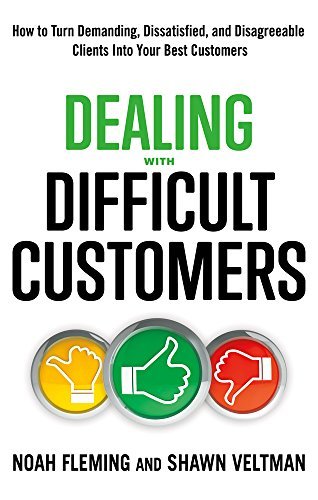
Surprisingly good. "Difficult Customers" has some great insight into some of the mindset problems that plague customer service. The practical parts aren’t on par, but overall a very good read.
Notes:
Nook
You need to demonstrate to anybody who walks in that you have their best interest at heart, and that you’ll do everything you can to truly understand what they want, what they need, and how they can get it in the easiest, most enjoyable way possible. (9)
Chapter 1 Defining the Difficult Customer (14)
Robbers Cave experiment proved that it's easy to get people to dislike each other. Much harder to turn that around (16)
It is Not enough that I succeed -- others must fail (16)
Anytime we see somebody we consider to be a part of our out-group hurt, our brain's first reaction is to celebrate. Similarly, when we see anybody in our in-group hurt, our brain's first reaction is to commiserate with them and feel pain (18)
John Kenneth Galbraith, "Faced with the choice between changing one's mind and proving that there is no need to do so, almost everyone gets busy on the proof" (18)
Expectations gap (24)
Hierarchy of horrors: what are the things my company does that create unpleasant feelings for its customers (27) Personal note: another way to look at this, what are our failures that most frustrate our customers
Have you created an expectations gap by overpromising? (30)
customer loyally is never owed (31)
All who open their wallet should get the same service (31)
Being consistently good is better than being great once in a while (31)
Chapter 2: Managing Expectations: What they Want vs. What you Deliver (32)
Could it be the reason we can't please our customers is that we don't understand them? (43)
Chapter 3: Buying vs. Selling: Creating Greater alignment
The death of the trusted advisor
The sales person's job is not to sell, but to help the customer to buy (46)
This distinction is the difference between company who struggle to deal with difficult customers and those who get hand-written Thank you notes for their client base (46)
Four stages of readiness to buy
1. "Shut up and take my money"
2. I saw your advance but I'm not interested
3. I have a problem that I'll pay you to fix, but I have no idea your product exists (50)
1. only once the problem has been adequately defined will the prospect even be willing to hear about solutions to it.
4. Who would ever buy that and why? (51)
Covey: A trusting relationship is built on four foundatons
1. Intergrity
2. Intent
3. Capabilities
4. Results
Chapter 4: understand Problem Children and Hungy Hippos: They May be Loyal, but are they Wroth It? (58)
The pareto principle, also known as the 80/20 rule (61)
Lets be very clear here: we're not suggesting that you fire your customers based on how much revenue they bring you, but rather how many problems they're creating that aren’t your fault (61)
The problem child = the customer who is insatiable and can never be pleased
It's usually pretty easy to identify the problem children in most businesses. they're almost always the lowest value, most price-sensitive customers you have (61)
If 30% of your complaints are about price then you're doing a bad job in attracting the right customers with your marketing answer pre-selling processes, or you're doing a bad job with their buying experiences, which leads them to assume they shouldn't be paying a premium (66)
Here are three simple tips for helping you address any customer's first complaint
1. Treat every customer's first complaint as if it was served to you on a silver platter (68)
2. Determine if this is a new issue or if somebody else has commented about it
1. if it's new, ask yourself and your team if theres anything you can do to correct it
2. if it's not new, re-examine why it hasn't been corrected yet
3. Have somebody on your team follow up with them personally (69)
Renegotiating the terms of the relationship
1. identify a behavior or set of behaviors that is causing friction /with you and the customer
2. Identify what would have to change in order to make you want to continue serving that customer
3. Communicate the required changes to the customer, and enforce the terms of the new relationship (69)
Chapter 5: The Three Disciplines of excellent customer service Organizations (72)
Give scripts to my team (78)
Chapter 8: How to be Your Own Worst Customer (108)
The undercover boss syndrome
"Make me feel special" (110)
Book-breaking bug that made the rest of the book unreadable
Do everything in your power to make the current customer feel special (127)