Jump to ratings and reviews
Rate this book

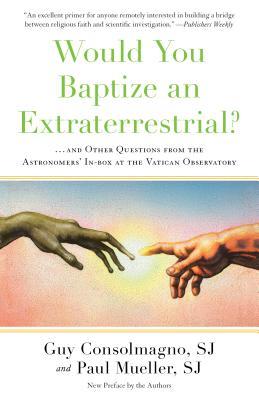
Would You Baptize an Extraterrestrial?: . . . and Other Questions from the Astronomers' In-box at the Vatican Observatory

Rate this book
Witty and thought provoking, two Vatican astronomers shed provocative light on some of the strange places where religion and science meet.

"Imagine if a Martian showed up, all big ears and big nose like a child's drawing, and he asked to be baptized. How would you react?"
- Pope Francis, May, 2014


Pope Francis posed that question - without insisting on an answer! - to provoke deeper reflection about inclusiveness and diversity in the Church. But it's not the first time that question has been asked.

Brother Guy Consolmagno and Father Paul Mueller hear questions like that all the time. They're scientists at the Vatican Observatory, the official astronomical research institute of the Catholic Church. In Would You Baptize an Extraterrestrial? they explore a variety of questions at the crossroads of faith and reason: How do you reconcile the The Big Bang with Genesis? Was the Star of Bethlehem just a pious religious story or an actual description of astronomical events? What really went down between Galileo and the Catholic Church - and why do the effects of that confrontation still reverberate to this day? Will the Universe come to an end? And... could you really baptize an extraterrestrial?

With disarming humor, Brother Guy and Father Paul explore these questions and more over the course of six days of dialogue. Would You Baptize an Extraterrestrial will make you laugh, make you think, and make you reflect more deeply on science, faith, and the nature of the universe.

304 pages, Paperback

First published October 1, 2014

80 people are currently reading
867 people want to read

About the author

Guy Consolmagno

32 books45 followers
American research astronomer and planetary scientist at the Vatican Observatory.

B.A. and M.A. at MIT, Ph.D. at the University of Arizona's Lunar and Planetary Laboratory, all in planetary science. After postdoctoral research and teaching at Harvard College Observatory and MIT, in 1983 he joined the US Peace Corps to serve in Kenya for two years, teaching astronomy and physics. After his return he took a position as Assistant Professor at Lafayette College in Easton, Pennsylvania.

In 1989 he entered the Society of Jesus, and took vows as a brother in 1991. On entry into the order, he was assigned as an astronomer to the Vatican Observatory, where he also serves as curator of the Vatican Meteorite collection, positions he has held since then. In addition to his continuing professional work in planetary science, he has also studied philosophy and theology. (source: Wikipedia)

Ratings & Reviews

What do you think?
Rate this book

Friends & Following

Create a free account to discover what your friends think of this book!

Community Reviews

5 stars
146 (35%)
4 stars
158 (38%)
3 stars
84 (20%)
2 stars
11 (2%)
1 star
7 (1%)
Displaying 1 - 30 of 87 reviews
Profile Image for Julie Davis.
Author 5 books320 followers
August 19, 2017
Rereading for an upcoming book club. And loving it just as much the second time around.

========

This book is structured around a half dozen particular questions we've been asked time and again—questions that are interesting in themselves but that tend also to presuppose a conflict of some sort between religion and science.
This intent leads to rich, interesting dialogues. I use the word dialogues intentionally because the book is structured as a conversation between the two authors who are astronomers for the Vatican. Each is a highly accredited scientist and a Jesuit. The broad topics they discuss:

Biblical Genesis or the Big Bang?
(how science and religion can have different but complementary ways of viewing the same subject)

What Happened to Poor Pluto?
(how scientific theories and ideas change over time)

What Really Happened to Galileo?
(how religion can or should respond when science changes)

What Was the Star of Bethlehem?
(how can God be active in a universe governed by scientific laws)

What's Going to Happen When the World Ends?
(How can humans be important to God in a universe that will come to an end)

Would You Baptize an Extraterrestrial?
(what could the message of Christ mean in an endless univers with countless planets and possibly countless other intelligent races)

The list above doesn't properly convey the riches contained within. Each chapter careens from science to faith to history and then back again. It is really like following an actual conversation where you can never tell exactly what sorts of ideas will flow from the give-and-take.

Also, each chapter asks you to image a different setting which helps to illustrate the points they are making. One is in the Chicago Art Institute, another at Antarctica, yet another at the Restaurant at the End of the World. If that last one makes you think of Douglas Adams books you are correct. These fellows have lively senses of humor and a love of science fiction to boot.

As an example, the Star of Bethlehem chapter was set in the Papal Summer Palace with the Vatican Observatory telescopes. It went something like this:

-Scientific possibilities for unusual events in the sky around the time Jesus was born, including conjunctions of planets
-Possible interpretations of scripture (Matthew) about the event including how standards in interpretation have shifted over the ages
-Who were the Magi, why did they come from the East and what part could astrology play
-Ancient cosmology of the spheres
-Comets
-God's actions in human history and the true nature of a miracle
-Old versus new ways of thinking about the physical world
-What is a mystery: scientific versus religious mysteries
-How do men of science and faith see this event as opportunities for encounters with the divine

Every chapter was like a roller coaster ride of new ideas, melding of concepts, and considerations of different opinions ... exactly like following a lively conversation with a couple of friends.

The authors are really good at talking about both science and faith in ways that are eminently reasonable and understandable. I was wary of the dialogue format but wound up enjoying it a lot because they could use it to show a variety of points of view, including the points where they disagreed with each other. I think this would be an excellent book to share with all sorts of folks, whether Catholic or not.

This seems like the perfect book for someone who is interested in both faith and science. And if you are interested in one and wary of the other, I think it could be very fruitful if for no other reason than to understand how the other side thinks. If you keep an open mind, you may be surprised at how well faith and science go together. Like a couple of folded hands, in fact.

Very highly recommended.
Profile Image for Trevin Sandlin.
353 reviews1 follower
July 5, 2017
5 stars. Thank you, God, for the Jesuits. I want to give this book to every fundamentalist (both atheist and religious) and then beat them over the head with it. Science and religion are only in conflict if you let them be. They have not always been so. And BOTH sides are to blame: both religious fundamentalists who, for some reason, have stopped reading the Bible figuratively and atheist fundamentalists who likewise ignore the value that faith has for other people and group all people of faith with the nutjobs who think Adam and Eve rode dinosaurs. Fantastic experience reading this. Can't recommend it enough.
Profile Image for Tom LA.
682 reviews285 followers
November 3, 2017
Clever, funny, creative, original, necessary work. The two authors explore a variety of questions at the crossroads of faith and reason.

The dialogue format makes the book extremely readable and fast.

I loved the analogy with a pointillist painting: if you look at reality only through the lense of science, you might as well look at the painting as a collection of dots. If you look at it through the lense of religion, you can see the meaning of the painting and the "bigger picture". Both views can be true without contradicting each other, like science and faith. If one is true, it doesn't mean the other one is false.
Profile Image for Colin.
108 reviews4 followers
July 13, 2015
First of all, Jesuit Vatican Astronomers. Yes, that's a real thing. Second, I appreciate the attempt to ease the antagonism between faith and science. It doesn't work that well, but it's the thought that counts.
Six questions are discussed by the two religious scientists. They're topics that kind of have one foot in the rational world and one in the ineffable. Big Bang vs. Genesis; Pluto's demotion (this one was a major stretch); The Galileo affair; The Star of Bethlehem; The end of the universe; and finally the issue of baptizing aliens. The guys did their best to present both sides, and I applaud the effort. They just didn't pull it off, though. For example, in the Galileo chapter, they never once presented coherently the theological basis for rejection of heliocentrism. Perhaps they knew it would sound idiotic? I don't know, maybe my expectations were too high. I had bought this book for Grandma, and she seemed to like it. I, however, was disappointed. Don't expect in-depth theological analysis or scientific description. Just appreciate the concept.
Profile Image for Tim Byron.
38 reviews9 followers
May 8, 2016
Very interesting - and stimulating reading for the openminded and intelligent reader. Certainly belongs to a very small but desperately needed genre, sophisticated religious books by practising scientists. What is outstanding in the topics covered is the exploration of the Galileo affair, sorely needed myth busting and important historical context is provided. The Best treatment of Galileo I have read. Challenges the pernicious growth of 'scientism' and also challenges the curious historical amnesia of many of the aggressive secularists and atheists.
Profile Image for Miguel Panão.
374 reviews6 followers
August 22, 2017
For more than 10 years I reflect on the interaction between science and religion. I learn a lot with this book and this is the best review I can make. If you want to expand your horizons, read it too.
Profile Image for Antonio Gallo.
Author 6 books54 followers
March 26, 2019
Scienza e fede possono camminare assieme? Sono forse conflittuali? Il titolo di questo post vi sembra blasfemo? Richiama quello del libro la cui copertina è qui riprodotta.

Non preoccupatevi, gli autori sono due gesuiti: Guy Consolmagno e Paul Mueller. Sono, però, anche degli scienziati esperti di fisica e astronomia.

Per la precisione due astronomi della più importante struttura scientifica afferente allo Stato pontificio: la specola vaticana. Consolmagno ne è il direttore.

Ho avuto modo di conoscere, anzi di ascoltare, Guy Consolmagno, coautore di questo libro, qualche settimana fa, in occasione di un convegno celebrato a Sarno intitolato “Fede & Scienza”. Ha tenuto una “lectio magistralis” sull’argomento in qualità di studioso di fede e di scienza, per onorare la memoria del Dott. Vincenzo De Colibus, nota ed amata figura di medico locale.

La scelta viene fatta ogni anno in nome di un modello di riferimento che continua a vivere nei cuori e nella mente di tutta la comunità sarnese nella quale questa persona visse. Il prof. Consolmagno ha egregiamente svolto la sua relazione di fronte ad un folto ed attento uditorio composto da molti giovani studenti delle scuole del territorio. Una davvero lunga, ricca ed appassionata “lectio” che sarebbe utile se venisse pubblicata anche in rete.

Sono argomenti questi che, mi sia permesso dirlo senza infingimenti, non possono essere offerti gratuitamente e con leggerezza in occasioni di questo tipo. Significa spesso banalizzare oltre che l’impegno, le qualità e le intenzioni di chi ha proposto una cosa del genere, anche le qualità del relatore. Parlare sia di scienza che di fede non è cosa facile nè tantomeno leggera.

Con il suo accento spiccatamente anglo-italiano, il professore gesuita ha cercato di dare una risposta, tante risposte, non sempre compresnsibili, anche per una cattiva acustica del sistema nella sala della conferenza. Che cos’è l’Universo? Perché c’è? E’ finito, infinito o illimitato? Esiste da sempre o ha avuto un inizio? E’ stato creato da un Essere soprannaturale o si è originato dal nulla in un dato istante del passato? Scomparirà nel nulla in un lontano futuro? Perchè esiste? La Bibbia ha ragione oppure no?

Impossibile elencare tutte le domande che si pongono da sempre tutti gli esseri umani. Sono sicuro che se ci fosse stata più sintesi e una migliore organizzazione della conferenza, molti dubbi ed interrogativi sarebbero stati risolti in quelle oltre due ore di relazione. Per questa ragione ho deciso di leggere questo libro, che ha per titolo questa forse impertinente ma legittima domanda per saperne di più.

Per pochi euri, in versione Kindle, al giorno d’oggi puoi trovare risposte ai tuoi dubbi senza per questo essere messo all’indice, nè tanto meno scomunicato o addirittura bruciato vivo al rogo come tanti, nel corso dei secoli. Laici o religiosi, fedeli o infedeli, credenti o miscredenti, scienziati o ignoranti, grazie a Dio, ed anche alla moderna tecnologia, possono avere una risposta affidabile.

Questa è l’idea di questo libro ed è giusto che gli autori, non a caso due gesuiti, lo abbiano pubblicato con o senza il classico, rigorosamente canonico, “nihil obstat” della gerarchia. In altri tempi, a leggere il solo titolo sarebbe costata almeno la scomunica. La mente umana si è sempre appassionata a domande come queste e, col fiorire delle prime civiltà nell’area del Mediterraneo, filosofi e matematici hanno cominciato a studiare l’universo in modo sistematico, ricercando spiegazioni plausibili sulla natura dei suoi costituenti fondamentali, sulle leggi che vi operano e sul ruolo che riveste la presenza di vita e di osservatori coscienti.

Nel corso delle varie epoche questa ricerca è stata approfondita e ha portato ad elaborare diverse teorie, dapprima basate sul linguaggio filosofico o religioso e, in seguito, su quello rigoroso della scienza moderna, fondata essenzialmente sull’osservazione dei fenomeni, il calcolo e le prove sperimentali. Pertanto, le questioni che non potevano essere oggetto di indagine scientifica rimanevano di esclusiva competenza della metafisica e della teologia, e tra esse, la più importante riguardava la ragione dell’esistenza dell’universo.

Lungo tutto il percorso storico della filosofia, a fronte di questa profonda questione si sono imposte due principali scuole di pensiero fra loro contrastanti. Una di esse, radicata nelle culture giudaico-cristiana e islamica, sosteneva che l’universo è stato creato dal nulla ad opera di Dio, mentre l’altra consisteva nella tesi dell’universo eterno, senza inizio né fine. A quest’ultima aveva pienamente aderito il padre della Logica, Aristotele, semplicemente perché da lui giudicata di gran lunga più ragionevole della prima.

Nonostante la loro spiccata diversità, queste due concezioni avevano in comune una stessa idea: l’immutabilità del cosmo nella sua complessiva struttura. Peraltro, questa credenza non è mai stata messa in discussione fino in tempi recenti, più precisamente fino a quando il mondo della scienza è stato dominato dalla fisica di Newton.

Il titolo del libro è tratto da una delle moltissime lettere che devoti e curiosi scrivono a questo organismo scientifico, i cui membri non hanno problemi a conciliare la fede e la meccanica quantistica. E proprio per spiegare come tra scienza e fede il contrasto non ci sia, i due scienziati e gesuiti hanno scritto questo lungo dialogo (la forma dialogica è stata scelta proprio in omaggio a Galileo che ha esposto così le sue teorie).

Sfogliando questa chiacchierata il lettore non esperto di fisica si vedrà chiarire molti dubbi, dai più bizzarri ai più seri. Ad esempio, si parte dalla teoria del Big Bang per spiegare come non ponga nessun problema di fede e come, utilizzando il giusto modo di leggere, la Bibbia non sia in nessun modo in contrasto con i testi sacri. Anzi, ironia della sorte, è stato proprio un astronomo e presbitero cattolico, Georges Edouard Lemaître, a postulare per primo, nel 1927, la teoria del Big Bang, anche se all’epoca si chiamava ipotesi dell’atomo primigenio.

All’origine l’idea di Lemaître ricevette un sacco di critiche proprio perché sembrava essere troppo vicina all’idea della Genesi. Peccato poi che le tutte le evidenze raccolte negli anni a seguire abbiano confermato la sua idea dando origine alla teoria più solida e importante dell’astronomia. Questo con gran gioia di Papa Pio XII tanto che Lemaître «pregò il pontefice di non promuovere la sua teoria come fosse una prova della Genesi». Questione di rigore accademico, e il papa lo accontentò.

Nello spiegare il Big Bang i due scienziati/sacerdoti mettono il lettore in grado di capire bene come scienza e fede si muovano su due piani diversi. Ecco perché nessuna delle due può confutare l’altra, con buona pace di tutti quelli che, credenti e non, vorrebbero poter usare testi sacri e telescopi come fossero clave intellettuali. In molti scrivono alla Specola Vaticana per chiedere lumi sul caso Galileo.

I due scienziati nel libro li forniscono e sostengono l’idea che il processo a Galileo fosse soprattutto un processo politico, legato al contrasto tra il Papa e i Medici e alle pressioni internazionali provocate dalla Guerra dei Trent’anni. E forse anche a uno sgarbo personale di Galileo nei confronti di papa Urbano VIII, che di Galileo era amico. Non minimizzano il ritardo che molti ecclesiastici del tempo avevano nei confronti della scienza (che era in una fase di evoluzione rapida) per carità, però mostrano come il processo a Galileo fu tutt’altro che una contrapposizione tra scienza e fede.

Le contestazioni a Galileo da parte del cardinale Bellarmino erano semplicemente mutuate dal metodo scientifico comunemente accettato, era il metodo di Galileo ad essere un passo avanti. Solo con Newton il sistema galileiano sarebbe diventato perfettamente spiegabile e dimostrabile. Insomma, il processo guardato da vicino racconta una storia diversa dalla «vulgata».

Ci sono temi leggeri e pesanti nel libro. Tanto pesanti, quanto “pensanti” come quando cercano di trovare giustificazione e conferma dei collegamenti tra la Bibbia e le diverse “voci” della scienza. Non sempre la Bibbia ha ragione, non sempre la scienza ci fa capire le cose come effettivamente sono andate. Quando arriviamo alla domanda riguardante il battesimo dell’alieno, ci viene da pensare al battesimo di un “barbaro”, in un tempo quando sussistevano queste differenze.

Il fatto è che, il tempo e lo spazio hanno le loro esigenze delle quali non sempre, anzi quasi mai, gli uomini sono in grado di comprendere e gestire le ragioni e le finalità. Ci sono cose in cielo e in terra che si possono spiegare soltanto con la scienza, intesa come come sapere e conoscenza. Alla stessa maniera, la fede non sarà mai in grado di spiegare cose che soltanto con il soprannaturale si possono comprendere. Si chiama: “mistero della fede”.
Profile Image for taylor.
105 reviews7 followers
July 7, 2025
I was looking for a book on the history of the telescopes managed by the Vatican. I recently learned the Jesuits operated one not only in Italy but a fairly advanced facility in Arizona.
Don't be put off by the silly title, this is a serious book. If not for the occasional humor from the authors, it would be considered scholarly.

The story is a dialog between two real Jesuit priests who also run the Vatican observatory. Their academic credentials are solid as is their faith. The conversations happen at real and imagined locations. This informal theme softened the story and made it more enjoyable. Much of the book is about cosmology and the intersection of Christianity and Science. My take away from the book is that Catholicism advocates not to interpret the bible literally. The stories (especially those that contradict science) should be interpreted symbolically. Fundamentalism is a Protestant belief and only recently found a small home in the Catholic Church. So there we have it, the Bible is not a set of true stories according to these Jesuits. I am not sure how one filters those of fiction and those of truth. It reminded me of one my early experiences going over a software schedule. The grand boss had a spreadsheet up everyone's estimates of when they would complete their projects. The boss's quote still rattles my brain. "I don't believe a single line, but I think the total is right"


There were many attempts by the authors to describe there is no tension between science and the Bible. the Bible is not science, nor is science a discussion of religion.

The silly title comes from a popular question to these astronomers from the public. It was so popular that the pope actually addressed the topic of baptizing an extraterrestrial.

If you have ever heard of the game "Name 3 people dead or alive you would like to invite to dinner", I think I have found my third. Guy Consolmagno (one of the authors) is extremely witty, but more than that is able to keep 2 competing ideas in his head (faith, and science) at the same time. A true measure of intellect. Oh invite living people, they smell better.

For a better understanding of Guy
https://youtu.be/kmU2gDbP_Tk?si=Q036e...
For a better review, here is one from the authors.
https://www.vaticanobservatory.org/sa...
Profile Image for Donna.
1,625 reviews115 followers
August 14, 2017
I am not now nor have I ever been a scientist. This book is written by two Jesuit scientists, an astronomer and a physicist. They address some of the typical questions that are raised to foment discussion on faith and science: the Big Bang vs. Genesis, the Galileo affair, the end of the world, and, yes, intelligent life in the universe. Most of the science the authors' present is difficult but understandable if you take your time with it; I followed most of what was being discussed. The method used for these discussions is a dialog between Guy and Paul. For the most part this is effective and some of their humor is right on target. (Some humor is just silly and causes groans)

Yes, if you want to engage in a discussion on faith and science this would be a great book to use. You might supplement the Galileo chapter with the Bertolt Brecht play "Galileo" or Dava Sobel's work, "Galileo's Daughter." For the chapter on extraterrestrials, you couldn't go wrong reading "The Sparrow" by Mary Doria Russell. The chapter on the end of the universe is filled with references to "Hitchhiker's Guide to the Galaxy." The use of art from the Art Institute of Chicago in the chapter on creation is well done.

Every so often I need to challenge myself with a hard book and this book was that title currently. While I enjoy my "brain candy" of mysteries, I do need to stretch myself into areas in which I am not completely familiar. I'm glad I picked this book up.
Profile Image for Pedro.
91 reviews
February 11, 2015
The book is well written and delves into 5 questions: The Big Bang and the Genesis, The fate of Pluto, What happened to Galileo, What was the star of Bethlehem and What's going to happen when the World ends. Ah, I almost forgot, in the last few pages it handles, not with the best solution in my opinion, the question of the what-if Baptism of the extraterrestrial.

I got this book because I was writing a What-if collection, that may one day become something larger and the title of the book mislead and somehow disappointed me. Nonetheless the book is good, written in form of a dialogue between two Jesuits that work at the observatory of the Vatican.
Profile Image for Steven Jacke.
158 reviews
November 27, 2014
One of the best books I've read all year. Made me wish I was Catholic.

Set as a dialogue between two friends around 6 different questions, this book made me say, "I wish all Christians thought this way." Each question expands to cover a wider topic. For example, "What was the Star of Bethlehem?" starts with various astrological possibilities, before become a discussion of miracles, and even Biblical interpretation.
Profile Image for Nick D.
151 reviews3 followers
April 21, 2015
As someone who is not religious, but respects religion, I thought this book was pretty interesting. Hearing devoutly religious scientists discuss common "religion vs. science" questions allowed me to see things from a wider perspective. It hasn't exactly changed my mind about anything, but it's still neat to know the line of thinking of those I disagree with.

87 reviews2 followers
December 29, 2014
Internally contradictory, full of special pleading and the like. In a nutshell, science does not know everything and the gaps can be filled with god. That each God contradicts the other God is never mentioned. What makes their God the special one?
Profile Image for Jeff Miller.
1,179 reviews206 followers
January 6, 2018
A real interesting look at the false faith versus science debate. Laid out as a series of conversations around the world to a fictional Douglas Adam's restaurant. Well done.
Profile Image for Kiley Randoll.
105 reviews
January 16, 2025
if you have ever had any doubts about how religion and science fit together, read this book. if you think you have to choose religion or science, read this book. just read this book. it asks huge questions about how these two belief systems work together harmoniously. it was a fun read, while at the same time offering huge revelations. it put to rest questions and doubts i had, and made me realize we really do not have to pick one or the other. i leave you with these quotes:

"God is not using the laws of physics; God is establishing and sustaining those laws"

"The Bible was never meant to be read literally as a science textbook"

"When we do science- when we try to make sense of the world via reason- we are imitating God; we are acting in the image of God"
Profile Image for April.
273 reviews10 followers
September 5, 2024
Interesting perspectives from a couple of Jesuit scientists. Who knew that the Vatican employs astronomers? Bonus points for alll the references to The Hitchhiker’s Guide books.
Profile Image for Tim.
20 reviews
April 15, 2020
This is a really fun and informative book. The authors address several questions from both faith and science perspectives: Does the Big Bang contradict Genesis? Why is Pluto no longer considered a planet? How/when will the universe and? What really happened between Galileo and the Catholic Church? And the title question. Humor and insight ensue. Great read.
Profile Image for Melanie.
458 reviews14 followers
March 26, 2018
This book has the following chapters:
1) Biblical Genesis or Scientific Big Bang?
2)What happened to Poor Pluto?
3) What Really Happened to Galileo?
4) what was the Star of Bethlehem?
5) What's Going to Happen at the End of the Universe?
6) Would you Baptize an Extra-Terrestrial?

It is written by two Jesuits, one of whom is an astronomer and the other studies the history and philosophy of science. So they are reasonable sources for commentary on the selected topics. The book is presented as a series of conversations between the two men discussing the various issues. This, they claim, is in homage to Galileo who presented the Copernican theory of the solar system as fact rather than as a mathematical convenience in the prediction of planetary motion. (You can read Chapter 3 if you want more detail.) The problem with this comparison is that Galileo wrote as if two or three men were arguing different positions on a controversial topic. This book is a dialog between two people who essentially agree with each other. That is not as dynamic or as interesting.

As an atheist, I found the religious justification for their stances to be enlightening. For one thing, the defeat the tendency of religious fundamentalist to create a "god of the gaps," meaning a generally diminishing god who only controls those aspects of the universe that science has not already successfully tackled. They do this by supposing that god exists outside of the universe, in fact, outside of all universes if the 'brane' theory turns out to be true. However, no matter how they present it, they have created a god that set things in motion and has no current intervention in the workings of the universe or human lives. They give some reasonable arguments for why this is not true, but they are not convincing, at least to me.

At any rate, the discussions and examination of each of the topics from both a scientific and Catholic mindset is interesting and informative. There are a lot of aspects of the "Galileo Affair," as it is called, that are not generally known. The Church's stance and actions become more rational. The demotion of Pluto to dwarf planet is explained, which is not really science or religion but should be of interest to many people. I'm not going to go through the rest, but you get the idea.

I gave the book three stars because the situations are contrived and the conversation can get boring.

I think it is of interest to atheists, Catholics, and Protestants alike in that it can provide a glimpse into each others' thoughts and rationalizations, but you have to be willing to slug through it.
Profile Image for Donna Parker.
337 reviews21 followers
March 16, 2015
The world is full of sure people.
I don’t mean confident people.
I mean sure people – sure they’re right and those that don’t agree with them are wrong.
They know what is best. They know what is ‘the best’.
They know where you should live, what you should wear, drive, read, watch, worship, love, hate, etc.

I was more like that until someone made me unsure. In retrospect, they probably did me a favour, but it didn’t have to be so horrible. Ironically, they haven’t changed.
I knew what was right and wrong; I really knew what was wrong.
I didn’t know that what I didn’t know was more important than what I knew. I’m pretty sure about that.

Sure people don’t need to listen to other people, they’re already sure they’re right.
They’ve made up their minds. Often, not even facts will alter that.

I’m a voracious reader. I can tell you why I like or dislike a book, but I don’t know if you’ll like it.
Same goes for TV, movies, restaurants, clothes, technology.
I can recommend.
I can advocate.
I can oppose.
But only you can decide.

I was thinking of Sure People when reading a surprisingly funny and fascinating book, Would You Baptize An Extraterrestrial? (And Other Strange Questions from the Inbox at the Vatican Observatory) by two witty Jesuit astronomers, Guy Consolmagno, SJ and Paul Mueller, SJ (Image/Random House), primarily involved in research, who try to answer all the wild and wacky questions posed to the Vatican, but in a conversational, refreshing, and unexpectedly, amusing style. Pope Francis said last year he would baptize a Martian…hmm, are they trying to prepare us for a coming invasion?

This book tries to show that religion and science don’t have to be at odds. People can believe in both. Do you think that’s true, dear readers? I certainly think we have more important things to worry about. We too often go for ‘or’ when we should use ‘and’. Economy and the environment, not or. Security and civil liberties, not or.

Which brought me to trust, can we trust when we’re not sure?
We can observe, listen, use our instincts and critical thinking, look for facts, question, see the world as it is…I prefer reality, if I want fantasy, I’ll watch TV or a movie, read a book or listen to governments.

Which brings me back to, the Sures. The more I learn, the more I hear, see, and observe, the more I wonder.
I’m only sure of so many things in this world: Love. Compassion. Hope. And cookies, and who knows, maybe those aren’t even what they seem.

http://yadadarcyyada.com/2015/03/09/w...
Profile Image for Patricia Mckenna.
46 reviews
April 8, 2015
I love science and religion, therefore I thought reading Would you Baptize an Extraterrestrial would be a great extension of these two interests. You often hear in the media how these two do not mix. You even hear about the Catholic Church being at odds with science, but this is a false impression. Consolmagno and Mueller point out that “God wrote both books of Scripture and Nature and God does not disagree with himself. Truth Cannot Contradict Truth.”

The title is certainly catching to the imagination and the authors certainly do no let their readers down. What about ET being baptized, you might ask? Consolmagno and Mueller tell us that that would depend on whether ET wants to be part of the Kingdom of God and how he hopes to treat the least of his brothers. It is fascinating to ponder the analysis outlined by the authors regarding faith and extraterrestrials. The authors state that believers usually say evidence of ETs would support their religious faith, while nonbelievers sat this would invalidate religious faith.

The format of the book is easy to follow since it is conversational between the two Vatican astronomers. Many topics are covered like Pluto becoming a non planet, the Galileo controversy, the star of Bethlehem theories, and the end of the cosmos as we know it. The book is fun and lighthearted while still being steeped deep in faith and scientific facts.

I would recommend this book to all Christians as well as nonbelievers for information to bridge the gap between the two. The science was a little weighty at times but I learned a lot about physics and astronomy. Consolmagno and Mueller interpret these sciences well and open our minds with further questions. We can be steeped in these mysteries and further our faith because as the authors say, “Mystery is where the human capacity for understanding gets swamped-not because we haven’t yet figured things out, not because there is a problem to be solved, but because the proper response to God and to love is not to understand but rather to treasure and to ponder”

Profile Image for Stuart.
690 reviews53 followers
May 25, 2015
Would you Baptize an Extraterrestrial? is a unique book in conversation style between two Jesuits, Brother Guy Consolmagno and Father Paul Mueller, who work on the research staff at the Vatican Observatory. The fact that the Vatican has an observatory is pretty awesome in and of itself. There are six conversations in all:

1. Biblical Genesis or Scientific Big Bang?
2. What Happened to Poor Pluto?
3. What Really Happened to Galileo?
4. What Was the Star of Bethlehem?
5. What's Going to Happen When the World Ends?
6. Would You Baptize an Extraterrestrial?

Questions Four was most interesting to me, as I have read many explanations on the Star of Bethlehem before. Brother Guy and Father Paul address most of the planetary alignment theories and the possibility of the star being a nova or supernova. They never tell you what the answer is, because honestly they don't know the answer. Instead, they show you that science is able to provide a lot of possible explanations to something that so many people doubt. (I personally believe that it was the Holy Spirit and not a physical star, but to each their own.) This book isn't going to give you simple black and white answers to these complicated questions. Instead, it is going to invite you to stop trying to separate and compartmentalize science and faith from one another and look at these questions in light of both. This is just one of the ways the Catholic Church is more beautiful than Protestantism. We aren't a "one or the other" church, but a "both and" church.

Overall, I would give this book four stars. It is intelligent, but accessible. It is clever, but conversational. At times when they went off topic to talk about pizza or whatever, I found myself wishing they would stick to the matter at hand, and that is why I took a star away from it. These men, however, know what they are talking about, so I can see this broadly appealing to a wide audience. It might not answer all your questions, but it will open your mind and make you think more, which is never a bad thing.
Profile Image for Mary.
833 reviews16 followers
May 20, 2015
This is my kind of book! A joy and a delight, if you have any interest at all in either science or theology. Two Jesuit astronomers from the Vatican observatory take their reader on a funny, brilliant whirlwind "tour": stops include Antarctica, the Chicago art institute, and the restaurant at the end of the Universe. On the way, they discuss knowledge, scientific theory, Galileo, Pluto, meteorites, ETs, and much more. These men are excellent teachers, especially Father Paul. Many years ago, the brilliant Owen Barfield wrote a book called "Saving the Appearances". My Dad owned it, and I recently picked it up and tried to read it. it was a struggle, let me tell you. In two pages, Father Paul explained "saving the appearances" in a way that I understood. (The phrase describes a goal of Medieval math and astronomy. The goal was to "save the appearances" - that is, to explain why the planets and stars seemed to move as they seem to. There was no interest in finding out what the stars were actually doing. And that was part of Galileo's trouble: he asserted that we could actually know what the stars and planets were doing, and had no interest in saving the appearances.) Father Paul also gave a lovely, illuminating definition of miracles. And I adored Brother Guy's answer to the title question!

The book's structure might not appeal to every reader. It's basically a long conversation about various topics between two passionate astronomers. As such, it puts the reader rather in the position of an eavesdropper - or an invited guest at the table. But that's one of the pleasures of reading, isn't it? We get to hear other voices, enter other worlds, and know what others are thinking.

This is a book I was happy to have read. I'd be glad to reread it from time to time. It opens the reader's eyes to the wonders of the universe.

(What Brother Guy said to the reporters who kept asking if he'd baptize ET: "Yes, only if she wants to be baptized.")

Profile Image for C.
196 reviews5 followers
May 31, 2016
**I received a review copy of this book from Goodreads giveaways**

Do you think that both science and faith should be taken seriously, but you struggle with how to hold science and faith together, with integrity? Do you find yourself tending to keep science and faith isolated from each other, in separate watertight compartments, but you wish that science and faith didn't have to "take turns" in your life? Then this book is for you.

--from the Introduction


That's the quote that the authors chose to feature on the book's jacket, and it does a marvelous job of summing up why I loved reading this. In a world of never-give-an-inch scientific materialists and hardcore Biblical fundamentalists, there is a real need for people who can speak to both sides of the divide, and Consolmagno and Mueller are perfectly suited to be such mediators.

I was worried that the book's stylistic conceit of dialogues in exotic locales would be hokey, but I found it to be a nice nod to the giants of Classical and Renaissance philosophy who wrote in the same mode (Aristotle, Galileo, etc.), as well as a way to keep the tone informal, accessible, and buoyed by humor. Like a great lecture in college, there's a lot of intellectual ground covered, but it's the unexpected digressions and pop culture references that make the information "stick." As a sci-fi fan, I also appreciated Day 5's homage to Douglas Adams (where better to discuss TEOTWAWKI than at Milliways?), and its shout-out to Lois McMaster Bujold.

Very highly recommended.
Profile Image for Lis Carey.
2,213 reviews137 followers
November 17, 2014
Why does the Vatican have an observatory? Can science and religion exist together? What really happened to Galileo? Does the Bible have anything to say about the Big Bang? Does science have anything to say about the Bible?

And, oh yes, would you baptize an extraterrestrial?

This is a very lively discussion, a dialog between two Jesuit scientists, a planetary scientist and a physicist, about Christianity, science, cosmology, conflicts and resonances between science and religion, and what questions each can address. Consolmagno and Mueller are both men of faith and men of science, people who felt called to the religious life, and to do science as part of that religious life. They're thoughtful, serious, and each has his own sense of humor and interests outside the realms of science and religion.

The discussion of Galileo is detailed, nuanced, and supported by a fairly detailed chronology of the major events, scientific, personal, and political.

Without giving either man's answer to the question about baptizing an extraterrestrial, I will say that that discussion also goes in some interesting and unexpected directions.

If you think that the Bible has to be read literally and doing otherwise is sinful, or if you think religion is nonsense that no intelligent person could take seriously, this is not the book for you. On the other hand, if you are interested in how two intelligent men who are both working scientists and members of a Catholic religious order think about these questions and about what they're doing both scientifically and as men of faith, this truly is a fascinating read, or listen.

Highly recommended.

I bought this book.
Profile Image for Rachel.
Author 15 books45 followers
Read
August 8, 2015
Like most Catholics (or Christians for that matter) I have heard the arguments on science vs. religion before which is why I was interested in this book. I might have wanted a way to show how religion is true and science can prove it when I started this book (which the authors warn against) and learned some interesting things (such as the Vatican has an observatory and astronomers! ;) ). The idea of using conversation style writing and locations was intriguing in the beginning and seemed like it would help explain the science and religion is similar forms so it might be more understandable. But, it got awkward pretty quick. It didn't seem to be used as effectively as it could and, on occasion, the authors got on tangents on the location for a couple of sentences that felt like the chapter was going off topic for no good reason. I struggle with science so that didn't help me and the explanations seemed long winded and over done. To a scientist, everything was probably necessary and it was pretty much understandable but overwhelming. I could only read so much at a time and then needed a break, yet, at the same time, I felt like if I kept reading everything would come together clearer. I did appreciate what they were trying to do. This book I would recommend to someone who understands science more than me, even borrow them the book. But, someone who struggles with science, I would tell them about the book but hesitate in giving it to them.

Disclaimer - In exchange for an honest review, I received this book for free from the publisher though Blogging for Books.
Profile Image for Nate McHugh.
90 reviews3 followers
September 23, 2015
I'd probably give it 3.5 stars instead of 4 because it is in dialogue form.

Science is forever changing. Our understanding of our faith is forever changing.

It's a popular opinion that Christianity has been nullified or displaced because of science. These two Jesuits disagree.

Those who wish to demean the faith will point to christian fundamentalists who take every line of the bible literally and say "See Christians believe the earth is only 4,000 years old." I believe that the Earth is over 4 billion years old and that the universe is over 14 billion years old. If science concludes that it is older or younger then my opinion will follow that conclusion.

They don't wish to point out Georges Lemaitre originally proposed the theory of an expanding universe back to a certain point in time (The Big Bang Theory). He was an astronomer, physicist and a priest.

Lemaitre is not the only Catholic scientist who fully embraces science.

Since the Church believes that through the bible we can find truth, and that through science we can find truth, they cannot contradict each other and thus as one advances so must the other.

I think this is a great read for Christians (or any other faiths) who have trouble dealing with science or feel uncomfortable with science. We all should be embracing science.

This is a good introduction to science and will be purchasing other books on science in the future.
Profile Image for Fred Roldan.
49 reviews2 followers
November 26, 2016
El tema de Ciencia y Fe, es entendido en la cultura popular como una lucha irreconciliable. Dentro de la Iglesia Católica, hay una clara relación entre ciencia y fe, donde una no sustituye a la otra, sino que cada una complementa a la otra en una mayor comprensión de la totalidad.

Este libro es escrito por un Astrónomo y a la vez Sacerdote Jesuita, a través de un dialogo tratan de dar dar a conocer la relación entre ciencia y fe, como dos formas de comprender la realidad desde diferente aspecto.

El autor utiliza su experiencia científica, para explicar fenómenos naturales y temas científicos, por ejemplo la razón por la cual Pluton dejo de ser planetas. Pero al mismo tiempo lleva a dar una explicación de como esta realidades no se oponen directamente a la fe, a pesar de diferentes concepciones fundamentalistas tanto religiosas o científicas.

Ademas de un lenguaje sencillo, el libro esta cargado de humor e imaginación, donde se viaja desde el frió del ártico hasta el restaurante del fin del mundo del libro de la "guía del autoestopista intergalactico".

Este libro puede ser leído por aquellos que están metidos en el ambiente científico, para conocer que tiene que de ser la fe en los temas del conocimiento de la realidad material. Al mismo tiempo puede ser leído por las personas de fe, para tener una comprensión más objetiva de la realidad y al mismo tiempo de su propia fe.
Profile Image for Reid Mccormick.
442 reviews5 followers
December 22, 2016
For centuries, it seems like science and religion have been battling each other for superiority. Which one is the final authority? What side do you choose? But what about this concept: science and religion are not adversaries, but companions working together to find the truth.

Would You Baptize an Extraterrestrial? is written by two Jesuits who do research at the Vatican Observatory (which I had no clue the Vatican had its own observatory). As the title suggests, the book looks into the silly questions they get from tourists and theological inquisitors; however the book discusses the meaningful issues of the Big Bang, Pluto’s planet status, the saga of Galileo, the star of Bethlehem, the end of the world, and extraterrestrial life.

The main theme of the book is the growing relationship between science and religion. Generally speaking, scientists see religious people as anti-intellectual nut jobs while religious folk see scientists as nihilistic, misguided atheists. But, this book strives for the middle. Science is not static, and neither is religion. The science of the Big Bang does not destroy or belittle the work of God, it actually can enhance it.

This is a good book with a share of boring parts. The whole chapter on Pluto seemed superfluous. The book’s dialogue structure was unnecessary. The content concerning the relationship between science and religion was really fascinating.
Profile Image for Erin O'Riordan.
Author 42 books137 followers
March 23, 2015
This is a thoughtful, entertaining, and provocative book. I'd recommend it to anyone who has any interest in religion, science, or both. The title question was the final one in the book. The Vatican Observatory astronomers who wrote this book first discuss, in an engaging dialogue format, the apparent contradiction between the Biblical account of creation and the scientific Big Bang Theory, the status of Pluto, the true story of Galileo's heresy trial, the Star of Bethlehem, and the end of the universe. (The last of these requires some fictional assistance from The Hitchhiker's Guide to the Galaxy.) Along the way, they address both Christian fundamentalists who believe in the literal interpretation of the Bible and scientific fundamentalists who think science eliminates the need for a God at all. The result is a balanced, well-reasoned book of nonfiction from two highly educated, highly scientific, highly theological authors - one a priest, the other an ordained brother - that should be eminently readable to most any lay person.
Profile Image for Joe Hinojosa.
29 reviews3 followers
March 10, 2015
What attracted me to this book is the title. It's a question that most of us don't think about, but which makes us think about the implications of faith and how it relates to matters of science. This book is a discourse on faith, theology, and science.

The authors take what promised to be a dry and boring subject and brought it to life using humor to illustrate their point. Science and religion, they contend, are not at odds with each other, but instead complement each other. Science is not meant to be a tool used to neither prove nor discredit religion. The Bible was never meant to be taken literally. This is at the heart of Catholicism.

I enjoyed the book. It engages the reader, making us think about how we view our faith. I've always been a believer in science, though I'm not a scientist. Still, I'm a curious soul and I learned quite a bit. I think it's a must read for all Christians and non-Christians alike.
Displaying 1 - 30 of 87 reviews

Can't find what you're looking for?

Get help and learn more about the design.