Jump to ratings and reviews
Rate this book

Globalists: The End of Empire and the Birth of Neoliberalism

Rate this book
Chosen by Pankaj Mishra as one of the Best Books of the Summer

Neoliberals hate the state. Or do they? In the first intellectual history of neoliberal globalism, Quinn Slobodian follows a group of thinkers from the ashes of the Habsburg Empire to the creation of the World Trade Organization to show that neoliberalism emerged less to shrink government and abolish regulations than to redeploy them at a global level.

Slobodian begins in Austria in the 1920s. Empires were dissolving and nationalism, socialism, and democratic self-determination threatened the stability of the global capitalist system. In response, Austrian intellectuals called for a new way of organizing the world. But they and their successors in academia and government, from such famous economists as Friedrich Hayek and Ludwig von Mises to influential but lesser-known figures such as Wilhelm Röpke and Michael Heilperin, did not propose a regime of laissez-faire. Rather they used states and global institutions--the League of Nations, the European Court of Justice, the World Trade Organization, and international investment law--to insulate the markets against sovereign states, political change, and turbulent democratic demands for greater equality and social justice.

Far from discarding the regulatory state, neoliberals wanted to harness it to their grand project of protecting capitalism on a global scale. It was a project, Slobodian shows, that changed the world, but that was also undermined time and again by the inequality, relentless change, and social injustice that accompanied it.

400 pages, Hardcover

First published March 16, 2018

220 people are currently reading
5558 people want to read

About the author

Quinn Slobodian

11 books314 followers

Ratings & Reviews

What do you think?
Rate this book

Friends & Following

Create a free account to discover what your friends think of this book!

Community Reviews

5 stars
341 (36%)
4 stars
432 (46%)
3 stars
133 (14%)
2 stars
24 (2%)
1 star
4 (<1%)
Displaying 1 - 30 of 127 reviews
Profile Image for Trevor.
1,528 reviews24.8k followers
October 31, 2024
This book is a kind of updated look at a book I reviewed a couple of days ago, The Great Transformation by Polanyi. It is that and a criticism, in part, at least of the idea that that book is a critique of neoliberalism, despite neoliberalism not having really existed at the time it was written. I’m going to start with a few ideas discussed in the Polanyi book that I didn’t mention in my review. But before that I was scrolling social media the other day and someone had put together a history of Palestine. It was designed to ‘prove’ that Palestine never really existed. They went through all of the empires that had controlled Palestine back 2000 years or so. They ended each paragraph with ‘not the state of Palestine’ in one of those flourishes that quickly becomes annoying, but that is meant as a complete refutation. The problem is that people assume nation states have existed for much longer than they really have. In fact, they are insanely recent. They really only started with the Treaty of Westphalia in 1648, so, not even 400 years ago. To complain that Palestine wasn’t ever a nation state seems a very odd argument to make for dispossession, ethnic cleansing and genocide. Certainly not an argument I would ever make.

If the history of nation states is remarkably recent, the history of globalisation is even more so. Something that Polanyi makes clear in his discussion of the move away from the gold standard is that while this made sense within nation states, it was deeply problematical between nation states. To conduct trade you need an agreed form of currency between those two trading states – the last thing you want is for one side to be able to arbitrarily change their currency so they can reap an advantage during the process of trading.

There are two distinct ways in which economists have viewed the question of value. The first comes from Adam Smith and David Ricardo, but is now mostly associated with Karl Marx – this is, the labour theory of value. In this, the value of any commodity depends upon the amount of human labour that is contained within it. The more labour you need to expend to create a commodity, the more value it will have. The other view is held by liberal economists. They say that value is decided by factors beyond our ability to understand – that is, supply and demand. We can’t really know what demand there is in an economy for any particular commodity and so its price depends upon the interaction between demand and supply. The bottom line with this is that the world is essentially unknowable and the only means we have of making anything approaching an informed guess about economic matters is the price mechanism. This is why liberal economists are so obsessed with money, inflation and the gold standard. Any messing around with the price mechanism is seen by them as destroying the only means we have available of understanding anything about the economy at all. It destroys our ways of knowing how and when to invest. Money must be protected at all costs, since it is the data that makes information about the world available to us.

This book provides lots of quotes that could be read as showing that neoliberals are opposed to globalisation – but this is because they have two views on globalisation that need to put these quotes into perspective. The first is that they are opposed to any form of economic redistribution. This is because redistribution would also interfere with the reward system of capitalism, and, like messing around with the value of money, would also have catastrophic economic effects. However, the author also points out that people like Hayek were very keen to have legal structures that would ensure free trade. That is, while they didn’t agree with Ricardo on the labour theory of value, they certainly agreed with him on comparative advantage between nations. The problem they saw with what was increasingly becoming the new world order after the Second World War was that former colonies were demanding a form of global redistribution, if not outright nationalisation of resources and industries in their nations. As the author points out, neoliberals have always had an uneasy relationship with democracy – Hayek’s fondness for post-coup Chile is a case in point. Overcoming the demands from previous colonies for a more equitable distribution of the wealth being drained from their nations became a rallying cry of the neoliberal economists.

What is perhaps most interesting here is that many of the neoliberal economists didn’t think very highly of economics – at least, not economics as a discipline on its own. Hayek shifted his focus towards law, for example. He is quoted at one point as saying that an economist who only knows economics is by definition a poor economist. He believed, as I said before, that the world is fundamentally unknowable, regardless of how much data you have at your disposal, and so the only thing that will work is allowing the market to operate freely. Any planning will ultimately destroy the free market and therefore the economy as well. He also said that it would also destroy democracy – his most famous book being The Road to Serfdom – where he argues that the welfare state was an inevitable first step towards serfdom. The author makes the point that given he started from the premise that the world is irreducibly complex and unknowable, this certainty that even the smallest step towards welfare would inevitably lead to serfdom is a contradiction he never even attempts to resolve. The author also says that claiming Hayek predicted the collapse of the Soviet block or the end of the cold war also flies in the face of his fundamental agnosticism. In fact, it seems Hayek said remarkably little about the cold war, certainly not about how he predicted it might end.

The mistake is to take people at their word. When Thatcher said there is no such thing as society, the assumption often is that all there really is, is an economy. But this book, and Polanyi’s before it, show that neoliberals are at least as concerned with society as they are with the economy – in fact, probably more so. For the economy to work there must be social structures – mostly laws – that can be imposed to allow the market to operate freely. If these laws need to be imposed against the will of the majority – so be it. The level of paternalism cannot really be under-estimated. Avoiding the consequences of democracy then becomes one of the main purposes of the state – while allowing ineffectual elected clowns to keep the masses distracted.

This book perhaps will give you more information on the history of these ideas – and the people who shaped them – than you will feel you really need. All the same, it is hard to see how else the author could have written this book.
Profile Image for Conor Ahern.
667 reviews235 followers
November 9, 2018
I visited Stanford University for the first time in years this past summer, and saw that the author was giving a talk on this book at some point. I looked it up and it sounded interesting--why not find out more about this neoliberal impulse that benights those who have had power in Western and especially U.S. politics over the past 70 years? Overall this book was way above my pay grade, but I'll take a stab at summarizing it.

This dense but expertly researched work traces the development of world economic orders from the Hapsburg Empire to the development of the World Trade Organization. Summed up succinctly, it discusses the emergence of neoliberal thought as the process of keeping capitalism safe from democracy. Following the twilight of colonial power, Western metropoles fought to preserve the economic inequities that characterized those relationships, using paternalistic language and coercive development aid and trade as a way of suggesting that the long subjugated and plundered peoples of the world were "radical" and "disruptive" for demanding fairly equitable redistributive equitable measures. Whether through severe sanctions imposed for the nationalization of rapacious extraction industries or their subtle but strong support for the apartheid regime in South Africa, these folks did not want anything to get in the way of free trade at the lowest prices possible, justice be damned.

In addition to this backdrop of reaction to decolonization, Slobodian addresses the other supranational entities that have emerged in the last century, including the EU, that place markets beyond the power of national governments, while granting property rights to individuals outside of the citizenry. He argues that this has largely been a capitalist push, and has marginalized democracy in general and labor in particular as a consequence. Finally, he discusses the role of law in propitiating global capitalism, where "laissez faire" ironically required quite a robust set of rules and regulations as base assumptions.

We tend to view the post-WWII period as one of great prosperity and cooperation, but this book has made me wonder who really benefits, and who loses out because of that cooperation. If our international systems provide more ballast for private interests than mechanisms for rights and equity redress, then how much pride should we be taking in them? I'm not hopeful that a truly equitable system of international economic redress would ever gain traction, but I hope it's at least possible for international legal systems to evolve in a way that they can resist the antidemocratic impulses that have characterized their development over the past century.
Profile Image for Otto Lehto.
475 reviews237 followers
August 26, 2019
Neoliberal is a slippery label that is more often used to obscure reality rather than illuminate it. It is usually the domain of various bogeymen and unsubstantiated conspiracy theories. Given the fact that most vocal critics of "neoliberalism" have little interest in treating libertarian thinkers like Hayek with sufficient respect or scholarly accuracy, this book is a pleasant surprise. This book does not create bogeymen and it does not engage in unsubstantiated conspiracy mongering. Instead, it offers a historically factual account of the main ideas and figures of a school of thought.

Slobodian makes a strong case for the unified reality of what he calls the "Geneva School" of neoliberalism, which has its origins in places like Vienna and Freiburg. Although Slobodian is a critic of the movement, his book is one of the fairest and most evenhanded treatments on the subject - and I say that as someone who is deeply sympathetic to the globalist project of the Geneva liberals in general and F.A. Hayek in particular. Slobodian's evenhanded treatment of the motivations and central ideas of people like Ludwig von Mises and F.A. Hayek is surprisingly accurate and nuanced, and his explanation of the link that liberals saw (and still see) between the spontaneous order of the market and the institutions of the rule of law is spot on.

The substantive problems that I have with the main arguments of the book relate to 1) the book's overemphasis on the Geneva link in the classical liberal story of modernity and 2) the tendentious historical connections it makes between the globalist and anti-racist classical liberal tradition and the various 20th to 21st century populist, antidemocratic, and anti-immigrant movements. (EDIT: Upon further discussions with the author, I should emphasize that these problems are mostly absent from the book itself, and they mostly appear in his other writings. But in emphasizing the tension between liberalism and the postcolonial and popular democratic movements, the book creates an underlying emphasis of a narrative that naturally leads to those later conclusions.) In emphasizing these factors, the author has justifiably highlighted some understudied aspects of the liberal movement, but in so doing he has also obscured some essential features of its history - for example the clearly lukewarm interest that Hayek ever had in international organizations, or the crucial role that Keynesians and various non-classical liberal technocrats had in their rise.

Although I deeply disagree with the author's normative framework, I have to admire his commitment to factual honesty. The author sees the story as a narration of the rise of a dangerous ideology, but this normative angle is almost absent from the brutally neutral and non-ideological narration. Although I'm still not a big fan of the neoliberal label, this is the first book-length treatment of (the internationalist dimension of) contemporary economic liberalism that does not commit some wholly embarrassing factual mistake or obvious exaggeration (I'm looking at you, Naomi Klein).

As a consequence, I can recommend the book to critics and friends of liberalism alike. It may help dispel some of the illusions that people on both sides of the debate have about it - and hopefully encourage more people to study the liberal thinkers directly without relying on exaggerated or conspiratorial third-hand accounts.
Profile Image for W.D. Clarke.
Author 3 books352 followers
September 22, 2024
In 1933 H. G. Wells published a novel, The Shape of Things to Come, that purported to be the dream journal of Dr. Philip Raven, an economist in the employ of the League of Nations who met an “unexpected death” in November 1930. Raven had been dreaming of the future, and his journal projected the vision of the League forward. It spoke of a Central Observation Bureau—a “complex organization of discussion, calculation, criticism and forecast” and a “World Encyclopaedia Establishment” in the “mother thought-city”—a transparent stand-in for Geneva. It was a version of the future where scientific knowledge was complete and coming events were an open book. [...] which gave “the World-State prophets the courage of their conviction”—“they had arrived at the realization that human society had become one indivisible economic system.”
Liberalism is a term unfortunately chosen by history, in most of the ROW, not to denote those with latituddinary beliefs or an optimistic, open mind or a commitment to teleological progress and (least of all) democracy, but, going back to the 18th century, to a much more fundamental (in the eyes of its exponents), set of rights (of property owners) and freedoms (of capital, to flow—as and where and when it chooses).
Neo-liberalism, then, is a movement of highly-placed intellectuals and mandarins to reassert and (in Hayek's case, quite literally!) enshrine market and property rights against all democratic and/or nationalist, but above all, bottom-up movements' attempts to modify or curtail said rights through taxation, regulation, and even (eek!) expropriation.

And, as Quinn Slobodian shows, in this history of the movement from the end of the Hapsburgh empire to the Seattle WTO riots of 1999, they were laregly QUITE successful in said efforts, since since most of us now live in countries subject to trade treaties signed in our name over which we had little say in their making: WTO (the child of the GATT) and the EU (from the EEC), for example, were crafted to subject all treaty members to the same supranational trade laws, and the IMF and World Bank are two more examples of global neoliberal instituions whose primary aims are the fostering of 'free' markets and trade.

Should we care? I think so. Given that neoliberalism's chief thinkers were obsessed most of all with making sure that bottom-up demands for social or distributive (or indeed, environmental) justice NEVER impeded the rights of capital to flow and accumulate, it behoves us to look a little more closely at their strategies and rhetoric as well as at their (often axiomatic, it seems) premises.

This book does an exellent job of laying all that out—in acronym-heavy detail at times, true, but such is the lay of the land, I'm afraid.

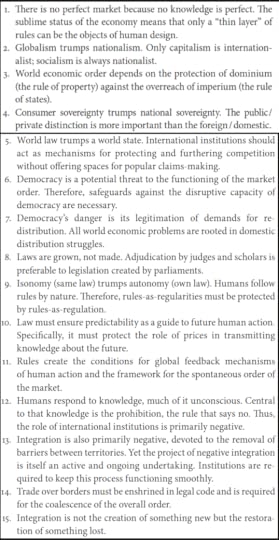
BTW, the epigraph illustrates but one early neoliberal belief. Famously, Hayek's contention to the contrary, that knowledge is forever imperfect, economic reality transcendent, sublime, substantially unknowable, dictated the way forward: only the market knows, and our job, as neoliberals, is to make sure we build institutions that will protect its transcendent work from any redistributive or protectionist meddling. These pages set down how much was attempted—and accomplished in this vein, and what fault lines suggest an unfinished project that may well be unfinishable, indeed utopian in its own way.

Should you desire the TLDR version, I've pasted a choice 15-point passage below.

I, however, look forward to more books by the ever-perceptive and -persuasive Mr. Slobodian

- - - - - - - - - -
15 Habits of Mind of Highly-Placed Neoliberals
(larger version:https://imgur.com/SpQIJnD)
Profile Image for Mehrsa.
2,245 reviews3,580 followers
July 24, 2018
This is such an important history and needs to be read by all academics and policymakers. It is sort of a revisionist history on neoliberalism--the thesis is that Hayek and others understood that their theories of the economy were aspirational ideals and not reflective of actual reality. They would make them come to pass through laws and so they did. To me, what was particularly fascinating in this account was how the neoliberal turn was rooted in racism (not Hayek, but some later advocates). Specifically, in bolstering South Africa's apartheid regime and in snuffing out the global south's demands for equality. It's not a quick or easy read, but this book will be around for a long time and will foster more research and literature.
591 reviews90 followers
April 9, 2018
Speaking as someone who has confronted “anarcho-capitalists” on the other side of the line at counter-fascist demonstrations (including one where these supposed anarchists came out to support ICE), the idea that neoliberalism and empire might have some elective affinities was not a new one to me. But historian Quinn Slobodian opens up some new angles by looking at the “Geneva School,” a circle of mostly German-speaking economists and lawyers and a counterpoint to the much more celebrated “Chicago School” of neoliberal economics and governance.

The Geneva neoliberals — figures like Wilhelm Ropke, Joachim-Ernst Mestmayer, and, Slobodian argues, Friedrich Hayek deserves to be seen in their company as well — come off as a gloomier, more philosophical, continental counterpart to their sunnier, gladhanding fellow travelers based at U Chicago. No PBS specials for them, like you got with Friedman! There’s a certain degree to which the Chicago School got over by sleight of hand- math proves the market, and we don’t need to think that much about the institutions that make it happen (or don’t). The Genevans didn’t think that much of math — Hayek was no friend of modeling — and thought a great deal about institutions. Emerging out of the collapse of the Hapsburg Empire and witnessing the rise (and bloody suppression) of Red Vienna, literally out of their office windows in many cases, European neoliberals thought deeply for decades about what could protect the market from those two persistent enemies: states and peoples.

Slobodian depicts the Geneva School as persistently fascinated with two empires: the Hapsburg empire that ran Central Europe when many of them were young, and the British Empire at its height in the nineteenth century. They saw both (pretty ahistorically, fwiw) as benign supranational referees and guarantors of market order, lowering barriers to the free movement of goods, capital, and people. As they and other empires collapsed, and more (and browner) nations began asserting themselves, the Geneva School came to concern themselves less with liberating markets and more with casting about for ways to replace empire in its supranational governance role.

In the interwar period, many looked to the League of Nations; thereafter, they fought amongst themselves as to whether European integration could be turned to their purposes (spoilers: it could), and set up GATT and WTO to play the role empire could not anymore. These were/are all institutions encased from democratic pressure, even the indirect pressure of legislation or diplomacy. More than economics, the Geneva School pit many of its chits on law, especially constitutional law. For Hayek and Ropke as for Schmitt and Machiavelli, the moment of decision — of staking a value claim — was the foundational moment of a given order that determines all else that comes after.

This neoliberalism was generated by fear. First it was fear of the masses in Europe and the industrialized countries, then of the nation-states who might undermine the market to appease them. Finally, and this is what gave them their opening to international influence in the 1970s, fear of the rising decolonized nations, demanding what was due them and attempting to rewrite the rules of the game. Not that the scraggly bearded ancap teens I’ve seen waving the black and gold for ICE would know or care, but in many ways neoliberalism really is about setting up walls against people, so that people don’t set up walls against capital. This includes racial barriers, as shown by the neoliberal activists who condemned South African apartheid for its market distorting aspects only to propose replacing it with various intricate racially-weighted franchise schemes to protect against majority rule.

Along with illuminating neglected corners of the history of neoliberalism, “Globalists” also presents some new angles on the twentieth century more generally. Most of the Geneva School thought the Cold War an irrelevance waste of time- Hayek wrote somewhere about the US and the USSR bidding to fund the socialist experiments of ex-colonies, and if you see any kind of government developing aid as “socialism,” it makes sense. The Cold War US cared less about “free” markets than it did about markets open to itself, attached to states who were amenable to its Cold War goals. Neoliberalism only really came into its own when developing world self-assertion (and developed world reaction) forced the elites of the US and elsewhere to abandon more robust development strategies and find ways to simply contain and discipline developing countries rather than entice them.

Moreover, this work reveals neoliberalism as an art of governance, and as one in a long old European tradition. Rather than the sunny (if clinical) rationalism of the Chicago School, the Genevan neoliberals insisted on a murky, turbulent world. To them, really comprehending the market — or any complex cybernetic system — was both impossible and vaguely wrong to attempt. What created order and allowed for (some version of) progress was continual adjustment under pain of severe negative circumstances, and the key figure of this process — the decisionmaker taking the role of Schmitt’s dictator or Machiavelli’s prince — is the entrepreneur, attuned to the ineffable flows of supply and demand and taking risks on value propositions. This is a strongly philosophical and moral vision, and the neoliberals sought — seek, in many cases — to create constitutional orders to bring that moral vision in to reality (or remove the artificial impediments “special interests” put up against it, in their telling). This doesn’t mean small government or non-intervention- far from it. It’s not hypocrisy, then, for “free market” fundamentalists to support calling out the troops to break up strikes, or force countries to lower tariffs, or separate asylum seekers from their children. That’s what the free market order is. *****

https://toomuchberard.wordpress.com/2...
Profile Image for Marcel Santos.
115 reviews19 followers
December 8, 2023
ENGLISH

In this book, Historian Quinn Slobodian develops a very illustrative account on the birth and evolvement of Neoliberalism in 20th century Europe, particularly in the 1920s and 1930s.

The phenomenon is complex, and many economists say that the term “Neoliberalism” has no meaning in fact, and that it is more of a pet peeve of left-wing opponents trying to denigrate the liberal-inspired policies that took over the political arena in 20th century.

Slobodian, however, delimits the movement very well, bringing quotes from its authors recognizing and naming themselves “neoliberals”.

He focuses his narrative on Europe, covering History from the end of the Habsburg Empire to the present day, mentioning important milestones in the history of the movement, such as the Walter Lipmann colloquium in the 1930s and the creation of the Mont Pelèrin Society by Friedrich Von Hayek in the 1940s. Slobodian, however, attributes the foundation and protagonism of the movement to scholars of the “Geneva School” such as Hayek, Röpke, Tumlir, Petersmann, among others, who were direct heirs of the Austrian School, if not its actual members such as Hayek.

The author focuses on the political and legal aspects of the movement, as he convincingly argues that these were in fact the main concerns of its founders, more than economics.

I must confess that I had never heard of that School in such a prominent position as he identifies it. My expectation was that he would go over US Schools such as Chicago, but he barely mentions them in the book.

The Geneva School borrowed grounds from the Austrian School, but also — and maybe mainly — from the Freiburg School, homeland of German-based Ordoliberal movement, which was obsessed with the idea of order; in fact, an economic order set by constitutional rules, with freedom of competition and enterprise, but condemnation of monopolies and cartels (see my review of Walter Eucken’s “The Foundations of Economics” and “The Ordo-Liberal Manifesto” here: https://www.goodreads.com/review/show...).

Slobodian’s focus is on the clash between the national and international domains of international trade, especially in Europe and particularly with the formation of transnational economic trade blocs such as GATT, WTO and EEC. Slobodian makes it clear that the neoliberal movement is not a mere revival of classical Liberalism, or a simple preaching of a minimal State in favor of the total liberalization of markets at the international level. The imposition of economic power of large corporations and the reduction of the role of workers' unions is a striking feature indeed. Yet what differentiates the movement, Slobodian argues, is the central concern of its authors with the creation of rules and institutions that guarantee and preserve market competition and the protection of private property at national and mainly international levels. The author calls this phenomenon “encasement” of the market.

The concern with these aspects was so great that in the dispute between those values ​​and democracy, the authors did not hesitate to proclaim the superiority of the former to the detriment of the latter, as Slobodian vehemently points out. In fact, in 20th century Europe, which was the scene of two World Wars and the birth of totalitarian movements such as Fascism and Communism, Neoliberalism represented the quest for the preservation and expansion of capitalist values.

Slobodian mentions two fundamental concepts present in Neoliberal dynamics: “imperium” and “dominium”. “Imperium” relates to the direct domination of countries over their colonies, something that decreased in importance during the 20th century — or at least changed forms, though keeping the essence —, especially after the Second World War, in a movement of decolonization. The concept is actually more related to domination over people, according to the author; in this case, the residents of colonies by metropolises.

In the modern dynamics of the 20th century, the concept of “dominium”, which refers to domination over goods, or more specifically, property, becomes more important. In the context of increasing financialization of the world economy, neoliberalism's concern was to preserve the free mobility of capital around the world.

The author conducts his study through numerous citations from works by the most prominent authors of the so-called “Geneva School”. The authors present varying levels of complexity and obviously have differences in thought, but they chant common, determining mantras.

Leading the movement, Hayek is a complex author; his concern with the State's interference in economic affairs, prescribing its role only as a planner for competition, is just the author's easiest and most immediate facet (my review here: https://www.goodreads.com/review/show...). Slobodian goes through three of the author's main ideas that deserve mention: the price system as a process of information discovery; the parallel between cybernetics and the functioning of markets, with negative feedbacks provoking adjustments of route by the economic agents; and the explicit support for dictatorships as long as they promote economic liberalism, as in the case of Chile — yet his condemnation of South African apartheid.

Slobodian also dwells a lot on Wilhelm Röpke, pointed out as an influential member of the School. This author, according to Slobodian's portrait, repeats the most obvious liberal mantras, albeit with great emphasis, but openly defended apartheid in South Africa and in the south of the USA, for example.

Another point that deserves highlight is how the Geneva School dealt with the conflict between countries in the context of international trade. Slobodian identifies a clear preference of the School authors for maintaining the GATT and condemning the creation of the WTO in replacement of the GATT, and even more so the creation of the EEC. The “one country, one vote” mechanism in the WTO excessively empowered countries from the Global South that, in the view of the Geneva School authors, had no commitment to the free market. It turns out, however, as well pointed out by Slobodian, that countries of the Global North also practiced heavy protectionism, especially in relation to their agricultural products, but also regarding intellectual property, so that free trade has always been more of a pipe dream than a reality.

In fact, one does not need much effort to see that a pure liberal system is a utopia. Even the founding fathers of Liberalism in the economic realm never preached complete or even radical withdrawal of the State from the private dominium. Adam Smith claimed for less intrusion of the State in the economic life, but never a complete withdrawal (my review here: https://www.goodreads.com/review/show...). John Stuart Mill affirmed that sometimes private monopolies were worse than the State managing some public services (my review here: https://www.goodreads.com/review/show...). Like in all ideologies, intentions of purism are chimerical — the same with Socialism or Communism. That said, we should judge the application of ideological principles as how far they go and how successful they fit reality and dialog with it — essentially, their results in terms of what they aim and how much they achieve.

“Globalists” is a deep Historical study on the roots of Neoliberalism as an intellectual and political movement in Europe. I read it after having read David Harvey’s “The Condition of Post-Modernity” (my review here: https://www.goodreads.com/review/show...) and “A Brief History of Neoloberalism” (my review here: https://www.goodreads.com/review/show...). The three works dialogue very well among each other, though it seems that there is much more out there to get a more comprehensive understanding of such a complex phenomenon. Little is said in “Globalists”, for instance, about: (1) the economic conditions of the world, which the Neoliberal recipe aimed at; (2) the famous “Washington Consensus”, and the role of the IMF in preserving the economic power relations worldwide; and (3) the geopolitics of the Cold War, which exerted an undeniable role in the context.

The book, nevertheless, is a good starting point to understand a great deal of the historical and political aspects of Neoliberalism.


PORTUGUÊS

O historiador Quinn Slobodian desenvolve neste livro um relato muito ilustrativo sobre o nascimento e o desenvolvimento do Neoliberalismo na Europa do século XX, particularmente nas décadas de 1920 e 1930.

O fenômeno é complexo, e muitos economistas dizem que o termo “Neoliberalismo” não tem, de fato, significado, e que é mais implicância de adversários de esquerda tentando denegrir as políticas de inspiração liberal que tomaram a arena política no século XX.

Slobodian, porém, delimita muito bem o movimento, trazendo falas de seus autores reconhecendo-se e autodenominando-se “neoliberais”.

Ele centra sua narrativa na Europa, percorrendo a História desde o fim do Império Habsburgo até os dias atuais, mencionando marcos importantes na história do movimento, como o colóquio Walter Lipmann, na década de 1930, e a criação da Sociedade Mont Pelèrin por Friedrich Von Hayek na década de 1940. Slobodian, no entanto, atribui a fundação e o protagonismo do movimento a estudiosos da “Escola de Genebra” como Hayek, Röpke, Tumlir, Petersmann, entre outros, que foram herdeiros diretos da Escola Austríaca, senão membros dela própria como Hayek.

O autor focaliza os aspectos políticos e jurídicos do movimento, ao argumentar de forma convincente que estas foram de fato as principais preocupações dos seus fundadores, mais do que a economia.

Confesso que nunca tinha ouvido falar dessa Escola numa posição de destaque como ele a identifica. Minha expectativa era que ele abordasse Escolas dos EUA, como Chicago, mas ele quase não as menciona, se é que o faz.

A Escola de Genebra tomou emprestados fundamentos da Escola Austríaca, mas também – e talvez principalmente – da Escola de Freiburg, berço do movimento alemão Ordoliberal, que era obcecado pela ideia de ordem; na verdade, uma ordem econômica estabelecida por regras constitucionais, com liberdade de concorrência e de empresa, mas com condenação de monopólios e cartéis (veja a minha resenha de “The Foundations of Economics” e “The Ordo-Liberal Manifesto” de Walter Eucken aqui: https:/ /www.goodreads.com/review/show/5578462624).

O foco de Slobodian está no choque entre os domínios nacional e internacional do comércio internacional, especialmente na Europa e particularmente com a formação de blocos comerciais econômicos transnacionais como o GATT, a OMC e a CEE. Slobodian deixa claro que o movimento Neoliberal não é um mero renascimento do Liberalismo Clássico, ou uma simples pregação de um Estado mínimo a favor da liberalização total dos mercados a nível internacional. A imposição do poder econômico de grandes corporações e redução do papel de sindicatos de trabalhadores é sim uma característica marcante. Mas o que diferencia o movimento, argumenta Slobodian, é a preocupação central dos seus autores com a criação de regras e instituições que garantam e preservem a concorrência de mercado e a proteção da propriedade privada a nível nacional e principalmente internacional. O autor chama esse fenômeno de “encapsulamento” do mercado.

A preocupação com esses aspectos era tão grande que na disputa entre aqueles valores e a democracia, os autores não hesitavam em proclamar a superioridade dos primeiros em detrimento da segunda, como aponta veementemente Slobodian. Na verdade, na Europa do século XX, palco de duas Guerras Mundiais e do nascimento de movimentos totalitários como o Fascismo e o Comunismo, o Neoliberalismo representou a busca pela preservação e expansão dos valores capitalistas.

Slobodian menciona dois conceitos fundamentais presentes na dinâmica neoliberal: “imperium” e “dominium”. “Imperium” diz respeito ao domínio direto dos países sobre as suas colônias, algo que diminuiu de importância ao longo do século XX — ou pelo menos mudou de forma, mas mantendo a essência —, especialmente após a Segunda Guerra Mundial, num verdadeiro movimento de descolonização. O conceito, na verdade, está mais relacionado à dominação sobre pessoas, segundo o autor; neste caso, os moradores das colônias pelas metrópoles.

Na dinâmica moderna do século XX, o conceito de “dominium”, que se refere à dominação sobre os bens, ou mais especificamente, sobre a propriedade, ganha maior importância. No contexto da crescente financerização da economia mundial, a preocupação do Neoliberalismo era preservar a livre mobilidade do capital em todo o mundo.

O autor conduz seu estudo por meio de inúmeras citações de obras dos mais destacados autores da chamada “Escola de Genebra”. Os autores apresentam níveis variados de complexidade e obviamente possuem diferenças de pensamento, mas entoam mantras comuns determinantes.

Encabeçando o movimento, Hayek é um autor complexo; a sua preocupação com a interferência do Estado nos assuntos econômicos, prescrevendo o seu papel apenas como planejador da concorrência, é apenas a faceta mais fácil e imediata do autor (a minha crítica aqui: https://www.goodreads.com/review/show...). Slobodian aborda três ideias principais do autor que merecem destaque: o sistema de preços como processo de descoberta de informação; o paralelo entre a cibernética e o funcionamento dos mercados, com feedbacks negativos provocando ajustes de rota por parte dos agentes econômicos; e o apoio explícito às ditaduras, desde que promovam o liberalismo econômico, como no caso do Chile – mas a sua condenação do apartheid sul-africano.

Slobodian também se detém muito em Wilhelm Röpke, apontado como um membro influente da Escola. Este autor, segundo o retrato de Slobodian, repete os mais óbvios mantras liberais, ainda que com grande ênfase, mas defendeu abertamente o apartheid na África do Sul e no sul dos EUA, por exemplo.

Outro ponto que merece destaque é a forma como a Escola de Genebra tratou o conflito entre países no contexto do comércio internacional. Slobodian identifica uma clara preferência dos autores da Escola pela manutenção do GATT, condenando a criação da OMC em substituição do GATT e, mais ainda, a criação da CEE. O mecanismo “um país, um voto” na OMC deu poderes excessivos aos países do Sul Global que, na opinião dos autores da Escola de Genebra, não tinham qualquer compromisso com o mercado livre. Acontece, no entanto, como bem salienta Slobodian, que os países do Norte Global também praticaram um forte proteccionismo, especialmente em relação aos seus produtos agrícolas, mas também com relação à propriedade intelectual, de modo que o comércio livre sempre foi mais uma quimera do que uma realidade.

Na verdade, não é necessário muito esforço para ver que um sistema liberal puro é uma utopia. Mesmo os pais fundadores do liberalismo no domínio econômico nunca pregaram a retirada completa ou mesmo radical do Estado do domínio privado. Adam Smith reivindicou uma menor intrusão do Estado na vida econômica, mas nunca uma retirada completa (a minha resenha aqui: https ://www.goodreads.com/review/show/4541858181). John Stuart Mill afirmou que às vezes os monopólios privados eram piores do que o Estado gerir alguns serviços públicos (minha análise aqui: https://www.goodreads.com/review/show...). Como em todas as ideologias, as intenções de purismo são quiméricas – o mesmo acontece com o Socialismo ou o Comunismo. Dito isto, devemos julgar a aplicação de princípios ideológicos pelo quão longe eles vão na realidade e quão bem sucedidos eles se ajustam à realidade e dialogam com ela – essencialmente, os seus resultados em termos do que pretendem e do quanto alcançam.

“Globalistas” é um estudo histórico profundo sobre as raízes do Neoliberalismo como movimento intelectual e político na Europa. Eu o li depois de ler “The Condition of Post-Modernity” de David Harvey (minha resenha aqui: https://www.goodreads.com/review/show...) e “A Brief History of Neoloberalism” (minha resenha aqui: https://www.goodreads.com/review/show...). As três obras dialogam muito bem entre si, embora pareça que há muito mais por aí para se obter uma compreensão mais abrangente de um fenômeno tão complexo. Pouco se fala em “Globalistas”, por exemplo, sobre: ​​(1) as condições econômicas do mundo a que a receita neoliberal visava; (2) o famoso “Consenso de Washington” e o papel do FMI na preservação das relações econômicas de poder em todo o mundo; e (3) a geopolítica da Guerra Fria, que exerceu um papel inegável no contexto.

O livro, no entanto, é um bom ponto de partida para compreender muito dos aspectos históricos e políticos do Neoliberalismo.
Profile Image for Matthew Hall.
162 reviews26 followers
April 19, 2019
This book is a great example of an academic book that could've used a perusal by a non-academic editor. The ideas are fascinating and thought-provoking, ponderous and infuriating, but it needed maybe a slightly more human touch. The narrative thread of the book follows the life of Friederich Hayek and his ideas and work, and while those ideas are particularly human (idiosyncratic, at times baffling, at times contradictory and yet without a doubt wildly influential) Hayek the man comes off as an enigma and I'd've liked to see him drawn out a bit more, although I gather that Slobodian is going for an academic history, not a human interest piece. He also repeatedly frames everything in terms of "his argument" which smacks of a kind of academic hubris I've never cared for.

Generally this book gave me a lot to think about, and filled in some historical gaps I've wondered about but never quite had the language to form the question: after the first World War, how did Empires end (if they did at all?) and how did we so neatly become this world where global capital and the global economy become unassailably good? In particular to my mind, where did the virulent racism of Empire go?

The short answer: a group of neoliberals from the 1930s - 1980s set about creating an intellectual framework where the private capital from Empire rebranded itself as "the global market" and there was a concerted effort to protect private capital from democratic oversight or the governments of nations (and these dudes seriously hate democracy and viewed it AT BEST as a necessary evil to legitimate their views on the "human rights" of free-flowing capital) and the creation of supranational organizations (think the EU) to protect and encase that capital and its free flow/extraction etc. (Also, the racism never went away. These guys were unabashedly racist and the idea that governments from the global south would try to use the hand of government to stop corporate extraction of natural and national resources was particularly galling to them.)

It's easy to see in this narrative how Hayek and von Mises' knownothing-ism (no one can ever truly grasp the ineffable beauty of the free market, so why should we ever try to "regulate it" other than creating organizations to protect it?) translates into conservatism (and they did make in-roads to the National Review and William F. Buckley in the '50s).

What's harder to grapple with are the implications of nationalism and the role of the nation-state. Having traveled through Europe and generally accepting that I am privileged cosmopolitan internationalist piece of shit, I can see the internal moral value of free movement as a human right within the EU (or anywhere else for that matter).To recognize that that right has been affixed like drapery to the "rights" of property and unencumbered and un-taxed flow of capital feels... not great. Conversely, as a social democrat-leaning person who values systems of social welfare and uplift, I'm deeply angry that seemingly the only mechanisms we have for capturing capital and redistributing it rely on the absolutely fucking absurd notion of clearly delineated historic nation-states and "firm borders" and all of the racist garbage we can see those ideas truck in. (see: Trump and Brexit)

I don't know, I guess all this means is that I'm an internationalist socialist scumbag and I want a better system that both captures capital and allows for the free movement of peoples and I'm too dumb to know how to design that system or how to begin paving the road to international socialism at all. (yes, kudos to myself for fitting that reference in).
161 reviews11 followers
November 17, 2021
This is a headspinning read. A history of the branch of neoliberalism that you probably haven't heard of - the Geneva school. Sounds dry. But seriously, it's a must-read if you want to understand 'the present conjuncture'. All the intellectual strands that came together after the collapse of the Hapsburg Empire to form Reaganism/Thatcherism, the grim international order of GATT, WTO, the International Chamber of Commerce (and the EEC/EU, very much an expression of the neoliberal consensus) and their various offshoots and national representations. The hideous and hugely influential deep-establishment consensus that opposed decolonisation, labour solidarity, international development, the spread of democracy and national sovereignty - while supporting Pinochet and apartheid and the routine slaughter and imprisonment of opposition groups and indigenous people. The awful idea of the 'weighted franchise' (more votes for wealthy people!). And, of course, the continuining deep influence of this school of thought - the brilliant and persuasive and hateful Heyek, von Mieses and all their descendents. The whole bleak context to the collapsing world economic order. Gripping and illuminating.
Profile Image for Laura.
1,611 reviews129 followers
December 17, 2019
Traces the development of neoliberal thinking from the Austrian School of Economics (Baron Ludwig von Mises! I almost don't scream anymore when I hear his name) to the establishment of the World Trade Organization. Posits that neoliberalism starts with the idea the market his the ideal form of social coordination and ends with property rights being elevated over civil and civic rights.

Had some great lines. "Against Roosevelt's Four Freedoms -- of speech, of worship, from fear, from want -- neoliberals posed the four freedoms of capital, goods, services, and labor." (136).

"Order for Hayek must be as unplanned and spontaneous as the movement of a school of fish in water." (228)

"Neoliberals criticize socialists for their dream of a world economy without losers, but they had their own dream of a world economy without rule breakers and more importantly without idealistic -- or, in their opinion, atavistic - alliances of rule breakers who seek to change the system of incentives, obligations, and rewards. In the mid-2010s, the popular referendum in favor of Brexit and the declining popularity of binding trade legislation suggests that even if the intentions of the neoliberals was to 'undo the demos,' the demos -- for better or for worse -- is not undone yet." (286).

Was hoping for some deeper insights about this ongoing struggle between the idea that civic society should constrain the market and the idea that the market is the ultimate expression of human freedom. But maybe this is all there is.

Profile Image for Josh Friedlander.
833 reviews136 followers
September 13, 2020
Before hearing Quinn Slobodian (in this 2018 podcast) on the topic, I'd decided that neoliberalism - despite the ubiquity of the term - could be dismissed by a useful intellectual history rule I have: in any "neo-x" (sometimes "x revival"), you can just ignore the prefix (or suffix); the differences are invariably historical but not substantial. So critics of neoliberalism are critics of liberalism - an important debate, sure, but old-hat. This learned, fascinating book is full of interesting details (more in a bit), but since I found the definition of neoliberalism a bit slippery, I will put it here (in my understanding) for the impatient:

1) Historically neoliberalism was a response to the shocks of the entre-deux-guerres in Central Europe, and the Keynesian moment. Neoliberal thinkers differ from classical liberals most markedly in their desire for state structures (an order) to protect the security and stability of the market from the populist pressures of special interest groups. Far from trying to "unfetter" markets, they wish to strengthen the legal structures in which those markets operate against democratic pressures.

2) In recent times, the book focuses on the global application of those principles, via international institutions such as the World Trade Organisation. Just as neoliberals seek to circumvent democratic pressures on a national level by enshrining commercial freedom in law, the international neoliberal institutions seek to replicate the dominating force of empire to protect trade in a world of selfish, unruly nationalism.

The origins of neoliberalism aren't hard to trace back to the Walter Lippmann Colloquium in 1938, where both neoliberalism and ordoliberalism began. From Slobodian's book it seems that the two are largely synonymous: English Wikipedia stresses their differences
Ordoliberals promoted the concept of the social market economy, and this concept promotes a strong role for the state with respect to the market, which is in many ways different from the ideas connected to the term neoliberalism. Oddly the term neoliberalism was originally coined by ordoliberal Alexander Rüstow.
but the German language one disagrees
Der Ordoliberalismus gehört zu einer heterogenen wirtschaftswissenschaftlichen Strömung, die unter dem Oberbegriff Neoliberalismus zusammengefasst wird...Die Begriffe Ordoliberalismus und Neoliberalismus werden in der Literatur teilweise aber auch synonym verwendet.
My understanding is that leftist critics of liberalism have tended to indiscriminately label all free-market liberals as neoliberals (Thatcher, Reagan, Milton Friedman...), but see ordoliberals as different; however in truth the differences between ordo- and neoliberals are nugatory compared to their mutual distance from standard liberalism. Slobodian at least chooses to focus on the subgenre of neoliberal most similar to ordoliberals, that of what he terms (parallel to the "Freiburg School" of ordoliberalism) the "Geneva School". (Globalist cosmopolitanism, of course, is very Swiss.)

Geneva Schoolers such as Friedrich Hayek and Ludwig von Mises were involved early on in the collection of statistics on the global economy. (Both attended a 1936 conference to discuss the question "Does the global economy exist?") One of the interesting ideas in the book is that Hayek tended to answer negatively: that the economy was so complex, almost mystical, that no attempts to map or plan it would succeed, contra both Keynesians and socialists. He sometimes borrowed the language of cybernetics (describing prices as a "feedback effect"). Evidence of this (to me) is that highly educated people will argue passionately as to whether Keynesian stimulus is effective, implying that this cannot be definitively answered by empirical means.

Thus the term "ordoglobalism". Order, noted Jan Tumlir (a senior wonk at the WTO predecessor, GATT, and a major figure in the book) can have two meanings: stability, in the sense of "law and order"; and the rules and institutions which create it. Freiburg School ordoliberals saw chaos in postwar Vienna, and sought to use "nomocracy", rule by law, to protect the social order from the demands of the masses. Likewise, as empires crumbled and postcolonial states stepped up to demand more privileges, the Geneva School "ordoglobalists" sought to utilise international law and institutions to curtail that disruption. In Tumlir's words: “International rules protect the world market against governments.”

Early on the book cites a useful distinction made by the Nazi jurist Carl Schmitt, based in Roman law, between empirium (government) and dominium (private property). Schmitt thought it desirable to strengthen the former world at the expense of the latter, but the Geneva School believed the oppposite. Most of them were Austrians who remembered warmly the advantages of the Dual Monarchy, and saw it as a model to try and reproduce. In the words of Röpke (discussed below), they were
the generation which in its youth saw the sunset glow of that long and glorious sunny day of the western world, which lasted from the Congress of Vienna until August 1914, and of which those who have only lived in the present arctic night of history can have no adequate conception.
Chapter Five focuses mostly on Wilhelm Röpke, a heterodox neoliberal (he quit the neoliberal Mont Pelerin society after disagreements with Hayek) who was a notable defender of South African apartheid. However, Hayek and Milton Friedman were also skeptical about boycotts of the regime, emphasising neoliberalism's priority of markets over human rights. (This is basically Friedman's only appearance in the book, adding to the confusion of the term "neoliberal".) Another example is the way the Geneva School supported freedom of movement for capital, but not for people. In the words of Gottfried von Haberler:
The Ruhr Valley would become unbelievably crowded, and the Alps would empty out entirely...One need not be a nationalist for such things to be undesirable...free trade is beneficial for all even when there is no freedom of migration and the peoples remain firmly rooted in their countries.
Slobodian relates how the founding of the European Economic Community, far from being a boon to ordoglobalists, actually worried them. A colonial bloc spanning from "the Baltic to the Congo" meant simply a vast space of imperial protectionism, a trading bloc that would disrupt the natural flow of capital in and out of its borders (while liberating it internally). (In Schmitt's terminology, it was empirium, not dominium, which perhaps can be said of its successor European Union.) In fact some European rearguard defenders of colonialism projected a potential Eurafrique trading zone - but it was not to be. Decolonisation meant a potentially destabilising wave of countries leaving the framework of empire and allowing the particular interests of their populations to threaten global trade. It was in global institutions that neoliberal ideas would now come to expression.

It is a curious fact that while Slobodian's politics are rooted in left opposition to trade treaties and globalisation, the standard-bearers of anti-globalist nationalism are now on the right, the most prominent of whom is in the Oval Office, and it is because of them that this book has probably been read by far more people than its austere prose would predict. This surprising convergence of two worlds has surprised many, myself included, and besides for noting it I won't add to this already long review.

PS I first came across Foucault's Collége de France lectures on neoliberal history when I was researching Walter Lippmann's ideas on democracy and public understanding. Despite (because of?) being a journalist, Lippmann was skeptical about the public's understanding of complex issues, and debated John Dewey on the topic. Dewey advocated expanded citizen journalism, while Lippmann leaned towards technocracy, a view shared by Schumpeter in Capitalism, Socialism and Democracy. The idea of the law as a methodical, slow process which serves as a buffer against the democratic winds of populism, is related, and informs a good deal of why I strongly disagree with Slobodian's politics...

PPS Historian Patrick Iber's review in the New Republic is misled by this book in the same way I was, so I want to clarify. The term "neoliberal" has been criticised (even on the left, as Iber discusses) as signifying basically "all the people I dislike", and rarely a self-appellation. In theory Slobodian restores rigour to the term by focusing on the ideology of those who explicitly call themselves neoliberals. But in fact Slobodian also uses the term for "people he dislikes" (such as Milton Friedman, otherwise completely outside this book's purview). In fact despite the title, the book makes clear that it is only about a narrow corner of neoliberal history. So this is not really a definition of "neoliberalism" as currently used - even by the author.
Profile Image for Adam.
997 reviews241 followers
November 18, 2020
Political discourse online has, many people agree, made a night incomprehensible hash of whatever the word 'neoliberalism' might have once meant. I remember hearing of it as a term associated with economic imperialism back in my anarchist days, then came to see it as essentially synonymous with technocratic market progressivism on Twitter. For a while there, before socdem and neoliberal twitter schismed, it seemed like neoliberal was a reasonable term for the outlook I had gravitated toward after leaving anti-civism, listening to a lot of Econtalk and feeling convinced by some of it but not totally on board with the Libertarian anti-progressivism Russ leans to. On top of that, though, there was Hayek: making points I found compelling and ahead of their time on one hand but fairly credibly condemned as a dictator-lover by more orthodox socialists.

What this book makes very clear is that I had just not done my homework on any of this stuff. It certainly validates my decision to never go so far as to actually call myself a neoliberal. The ideological history here is in many ways much more straightforward than I thought. Hayek wasn't a laissez faire libertarian as opposed to intervention-friendly neoliberals. He was a self-identitied neoliberal himself, and he and his colleagues took the term to refer to an ideology that suggested exactly the international institutions modern anti-capitalists smear with the term. I'm glad to have all of that clarified.

Beyond that, though, I was a bit frustrated by what the book had to offer. The content is loaded with historical minutiae--which scholars met at which conferences in which cities in which years, who corresponded with who about what, what positions they took on which trade deals and international institutions, etc--but it doesn't add up to much. Slobodian makes his thesis clear throughout: that neoliberalism isn't a laissez-faire ideology but one concerned with establishing a clear and uniform legal context for the global market. That matches the broad strokes idea of the modern neoliberal twitter ppl as markets harnessed and bounded by smart intervention, except that the subjects of the book meant it far more specifically--eg to exclude Keynesian economic policy as well as mercantilism and Marxism.

The problem is that the exposition of this thesis is extremely superficial in all the ways one might hope an intellectual history should be deep. Slobodian frames it in terms that would with absolute certainty read as explicitly derogatory to anyone coming in with even the slightest bit of anti-capitalist bent, and fairly suspicious to anyone who isn't already friendly to Hayek. As he puts it, neoliberalism is about creating legal frameworks to "protect capitalism from democracy." Elsewhere he goes further. Neoliberals wanted to create "human rights for capital" that would protect investors from nationalization and certain kinds of regulation. And he quotes them saying these things in their own words! Hard to deny he's being accurate here. But it's not entirely clear that he's being fair, because he doesn't give their ideas a hearing at all. Slobodian never bothers to even try to explain why Hayek and his colleagues might have thought such things. He simply allows them to find support for their negative biases--von Mises worked as an overt advocate for big business, Hayek had a special dislike for unions, Rubka(sp?) supported apartheid, etc. Their idea was as bad as it sounds a face value because they had bad motivations.

The problem with this approach is not that Slobodian is wrong, but that for readers like me, who have a charitable reading of Hayek at least in mind that makes the superficial shock of "protecting capitalism from democracy" a lot less shocking and a lot more consistent with progressive principles, there's almost nothing here to inform me as to why and even often to what extent actual neoliberal belief and policy differed from this left-libertarian cousin. I often got the sense that Slobodian wanted us to think neoliberalism was working exactly as intended, because it wasn't a credible and well meaning ideology subverted by business interests so much as a crock of shit made up to justify those interests in the first place.

Slobodian never really discusses at all why any of these thinkers thought these policies were a good idea, what their motivations were, whether they were pleased by the results their policies got when enacted, or anything that would allow us to actually judge neoliberalism per se against the flawed reality. You might argue that that's not the point of a book like this, but aside from the fact that it does give a very unsupported negative impression on the question, I just think that that is wrong. By contrast, for instance, Paul Sabin's book The Bet is an intellectual history that goes very far to explore actual context, motivation, results, etc, and that's the sort of thing I'd like to have gotten here.

I would have quite liked to come away from this book with a better understanding of why Hayek found labor unions so much more of a threat to his ideals than they seem to be to me, especially relative to more obvious threats like corporate lobbying. But that question just doesn't seem very obvious here because it never seems like the neoliberals held principles that might have threatened corporate interests in the first place. And since they certainly did, it's hard to see how that doesn't make Slobodian's portrayal feel misleading.
19 reviews
October 7, 2022
Intellectuele geschiedenis op z'n best, die aantoont dat neoliberalisme niet om een 'terugtrekkende staat' gaat die de markt z'n gang laat gaan, maar om het opbouwen van instituties die kapitaal(markten) maken, bevorderen en beschermen. Dat ik geen vijfde ster geef, is hierom: het was interessant geweest om iets meer aandacht te besteden aan de praktische uitwerking van deze ideeën in de WTO en het IMF. 'Structural adjustment programs' zijn bijvoorbeeld hét voorbeeld waarmee nationale democratieën werden onderworpen aan de mondiale, neoliberale instituties. De plannen van de troika in de Europese schuldencrisis zijn daar een ander voorbeeld van.
Profile Image for David.
89 reviews10 followers
March 26, 2023
An intellectual history of neoliberal thinkers, from the demise of the Habsburg Empire to the end of the Cold War. In the political wilderness for much of the 20th c., these thinkers and their legacy finally came into their own during the Age of Reagan, and only lost credibility with the 2008 Recession. For Neoliberals, protecting global markets and price signals was paramount, and the greatest threats to guard against were the demos and other groups that attempted to circumvent or otherwise distort markets and price signals. Neoliberals came down hard on state sovereignty insofar as it was "captured" by democratic elements within a nation-state or was used by a nation-state to elude market discipline i.e. tariffs, imposed by international institutions. For Neoliberals, postwar decolonization untethered many countries in the Global South from their colonial masters, who then sought to carve out exceptions to global market discipline. And social democracy--frankly most democratic impulses--were anathema to this school. Reading Slobodian also reminded me how international the atlantic trade was in the second half of the 19th c. and how closely political economy was tied to the gold standard.
A very well-written book.
Profile Image for Joshua Rosen.
40 reviews5 followers
January 25, 2021
Hayek thought that the global marketplace was an unknowable God, and that any attempt at studying it would destroy it. In other words, he was afraid of math, and the use of math for any kind of national planning was his version of hell. In his mind, social safety nets and unions, corporate taxes and reparations to the Global South were tantamount to serfdom, enslaving the free movement of capital to the whims of democracy and social justice. Lack of food and housing and jobs and healthcare were unfortunate but necessary sacrifices for the efficient flow of capital.

Along with segregationist William Buckley and apartheid-defender Wilhelm Ropke, Hayek received the presidential medal of freedom from H.W. in 1991. Their shitty books and speculative essays and garbage rhetoric quite literally built the international economic order of the world today. It’s good to know that. This book does of good job of showing how, and why.
Profile Image for Nike Norin.
11 reviews2 followers
April 2, 2024
Absolut ett viktigt bidrag för att förstå nyliberalismens globala grund, men gud vad tråkigt att läsa en historisk redogörelse över vem som lobbade vem, vem som var med i vilken studiegrupp, gubbnamn efter gubbnamn…

En ljusglimt när man får dyka ner i Hayek och hans (över)tro på Ekonomin - detta ofelande och för människan ogreppbara fenomen av prissignaler med förmågan att styra mänskligheten rätt. Politikern ska inte styra, planera, eller över huvud taget försöka förstå sig på Ekonomin, utan endast skydda systemet till varje pris (dvs skydda från demokratiskt inflytande). “Hayek saw the real danger not in the rule of the jungle but in the rule of the engineer”, skriver Slobodian, och menar att Hayek ansåg att analyser och datainsamling för att förutspå ekonomins nycker var lika farliga som socialism. Milton Friedman lika farlig som Keynes!

Och ja min recension recenserar inte det akademiska bidraget utan läsglädjen i en sån här bok eftersom den är utgiven som, just ja, BOK
Profile Image for Evan Puschak.
32 reviews362 followers
November 20, 2019
I think from now on four out of five stars will be my baseline rating for books. You can essentially take it to mean: this book is worth reading, I learned something and/or I enjoyed the experience and I don't regret having spent the time. The reason I preface these comments with that is because Quinn Slobodian's Globalists: The End of Empire and the Birth of Neoliberalism isn't exactly a rip-roaring read. I suspect many people would find it dry and rather boring. I know at times I did. Despite that, I'm glad I powered through because this book helped to clarify a lot of vague notions I had swirling around in my head about that dirty word, "neoliberalism."

This is a limited history of the neoliberalist movement, from roughly the fall of the Hapsburg Empire after World War I to the inception of the World Trade Organization in the mid 1990s. It was slightly frustrating to me at first that this book doesn't carry through to the present, as 1995 feels so long ago, an epoch away from where we are now. But Slobodian makes the point that the apotheosis of the neoliberal movement (the birth of the WTO) is also the moment at which a popular backlash starts to form which would come to define the new millenium. These days that backlash has reached a fever pitch, even as neoliberal policy still holds much sway.

Slobodian traces the rise of neoliberal ideology through a handful of European thinkers, namely Ludwig Von Mises, Wilhelm Röpke and Friedrich Hayek. In some ways the point of the book is to dispel myths about what these thinkers advocated, and neoliberalism in general. Before reading Globalists, if someone asked me what the neoliberal program is I might have said: slash regulations, cut taxes on corporations and promote an interconnected, global economy through free trade. In essence, reduce the power of government and increase the power of markets. These things are not necessarily wrong, but they miss important aspects.

While early neoliberal thinkers had an implicit faith in markets, they did not believe in laissez faire. As vital as it was to let competition run its course, neoliberals felt strongly that they had to create a system to protect free markets from the vicissitudes of national politics. They had a profound distrust of democratic government, fearing that the popular vote tended toward protectionist and/or redistributive policy, which would snag the free flow of the world economy. This fear was exacerbated after decolonization, in which dozens of new nation-states were formed, then given a seat at the international table in the United Nations. They worked against these trends in what sometimes amounted to racist proposals in support of, for example, the white Apartheid regime in South Africa. This and their antipathy to democracy is striking.

Slobodian makes clear that neoliberalism was never an ideology set in stone, but one that constantly adjusted to the times. After World War I the neoliberals, eager to better understand global economy, pushed for statistics and other fine measurements of the market, only to watch their confidence in numbers crash with the Great Depression. Hayek, for his part, believed that the world economy was far too complex for anyone to understand, and so efforts should be devoted not to controlling the market but to encasing it (Slobodian's term) in an international system of laws that would prevent countries from hindering its ability to find a natural equilibrium.

Neoliberals wanted the world economy to be an invisible layer that floated above national sovereignty and could not be constrained by it. They sought and helped design international bodies that could enforce the laws of global competition, eventually succeeding (after various hiccups) with the creation of the WTO. The supreme irony, as Slobodian points out, is that the WTO prompted demonstrations from publics who felt that decisions influencing their livelihoods were being made by a supranational body that did not consult them. The invisible world economy became visible. And neoliberalism, a movement which sought to transcend the political, found itself mired in a political backlash that, as I said above, has reached a fever pitch today.

Slobodian doesn't make qualitative judgements about neoliberalism. He skillfully lays out the growth of the movement and its evolving, sometimes hypocritical platform through the writings of its most prominent figureheads. As he says, neoliberalism should be seen as one only one argument for how to design the world among many. It may be impossible now to turn back from a globalized economy, but we're clearly at some kind of inflection point. The cracks in neoliberalism have made it visible, and for this kind of ideology that constitutes something of a defeat.
Profile Image for David Sogge.
Author 7 books31 followers
December 10, 2020
This compelling, careful work of intellectual history makes a deep dive into the origins of the most powerful political ideas at play in recent times. The problem is, they are seriously bad ideas. Roughly speaking, they seek to sideline democracy with its tendencies to respond to citizen needs through public welfare and other kinds of ‘downward’ redistribution. (Meanwhile ‘upward’ redistribution is quietly welcomed.) These ideas spurn national developmental ambitions, especially those promoted with plans. Instead they favour supranational governance with strong, binding laws meant to protect private interests. That is, governance that can neutralize political life of nation-states and their obligations to citizens. Such ideas downplay data and quantitative targets as topics of public debate and policy-making. Instead, they favour non-transparent, go-with-the-flow, de-politicised economic statecraft. Yet when it comes to investments, commerce and the protection of wealth, the rules must be rigorous, binding, and wholly beyond the reach of public politics. All in the name of "freedom".
Sound familiar? These notions are, after all, the conceptual building-blocks of today’s globalized capitalism and its defense forces in corporate law, politically 'independent' central banks, international tax competition and tax havenry, the World Trade Organisation, the European Union and so forth.

Before reading this book I thought I was reasonably well informed about the taproots of neoliberalism, the Mont Pelerin Society and kindred policy lobby networks. But I was mistaken. This book gave me a comeuppance, and a welcome one at that. Thanks to Slobodian’s Globalists, the foundations of today’s corporate-friendly discourse and legal architecture, as revealed in Pistor’s The Code of Capital (see my ***** review here in Goodreads) have been exposed for all to see.
Profile Image for Erik Champenois.
413 reviews28 followers
February 5, 2021
A helpful overview of the Geneva school of neoliberalism, with Mises, Hayek, and Röpke as some of the most prominent figures, and as distinguished from the (Milton Friedman) Chicago school of neoliberalism. Slobodian shows how the Geneva neoliberals were not mere proponents of market fundamentalism in a shrinking state, but were instead focused on designing institutions to protect the market and ensure the free flow of capital in a globalized world. The author also shows the deep suspicions towards democracy held by neoliberals, who wished to design state and supranational institutions to safeguard the market against the masses, including protecting the market against redistributive policies, price adjustments, etc. Neoliberalism has been at least partly successful in the establishment of the World Trade Organization and other international institutions protecting trade and investment worldwide.

This is the kind of intellectual history that is best read in companionship with other books, as the book deals with the 1920s-1970s and doesn't cover the full scope of neoliberal intellectual thought and history - there's only minor treatment or reference to the Reagan-Thatcher era, the seemingly successful decade of globalization in the 1990s, and the crisis of globalization resulting from the 2007-2010 financial crises and later elections of Trump and Brexit. "Neoliberalism" is often used as a catchall phrase, especially on the political left, without there being more of a detailed analysis of what exactly neoliberalism is, what exactly is bad or good about neoliberalism, and what alternatives to neoliberalism there are. I read this book in part to engage these deeper questions and while the book provided me with more background information I will need to find more books to engage my questions more thoroughly.
Profile Image for Raul Vergara.
4 reviews4 followers
July 29, 2018
Really illustrates what neoliberalism is: a system that devises international institutions and interdependency between national economies as a way to shield markets from democratic pressures.
Profile Image for Eoin Flynn.
198 reviews22 followers
August 24, 2019
Good content, somewhat tediously presented. Worth a read if you're unfamiliar with what a racket neoliberalism is.
Profile Image for Salvatore Genuensis.
56 reviews3 followers
October 25, 2020
This review seeks to articulate my reading of Globalists by Slobodian. The book thoroughly examines the intellectual legacy of a group of neoliberal scholars and their impact on globalization. I would have preferred seeing Geneva as an international network hub during the interwar period. The problem with identifying a heterogeneous group as a school is problematic, but Slobodian recognizes that in his introduction. His narrative focuses on a group of thinkers that shaped post-war institutions.

Positive remarks:
Speaking of which, early in the book captures my attention by taking the reader back in time to Vienna’s Ringstrasse. In Slobodian’s interpretation, back in the day, Vienna’s Ringstrasse represented a symbol of a modern city and its vision of social order. Here, according to him, is neoliberalism's birthplace. Generally, it should not be left unmentioned that Vienna of the 1920s must have been a stimulating city for the intellectually-minded. As ‘The Economist’ wrote in 2016 that “The sceptics were right. Imperial Viennese society could not survive. But the ideas and art brought forth during the fecund period of Viennese history from the late 1880s to the 1920s endured”. The Habsburg Empire did not survive and Austria once a great power became the opposite, a small nation. This shift from Empire to a small nation must have had a big impact on the Austrian scholars. But for the neoliberals of that period, the interwar period was a difficult period. Milton’s quote from “Samson Agonistes” can capture their sentiment perfectly: “But what more oft in nations grown corrupt, and by their vices brought to servitude, than to love bondage more than liberty – bondage with ease than strenuous liberty”. This sentiment is captured and described well by Slobodian, how this unstable period shaped their views. Slobodian rightly points out, that the economism of which neoliberals are often accused, is simply not true. At the very heart of neoliberals is as he puts it of statecraft and law. With reference to Foucault, neoliberals are legal interventionists. Here I want to point out those institutional safeguards and legal constraints to prevent what happened with the collapse of the Empire and the protectionist wave of the interwar period. That may have an impression of thwarting democracy, but one core element is the rule of law (Herrschaft des Rechts) and equity before the law, and not arbitrary legalism. Slobodian has succeeded in placing the aspects of law as an integral part of a neoliberal governance structure. Slobodian (2018: 18) writes that “The essence of this project was multitiered governance or neoliberal federalism. In the wake of the mystification of the world economy, the Geneva School neoliberal’s most important field of influence was not in economics per se but in international law and international governance”. In a similar vein, Slobodian (2018: 240) notes that “In 1979, in a section calling for “the dethronement of politics,” Hayek wrote, “In this century our attempts to create an international government capable of assuring peace have generally approached the task from the wrong end: creating large numbers of specialized authorities aiming at particular regulations rather than aiming at a true international law which would limit the powers of national governments to harm each other”. Also, he succeeds in describing the neoliberals as a heterogeneous group of thinkers, distinguishes them as universalists and constitutionalists (p. 183).

Critical remarks:
As much as I find Slobodian’s book a stimulating read, there is one issue that I have to mention. Slobodian gave numerous talks about this book. One of those was the book presentation that he gave at the Watson Institute for International and Public Affairs. There he used a term speaking of “constitutional fetishism” which I found rather odd. In the book, he refers to as institutional encasement (p. 13). First, the main critique I have is that while he outlined in his introduction this particular term, he did not include his notion of a constitutional design. He, as a historian, should have outlined his own position and placed it in the introduction, regardless of a lack of space. Hence, Slobodian leaves the reader alone where he stands. While his position is against institutional encasement; his position is clear but subtle, arguing that it thwarts the democratic processes in favor of their goals such as property rights, capital mobility, and global free trade. I do understand that some of the highly specialized multinational institutions seem opaque to many of us. What is his alternative? Which concept of democratic participation he has in mind? What is his take on multi-level governance? What I miss is a serious treatment of constitutional theory in general and compared to neoliberal constitutional thought. Constitutional constraints exist to limit the abuse of power under which evil men can do the least harm. Yet, constitutions are man-made institutions that are far from perfect. One example that I can think of, is voting rights, which has been contested throughout US history, and this is one of the oldest democracies.
The discontent with supranational governance, globalization, and trade policies has led to political disruptions. On both sides of the Atlantic the rise of demagogues, Brexit, and the anti-trade rhetoric of Trump has changed the post-World war II order for good. Hence, Globalism is on the defensive, and very few timidly defend the gains from freer trade. But, of course, globalization has produced both winners and losers. On the one hand, the hockey stick of human prosperity of the past two hundred years has lifted ordinary people from dire conditions (see McCloskey 2016). On the other hand, the elephant graph is a result of the third wave of globalization, the winners have been the poor and middle classes in Asia (mostly China and India), and losers the lower middle class of the rich world (see Milanovic 2016). This particular point I just briefly sketched, I have missed at least as a side note in his book. Most importantly, Slobodian does not hide his left-leaning political stance, but throughout the book, I found subtle ideological driven misrepresentation that I must call the “malevolence assumption”. The Geneva network did not have a monopoly within the broader debate. Why? First, is it for Slobodian so hard to accept that even neoliberals are thinking hard about how to achieve progress and the common good? I think both left-leaning and liberal-leaning (in the European sense) stance suggest progress and the common good, only the means to that end differ. Second, what about the influence of Keynes in being a key player of post-war institution building? These are the main criticisms that I have.

Additional thoughts related to the book:
Neoliberals recognize that human beings are far from perfect, we make mistakes, are flawed, we err, and we commit consciously and repeated mistakes. And, of course, this makes markets imperfect as well as all of our man-made institutions. The fear of markets (emporiophobia) is not a good counselor for finding answers to social and economic problems but often stem from institutional deficiencies of a politico-economic framework. The “rules of the game” are crucial institutional preconditions for a social and economic order that is conducive to the commonweal. That is why neoliberals as described in this book, are so eager about thinking in orders. Thinking in orders may sound odd because it suggests orderliness that you’d expect from the German-speaking world. The end of the empire and the interwar period was in for the individual scholars of the Geneva network a decisive event. Neoliberals thought long and hard about smart rules for a robust political economy and how a competitive order should look like. Think of it in terms of a three-legged bar-stool that represents: 1) economic institutions, 2) political/legal institutions, and 3) social/cultural institutions (Boettke 2001: 5).
The book has also shown how world history and their events have an impact on individuals, which is not surprising. Considering this, the fall of the iron curtain, the financial crises of 2007-2009, and the pandemic of COVID-19 had a significant impact. In sum, I highly recommend this book regardless of political leaning. Slobodian’s book provides a stimulating read and contributes to the history of ideas in general and neoliberalism in particular. This book might be capable of promoting an inter-ideological conversation among moderates. Despite the strength of a novel approach and shortcomings in the historical facts, by and large, Slobodian is a fair idea trader, and his book deserves a four-star rating.

Academic book reviews as additional reading:

Kolev, S. (2019). Yet Another Neoliberal School? Geneva and Its Ordoglobalists. ORDO, 2018(69), 523-528.

Roessler, F. (2019). BOOK REVIEW: Democracy, Redistribution and the WTO: A Comment on Quinn Slobodian's book Globalists: The End of Empire and the Birth of Neoliberalism Harvard University Press, 2018. World Trade Review, 18(2), 353-359.

Stöcker, L. F. (2019). Globalists: The End of Empire and the Birth of Neoliberalism. By Quinn Slobodian. Cambridge, MA: Harvard University Press, 2018. Pp. 400. Cloth $35.00. ISBN 978-0674979529. Central European History, 52(2), 374-376.
26 reviews
March 6, 2025
Amazing book and it was way more revealing (in terms of unveiled information and questions to think about) than I was expecting.

I thought the content was consistently interesting throughout, but some parts of the middle chapters got a little stale for me as I felt the book was becoming a sort-of self-contained intellectual history of Austrian and German neoliberals. But the last chapter (before the conclusion) was really excellent and tied the ideas of the previous chapters into a pretty wild account of how the world's most important trade organization (GATT/WTO) was designed by the followers of these European neoliberals, especially Hayek. I was pretty surprised to learn that the 1970s counter-mobilization against Global South nations coming together to advocate against neo-colonialism and for economic autonomy didn't simply come from the U.S. and European powers shutting them down through military or economic pressure, but from the followers of Hayek behind the GATT/WTO who thought that the Northern powers didn't go far enough.

I think this is the part that really puzzles me, because the epistemology and worldview of Hayek and his followers is actually batshit crazy and I think everyone (except maybe libertarians) would agree with that if his model of the economy was analogized to a context unmarred by neoliberal economic 'common-sense'. I have a hard time understanding what moral imperatives drove his worldview, or if he was just someone who was wealthy enough to internalize a completely miserable goal and vision of the world and economy, kind of like Locke's view on property and freedom (although his elitism was more clear).

The fact that you can have left-wing economists and Global South nations saying, "yeah, you know, we just want to develop economically and have more autonomy and better outcomes for our citizens, so we're pushing for more democracy in our international institutions more fair trade laws with the North which account for the historical and present real inequality imposed on us by them," and then on the other hand, have a small group of German and other European legal professors and economists say, (unironically) "No, the global economy is an unknowable and nearly untouchable organism that you must not mess with, for you will be disrupting the sacred order and going beyond your status as an individual cog in the machine" is probably some of the most astonishing religious fanaticism I've ever seen.
Profile Image for Adora.
Author 6 books37 followers
September 21, 2020
Pretty gripping intellectual history illustrating the underpinnings of neoliberal thought; Slobodian challenges dominant narratives of neoliberalism as being somehow positioned against rules/institutions, pointing out that Hayek and others envisioned a world with a lot of rules - just ones that enabled the free(r) passage of capital. Though some readers may find it easy to detach judgment I found it difficult not to react to feel a little incensed at some of the Geneva School's preeminent cast of characters. Like Ludwig von Mises, who saw nothing wrong with the violent police reaction to a work stoppage by Social Democrats in Vienna in July 1927 (cops "killed protestors with rifles in the center of the city, and then drove out to workers' housing complexes in the suburbs and killed more. After three days, eighty-nine people were dead and over a thousand injured. The workers' movement was permanently crippled.") Slobodian goes on to write, "The right to kill with impunity under emergency powers met Mises's approval." Because anything goes to protect your beloved ~free economic exchange ~! (At what point, one wonders, does the pile of bodies become high enough to outweigh your desire for unhindered price signaling?) Oh and then there's Wilhelm Röpke, who vocally supported apartheid in South Africa, and for whom white supremacy was an "essential feature of the extra-economic framework securing the world economy" (ended up being bedfellows with the ascendant American right, no surprise there). After these dudes Hayek sounded positively woke by comparison. Ultimately the title of the book's final chapter, "A World of People without a People," sums up the utopia envisioned by these figures: a world economy that transcends projects of social justice and democratic governance in nation-states -- the market only then freed to fulfill its unknowable and sublime potential. (And if you have to back some dictators to get there, nbd!)
>:(
Profile Image for Leo.
347 reviews26 followers
April 21, 2024
This one was on my list for a while, so I finally decided to go with an audiobook (which might be not the best option really, as it's definitely not an easy listening)
The book itself gives a very interesting persective on how certain thinkers we associate with "libertarianism" (Mises, Hayek) proposed to shape the world. And their ideas are actually quite different from what currently often seen as "regular libertarian" view - laissez faire, minimal state etc (or at least not to the point people think about it).
Free markets and free trade for them meant certain constraints on government regulations inside the country, opposing tariffs and quotas, and posing rights of capital as inseparable part of human rights.
Believing that economics is too complex to understand, and impossible to control, they proposed certain ways to achieve equilibrium, a system that will provide feedbacks and allow people to adjust their behaviour according to what others need (price being the main feedback mechanism).
At the same time, this ideology at times was quite distrustful of democracy - and seeing how majority eagerly votes for populists giving lots of promises but never delivering on them, I can see their point. Free capital flow was seen as a necessary safety mechanism - punishing the government who wants to ignore economic laws.
Profile Image for Brendan Campisi.
60 reviews18 followers
October 9, 2024
A fascinating re-interpretation of the development of neoliberal doctrine through the twentieth century, arguing convincingly that for its key ideologues neoliberalism was less about 'freeing the market' than about 'encasing' it in institutions protected from democratic politics, national sovereignty, and redistribution. Worth reading for such sidelights as the neoliberals' varied, but entirely repulsive, takes on Apartheid, and the debate on whether European integration is the fulfillment of Hayek's dream.
Profile Image for Mitchell.
25 reviews
September 24, 2023
Erudite

Hi. My name is Mitchell, and I am a neoliberal.

There is no complete planning solution, but neither can trade be abstracted out to an ossified set of rules, laws, and theorems: mathematically or philosophically.

Neoliberalism, like Marxism, is not a bogeyman. It’s a tool of thought for balancing the natural tendency for trade against the pressures of scaling trade. Both are best understood when viewed together, since they make the same journey via different roads.

But, for me, after reading this, I’ll walk the neoliberal path.
Profile Image for Tutankhamun18.
1,407 reviews28 followers
January 14, 2022
//4.5//
Great book that illustrates the history of the idea of neoliberalism from the 1900s till the 1980s. Demonstrates how the idea morphed through the lense of different thinkers, but the central premise of a unified world market that benefits the flow of goods and capital and favours investors remains.
Displaying 1 - 30 of 127 reviews

Can't find what you're looking for?

Get help and learn more about the design.