

What do you think?

Pikova dama i druge priče
This volume contains translations of Pushkin's best works of fiction to Serbian language.
230 pages, Paperback
First published January 1, 1841
About the author
Alexander Pushkin
2,920 books3,637 followersWorks of Russian writer Aleksandr Sergeyevich Pushkin include the verse novel
Eugene Onegin
(1831), the play
Boris Godunov
(1831), and many narrative and lyrical poems and short stories.
See also:
Russian: Александр Сергеевич Пушкин
French: Alexandre Pouchkine
Norwegian: Aleksander Pusjkin
Spanish:Aleksandr Pushkin
People consider this author the greatest poet and the founder of modern literature. Pushkin pioneered the use of vernacular speech in his poems, creating a style of storytelling—mixing drama, romance, and satire—associated ever with greatly influential later literature.
Pushkin published his first poem at the age of 15 years in 1814, and the literary establishment widely recognized him before the time of his graduation from the imperial lyceum in Tsarskoe Selo. Social reform gradually committed Pushkin, who emerged as a spokesman for literary radicals and in the early 1820s clashed with the government, which sent him into exile in southern Russia. Under the strict surveillance of government censors and unable to travel or publish at will, he wrote his most famous drama but ably published it not until years later. People published his verse serially from 1825 to 1832.
Pushkin and his wife Natalya Goncharova, whom he married in 1831, later became regulars of court society. In 1837, while falling into ever greater debt amidst rumors that his wife started conducting a scandalous affair, Pushkin challenged her alleged lover, Georges d'Anthès, to a duel. Pushkin was mortally wounded and died two days later.
Because of his liberal political views and influence on generations of Russian rebels, Pushkin was portrayed by Bolsheviks as an opponent to bourgeois literature and culture and a predecessor of Soviet literature and poetry. Tsarskoe Selo was renamed after him.
See also:
Russian: Александр Сергеевич Пушкин
French: Alexandre Pouchkine
Norwegian: Aleksander Pusjkin
Spanish:Aleksandr Pushkin
People consider this author the greatest poet and the founder of modern literature. Pushkin pioneered the use of vernacular speech in his poems, creating a style of storytelling—mixing drama, romance, and satire—associated ever with greatly influential later literature.
Pushkin published his first poem at the age of 15 years in 1814, and the literary establishment widely recognized him before the time of his graduation from the imperial lyceum in Tsarskoe Selo. Social reform gradually committed Pushkin, who emerged as a spokesman for literary radicals and in the early 1820s clashed with the government, which sent him into exile in southern Russia. Under the strict surveillance of government censors and unable to travel or publish at will, he wrote his most famous drama but ably published it not until years later. People published his verse serially from 1825 to 1832.
Pushkin and his wife Natalya Goncharova, whom he married in 1831, later became regulars of court society. In 1837, while falling into ever greater debt amidst rumors that his wife started conducting a scandalous affair, Pushkin challenged her alleged lover, Georges d'Anthès, to a duel. Pushkin was mortally wounded and died two days later.
Because of his liberal political views and influence on generations of Russian rebels, Pushkin was portrayed by Bolsheviks as an opponent to bourgeois literature and culture and a predecessor of Soviet literature and poetry. Tsarskoe Selo was renamed after him.
Ratings & Reviews
Friends & Following
Create a free account to discover what your friends think of this book!
Community Reviews
Displaying 1 - 30 of 320 reviews

February 15, 2023
The Queen of Spades story and the card that signifies bad luck and death, and what could be more appropriate in this game of deception and greed.
This short story is about an army officer with a compulsive gambling addiction and debts to match. In desperation he seeks out an elderly countess who is said to hold a three card secret that is guaranteed to win and change the luck of the people who dare use it, but it comes with a warning. The cards must not be played together and should only be used once.
Armed with a pistol he seeks out the countess, who dies after the frightening encounter. However, undeterred the soldier plays the odds and wagers his fortune but is blinded by greed as the ‘Queen of Spades’ wins in the end….
A moralising story of greed. A game of trickery and duplicity. An eternal tale of gambling and avarice, and a lottery of luck and chance where the stakes are high, and the outcome is almost always unfavourable when you gamble with the supernatural!!!
An excellent short story from a superb author. Short, precise, immoral, and shameless but satisfying.
This short story is about an army officer with a compulsive gambling addiction and debts to match. In desperation he seeks out an elderly countess who is said to hold a three card secret that is guaranteed to win and change the luck of the people who dare use it, but it comes with a warning. The cards must not be played together and should only be used once.
Armed with a pistol he seeks out the countess, who dies after the frightening encounter. However, undeterred the soldier plays the odds and wagers his fortune but is blinded by greed as the ‘Queen of Spades’ wins in the end….
A moralising story of greed. A game of trickery and duplicity. An eternal tale of gambling and avarice, and a lottery of luck and chance where the stakes are high, and the outcome is almost always unfavourable when you gamble with the supernatural!!!
An excellent short story from a superb author. Short, precise, immoral, and shameless but satisfying.

Read
November 16, 2019In the final story of this collection, there's an episode in which a male character makes good use of the last shot in a round of ammunition.
In the same tale, a female character makes very good use of the only ammunition she possesses: her ability to recount a story.
Yes, the Captain's daughter, of the story of the same name, succeeds in telling her version of the 1775 Pugachev rebellion to the empress regent, Catherine the Great, with such powerful effect that she succeeds in clearing the name of someone very dear to her.
Alexander Pushkin is very good at telling stories too. In the first story of the collection, he chooses to recount his version of the life of someone dear to him: his maternal great-grandfather Ibrahim Gannibal. Ibrahim was a page who had been gifted to Peter the Great by the Ottoman Sultan, having originally been kidnapped from his home in Central Africa in the early 1700s.
Pushkin fictionalises the story but retains enough elements for us to get a clear grasp of the life his great-grandfather led in the Russian court until he married Pushkin's great-grandmother by order of Peter the Great. The story is unfinished, as is another in the collection, but that didn't bother me at all because Ibrahim's story contains many interesting details regarding life in Russia at that time, or at least the life of the nobility and their servants.
That story also presents an interesting portrait of Peter the Great. We hear how he imposed Western habits and styles on the nobility, forcing the men to shave off their beards, eventually taxing those who refused. We see him visiting the docks in St Petersburg which were built during his reign, and overseeing the shipbuilding works, another passion of his connected to his ambitions to acquire more sea coast for his empire. Under his reign, Russian territory increased as far as the Black Sea. Under the reign of Catherine the Great, in the second half of the eighteenth century, the territory was further extended towards the Caspian Sea and across the Caucasus mountains towards Persian and Ottoman territories.
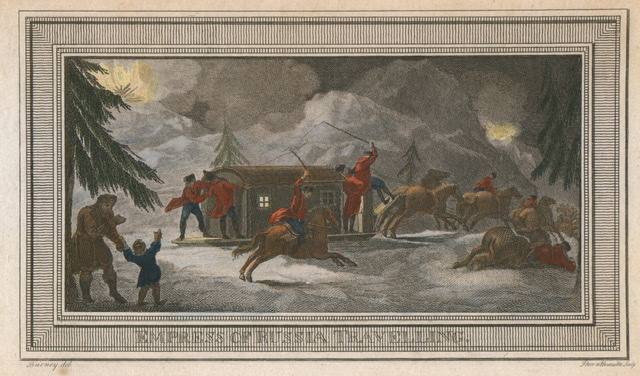
Catherine the Great traveling in the Caucuses.
I chose to read this book because I'd just read Mikhail Lermontov's A Hero of Our Time which pointed me towards Pushkin. Now this book, plus Pushkin's Tales of Belkin and Other Prose Writings, which I've since read, has filled me in perfectly on some of the history behind the geography which had fascinated me while reading about Lermontov's narrator's travels in the Caucasus. Perfect.
In the same tale, a female character makes very good use of the only ammunition she possesses: her ability to recount a story.
Yes, the Captain's daughter, of the story of the same name, succeeds in telling her version of the 1775 Pugachev rebellion to the empress regent, Catherine the Great, with such powerful effect that she succeeds in clearing the name of someone very dear to her.
Alexander Pushkin is very good at telling stories too. In the first story of the collection, he chooses to recount his version of the life of someone dear to him: his maternal great-grandfather Ibrahim Gannibal. Ibrahim was a page who had been gifted to Peter the Great by the Ottoman Sultan, having originally been kidnapped from his home in Central Africa in the early 1700s.
Pushkin fictionalises the story but retains enough elements for us to get a clear grasp of the life his great-grandfather led in the Russian court until he married Pushkin's great-grandmother by order of Peter the Great. The story is unfinished, as is another in the collection, but that didn't bother me at all because Ibrahim's story contains many interesting details regarding life in Russia at that time, or at least the life of the nobility and their servants.
That story also presents an interesting portrait of Peter the Great. We hear how he imposed Western habits and styles on the nobility, forcing the men to shave off their beards, eventually taxing those who refused. We see him visiting the docks in St Petersburg which were built during his reign, and overseeing the shipbuilding works, another passion of his connected to his ambitions to acquire more sea coast for his empire. Under his reign, Russian territory increased as far as the Black Sea. Under the reign of Catherine the Great, in the second half of the eighteenth century, the territory was further extended towards the Caspian Sea and across the Caucasus mountains towards Persian and Ottoman territories.
Catherine the Great traveling in the Caucuses.
I chose to read this book because I'd just read Mikhail Lermontov's A Hero of Our Time which pointed me towards Pushkin. Now this book, plus Pushkin's Tales of Belkin and Other Prose Writings, which I've since read, has filled me in perfectly on some of the history behind the geography which had fascinated me while reading about Lermontov's narrator's travels in the Caucasus. Perfect.

Read
May 12, 2024Imaginative. Fun to read.

March 4, 2014
FATA CĂPITANULUI
Cred că, din tot ce-am citit de Puşkin, romanul acesta este singurul care m-a făcut să reflectez asupra obârşiei emoţionale, stereotipice, a poporului rus (citisem mai întâi Puşkin, iar ulterior Dostoievski). Şi, după cele descrise în "Fata căpitanului", constat cu melancoliei că numai unui popor ca cel rus i-ar fi priit socialismul leninist. Şi nu e o anticipare de două secole (Puşkin scriind opera în secolul XVIII, iar Revoluţia Bolşevică având loc în 1917), e pur şi simplu poporul rus. E drumul lui.
Simplul cadru rusesc conferă întreaga magie a scrierii, căci stepa rusă nu e alcătuită din roci şi plante ierboase, ci din melancolie...
Libertatea rusă, libertinajul social al ruşilor, răscoala lui Emilian Pugaciov şi absolutismul monarhic în contrast cu o idilă romanţată. Şi este de departe cea mai bună proză a lui Puşkin.
Cred că, din tot ce-am citit de Puşkin, romanul acesta este singurul care m-a făcut să reflectez asupra obârşiei emoţionale, stereotipice, a poporului rus (citisem mai întâi Puşkin, iar ulterior Dostoievski). Şi, după cele descrise în "Fata căpitanului", constat cu melancoliei că numai unui popor ca cel rus i-ar fi priit socialismul leninist. Şi nu e o anticipare de două secole (Puşkin scriind opera în secolul XVIII, iar Revoluţia Bolşevică având loc în 1917), e pur şi simplu poporul rus. E drumul lui.
Simplul cadru rusesc conferă întreaga magie a scrierii, căci stepa rusă nu e alcătuită din roci şi plante ierboase, ci din melancolie...
Libertatea rusă, libertinajul social al ruşilor, răscoala lui Emilian Pugaciov şi absolutismul monarhic în contrast cu o idilă romanţată. Şi este de departe cea mai bună proză a lui Puşkin.

February 3, 2018
1.Tales of the Late Ivan Petrovich Belkin.
Funny and interesting stories. 4 stars.
2. The Queen of Spades.
A short story with a twist at the end. The secret of a winning 3 card game and a man who wants to know it at all costs.
I would rate this 3.5 stars.
3. The Captain's Daughter.
I thought this story started a little slow but then it really picked up. By far the best of the stories and a definite 5 star.
4. Peter the Great's Blackamoor.
Pushkin wanted to write an historical novel along the lines of Waverley by Sir Walter Scott. The result was the above story; using his ancestor, Ibrahim, as the main character. Peter the Great was the godfather of Ibrahim and had him educated in the European fashion. He went on to a great military career. Pushkin never completed the novel which is a pity as it had potential.
I would give this story 4 stars
Funny and interesting stories. 4 stars.
2. The Queen of Spades.
A short story with a twist at the end. The secret of a winning 3 card game and a man who wants to know it at all costs.
I would rate this 3.5 stars.
3. The Captain's Daughter.
I thought this story started a little slow but then it really picked up. By far the best of the stories and a definite 5 star.
4. Peter the Great's Blackamoor.
Pushkin wanted to write an historical novel along the lines of Waverley by Sir Walter Scott. The result was the above story; using his ancestor, Ibrahim, as the main character. Peter the Great was the godfather of Ibrahim and had him educated in the European fashion. He went on to a great military career. Pushkin never completed the novel which is a pity as it had potential.
I would give this story 4 stars

September 23, 2008
Timeless and accessible writing. I thoroughly appreciated Pushkin`s stories infused with seeds of historical trivia and perspective. I also enjoyed his use of humor and irony to mock comedic, sentimental, or ironic writing. As was I impressed with his successful addresses to the audience... in fact, he pulls off many things I`m traditionally not a fan of ... kudos! An aside, the translation is brilliant... it`s hard to seperate authors really, but amazing word choices and phrasing.
July 18, 2026
Si dice fosse il libro preferito di Dostoevskij ed in effetti leggendo questi tre brevi racconti non si può non restare sorpresi dalla "modernità" di Puskin.
Le storie di un fabbricante di bare, di un padre affettuoso che vive nel mito del figliol prodigo e quella di un giovane squattrinato ambizioso e privo di scrupoli, mischiano continuamente vari registri e stili letterari quasi fossero le parole, un gioco, un virtuosismo di poesia dello scrittore che le padroneggia e le rende cangianti in ogni momento.
Racconti che da uno stile leggero e quasi comico si fanno gotici ed angosciosi, a tratti quasi barocchi in pochissime pagine: davvero ha senso definire Puskin il "capostipite della letteratura russa" come mi è capitato di leggere e come ci si trova a pensare leggendo questo breve libro.
Buffo pensare ad un libro scritto da uno scrittore leggendario e così apprezzato da un altra leggenda.
Le storie di un fabbricante di bare, di un padre affettuoso che vive nel mito del figliol prodigo e quella di un giovane squattrinato ambizioso e privo di scrupoli, mischiano continuamente vari registri e stili letterari quasi fossero le parole, un gioco, un virtuosismo di poesia dello scrittore che le padroneggia e le rende cangianti in ogni momento.
Racconti che da uno stile leggero e quasi comico si fanno gotici ed angosciosi, a tratti quasi barocchi in pochissime pagine: davvero ha senso definire Puskin il "capostipite della letteratura russa" come mi è capitato di leggere e come ci si trova a pensare leggendo questo breve libro.
Buffo pensare ad un libro scritto da uno scrittore leggendario e così apprezzato da un altra leggenda.

September 2, 2012
Tre brevi incantevoli racconti, di cui La dama di picchè è il più famoso. Forse anche il più bello, non saprei fare una graduatoria. Posso dire che il racconto, che narra dell’irrefrenabile ambizione di un giovane con pochi mezzi economici che lo condurrà alla follia, è un perfetto equilibrio di stili, dal romantico al fantastico al gotico, tenuti insieme da una scrittura brillante e da una sottile ironia. Vorrei parlare di uno degli altri due racconti, Il mastro di posta. Mi è piaciuto molto. Quest’uomo semplice, che tiene appesi nella sua dimora i quadretti raffiguranti la storia del figliol prodigo, è padre amorevole di una splendida ragazzina (la cui descrizione, appena maliziosa, ha di certo ispirato Nabokov ) , Dunja, che gli viene strappata da un bell’ussaro dai baffetti neri, in mala fede ospite della sua dimora. Il dolore di questo padre ferito a morte, pronto a supplicare ed umiliarsi per rivedere l’amatissima figlia e riportarla all’ovile come il figliol prodigo nei suoi quadretti, è grande e coinvolge il lettore, ma il punto più bello è il finale in cui i toni cambiano, e la commistione tra immaginazione e realtà si sbilancia a favore della prima, sorprendendoci e lasciandoci meno tristi di quanto prevedibile. L’ampia gamma di emozioni che si attraversano leggendo questo brevissimo racconto lo rende, secondo me, una perla rara.

March 30, 2018
Pushkin never ceases to amaze me with all the twists written in this short prose. There is a reason why Russian writers are one of the most profound type out there and this is exactly how Pushkin captures the Russian spirit: problematic, tormented by ethical questions, with a very-well defined personality. Would definitely recommend it to anyone who wants to dig in a very different perspective on Russian characters.

December 15, 2008
Alexandr Pushkin is a wonderful storyteller. He is insightful and witty...in my opinion Russia's greatest poet (followed closely by Anna Akhmatova).
If you're looking for other stories from Russian authors I would also recommend Gogol, Bulgokov, and the lesser appreciated Turgenev (I loved Fathers and Sons). I mean really you just can't go wrong.
If you're looking for other stories from Russian authors I would also recommend Gogol, Bulgokov, and the lesser appreciated Turgenev (I loved Fathers and Sons). I mean really you just can't go wrong.

November 17, 2017
Μία πολύ ωραία συλλογή τεσσάρων ολοκληρωμένων και μη διηγημάτων του σπουδαίου Ρώσου συγγραφέα.
Στο πρώτο συναντάμε την αρχή μιας ρομαντικής ιστορίας με πρωταγωνιστή τον Αφρικανό προ-παππού του συγγραφέα που μας προϊδεάζει για μία ενδιαφέρουσα συνέχεια αλλά δυστυχώς η συγγραφή του σταματάει πολύ νωρίς για να μπορέσουμε να βγάλουμε κάποιο συμπέρασμα.
Στο δεύτερο έχουμε μία πιο ολοκληρωμένη ιστορία μου θυμίζει κάτι από τα μυθιστορήματα της Ann Radcliffe. Παρά τη συντομία της είναι συναρπαστική και διαβάζεται με πολύ ενδιαφέρον. Είναι κρίμα που δεν ολοκληρώθηκε γιατί νομίζω ότι θα οδηγούσε στη συγγραφή ενός εξαιρετικού μυθιστορήματος.
Το τρίτο διήγημα είναι μία ιστορία μυστηρίου με έντονα μεταφυσικά χαρακτηριστικά που καθηλώνει τον αναγνώστη παρά τη συντομία του.
Η τέταρτη ιστορία είναι και το αποκορύφωμα νομίζω και σίγουρα η πιο ολοκληρωμένη δουλειά που έχουμε που υπάρχει σε αυτή τη συλλογή. Μία συναρπαστική ιστορία που εκτυλίσσεται τον καιρό της εξέγερσης του Πουγκατσιόφ.
Με λίγα λόγια σε αυτή τη συλλογή συναντάμε μερικές από τις καλύτερες ιδέες του Πούσκιν, τέσσερα πειράματα θα έλεγα πάνω στη συγγραφή ιστοριών που σίγουρα είναι αρκετά πετυχημένα κάπως όλες αυτές οι ιστορίες είναι εξαιρετικές παρά το γεγονός ότι οι μισές δεν είναι ολοκληρωμένες.
Στο πρώτο συναντάμε την αρχή μιας ρομαντικής ιστορίας με πρωταγωνιστή τον Αφρικανό προ-παππού του συγγραφέα που μας προϊδεάζει για μία ενδιαφέρουσα συνέχεια αλλά δυστυχώς η συγγραφή του σταματάει πολύ νωρίς για να μπορέσουμε να βγάλουμε κάποιο συμπέρασμα.
Στο δεύτερο έχουμε μία πιο ολοκληρωμένη ιστορία μου θυμίζει κάτι από τα μυθιστορήματα της Ann Radcliffe. Παρά τη συντομία της είναι συναρπαστική και διαβάζεται με πολύ ενδιαφέρον. Είναι κρίμα που δεν ολοκληρώθηκε γιατί νομίζω ότι θα οδηγούσε στη συγγραφή ενός εξαιρετικού μυθιστορήματος.
Το τρίτο διήγημα είναι μία ιστορία μυστηρίου με έντονα μεταφυσικά χαρακτηριστικά που καθηλώνει τον αναγνώστη παρά τη συντομία του.
Η τέταρτη ιστορία είναι και το αποκορύφωμα νομίζω και σίγουρα η πιο ολοκληρωμένη δουλειά που έχουμε που υπάρχει σε αυτή τη συλλογή. Μία συναρπαστική ιστορία που εκτυλίσσεται τον καιρό της εξέγερσης του Πουγκατσιόφ.
Με λίγα λόγια σε αυτή τη συλλογή συναντάμε μερικές από τις καλύτερες ιδέες του Πούσκιν, τέσσερα πειράματα θα έλεγα πάνω στη συγγραφή ιστοριών που σίγουρα είναι αρκετά πετυχημένα κάπως όλες αυτές οι ιστορίες είναι εξαιρετικές παρά το γεγονός ότι οι μισές δεν είναι ολοκληρωμένες.
May 23, 2017
I really enjoyed this collection of 6 short stories by the “father of Russian literature”.

May 18, 2025
Get out your Russian Literature bingo cards. What’s delicious about this book is that you can play Fairy Tale bingo at the same time because that is Pushkin’s narrative mode. Troika, vodka, loyal servant, duel, root Al hounds, snowstorm, peasant, Cossack, serfs. An empress, a regiment, exile in Siberia, a shy young woman, a reckless young man, card playing, rubles lost at card-playing, ANOTHER DUEL! names ending in -ovna. I found exactly what I was looking for in this collection—a writer from the Regency period I had not yet read, engrossing drama, and people keeping warm by sleeping on stoves. Cannot wait to read more Pushkin.

September 22, 2023
Toate povestirile mi-au părut a fi schițe mai mari sau mai mici de cărți cu întinderi ample. Foarte bine detaliate personajele și unele întâmplări, mi-a părut rău că au fost doar scurte povestiri.

January 13, 2025
With the and other stories in the title, I expected this to be a collection of short stories. Instead it is two short stories and two novellas. Though unexpected, I was not disappointed.
The Negro of Peter the Great, also sometimes titled in English as The Moor of Peter the Great. This is about 40 pages in my Kindle edition. The "Negro" is a young man who was the godson of Peter the Great. Pushkin's great grandfather was Abyssinian, and I think this was a tribute to him.
Dubrovsky is an unfinished novel, so ended up being a novella here. It is the story of a smaller landholding being swallowed up by a large landholding. It appeared this takeover was perhaps, not legal, though it went through the courts. Dubrovsky retaliates.
The Queen of Spades is a short story about a young man who has sufficient to meet his needs, but insufficient to gamble. He would like to be like his gambling friends.
The Captain's Daughter also sometimes titled in English as The Daughter of the Commandant. This was the longest of the offerings. It is told in the first person by Piotr Andreivich Griniov, a young man who is sent off to the military to serve his country. It is the time of Catherine the Great and when a band of outlaws is roving the countryside. The outlaws are headed by a man called Pugachev who claims to be Peter III and rightful Tsar. There is a love story folded in, and, thus, The Captain's Daughter.
I don't know how accurate was the translation, but it was quite readable. It made the reading a pleasure rather than a chore. I enjoyed all of the stories/novellas, which I read interspersed with other reading as is my habit with collections. I don't hesitate to recommend any of them, but especially this collection and I'll happily color in a 5th star.
The Negro of Peter the Great, also sometimes titled in English as The Moor of Peter the Great. This is about 40 pages in my Kindle edition. The "Negro" is a young man who was the godson of Peter the Great. Pushkin's great grandfather was Abyssinian, and I think this was a tribute to him.
Dubrovsky is an unfinished novel, so ended up being a novella here. It is the story of a smaller landholding being swallowed up by a large landholding. It appeared this takeover was perhaps, not legal, though it went through the courts. Dubrovsky retaliates.
The Queen of Spades is a short story about a young man who has sufficient to meet his needs, but insufficient to gamble. He would like to be like his gambling friends.
The Captain's Daughter also sometimes titled in English as The Daughter of the Commandant. This was the longest of the offerings. It is told in the first person by Piotr Andreivich Griniov, a young man who is sent off to the military to serve his country. It is the time of Catherine the Great and when a band of outlaws is roving the countryside. The outlaws are headed by a man called Pugachev who claims to be Peter III and rightful Tsar. There is a love story folded in, and, thus, The Captain's Daughter.
I don't know how accurate was the translation, but it was quite readable. It made the reading a pleasure rather than a chore. I enjoyed all of the stories/novellas, which I read interspersed with other reading as is my habit with collections. I don't hesitate to recommend any of them, but especially this collection and I'll happily color in a 5th star.

July 3, 2021
I have been on a Pushkin reading spree; my other review in this project: The Belkin Tales
”The queen of spades”
➜The epigraph summarizes the story well, The Queen of spades is, indeed, a story about hidden greed/avarice.
The main character is a German engineer of the Russian army called Hermann( there is a prejudice in the making of his character, as German people were perceived as cold and calculated) who observes card games but never invests the money in such games, well, not until he learns of a certain countess achieving a fortune with her infallible trick.
He develops a plot of unraveling her secret by seducing her ward Lizavyeta Ivanovna, to let him into the house leading to him threatening an old 87-year-old lady and scaring her to death(quite literally).
He shows no feeling of regret after the act but subconsciously dreams of the old lady revealing to him the trick.
He begins to be haunted by the card numbers in everyone and everything he sees; until the day comes where he chooses to engage in the card game betting all of his money and losing it all in the end by mistakingly choosing the wrong card(of the lady of Spades who holds a resemblance to the recently deceased old lady).
Why did Hermann choose the wrong card is ambiguous. Was it because of his subconscious guilt or because the lady was truly an apparition taking her revenge? Is there a fantastical element in this story or are they all the projections of the mind?
Another common thing in Pushkin’s prose work is that it is put together skilfully. The structure of the stories makes them both accessible and interesting and above all engaging. This story being the perfect example of that.
Personal rating: 5/5
”Peter the Great's Blackamoor”
➜Fun fact about this one, it is loosely based on the story of an actual ancestor of Pushkin, Abram Petrovich Gannibal who was an actual black slave brought at the request of Peter the Great by none other but a Serbian ambassador Sava Vladislavich-Raguzinsky(Raguzium was the name for Dubrovnik). Gannibal gained a nobility status because of his intelligence and hard work and was loved a lot by Peter the Great, that’s where Ibrahim’s character draws inspiration.
This is an unfinished historical novel that follows the main character, Ibrahim, through two contrasting places: Parisian society(mostly showing decadence and immorality; Ibrahim had a love affair with the Parisian married countess) and the Russian court(where Peter the Great makes an engagement for Ibrahim with a Russian boyar’s daughter Natalia).
It’s not a long piece of writing but it shows the status of how hard it was for a black man to fit into white Russian society in the 18th-19th century; even though he deserved his position and was a man of many outstanding qualities.
Personal rating: 3,5/5
Dubrovsky
➜Another unfinished novel, which can parallel the legend of Robin Hudd.
Dubrovsky is a young man of 22-23 years who loses all of his property because of a quarrel his father had with a powerful rich man Troekurov. At that point, Dubrovsky, unsatisfied with the injustice of the world, starts a band of thieves robbing the rich and giving it to the poor.
Of course, the climax of this novel is caused by his love for the daughter of the very man who was the cause of his misfortune.
Personal rating: 4/5
My final thoughts about this collection are that it shows that Pushkin’s skill in prose can parallel his lyrical skill, a sentence I never thought I would say. And if you can choose to read one Pushkin prose work, I highly recommend This collection along with The Belkin tales.
----------------------------------------------------------
One could write a 10page essay about The queen of Spades only. RTC.
”The queen of spades”
”The queen of spades signifies secret malevolence”
➜The epigraph summarizes the story well, The Queen of spades is, indeed, a story about hidden greed/avarice.
The main character is a German engineer of the Russian army called Hermann( there is a prejudice in the making of his character, as German people were perceived as cold and calculated) who observes card games but never invests the money in such games, well, not until he learns of a certain countess achieving a fortune with her infallible trick.
He develops a plot of unraveling her secret by seducing her ward Lizavyeta Ivanovna, to let him into the house leading to him threatening an old 87-year-old lady and scaring her to death(quite literally).
He shows no feeling of regret after the act but subconsciously dreams of the old lady revealing to him the trick.
He begins to be haunted by the card numbers in everyone and everything he sees; until the day comes where he chooses to engage in the card game betting all of his money and losing it all in the end by mistakingly choosing the wrong card(of the lady of Spades who holds a resemblance to the recently deceased old lady).
Why did Hermann choose the wrong card is ambiguous. Was it because of his subconscious guilt or because the lady was truly an apparition taking her revenge? Is there a fantastical element in this story or are they all the projections of the mind?
Another common thing in Pushkin’s prose work is that it is put together skilfully. The structure of the stories makes them both accessible and interesting and above all engaging. This story being the perfect example of that.
Personal rating: 5/5
”Peter the Great's Blackamoor”
➜Fun fact about this one, it is loosely based on the story of an actual ancestor of Pushkin, Abram Petrovich Gannibal who was an actual black slave brought at the request of Peter the Great by none other but a Serbian ambassador Sava Vladislavich-Raguzinsky(Raguzium was the name for Dubrovnik). Gannibal gained a nobility status because of his intelligence and hard work and was loved a lot by Peter the Great, that’s where Ibrahim’s character draws inspiration.
This is an unfinished historical novel that follows the main character, Ibrahim, through two contrasting places: Parisian society(mostly showing decadence and immorality; Ibrahim had a love affair with the Parisian married countess) and the Russian court(where Peter the Great makes an engagement for Ibrahim with a Russian boyar’s daughter Natalia).
It’s not a long piece of writing but it shows the status of how hard it was for a black man to fit into white Russian society in the 18th-19th century; even though he deserved his position and was a man of many outstanding qualities.
Personal rating: 3,5/5
Dubrovsky
➜Another unfinished novel, which can parallel the legend of Robin Hudd.
Dubrovsky is a young man of 22-23 years who loses all of his property because of a quarrel his father had with a powerful rich man Troekurov. At that point, Dubrovsky, unsatisfied with the injustice of the world, starts a band of thieves robbing the rich and giving it to the poor.
Of course, the climax of this novel is caused by his love for the daughter of the very man who was the cause of his misfortune.
Personal rating: 4/5
My final thoughts about this collection are that it shows that Pushkin’s skill in prose can parallel his lyrical skill, a sentence I never thought I would say. And if you can choose to read one Pushkin prose work, I highly recommend This collection along with The Belkin tales.
----------------------------------------------------------
One could write a 10page essay about The queen of Spades only. RTC.

June 13, 2015
[3.5] Pushkin from Pushkin Press. (This is at once amusing symmetry, and a little too on-the-nose. First time I've read him. This collection is mostly poetry.) Translation by Anthony Briggs, whose War & Peace I'd have read if it were available as an ebook two years ago; glad to read more of his at last.
'The Queen of Spades'; 'The Stationmaster':
More than cosy enough in the way perfectly characteristic of C19th classics. (A paper book of these, read after nightfall, beside a fire, teeters on the brink between perfect and cloying.) Marginally darker ends than British Victorians - perhaps the Russian sting is reminiscent of someone later like Saki or M.R. James, but it's too long since I've read them. Less harshly realist than l.C19th Scandinavians, and very much in a pretty world of the upper classes, where everything turns out fairytale-alright for a lot of people, and toughness and poverty, whilst mentioned, ultimately seem skimmed over - the same again in a somewhat facile poem near the end, 'Winter Evening'. (Easy to forgive in film, less so in books for some reason; perhaps expect greater seriousness of the latter.) Feels like the same world as War & Peace. These stories are so famous it would have been impossible for them to live up to their reputation - another argument for reading classics as a teenager, because you experience them fresh without so much that came after.
At one point in Queen of Spades, someone asks if there even are any Russian novels...
Pimen's Monologue from Boris Godunov:
Nice clean readable translation of blank verse; obviously modern, still atmospheric. Would have liked to read the rest if it were here. Shame there was so much less of this play than of...
Mozart and Salieri:
which was hammy in a way no translator could rescue - in what followed what, and in the basic meanings of what was said. Might have been camply funny if it weren't one of those stories in which I've minimal interest as fiction as opposed to carefully researched biography pointing out what we just can't know. Also lacks the attraction of reading a Russian write about Russian history as in Boris Godunov.
'The Bronze Horseman'
Easy to imagine reading this aloud as a kid. Small epic of St Petersburg, its flooding and one young working class chap's story. Nice tidy rhymed translation with ample enjambments. Very 4-stars. Again, the surprise of its being darker than English equivalents of this sort of thing.
'Tsar Nikita and His Forty Daughters'
Very silly smutty fairytale, translated in a very silly jaunty rhymed style whose name I should probably know (or used to). I like it when he manages to make extra puns [probably] peculiar to English.
pointlessly short Extract from Yevgeny Onegin
I stumble around under the impression that there is no satisfactory English translation of Onegin: no wonder, given that my GR friends give the thing an average rating of 3.14 - against a general average of 4.06. (I like people who are fussy about translations. Though if I do try it, and not in an old, free version, it'll be the Stanley Mitchell translation - praised in an Amazon review by Russian translator Robert Chandler, who also recommended an edition of Crime and Punishment that I loved.) Little to say about this extract, except it gives the impression that the poem contains different moods and rhythms within a few pages of one another, and as a fragment of an obviously much bigger story it's too short to have much opinion about other than via close reading and dissection.
Various short poems:
General tendency for these to open promisingly, then I would be disappointed by the ending. I did enjoy (and these are very typical subjects for me to like, and typical Romantic-era subjects): some bits about autumn and winter, a few of the more florid love verses, miscellaneous intimations of mortality, a working-class setting with more attention to the people's lives (in 'Man Found Drowned', though again an anticlimatic conclusion).
I'm a bit morbid compared with most other non-Goths these days, finding it a philosophical and picturesque way to live with ropey health; interesting to see how Pushkin (writing in his thirties) takes it that bit further, in a time when one saw far more younger people and contemporaries die. (He died at 37, but in a duel, not from consumption or the like.)
Some of 'When I Stroll Down a Busy Street' is familiar:
I tell myself: the world keeps turning.
However many of us are here,
or
A lone oak tree attracts my gaze.
I think: this patriarch sublime
Will long outlive these empty days,
As it outlived my father’s time...
or
I think: farewell, I’ve had my day.
You take my place, I’m reconciled —
Yours is to thrive, mine to decay.
But he is far more (to me strangely) specific; the era, presumably, means he sees far greater probability an imminence, and thinks of things I felt no need to:
I always say goodbye in thought
Each day, each year, and try to guess
Which day in which year will have brought
The anniversary of my death.
It is strange to read that knowing it, nearly two hundred years later; one gets the impression from the final 'I Have My Monument', that he suspected people still would.
'Autumn (a fragment)' I commend to those friends who also like autumn and winter best:
Springtime I can’t abide, With all that smelly, thawing slush. Thank you. I can't stand spring either - bright and cold at the same time, no thanks - and suspect it would be even worse in Russia. Summer though, if comfortably warm enough to spend outside, and it's possible to spend it outside (and otherwise to sleep long enough in the dark), I love, but indoor days in summer, urgh apart from lack of heating bills.
In autumn every year I come into full flower.
The thrilling Russian cold inspires me through and through.
I love my life again each day and every hour.
My appetite returns on time, and sleep does, too.
My blood is up, my glad heart surges with new power.
Desire and joy are mine, I’m young, the world is new,
Fresh life wells up in me… Such is my constitution.
(If you’ll forgive such a prosaical intrusion.)
'The Queen of Spades'; 'The Stationmaster':
More than cosy enough in the way perfectly characteristic of C19th classics. (A paper book of these, read after nightfall, beside a fire, teeters on the brink between perfect and cloying.) Marginally darker ends than British Victorians - perhaps the Russian sting is reminiscent of someone later like Saki or M.R. James, but it's too long since I've read them. Less harshly realist than l.C19th Scandinavians, and very much in a pretty world of the upper classes, where everything turns out fairytale-alright for a lot of people, and toughness and poverty, whilst mentioned, ultimately seem skimmed over - the same again in a somewhat facile poem near the end, 'Winter Evening'. (Easy to forgive in film, less so in books for some reason; perhaps expect greater seriousness of the latter.) Feels like the same world as War & Peace. These stories are so famous it would have been impossible for them to live up to their reputation - another argument for reading classics as a teenager, because you experience them fresh without so much that came after.
At one point in Queen of Spades, someone asks if there even are any Russian novels...
Pimen's Monologue from Boris Godunov:
Nice clean readable translation of blank verse; obviously modern, still atmospheric. Would have liked to read the rest if it were here. Shame there was so much less of this play than of...
Mozart and Salieri:
which was hammy in a way no translator could rescue - in what followed what, and in the basic meanings of what was said. Might have been camply funny if it weren't one of those stories in which I've minimal interest as fiction as opposed to carefully researched biography pointing out what we just can't know. Also lacks the attraction of reading a Russian write about Russian history as in Boris Godunov.
'The Bronze Horseman'
Easy to imagine reading this aloud as a kid. Small epic of St Petersburg, its flooding and one young working class chap's story. Nice tidy rhymed translation with ample enjambments. Very 4-stars. Again, the surprise of its being darker than English equivalents of this sort of thing.
'Tsar Nikita and His Forty Daughters'
Very silly smutty fairytale, translated in a very silly jaunty rhymed style whose name I should probably know (or used to). I like it when he manages to make extra puns [probably] peculiar to English.
pointlessly short Extract from Yevgeny Onegin
I stumble around under the impression that there is no satisfactory English translation of Onegin: no wonder, given that my GR friends give the thing an average rating of 3.14 - against a general average of 4.06. (I like people who are fussy about translations. Though if I do try it, and not in an old, free version, it'll be the Stanley Mitchell translation - praised in an Amazon review by Russian translator Robert Chandler, who also recommended an edition of Crime and Punishment that I loved.) Little to say about this extract, except it gives the impression that the poem contains different moods and rhythms within a few pages of one another, and as a fragment of an obviously much bigger story it's too short to have much opinion about other than via close reading and dissection.
Various short poems:
General tendency for these to open promisingly, then I would be disappointed by the ending. I did enjoy (and these are very typical subjects for me to like, and typical Romantic-era subjects): some bits about autumn and winter, a few of the more florid love verses, miscellaneous intimations of mortality, a working-class setting with more attention to the people's lives (in 'Man Found Drowned', though again an anticlimatic conclusion).
I'm a bit morbid compared with most other non-Goths these days, finding it a philosophical and picturesque way to live with ropey health; interesting to see how Pushkin (writing in his thirties) takes it that bit further, in a time when one saw far more younger people and contemporaries die. (He died at 37, but in a duel, not from consumption or the like.)
Some of 'When I Stroll Down a Busy Street' is familiar:
I tell myself: the world keeps turning.
However many of us are here,
or
A lone oak tree attracts my gaze.
I think: this patriarch sublime
Will long outlive these empty days,
As it outlived my father’s time...
or
I think: farewell, I’ve had my day.
You take my place, I’m reconciled —
Yours is to thrive, mine to decay.
But he is far more (to me strangely) specific; the era, presumably, means he sees far greater probability an imminence, and thinks of things I felt no need to:
I always say goodbye in thought
Each day, each year, and try to guess
Which day in which year will have brought
The anniversary of my death.
It is strange to read that knowing it, nearly two hundred years later; one gets the impression from the final 'I Have My Monument', that he suspected people still would.
'Autumn (a fragment)' I commend to those friends who also like autumn and winter best:
Springtime I can’t abide, With all that smelly, thawing slush. Thank you. I can't stand spring either - bright and cold at the same time, no thanks - and suspect it would be even worse in Russia. Summer though, if comfortably warm enough to spend outside, and it's possible to spend it outside (and otherwise to sleep long enough in the dark), I love, but indoor days in summer, urgh apart from lack of heating bills.
In autumn every year I come into full flower.
The thrilling Russian cold inspires me through and through.
I love my life again each day and every hour.
My appetite returns on time, and sleep does, too.
My blood is up, my glad heart surges with new power.
Desire and joy are mine, I’m young, the world is new,
Fresh life wells up in me… Such is my constitution.
(If you’ll forgive such a prosaical intrusion.)

April 17, 2021
C’ÉTAIT TROP BIEN !!!!
Je savais pas à quoi m’attendre mais je n’ai pas du tout été déçue. C’était une super nouvelle dont j’ai adoré l’intrigue et surtout, ses retournements de situation.
La dame de Pique est mon premier opus de littérature russe qui me donne pas envie de me jeter du balcon, je pense que Alexandre Pouchkine et moi on va bien s’entendre.
Je savais pas à quoi m’attendre mais je n’ai pas du tout été déçue. C’était une super nouvelle dont j’ai adoré l’intrigue et surtout, ses retournements de situation.
La dame de Pique est mon premier opus de littérature russe qui me donne pas envie de me jeter du balcon, je pense que Alexandre Pouchkine et moi on va bien s’entendre.
February 18, 2025
Les récits de feu Ivan Petrovitch Bielkine sont d'excellentes nouvelles prenantes à la fin surprenante, La dame de pique est également une très bonne nouvelle mais que dire de Doubrovski, c'a été une excellente lecture assez courte mais où on retrouve quand même tout ce qui fait une très belle œuvre russe.

October 20, 2025
Enjoyable at times. That's fulsome praise for Russian short stories.
Want to Read
June 2, 2024Contains the stories:
The Tales of the Late Ivan Petrovich Belkin
The Shot -
The Snowstorm -
The Undertaker -
The Stationmaster -
The Lady Peasant -
The Queen of Spades - 4/5 - Beware of the Queen of Spades!
The Captain's Daughter -
Peter the Great's Blackamoor -
The Tales of the Late Ivan Petrovich Belkin
The Shot -
The Snowstorm -
The Undertaker -
The Stationmaster -
The Lady Peasant -
The Queen of Spades - 4/5 - Beware of the Queen of Spades!
The Captain's Daughter -
Peter the Great's Blackamoor -
June 21, 2018
When I was young, handsome, famous and rich and had a half crazed belief in my good luck, I lost a fortune in Monte Carlo on roulette and so I can see with the authority of an expensive experience that there is no better piece of fiction to cure you of the habit of gambling than The Queen of Spades.
The Queen of Spades is another Pushkin’s masterpieces in which in which a conservative German officer who says that he said he doesn't gamble because he has no means to sacrifice the necessary for the luxurious, but then he thinks he has learnt the secret of winning at gambling, which eventually drives him insane.
The best thing to read if you have a gambling habit is still read Pushin’s great story at least once every other year. It will make you wiser and save you from bankruptcy.
The Queen of Spades is another Pushkin’s masterpieces in which in which a conservative German officer who says that he said he doesn't gamble because he has no means to sacrifice the necessary for the luxurious, but then he thinks he has learnt the secret of winning at gambling, which eventually drives him insane.
The best thing to read if you have a gambling habit is still read Pushin’s great story at least once every other year. It will make you wiser and save you from bankruptcy.

February 22, 2011
I've lately developed quite an interest in the fabulous Russian literature. And Pushkin, well, he's supposedly one of the most fabulous Russians. I've been quite afraid of him - I somehow had an image of monstrous romantic poetry.
How very wrong I was.
Pushkin combines wonderous Russian fairytales, historical fiction and makes it all so interesting that you're feeling as if you were watching an 18th century soap opera. And Dubrovsky. By Jove what a man.
And did I mention that Alexander is a fantastic storyteller? Few manage to tell stories so... enchantingly. Magic.
Next stop - Pushkin's poetry. Here I come.
How very wrong I was.
Pushkin combines wonderous Russian fairytales, historical fiction and makes it all so interesting that you're feeling as if you were watching an 18th century soap opera. And Dubrovsky. By Jove what a man.
And did I mention that Alexander is a fantastic storyteller? Few manage to tell stories so... enchantingly. Magic.
Next stop - Pushkin's poetry. Here I come.

September 11, 2023
2,5/5✨
N-am citit nimic de la autor, însă am avut ceva așteptări pentru că am auzit doar de bine despre lucrările sale. Per total, a fost o lectură ok, însă nu pot să zic că m-a impresionat (așa cum speram).
Ce mi-a plăcut:
- trei nuvele mi-au plăcut foarte mult, iar alte două au fost ok
- am regăsit mai multe tematici interesante
- unele mesaje au fost puternice și foarte bine alese
- au fost și câteva personaje care mi-au intrat la suflet
- am regăsit și un romantism superb la vreo două povestiri
- câteva pasaje scrise tare frumos
- am și râs, am și suspinat câteodată
- că s-a citit ușor de obicei.
Ce nu mi-a plăcut:
- două povestiri m-au exasperat maxim
- multe detalii irelevante; pe aceeași idee, anumite situații nu au adus un plus cărții
- multe personaje au fost insuficient conturate, astfel nereușind să mă atașez de ele
- unele povestiri au fost lungite
- lipsa emoțiilor transmise în majoritatea cărții, având deseori senzația că citesc cursuri de la facultate
- adresările directe către cititor nu mi-au lăsat o impresie bună întotdeauna căci aveam senzația că ni se vorbește de sus
- prima povestire, care este de fapt un roman finalizat (pentru că voiam neapărat să văd ce se alege de personajul principal și, fiind neterminată, m-am simțit păcălită).
În concluzie, chiar dacă nu am avut experiența la care mă așteptam, consider că merită o șansă. În ce mă privește, îmi propun să ajung și la alte titluri ale dânsului pentru a-mi satisface curiozitatea.
Mai jos am lăsat câteva cuvinte despre fiecare povestire. Sunt scrise "la cald", imediat după terminarea fiecăreia. ⤵️
1️⃣ Arapul lui Petru cel Mare (?✨)
N-am înțeles finalul și am căutat mai multe informații. Se pare că e un roman început, dar neterminat, deci nu știu ce notă aș putea să îi ofer.
Mi-a plăcut în mare firea arapului și tare aș fi vrut să aflu ce urma să se aleagă de el. Și celelalte personaje au fost fie interesante, fie amuzante.
Ce am remarcat cel mai tare a fost romantismul autorului, poate și pentru că nu mă așteptam la el. Am colorat astfel câteva pasaje tare frumoase.
Se citește și ușor în mare. Doar numele mi-au dat câteva bătăi de cap, dar în rest a fost totul ok.
2️⃣ Împușcătura (3✨) - Belkin
A fost ok în mare parte, dar parcă voiam mai mult. A început bine și mi-a menținut cât de cât interesul, dar apoi am avut senzația că citesc un curs de la facultate pentru că nu-mi mai transmitea nimic.
Totuși, am găsit câteva pasaje de colorat și s-a citit și ușor, fiind oricum scurtă.
3️⃣ Viscolul (4✨)
Mi-a plăcut în mare povestirea, dar nu pot să zic că e ceva memorabil (nu că mă așteptam să fie, dar ca idee).
Personajele principale au fost conturate destul de slab, dar măcar nu mi-au părut antipatice. Am găsit și câteva fragmente tare faine.
Totuși, nu este o poveste care iese în evidență. Nici finalul nu mi-a plăcut, fiind artificial, forțat de împrejurări.
4️⃣ Dricarul (5✨)
E favorita mea de până acum din pricina umorului negru, care e tare pe sufletul meu.
Aș fi adorat să o văd transformată în roman. Ar fi ieșit ceva superb.
Inițial, părea tristă, ușor depresivă, dar după și-a schimbat direcția foarte frumos. Am și râs puțin, de ce să mint? Și finalul a fost divin.
S-a citit și foarte ușor și a avut și o oarecare muzicalitate.
5️⃣ Căpitanul de poștă (3✨)
Povestirea a fost drăguță, scrisă bine, cu un mesaj puternic, dar cam atât.
Scriitura este destul de formală, nereușind să-mi transmită vreo emoție, oricât de mică ar fi ea.
Nu e nimic din ce n-am mai întâlnit. Nu e nici din cele care vor rămâne cu mine peste timp.
6️⃣ Domnișoara țărăncuță (5✨)
A fost o poveste tare dulce, care m-a făcut să visez la prinți pe cai albi.
Mi-au plăcut super mult personajele principale și pățaniile lor. Super simpatice, au fost acel gen care îți intră în suflet imediat.
Am găsit și câteva fragmente bune de colorat, deci nu am ce să cer mai mult.
7️⃣ Dubrovski (2✨)
Prima parte mi-a menținut interesul în mare parte, dar a doua m-a plictisit foarte tare și abia așteptam să se termine.
Au fost povestite întâmplări care nu au adus un plus lecturii. Au fost și detalii irelevante. Per total, putea fi mult mai scurtă.
Nici de personaje nu prea mi-a păsat. Acțiunea a fost cât de cât ok, dar prea lungită.
Finalul însă a fost imprevizil, ceea ce apreciez.
8️⃣ Dama de pică (3✨)
Nu mă pasionează jocul de cărți, deci pot să zic că nu ne-am potrivit pe subiect și că nici nu mi s-a părut interesant.
Un personaj mi-a plăcut, iar restul mi-au fost indiferente, lăsându-mi impresia că am mai dat de ele deja prin alte lecturi.
Totuși, intriga a fost tare interesantă, la fel și deznodământul. Și atmosfera a fost drăguță. De asemenea, s-a citit și ușor.
9️⃣ Kirdjali (1✨)
Nu mi-a plăcut absolut deloc. Nu m-a atras subiectul, personajul nici atât. Nici povestea în sine nu mi-a trezit vreun interes.
Măcar a fost scurtă și s-a citit și ușor.
🔟 Fata căpitanului (5✨)
Aceasta este ultima povestire din carte, fiind totodată și o mare surpriză. M-a speriat dimensiunea ei și îmi era frică că o să fie plictisitoare, dar nu a fost cazul.
Personajele principale au fost iubibile. Mi-a plăcut mult că am cunoscut și trecutul lor, astfel reușind să mă atașez de ei mult mai ușor.
Și acțiunea în sine a fost bună. Mi-a menținut interesul pe tot parcursul. A avut și suspans, și chiar și un final imprevizibil.
Scrierea a fost simplă în mare parte, dar a mers la fix. Uneori au existat cam multe detalii, dar am trecut peste.
N-am citit nimic de la autor, însă am avut ceva așteptări pentru că am auzit doar de bine despre lucrările sale. Per total, a fost o lectură ok, însă nu pot să zic că m-a impresionat (așa cum speram).
Ce mi-a plăcut:
- trei nuvele mi-au plăcut foarte mult, iar alte două au fost ok
- am regăsit mai multe tematici interesante
- unele mesaje au fost puternice și foarte bine alese
- au fost și câteva personaje care mi-au intrat la suflet
- am regăsit și un romantism superb la vreo două povestiri
- câteva pasaje scrise tare frumos
- am și râs, am și suspinat câteodată
- că s-a citit ușor de obicei.
Ce nu mi-a plăcut:
- două povestiri m-au exasperat maxim
- multe detalii irelevante; pe aceeași idee, anumite situații nu au adus un plus cărții
- multe personaje au fost insuficient conturate, astfel nereușind să mă atașez de ele
- unele povestiri au fost lungite
- lipsa emoțiilor transmise în majoritatea cărții, având deseori senzația că citesc cursuri de la facultate
- adresările directe către cititor nu mi-au lăsat o impresie bună întotdeauna căci aveam senzația că ni se vorbește de sus
- prima povestire, care este de fapt un roman finalizat (pentru că voiam neapărat să văd ce se alege de personajul principal și, fiind neterminată, m-am simțit păcălită).
În concluzie, chiar dacă nu am avut experiența la care mă așteptam, consider că merită o șansă. În ce mă privește, îmi propun să ajung și la alte titluri ale dânsului pentru a-mi satisface curiozitatea.
Mai jos am lăsat câteva cuvinte despre fiecare povestire. Sunt scrise "la cald", imediat după terminarea fiecăreia. ⤵️
1️⃣ Arapul lui Petru cel Mare (?✨)
N-am înțeles finalul și am căutat mai multe informații. Se pare că e un roman început, dar neterminat, deci nu știu ce notă aș putea să îi ofer.
Mi-a plăcut în mare firea arapului și tare aș fi vrut să aflu ce urma să se aleagă de el. Și celelalte personaje au fost fie interesante, fie amuzante.
Ce am remarcat cel mai tare a fost romantismul autorului, poate și pentru că nu mă așteptam la el. Am colorat astfel câteva pasaje tare frumoase.
Se citește și ușor în mare. Doar numele mi-au dat câteva bătăi de cap, dar în rest a fost totul ok.
2️⃣ Împușcătura (3✨) - Belkin
A fost ok în mare parte, dar parcă voiam mai mult. A început bine și mi-a menținut cât de cât interesul, dar apoi am avut senzația că citesc un curs de la facultate pentru că nu-mi mai transmitea nimic.
Totuși, am găsit câteva pasaje de colorat și s-a citit și ușor, fiind oricum scurtă.
3️⃣ Viscolul (4✨)
Mi-a plăcut în mare povestirea, dar nu pot să zic că e ceva memorabil (nu că mă așteptam să fie, dar ca idee).
Personajele principale au fost conturate destul de slab, dar măcar nu mi-au părut antipatice. Am găsit și câteva fragmente tare faine.
Totuși, nu este o poveste care iese în evidență. Nici finalul nu mi-a plăcut, fiind artificial, forțat de împrejurări.
4️⃣ Dricarul (5✨)
E favorita mea de până acum din pricina umorului negru, care e tare pe sufletul meu.
Aș fi adorat să o văd transformată în roman. Ar fi ieșit ceva superb.
Inițial, părea tristă, ușor depresivă, dar după și-a schimbat direcția foarte frumos. Am și râs puțin, de ce să mint? Și finalul a fost divin.
S-a citit și foarte ușor și a avut și o oarecare muzicalitate.
5️⃣ Căpitanul de poștă (3✨)
Povestirea a fost drăguță, scrisă bine, cu un mesaj puternic, dar cam atât.
Scriitura este destul de formală, nereușind să-mi transmită vreo emoție, oricât de mică ar fi ea.
Nu e nimic din ce n-am mai întâlnit. Nu e nici din cele care vor rămâne cu mine peste timp.
6️⃣ Domnișoara țărăncuță (5✨)
A fost o poveste tare dulce, care m-a făcut să visez la prinți pe cai albi.
Mi-au plăcut super mult personajele principale și pățaniile lor. Super simpatice, au fost acel gen care îți intră în suflet imediat.
Am găsit și câteva fragmente bune de colorat, deci nu am ce să cer mai mult.
7️⃣ Dubrovski (2✨)
Prima parte mi-a menținut interesul în mare parte, dar a doua m-a plictisit foarte tare și abia așteptam să se termine.
Au fost povestite întâmplări care nu au adus un plus lecturii. Au fost și detalii irelevante. Per total, putea fi mult mai scurtă.
Nici de personaje nu prea mi-a păsat. Acțiunea a fost cât de cât ok, dar prea lungită.
Finalul însă a fost imprevizil, ceea ce apreciez.
8️⃣ Dama de pică (3✨)
Nu mă pasionează jocul de cărți, deci pot să zic că nu ne-am potrivit pe subiect și că nici nu mi s-a părut interesant.
Un personaj mi-a plăcut, iar restul mi-au fost indiferente, lăsându-mi impresia că am mai dat de ele deja prin alte lecturi.
Totuși, intriga a fost tare interesantă, la fel și deznodământul. Și atmosfera a fost drăguță. De asemenea, s-a citit și ușor.
9️⃣ Kirdjali (1✨)
Nu mi-a plăcut absolut deloc. Nu m-a atras subiectul, personajul nici atât. Nici povestea în sine nu mi-a trezit vreun interes.
Măcar a fost scurtă și s-a citit și ușor.
🔟 Fata căpitanului (5✨)
Aceasta este ultima povestire din carte, fiind totodată și o mare surpriză. M-a speriat dimensiunea ei și îmi era frică că o să fie plictisitoare, dar nu a fost cazul.
Personajele principale au fost iubibile. Mi-a plăcut mult că am cunoscut și trecutul lor, astfel reușind să mă atașez de ei mult mai ușor.
Și acțiunea în sine a fost bună. Mi-a menținut interesul pe tot parcursul. A avut și suspans, și chiar și un final imprevizibil.
Scrierea a fost simplă în mare parte, dar a mers la fix. Uneori au existat cam multe detalii, dar am trecut peste.

March 12, 2026
det är sött med med dygd, blygd och av seden påtvingade uppvaktningslekar i de hära små kärlekssagorna

November 8, 2018
Among Alexander Pushkin's nineteen stories here, only two, The Queen of Spades and Kirdzhali, are complete. The rest are fragments and sketches ranging from the hysterically trivial (What do two impoverished princes of Russia, while ploughing their land, say to each other when they meet among the furrows? "Lord bless you, Prince Antip Kuzmich, how much has your Princely Healthiness ploughed today?" "I thank you, Prince Yerema Avdeyevich..."), to the bizarre (Cleopatra's open invitation to bed and beheading), to the profound (Pushkin's re-imagining of Petronius' last evening alive, where he also flexes his aptitude for verse; two poets' very different sentiments and approaches to their craft). Needless to say, all of them are intriguing and engaging, but also unfinished and unresolved, which left me wanting. Not to mention wondering if secret stairways were de rigueur in Russian manors of that era, and did all their successful balls really end at daybreak? Some stories and characters seemed familiar. Take The Queen of Spades' scalawag Hermann, whom I initially thought otherwise, with his early refusal at cards ("I am not in a position to sacrifice the necessary in the hope of gaining the superfluous."). Hermann could well be the prototype for Dostoyevsky's Raselnikov in Crime and Punishment, but without the overthinking. Apart from Raselnikov-Lite we have Lizaveta Ivanova, whose calling is similar to that of Tolstoy's unhappy Sonya in War and Peace. The drawing room and ballroom scenes, the parlour talk (in French, naturally), Russian patriotism's slow uptake among the aristocracy--these all reminded me of War and Peace. And small wonder, because Tolstoy was in fact a fan of Pushkin's, a detail I'm glad I found out for myself after reading all the stories; I've since learned to avoid reading forewords which mean well, but usually reveal spoilers.
* This is my first book by Pushkin, and among the Russian authors I've read--Tolstoy, Chekhov, Nabokov, Dostoyevsky, Gogol, and Zhivago--I think he's one of the lighter ones. Dostoyevsky certainly, has the bleakest, most existentially-inclined stories, followed by Chekhov, whose byword is melancholy. My favorites, in no particular ranking, are Chekhov, Nabokov, Tolstoy, and now, Pushkin.
* This is my first book by Pushkin, and among the Russian authors I've read--Tolstoy, Chekhov, Nabokov, Dostoyevsky, Gogol, and Zhivago--I think he's one of the lighter ones. Dostoyevsky certainly, has the bleakest, most existentially-inclined stories, followed by Chekhov, whose byword is melancholy. My favorites, in no particular ranking, are Chekhov, Nabokov, Tolstoy, and now, Pushkin.

February 19, 2009
These 6 atmospheric short stories by Russia's Shakespeare, Alexander Pushkin, would not be the works I would judge him by--as I would not judge a master chef by his sandwiches--yet they're wonderful sandwiches. Written in the early 19thC, they're full of twists and turns, domineering old ladies and pious young girls and Hussars, and always end startlingly. Charming.
Note: this is the newsprintish Dover edition, which does not contain the Captain's Daughter, Tales of Belkin etc. I would generally recommend the 1999 Oxford University Press edition. However, I'd bought the boxed set of Dover "Masterpieces of Russian Literature"--7 slim paperback volumes which include the Overcoat, Tolstoy's Kreutzer Sonata, Death of Ivan Illich, How Much Land does a Man Need?, Doestoevsky's Notes from the underground, Gorky's Chelkash, five Chekhov stories, and Turgenev's Fathers and Sons in the Constance Garnett translation. A very nice looking little compendium (though it does have that cheap gray newsprint paper) A great gift to introduce people to Russian literature, the small volumes are very reader friendly.
Note: this is the newsprintish Dover edition, which does not contain the Captain's Daughter, Tales of Belkin etc. I would generally recommend the 1999 Oxford University Press edition. However, I'd bought the boxed set of Dover "Masterpieces of Russian Literature"--7 slim paperback volumes which include the Overcoat, Tolstoy's Kreutzer Sonata, Death of Ivan Illich, How Much Land does a Man Need?, Doestoevsky's Notes from the underground, Gorky's Chelkash, five Chekhov stories, and Turgenev's Fathers and Sons in the Constance Garnett translation. A very nice looking little compendium (though it does have that cheap gray newsprint paper) A great gift to introduce people to Russian literature, the small volumes are very reader friendly.

July 25, 2011
Fantastic stories, although 2 are unfortunately incomplete. Pushkin's writing is so fantastic that I feel like I could actually relate to and immerse myself in 18th century Russia amidst rebels and Robin Hood like figures and land squabbles. The most bizarre thing to me was that there are several references, in various stories to "gingers." I'm naive (and happily so) to things like that, but I totally thought South Park made 'ginger' into a ridiculous taunt to people with beautiful red hair. Evidently, Pushkin was the original Trey & Matt. It's always amazing when you see something that you think is a modern thought reflected in classical literature. Anyway, even if you're fortunate enough to have red hair, I recommend picking up a collection of Pushkin stories. If nothing else, reading about the chill of the wind across Russian steppes will cool you off a bit this hot summer!

August 23, 2014
People who know languages like French or English can scarcely imagine the tools that the inflected slavic languages place in the hands of their poets. Hence reading Pushkin's poetry in translation allows the reader at best to perceive his genius through a glass darkly.
The best means then for a French or English speaker to get to know Pushkin might be to read a collection of Pushkin's stories.
For those of you living near a major metropolitan centre my recommendation would be to take in a performance of Tchaikovsky's Queen of Spades based on the story that gives this volume its title. By the time you add a symphonic score and a solid cast of singers to the story in English supertitles, you begin to feel what it would be like to read this remarkable story in the original Russian.
The best means then for a French or English speaker to get to know Pushkin might be to read a collection of Pushkin's stories.
For those of you living near a major metropolitan centre my recommendation would be to take in a performance of Tchaikovsky's Queen of Spades based on the story that gives this volume its title. By the time you add a symphonic score and a solid cast of singers to the story in English supertitles, you begin to feel what it would be like to read this remarkable story in the original Russian.
Displaying 1 - 30 of 320 reviews