

What do you think?
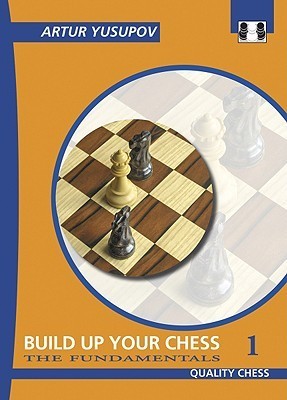
Build up your Chess 1: The Fundamentals
A book for chess players who want to build their skills on solid foundations. Yusupov guides the reader towards a higher level of chess understanding using carefully selected positions and advice. This new understanding is then tested by a series of puzzles.Artur Yusupov was ranked No. 3 in the world from 1986 to 1992, just behind the legendary Karpov and Kasparov. He has won everything there is to win in chess except for the World Championship. In recent years he has mainly worked as a chess trainer with players ranging from current World Champion Anand to local amateurs in Germany, where he resides.
264 pages, Paperback
First published January 1, 2007
Ratings & Reviews
Friends & Following
Create a free account to discover what your friends think of this book!
Community Reviews
Displaying 1 - 7 of 7 reviews
August 8, 2015
This is the exact type of book I wish I had 10 years ago. I might not have "quit" chess for so long, although that may just be wishful thinking.
The "orange" series of three books for The Fundamentals is for 1500 elo or so I believe. My USCF rating is a bit over 1800 and I found this book plenty challenging, although I did get ~85% of all available points throughout, never being in too much danger of failing a chapter.
I definitely don't regret starting with The Fundamentals rather than the next level of books. I have a hard time figuring out what the minimum strength a player should be to go through this. I think at least 1200 USCF, possibly higher if it's a kid as they may just get too frustrated. Someone under 1500 USCF may struggle with the book in places but I don't agree with some reviews I've read that the material is too advanced for for someone under 1500. If they sit down and really spend 2 to 4 hours on each chapter I think they'd get an enormous out of the book as long as they were ok not dominating many chapters.
In fact, I'd imagine up to 2000 USCF could certainly get a decent amount out of this. They certainly wouldn't be able to breeze through every chapter (some of them, perhaps, but certainly not all).
While the grading scale isn't perfect, it provides great motivation and is the #1 reason I enjoyed going through this so much. It's so easy to get lazy when trying to study or skip stuff if it doesn't seem exciting. However, it's great to look forward to each new chapter and try to do well on it.
The "orange" series of three books for The Fundamentals is for 1500 elo or so I believe. My USCF rating is a bit over 1800 and I found this book plenty challenging, although I did get ~85% of all available points throughout, never being in too much danger of failing a chapter.
I definitely don't regret starting with The Fundamentals rather than the next level of books. I have a hard time figuring out what the minimum strength a player should be to go through this. I think at least 1200 USCF, possibly higher if it's a kid as they may just get too frustrated. Someone under 1500 USCF may struggle with the book in places but I don't agree with some reviews I've read that the material is too advanced for for someone under 1500. If they sit down and really spend 2 to 4 hours on each chapter I think they'd get an enormous out of the book as long as they were ok not dominating many chapters.
In fact, I'd imagine up to 2000 USCF could certainly get a decent amount out of this. They certainly wouldn't be able to breeze through every chapter (some of them, perhaps, but certainly not all).
While the grading scale isn't perfect, it provides great motivation and is the #1 reason I enjoyed going through this so much. It's so easy to get lazy when trying to study or skip stuff if it doesn't seem exciting. However, it's great to look forward to each new chapter and try to do well on it.

February 7, 2018
Artur Yusupov is absolutely a genius! His series are made especially for self-training players with great care. I highly recommend this book for players who want to build/review their chess skills on a solid foundation. The book covers various areas of chess: tactics, positional play, strategy, the calculation of variations, the opening and the endgame without putting too much concentration on only one or two areas of them, as many beginners prefer to do. I think it may be useful for players with 1200: 1800 ELO.
March 14, 2021
A great training book that helps you exercise all the different facets of the game. At first I was disappointed that it was so thin, however after going through it I found it was just perfect. It's a set of lessons and after each lesson there is a test to evaluate how much you learned. I specially liked the answers to the questions, they have partial grading and sometimes full games.
This volume focused heavily on tactics/calculation which makes sense as a first book of the series. As a club player (1600-1800) I found it challenging but doable. Definitely some sections were harder for me than others (mate compositions) and I would expect each person can find their strengths by going through the book. It was eye opening to me to learn how much I need to learn on some areas!
Also I was happy that I got the hardback version. It made studying easier so I would recommend doing the same if you can.
This volume focused heavily on tactics/calculation which makes sense as a first book of the series. As a club player (1600-1800) I found it challenging but doable. Definitely some sections were harder for me than others (mate compositions) and I would expect each person can find their strengths by going through the book. It was eye opening to me to learn how much I need to learn on some areas!
Also I was happy that I got the hardback version. It made studying easier so I would recommend doing the same if you can.

November 15, 2020
This is the first book I purchased from the famed Yusupov 9-book training course, with the intention of purchasing potentially the entire course over the long term. The plan is to spend about 3 months per each book, as I am a working adult and don't have the time to spend more than a few hours each week studying chess. I have gone over a quarter of the book so far and while this is a solid training book, there are a few caveats to consider, as per below:
1. Firstly, this is 100% not a beginner's book, unless you are supremely talented, a genius or Beth Harmon when it comes to chess. This isn't even really for most intermediate players who fool around on chess.com or other websites playing casual games. Material in this book would be tough for most intermediates, and some of it would even challenge the more advanced players (my blitz rating on chess.com is top 10%, bullet rating top 20% and my puzzle training rating 2400+).
And remember, this is the first orange book, which is the easiest level in the 9 book course (Orange --> Blue --> Green).
2. Yusupov's books are known for their brevity, concision and precision. Don't expect long, or even of moderate length, verbal explanations. Definitely look elsewhere for that. There are 24 chapters and each chapter focuses on some particular theme (e.g. checkmates in 3, value of pieces, pawn structure, etc.). The chapter is introduced with several examples from actual games (as opposed to artificial composed & unrealistic studies), very brief verbal explanation is provided as to the goals of the exercises, and then a solution is given, along with relevant variations.
The first example or two in any given chapter are fairly easy and straight forward, but increase in difficulty very rapidly. At the end of each chapter, there are 12 exercises ranging from 1-3 stars - corresponding to the difficulty level of the puzzle. You are to consider each example, and your answer must consist of a series of moves (usually 1-3, but sometimes more), including considering the various alternative moves from the opponent. Ideally, you have to figure everything out in your head using a real chessboard or a computer screen, but without moving pieces to aid you (that's how I approach it). And you score 1-3 points on any given puzzle. For example, if the puzzle is denoted by 2 stars, you can receive up to 2 points on it, depending on whether you get all your own moves correct.
3. Finally, and this is the only critical comment upon the book, some exercises don't seem to correspond very well to the theme of the chapter studied. For example, one chapter was about the value of the pieces, i.e. in some positions the relative strength of the rook may be less than that a of a knight or bishop. However, when provided exercise examples, it really was all about tactical vision and calculation, rather than conceptual understanding. One would think that when discussing the value of the pieces, the focus would be geared toward explaining how to secure long term strategic and positional advantages, rather than how to enact a 3-4 move tactical combo that ends in a blow to the opponent.
Considering that I have reviewed only 6/24 chapters, maybe I am wrong about the rest of the book. If so, I will update my review and increase my rating to 5 stars.
Finally, you should take 1-2 hours studying each chapter (inclusive of doing the exercises) to really obtain some useful knowledge from the book. If you just skim it, and don't consider variations, then it will be fruitless and a waste of time.
Highly recommended.
1. Firstly, this is 100% not a beginner's book, unless you are supremely talented, a genius or Beth Harmon when it comes to chess. This isn't even really for most intermediate players who fool around on chess.com or other websites playing casual games. Material in this book would be tough for most intermediates, and some of it would even challenge the more advanced players (my blitz rating on chess.com is top 10%, bullet rating top 20% and my puzzle training rating 2400+).
And remember, this is the first orange book, which is the easiest level in the 9 book course (Orange --> Blue --> Green).
2. Yusupov's books are known for their brevity, concision and precision. Don't expect long, or even of moderate length, verbal explanations. Definitely look elsewhere for that. There are 24 chapters and each chapter focuses on some particular theme (e.g. checkmates in 3, value of pieces, pawn structure, etc.). The chapter is introduced with several examples from actual games (as opposed to artificial composed & unrealistic studies), very brief verbal explanation is provided as to the goals of the exercises, and then a solution is given, along with relevant variations.
The first example or two in any given chapter are fairly easy and straight forward, but increase in difficulty very rapidly. At the end of each chapter, there are 12 exercises ranging from 1-3 stars - corresponding to the difficulty level of the puzzle. You are to consider each example, and your answer must consist of a series of moves (usually 1-3, but sometimes more), including considering the various alternative moves from the opponent. Ideally, you have to figure everything out in your head using a real chessboard or a computer screen, but without moving pieces to aid you (that's how I approach it). And you score 1-3 points on any given puzzle. For example, if the puzzle is denoted by 2 stars, you can receive up to 2 points on it, depending on whether you get all your own moves correct.
3. Finally, and this is the only critical comment upon the book, some exercises don't seem to correspond very well to the theme of the chapter studied. For example, one chapter was about the value of the pieces, i.e. in some positions the relative strength of the rook may be less than that a of a knight or bishop. However, when provided exercise examples, it really was all about tactical vision and calculation, rather than conceptual understanding. One would think that when discussing the value of the pieces, the focus would be geared toward explaining how to secure long term strategic and positional advantages, rather than how to enact a 3-4 move tactical combo that ends in a blow to the opponent.
Considering that I have reviewed only 6/24 chapters, maybe I am wrong about the rest of the book. If so, I will update my review and increase my rating to 5 stars.
Finally, you should take 1-2 hours studying each chapter (inclusive of doing the exercises) to really obtain some useful knowledge from the book. If you just skim it, and don't consider variations, then it will be fruitless and a waste of time.
Highly recommended.

January 27, 2022
Good:
* Forces the readers to work hard and hopefully they become better because of it.
* Plenty of exercises to make sure that the presented lessons are understood.
Bad:
* Extremely difficult to go through.
* Some questions have mistakes or missing variations (one is missing an alternate checkmate with equal number of moves, at least a couple only give points if the opponent play weaker variation, etc).
* Forces the readers to work hard and hopefully they become better because of it.
* Plenty of exercises to make sure that the presented lessons are understood.
Bad:
* Extremely difficult to go through.
* Some questions have mistakes or missing variations (one is missing an alternate checkmate with equal number of moves, at least a couple only give points if the opponent play weaker variation, etc).
Read
February 17, 2018bravo
This entire review has been hidden because of spoilers.
April 9, 2021
Very instructive book.
Displaying 1 - 7 of 7 reviews