Jump to ratings and reviews
Rate this book

Inspector Ghote #1

The Perfect Murder

Rate this book
It is just Inspector Ghote's luck to be landed with the case of the Perfect Murder at the start of his career with the Bombay Police. For this most baffling of crimes there is the cunning and important tycoon Lala Varde to contend with. And if this were not enough, Ghote finds himself having to investigate the mysertious theft of one rupee from the desk of yet another Very Important Person—the Minister of Police Affairs and the Arts. "If people would only behave in a simple, reasonable, logical way, " sighs the inspector as he struggles through the quagmires of incompentence and corruption to solve these curious crimes.

256 pages, Paperback

First published January 1, 1964

29 people are currently reading
797 people want to read

About the author

H.R.F. Keating

157 books54 followers
Henry Reymond Fitzwalter Keating was an English writer of crime fiction most notable for his series of novels featuring Inspector Ghote of the Bombay CID.

H. R. F. KEATING was well versed in the worlds of crime, fiction and nonfiction. He was the crime books reviewer for The Times for fifteen years, as well as serving as the chairman of the Crime Writers Association and the Society of Authors. He won the CWA Gold Dagger Award twice, and in 1996 was awarded the CWA Cartier Diamond Dagger for outstanding service to crime fiction.

Series:
. Inspector Ghote
. Harriet Martens

Series contributed to:
. Malice Domestic
. Perfectly Criminal

Ratings & Reviews

What do you think?
Rate this book

Friends & Following

Create a free account to discover what your friends think of this book!

Community Reviews

5 stars
299 (23%)
4 stars
436 (34%)
3 stars
304 (24%)
2 stars
149 (11%)
1 star
70 (5%)
Displaying 1 - 30 of 95 reviews
Profile Image for Майя Ставитская.
2,282 reviews232 followers
July 23, 2022
The fashion for "about India" among the broad reading masses began with "Shantaram" - the story of an Australian convict who became his own in the Bombay slums. Then, at the beginning of the tenth, it turned out to be a trigger of interest in the region as a whole: Korea, China, Indonesia, Taiwan, Vietnam - formerly a huge white spot on the literary map of the world, began to open up to reading Russia. Arundati Roy's supernova outbreak with the "God of Little Things".

And since the end of last year, the ice has broken: "The Poppy Sea" by Amitav Ghosh - and everyone saw that it was good, "The Artist from Jaipur" by Joshi (well, this), a detective story about Calcutta 1919 "A Man with a great Future" by Abir Mukherjee is a very worthy thing.

But there was, it turns out, a series of Bombay detectives from the English writer Henry Kitting, about Inspector Ganesh Gotha, which he started already in 1964. Atmospheric, authentic and generally not devoid of entertainment, Ronan Keating was awarded the "Golden Dagger" - the main English detective award, and Skarsgard played in the film adaptation.

Неидеальное Совершенство
Ему следовало ожидать чего-то подобного в этой несовершенной стране: столкнуться с несовершенным убийством.
Индия в долгоиграющем тренде, которому десять лет назад положил начало "Шантарам". То есть, Рабиндранат Тагор был всегда, но кто его читал, кроме специалистов да горстки ударенных всей головой о "Хинди-Руси-бхай-бхай"?

Еще в начале восьмидесятых, Салман Рушди ворвался в мировую литературу с Букером букеров "Детьми полуночи". Но то было открытием скорее для Европы и Америки. В Советском Союзе Рушди с его изысканной прозой не прозвучал сколько-нибудь внятно, а большинство читателей так прямо уверено было, что он пишет стихи (ну те самые, вы понимаете).

Мода на "об Индии" среди широких читающих масс началась с "Шантарама" - истории австралийского зека, ставшего своим в бомбейских трущобах. Тогда, в начале десятых, это оказалось триггером интереса к региону в целом. Корея, Китай, Индонезия, Тайвань, Вьетнам, прежде бывшие огромным белым пятном на литературной карте мира, начали раскрываться читающей России. Из Индии только вспыхнула сверхновой Арундати Рой с "Богом мелочей" .

А с конца прошлого года лед тронулся: "Маковое море" Амитава Гоша - и увидели все, что это хорошо, "Художницe из Джайпура" Джоши (ну, такое), детектив про Калькутту 1919 "Человек с большим будущим" от Абира Мукерджи весьма достойная вещь.

Но была, оказывается серия бомбейских детективов от английского писателя Генри Киттинга, об инспекторе Ганеше Готе, начатая им аж в 1964 году. В герое этого цикла что-то от Эркюля Пуаро Кристи и довольно много от нашего Путилина в описании Леонида Юзефовича. Он честно служит, отдает всего себя работе, не теряя самоуважения и не поддаваясь соблазнам расследует преступления сильных мира сего, терпит недовольство супруги его чрезмерной любовью к работе, пытается урывками воспитывать сына

"Идеальное убийство" стало первой в ряду двадцати шести книг о Готе, последняя из которых написана в 2009, незадолго до смерти автора. За него Киттинг удостоился "Золотого кинжала" - главной английской детективной премии. Действие происходит в Бомбее начала шестидесятых.

Прошло немного времени после обретения независимости, общественные отношения еще сильно следуют по колониальной колее: англомания сильных мира сего в соединении едва не с презрением к индийцам, работающим в полиции, крайняя степень коррумпированности во всех сферах, мощный национальный колорит, который пробивается сквозь усвоенную европейскость - все это придает дополнительный интерес, помимо основной интриги.

Основная же в том, что в доме могущественного и обладающего связями в высших эшелонах власти бизнесмена господина Варда произошло нападение на его секретаря, пожилого парса по фамилии Пефект. Собственно, в названии The Perfect Murder обыгрывается имя жертвы. Убийства-то, кстати, и не случилось - после удара по голове Пефект в коме. Но дело громкое - в доме такого большого человека!

Инспектор Готе получает задание разобраться. В помощь ему (а скорее, чтобы путаться под ногами и мешать) придан наблюдатель от ЮНЕСКО швед Аксель Свенсон (в экранизации 1998 года его сыграл Скарсгард).. Все очень атмосферно, аутентично и в целом не лишено занятности, я читала в переводе Ирины Шапиро, надеюсь, что книга будет издана.
Profile Image for 3 no 7.
751 reviews24 followers
April 20, 2022
I listened to "The Perfect Murder" as an audio book. It was an "easy" listen, and the narration gave authenticity to the time and place. Inspector Ghote is starting his career with the Bombay Police and is assigned to investigate the mysterious theft of one rupee from the desk of the Minister of Police Affairs and the Arts. He finds incompetency everywhere which makes for a very enjoyable audio book. This is the first book in the series.

Profile Image for Supratim.
309 reviews460 followers
May 25, 2022
Had read a short story featuring Inspector Ghote a long time back. So when I came across this novel - the enticing title and the fact that this was the first book in the series were too much for me to resist. Had a lot of expectations, but somewhere felt let down.

Full review to come. Not sure when!!! :)
Profile Image for Alan (on December semi-hiatus) Teder.
2,706 reviews250 followers
November 30, 2022
A Peculiar Case
Review of the Penguin Classics Kindle eBook edition (2011) of the original Collins Crime Club hardcover The Perfect Murder (1964)
It was called the Perfect Murder right from the start. First the Bombay papers plastered it all the way across their pages. And then it was taken up by papers all over India.
The Perfect Murder: Police at House.
The Perfect Murder: New Police Moves.
The Perfect Murder: Police Baffled.
- opening sentences of "A Perfect Murder".
Somehow I missed reading HRF Keating's Inspector Ghote novels (1964-2009) when they were first released, but came across them only recently. This first book left a very odd impression and is surprising as a debut for a series that went on to 26 books. The lead Inspector Ghote is portrayed here as a rather naive detective who is belittled by his superiors in the Bombay (then the name of present day Mumbai) Police and its related government ministry and also henpecked at home by his shrewish wife. Together with his sidekick/Watson Axel Svensson (a Swedish criminologist sent to India to study international policing) they stumble towards an eventual solution.

The book feels like a bait and switch right off the bat as the so-called "Perfect Murder" is revealed to be a non-fatal assault on a Mr. Perfect, the secretary of a rich man named Mr. Arun Varde. The initial outrage announcing a "murder" from the household has been broadcast further by the scurrilous press and is the basis for a running joke throughout. The farce continues when Ghote and Svensson arrive to investigate and are met with denials and obstruction by everyone in the household, except for the secretary who is still unconscious and unable to be interviewed. It is all dragged out to book length with one fruitless interview after another with a diversion to another case involving the supposed theft of a single rupee note from the office of the Minister in charge of the Police.


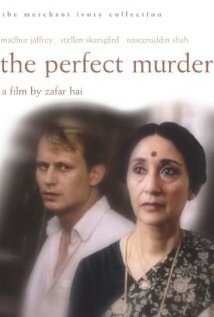
The cover for the DVD release of the 1988 film adaptation of "A Perfect Murder". Actor Naseeruddin Shah as Inspector Ghote doesn't even get on the poster, which instead features Stellan Skarsgård (criminologist Axel Svensson) and Madhur Jaffrey (Mrs. Lai, renamed from the Mrs. Varde in the novel). Image sourced from Wikipedia.

Ghote and Svensson still solve both cases in the end and the reason for the obstruction becomes clear. It is an odd beginning to what apparently was a popular series. I think I will try at least one more to find out if the later books became more standard procedurals. Otherwise this would be cringe reading to have a protagonist who is belittled throughout his own books.

Trivia and Links
The Perfect Murder was adapted as the same-titled England/India film in 1988 directed by Zahar Hai, produced by Merchant Ivory Productions. I haven't watched the whole film, but from the opening scenes it seems to have been adapted as a comedy farce along the lines of the Inspector Clouseau films. You can watch the whole film on YouTube here.

There was a May 2020 announcement that the Inspector Ghote/HRF Keating novels were to be adapted for an Indian TV series. No TV series has yet appeared though. You can read the announcement in Variety here.
Profile Image for Dariko.
45 reviews
November 22, 2012
Very disappointed with this book. There was nothing Indian about the indian inspector Ghote. Read Vish Puri series by Tarquin Hall and you will see the difference.
Profile Image for Bev.
3,268 reviews346 followers
did-not-finish
October 21, 2019
Spoiler Alert! There is NO murder in The Perfect Murder. Sorry about that. But for all of you who might pick this up thinking that this is one of those impossible crimes or that your murder mystery actually has a murder in it, I thought you ought to know. I also think you ought to know that this is (in my opinion) far from the perfect anything--story, crime novel, etc. This is my second outing with Keating writing under his own name* and I have to say that I am beginning to think that he just isn't for me.

But...back to the story. Why, you might ask, is it called "The Perfect Murder" if there's no murder and what we do have going on isn't perfect? Glad you asked. It seems that the secretary of Lala Varde, a prosperous businessman, has been bashed over the head with a candlestick. Lala Varde reported it to the police as a murder--because by his logic someone was trying to murder his secretary, so by golly it's murder. Even if it didn't succeed. The name caught on with the newspapers and such and nobody seems to care that the man really didn't die. The ever-conscientious Inspector Ghote is assigned to the case and is immediately faced with lies, disdain, and corruption.

So...I'll just fess up now and tell you that I did not read every word of this. Not even as much as every other word. Only enough that I decided that I could legitimately count it for a few challenges and I'm shoving this thing off my Mount TBR and sending it back to the library's used book shop where it came from. I skimmed to the end just so I could know what really happened. Kate over at crossexamingingcrime says that Keating is "good at establishing an interesting setting in a culture which readers can identify with but also find difference in." I'm afraid I didn't find this to be the case. I never did settle into the setting that Keating gave us and I certainly didn't warm to the methods of Ghote and the culture surrounding him as represented. And don't even get me started on Lala Varde and his never-ending need to make silly rhymes about everything when talking. No rating because I didn't really read closely enough to hand one out. Others have handed out four and five stars...so your mileage may vary.

*I have also read a couple of his historical mysteries written under the name Evelyn Hervey. I enjoyed those more--handing out three stars.

First posted on my blog My Reader's Block.
This entire review has been hidden because of spoilers.
Profile Image for Linda.
620 reviews34 followers
July 9, 2011
I love these "cute" little books with foreign detectives. They're so light and airy and so different than the typical American detective.

When I read the obituary for H.R.F. Keating back in March, I decided I wanted to read at least one of his Inspector Ghote books. I discovered they're very hard to find outside a library. But I finally got my hands on my own copy of his first Ghote book: The Perfect Murder. Don't get excited. Mr. Perfect hasn't been murdered, but the media and Indian police seem to prefer to call it the Perfect murder rather than the Perfect attack or assault.

Anyway, that's the first indication that this is going to be a well-written, enjoyable detective story. Inspector Ghote, having worked himself up to this position from his starting position as a beat cop, is rather insecure, has a boss who never seems to be in his office, and is forever having another No. 1 priority heaped on one or two other No. 1 priorities.

After being roused from bed in the very early morning to investigate the Perfect murder, he is given another No. 1 priority: to find the thief who stole 1 rupee from the desk of the Minister of Police Affairs and the Arts. Of course, no one was allowed in the room, no one had been in the room, nobody had seen anyone who MIGHT have been in the room, the room has no entry but the door.....

So poor Inspector Ghote bounces between the two crimes for days. On top of this, he is the "mentor" for a Swedish representative of UNESCO who is studying police techniques around the world. Axel Svensson is forever trying to make the Indian system rational, like the system he is familiar with in Sweden. It just ain't that way.

In addition, Mr. Perfect is the secretary to a very rich businessman, Lala Arun Varde, who is himself quite a character. For instance, when asked by Inspector Ghote why Mr. Perfect would have been in the room where he was attacked at the time he was attacked, Lala Varde answers:

"Oh, Inspector, what questions you are asking. How should I know a thing like that? How should I know anything? I have too many things to think to be knowing why is this and why is that. It all falls on my shoulders. My son Dilip is no good. I have ordered him not to go to office today. He can think instead about what is the right thing to say and the right thing to do, and he can read his mysteries histories at home. If he went to office he would give orders, and then where would we be?"

You can just hear this excessively fat man saying this. He is a wonderful character!

And the entire story is that way.

Please read it. It deserves to be read.
Profile Image for Orinoco Womble (tidy bag and all).
2,273 reviews234 followers
September 30, 2017
This is not really a detective novel or police procedural. It's not even a cosy. It might be considered a parody of those, but that's all. The Inspector wanders around from pillar to post, stonewalled at every turn by a wealthy, fat businessman who rhymes ridiculously and his playboy sons--and all officialdom. (And what was the point of saddling him with a visiting Swedish sidekick?)
The author had never been to India and it shows. Cardboard caricatures for characters, no real mention of places, nor of the sounds and smells (and food) that evoke India in better authors. It's supposed to be a novel of family secrets, but the relationships are hardly even sketched in, let alone developed. You can't develop cardboard. The "case", if you can call it that, wanders and wembles along to a ridiculous conclusion. I felt that the author had set up the reader and then stood there thumbing his nose and laughing at me for wading through the hundred-some pages. And this is the fellow who constituted himself judge and jury on the Golden Age of fiction in Murder Must Appetize!!

Well, you know what they say about critics.

I understand there's quite a long series of Ghote novels. I might possibly read another some day if I get really bored and have nothing else to read, but I wonder. He'll never replace Maigret; shoot, he'll never even get close to Nestor Burma!

Alexander McCall Smith wrote the introduction to the edition I read, and slobbered appreciatively all over the author. Well he would; it's obvious where he got his own inspiration--right down to Ghote's obsession with Hans Gross on Criminal Investigation, reincarnated in Botswana as Principles of Private Detection by Clovis What's-his-name. I never thought I'd say this, but McCall Smith does it better. His books may be episodic fluff, but at least he knows the territory.
144 reviews
April 26, 2017
Disappointing. I read an Inspector Ghote book 10-15 years ago and really enjoyed it. Over the years I got sucked into other series and lost track of this one. For whatever reason it popped back into my head and I decided to start the series from the beginning. However, this first book didn't measure up to what I had previously read. The characters were stereotypes and would have been equally at home in a sitcom. I will try another book or two, before I give up. After all, I did enjoy the book I read years ago. Maybe they're better as the series develops. Or maybe I'm more discerning now!
Profile Image for Felice.
250 reviews82 followers
August 10, 2011
The Perfect Murder is the first in a series of detective novels. The detective is the Indian copper Inspector Ghote of the Bombay (now Mumbai) CID. After falling in love with the cover design to find that the murder victim is the elderly private secretary Mr. Perfect cemented my affection. I knew then that this was no crush. It was love.


Mr. Perfect had been employed by Lala Arun Varde a very rich man with influence at the highest levels. It is soon apparent that Mr Varde's distress at his secretary's death is not because of any deep feeling for a fellow man but because he sees the murder as an attack on him by business rivals. The Inspector is assured that any number of people would want to see Varde out of the way. However Varde is unwilling to name names and Ghote is hesitant to push such an important man. Then...read it yourself. It is a murder mystery after all.


Since discovering Inspector Ghote I have read the first four books in the series. They are terrific throwbacks to pre-laboratory procedurals. There is no DNA, traced cell phone calls or magical scientifically found evidence. The Inspector gets his man by old fashioned police work: knocking on doors, interviewing suspects, checking alibis, deductive reasoning, common sense, the dogged pursuit of justice and clues. There are bad guys, good guys, a corruption and political posturing. On the local color side Keating packs each novel with a tour of Indian life and culture for the high brow, the low brow and all the brows in between.


The Inspector is a diffident man with a great deal of integrity and a humanistic view of mankind. He does not have a flashy character traits or an unhappy personal life. He's more of a marriage of Maigret and Precious Ramotswe than the current crop of cranky Swedes or moody American gumshoes. Hooray for that. I'm tired of ever more gruesome murders and disturbed killers. I want my victims to be cheating maids, money hungry industrialists or distraught housewives and I want my murderers to be understandable: greedy, jealous or vengeful. Thanks to H.R.F. Keating I can get to read sixteen more excellent mysteries that will meet all my demands.
Profile Image for Sid Nuncius.
1,127 reviews127 followers
January 8, 2016
As a readable detective story this is enjoyable and quite engaging. Alexander McCall Smith provides the enthusiastic introduction and one can see why because there is more than a faint echo of Ghote in Mma Ramotswe. They are both innocent but determined and resilient, both beacons of decency in a less than decent world and both rely heavily on a slightly obscure written authority for their methodology, with Mma Ramotswe's relationship with Clovis Andersen's `Principles of Private Detection' bearing a striking resemblance to Ghote's with Gross's `Criminal Investigation'. The plot here is also concerned with puzzling but relatively minor crimes, which all makes for an amiable read, with Bombay and its characters colourfully drawn.

It is this last which made me slightly uneasy about the book. Keating is an Englishman who, in 1964 when this book was published, had never been to India. I am sorry of this seems like Political Correctness Gone Mad, but for him then to paint poisonous portraits of some Indians, and somewhat patronising comic ones of others did worry me. Even if, as McCall Smith says by way of exoneration, such characters exist, it seems to me that it is one thing for a knowledgeable author with experience of India (even if non-Indian) to describe them, but another for a mid-1960s white Englishman to imagine them without any first-hand knowledge.

So...it's an amiable, well-written and engaging book. My reservations are a personal response to wider issues around the book rather than to the book itself and I have given it four stars because I think that's what the text itself deserves. If you don't share my reservations and like fairly gentle detective fiction I can recommend it.
Profile Image for Leah.
1,732 reviews290 followers
July 27, 2013
Not quite perfect...

This is a light-hearted crime mystery set in Bombay. The hero, Inspector Ghote, is an attractive character, warm-hearted and honourable, trying to do the right thing by his job and his family in a system filled with corruption and incompetence. Unfortunately, the rest of the characters too often seemed like caricatures, and unlikeable ones at that. Everyone is portrayed as either foolish, incompetent, lying or corrupt – and that’s just the police! And then poor Ghote has to go home to his deeply awful wife. He seems to love her – can’t think why!

The plot was OK but moved along at a snail’s pace and with constant repetitions. I think the lengthy descriptive passages were spoiled for me by the fact that so much is made in the blurb and introduction of the fact that the author had never actually been in Bombay – so how authentic is the picture of the city?

All-in-all, a reasonably enjoyable, undemanding read but I won’t be putting the second volume on my wish list.

NB This book was provided for review by Amazon Vine UK.

www.fictionfanblog.wordpress.com
Profile Image for Shahana Roy.
39 reviews
January 3, 2022
This has been a childhood favourite of mine which I revisited. It remains as evergreen as other classic works in the mystery genre. In the leagues of Indian detective characters like Feluda and Byomkesh Bakshi, Inspector Ghote is a particularly appealing sleuth because he is human like all of us - with vulnerabilities, insecurities, family troubles, in a very endearingly Indian setting; with a surprising Swedish friend filling in the shoes of Watson/Hastings/Topshe/Ajit.
In case anyone reads it, my suggestion will be to skip the foreword by Alexander McCall Smith until after you finish the book. If you do that you will get a suprise in the foreword that you'd have never expected.
Profile Image for George.
3,258 reviews
July 6, 2022
3.5 stars. An entertaining crime fiction novel set in India. Inspector Ghote with the aid of a Swedish UNESCO representative, investigates the assault of the businessman’s personal assistant in the businessman’s private residence.

This book was first published in 1964 and won the 1964 Gold Dagger Award.
Profile Image for Iona Sharma.
Author 12 books175 followers
Read
November 30, 2021
Why, in the year of our Lord 1964, did HRF Keating sit down to write a mystery novel and set it in Bombay, a city he'd never been to in a country he'd never been to either? And having done this once why did he do it eleven more times? (There are about 25 Ghote books, it's just he went to Bombay around no 12.) I did want to give this a try regardless as it's meant to be a classic of the genre, but... no, I don't think so. He's trying with the setting, and I might have tolerated it just on that account, but the problem is the book isn't great as a detective novel generally? The mystery isn't very engaging and neither are the characters. I read it to the end, but I won't try the others in the series.
Profile Image for Carol.
2,707 reviews17 followers
August 27, 2021
My feelings about this story are mixed. I listened to it and that made it better and yet harder to understand/follow. I sometimes felt lost. I loved the character of Inspector Ghote. He wouldn't be tricked by the cleverness of those he was investigating, nor would he give up. And I think he learned his lesson about his family and how he had been mistreating them - at least hopefully he did.
Profile Image for Sylvia Kelso.
Author 32 books19 followers
May 10, 2013
After a 6-book attempt to get on terms with P. D. James, Inspector Ghote came as welcome relief. A human being! A person involved with other people and not ashamed of it! A person with so many neighbours he doesn't have time to worry about "privacy" - that word that jumps up every 6 pages or so in James. A detective with a family and best of all, a detective with a heart!
Whew! It was like leaving a dreary UK autumn day for a Delhi spring. Yeah, could be too hot and crowded eventually, but at least you thaw out first.
There is more than a slight hint of over-the-top comedy about *The Perfect Murder*, with its deliberately ambiguous title, its definitely over-the-top rhyming-slang - Hindu? he's certainly not Cockney - rich man Arun Varde, and the sub-plot Case of the Stolen Rupee (yes, just one of them.) The link between the two cases is somewhat tenuous if finally vital, and the ongoing chaos at the Varde house also tends to the edge of credibility at times. On the other hand,the power of money and the presence of corruption in Bombay come as no surprise, and the portrait of Varde's elder son with his exaggerated English argot feels as if it shd. strike maliciously home in a setting of post-British India. Then, too, the lyric scene when the monsoon and the case finally break together can seem, on reflection, just a tad too Indian, so to speak - one of those loces classici, like the sacred cows and the "brightly-clad women" that you wd. expect in any superficial treatment - but at the time, it's wonderfully cathartic, for the reader and Inspector Ghote both.

Which leads to the only real difficulty about Inspector Ghote, at least for me: for the first 9 Inspector Ghote books, Keating had never actually BEEN to Bombay.

Sure, he handles the inflections of Indian English as if he was born to them, not over-exaggerating the flood of present participles, doing the wordiness nicely, sure, he adds in the odd Indian word - not sure if they are in Marathi or some other dialect, though Keating does know such exist - with the panache of an Amitav Ghosh. Sure, he has a convincing presentation up and down the strata of Bombay, from the street beggars to the magnificently miserly Minister's over-plush office, with a malicious side-look at "imported air-conditioning!" and such. And he treats all those strata with a democracy sadly lacking from P. D. James's apparently unconscious sieving of an English village into Those we know and Those We Only Know About.

All the same, Keating is NOT an Indian. Like Alexander McCall, who wrote a very nicely defensive preface to my edition of *The Perfect Murder*, he is from a colonizing culture taking the voice of a culture that has been colonized. And yes, we shd. all let bygones be bygones. But if Australia had been colonized by, say, the US, (not that we aren't culturally colonized already) and some US writer decided to do a novel Down Among the Oz-ites, for the edification of those Not Down Among Same, taking on the language and outlook and setting of these (implicitly inferior)Others, as if he/she belonged there, how wd. I feel?
Not too damn friendly, I seem to think.
Keating does a Real Good Job of Bombay. It's wickedly alive, it can be gently malicious, it's sloppy and vivid and Ghote himself is a treat. All the same, at times I had a sense of - exaggeration, for want of a better word, of stereotypic qualities, such as Indian volubility and "quaintness," especially in agitation - a sense, which might have been wholly in my own view, that the writer, like the earlier writers of Children's Lit, is silently looking over his characters' heads to the (white Western) reader, and maybe not even consciously, asking, Oh, look at these excitable Orientals! Ain't they quaint?
It may be wholly unjust. In the wake of Kipling, who probably lived further into India than any outsider who ever wrote about the country, yet still could not shake off that white view at times, it wd. be hard for Keating NOT to have slid into such a stance. The theoretical question of his taking on an Indian's voice, however, did leave me putting 4 instead of 5 stars on Inspector Ghote's first appearance. Despite what McCall Smith says, I don't think even great works of fiction can wholly override the questions of who wrote them, about whom, and when.
Otherwise, kudos. And whyinhell aren't all the Inspector Ghote books on Kindle instead a mere handful, and the rest only on Audiobooks? Certainly a chance missed there with this reader, publishers.
Profile Image for Maya Panika.
Author 1 book78 followers
April 6, 2011
Inspector Ghote of the Bombay CID is sent to investigate an attack on Mr Perfect, employee in the household of the, apparently very important, Lala Arun Varde. None of the potential witnesses is in the least cooperative, they seem to have a low opinion of both Inspector Ghote and the victim as people of no importance. In the midst of this frustrating investigation, he is sent by his superiors on a priority case, the theft of one rupee from the desk of the even more important Minister Of Police Affairs And The Arts.

There is something very uncomfortable to me in this unflattering portrayal of Indian society, which becomes even more disquieting when you find out the author had never set foot in India until he'd published nine of these stories (The Perfect Murder is the first in the series). I'm not sure why a writer would set his story in a real-life environment of which he has no experience whatsoever; maybe the patronising tone would have seemed less apparent if the tale itself had been more gripping?

It was no surprise to me that Alexander McCall Smith had written an introduction to this tragi-comic mystery. To me, the Perfect Murder has a strong feel of McCall Smith's work, peopled with similarly annoying and thinly-drawn characters who hold endlessly contrived and unconvincing conversations that hold up the plot to no good purpose.

As is probably clear, I'm not a fan of Alexander McCall Smith's writing, if you are, you'll probably enjoy this story a great deal more than I did.

The Perfect Murder has it's moments, there are times when the style settles down and the plot is allowed to emerge. It's occasionally amusing and has a few sharp twists, but the writing style was so annoying - it was a hard one for me to finish, just not my cup of tea at all.
333 reviews18 followers
April 5, 2021
I first read an Inspector Ghote novel about 30 years or so ago. While I don't remember which novel, I do remember enjoying it quite a bit. When I saw this offered as an audiobook, I decided to give it a go.

It was enjoyable and I will read or listen to other book s in this series. I usually like to listen to a book while crafting or doing housework but I do think that dedicated attention may be needed. The accents, unfamiliar terms, etc require your full attention.

Alert - murder may be in the title but it is not in the book. Poor Inspector Ghote is stuck with a foreign observer who s struggles with the complexities and confusing policies of policing in India; a victim who is vocal, dramatic and entitled, strange crimes; and a very crowded life. There are smiles and chuckled throughout but those can can list in the mix. I think I must have read a novel further along in the series because I think this may have been a bit different than the little I remembered from my previous encounter with this authir. This writing style and the focus of the book (as far as the character development, etc) is a bit different.
944 reviews10 followers
August 16, 2020
This is the first book of this series and unfortunately it is a weak entry to be the lead in to a very interesting series. Had I not read the second book, first, I probably wouldn't have bothers with any of the books in the series. How is that possible?

While the second book that I read was sleek and moving along, this volume was more like a horse that had been pulling a heavy load for to long and was just plodding away. Once in a while the old nag gets a spurt of energy, but it is infrequently and easy to miss if you are not paying attention.

Of the two crimes that Inspector Ghote is pursuing, is the theft of one rupee (about 2o cents) from the desk of his boss the DSP (deputy superintendent of police). It's a worthless case and does little to teach us about Inspector Ghote, except that he is diligent as to anything his bosses give him to investigate. If you can, skip this volume and go on to the second and the rest
Profile Image for Daniela Sorgente.
345 reviews44 followers
August 7, 2021
A detective story from 1964 with a murder that is not a murder, in a still very colonial India, where the poor inspector Ghote finds a thousand obstacles and hindrances on his investigation path; in the whole book there is no real questioning, because the inspector, endowed with the patience of Job and a frankly unpleasant wife, is continually bullied by arrogant, overbearing, insolent characters who refuse to answer every question. The indignation of the reader, which increases more and more with each page, is fortunately personified by Axel Svensson, external observer of Unesco, who assists Ghote in the investigations, and at least through him the reader is able to let off steam a little from time to time. The reader is not given many chances to arrive at the solution, Inspector Ghote just a little more.
15 reviews
January 2, 2021
It was good. I liked the setting, reading about a different culture and how they go about investigation into things like murder and theft. The characterization was rather excellent. The characters themselves were interesting and complex. Honestly I could tell who the perpetrator was the moment they were introduced but the plot twist at the end was...nice? I don't know. I feel in some ways it was good but it also felt like a last minute 'well actually~" and it kind of came across as a bit...cheap, I wanna say? Whatever. All in all, definitely worth a read if you're a fan of murder mysteries.
39 reviews
June 6, 2021
Mr Perfect, a parsi, is knocked unconscious and hovering near death by an unknown assailant, but the detective is simultaneously assigned to search for a missing 1 rupee note. A wild tour of Mumbai, with deception and corruption around every corner. The indifferent but upstanding detective deals with what he can discretely using Gross' handbook on criminal investigation and a little bit of imagination, along with some support from Axel Svenson of UNESCO who is looking into the Indian Criminal Justice System.
Profile Image for Sean Brennan.
402 reviews23 followers
March 28, 2014
I rather enjoyed this the first Inspector Ghote novel, what made this detective unusual was having as his city of operations Bombay after the Brits had left. This is what makes the book so appealing as the honourable and likable Ghote has to fight corruption, cronyism and the ridiculously Indian class system to get anywhere near the actual clues to the case. Highly enjoyable!
Profile Image for Malavika.
12 reviews
August 13, 2016
Keating's approach to the story is quite bland .The story does not give you the chills or thrills that a mystery book must possess. Even though the crime is ordinary, Ghote's approach to the case could have spiced it up, but Keating keeps him on a leash and refuses to budge . Overall this book was a dissapointment.
Profile Image for John.
869 reviews
January 10, 2022
Very well done as an audio book. The reader differentiated the characters well using unique Indian accents. The language differences added to the entertainment. Although this series has been around for decades it stands the test of time and maintains the readers interest. Devices Keating used appear in modern mystery writers style too. Well done.
Profile Image for Phil Noble.
85 reviews5 followers
February 19, 2020
Exceptional writing style and a good story, although it seemed a bit contrived in places. I think its especially well done considering he'd never been to India and seems to have gotten the culture down pretty pat.
Profile Image for Tanya Bellehumeur-Allatt.
Author 3 books11 followers
November 9, 2022
I enjoyed the lighthearted tone of this mystery as well as its wonderfully realized setting. Keating recreates the neighbourhoods of Bombay with a sure hand. An interesting cozy with an exotic setting and a main character who is both endearing and funny.
Profile Image for Hannah Loo.
18 reviews
November 1, 2025
The Perfect Murder by H.R.F. Keating (includes a preface by Alexander McCall Smith)
The Perfect Murder is a crime fiction and is the first book in the Inspector Ghote Mystery Series. HRF Keating, also known as Harry, was born in Saint Leonards, United kingdom and had typed out his first story at age eight. The book is based in India and Harry had written these books with this specific setting because his previous crime books had appeared "too british" for american publishers. Surprisingly, Harry had only come to India ten years after he started writing this Mystery series. The genre, Crime Fiction, was present in the story because the whole book revolves around Inspector Ghote, a police officer, trying to solve the mysterious attack of Mr Perfect, a secretary, in the house of Lala Arun Varde. Investigation and Crime solving is a real activity and on page 4 the author writes, "The perfect murder, and in my house, the house of Lala Arun Varde. It must not be allowed. It shall not be allowed." On page 62 It also states, "But I must remind you that Mr Perfect is still in a most serious condition as a result of the attack last night. Rigorous investigation is essential.

I enjoyed how the book was suspenseful, it had a logical ending and it was also exciting for me to read because I love reading crime and thriller books. I would change how the book was too slow paced and how Inspector Ghote kept interrogating people but most of the time was leading to any useful information. I would change how the ending was a bit too obvious and not much of a surprise. I would rate the book 6 out of 10 because the whole story line was too slow and most of the characters were very arrogant and uncooperative which was very irritating for me to read.
This entire review has been hidden because of spoilers.
851 reviews158 followers
March 18, 2024
I am in awe of H.R.F. Keating's writing in a setting he never experienced personally. It is unbelievable that he wrote this book without visiting India. It's unbelievable he is able to put in so many nuances which could be captured only from someone local. I want to know the sources which helped him describe the Bombay city and the life in this city so vividly. Like the colloquial expressions, description of the landmarks like Crawford market, Pedder Road, the first rains in Bombay where everyone rushes out to enjoy getting drenched.

The author's first visit to India was 10 years after the first book was published when invited by Air India.
Do watch the movie based on the book. Though there are lot of changes, the casting is just perfect. The physical description of Lala Varde could be describing the actor Amjad Khan.

The detective plot took a back seat when the author is busy describing the setting and the inter-personal dynamics. The story was dragged out, with unreliable witness giving information very late. I am not sure how the Inspector zeroed in on the killer. But I enjoyed listening to Sam Dastor's Audible narration.
Displaying 1 - 30 of 95 reviews

Can't find what you're looking for?

Get help and learn more about the design.