

What do you think?

The Alphabet Versus the Goddess: The Conflict Between Word and Image
Who changed the sex of God? This groundbreaking book proposes that the rise of alphabetic literacy reconfigured the human brain and brought about profound changes in history, religion, and gender relations. Making remarkable connections across brain function, myth, and anthropology, Dr. Shlain shows why pre-literate cultures were principally informed by holistic, right-brain modes that venerated the Goddess, images, and feminine values. Writing drove cultures toward linear left-brain thinking and this shift upset the balance between men and women, initiating the decline of the feminine and ushering in patriarchal rule. Examining the cultures of the Israelites, Greeks, Christians, and Muslims, Shlain reinterprets ancient myths and parables in light of his theory. Provocative and inspiring, this book is a paradigm-shattering work that will transform your view of history and the mind.
Audio CD
First published September 1, 1998
About the author
Leonard Shlain
8 books131 followersLeonard Shlain was an American surgeon, author, and inventor. He was chairperson of laparoscopic surgery at the California Pacific Medical Center in San Francisco, and was an associate professor of surgery at University of California, San Francisco.
Ratings & Reviews
Friends & Following
Create a free account to discover what your friends think of this book!
Community Reviews
Displaying 1 - 30 of 337 reviews

September 29, 2011
Dr. Leonard Shlain has an idee fixe (or in more colloquial – and colourful – terms, a “bee in his bonnet”). It is this: alphabet literacy is the cause of misogyny among humanity. He spends 400+ pages of the current book, The Alphabet vs. the Goddess , trying to convince us of this path-breaking, explosive idea.
Does he succeed? Sadly, no.
Dr. Shlain starts out well enough:
In first three chapters, the author traces the development of human beings from “hunted vegetarian to scared scavenger to tentative hunter to accomplished killer in a mere million years”. This remarkable development was achieved by three accidents of natural selection: forelimbs with opposable thumbs, spectacularly powerful eyes and a huge brain. Bigger brains meant more difficult childbirth and extended childhoods – which required the female of the species to specialize in child-bearing and –rearing, leaving the male to hunt for food. It also meant there had to be a strong pair bonding between couples, so that the child can have a stable family to grow up in. This was achieved through perpetual estrus of the female, so that sexual attraction became a permanent bond. Lo! The modern family unit was born.
Even though the above anthropological analysis of evolution may be debated, we can more or less take it as true (though some contentions of Dr.Shlain, that females initially traded sex for food, may be questionable). However, from here the author takes off into uncharted waters. He argues (quite convincingly) that the hunter male needed much more of tunnel vision, so that the cone cells of the central part of the retina developed at the expense of the rod cells, which aid in peripheral vision; also, the analytical left brain developed at the expense of the contemplative right brain. In the females, whose role was nurture rather than killing, it happened exactly the opposite way. So … males=death, females=life.
(…All right, all right! I know you cannot reduce humanity to such a simple equation, but let’s accompany Dr. Shlain a little further on this unusual logical journey.)
The nurturing role of the female in mythology is, of course, well known. Before the patriarchal religions took over, there was the Great Goddess in many forms across the globe: this matriarchal divinity was all-encompassing and nurturing in almost all the cultures. In contrast, the male divinity is aggressive, acquisitive and predatory. As time went by, this male god subjugated the goddess, to extent of removing her totally from existence in the three Levantine religions (Judaism, Christianity and Islam) and reigning supreme as the only true God. In Dr. Shlain’s opinion, this happened because human beings became alphabet literate.
The first form of abstract writing we have is the cuneiform script of Mesopotamia. It is a commonly accepted fact that the original forms of writing were pictorial – in Dr. Shlain’s words, “before there was writing, there were pictures.” In his opinion, in creating an abstract script, human beings moved firmly into the camp of the left brain and the holistic right brain was marginalised. With this, the fall of the Goddess began.
Dr. Shlain cites the myth of the god Marduk, who killed the mother goddess Tiamat and dismembered her corpse to create the universe, as the first male-centric myth, “shocking for its misogynist virulence”. He sees it as the creation of Akkadian priests, who conquered the Sumerians; significantly, they also converted the image-inspired ideograms of the Sumerian cuneiform into phonograms, symbols representing the sounds of words. This is a paradigm shift into the abstract arena of the left brain, where the Goddess and her humanistic and holistic values have no existence.
Starting from this, the author moves through the history of the ancient, classical, medieval and modern civilisation (mostly Western), arguing with examples of how the world slowly adopted patriarchy as they got more literate; to reach its pinnacle in the Abrahamic religions, where images are total anathema, God is a faceless, male entity (even though sexless, God is always He), and the word of God and the Holy Book are the only sacred things.
Here is where the things get a bit woolly. Dr. Shlain does a good job of analysing the growth of misogyny over the years, along with the growth and spread of the Abrahamic religions: however, he does not succeed in proving that literacy itself is the cause. Alphabet literacy grew along with the patriarchal religions, true. But, as the author himself admits, correlation does not immediately prove causation.
There are one or two areas where Dr. Shlain posits a far-fetched theory and later on, builds his arguments on this dubious foundation. Take his analysis of the Cadmus myth, for example. In one of the versions, the Greek hero Cadmus came to Thebes from Phoenicia, slew a terrible serpent which had been terrorising the populace, extracted its fangs, and sowed them in a nearby field. From each tooth sprang a fierce warrior. The grateful Thebans made him king. Dr. Shlain sees the serpent as a feminine symbol (throughout the book: this itself is dubious, as most mythologists and psychologists see the snake as a phallic symbol) – and the teeth as the symbol for the alphabet. So in killing the serpent and sowing the teeth, the myth is talking about the Phoenicians’ feat of bringing the art of writing to Greece, for which there is historical evidence. Ergo: the advent of alphabet literacy killed the Goddess in Greece! I would call this dubious reasoning at best.
Dr. Shlain also makes mistakes while analysing history. For example, even though he says that Israelites’ captivity in Egypt is unproven and the majority of the historians do not subscribe to it: however, one of his chapters is based on the Exodus as a historical event, and he brings in a lot of questionable claims to support his theory, even quoting discredited authors like Immanuel Vellikovsky to support his arguments. Also, his chapter on India is full of erroneous statements. He considers the Aryan invaders to India (an invasion theory which has been largely disproved) to have been alphabet-literate, hence misogynist and aggressive: whereas the Harappan civilisation which existed before that to have been illiterate and hence Goddess-oriented. He also puts in such patently silly statements such as “the Harappans spoke a form of early Sanskrit”, “The Rig Veda is India’s oldest epic poem [it is not an epic poem at all!] and contains glimpses of the culture as it existed before the arrival of the Aryan warriors and alphabet literacy. [the Vedas were written by Aryans – according to some sources, before they reached India-see The Vedic People by Rajesh Kochhar]”
(I could go on quoting, but I think the above examples are sufficient to show why Dr. Shlain’s credibility took a severe beating once I passed this chapter.)
The author makes a lot of definitive statements on things which could only be conjecture. He seems to be hell-bent on splitting things into twos, one part dealing with literacy, the left brain, misogyny and intolerance: and the other dealing with the right brain, image-centric Goddess worship and tolerance.
The book analyses almost all of the religious and cultural history of mankind through this dualistic glass: be it the cult of Dionysus, Buddhism, the Tao or the teachings of Confucius.
As he moves past the medieval age into the history modern religion (especially in the West), however, Dr. Shlain proves to be an entertaining narrator. He has meticulously traced the transformation of Christianity from the unorganised and tolerant religion preached by Jesus into the intolerant and murderous behemoth it became after the Renaissance: also, the story of the metamorphosis of Islam from the frugal desert religion based on surrender to God to an empire spanning half the globe is also enchantingly told. One can only cringe at the excesses of the inquisition and the cruelties of the witch hunts. One fails to understand how such hatred towards believers of another faith, and general intolerance towards women could reach such paranoid heights – but apparently they did. The only caveat I have is that Dr. Shlain relates intolerance and bigotry everywhere to literacy, based on very tenuous evidence.
More of the same arguments follow as the development of the “modern” world, as we know it, is analysed – it would be tedious to give a line-by-line account. Suffice it to say that the monster of alphabet literacy is identified to be behind all modern evils such as the Holocaust and the Stalinist purges: and the re-awakening of the right brain in the twentieth century is seen as the source of positive movements like feminism –although it is never made clear exactly how the connection is made. By now, the book starts reading like a polemic against the alphabet!
However, the last chapter, where Leonard Shlain identifies television as the antidote to the misogyny engendered by the written word takes the cake. His argument that the return of the image on the TV screen to replace the word on the printed page has again started engendering right brain values in human beings is extremely questionable. Does the production of a generation of couch potatoes, addicted to reality shows and mindless soaps, imbibing the lies dished out by the corporate news networks along with chunks of lurid advertisements, help the Goddess come back into our lives?
To be fair to Dr. Shlain, he writes in the epilogue:
I have to say that you are right on that count, Dr. Shlain. For someone who has been taught that
it is very difficult to differentiate art and literature – and to see either of them as not emanating from the Goddess.
Edit to add: Even though I do not agree with Dr. Shlain's premise, the growth of misogyny along with dogmatic religious views merit serious consideration. There is ample reason to believe that the left brain took over from the right brain somewhere along our march to civilisation: even though it helped us in material ways, our spiritual side atrophied. And I personally believe this spiritual side has a lot to do with the Goddess. Hence my two stars.
Does he succeed? Sadly, no.
Dr. Shlain starts out well enough:
Of all sacred cows allowed to roam unimpeded in our culture, few are as revered as literacy. Its benefits have been so incontestable that in the five millennia since the advent of the written word numerous poets and writers have extolled its virtues. Few paused to consider its costs. Sophocles once warned, “Nothing vast enters the life of mortals without a curse.” The invention of writing was vast; this book will investigate the curse.
In first three chapters, the author traces the development of human beings from “hunted vegetarian to scared scavenger to tentative hunter to accomplished killer in a mere million years”. This remarkable development was achieved by three accidents of natural selection: forelimbs with opposable thumbs, spectacularly powerful eyes and a huge brain. Bigger brains meant more difficult childbirth and extended childhoods – which required the female of the species to specialize in child-bearing and –rearing, leaving the male to hunt for food. It also meant there had to be a strong pair bonding between couples, so that the child can have a stable family to grow up in. This was achieved through perpetual estrus of the female, so that sexual attraction became a permanent bond. Lo! The modern family unit was born.
Even though the above anthropological analysis of evolution may be debated, we can more or less take it as true (though some contentions of Dr.Shlain, that females initially traded sex for food, may be questionable). However, from here the author takes off into uncharted waters. He argues (quite convincingly) that the hunter male needed much more of tunnel vision, so that the cone cells of the central part of the retina developed at the expense of the rod cells, which aid in peripheral vision; also, the analytical left brain developed at the expense of the contemplative right brain. In the females, whose role was nurture rather than killing, it happened exactly the opposite way. So … males=death, females=life.
(…All right, all right! I know you cannot reduce humanity to such a simple equation, but let’s accompany Dr. Shlain a little further on this unusual logical journey.)
The nurturing role of the female in mythology is, of course, well known. Before the patriarchal religions took over, there was the Great Goddess in many forms across the globe: this matriarchal divinity was all-encompassing and nurturing in almost all the cultures. In contrast, the male divinity is aggressive, acquisitive and predatory. As time went by, this male god subjugated the goddess, to extent of removing her totally from existence in the three Levantine religions (Judaism, Christianity and Islam) and reigning supreme as the only true God. In Dr. Shlain’s opinion, this happened because human beings became alphabet literate.
The first form of abstract writing we have is the cuneiform script of Mesopotamia. It is a commonly accepted fact that the original forms of writing were pictorial – in Dr. Shlain’s words, “before there was writing, there were pictures.” In his opinion, in creating an abstract script, human beings moved firmly into the camp of the left brain and the holistic right brain was marginalised. With this, the fall of the Goddess began.
Dr. Shlain cites the myth of the god Marduk, who killed the mother goddess Tiamat and dismembered her corpse to create the universe, as the first male-centric myth, “shocking for its misogynist virulence”. He sees it as the creation of Akkadian priests, who conquered the Sumerians; significantly, they also converted the image-inspired ideograms of the Sumerian cuneiform into phonograms, symbols representing the sounds of words. This is a paradigm shift into the abstract arena of the left brain, where the Goddess and her humanistic and holistic values have no existence.
Starting from this, the author moves through the history of the ancient, classical, medieval and modern civilisation (mostly Western), arguing with examples of how the world slowly adopted patriarchy as they got more literate; to reach its pinnacle in the Abrahamic religions, where images are total anathema, God is a faceless, male entity (even though sexless, God is always He), and the word of God and the Holy Book are the only sacred things.
Here is where the things get a bit woolly. Dr. Shlain does a good job of analysing the growth of misogyny over the years, along with the growth and spread of the Abrahamic religions: however, he does not succeed in proving that literacy itself is the cause. Alphabet literacy grew along with the patriarchal religions, true. But, as the author himself admits, correlation does not immediately prove causation.
There are one or two areas where Dr. Shlain posits a far-fetched theory and later on, builds his arguments on this dubious foundation. Take his analysis of the Cadmus myth, for example. In one of the versions, the Greek hero Cadmus came to Thebes from Phoenicia, slew a terrible serpent which had been terrorising the populace, extracted its fangs, and sowed them in a nearby field. From each tooth sprang a fierce warrior. The grateful Thebans made him king. Dr. Shlain sees the serpent as a feminine symbol (throughout the book: this itself is dubious, as most mythologists and psychologists see the snake as a phallic symbol) – and the teeth as the symbol for the alphabet. So in killing the serpent and sowing the teeth, the myth is talking about the Phoenicians’ feat of bringing the art of writing to Greece, for which there is historical evidence. Ergo: the advent of alphabet literacy killed the Goddess in Greece! I would call this dubious reasoning at best.
Dr. Shlain also makes mistakes while analysing history. For example, even though he says that Israelites’ captivity in Egypt is unproven and the majority of the historians do not subscribe to it: however, one of his chapters is based on the Exodus as a historical event, and he brings in a lot of questionable claims to support his theory, even quoting discredited authors like Immanuel Vellikovsky to support his arguments. Also, his chapter on India is full of erroneous statements. He considers the Aryan invaders to India (an invasion theory which has been largely disproved) to have been alphabet-literate, hence misogynist and aggressive: whereas the Harappan civilisation which existed before that to have been illiterate and hence Goddess-oriented. He also puts in such patently silly statements such as “the Harappans spoke a form of early Sanskrit”, “The Rig Veda is India’s oldest epic poem [it is not an epic poem at all!] and contains glimpses of the culture as it existed before the arrival of the Aryan warriors and alphabet literacy. [the Vedas were written by Aryans – according to some sources, before they reached India-see The Vedic People by Rajesh Kochhar]”
(I could go on quoting, but I think the above examples are sufficient to show why Dr. Shlain’s credibility took a severe beating once I passed this chapter.)
The author makes a lot of definitive statements on things which could only be conjecture. He seems to be hell-bent on splitting things into twos, one part dealing with literacy, the left brain, misogyny and intolerance: and the other dealing with the right brain, image-centric Goddess worship and tolerance.
The book analyses almost all of the religious and cultural history of mankind through this dualistic glass: be it the cult of Dionysus, Buddhism, the Tao or the teachings of Confucius.
As he moves past the medieval age into the history modern religion (especially in the West), however, Dr. Shlain proves to be an entertaining narrator. He has meticulously traced the transformation of Christianity from the unorganised and tolerant religion preached by Jesus into the intolerant and murderous behemoth it became after the Renaissance: also, the story of the metamorphosis of Islam from the frugal desert religion based on surrender to God to an empire spanning half the globe is also enchantingly told. One can only cringe at the excesses of the inquisition and the cruelties of the witch hunts. One fails to understand how such hatred towards believers of another faith, and general intolerance towards women could reach such paranoid heights – but apparently they did. The only caveat I have is that Dr. Shlain relates intolerance and bigotry everywhere to literacy, based on very tenuous evidence.
More of the same arguments follow as the development of the “modern” world, as we know it, is analysed – it would be tedious to give a line-by-line account. Suffice it to say that the monster of alphabet literacy is identified to be behind all modern evils such as the Holocaust and the Stalinist purges: and the re-awakening of the right brain in the twentieth century is seen as the source of positive movements like feminism –although it is never made clear exactly how the connection is made. By now, the book starts reading like a polemic against the alphabet!
However, the last chapter, where Leonard Shlain identifies television as the antidote to the misogyny engendered by the written word takes the cake. His argument that the return of the image on the TV screen to replace the word on the printed page has again started engendering right brain values in human beings is extremely questionable. Does the production of a generation of couch potatoes, addicted to reality shows and mindless soaps, imbibing the lies dished out by the corporate news networks along with chunks of lurid advertisements, help the Goddess come back into our lives?
To be fair to Dr. Shlain, he writes in the epilogue:
I began my inquiry intent on answering the question Who killed the Great Goddess? My conclusion – the thug who mugged the Goddess was alphabet literacy – may seem repugnant to some and counterintuitive to others. I cannot prove that I am right.
I have to say that you are right on that count, Dr. Shlain. For someone who has been taught that
Music and literature and are the twin breasts of Goddess Saraswathi:
One (music) pure sweetness from top to bottom; the other (literature), ambrosia to the mind.
it is very difficult to differentiate art and literature – and to see either of them as not emanating from the Goddess.
Edit to add: Even though I do not agree with Dr. Shlain's premise, the growth of misogyny along with dogmatic religious views merit serious consideration. There is ample reason to believe that the left brain took over from the right brain somewhere along our march to civilisation: even though it helped us in material ways, our spiritual side atrophied. And I personally believe this spiritual side has a lot to do with the Goddess. Hence my two stars.

May 13, 2007
Ok, for bibliophiles, this book is like being told that the parents you've admired and cherished and emulated for so long were drunken, abusive, misanthropes.
But if you tough it out, accept the possibility that this habit, this passion that keeps making life worth living, has had possible side-effects, then the pay-off is astounding.
Shlain provides copious examples for his thesis--that the invention of the abstract alphabets (western and, to some extent, eastern pictograph-alphabets) subtly altered the brain functions of all humans.
Ultimately, what one gets from this book (aside from the elasticity of Mind) is the cautionary tale of technological progress: Do the things we make, make (or remake) us in turn? Think about this next time you pick up our cell phone--how has that changed your life and the culture around you?
But if you tough it out, accept the possibility that this habit, this passion that keeps making life worth living, has had possible side-effects, then the pay-off is astounding.
Shlain provides copious examples for his thesis--that the invention of the abstract alphabets (western and, to some extent, eastern pictograph-alphabets) subtly altered the brain functions of all humans.
Ultimately, what one gets from this book (aside from the elasticity of Mind) is the cautionary tale of technological progress: Do the things we make, make (or remake) us in turn? Think about this next time you pick up our cell phone--how has that changed your life and the culture around you?

April 27, 2009
Imagine that you have a rich friend whose Saint Bernard ate a solid gold ring. The friend tells you that you can have the ring if you are willing to go through the dog's poop to get it. That's what this book is like, something valuable within a big pile of crap.
It begins along these lines: early human females needed a lot of iron to give birth to their big brained children, and since they were too weak to hunt the great woolly mammoth needed to get this iron, they offered sex in exchange for whatever meat their big manly studs would give them.
It pretty much ends along these lines: television is bringing down the patriarchy.
In between, literacy causes sexism, war and oppression. That's what Leonard Shlain proposes. In fact, he writes "I propose..." a lot every time he tries to reinforce his theory.
Quite a bit of this was fascinating; if I could edit it down from 432 pages to about a hundred, it would be a great reference to keep on hand. Every time he started tossing in his own opinions and social commentary I had to ask myself "WHY am I reading this?". I almost want to recommend this to all my friends, to see what kind of drunken conversations we can have afterwards.
It begins along these lines: early human females needed a lot of iron to give birth to their big brained children, and since they were too weak to hunt the great woolly mammoth needed to get this iron, they offered sex in exchange for whatever meat their big manly studs would give them.
It pretty much ends along these lines: television is bringing down the patriarchy.
In between, literacy causes sexism, war and oppression. That's what Leonard Shlain proposes. In fact, he writes "I propose..." a lot every time he tries to reinforce his theory.
Quite a bit of this was fascinating; if I could edit it down from 432 pages to about a hundred, it would be a great reference to keep on hand. Every time he started tossing in his own opinions and social commentary I had to ask myself "WHY am I reading this?". I almost want to recommend this to all my friends, to see what kind of drunken conversations we can have afterwards.

December 22, 2019
As a linguist and feminist, this book was an embarrassing and offensive disappointment.
I had to abandon reading this book on page 144. The only reason I made it that far was because I happened to have the book with me several times while stuck waiting somewhere.
This book is absolute garbage. Dr. Shlain makes definitive, factual statements built on a very shoddy foundation of conjectures and assumptions. From the beginning, he asks us to accept certain questionable theories as proof so that he can add his even more questionable theory on top.
Worst of all, a lot of the “evidence” he supplies are his own metaphors. Because he can make a metaphor between X thing/event and Y feminine characteristic, it’s proof that X represents the Goddess. To do so, he invokes the following language, “It’s more than coincidence that...” or “this symbol is ancient” (notably, without any further proof than these statements).
For example, because the Trojan horse is made of wood, it represents a penis “entering” the helpless city who opens her gates to it. I can picture an old professor in his office giving his imaginary audience a wink as he describes the Trojan horse as “hard.” Are all hard objects phallic symbols? To Dr. Shlain, the answer is a vehement YES.
Among his many self-determined metaphors and symbols, there are so many contradictions. For example, he says that water is a universally accepted symbol of women. He uses this to make a point. However, later, when he needs it to, water represents masculinity and therefore when Aphrodite was born of ocean water and foam, she was being born of a male symbol. On one page Dionysus is a god of solely images, not words—the next page (to make a different point), he is also the god of theater, poems, and music. Over and over with metaphors as evidence and over and over with self-contradictions. It’s nauseating.
Equally bad is that although the book proposes to have a feminist bend, it relies on insult after insult to womankind to do so. Dr. Shlain says (and I quote) that a woman’s power is her sexuality—but notably, that women themselves don’t enjoy sex and instead use it as a commodity to trade with men for food. Because ostensibly it is useless to them. He also says that women “know in their bones” how to compete with each other for men. These statements and so many others represent a huge leap backward in feminist literature.
I had to abandon reading this book on page 144. The only reason I made it that far was because I happened to have the book with me several times while stuck waiting somewhere.
This book is absolute garbage. Dr. Shlain makes definitive, factual statements built on a very shoddy foundation of conjectures and assumptions. From the beginning, he asks us to accept certain questionable theories as proof so that he can add his even more questionable theory on top.
Worst of all, a lot of the “evidence” he supplies are his own metaphors. Because he can make a metaphor between X thing/event and Y feminine characteristic, it’s proof that X represents the Goddess. To do so, he invokes the following language, “It’s more than coincidence that...” or “this symbol is ancient” (notably, without any further proof than these statements).
For example, because the Trojan horse is made of wood, it represents a penis “entering” the helpless city who opens her gates to it. I can picture an old professor in his office giving his imaginary audience a wink as he describes the Trojan horse as “hard.” Are all hard objects phallic symbols? To Dr. Shlain, the answer is a vehement YES.
Among his many self-determined metaphors and symbols, there are so many contradictions. For example, he says that water is a universally accepted symbol of women. He uses this to make a point. However, later, when he needs it to, water represents masculinity and therefore when Aphrodite was born of ocean water and foam, she was being born of a male symbol. On one page Dionysus is a god of solely images, not words—the next page (to make a different point), he is also the god of theater, poems, and music. Over and over with metaphors as evidence and over and over with self-contradictions. It’s nauseating.
Equally bad is that although the book proposes to have a feminist bend, it relies on insult after insult to womankind to do so. Dr. Shlain says (and I quote) that a woman’s power is her sexuality—but notably, that women themselves don’t enjoy sex and instead use it as a commodity to trade with men for food. Because ostensibly it is useless to them. He also says that women “know in their bones” how to compete with each other for men. These statements and so many others represent a huge leap backward in feminist literature.
May 16, 2012
This book offers anecdotes, but no evidence. He claims that the written word alters people's brains to make them less feminist, but offers no evidence. Where are the experiments? If, as he claims, the media is what matters, and not the content, then you should be able to measure changes in people's attitudes before and after they read certain books. If he is correct, reading feminist books should make people less feminist. The spoken word has much more power to manipulate emotions than does the written word. If you want to whip a mob into a frenzy, you want the spoken word. When people read, they take time and think about what they are reading. The spoken word is highly linear. It comes at you at its pace, not at yours. People are a lot more likely to burn witches because they are whipped into a frenzy by the spoken word than they are by reading a book.
One of his examples is to claim tha the left side of the brain is the "bad" side, while the right side is the "good" side. One of his examples is that the dominant hand is the hand that holds the weapon, while the other hand is the one that holds the baby. But while that baby is being held in the left hand, the dominant hand is holding the spoon. The dominant hand is simply the hand which we are best able to use. It is much better better for fine work and is more accurate, whether that accuracy is with a weapon, threading a needle or feeding a baby.
The use of goddess imagery does not imply feminism. Look at American coinage, there used to be female imagery on the coinage in the late 18th through the 19th century. But in the early 20th century, the female image was replaced by male image. But the 20th century was clearly more feminist than the 19th century. He gives the credit for feminism to television, glossing over the fact that the suffrage movement was a literary movement. It wasn't TV that obtained the vote for women, it was the written word.
He does to great lengths to scrub male symbolism. Consider the myth of Cybelle and Attis. Attis is contrary to his agenda, so he dismisses Attis as a footnote, saying essentially that all Attis does is to die and rise again. But this role as an agricultural god was very important in ancient mythology. Perhaps as people are more estranged from where their food comes from, the less value is placed in the gods and goddesses of agriculture. He also makes the peculiar claim that the bull is a female symbol, because, according to his claim, the bull's skull and horns looks like a uterus and falopian tubes. It really doesn't. You would have to arrange them just right and squint to see them like a bull's skull. The bull is a symbol of male virility for good reason, its genitalia is just the most obvious reason. Everyone who sees a bull notices this. Most people don't get a look at a bull's uterus.
It is ironic that people who love books like this book so much. Imagine two people, the first person has many books, the second has few. Which of these two people are more likely to be feminist? If Slain was right, the second person, the non-reader would be the feminist. But it is the first, the person with many books is much more likely to be a feminist. If he's right, those who listen to anti-feminist speakers should become more feminist, while those who read feminist books should become less feminist.
Shlain makes a major mistake. The written word great power, but the power doesn't lie in the written word itself. The power lies in its permanance. The written word remains, even when you aren't there. It can persist for centuries after your death. And you can distribute identical texts far and wide. The permanence of the written word allows one version to dominate and replace every version which was not written down. We know mythology only from the versions that were written down. How many other versions of these stories do we not have because no one wrote them down? Patriarchal societies did not arise because of the written word. The written word allowed those who wanted power to control the messages that people were exposed to.
One of his examples is to claim tha the left side of the brain is the "bad" side, while the right side is the "good" side. One of his examples is that the dominant hand is the hand that holds the weapon, while the other hand is the one that holds the baby. But while that baby is being held in the left hand, the dominant hand is holding the spoon. The dominant hand is simply the hand which we are best able to use. It is much better better for fine work and is more accurate, whether that accuracy is with a weapon, threading a needle or feeding a baby.
The use of goddess imagery does not imply feminism. Look at American coinage, there used to be female imagery on the coinage in the late 18th through the 19th century. But in the early 20th century, the female image was replaced by male image. But the 20th century was clearly more feminist than the 19th century. He gives the credit for feminism to television, glossing over the fact that the suffrage movement was a literary movement. It wasn't TV that obtained the vote for women, it was the written word.
He does to great lengths to scrub male symbolism. Consider the myth of Cybelle and Attis. Attis is contrary to his agenda, so he dismisses Attis as a footnote, saying essentially that all Attis does is to die and rise again. But this role as an agricultural god was very important in ancient mythology. Perhaps as people are more estranged from where their food comes from, the less value is placed in the gods and goddesses of agriculture. He also makes the peculiar claim that the bull is a female symbol, because, according to his claim, the bull's skull and horns looks like a uterus and falopian tubes. It really doesn't. You would have to arrange them just right and squint to see them like a bull's skull. The bull is a symbol of male virility for good reason, its genitalia is just the most obvious reason. Everyone who sees a bull notices this. Most people don't get a look at a bull's uterus.
It is ironic that people who love books like this book so much. Imagine two people, the first person has many books, the second has few. Which of these two people are more likely to be feminist? If Slain was right, the second person, the non-reader would be the feminist. But it is the first, the person with many books is much more likely to be a feminist. If he's right, those who listen to anti-feminist speakers should become more feminist, while those who read feminist books should become less feminist.
Shlain makes a major mistake. The written word great power, but the power doesn't lie in the written word itself. The power lies in its permanance. The written word remains, even when you aren't there. It can persist for centuries after your death. And you can distribute identical texts far and wide. The permanence of the written word allows one version to dominate and replace every version which was not written down. We know mythology only from the versions that were written down. How many other versions of these stories do we not have because no one wrote them down? Patriarchal societies did not arise because of the written word. The written word allowed those who wanted power to control the messages that people were exposed to.

December 27, 2012
This one is in my top books ever read, definitely a 5 star book. Mr. Shain takes us through the history of Western civilization via the lense of the development of the alphabet. He cites the linear sequential alphabet for creating an out of balance left hemispheric lobe -- hyper developed. In the wake of literacy comes religious wars, witch hunts, and misogyny. He demonstrates how each culture becomes extremely left brained -- veering toward hunter/killers, and away from gatherer / nurturers i.e. the Goddess. The writing is riveting and Mr. Shlain points out in his epilogue that the irony that he has just written a book full of black letters is not lost on him. The book is eye-opening and reframed history for me in an extremely unique way.

June 27, 2007
Dr. Shlain definitely takes some liberties in his review of history, but he also asks himself questions that you find yourself equally as curious about as he is when he presents them. The historical flux between word and image, masculine and feminine is often filled with reversals of fortune, tales of religious zealotry, attempts to wipe out the past, sweeping changes by rulers, and equally as sweeping changes back by their successors. History is by no means boring when you are looking through these lenses. Even if you take issue with his willingness to stretch an idea to the limit, in my experience...you weren't necessarily dragged kicking and screaming to get there. =)

June 8, 2025
Engaging work of critical theory. I read it two times. Shlain’s idea about literacy, neurology, and language is revolutionary. However, I enjoyed the book for its impressionistic approach to historical knowledge and its critical analysis of religion and the past.
I recommended this title to my sister and she roundly enjoyed the audiobook years ago during her drives to work. Her partner despised the book. However, whether you are a history “buff” or someone interested in contemporary diagnoses like dyslexia, the thesis is a very interesting one. Leonard Shlain is a neurosurgeon, and his education lends to his books a certain specialization not active in all works of critical theory.
I recommended this title to my sister and she roundly enjoyed the audiobook years ago during her drives to work. Her partner despised the book. However, whether you are a history “buff” or someone interested in contemporary diagnoses like dyslexia, the thesis is a very interesting one. Leonard Shlain is a neurosurgeon, and his education lends to his books a certain specialization not active in all works of critical theory.

February 2, 2008
Really interesting, enlightening theory on literacy's influence on brain development and sexism.
Makes a lot of sense, an easy, very interesting read.
Explains why non-literate cultures were goddess worshipping and more egalitarian. Literacy sparks a shift in society to a dominant Left brain, resulting in forsaking many valuable feminine instincts/attributes/ways of thinking/attitudes,
especially causing mistreatment of women as a whole.
The historical evidence Schlain lines up makes a pretty compelling case. Look at almost any culture through out history before and after the advent of literacy and you almost always see a violent shift in attitudes towards women.
ie. Europe in the middle ages: printing press precedes the women's holocaust, when hundreds of thousands of women were burned.
Foot binding didn't start in china until after the printing press became widespread there.
The list goes on....
Makes a lot of sense, an easy, very interesting read.
Explains why non-literate cultures were goddess worshipping and more egalitarian. Literacy sparks a shift in society to a dominant Left brain, resulting in forsaking many valuable feminine instincts/attributes/ways of thinking/attitudes,
especially causing mistreatment of women as a whole.
The historical evidence Schlain lines up makes a pretty compelling case. Look at almost any culture through out history before and after the advent of literacy and you almost always see a violent shift in attitudes towards women.
ie. Europe in the middle ages: printing press precedes the women's holocaust, when hundreds of thousands of women were burned.
Foot binding didn't start in china until after the printing press became widespread there.
The list goes on....
This entire review has been hidden because of spoilers.

January 16, 2015
Here is a book which -- according to the number of 1- or 2-star reviews on the first page -- roughly 75% of its readers will be predisposed to agree with upon picking it up. The other 25% will more or less reject its central premise out of hand. I am among the 75% who accept Shlain's hypothesis that alphabet literacy has fundamentally realigned humanity's brain function. To me it is a compelling, convincing argument that explains many of the large-scale patterns in modern history. It's an argument that stuck with me for so long after originally reading it almost a decade ago that I recently felt called to re-read it, to see if the ideas held up after some maturing on my part.
To my contentment, the ideas do hold up, though I've found upon the 2nd reading that Shlain does himself and his hypothesis a huge disservice by presenting said ideas in such a bloated, disorganized and overreaching book. Really the book could have been about half as long and probably reached (and convinced) a much larger population as a result.
In other words, in those sage words that once exited the mouth of Renee Zellweger: "Shut up, just shut up. . . You had me at (Ch. 3)."
Given the first sentence of this review, that most of this book's audience will basically accept the premise uncritically within the first 100 pages, Shlain's decision to continue harping on the point for 300 more pages is just plain overkill. The history he presents is engaging and intriguing from his hyper-feminist perspective, but by obsessing over all the details in his attempt to fit them to his hypothesis, he not only exhausts the reader but also loses credibility when he inevitably exaggerates or mischaracterizes certain events in order to fit their roundness into his square hole.
Better to discuss the loose pattern and leave it at that -- the archaeological record of vast Goddess-worship, the essentially systematic usurpation of the Goddess by masculine religions at the same time as alphabet literacy swarmed the land, the horrors of the Reformation/Inquisition coinciding almost exactly with the invention of the printing press, etc. -- than get lost in the trees as Shlain does.
In his zeal he loses credibility, for instance with his speculation (presented as explanation) of the Black Mary of the Middle Ages, or his insinuation that TV is somehow the cure for books, or when he says that whites now try to imitate blacks because "they have intuited that African Americans are closer to their tribal ancestry and therefore are better guides to this preliterate wisdom than are any of the European American print people." Yeah no.
The unfortunate effect of these obvious overreaches are to make the cautious reader dubious as to some of his other more erudite claims, such as late in the book when he proposes that the explosion of dyslexia is a result of TV realigning male brains to the more image-based right hemisphere, or his proposition that "the more recently a Muslim nation experienced its print revolution, the more patriarchal it is." These hypotheses are intriguing if true, there's just no way you can fully trust Shlain's research or interpretation due to his apparent zealotry.
Still, I really loved some of the discussions here, especially: the Jews and their revolutionary approach to reading/literacy; Gnosticism and its subjugation by the Orthodox; and the horrors of the witch hunts. Shlain's general emphasis on the fundamental alteration that reading forces onto our brains seems incredibly important and is unlike anything I have ever seen in a relatively academic text. He does well to make his reader understand just how revolutionary the act of reading was and is -- it's not at all as intuitive as is presumed by 99% of Westerners. Shlain's research is also impressive; he clearly spent hours/days/weeks reading on the extensive history he presents.
I just really wish he had split this book into two, the first being an introductory version with the important points, and the second being a more optional "Extended Notes" version or something. I probably would have read both of them and given the first 4 stars and the second 2. Many more people would have read the first one, instead of opening this version, seeing how dense it is over 400-plus pages and immediately replacing it on the shelf.
It's a real shame because the central idea here is hugely significant to how we understand reading, feminism, duality and even the universe. I think it's difficult if not impossible to overstate its importance. And I walk the walk; I love books but have a near 5-year-old who I am not instructing in the least with regards to reading (though he is, however, taking a natural interest and learning more or less independently). I want him to preserve his "hemispheric balance" for as long as possible.
And here's a fact that Shlain omitted in support of his hypothesis (surprisingly since he seemed to grasp at every other piece of minutiae): Finland teaches its children to read later than any other developed nation (age 7), and they also have the best education system of any Western nation.
So should you read this book? The first 100 pages definitely. After that you can decide if you agree or not, then keep reading accordingly at your leisure -- a chapter every now and then should do the trick.
Not Bad Reviews
@pointblaek
To my contentment, the ideas do hold up, though I've found upon the 2nd reading that Shlain does himself and his hypothesis a huge disservice by presenting said ideas in such a bloated, disorganized and overreaching book. Really the book could have been about half as long and probably reached (and convinced) a much larger population as a result.
In other words, in those sage words that once exited the mouth of Renee Zellweger: "Shut up, just shut up. . . You had me at (Ch. 3)."
Given the first sentence of this review, that most of this book's audience will basically accept the premise uncritically within the first 100 pages, Shlain's decision to continue harping on the point for 300 more pages is just plain overkill. The history he presents is engaging and intriguing from his hyper-feminist perspective, but by obsessing over all the details in his attempt to fit them to his hypothesis, he not only exhausts the reader but also loses credibility when he inevitably exaggerates or mischaracterizes certain events in order to fit their roundness into his square hole.
Better to discuss the loose pattern and leave it at that -- the archaeological record of vast Goddess-worship, the essentially systematic usurpation of the Goddess by masculine religions at the same time as alphabet literacy swarmed the land, the horrors of the Reformation/Inquisition coinciding almost exactly with the invention of the printing press, etc. -- than get lost in the trees as Shlain does.
In his zeal he loses credibility, for instance with his speculation (presented as explanation) of the Black Mary of the Middle Ages, or his insinuation that TV is somehow the cure for books, or when he says that whites now try to imitate blacks because "they have intuited that African Americans are closer to their tribal ancestry and therefore are better guides to this preliterate wisdom than are any of the European American print people." Yeah no.
The unfortunate effect of these obvious overreaches are to make the cautious reader dubious as to some of his other more erudite claims, such as late in the book when he proposes that the explosion of dyslexia is a result of TV realigning male brains to the more image-based right hemisphere, or his proposition that "the more recently a Muslim nation experienced its print revolution, the more patriarchal it is." These hypotheses are intriguing if true, there's just no way you can fully trust Shlain's research or interpretation due to his apparent zealotry.
Still, I really loved some of the discussions here, especially: the Jews and their revolutionary approach to reading/literacy; Gnosticism and its subjugation by the Orthodox; and the horrors of the witch hunts. Shlain's general emphasis on the fundamental alteration that reading forces onto our brains seems incredibly important and is unlike anything I have ever seen in a relatively academic text. He does well to make his reader understand just how revolutionary the act of reading was and is -- it's not at all as intuitive as is presumed by 99% of Westerners. Shlain's research is also impressive; he clearly spent hours/days/weeks reading on the extensive history he presents.
I just really wish he had split this book into two, the first being an introductory version with the important points, and the second being a more optional "Extended Notes" version or something. I probably would have read both of them and given the first 4 stars and the second 2. Many more people would have read the first one, instead of opening this version, seeing how dense it is over 400-plus pages and immediately replacing it on the shelf.
It's a real shame because the central idea here is hugely significant to how we understand reading, feminism, duality and even the universe. I think it's difficult if not impossible to overstate its importance. And I walk the walk; I love books but have a near 5-year-old who I am not instructing in the least with regards to reading (though he is, however, taking a natural interest and learning more or less independently). I want him to preserve his "hemispheric balance" for as long as possible.
And here's a fact that Shlain omitted in support of his hypothesis (surprisingly since he seemed to grasp at every other piece of minutiae): Finland teaches its children to read later than any other developed nation (age 7), and they also have the best education system of any Western nation.
So should you read this book? The first 100 pages definitely. After that you can decide if you agree or not, then keep reading accordingly at your leisure -- a chapter every now and then should do the trick.
Not Bad Reviews
@pointblaek

January 5, 2019
“In the beginning was the image”.
Leonard Schlain
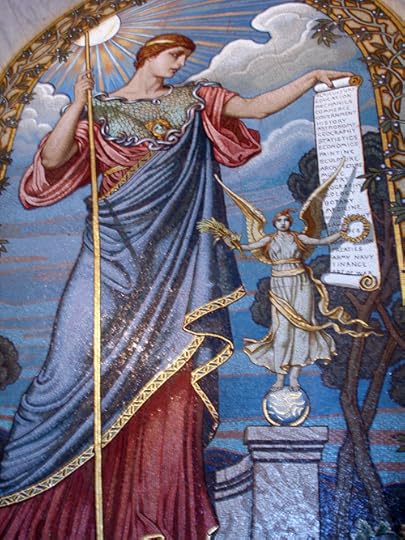
This is pretty much on the topic of the “rise of the feminine”; its apology; its prediction, as the author had his main thesis-idea back in 1991, while on a Mediterranean tour.
Schlain highlights the tremendous evolution humankind witnessed with the (alphabet) literacy acquisition, made possible via the use of the alphabetical writing. He contrasts this acquisition with previous complicated forms of communication: cuneiform and hieroglyphic writings, namely. From a historical perspective, even Mao Zedong saw benefits in abandoning the old “ideographic writing" and adopting the “romanized alphabet” (thus, overnight, Peking, became Beijing, and Mao Tse-Tung became Mao Zedong; etc).
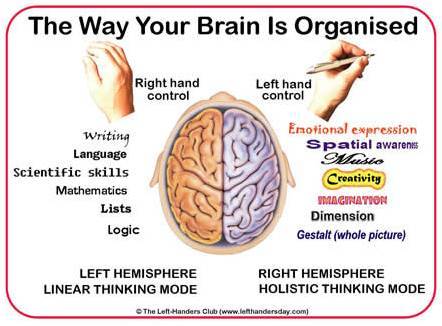
His main thesis just recaps the “old” idea of two brain hemispheres with distinct functions. Leonard Schlain argues for gender hemispheres. Therefore, the masculine left-brain is responsible for 90% of the verbal function (on right-handed people); its processes are “linear, sequential, reductionist and abstract”.
On the other hand the feminine right-hemisphere is holistic, spatial, and is responsible for patterns and faces recognition and gestalt perception; thus, it has a “simultaneous” and concrete form of processing.
Yet, Schlain speaks about a “repression of women” played by the alphabet’s role and advocates for the “iconic” information processing; an “equilibrium” between the two hemispheres.
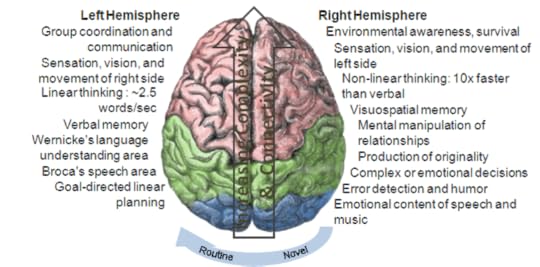
None better to grasp these ideas than a quote from Virginia Woolf: “In each of us two powers preside, one male, one female, and in the man’s brain, the man predominates over the woman, an in the woman’s brain, the woman predominates over man….If one is a man, still the woman part of the brain must have effect; and a woman also must have intercourse with the man in her. Coleridge perhaps meant this when he said that a great mind is androgynous. It is when this fusion takes place that the mind is fully fertilized and uses all its faculties”.
He predicted when writing this book that a “new Golden” age was arriving. His analysis is historical; he visits the Greeks, the Egyptians and Babylon. He noticed a difference in Pharaoh Ikhnaton: a different usage of images.
Some of the debatable ideas of Schlain look like this: with the Gutenberg printing, massive witch hunts ensued in Europe (in England, France, Spain…); the patriarchs of the Reform dressed up in black and white and they wanted to get rid of Mary. Clearly, the printed word wasn’t good for women one might conclude. Schlain believes the oral words of Jesus were changed and his message became one of “sin, guilt, suffering and death”.
"Lateralization of brain structures is based on general trends expressed in healthy patients; however, there are numerous counterexamples to each generalization"
from WIKI
Just one final, little objection. All these brain functions depend, for each specific individual, namely, on the lateralization process.
🙏
My comment.
Leonard Schlain
This is pretty much on the topic of the “rise of the feminine”; its apology; its prediction, as the author had his main thesis-idea back in 1991, while on a Mediterranean tour.
Schlain highlights the tremendous evolution humankind witnessed with the (alphabet) literacy acquisition, made possible via the use of the alphabetical writing. He contrasts this acquisition with previous complicated forms of communication: cuneiform and hieroglyphic writings, namely. From a historical perspective, even Mao Zedong saw benefits in abandoning the old “ideographic writing" and adopting the “romanized alphabet” (thus, overnight, Peking, became Beijing, and Mao Tse-Tung became Mao Zedong; etc).
His main thesis just recaps the “old” idea of two brain hemispheres with distinct functions. Leonard Schlain argues for gender hemispheres. Therefore, the masculine left-brain is responsible for 90% of the verbal function (on right-handed people); its processes are “linear, sequential, reductionist and abstract”.
On the other hand the feminine right-hemisphere is holistic, spatial, and is responsible for patterns and faces recognition and gestalt perception; thus, it has a “simultaneous” and concrete form of processing.
Yet, Schlain speaks about a “repression of women” played by the alphabet’s role and advocates for the “iconic” information processing; an “equilibrium” between the two hemispheres.
None better to grasp these ideas than a quote from Virginia Woolf: “In each of us two powers preside, one male, one female, and in the man’s brain, the man predominates over the woman, an in the woman’s brain, the woman predominates over man….If one is a man, still the woman part of the brain must have effect; and a woman also must have intercourse with the man in her. Coleridge perhaps meant this when he said that a great mind is androgynous. It is when this fusion takes place that the mind is fully fertilized and uses all its faculties”.
He predicted when writing this book that a “new Golden” age was arriving. His analysis is historical; he visits the Greeks, the Egyptians and Babylon. He noticed a difference in Pharaoh Ikhnaton: a different usage of images.
Some of the debatable ideas of Schlain look like this: with the Gutenberg printing, massive witch hunts ensued in Europe (in England, France, Spain…); the patriarchs of the Reform dressed up in black and white and they wanted to get rid of Mary. Clearly, the printed word wasn’t good for women one might conclude. Schlain believes the oral words of Jesus were changed and his message became one of “sin, guilt, suffering and death”.
"Lateralization of brain structures is based on general trends expressed in healthy patients; however, there are numerous counterexamples to each generalization"
from WIKI
Just one final, little objection. All these brain functions depend, for each specific individual, namely, on the lateralization process.
🙏
My comment.

February 18, 2011
I am a feminist and lover of women. I admire women as a mysterious entity that never stops fascinating me. This book walks you through the history of women power through out the years. As you understand the constant battle that women have had to fight against a male dominated world, one begins to understand why the written world has become a way to chain them and take their power away.
However, the future will tell us differently. Already there are more women graduating in the US than men. Some of them, Generation X women, are moving from stay home moms to vixens ready to take over their rightful place in the world.
This book is hard to read because it provides a grim view of women's role in our society through out history. However, the analysis of how women process information and how the future is brighter for our female counterparts is encouraging.
If you are a feminist, this book is a must.
If you want to learn about different religions and what are they about, this is surprisingly a great resource.
However, the future will tell us differently. Already there are more women graduating in the US than men. Some of them, Generation X women, are moving from stay home moms to vixens ready to take over their rightful place in the world.
This book is hard to read because it provides a grim view of women's role in our society through out history. However, the analysis of how women process information and how the future is brighter for our female counterparts is encouraging.
If you are a feminist, this book is a must.
If you want to learn about different religions and what are they about, this is surprisingly a great resource.

November 28, 2008
stimulating, fun, insightful - and you don't have to buy his theory to enjoy this book. it is that fantasy - a history of the world - of thought and art and language - as if women mattered. starting at the beginning is a good idea, but you can also just open to any of the pairings.
so much history, perspective and wonder-ing in this book. He is all about his theory, but its enthusiasm, compassion and intelligence that define his voice for me - and i am grateful for it.
so much history, perspective and wonder-ing in this book. He is all about his theory, but its enthusiasm, compassion and intelligence that define his voice for me - and i am grateful for it.

November 15, 2019
This is a very unusual book. Its thesis is that our ability to read -- in particular the alphabet in its syntactic atomization -- has pushed for a very left brained approach to understanding the world and constructing meaning. This approach has led to an increase in science and rationality but it has also impoverished the world by making it crueler, environmentally degraded, hierarchical and unequal in regard to women.
These assumptions about the left brained, alphabetic approach is very Marshall McLuhan++. Also, Shlain takes these assumptions as fact and uses evidence of these implicit qualities in various stages throughout history in order to highlight the effects of the increased spread of the alphabet. This kind of dovetails with John Vervaeke's work with his YouTube series "The Meaning Crisis" although Shlain doesn't go nearly as far although the scope of his work is pretty impressive.
Shlain is a surgeon. So he is scientifically minded and medically trained. However, this work is somewhat logically questionable, for without cognitive science it lacks backing. Instead he relies upon the move correlation is causation, which is my main objection.
Nonetheless, despite that, and despite the rigid right brain, left brain conviction, he draws up an interesting argument. Why did the West become so anti-woman? What does this happen? And how come this reverses itself in the age of television and visual media? Why did religion turn to reject the Goddess and Earth worship in favor of sky gods?
I put this book as a favorite because despite these issues, it fosters a great deal of imagination, and offers a big view of history and human development. It seems pretty inline with Vervaeke's work -- although Shlain doesn't back up his claims with cognitive science studies nor does he use the foundation of this book's argument to bolster any predictions about what the future might hold. And the future does hold quite a bit of promise for us.
These assumptions about the left brained, alphabetic approach is very Marshall McLuhan++. Also, Shlain takes these assumptions as fact and uses evidence of these implicit qualities in various stages throughout history in order to highlight the effects of the increased spread of the alphabet. This kind of dovetails with John Vervaeke's work with his YouTube series "The Meaning Crisis" although Shlain doesn't go nearly as far although the scope of his work is pretty impressive.
Shlain is a surgeon. So he is scientifically minded and medically trained. However, this work is somewhat logically questionable, for without cognitive science it lacks backing. Instead he relies upon the move correlation is causation, which is my main objection.
Nonetheless, despite that, and despite the rigid right brain, left brain conviction, he draws up an interesting argument. Why did the West become so anti-woman? What does this happen? And how come this reverses itself in the age of television and visual media? Why did religion turn to reject the Goddess and Earth worship in favor of sky gods?
I put this book as a favorite because despite these issues, it fosters a great deal of imagination, and offers a big view of history and human development. It seems pretty inline with Vervaeke's work -- although Shlain doesn't back up his claims with cognitive science studies nor does he use the foundation of this book's argument to bolster any predictions about what the future might hold. And the future does hold quite a bit of promise for us.

February 1, 2012
My favorite book of all time. I've owned my copy for over 12 years and it's definitely showing it's age. I have read it time and time again, always gleaning a bit more from it every time.
Slain's writing style is almost addicting. This book, like Art and Physics before it, uses parralel ideas/concepts as chapter headings. For examples, chapters such as Reason/Madness, Adam/Eve, Humanist/Egoist, present diametrically opposed ideas as illustrations for his theory that the linear, left brained, more masculine side of us is responsible for the subjugation of the holistic, right brained, femininely oriented other half.
Granted, sometimes his examples are a bit contrived to fit his theory, and Shlain admits, that as a Surgeon, he is no archaeologist, historian, or even neurobiological expert. While no one would ever deny this man's vast intelligence, it is fair to say that he occasionally wanders a bit too far 'out there'.
Read this book. Think outside of the box for a bit. Take it not as absolute literal fact in every instance, but as a musing of 'what if' and 'why' and 'how'.
Slain's writing style is almost addicting. This book, like Art and Physics before it, uses parralel ideas/concepts as chapter headings. For examples, chapters such as Reason/Madness, Adam/Eve, Humanist/Egoist, present diametrically opposed ideas as illustrations for his theory that the linear, left brained, more masculine side of us is responsible for the subjugation of the holistic, right brained, femininely oriented other half.
Granted, sometimes his examples are a bit contrived to fit his theory, and Shlain admits, that as a Surgeon, he is no archaeologist, historian, or even neurobiological expert. While no one would ever deny this man's vast intelligence, it is fair to say that he occasionally wanders a bit too far 'out there'.
Read this book. Think outside of the box for a bit. Take it not as absolute literal fact in every instance, but as a musing of 'what if' and 'why' and 'how'.

February 8, 2008
Some interesting ideas, but the author could do a better job of referencing his sources. Gotta be honest, the gender dichotomy really turned me off. Besides, I'm weary of any man who rants about "the goddess" and gushes about the beauty of "the feminine". Experience tells me that they tend to be shmucks.

December 11, 2008
What an interesting hypothesis--that acquisition of literacy goes hand-in-hand, through history, with misogyny. The scope of Shlain's work is truly breathtaking--I would sit here thinking "if 200 would be a theoretical maximum for IQs, Leonard Shlain must have an IQ of 300." Even so, I couldn't help worrying that Shlain was cherry-picking data. Since I'm not a historian, it's hard to know. But, for example, I did notice that Schlain said that the Great Leap Forward and the Cultural Revolution in China went hand in hand with the widespread use of pinyin, but I'm pretty sure pinyin characters were never widely taught in China. (After all--they are primarily useful only for Westerners who are learning Chinese.) And also, could it be that the spread of misogyny also had to do as much with the ability of literacy to exponentially improve communication? It still begs the question as to why the misogyny sprouted when it did, but there are two different things going on (misogyny and improved communication), and it's pretty tough to tease the effects apart.
Sometimes I was also quite bothered by the sort of slapdash "left brain=male" "right brain=female," approach. He acknowledges that there is far more complexity than he can really do justice to, but I think it would have helped his thesis to have a bit of the nitty gritty neuroscience involved.
But an A+ for a thought-provoking thesis that's totally different than anything I've seen before!
Sometimes I was also quite bothered by the sort of slapdash "left brain=male" "right brain=female," approach. He acknowledges that there is far more complexity than he can really do justice to, but I think it would have helped his thesis to have a bit of the nitty gritty neuroscience involved.
But an A+ for a thought-provoking thesis that's totally different than anything I've seen before!

February 29, 2008
I am amazed that I was able to force myself to finish this book. It is filled with so much speculation touted as fact, and wide generalization it makes me sick. Even the author himself admits at one point in the book that correlation of events in time is not evidence of causation, and yet that is exactly what he continues to base this book on. I see no factual evidence in this book that the author's thesis is backed up by any of what he says. Again, and again he interprets history in a way that supports his own suppositions in direct contradiction to facts.
October 28, 2007
This is an amazing book.. Shlain has a theory about the process of most of humanity losing contact with the immense importance of the feminine aspect and perspective on our world view. He goes all the way back and before to the early development of language and subsequently the alphabet and the written word. His research is vast and quite stunning. It is not a new book, and I have had it for years--- it is very dense so I am slowly chipping away at it. I heard the author interviewed on NPR.

December 23, 2010
I am officially disgusted enough with this book to be done with it. Sloppy science, sloppy history, the author deforms everything he touches to make it fit his pet theory. Too bad, because I really enjoyed the part about the evolution of human intelligence and shared knowledge, wish it wasn't tainted by being associated with so much bunk.

February 10, 2013
I came to this book with high hopes and excitement. The author's thesis sounded intriguing and I looked forward to seeing the archaeological, neurological, and scientific proof that birthed it. However, I stopped reading on page 9.
The citations are weak and the author's generalizations and assertions without proof were coming fast and furious.
In the few pages I read I came across the following uncited and fallacious statements:
"Researchers have never proven beyond dispute that there were ever societies in which women had power and influence greater than or even equal to that of men." Untrue.
"There exists a third realm: some call it spiritual, some call it sacred, and some call it supernatural. Humans have acknowledged and incorporated this third realm into every culture ever created." Am I supposed to take that huge generalization literally? And with no citation or footnote? For example, there is so much we do not know about our prehistoric ancestors there is no way we could assert that they all "acknowledged and incorporated" spirituality into their culture.
What I had hoped for from this book was obviously never coming to fruition. The footnote that made me shut the book for good reads as follows: "The evolution of life forms is impelled by three factors: changing environmental demands, the organisms' adaptations to these demands, and the mutation of genes that creates the adaptations. While the radiation into diverse species appears to have been carefully orchestrated by some supreme intelligence, many scientists do not believe any super-conscious effort is actually involved. They theorized the orderly progression of life forms results from constant friction among the three above listed factors. Exercising a writer's artistic license, I will anthropomorphize the random process of evolution in the coming pages and I will use the terms 'nature,' 'natural selection,' 'evolution,' and 'life' interchangeably."
I was hoping for a more scientifically grounded book. The above terms are clearly not interchangeable and confounding their meanings leaves me with grave concerns about the credibility of the author.
Disappointing.
The citations are weak and the author's generalizations and assertions without proof were coming fast and furious.
In the few pages I read I came across the following uncited and fallacious statements:
"Researchers have never proven beyond dispute that there were ever societies in which women had power and influence greater than or even equal to that of men." Untrue.
"There exists a third realm: some call it spiritual, some call it sacred, and some call it supernatural. Humans have acknowledged and incorporated this third realm into every culture ever created." Am I supposed to take that huge generalization literally? And with no citation or footnote? For example, there is so much we do not know about our prehistoric ancestors there is no way we could assert that they all "acknowledged and incorporated" spirituality into their culture.
What I had hoped for from this book was obviously never coming to fruition. The footnote that made me shut the book for good reads as follows: "The evolution of life forms is impelled by three factors: changing environmental demands, the organisms' adaptations to these demands, and the mutation of genes that creates the adaptations. While the radiation into diverse species appears to have been carefully orchestrated by some supreme intelligence, many scientists do not believe any super-conscious effort is actually involved. They theorized the orderly progression of life forms results from constant friction among the three above listed factors. Exercising a writer's artistic license, I will anthropomorphize the random process of evolution in the coming pages and I will use the terms 'nature,' 'natural selection,' 'evolution,' and 'life' interchangeably."
I was hoping for a more scientifically grounded book. The above terms are clearly not interchangeable and confounding their meanings leaves me with grave concerns about the credibility of the author.
Disappointing.

July 23, 2008
This book has an interesting thesis: literacy causes misogyny. The advent of literacy, according to Shlain, altered neural pathways in the literate, leading to strengthened "masculine"/left-brained characteristics (as linear thinking, rationality, reductionism, etc.), which in turn, lead to increasing the mistreatment of women.
As I said, interesting hypothesis. Except that his supporting evidence is lacking, misinterpreted, misunderstood, or simply made up at every step along the way. The whole argument hinges on Shlain's belief that every time literacy appears in society, women's rights disappear or diminish, and whenever literacy disappears (as in the Dark Ages), sexual egalitarianism becomes rampant. Even if this were true, (I remain unconvinced), even high school students are taught that correlation does not imply causation.
On the other hand, he does cast the origin of the Judeo-Christian God in a new light. I don't know enough about biblical history to know if his account is accurate, but if so, the birth of the biblical God may well represent a sharp change in human cognitive behavior. It's definitely good food for thought.
While I completely disagree with his thesis, and all of the so-called "evidence", I nevertheless think that further studying the effects of literacy on cognition is in order. It is impossible to imagine that writing has not affected our cognitive behavior to some degree.
As I said, interesting hypothesis. Except that his supporting evidence is lacking, misinterpreted, misunderstood, or simply made up at every step along the way. The whole argument hinges on Shlain's belief that every time literacy appears in society, women's rights disappear or diminish, and whenever literacy disappears (as in the Dark Ages), sexual egalitarianism becomes rampant. Even if this were true, (I remain unconvinced), even high school students are taught that correlation does not imply causation.
On the other hand, he does cast the origin of the Judeo-Christian God in a new light. I don't know enough about biblical history to know if his account is accurate, but if so, the birth of the biblical God may well represent a sharp change in human cognitive behavior. It's definitely good food for thought.
While I completely disagree with his thesis, and all of the so-called "evidence", I nevertheless think that further studying the effects of literacy on cognition is in order. It is impossible to imagine that writing has not affected our cognitive behavior to some degree.
August 11, 2008
This might take some time... it's a fascinating read, but not the kind of thing you can read while tired -- which is when I get some of my best reading in. It very much needs active reading and thought.
I think he has an interesting hypothesis, and does a great job of recapping other theories and anthropologists' suggestions, but sometimes it feels that he's making a bit of a stretch to take correlation and turn it into causation to support his view of an inevitable decline in women's rights due to written language. Even so, I'm really enjoying the research he's put into this, even though it makes it a slow read.
As he goes through each culture's adaptation following literacy, I think some make better cases than others - but he's trying to make them ALL support his views. That's my only problem thus far. Regardless of that, this gives you a lot of things to think on, and a much deeper appreciation for the price we might have paid for our tree of knowledge.
-- Update:
Never finished this book and suspect I'll never get back to it again. He made some really great points that have stuck with me still, he just felt so heavy-handed in trying to make his case that I quit about half-way through... Having already been pulled to agree with and understand his perspective, I grew tired of the lecture.
I think he has an interesting hypothesis, and does a great job of recapping other theories and anthropologists' suggestions, but sometimes it feels that he's making a bit of a stretch to take correlation and turn it into causation to support his view of an inevitable decline in women's rights due to written language. Even so, I'm really enjoying the research he's put into this, even though it makes it a slow read.
As he goes through each culture's adaptation following literacy, I think some make better cases than others - but he's trying to make them ALL support his views. That's my only problem thus far. Regardless of that, this gives you a lot of things to think on, and a much deeper appreciation for the price we might have paid for our tree of knowledge.
-- Update:
Never finished this book and suspect I'll never get back to it again. He made some really great points that have stuck with me still, he just felt so heavy-handed in trying to make his case that I quit about half-way through... Having already been pulled to agree with and understand his perspective, I grew tired of the lecture.
November 30, 2013
The word that comes to mind here is 'drek'. I made it through the first chapter - barely. While I was interested to see some new ideas on literacy and gender, I couldn't handle the sloppy science. For example, I would expect someone with a science background to know that there's no such thing as a "female" brain and a "male" brain. Even though he offers a footnote about there being a lot of overlap and most people exist as a blend of the extremes, everything he talks about is presented as one of two aspects and never the twain shall meet.
There are several other concepts he gets almost right but then at the last moment veers into unsupported conclusions. (And I might be okay with that except there's no 'what if' or 'maybe' disclaimer.) I'm not sure if this reflects his simplistic understanding or if he's trying to dumb things down; either way, I'm not finding much of substance. With foundations this shaky, I'm not at all confident that he'd be able to support his larger assertion that written language had a detrimental effect on female status.
I would be interested to read more about this theory from someone that gets the fundamentals right. As it stands now, I'd have to say that Shlain's hypothesis is plausible but definitely requires research before publication.
There are several other concepts he gets almost right but then at the last moment veers into unsupported conclusions. (And I might be okay with that except there's no 'what if' or 'maybe' disclaimer.) I'm not sure if this reflects his simplistic understanding or if he's trying to dumb things down; either way, I'm not finding much of substance. With foundations this shaky, I'm not at all confident that he'd be able to support his larger assertion that written language had a detrimental effect on female status.
I would be interested to read more about this theory from someone that gets the fundamentals right. As it stands now, I'd have to say that Shlain's hypothesis is plausible but definitely requires research before publication.

July 13, 2009
Offers an amazing review of the co-evolution of language and religion with a fascinating and compelling central thesis: the arrival of alphabetic (vs. pictographic) literacy via religious texts (Old Testament, New Testament and the Quran - all with a singular abstract God) brought a paradigmatic leap into left-brained, abstract thought, encouraging the male hunter (killer) mentality to take hold of the collective consciousness. Up until then, world religions generally involved worship of concrete image-based deities, including numerous goddesses, more accurately reflecting the natural world (right brain). Such early societies were egalitarian. The creators and holders of the first alphabetic books - powerful religious men - served as the "translators" of what were effectively the Hope (an afterlife) and the Code (do's and don'ts) sought by the masses; unfortunately, these men inserted misogynistic commentary and proscriptions, bringing forth the shift to punitive, patriarchal societies which gave us the barbarism of the Inquisition and then the so-called Reformation.
And all of that was the basic overview.
And all of that was the basic overview.

Read
September 22, 2016(2.5 stars) Maybe I should give this one 3 stars, but I had a real hard time getting through this one.
I heard about this book at an Ani Difranco show. She'd just read it and told everyone to run out and read it because it had her reeling. I added it to my TBR list and now, two years later, I finally picked it up.
It's a pretty dry read and at one point the author talks about his thesis and all I could think from that point on was how it read like a dissertation. There is a lot of information crammed into this book, spanning the beginning of time to 2000. The author's basic argument is that there is a strong correlation between the alphabet (or the written word) and the rise of violence against women; that though the written word has its virtues, it also has its problems. There are some compelling points made, but it felt like the topic was too big for a book this size (or conversely, maybe the book was too big and the topic needed to be narrowed down). As a writer and bibliophile I have a difficult time thinking the written word is harmful, but I thought the book had some interesting points and I'm glad I plowed through it.
I heard about this book at an Ani Difranco show. She'd just read it and told everyone to run out and read it because it had her reeling. I added it to my TBR list and now, two years later, I finally picked it up.
It's a pretty dry read and at one point the author talks about his thesis and all I could think from that point on was how it read like a dissertation. There is a lot of information crammed into this book, spanning the beginning of time to 2000. The author's basic argument is that there is a strong correlation between the alphabet (or the written word) and the rise of violence against women; that though the written word has its virtues, it also has its problems. There are some compelling points made, but it felt like the topic was too big for a book this size (or conversely, maybe the book was too big and the topic needed to be narrowed down). As a writer and bibliophile I have a difficult time thinking the written word is harmful, but I thought the book had some interesting points and I'm glad I plowed through it.
September 11, 2009
A blurb by Bart Schneider in "The Washington Post Book World" says this book is a "bold and fascinating investigation of the 'dark side of literacy.' Shlain...makes the startling claim that the advent of literacy ushered in the demise of goddess societies, and shifted the balance of power from women with their intuitive and holistic, right-brain orientation to the more concrete, linear-focused, left-brained men...Both hemispheres of my cerebrum...remained stimulated throughout."
I agree.
Shlain is a surgeon who combines scientific rigor in research with an earthy, lively, and quirky style that is a delight to read. While I often quibble with the leaps he takes from fact to hypothesis, I am fascinated by his ideas and insights into the origins of civilization as we know it now.
I am tantalized by the idea that our current global problems originated in the over emphasis on left-brain, literal experience, engendered by the alphabet. Especially since I love that aspect of our humanity.
I agree.
Shlain is a surgeon who combines scientific rigor in research with an earthy, lively, and quirky style that is a delight to read. While I often quibble with the leaps he takes from fact to hypothesis, I am fascinated by his ideas and insights into the origins of civilization as we know it now.
I am tantalized by the idea that our current global problems originated in the over emphasis on left-brain, literal experience, engendered by the alphabet. Especially since I love that aspect of our humanity.
June 23, 2022
I must admit to picking this book up because of Bjork's recommendation. But gosh, was it worth the read. I wish I could articulate all my thoughts at once, but I'm still thinking about it. Shlain has put almost all pre-history and written history into a new context, with a new thesis that is so radically different from anything I've learned at school that I checked multiple times to be sure a woman didn't write this, Shlain writes from such an empathetic, grounded, and introspective point of view. And I think that also speaks to the points Shlain argues.
I literally cannot recommend this book more. READ IT!
I literally cannot recommend this book more. READ IT!

June 2, 2018
I wouldn't recommend this book because it's so outdated. At the time I read this I loved it. Even then, I thought Shlain's personal hypotheses were...out there...but as someone new to the field of anthropology at the time, this exposed me to a lot of different theories I had never encountered before. In school I often used this book as a reference to other studies. This book is outdated now, but I'm giving it five stars for nostalgic reasons.
If you read this book with a grain of salt, and recognize there's outdated information it is an entertaining and engaging read.
If you read this book with a grain of salt, and recognize there's outdated information it is an entertaining and engaging read.

July 1, 2007
I should have NOT highlighted the good parts, instead of vice versa. That way, my book would not currently resemble a yellow neon sign. Everything in this book is high-light-able. It's astonishing. Really.
If you've ever wondered why God became a man in every culture around the world before 6000 BC... why it's so often denied that God once was a woman EVERYWHERE... and why all cultures become violent upon their first encounter with the written word, take heed. This book is HERE.
If you've ever wondered why God became a man in every culture around the world before 6000 BC... why it's so often denied that God once was a woman EVERYWHERE... and why all cultures become violent upon their first encounter with the written word, take heed. This book is HERE.
Displaying 1 - 30 of 337 reviews