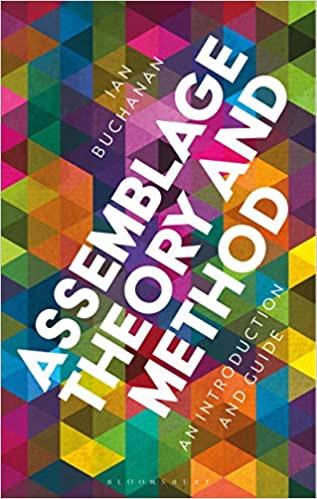
What do we mean by 'assemblage' in contemporary theory? The constant and seemingly limitless expansion of the concept’s range of applications begs the question, if any and every kind of collection of things is an assemblage, then what advantage is there is in using this term and not some other term, or indeed no term at all? What makes an assemblage an assemblage, and not some other kind of collection of things? This book advances beyond this impasse and offers practical help in thinking about and using assemblage theory for contemporary cultural and social research, in order - Answer the what is an assemblage? - Explain why assemblage theory is necessary - Provide clear instructions on how to use assemblage theory Ian Buchanan maps the beginnings of a brand new field within the humanities.
Born in rural Western Australia, Buchanan grew up in the suburbs of Perth. He did his BA and PhD in the English and Comparative Literature program at Murdoch University, graduating in 1995. His PhD dissertation, entitled, "Heterology: Towards a Transcendental Empiricist Approach to Cultural Studies" attempted to fuse the work of de Certeau and Deleuze for the purposes of doing cultural analysis
Chapter 1 In Assemblage Theory and Method, Ian Buchanan directs us to the "first principles" of Assemblage Theory (AT) embedded in the "Geology of Morals" plateau of A Thousand Plateaus. Deciphering this plateau has long been an interpretive mystery not previously well unveiled because the theory is so abstract, as Deleuze and Guattari intended. Buchanan's incisive and patient explication of AT raises scholarly understanding of the subject to a new level and accounts for why the book was so hard to write. He also tells the rich personal and philosophical stories of Deleuze and Guattari behind the theory itself which only a veteran in the field could provide.
For example: "Deleuze and Guattari only ever had one project--the invention of schizoanalysis." (p. 10) And "Deleuze wanted to talk to someone who worked with schizophrenics in order to test certain ideas he was developing about the language of schizophrenia and his former student suggested he get in touch with Guattari." (p. 11) Deleuze states about A Thousand Plateaus, that what holds it together is "the idea of an assemblage (which replaces the idea of desiring machines)." (p. 12) We are also reminded that Guattari continues to develop schizoanalysis and AT in his Machinic Unconscious after Deleuze died.
Deleuze's meta-assemblage concepts ("given a specific situation what kind of assemblage would be required to produce it"): 1) AT replaces the idea of the "desiring machine." It is not just about things arranged together in a merely materialistic or mechanistic or materialistic order, but the problematic of identifying the conditions for what is happening in the happening (event), the ongoing process. 2) Deleuze states that he and Guattari "are trying to substitute the idea of the assemblage for the idea of behavior [the basis of which is desire]: whence the importance of ethology." (p. 13) Ethology then becomes not just about animal behavior, but a means by which to formulate the problem of desire in general, and is not limited to animalistic determinism characteristic of past ethological concepts. 3) The 'general logic' of assemblages includes the basis of chaos as ground zero for desire and the source of all creativity, and of all destruction. Also, one cannot start from a single assemblage, but must start "all at once."
The Problem of Strata: Strata are a systemic way of problematizing appearances and are the processes over time at the heart of producing nature, whether geological, biological or alloplastic (techno-semiological, Buchanan's term), not just the thing itself. Each strata is composed of the double articulation of two quintessential variables , content and expression, which are in turn different for each strata. Like a three dimensional chess game, only the pieces at the top level (cultural, translation) can move across all planes (alloplastic) while the first (geological/induction) and second (biological, transduction) are homoplastic.
The dimension of the internal limit of the assemblage is the form of content (machinic assemblage of bodies) while the dimension of the external limit of assemblage is the form of expression (collective assemblage of enunciation). Content and expression (from Hjelmslev) interact reciprocally in resonance between two distinct and autonomous formalizations. The event occurs on the expressive side which resonates and bounces off the bodies on the content side. It is the abstract machine which is the event that gives a stratum its unity while the process of deterritorialization moves via affects which unite and disunite with bodies.
First principles of stratification: 1) Chaosmosis: "In the beginning, there is the chaos of unformed and unstable matters that flow freely as so many mad particles or intensities." (p. 35) 2) "Desire is a free flowing stream of intensities subject to processes of capture and coagulation which give rise to and constitute the entire world." (p. 38) 3) Stratification is a process of capture which works by means of coding and territorialization (the dual processes of the assemblage)." (p. 42). 4) The abstract machine "simultaneously constitutes the unity of composition of the stratum and constructs 'continuums of intensity' on the plane of consistency." (p. 44) It is a machine because it is pragmatic, i.e., influences our behavior, but it is abstract because it is not material or tangible.
Why the concept of stratification is needed: 1) Assemblages produce things other than themselves such as complex forms and objects which populate society and culture. 2) Stratification is needed to analyze and explain our otherwise unarticulated multi-layered lives. 3) Stratification locates events in periods and conceptualizes history as discontinuous. 4) Since subjects are produced, a process must be theorized capable of producing subjects and subjectivity as can be seen in the chapter of A Thousand Plateaus on the body without organs. Deleuze and Guattari's ontology is the transcendental empiricism of an "organized transcendental pane sitting on top of an unorganized immanent plane." (p. 52)
Chapter Two: Desire and Machines. The assemblage is desire in its machinic modality (not just Oedipal). "The body without organs is positioned here as an agency of the mind that determines when and how and under what conditions desire can flow." (p. 77) The Masochist Assemblage section is an explication of how sadism and masochism can be analyzed not by Freudian drive theory, but by AT.
Chapter Three: Territory Territory is "chaos defined as an existential condition rather than a physical state of affairs. Chaos relentlessly activates processes of death, against which processes of life such as art, philosophy and science develop. "Territory is an act, a passage, not a space. It is the composition of one's own world." (p. 98) D&G parse language as "the set of all order words, implicit presuppositions, or speech acts current in a language at a given moment." (p. 100) They focus on language, not as communication of a sign as information, but as a social phenomenon by which order-words impose order on human reality, the collective assemblage of enunciation. The performative as order-word is everywhere in language, where an act is connected to the expressed of a statement by the power of social obligation. (p. 102)
Chapter Four: Expressive Materialism (vs. new materialism or vital materialism) This chapter is basically a critical review of Jane Bennet who makes the error of reducing assemblage to physical parts just added together, ignoring the dual dimension not only of the material (form of content, machinic assemblage) but also of the expressive (form of expression, collective assemblages of enunciation. Also ignored is the principle of unity (abstract machine) and the condition of any thing’s possibility (body without organs, plane of immanence, plane of consistency, etc.) (p. 121). Buchanan also demonstrates the explanatory power of AT by reviewing a study of itinerant housing (Lea) and one of imprisonment (Wacquant) by AT standards.
Chapter Five: Control Assemblage--an insightful explication based on Deleuze's essay "Postscript on Control Societies" which adds nicely to the trajectory of AT. Buchanan thus gives us a much needed redefinition and a boiling down of D&G's most abstract concepts into a pragmatic explication of AT and related concepts for the rest of us to use as touch points and stepping stones to more accurately implement their concepts with both consistency and creativity
Great application of the work of Deleuze and Guattari and a refreshing analytical insight into their work. I found an array of different material that was well contextualised for our contemporary understanding of social and cultural developments. It’s a text rich with analytical expositions and penetrating insights into how one might conduct schizoanalysis and theorise with the concept of the assemblage. A must read for anyone studying the works of Deleuze and Guattari.
Assemblage Theory and Method is the book one needs to base for oneself a comprehensive understanding of most of Deleuze and Guattari's collaborative work, particularly of the Capitalism and Schizophrenia project. The book circles around the concept of assemblage, but this concept is presented in connection to D&G's vast conceptual arsenal, and it is suitable for students as it is for the more experienced D&G's scholars. Highly recommended.
A bit difficult at first, but by the end I was blown away. Highly recommend for anyone that tried to read D&G and we're baffled. I feel much more prepared now.
This is a great introduction to assemblage theory, written in a very accessible style. I particularly enjoyed Buchanan’s exploration of territory and ritournelles/refrains. However, it does feel too polemic at times, with attacks on other thinkers seeming to go almost too far. All in all, ‘Assemblage Theory and Method’ is a very interesting, very clear introduction to Deleuzoguattarian thought, but off putting at times.
Brilliant survey and introduction to the core aspects of the 'assemblage' concept
There are two key points to make about Buchanan's volume. The first kept point point is regarding Buchanan's intervention in the field of existing commentaries. Lots of disciplinary fields use the concept of assemblage. Buchanan provides insightful and critical commentary on these uses in the context of Deleuze and Guattari's body of work. The reception of Deleuze and Guattari's work has proceeded through two phases: 1. Engagement and commentary with their major works as they were gradually translated and published in English. 2. Engagement and commentary with what is basically the totality of their work. Buchanan intervenes in the field of existing commentaries that mostly emerged during the first phase and produces a commentary worthy of the second phase. The second key point is regarding the balance of patience and impatience that characterises the tone of Buchanan's work. At various points Buchanan patiently explicates the concept of assemblage in the context of work that develops relevant conceptual problematics. This is useful for teachers and students when grappling with the concept. On the other hand, Buchanan is impatient with existing commentaries that insufficiently mobilise the concept and that, at worst, are merely performative.
The best introduction to Deleuze I have read that corrects the misuses and abuses of assemblage theory, particularly amongst those labelled as new materialists.
In some ways, this is a very logical continuation of Ian B’s 'The Incomplete Project of Schizoanalysis' since that book ends with a three-chapter final section on different assemblages (and the final ‘The Self-Help Assemblage’ is particularly insightful). His key question in this volume is: ‘what can the concept of the assemblage enable us to see that we couldn’t see before?’ (2). As I just said, I think Buchanan has been actively pursuing this question for years, but his effort here is to zero in on just what the term refers to and, more importantly, how it works, ‘to isolate and define the specifically Deleuze and Guattarian species of assemblage and evaluate against other varieties on offer’ (4). Of particular importance to Buchanan is “to show how one might go about using their concept of the assemblage for practical applications in social and cultural research’ (6), but as an ‘incomplete project’ that allows for more work based on a set of ‘first principles’ (6). What really speaks to me in Buchanan’s work is his unflagging effort to confront what is difficult in D&G, for example, the plateau in ‘A Thousand Plateaus’ titled ‘The Geology of Moral’ which, for Buchanan, ‘yields a small set of foundational propositions that one can use as a point of entry for the voyage into schizoanalysis’ (7). As this implies and as Buchanan says explicitly, this book is another (and a particularly astute) approach to how one might read D&G’s work, and in this case, ‘A Thousand Plateaus’, with Buchanan’s canny emphasis on the importance of the concept and practice of ‘variation’ in the D&G opus. But as he explains quite clearly, the concept of ‘assemblage’ drives ‘A Thousand Plateaus’ forward (12).
So, Buchanan pursues this renewed understanding of ‘assemblage’ as term, theory and method through successive (and overlapping) steps: the problem of strata (ch 1), desire and machines (2), territory (3), expressive materialism (4), and control assemblage (5). This latter chapter (as concluding) allows Buchanan a chance to review Deleuze’s seminal essay (published in 1990) ‘Postscript on Control Societies’, which Deleuze began to articulate in his book on Foucault as well as in the Foucault seminar (see sessions 18 & 19). As usual, Buchanan shows how ‘assemblage’ is an overlooked element of Deleuze’s statement on control societies. I think Buchanan is quite correct in seeing this essay as containing ‘the seeds of Deleuze’s well-known and much-lamented great unfinished project on the “greatness of Marx”’ (141). This essay only starts off in showing us a way beyond ‘control societies’, and I think Buchanan remarkably shows us some of the implications that Deleuze could not have done since social media and the rise of AI had yet to come. As I understand it, Buchanan remains true to his understanding of the ‘incomplete project’ since he continues work on the assemblage for a newer project.
This book has helped me understand the concept of assemblage better and how it might be used in methodology. Ian communicates these 'almost offensively obtuse' concepts in an accessible yet rigorous way, whilst referring to other current attempts at working with these concepts. I tended to stay away from desire when writing about assemblage because I was not confident despite much reading. Ian's book helped me in understanding how assemblage and desire can't be separated, and gave examples that helped me understand both better (the Lightning mcQueen bit helped me a lot!).
um livro dedicado a desbaratar Manuel DeLanda e ainda organiza os principais conceitos de Deleuze e Guattari de maneira acessível, 5 estrelas mesmo que eu ainda não tenha certeza como usar o método
P.S.: não costumo dar nota a livros teóricos porque raramente leio de cabo a rabo, mas esse é curtinho (160 páginas) e denso, vale a leitura pra quem se interessa por D+G