

What do you think?

Agamemnon #1
Warrior in Bronze
Warrior in Bronze deals with the life and times of Agamemnon, the king of an ancient Greek city state before and during the time of the Trojan wars.
276 pages, Hardcover
First published January 1, 1977
About the author
George Shipway
13 books20 followersGeorge Shipway (1908–1982) was a British author best known for his historical novels, but he also tried his hand at political satire in his book The Chilian Club.
Shipway was born in 1908, and served in the Indian Imperial Cavalry until 1946. He died in 1982. His cavalry background served him well when he took up writing; his descriptions of cavalry battles are full of minute detail and his works generally were meticulously researched.
IN his 1969 novel Knight in Anarchy Shipway describes the life of Humphrey de Visdelou as he follows Geoffrey de Mandeville to his doom. In the book Shipway indicates that he lives on the estates that de Visdelou once owned.
Shipway was born in 1908, and served in the Indian Imperial Cavalry until 1946. He died in 1982. His cavalry background served him well when he took up writing; his descriptions of cavalry battles are full of minute detail and his works generally were meticulously researched.
IN his 1969 novel Knight in Anarchy Shipway describes the life of Humphrey de Visdelou as he follows Geoffrey de Mandeville to his doom. In the book Shipway indicates that he lives on the estates that de Visdelou once owned.
Ratings & Reviews
Friends & Following
Create a free account to discover what your friends think of this book!
Community Reviews
Displaying 1 - 30 of 31 reviews

September 5, 2012
Shipway's interpretation of Greek myths took me by exceptionally pleasant surprise. It provides a favorite view of that ancient world.
***
KIRKUS REVIEW
"Another of Shipway's re-dos of ancient adventures, in which he shakes down fabled or time-muddled events for sense, if not sensibility. This is the fictional version of the pre-monarchical career of Agamemnon of Mycenae, circa 1300 B.C., in which all that flighty mythic stuff--from avian impregnations to Olympian interventions--is grounded, leaving here a residue of intra-Aegean politics (with confabs in exec-suite lingo) and grisly family feuds. Agamemnon and brother Menelaus observe the rise of father Atreus to the kingship of Mycenae--a bothersome route during which Agamemnon is trained for leadership (Atreus regards him as sufficiently ""unscrupulous""); is nearly killed by wild Goatmen led by Dionysius (known to all as a ""bleeding menace""); sees Jason come and go in the Argo. However, it's the feuding of Atreus and brother Thyestes--who ping-pong back and forth power-wise--that finds Agamemnon with his hands full. And, oh, the incest, hideous revenges and gore, gore, gore. King Tyndareus of Sparta sums it up: ""Atreus killed his son and wife, married his niece, fed a nephew to his father. Thyestes seduced his brother's wife, raped his own daughter and sired on her a child. The sons of Pelops certainly know how to sin."" And along the way Agamemnon learns a firm lesson: ""power and honor don't mix."" There are many twists to the old myths--Iphigenia is the offspring of Theseus and Helen; Hercules is a ""robber, freebooter and a little mad,"" etc. The old heady stuff of scholars and poets in an easy-open container--but, still, there's enough pull in the tales of ancient bloodbaths to find a faithful popular audience.
***
KIRKUS REVIEW
"Another of Shipway's re-dos of ancient adventures, in which he shakes down fabled or time-muddled events for sense, if not sensibility. This is the fictional version of the pre-monarchical career of Agamemnon of Mycenae, circa 1300 B.C., in which all that flighty mythic stuff--from avian impregnations to Olympian interventions--is grounded, leaving here a residue of intra-Aegean politics (with confabs in exec-suite lingo) and grisly family feuds. Agamemnon and brother Menelaus observe the rise of father Atreus to the kingship of Mycenae--a bothersome route during which Agamemnon is trained for leadership (Atreus regards him as sufficiently ""unscrupulous""); is nearly killed by wild Goatmen led by Dionysius (known to all as a ""bleeding menace""); sees Jason come and go in the Argo. However, it's the feuding of Atreus and brother Thyestes--who ping-pong back and forth power-wise--that finds Agamemnon with his hands full. And, oh, the incest, hideous revenges and gore, gore, gore. King Tyndareus of Sparta sums it up: ""Atreus killed his son and wife, married his niece, fed a nephew to his father. Thyestes seduced his brother's wife, raped his own daughter and sired on her a child. The sons of Pelops certainly know how to sin."" And along the way Agamemnon learns a firm lesson: ""power and honor don't mix."" There are many twists to the old myths--Iphigenia is the offspring of Theseus and Helen; Hercules is a ""robber, freebooter and a little mad,"" etc. The old heady stuff of scholars and poets in an easy-open container--but, still, there's enough pull in the tales of ancient bloodbaths to find a faithful popular audience.

January 28, 2018
I really wanted to like this book. Agamemnon is one of if not my very favorite character from the Iliad. I've read just about every book, play, and academic essay about him. Sadly, in a lot of modern adaptions, he tends to be cast as the black and white villain of the story rather than the morally complex character that he is. As a result, I was rather excited to find a book that focused solely on telling his story. I thought that it would finally lend him the depth his character deserves.
From the beginning, things are off to a rather rough start in terms of accurate characterization. One of the first scenes includes Agamemnon letting his younger brother Menelaus wrongly take the blame and subsequent physical punishment for something that Agamemnon did. His father, Atreus, applauds this decision, claiming that he knew Agamemnon was really the one at fault, but that this willingness to betray even his brother will make him a good king some day. This line of dialogue is clearly meant to set the stage for the rest of the book and Agamemnon's character. As I will go on to say several more times throughout this review: let's take a moment now to consider the source material. Agamemnon has (at least) two scenes in the Iliad where he is shown to be fiercely, even disproportionately, protective of his brother-- who by that time is a grown man, certainly not in need of it. While I do give the author a few points for later having Agamemnon state that "Menelaus was the only man who ever saw my kinder side", all in all the close relationship I've come to expect between the two is rather lacking, an odd choice when this is one of the most positive relationships he has in the Iliad. In my opinion, we should have seen Agamemnon choosing to protect his brother despite the consequences as an introduction to his character, not the opposite.
This aside, the first half of the book is pretty good. There are only a few small inaccuracies-- things like Diomedes being two years younger than Agamemnon (in the Iliad, he is the youngest after the teenage Achilles), and the characterization of Priam as being cold and cantankerous (you know, the man who sheltered Helen within his city for ten years and was willing to let his city burn because he loved his son Paris too much to cast him out. Aight.) My favorite part was how he wrote the Atreus-Aerope-Thyestes "love triangle", and he has some really good character development with Atreus' personality before and after Aerope's betrayal. I'd say that Atreus was actually the most fleshed out character in the book-- a bit unfortunate the same can't be said for the title character (which I'll get into a little more later). But as a big fan of the entire House of Atreus, I'll take what I can get. The horrifying Thyestean Feast scene is particularly well written. All around, the author does a good job with taking the very confusing chronology of this part of Agamemnon's backstory and sorting it out in a believable enough manner.
Meanwhile, however, he has chosen to do something that seems quite popular among his fellow adapters: he gives his main character a love interest who is not from the source material. Look, I'm not going to say that's always a bad choice, it's not. But I will say that I have, several times over, seen this same tired plot where a prince falls for some no personality slave of his in some half-assed star crossed lovers dynamic (check out the french Odyssey miniseries from 2013 if you for some reason enjoy subjecting yourself to this plot). Listen up, authors: if you want me to believe that your original character is good enough to be the love interest of this very well known literary character, you had better round out her backstory and personality well and make her -- and their relationship-- interesting.
Unfortunately, all the author does with these two is gives us a few uninspired sex scenes and some rather bland dialogue. (Predictably), she later ends up murdered by Thyestes, and Agamemnon cries when he finds out. While despite the questionable context, I liked the choice of showing this harder character having a moment of emotion, but this is sadly/strangely the only time such a moment occurs. In contrast, he has almost no emotional reaction to things like his mother or his father's extremely brutal deaths. Because this is all written in first person, his earlier given excuse-- "I prefer not to dwell on my feelings"-- doesn't really fly. We're inside the character's head, so whether or not he would openly show those feelings to the characters around him, we should still be reading about them. Instead, it was all reserved for this one random slave girl. Well okay, I guess.
The worst offense of this whole arc, however, comes with this line: "It was sweet Clymene's killing which drove me to a vengeance that horrified the world." Really? That's why we're going to say he became hardened, and why he took revenge on Thyestes? Not because of the numerous awful things he witnessed growing up which would give anyone psychological damage up to here? I see. By the way, to the five people who I saw had underlined this line on the kindle version: that isn't canon and I'm sorry if you were lead to believe that a motivation so flimsy was.
I'm now going to take a moment to talk about perhaps one of the very worst things about his book: it's treatment of female characters. Before you might be inclined to stop me here, I absolutely understand that you need to read these things in their proper historical contexts. I know how women were commonly treated at the time, I know that Ancient Greece is not the place to be looking for the best feminist representation. But there's a difference between how the characters in the story treat women, and how the author does; the former can be terrible, but the latter shouldn't be.
Every single woman in this book is first and foremost described by how sexy they are. Again, not always an inherently bad thing-- except for when it's EVERY single woman (and one of them is a ten year old child. Yikes). You might say: this is from the point of view from a young man, it's fair he would notice their looks first. And I would say, though you're kind of underselling Agamemnon's character there, fair enough, but if so, WHY was I subjected to this horrendous passage, during the scene his mother is about to be executed:
Oh, really? Your first thought about your mother, before she's about to be murdered, is how attractive she is? I'm sure glad that we spent all that unnecessary time describing her outfit and breasts, rather than say, I don't know, the mixed feelings he has towards his mother's impending gruesome execution, maybe some memories or thoughts he has about her ...absolutely anything else but this. This is why I say that it is more the author's choice to purposely unjustly treat and undersell the potential of the role his female characters play in this story rather than what is believable as simply being the slant of the PoV character.
Another example, and personal pet peeve of this story: I counted no less than five times women were compared to animals. A filly, a sow, a minx, a kitten, a bird. These comparisons are not just made by Agamemnon, but other characters as well, which furthers my point this isn't so much a character choice as an author choice. As I said before, I get it, men in ancient Greece weren't very progressive when it came to women. You're gonna have some gross men, you're gonna have your fair share of misogyny. But I can't remember any time that Agamemnon used those terms for women in canon, and not EVERY single man is going to be that way, so really, can we just not with that?
The second half of the book, which has a lot to do Agamemnon and Clytemnestra's relationship is where it took a complete nose dive. Their complex relationship was something that I was really looking forward to seeing how this book tackles-- it is one that I am highly invested in seeing someone finally handle right for once. By this point in the book, though, I knew I had to lower my bar of expectations somewhat, so when, yet again, Clytemnestra's first description is how Sexy she is, I endured it, expecting once we got past that we would get to the interesting stuff. The interesting stuff, however, never comes. Agamemnon goes on to claim that he never loved her, and basically just was obsessed with having sex with her and married her for this+political power. In turn, Clytemnestra later says that she never loved, nor even liked him. Oh really, author? It's at this point I would like to take another glance back at ye old source material.

To name just a few. I would go so far as to say it is a rather vital element of Agamemnon's story that he loved and was loved by his family, as both Iphigenia in Aulis and Agamemnon lose their punch completely if it's just the story of some man who treats his wife and kids bad and then pays for it. Like sure, that is A Story, but it's not the Tragedy those plays are meant to be when you depict it like that.
At this point you now might be saying: well maybe the author didn't WANT to stick to the sources that closely. Maybe he wanted to completely do his own thing! Except for the fact that this book is strangely very accurate in places, and very... not, in others. Here's an example: he decides to work from the version of the story where Agamemnon had Clytemnestra's first husband murdered. As far as I know, the only source for this version is Iphigenia in Aulis, which is written by Euripides-- a playwright who was notoriously hit and miss with his characterization (I'm just saying, there's a reason his plays only won five awards in comparison to the 15/20 that Aeschylus and Sophocles did). Clytemnestra only says about two lines about this in Aulis. So the author obviously read this play, picked out that very specific detail and based a large part of his story for her on it. Fair enough. But in this SAME PLAY, there are many, many lines describing the close father and daughter relationship between Agamemnon and Iphigenia. She talks about how much she loves him, how good he always was to her, notices him trying to hide tears given that he is meant to sacrifice her, etc etc. Yet in the author's book, Agamemnon describes Iphigenia as this burden hoisted upon him, and even goes as far as to give us this choice line: "A girl-- I needed sons. It was too late to have the infant exposed". If this wasn't horrifyingly out of character enough, he also says that it was, "well known" you "rid yourself of a girl-child once they were born". He says this in Sparta. His wife a Spartan princess. You know, in Sparta............................ where the throne was very likely matrilineal at the time???
Me, at this point in the story:
(if you thought this book was all that historically accurate, think again)
Furthering the 'author clearly read up on his stuff, but then made very bad decisions what to do with said stuff' theory is that he does not chose for Iphigenia to even be Agamemnon and Clytemnestra's daughter, but Helen and Theseus' by rape, and which Clytemnestra adopts in secret to save her sister's image. Though this is indeed one version of the myth, there was no real reason he had to chose it-- especially not when it leads some more truly terrible lines, such as suggesting that Helen's rape by Theseus "turned her from a girl into a woman". Big yikes.
All in all I'd give this book one star (in comparison to 0) at least for handling the Atreus-Aerope-Thyestes arc well, but I bump it up to two because in this complete train wreck of a second half, the author actually manages to do something I've seen no modern author do correctly: he depicts there being genuine love between Menelaus and Helen. Menelaus is very often written like an Agamemnon 2.0 in many stories, and a poor version of Agamemnon at that; typically cruel and brutish, especially with his wife, I imagine to play up the false 'Romeo and Juliet' angle of the Paris/Helen story. Actually, Menelaus is one of the kinder and gentler characters we see in the Iliad, and we have plenty of sources that show him and Helen's relationship was both consensual and loving, so this was a very pleasant surprise for me. Good job on that one, author-- why couldn't you have written a book about them instead?
From the beginning, things are off to a rather rough start in terms of accurate characterization. One of the first scenes includes Agamemnon letting his younger brother Menelaus wrongly take the blame and subsequent physical punishment for something that Agamemnon did. His father, Atreus, applauds this decision, claiming that he knew Agamemnon was really the one at fault, but that this willingness to betray even his brother will make him a good king some day. This line of dialogue is clearly meant to set the stage for the rest of the book and Agamemnon's character. As I will go on to say several more times throughout this review: let's take a moment now to consider the source material. Agamemnon has (at least) two scenes in the Iliad where he is shown to be fiercely, even disproportionately, protective of his brother-- who by that time is a grown man, certainly not in need of it. While I do give the author a few points for later having Agamemnon state that "Menelaus was the only man who ever saw my kinder side", all in all the close relationship I've come to expect between the two is rather lacking, an odd choice when this is one of the most positive relationships he has in the Iliad. In my opinion, we should have seen Agamemnon choosing to protect his brother despite the consequences as an introduction to his character, not the opposite.
This aside, the first half of the book is pretty good. There are only a few small inaccuracies-- things like Diomedes being two years younger than Agamemnon (in the Iliad, he is the youngest after the teenage Achilles), and the characterization of Priam as being cold and cantankerous (you know, the man who sheltered Helen within his city for ten years and was willing to let his city burn because he loved his son Paris too much to cast him out. Aight.) My favorite part was how he wrote the Atreus-Aerope-Thyestes "love triangle", and he has some really good character development with Atreus' personality before and after Aerope's betrayal. I'd say that Atreus was actually the most fleshed out character in the book-- a bit unfortunate the same can't be said for the title character (which I'll get into a little more later). But as a big fan of the entire House of Atreus, I'll take what I can get. The horrifying Thyestean Feast scene is particularly well written. All around, the author does a good job with taking the very confusing chronology of this part of Agamemnon's backstory and sorting it out in a believable enough manner.
Meanwhile, however, he has chosen to do something that seems quite popular among his fellow adapters: he gives his main character a love interest who is not from the source material. Look, I'm not going to say that's always a bad choice, it's not. But I will say that I have, several times over, seen this same tired plot where a prince falls for some no personality slave of his in some half-assed star crossed lovers dynamic (check out the french Odyssey miniseries from 2013 if you for some reason enjoy subjecting yourself to this plot). Listen up, authors: if you want me to believe that your original character is good enough to be the love interest of this very well known literary character, you had better round out her backstory and personality well and make her -- and their relationship-- interesting.
Unfortunately, all the author does with these two is gives us a few uninspired sex scenes and some rather bland dialogue. (Predictably), she later ends up murdered by Thyestes, and Agamemnon cries when he finds out. While despite the questionable context, I liked the choice of showing this harder character having a moment of emotion, but this is sadly/strangely the only time such a moment occurs. In contrast, he has almost no emotional reaction to things like his mother or his father's extremely brutal deaths. Because this is all written in first person, his earlier given excuse-- "I prefer not to dwell on my feelings"-- doesn't really fly. We're inside the character's head, so whether or not he would openly show those feelings to the characters around him, we should still be reading about them. Instead, it was all reserved for this one random slave girl. Well okay, I guess.
The worst offense of this whole arc, however, comes with this line: "It was sweet Clymene's killing which drove me to a vengeance that horrified the world." Really? That's why we're going to say he became hardened, and why he took revenge on Thyestes? Not because of the numerous awful things he witnessed growing up which would give anyone psychological damage up to here? I see. By the way, to the five people who I saw had underlined this line on the kindle version: that isn't canon and I'm sorry if you were lead to believe that a motivation so flimsy was.
I'm now going to take a moment to talk about perhaps one of the very worst things about his book: it's treatment of female characters. Before you might be inclined to stop me here, I absolutely understand that you need to read these things in their proper historical contexts. I know how women were commonly treated at the time, I know that Ancient Greece is not the place to be looking for the best feminist representation. But there's a difference between how the characters in the story treat women, and how the author does; the former can be terrible, but the latter shouldn't be.
Every single woman in this book is first and foremost described by how sexy they are. Again, not always an inherently bad thing-- except for when it's EVERY single woman (and one of them is a ten year old child. Yikes). You might say: this is from the point of view from a young man, it's fair he would notice their looks first. And I would say, though you're kind of underselling Agamemnon's character there, fair enough, but if so, WHY was I subjected to this horrendous passage, during the scene his mother is about to be executed:
Aerope rode in the wagon, her seat a bale of hay. She dressed in the height of fashion. Naked rose-tipped breasts thrust from a short-sleeved bodice of transparent linen scalloped by silver threads. A girdle of solid gold suspended a quilted apron studded with gems and striped by golden sequins. Seven separate flounces of a gaudy embroidered skirt flowed gracefully to her feet. Carefully waved hair clung to her skull like an ebony cap, a tress in a bandeau across the top. Carmine stars adorned her cheekbones, the mouth a scarlet wound in a face the colour of chalk. She clasped her hands in her lap; wide, dark eyes stared trancelike straight ahead.
She had never looked more beautiful.
Oh, really? Your first thought about your mother, before she's about to be murdered, is how attractive she is? I'm sure glad that we spent all that unnecessary time describing her outfit and breasts, rather than say, I don't know, the mixed feelings he has towards his mother's impending gruesome execution, maybe some memories or thoughts he has about her ...absolutely anything else but this. This is why I say that it is more the author's choice to purposely unjustly treat and undersell the potential of the role his female characters play in this story rather than what is believable as simply being the slant of the PoV character.
Another example, and personal pet peeve of this story: I counted no less than five times women were compared to animals. A filly, a sow, a minx, a kitten, a bird. These comparisons are not just made by Agamemnon, but other characters as well, which furthers my point this isn't so much a character choice as an author choice. As I said before, I get it, men in ancient Greece weren't very progressive when it came to women. You're gonna have some gross men, you're gonna have your fair share of misogyny. But I can't remember any time that Agamemnon used those terms for women in canon, and not EVERY single man is going to be that way, so really, can we just not with that?
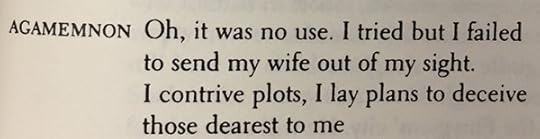
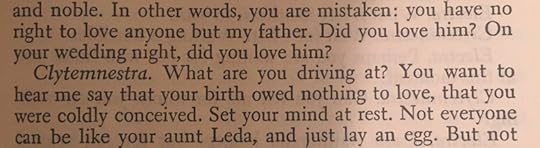
The second half of the book, which has a lot to do Agamemnon and Clytemnestra's relationship is where it took a complete nose dive. Their complex relationship was something that I was really looking forward to seeing how this book tackles-- it is one that I am highly invested in seeing someone finally handle right for once. By this point in the book, though, I knew I had to lower my bar of expectations somewhat, so when, yet again, Clytemnestra's first description is how Sexy she is, I endured it, expecting once we got past that we would get to the interesting stuff. The interesting stuff, however, never comes. Agamemnon goes on to claim that he never loved her, and basically just was obsessed with having sex with her and married her for this+political power. In turn, Clytemnestra later says that she never loved, nor even liked him. Oh really, author? It's at this point I would like to take another glance back at ye old source material.
To name just a few. I would go so far as to say it is a rather vital element of Agamemnon's story that he loved and was loved by his family, as both Iphigenia in Aulis and Agamemnon lose their punch completely if it's just the story of some man who treats his wife and kids bad and then pays for it. Like sure, that is A Story, but it's not the Tragedy those plays are meant to be when you depict it like that.
At this point you now might be saying: well maybe the author didn't WANT to stick to the sources that closely. Maybe he wanted to completely do his own thing! Except for the fact that this book is strangely very accurate in places, and very... not, in others. Here's an example: he decides to work from the version of the story where Agamemnon had Clytemnestra's first husband murdered. As far as I know, the only source for this version is Iphigenia in Aulis, which is written by Euripides-- a playwright who was notoriously hit and miss with his characterization (I'm just saying, there's a reason his plays only won five awards in comparison to the 15/20 that Aeschylus and Sophocles did). Clytemnestra only says about two lines about this in Aulis. So the author obviously read this play, picked out that very specific detail and based a large part of his story for her on it. Fair enough. But in this SAME PLAY, there are many, many lines describing the close father and daughter relationship between Agamemnon and Iphigenia. She talks about how much she loves him, how good he always was to her, notices him trying to hide tears given that he is meant to sacrifice her, etc etc. Yet in the author's book, Agamemnon describes Iphigenia as this burden hoisted upon him, and even goes as far as to give us this choice line: "A girl-- I needed sons. It was too late to have the infant exposed". If this wasn't horrifyingly out of character enough, he also says that it was, "well known" you "rid yourself of a girl-child once they were born". He says this in Sparta. His wife a Spartan princess. You know, in Sparta............................ where the throne was very likely matrilineal at the time???
Me, at this point in the story:
(if you thought this book was all that historically accurate, think again)
Furthering the 'author clearly read up on his stuff, but then made very bad decisions what to do with said stuff' theory is that he does not chose for Iphigenia to even be Agamemnon and Clytemnestra's daughter, but Helen and Theseus' by rape, and which Clytemnestra adopts in secret to save her sister's image. Though this is indeed one version of the myth, there was no real reason he had to chose it-- especially not when it leads some more truly terrible lines, such as suggesting that Helen's rape by Theseus "turned her from a girl into a woman". Big yikes.
All in all I'd give this book one star (in comparison to 0) at least for handling the Atreus-Aerope-Thyestes arc well, but I bump it up to two because in this complete train wreck of a second half, the author actually manages to do something I've seen no modern author do correctly: he depicts there being genuine love between Menelaus and Helen. Menelaus is very often written like an Agamemnon 2.0 in many stories, and a poor version of Agamemnon at that; typically cruel and brutish, especially with his wife, I imagine to play up the false 'Romeo and Juliet' angle of the Paris/Helen story. Actually, Menelaus is one of the kinder and gentler characters we see in the Iliad, and we have plenty of sources that show him and Helen's relationship was both consensual and loving, so this was a very pleasant surprise for me. Good job on that one, author-- why couldn't you have written a book about them instead?

April 24, 2014
This was an intelligent and well written story of Agamemnon, king of Mycenae, in his own words, from boyhood to his accession as king of Mycenae. Agamemnon takes us through his training as a warrior and his first battle [at night, which he remembers later and will use as a tactic in the Trojan War]. Blooded, he receives his greaves and is given the title of Hero. Due to a boyhood incident in which his brother, Menelaus, takes the blame for him and is punished brutally in his stead, he's told by Atreus several years later:
Thus Atreus designates his heir to the throne. We see through the novel both Atreus and Agamemnon are cruel men; no wonder the House of Atreus was cursed! Both men are reprehensible but I could accept them in the context of the novel, still not liking them. Yes, the Trojan War came after the novel and all events following it, but I enjoyed reading about ante-Trojan War for once.
The story follows Agamemnon through both land and sea battles; the author wrote especially well of those using chariots. We see Agamemnon's personal life and the increased responsibilities Atreus gives him:, as envoy; battle leader; Warden of Mycenae; bridegroom to Clytemnestra; and once he is king, his final thoughts of vengeance and how he will use his power since it is now in his grasp:
To Shipway there were plausible explanations for Greek myths; he gave sensible imaginative non-mythical reasons for many of the legends. He laid out his conception of why the Trojan War was really fought. He considered Helen's abduction by Paris only a precipitating factor, analogous to Princip's assassination of the archduke which set off World War One. There had been deep-rooted causes for each.
I recommend this book highly for a different slant on an ancient Greek hero.
"I knew you were guilty and you proved yourself a liar and a crook. You see, Agamemnon, a king must be entirely unscrupulous, ready at need to betray his dearest friend -- even his beloved brother. I think you meet the measure very fairly -- just the kind of ruler our treacherous Heroes need."
Thus Atreus designates his heir to the throne. We see through the novel both Atreus and Agamemnon are cruel men; no wonder the House of Atreus was cursed! Both men are reprehensible but I could accept them in the context of the novel, still not liking them. Yes, the Trojan War came after the novel and all events following it, but I enjoyed reading about ante-Trojan War for once.
The story follows Agamemnon through both land and sea battles; the author wrote especially well of those using chariots. We see Agamemnon's personal life and the increased responsibilities Atreus gives him:, as envoy; battle leader; Warden of Mycenae; bridegroom to Clytemnestra; and once he is king, his final thoughts of vengeance and how he will use his power since it is now in his grasp:
"Nothing was unattainable. Nothing lay beyond my grasp, beyond the reach of Agamemnon, the king."
To Shipway there were plausible explanations for Greek myths; he gave sensible imaginative non-mythical reasons for many of the legends. He laid out his conception of why the Trojan War was really fought. He considered Helen's abduction by Paris only a precipitating factor, analogous to Princip's assassination of the archduke which set off World War One. There had been deep-rooted causes for each.
I recommend this book highly for a different slant on an ancient Greek hero.

January 26, 2013
I loved the book. Apart from being a well written historical novel, one can rarely read a book where the narrator is a dishonorable man and apparently a murderer. Reminded me of Pop. 1280 by Jim Thompson
October 30, 2015
A novel of fiction wonderfully based on ancient history and legend.
5 stars because this book entrapped me. It sent me to maps of Greece and other references. I could not walk away from it! The author put me in early Greece and allowed me to experience of the politics of our evolving civilization.
5 stars because this book entrapped me. It sent me to maps of Greece and other references. I could not walk away from it! The author put me in early Greece and allowed me to experience of the politics of our evolving civilization.

November 13, 2012
Another Shipway novel that I first read back in the mid-1980s. "Warrior in Bronze" follows the career of Agamemnon up to the point where the backstory of the Iliad begins, up to the decision to sail for Troy. While Shipway is very good at setting up the Mycenaean world and introducing the characters who'll one day become the heroes of the Iliad and the Oresteia, the tale here does tend to drag a bit--- the reader knows that Agamemnon will lead the Hellenes to Troy, and they know what will happen to Achilles, to Hektor, and to Agamemnon himself, and there's always a feeling that the main story, the real story, is waiting to be told. Nonetheless, not a bad read. Shipway is always worth reading--- a fine historical novelist, and one who's been overlooked.

May 9, 2019
This one's been on my recommendation list for a little while and decided to give it a go and see what Mr. Shipway had to say about Agamemnon and the run-up to the Trojan War. I have to say, very interesting and impressive when considering the book was written and the ability to research back then (it's hard to beat a good education).
I'll open by saying this not re-written classical stories or the tying together of a few classical stories, Mr. Shipway has taken ancient Greek/Mycenae stories/myth and revisioned them. This is fascinating because you see things through Agamemnon's knowledge and thoughts and at some points the world is almost upside down. Here the gods (in general) and heroes are people who've done things in the "world". Zeus and Poseidon were people who lead migrations to Greece and became the leaders of people there. Hercules is a warrior and force along with Jason and others. This makes for good story telling as long as you flow with it (for the record I have though I was checking several people/events in his book and while Mr. Shipway's story may be a little different than modern interpretation, I generally like his take). Combats are a part of the storyline (this is the ancient world and this is Agamemnon) but honestly the violence is in line with how Mr. Cornwell tells his stories.
Rating wise it really depends on what you're looking for. The story is entertaining but sometimes I wasn't feeling the love, other times it rocks! What I will say is I believe Mr. Shipway has delivered a believable story about what made Agamemnon and the general environment of Mycenae Greece, this gives it a plus no matter what and to me is worthy of 4 stars but doesn't meet my 5 star rating.
I'll open by saying this not re-written classical stories or the tying together of a few classical stories, Mr. Shipway has taken ancient Greek/Mycenae stories/myth and revisioned them. This is fascinating because you see things through Agamemnon's knowledge and thoughts and at some points the world is almost upside down. Here the gods (in general) and heroes are people who've done things in the "world". Zeus and Poseidon were people who lead migrations to Greece and became the leaders of people there. Hercules is a warrior and force along with Jason and others. This makes for good story telling as long as you flow with it (for the record I have though I was checking several people/events in his book and while Mr. Shipway's story may be a little different than modern interpretation, I generally like his take). Combats are a part of the storyline (this is the ancient world and this is Agamemnon) but honestly the violence is in line with how Mr. Cornwell tells his stories.
Rating wise it really depends on what you're looking for. The story is entertaining but sometimes I wasn't feeling the love, other times it rocks! What I will say is I believe Mr. Shipway has delivered a believable story about what made Agamemnon and the general environment of Mycenae Greece, this gives it a plus no matter what and to me is worthy of 4 stars but doesn't meet my 5 star rating.

September 10, 2018
George Shipway (1908-82) was an excellent British historical novelist, whose strengths include a strong realism, and whose cavalry background made him well qualified to write about military matters. Not for Mr Shipway the clouds of mythology; the nasty, brutish and short side of life in ancient times is presented without romanticisation, to an extent that almost makes you feel you’re reading eye-witness accounts.
Warrior in Bronze is the story of Agamemnon, King of Mycenæ, told in the first person from the time of his youth to shortly before that of the Trojan War. The account does not invoke any interventions by supernatural beings (although of course all the characters believe in their own gods); rather, the narration is cleverly constructed of secular events that might easily have given rise to the myths we all know.
Looked at objectively, the protagonist is in many ways an abominably selfish person; but he pales by comparison with some of his rivals for power (such as Thyestes).
The Machiavellian manœuvrings of all these, told in a lively narrative style, supported by very clear maps and family trees, form the most gripping fictionalised account of this era that I’ve yet read.
There is a sequel: King in Splendour.
Warrior in Bronze is the story of Agamemnon, King of Mycenæ, told in the first person from the time of his youth to shortly before that of the Trojan War. The account does not invoke any interventions by supernatural beings (although of course all the characters believe in their own gods); rather, the narration is cleverly constructed of secular events that might easily have given rise to the myths we all know.
Looked at objectively, the protagonist is in many ways an abominably selfish person; but he pales by comparison with some of his rivals for power (such as Thyestes).
The Machiavellian manœuvrings of all these, told in a lively narrative style, supported by very clear maps and family trees, form the most gripping fictionalised account of this era that I’ve yet read.
There is a sequel: King in Splendour.

August 6, 2016
Absolutely loved this! Like many, I am very familiar with the events of the Trojan war but had never considered what lead to this, what really motivated the main players.
This book supplies a plausible and entertaining prequal to the well known Trojan war. In the tales of which, Agamemnon is pretty much a side note, we know next to nothing about him.
So I thoroughly enjoyed this story as something I'd not thought about before. Told in the first person, the story unfolds through Agamemnon's eyes. Beginning with his childhood, we see him develop from a bored young prince to a battle hardened, intelligent king, dealing with tragedy, betrayal, utter brutality and monumental disappointment. Times are hard and life is cheep. Even princes and heroes risk and lose their lives in the heart of battle or when betrayed by those they trust.
I was glued from the first page and highlighted several sections because the turn of phrase was so charming and evocative.
There is more to the tale, Agamemnon lives on and I'd be happy to read more from this author.
FIVE stars!
This book supplies a plausible and entertaining prequal to the well known Trojan war. In the tales of which, Agamemnon is pretty much a side note, we know next to nothing about him.
So I thoroughly enjoyed this story as something I'd not thought about before. Told in the first person, the story unfolds through Agamemnon's eyes. Beginning with his childhood, we see him develop from a bored young prince to a battle hardened, intelligent king, dealing with tragedy, betrayal, utter brutality and monumental disappointment. Times are hard and life is cheep. Even princes and heroes risk and lose their lives in the heart of battle or when betrayed by those they trust.
I was glued from the first page and highlighted several sections because the turn of phrase was so charming and evocative.
There is more to the tale, Agamemnon lives on and I'd be happy to read more from this author.
FIVE stars!

June 6, 2017
Absolutely amazing. I am so glad I read this book. A testament to the older ways of writing, this book balances wonderfully descriptive text with great storytelling and character development. My only regret is that the sequel has not been re-issued and I'm looking at $60 for a copy unless I join the dark side of the force (Kindle). I can only hope I enjoy other historical fiction reads this much. If you can find yourself a copy of this please take it, it's a must have.

September 2, 2008
Great read!
January 23, 2016
Interesting
I enjoyed reading this book as it kept me coming back for more. I will be looking forward to the next book.
I enjoyed reading this book as it kept me coming back for more. I will be looking forward to the next book.

December 26, 2019
OTOH, this was relatively well-researched in terms of knowing the myth (and what was known about the Mycenaean period at the teim), but OTOH, it felt *very* dated. Yeah, sure, historicals are supposed to feel dated...they're historicals. But Shipway was obviously a man of his era and couldn't climb out of it enough to make this novel stand the test of time. Shipway was born in 1908 (in India, when it was still a Crown possession) and fought in both world wars. So there's a *lot* of Imperial British attitude coming through.
The three stars are for the military aspects and general research accuracy but I can't give it higher because I couldn't make myself care about the characters, and not just because they're all pretty much d*cks. Readers know that going in. Agamemnon is not a good guy. But I wanted more insight into WHY he turned out to be such a bad guy. Despite the use of first person, the characterization is flat. We don't get much emotion from him. British stiff upper lip, but that's OUTside. Agamemnon was stiff through-and-through, despite the "passion" of his violence and his sexual attraction. His relationship with his father made more sense than the one with his brother, which appears to have been written as "close" just because they're supposed to be. Agamemnon treats him pretty badly.
The women, overall, were boring (even Clytemnestra) and/or plot devices to write sex scenes that (for the 70s) would have qualified as pretty racy. I didn't have any expectation there would be gay content, but the continual focus on the women as sex objects bored the gay guy after a while. You gotta do more with women as characters, because making them just "hot" doesn't do it for me. The female characters exist only to forward the plots of the male characters.
And that's a good example of how the book is dated. So while I appreciated some parts of it, ultimately, it wasn't satisfying and I doubt I'll read the sequel. I'm a little miffed that I spent my holiday free time on this instead of something I'd have liked better.
I'll end by pointing out that he's a contemporary of Mary Renault, and this book really shows how much more advanced for her day her thinking was. I may bitch sometimes about how Renault treats women in her novels, but when set next to Shipway, it's obvious it's part of a general trend of the time. And for all that Renault's style of writing is closer to Shipway's than most modern authors of historical fiction, hers is still readable in a way his really isn't.
The three stars are for the military aspects and general research accuracy but I can't give it higher because I couldn't make myself care about the characters, and not just because they're all pretty much d*cks. Readers know that going in. Agamemnon is not a good guy. But I wanted more insight into WHY he turned out to be such a bad guy. Despite the use of first person, the characterization is flat. We don't get much emotion from him. British stiff upper lip, but that's OUTside. Agamemnon was stiff through-and-through, despite the "passion" of his violence and his sexual attraction. His relationship with his father made more sense than the one with his brother, which appears to have been written as "close" just because they're supposed to be. Agamemnon treats him pretty badly.
The women, overall, were boring (even Clytemnestra) and/or plot devices to write sex scenes that (for the 70s) would have qualified as pretty racy. I didn't have any expectation there would be gay content, but the continual focus on the women as sex objects bored the gay guy after a while. You gotta do more with women as characters, because making them just "hot" doesn't do it for me. The female characters exist only to forward the plots of the male characters.
And that's a good example of how the book is dated. So while I appreciated some parts of it, ultimately, it wasn't satisfying and I doubt I'll read the sequel. I'm a little miffed that I spent my holiday free time on this instead of something I'd have liked better.
I'll end by pointing out that he's a contemporary of Mary Renault, and this book really shows how much more advanced for her day her thinking was. I may bitch sometimes about how Renault treats women in her novels, but when set next to Shipway, it's obvious it's part of a general trend of the time. And for all that Renault's style of writing is closer to Shipway's than most modern authors of historical fiction, hers is still readable in a way his really isn't.

May 14, 2018
I mostly enjoyed this book, which chronicles the life of Agamemnon, in his own words, from his youth to his becoming king of Mycenae, a span of about 30 years in the early 13th century BCE.
I particularly enjoyed the idea of the Greek mythology we're familiar with (Zeus, Poseidon, Dionysus and the rest) being based on real people, but transformed into gods after centuries of bardic tales and worship by the common folk. Zeus, according to this story, was the leader of the Achaeans who invaded from Crete and conquered Achaea.
Some less pleasant aspects include sexism (which doesn't seem surprising from a Bronze Age nobleman, but still, probably shouldn't ever refer to women as a "sheath") and my unease at reading about the sect of Scribes, which are described as hook-nosed and swarthy and worship a private god named something like "Jawah (I don't remember exactly how it's spelled).
While Agamemnon befriends one Scribe and gives him increased responsibility as Agamemnon also ascends, I can't help but feel like it's not the most politically correct way to write about a group of Jewish people who were brought from Egypt to Crete to Greece in order to keep accounts for the illiterate Achaean nobility.
These two minor problems may be due to the book, if I remember correctly, originally being published in 1977 by a British author born in 1908.
In any event, a mostly enjoyable read if you like Bronze Age adventure.
I particularly enjoyed the idea of the Greek mythology we're familiar with (Zeus, Poseidon, Dionysus and the rest) being based on real people, but transformed into gods after centuries of bardic tales and worship by the common folk. Zeus, according to this story, was the leader of the Achaeans who invaded from Crete and conquered Achaea.
Some less pleasant aspects include sexism (which doesn't seem surprising from a Bronze Age nobleman, but still, probably shouldn't ever refer to women as a "sheath") and my unease at reading about the sect of Scribes, which are described as hook-nosed and swarthy and worship a private god named something like "Jawah (I don't remember exactly how it's spelled).
While Agamemnon befriends one Scribe and gives him increased responsibility as Agamemnon also ascends, I can't help but feel like it's not the most politically correct way to write about a group of Jewish people who were brought from Egypt to Crete to Greece in order to keep accounts for the illiterate Achaean nobility.
These two minor problems may be due to the book, if I remember correctly, originally being published in 1977 by a British author born in 1908.
In any event, a mostly enjoyable read if you like Bronze Age adventure.

October 22, 2020
This was a fairly interesting story and it provided a different take on some aspects of Greek mythology. The biggest problem I had with it was I couldn't bring myself to admire or care for the main character, Agamemnon. Other than the author's portrayal of some of his good judgement, he just didn't have many good qualities in the book. It was hard to really care what happened to him.
March 3, 2018
Intrigue at the best
The intrigues that are shown in this story are of today .Fantastic writing worth the second read as I have.
The intrigues that are shown in this story are of today .Fantastic writing worth the second read as I have.
September 25, 2018
I liked it. Good story and subject matter. Enough energy to keep a reader engaged. And enough plot to make it interesting. I will most likely read the second book in the series as well.
December 14, 2019
great book, characters were great.
February 4, 2020
Took me a while to get into this book but once I did, I didnt put it down...I like the way Shipway is giving another angle for the Trojan War....I have already started the next book.

May 16, 2023
Entertaining light read - a fictionalised account of the early life of King Agamemnon prior to the Trojan War.

January 11, 2024
I enjoyed this retelling immensely. It is written in Agamemnon's voice and many of his comments are sarcastically funny, if you know the original tale.
December 9, 2015
Genius writing
If you enjoy Ancient Greek history this is the ideal story for you. It is written in first person style and you feel as if you are getting to know Agamemnon better and better throughout the book. You probably won't like him or any other of this cast of characters, but that is what life was like back then - a struggle to survive and an almost impossible struggle to obtain power and keep it for very long.
There's none of the superpower characters here, no mythical creatures, no Gods, no hyperbole, just a well researched interpretation of history. And it is presented in detail with genius descriptive narration.
If you enjoy Ancient Greek history this is the ideal story for you. It is written in first person style and you feel as if you are getting to know Agamemnon better and better throughout the book. You probably won't like him or any other of this cast of characters, but that is what life was like back then - a struggle to survive and an almost impossible struggle to obtain power and keep it for very long.
There's none of the superpower characters here, no mythical creatures, no Gods, no hyperbole, just a well researched interpretation of history. And it is presented in detail with genius descriptive narration.

January 31, 2016
Real Agamemnon
The author presents the tale of inmortal Agamemnon, without the legends and giving a sound and solid argument to the story of this greek hero. Starting with his childhood under the wing of cursed king Atreus, the book lead us with a more human narration, more cynical but solid and full of passions.
The author presents the tale of inmortal Agamemnon, without the legends and giving a sound and solid argument to the story of this greek hero. Starting with his childhood under the wing of cursed king Atreus, the book lead us with a more human narration, more cynical but solid and full of passions.
October 22, 2015
Great on-the-ground, "you are there" perspective on Greek history. The "gods" as we were taught them are people in this story, some of them legends. Verging on anachronism, especially the language ... and that makes it vivid and identifiable. I'll read the second book.

November 2, 2015
Good story though a bit confusing at times with all the names. I wish it was a bit better researched. e.g. corn did not get to Europe till the 15th or 16th century.
However, it is a good read and want to read the rest of the series.
However, it is a good read and want to read the rest of the series.
April 20, 2016
Great Rewrite of the Classics
The author has cleverly with great skill rewritten the ancient stories of Greece. His work has captured a realistic view of the ancient cities, the people who lived there, and the political conflicts of the times.
The author has cleverly with great skill rewritten the ancient stories of Greece. His work has captured a realistic view of the ancient cities, the people who lived there, and the political conflicts of the times.

May 29, 2016
Agamemnon, of Greek mythology, has grown up as the son of a king and must learn what Kings will do and prove himself. This is an interesting story depicting palace intrigues, travel, battles, and the life of a king-to-be in Ancient Greece.

February 9, 2013
Historically accurate. Great novel, I've read it three times in the past 20 years and enjoyed every time.

April 28, 2013
El joven Agamenon sufrirá mucho antes de poder ser coronado rey de Micenas. La traición, el asesinato y la venganza le ayudarán en ese camino y lo prepararán convenientemente para su asalto a Troya.
February 6, 2016
Treachery and torture
Just not my cup of tea. Although it is easy to imagine that men lived and died that way, for my entertainment I find it too grisly.
Just not my cup of tea. Although it is easy to imagine that men lived and died that way, for my entertainment I find it too grisly.
Displaying 1 - 30 of 31 reviews