

What do you think?

The Thief Taker #4
The Changeling Murders
Abduction. Murder. A conspiracy that could bring down the King.
London, 1667: In the wake of the Great Fire, a new city has emerged from the flames. The King has reopened the capital’s theatres, and the royal court is hell-bent on debauched entertainment. But amid the raucous festivities, an actress shows up dead, dressed in the clothes of a missing girl.
It’s a time of great change for thief taker Charlie Tuesday too: his old flame, Maria, is on the cusp of marrying someone else. But when she is abducted on the way to her wedding, Charlie realises her disappearance is linked to the murder.
Meanwhile, as Lent draws to a close, London is exploding into shocking riot. With brothels and theatres being attacked, Charlie and his sidekick Lily must find clues before an angry mob does. And as the mystery deepens and violence fills the streets, can Charlie solve a riddle that threatens not just Maria, but London itself?
London, 1667: In the wake of the Great Fire, a new city has emerged from the flames. The King has reopened the capital’s theatres, and the royal court is hell-bent on debauched entertainment. But amid the raucous festivities, an actress shows up dead, dressed in the clothes of a missing girl.
It’s a time of great change for thief taker Charlie Tuesday too: his old flame, Maria, is on the cusp of marrying someone else. But when she is abducted on the way to her wedding, Charlie realises her disappearance is linked to the murder.
Meanwhile, as Lent draws to a close, London is exploding into shocking riot. With brothels and theatres being attacked, Charlie and his sidekick Lily must find clues before an angry mob does. And as the mystery deepens and violence fills the streets, can Charlie solve a riddle that threatens not just Maria, but London itself?
366 pages, Kindle Edition
First published May 24, 2018
About the author
C.S. Quinn
9 books287 followersC.S. Quinn is a travel and lifestyle journalist for The Times, The Guardian and The Mirror, alongside many magazines. Prior to this, Quinn's background in historic research won prestigious postgraduate funding from the British Art Council. Quinn pooled these resources, combining historical research with first-hand experiences in far-flung places to create The Thief Taker's London.
Ratings & Reviews
Friends & Following
Create a free account to discover what your friends think of this book!
Community Reviews
Displaying 1 - 30 of 65 reviews

June 14, 2018
London 1667, and Charlie Tuesday, (thief taker) is right on the case when former lover Maria is abducted on the way to her wedding. However, to secure her release he will have to discover the whereabouts of the 'Lord and Lady'. This will be no easy task, as no word of them has been heard since their disappearance during the reign of Cromwell. Some believe they were burned along with Royalist supporters, but others say that their special magical powers enabled them to escape.
London lies in ruins after the great fire of 1666, a fire that swept through the central part of this medieval city, leaving businesses and homes completely destroyed and the air filled with death and destruction. Charles II doesn’t have the funds to rebuild, and the social and economic problems that his people suffer go unnoticed by him. However, he appears to throw money readily at the theatres which are a hotbed of debauchery. His long time lover and former prostitute Lady Castlemaine, is determined to have her share of the King’s money too.
Amidst all this comes the apprentice riots where whorehouses are attacked along with the prostitutes who ply their trade there. This is a dangerous time for the King, where an accumulation of events could lead to his downfall.
Charlie’s partner Lily joins him in his search for Maria and the Lord and Lady - a search that will immerse them in the world of changelings and fairy folk, together with some truly nasty individuals with murder in mind.
It’s clear that C. S. Quinn has carried out extensive research into this turbulent period in history, and she has written a tale full of atmosphere, that ensures the reader is fully entertained throughout.
*Thank you to Netgalley and Amazon Publishing UK for my ARC, I have given an honest unbiased review in exchange*
London lies in ruins after the great fire of 1666, a fire that swept through the central part of this medieval city, leaving businesses and homes completely destroyed and the air filled with death and destruction. Charles II doesn’t have the funds to rebuild, and the social and economic problems that his people suffer go unnoticed by him. However, he appears to throw money readily at the theatres which are a hotbed of debauchery. His long time lover and former prostitute Lady Castlemaine, is determined to have her share of the King’s money too.
Amidst all this comes the apprentice riots where whorehouses are attacked along with the prostitutes who ply their trade there. This is a dangerous time for the King, where an accumulation of events could lead to his downfall.
Charlie’s partner Lily joins him in his search for Maria and the Lord and Lady - a search that will immerse them in the world of changelings and fairy folk, together with some truly nasty individuals with murder in mind.
It’s clear that C. S. Quinn has carried out extensive research into this turbulent period in history, and she has written a tale full of atmosphere, that ensures the reader is fully entertained throughout.
*Thank you to Netgalley and Amazon Publishing UK for my ARC, I have given an honest unbiased review in exchange*

June 1, 2018
This is the 4th in this historical series featuring London Thieftaker Charlie Tuesday set during the 17th century restoration period of 1667. It is the first book I have read and it worked just fine as a standalone. Quinn's richly detailed descriptions conjures an atmospheric picture of a anarchic London where the simmering seeds of unrest have broken out into pockets of outright rebellion against the king. The Great Fire has laid waste to much of the city and Charles II has no money to rebuild, poverty and squalor is rampant, and paranoia reigns with spies everywhere. People are disgusted and disenchanted at what they see as money spent on his mistress, Lady Castlemaine, formerly a prostitute, manipulating to secure her precarious position, ruthless in her determination to eliminate all threats. Charles is indeed The Merry Monarch with his debauchery laid bare, his support of the theatres which are a hotbed of prostitution, alienating the Puritans and those who supported Cromwell. Quinn writes a tale of the supernatural, malevolent fairies, changelings, abduction and murder that threatens the King.
Maria is on her way to her to her wedding ceremony when she is abducted and imprisoned. She is a former lover of Charlie Tuesday, famed thieftaker and a dead body dressed in Maria's clothes is discovered in a theatre. If Maria is to be saved, Charlie must find the Lord and Lady who escaped burning and Cromwell, before Lent. A desperate Charlie tries to work out who the Lord and Lady are, where they are now, before others who want to get to them before him. Charlie finds himself in a world of soothsayers, fairies and changelings, a mysterious dress that is linked to a whorehouse, and a clue to the location of the Lord and Lady. London has been divided between 3 bawdy houses, Mrs Jenks who serves the well off, Mother Mitchell whom Charlie grew up with and the black ex-slave Damaris Paige, serving sailors and the poor. Praise-God Barebones is leading a growing army of apprentices intent on bringing down the whorehouses and theatres but he has a secret agenda behind the attacks he is leading but will he dare to challenge the king by encroaching on people and institutions that have the King's support? Charlie is joined by Lily Boswell, who fights beside him as he tries to locate the Lord and Lady before Maria is killed.
Quinn writes compelling and gripping historical fiction of a London in a turbulent time, subject to elements of superstition and a monarchy that is hellbent on overturning the austere Puritanism that had held sway in the country in the recent past. Charles is failing his subjects, flaunting his liaisons with prostitutes, supporting theatres and lacking the funds to defend himself or rebuild London. It is little wonder that his reign faces threats from numerous directions. Charlie has an understanding of London streets and those who live there that holds him in good stead as he battles to find Maria. His adventures make for a rip roaring yarn of myths and legends, a king living in fear, spies and murder. This is an entertaining novel that holds a reader's interest with ease. Many thanks to Amazon Publishing UK for an ARC.
Maria is on her way to her to her wedding ceremony when she is abducted and imprisoned. She is a former lover of Charlie Tuesday, famed thieftaker and a dead body dressed in Maria's clothes is discovered in a theatre. If Maria is to be saved, Charlie must find the Lord and Lady who escaped burning and Cromwell, before Lent. A desperate Charlie tries to work out who the Lord and Lady are, where they are now, before others who want to get to them before him. Charlie finds himself in a world of soothsayers, fairies and changelings, a mysterious dress that is linked to a whorehouse, and a clue to the location of the Lord and Lady. London has been divided between 3 bawdy houses, Mrs Jenks who serves the well off, Mother Mitchell whom Charlie grew up with and the black ex-slave Damaris Paige, serving sailors and the poor. Praise-God Barebones is leading a growing army of apprentices intent on bringing down the whorehouses and theatres but he has a secret agenda behind the attacks he is leading but will he dare to challenge the king by encroaching on people and institutions that have the King's support? Charlie is joined by Lily Boswell, who fights beside him as he tries to locate the Lord and Lady before Maria is killed.
Quinn writes compelling and gripping historical fiction of a London in a turbulent time, subject to elements of superstition and a monarchy that is hellbent on overturning the austere Puritanism that had held sway in the country in the recent past. Charles is failing his subjects, flaunting his liaisons with prostitutes, supporting theatres and lacking the funds to defend himself or rebuild London. It is little wonder that his reign faces threats from numerous directions. Charlie has an understanding of London streets and those who live there that holds him in good stead as he battles to find Maria. His adventures make for a rip roaring yarn of myths and legends, a king living in fear, spies and murder. This is an entertaining novel that holds a reader's interest with ease. Many thanks to Amazon Publishing UK for an ARC.

June 22, 2020
London 1667, and Maria was on her way to be wed when she was abducted. It was the beginning of a terrible time of rioting and death in London and King Charles was in the midst of it all. But it was Charlie Tuesday, the thief taker, who led the search for Maria. Charlie was joined by Lily and the two of them searched far and wide for the lost Lord and Lady, rumoured to have been whisked away in Cromwell’s time. If they were to find the Lord and Lady, perhaps they would find Maria. They had until the conclusion of Lent before Maria was to be put to death…
The Changeling Murders is the 4th in The Thief Taker series and the first I’ve read by C.S. Quinn. Different, intriguing, filled with bawdy houses, whores and much more, the pace was brisk, the tension gripping – recommended.
The Changeling Murders is the 4th in The Thief Taker series and the first I’ve read by C.S. Quinn. Different, intriguing, filled with bawdy houses, whores and much more, the pace was brisk, the tension gripping – recommended.

May 7, 2018
4 stars
Charlie Tuesday, thief-taker, is following a carriage. Meanwhile, his former beloved Maria is being kidnapped on the day of her wedding. When Charlie runs into Percy Berry, Maria’s fiancé, in a theatre, he asks how Maria is doing. Percy replies that Maria never showed up for their wedding.
Lady Castlemaine, consort of King Charles, is dead set against the theater and whores. She supports the Lenten observation of London’s apprentices vandalizing the theaters in an orgy of violence. The King, however, feels differently. With his actress friends and his penchant for debauchery, he opposes Lady Castlemaine’s attitudes.
Lily, Charlie’s partner joins in the hunt for the lost artifacts and Maria. Searching for the artifacts, they run into severe trouble. The apprentices are drunk – and they’ve found Charlie and Lily in an old theater. What follows is an exciting chase through the old theaters of London and the eventual capture of the bad guys – and the restoration of the artifacts.
There is a hint of the supernatural in this book. It is well-played out and scripted. The book is well written and plotted. It is exciting and reads linearly. That is to say, one event follows another logically. I liked Charlie and Lily. They make a good team. I didn’t care for the Percy character so much. I cannot fathom why Maria would prefer him over Charlie. Perhaps because he is a “respectable” lawyer where Charlie is just a poor man trying to eke out a living. Perhaps there is more in the cards for Charlie and Lily – stay tuned.
I want to thank NetGalley and Thomas & Mercer for forwarding to me a copy of this book to read, enjoy and review.
Charlie Tuesday, thief-taker, is following a carriage. Meanwhile, his former beloved Maria is being kidnapped on the day of her wedding. When Charlie runs into Percy Berry, Maria’s fiancé, in a theatre, he asks how Maria is doing. Percy replies that Maria never showed up for their wedding.
Lady Castlemaine, consort of King Charles, is dead set against the theater and whores. She supports the Lenten observation of London’s apprentices vandalizing the theaters in an orgy of violence. The King, however, feels differently. With his actress friends and his penchant for debauchery, he opposes Lady Castlemaine’s attitudes.
Lily, Charlie’s partner joins in the hunt for the lost artifacts and Maria. Searching for the artifacts, they run into severe trouble. The apprentices are drunk – and they’ve found Charlie and Lily in an old theater. What follows is an exciting chase through the old theaters of London and the eventual capture of the bad guys – and the restoration of the artifacts.
There is a hint of the supernatural in this book. It is well-played out and scripted. The book is well written and plotted. It is exciting and reads linearly. That is to say, one event follows another logically. I liked Charlie and Lily. They make a good team. I didn’t care for the Percy character so much. I cannot fathom why Maria would prefer him over Charlie. Perhaps because he is a “respectable” lawyer where Charlie is just a poor man trying to eke out a living. Perhaps there is more in the cards for Charlie and Lily – stay tuned.
I want to thank NetGalley and Thomas & Mercer for forwarding to me a copy of this book to read, enjoy and review.

May 21, 2018
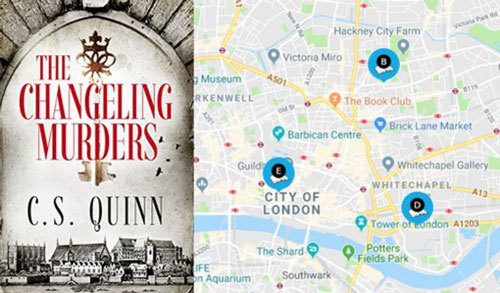
Visit the locations in the novel
Soot, debauchery and talk of changelings .... a journey back in time to 1667 London grab you? It should as it's fine fine fine!
Have a wet wipe to hand when you read this book as you’ll need to wipe yourself clean from all the stench and soot of London to come from its pages. I haven’t felt so immersed and in need of a wash after reading a novel in a long time and I mean that as a lovely complement! London is the den of debauchery and even those not in the opium dens or the whorehouses have to trudge the gritty, dirty streets to try and make a living, if not even just to survive.
Now that’s not all. This novel is the fourth in a series but I haven’t read the others and I didn’t feel I was missing out until the end of the book when I wondered why I hadn’t read the rest of this heart-pumping series. The theatre world was just fascinating and jaw-dropping both in detail and fantasy. There were threads of a magical and supernatural presence, which, for me, took the novel to an even better place. These illegal theatres just gave me a thrill reading about them and stepping inside, experiencing a world that the author has crafted with care and a mean glint in her eye.
If you love historical fiction, you’ll get goosebumps. If you don’t, you’ll get goosebumps and a new genre to get stuck into. The changeling murders is fascinating, wonderfully evoked and I haven’t even touched upon the changelings themselves…the fairy folk….now that really is something you have to discover for yourself, or is it that they will discover you?

July 20, 2018
Another fantastic addition to the series.
I have been utterly enchanted with this series since book 1. Each novel is beautifuly written and well researched, everything about it transports you back in time and you get lost in the charchters, places and plot.
Congratulations on a great novel a must read for all xx
I have been utterly enchanted with this series since book 1. Each novel is beautifuly written and well researched, everything about it transports you back in time and you get lost in the charchters, places and plot.
Congratulations on a great novel a must read for all xx

May 9, 2018
This is a wonderful and entertaining series. In the 4th volume, Charlie Tuesday is as sharp as ever, even when the case gets personal. Maria, who may or may not be his true love, has been abducted and, to release her, Charlie needs to find a mysterious Lord and Lady who could bring the King down. Of course, he is not the only one looking, and not everybody agrees over what should be done if these figures are found. Some want the king overthrown. Charlie just wants Maria back so he teams up with Lily to find her (come on, Charlie, Lily is the real deal… stop pining over Maria and just get with her ASAP!). The research that goes into the historical part of the novels is palpable, and the descriptions of the background so complete that you feel like you are walking in XVII Century London. But it’s the non-stop action that reminds me of old-fashioned adventure serials. Every chapter ends in a cliffhanger, so it’s easy to fall into the “one more chapter before I go to bed” circle until the plot has reached its conclusion. There are unexpected twists, and some more details of Charlie’s mysterious past. I wouldn’t like to live in these novels, but I like to visit Charlie as often as possible.
I chose to read this book and all opinions in this review are my own and completely unbiased. Thank you, NetGalley/Thomas & Mercer!
I chose to read this book and all opinions in this review are my own and completely unbiased. Thank you, NetGalley/Thomas & Mercer!

May 25, 2018
Another solid entry in the Thief Taker series of historical crime fiction, The Changeling Murders takes us back to London in 1667, and our by now familiar protagonist Charlie Tuesday is drawn into the hunt for the mysterious Lord and Lady when his old flame Maria is abducted on the way to her wedding. Without knowing who or what the Lord and Lady are, he faces an uphill battle ,even with the help of his sidekick Lily, recently returned from a life on the high seas. The clock is ticking , and Lent draws to a close and riots rock the city , time is running out. Little does Tuesday realise that more than just the fate of Maria is at stake, the City and even the King lie in the balance.
As with my previous foray into this series, I raced through this book, every revelation making me want to know more. While the fast pace rarely lets up, the author never sacrifices character or historical detail, and I found myself completely immersed in the world she had recreated. Once again she cleverly weaves background from the previous books into the narrative, so that a reader picking up this book without having read the rest of the series would not have any difficulty keeping up, in fact their only difficulty, like mine, might be putting the book down.
I read an advance copy courtesy of NetGalley and the publisher, all opinions are my own
As with my previous foray into this series, I raced through this book, every revelation making me want to know more. While the fast pace rarely lets up, the author never sacrifices character or historical detail, and I found myself completely immersed in the world she had recreated. Once again she cleverly weaves background from the previous books into the narrative, so that a reader picking up this book without having read the rest of the series would not have any difficulty keeping up, in fact their only difficulty, like mine, might be putting the book down.
I read an advance copy courtesy of NetGalley and the publisher, all opinions are my own

June 14, 2018
Three point five stars
As much as I've enjoyed this series and the creative writing of C.S. Quinn, this fourth book of the series was a bit hard to sink my teeth into.
The thief taker Charlie Tuesday 's story continues after London 's Great Fire as the woman he loves, Mary, is about to be married to another and is kidnapped on her way to the altar. It is up to Charlie to find a lord and a lady in order to save her.
Unfortunately, I found the plot extremely convoluted with an abundance of secondary and minor characters who distracted from the storyline. I took an inordinate amount of my time looking back to recall who was whom and what their purpose might be. The historical accuracy of the 17th century era post-Cromwell was interestingly employed, but with so much going on and so many characters added to enforce the plot of fairies and magic and riots and motivations ascribed to each it became almost a chore to keep it all straight.
All comes together and gels into an interesting finish, but the story took too many roads to get there. This wasn't a smooth read and I, several times, found myself going back to re-read in attempt to ascertain who a character was and how they might fit into the plot as well as grasp the fairy myths and their application.
Given the very creative mind of the author, having now finished the entire book, I see how it all results into a big finish but the plot up to the grand finale is messy.
I would recommend this book to readers of historical fiction as an important link to an otherwise good series and look forward to the next book of the 'Thief Taker' series. Books one through three are very good. I believe it was worth trudging through this fourth book of the series, although not as good. The end justified the messy means!
As much as I've enjoyed this series and the creative writing of C.S. Quinn, this fourth book of the series was a bit hard to sink my teeth into.
The thief taker Charlie Tuesday 's story continues after London 's Great Fire as the woman he loves, Mary, is about to be married to another and is kidnapped on her way to the altar. It is up to Charlie to find a lord and a lady in order to save her.
Unfortunately, I found the plot extremely convoluted with an abundance of secondary and minor characters who distracted from the storyline. I took an inordinate amount of my time looking back to recall who was whom and what their purpose might be. The historical accuracy of the 17th century era post-Cromwell was interestingly employed, but with so much going on and so many characters added to enforce the plot of fairies and magic and riots and motivations ascribed to each it became almost a chore to keep it all straight.
All comes together and gels into an interesting finish, but the story took too many roads to get there. This wasn't a smooth read and I, several times, found myself going back to re-read in attempt to ascertain who a character was and how they might fit into the plot as well as grasp the fairy myths and their application.
Given the very creative mind of the author, having now finished the entire book, I see how it all results into a big finish but the plot up to the grand finale is messy.
I would recommend this book to readers of historical fiction as an important link to an otherwise good series and look forward to the next book of the 'Thief Taker' series. Books one through three are very good. I believe it was worth trudging through this fourth book of the series, although not as good. The end justified the messy means!
June 21, 2018
The event rich 17th century in the United Kingdoms, England, Scotland, Ireland and Wales was as important, if not more so, to the story of how Great Britain became the country it is, as the years of Henry Tudor and his marital problems. The trials of this single century included regicide, daring and often comical escapes, government by an austere Protestant tyrant, and finally restoration of the legitimate monarch. The Changeling Murders is set in last third of this period. After the return of Charles the 2nd from France, many, many things changed. Not only was it possible to celebrate Christmas but the theatres and bawdy houses were once again open to those seeking these kinds of entertainments. This included the King himself.
The city of London was growing at an outrageous rate. The devastations of the plague and the Great Fire of 1666 caused barely a hiccup in this population rampage. The desperate poor were everywhere and, as no regular law enforcement existed, petty thievery and even murder were everyday occurrences. Within the mire of London’s stews and alleys, its stinking markets, its theatres, pubs and brothels, our protagonist Charlie Tuesday found his livelihood. He was a thief-taker, a private individual hired to capture criminals. While our Charlie may have been reasonably successful at his profession, his personal life was a mess. Divorced from Lynette, a successful comedic actress, hated by the Romany pirate, Lily Boswell and rejected by Maria, who had left him to marry a lawyer, he nonetheless retained the belief that he must help everybody.
When Maria goes missing on the way to her wedding, the prospective bridegroom, Percy Berry, and Charlie form an awkward and unlikely partnership to find the missing woman. An ominous note warns that if they do not find ‘The Lord and Lady’ before the end of Lent, she will die. The note was signed Tom Black.
Now the chase is on. Charlie must figure out who are the Lord and Lady referenced, who is Tom Black and what does he have to do with all of the this. Even as the answers insist on changing into more questions as soon as they are found, another deadly challenge begins surging through the streets and bawdy houses, the Lenten rampage of the Apprentices. This holdover from the Puritan rule of Cromwell’s time, usually an occasion of a few knocked heads and battered doors, has in this year, become a riotous mob of angry workers and starving poor determined to demonstrate their anger with the King by attacking the things he seems to care most about. To describe more of the dense tangle of events, risks giving away the turns and turns about that make this book so engaging. This is historical crime writing of a very high order.
OK, I love historical novels, mea culpa. It is the genre that first made me want to become a writer. The Changeling Murders is exactly my kind of book, a fast paced, well researched, well written romp of a book which I enjoyed enormously. The characters are sharply drawn, and for the most part likeable and engaging. The women especially have strong personalities and opinions which they express with clarity and agency. I am happy to recommend this and give it 4****.
The city of London was growing at an outrageous rate. The devastations of the plague and the Great Fire of 1666 caused barely a hiccup in this population rampage. The desperate poor were everywhere and, as no regular law enforcement existed, petty thievery and even murder were everyday occurrences. Within the mire of London’s stews and alleys, its stinking markets, its theatres, pubs and brothels, our protagonist Charlie Tuesday found his livelihood. He was a thief-taker, a private individual hired to capture criminals. While our Charlie may have been reasonably successful at his profession, his personal life was a mess. Divorced from Lynette, a successful comedic actress, hated by the Romany pirate, Lily Boswell and rejected by Maria, who had left him to marry a lawyer, he nonetheless retained the belief that he must help everybody.
When Maria goes missing on the way to her wedding, the prospective bridegroom, Percy Berry, and Charlie form an awkward and unlikely partnership to find the missing woman. An ominous note warns that if they do not find ‘The Lord and Lady’ before the end of Lent, she will die. The note was signed Tom Black.
Now the chase is on. Charlie must figure out who are the Lord and Lady referenced, who is Tom Black and what does he have to do with all of the this. Even as the answers insist on changing into more questions as soon as they are found, another deadly challenge begins surging through the streets and bawdy houses, the Lenten rampage of the Apprentices. This holdover from the Puritan rule of Cromwell’s time, usually an occasion of a few knocked heads and battered doors, has in this year, become a riotous mob of angry workers and starving poor determined to demonstrate their anger with the King by attacking the things he seems to care most about. To describe more of the dense tangle of events, risks giving away the turns and turns about that make this book so engaging. This is historical crime writing of a very high order.
OK, I love historical novels, mea culpa. It is the genre that first made me want to become a writer. The Changeling Murders is exactly my kind of book, a fast paced, well researched, well written romp of a book which I enjoyed enormously. The characters are sharply drawn, and for the most part likeable and engaging. The women especially have strong personalities and opinions which they express with clarity and agency. I am happy to recommend this and give it 4****.

September 18, 2018
First off I’d like to thank Netgalley, the author and of course the publisher, for allowing me to read this book in exchange for my honest review.
This is the fourth book in The Thief Taker series by C.S. Quinn. Charlie Tuesday, the main character, continues in his adventures with his complex life. Set in Renaissance England, The author detail and description provides an atmosphere of what England was really like during the 17th century.
Rebellion has broken out against the king. When the great fire broke out and wasted most of the city, King Charles II has no money to rebuild, poverty is plentiful in the city, and paranoia is among everyone. The people are noticing how Charles II is spending money on his mistress, Lady Castlemain, this ensures the people Charles not only supports the theater, but also prostitution, after all, Lady Castlemain was a prostitute before becoming a Lady.
Maria, Tuesday’s former love is kidnapped on her way to a wedding. When a dead body is found it is dressed in Maria’s clothes. Lily, Charlie’s partner teams up with him to help find Maria. A note also states that if Charlie doesn’t find The Lord and Lady before the end of Lent, Maria will die. Now Charlie must against the clock to find the mysterious Lord and Lady whom he doesn’t know who or where they are. For all he knows they could be standing right in front of him.
I loved this book, and found that it could be a standalone if you didn’t want to start from book one, but why wouldn’t you? The author has really done a remarkable research on this time period. Fast paced, intriguing, adventurous, twist and turns, the chapters are short but leave you wanting to continue on reading. The characters are wonderful, enjoyable, some are more tolerable then others, but you need those also in a book to make the story plausible, and engaging.
This is the fourth book in The Thief Taker series by C.S. Quinn. Charlie Tuesday, the main character, continues in his adventures with his complex life. Set in Renaissance England, The author detail and description provides an atmosphere of what England was really like during the 17th century.
Rebellion has broken out against the king. When the great fire broke out and wasted most of the city, King Charles II has no money to rebuild, poverty is plentiful in the city, and paranoia is among everyone. The people are noticing how Charles II is spending money on his mistress, Lady Castlemain, this ensures the people Charles not only supports the theater, but also prostitution, after all, Lady Castlemain was a prostitute before becoming a Lady.
Maria, Tuesday’s former love is kidnapped on her way to a wedding. When a dead body is found it is dressed in Maria’s clothes. Lily, Charlie’s partner teams up with him to help find Maria. A note also states that if Charlie doesn’t find The Lord and Lady before the end of Lent, Maria will die. Now Charlie must against the clock to find the mysterious Lord and Lady whom he doesn’t know who or where they are. For all he knows they could be standing right in front of him.
I loved this book, and found that it could be a standalone if you didn’t want to start from book one, but why wouldn’t you? The author has really done a remarkable research on this time period. Fast paced, intriguing, adventurous, twist and turns, the chapters are short but leave you wanting to continue on reading. The characters are wonderful, enjoyable, some are more tolerable then others, but you need those also in a book to make the story plausible, and engaging.

June 19, 2018
This story is set just after the Great Fire of London. It is a hard enough life just to forge a living in these hard times. Charlie Tuesday makes his living as a Thief Taker, sort of like a private eye. His old love interest Maria has been abducted and her now fiancé wants Charlie to find her. Charlie enlists his former wife, an actress favored by the current King, for help. One clue leads to another and Charlie finds he is looking for a fairy Lord and Lady and in order to find them he must find an old dress hidden in a brothel. The time is now Lent when apprentices are given liberty to destroy brothels; a yearly tradition. But something is amiss; the destruction goes way beyond usual endeavors and is too organized. Charlie thinks someone else is looking for The Lord and Lady and the cover is the apprentice riots. Tom Black thinks he is a changeling. He cleverly devises a plan to find the Lord and Lady to help him go home. He kidnapped Maria and threatens to kill her if Charlie can’t find the Lord and Lady in time. Lady Castlemaine, the King’s mistress, is also seeking the Lord and Lady for the power she thinks she can obtain over the King. “The Changeling Murders (The Thief Taker)” Book 4 is an entertaining tale, filled with wonderful characters and dialogue. The descriptions of old London, the brothels and theaters, and the rich and poor are remarkable and paint a perfect background for the reader. Nothing is as it seems. Lots of surprises. Will Charlie save Maria? Will Tom finally go home? Find out – read the book. I really enjoyed this book and look forward to reading books 1-3.
I won this e-book and Goodreads.com.
I won this e-book and Goodreads.com.

January 21, 2019
Of the four books in this series this was the one I actually heard of first. I'm not sure where I saw it advertised but it sounded interesting. I'm pleased to say that having now read all the books this one holds up to the interest.
I do think this is a series where you need to have read the previous books to understand some of the plot elements, and in this one events from all the previous books come into play so that we understand Charlie's relationships with the women in his life. The downside of reading the earlier books and then this is that you will quite quickly work out who the villain of the piece is so there is no real element of surprise near the climax of the story.
It doesn't look like there is another book in this series planned and I think the author would be right to end the series here. We don't have any real dangling plot threads left that the books haven't answered in a satisfactory manner, we have some character development (more Lilly than Charlie but still) and we have what qualify as neat and tidy and happy endings for the characters we have become invested in.
Overall these were, for the most part, a decent small series that kept me engaged and entertained. The plots perhaps weren't the most coherent and I imagine that an analysis would leave some plot holes gaping. But if you wanted some books that entertained you, whose descriptions seemed to perfectly capture the London of this era then you'd do worse than to pick this series up.
I do think this is a series where you need to have read the previous books to understand some of the plot elements, and in this one events from all the previous books come into play so that we understand Charlie's relationships with the women in his life. The downside of reading the earlier books and then this is that you will quite quickly work out who the villain of the piece is so there is no real element of surprise near the climax of the story.
It doesn't look like there is another book in this series planned and I think the author would be right to end the series here. We don't have any real dangling plot threads left that the books haven't answered in a satisfactory manner, we have some character development (more Lilly than Charlie but still) and we have what qualify as neat and tidy and happy endings for the characters we have become invested in.
Overall these were, for the most part, a decent small series that kept me engaged and entertained. The plots perhaps weren't the most coherent and I imagine that an analysis would leave some plot holes gaping. But if you wanted some books that entertained you, whose descriptions seemed to perfectly capture the London of this era then you'd do worse than to pick this series up.

September 28, 2023
Simply the Best :)
This one is definitely my favourite of the 4 books. I was gripped by this story from the beginning, and yep, once again, I found myself having conversations with the characters during their adventures,
(even if Charlie still refuses to listen to my advice on how to avoid dangerous situations 🙄).
While Charlie is obviously our hero, Lilly is his perfect partner in crime, and Maria seriously shows her inner strength in this one...which makes it impossible to decide who Charlie should choose out of the pair.
I love Lynette and Clancy in this book, their stories are excellent and they're my new favourite characters.
I'd happily accept Lynette as Queen. The world would be a lot brighter and a lot fairer with her whispering in the King's ear from time to time.
A book with them as the primary characters would be such a good read.
So urm... Dear C.S. Quinn, how about it, please? Would you kindly consider creating a story/stories around these two firecrackers :)
Finally, the best thing about all these books is that you don't have to have read the previous one/s (but it's definitely better if you do) to know who everyone is early on in the story, and there are tiny, little recaps of previous storylines, slipped in among the current story so that everything makes sense.
The only down side is that I didn't realise this was the last one in the series until I went looking for the next one... what do I read?/listen to now? 🥺
This one is definitely my favourite of the 4 books. I was gripped by this story from the beginning, and yep, once again, I found myself having conversations with the characters during their adventures,
(even if Charlie still refuses to listen to my advice on how to avoid dangerous situations 🙄).
While Charlie is obviously our hero, Lilly is his perfect partner in crime, and Maria seriously shows her inner strength in this one...which makes it impossible to decide who Charlie should choose out of the pair.
I love Lynette and Clancy in this book, their stories are excellent and they're my new favourite characters.
I'd happily accept Lynette as Queen. The world would be a lot brighter and a lot fairer with her whispering in the King's ear from time to time.
A book with them as the primary characters would be such a good read.
So urm... Dear C.S. Quinn, how about it, please? Would you kindly consider creating a story/stories around these two firecrackers :)
Finally, the best thing about all these books is that you don't have to have read the previous one/s (but it's definitely better if you do) to know who everyone is early on in the story, and there are tiny, little recaps of previous storylines, slipped in among the current story so that everything makes sense.
The only down side is that I didn't realise this was the last one in the series until I went looking for the next one... what do I read?/listen to now? 🥺

June 26, 2018
I love a good historical murder mystery/crime novel and this was definitely a good historical murder mystery novel. I hadn't read any of the previous books, but it really didn't matter. This worked fine as a stand-alone novel. Although, having enjoyed it so much, I'd be really keen to go back and read the earlier books.
The sense of time and place was very well written. This book touches on ideas of witchcraft, fairies and superstition. Unlike lots of books, there wasn't a clumsy attempt by the characters to whisper off camera that of course, they don't believe in it. What people believed or not was left shadowed, but their attitudes seemed to fit their time.
I enjoyed the mystery, the characters were well developed and interesting to read and the whole book was a great read. This was a great book to get lost in and visit another time. I couldn't put it down once I'd started and really enjoyed it. Highly recommended.
I received a complimentary copy of this book through NetGalley. Opinions expressed in this review are completely my own.
The sense of time and place was very well written. This book touches on ideas of witchcraft, fairies and superstition. Unlike lots of books, there wasn't a clumsy attempt by the characters to whisper off camera that of course, they don't believe in it. What people believed or not was left shadowed, but their attitudes seemed to fit their time.
I enjoyed the mystery, the characters were well developed and interesting to read and the whole book was a great read. This was a great book to get lost in and visit another time. I couldn't put it down once I'd started and really enjoyed it. Highly recommended.
I received a complimentary copy of this book through NetGalley. Opinions expressed in this review are completely my own.
September 29, 2021
The story starts with Maria from the first novel on her way to her wedding with a respectable lawyer who can offer her the security she craves and cannot find in the uncertainly of Charlie's existence even if not the passion. A carriage shows up supposedly to transport her to the church but is actually a kidnapping by an old enemy she was surprised to find knew about a secret she had inadvertantly discovered. Meanwhile London is experiencing riots against theatres and brothels which were welcomed after Cromwell. Spies and intrigue that relate back to the civil war and those who fought for the King and those who fought for the Parlimentary armies, so who turned their coats for expedience or favor who felt betrayed when they didn't obtain it. Mysterious references to the "Lord and the Lady" that could destabilize the monarchy while the Dutch wait for any show of weakness on the part of the crown. The dregs of Charlie's society and talk of fairies taking children and leaving changlings make it seem like a old wives tale yet the danger is very real.
June 2, 2018
Another fantastic chapter in the life of Charlie Tuesday
This the fourth instalment of the Theif Taker is just as well written and absorbing as its predecessors. Historical fiction at its best, it had me reaching for google on a number of occasions to look up a reference or fact and I was not let down once. CS Quinn creates a believable and fascinating restoration London and you won't be disappointed to spend time there.
This the fourth instalment of the Theif Taker is just as well written and absorbing as its predecessors. Historical fiction at its best, it had me reaching for google on a number of occasions to look up a reference or fact and I was not let down once. CS Quinn creates a believable and fascinating restoration London and you won't be disappointed to spend time there.

March 6, 2020
The Changling Murders
Charlie Tuesday has his hands full. Maria has been kidnapped and he only has a short time too find her. He also needs to find the mysterious Lord and Lady, plus the apprentices are rioting. Could things be any more difficult.
This really is the best Thief Taker book in the series. Full of adventure and plot twists it's brilliant. I really hope C S Quinn writes more about Charlie Tuesday.
Highly recommended.
Charlie Tuesday has his hands full. Maria has been kidnapped and he only has a short time too find her. He also needs to find the mysterious Lord and Lady, plus the apprentices are rioting. Could things be any more difficult.
This really is the best Thief Taker book in the series. Full of adventure and plot twists it's brilliant. I really hope C S Quinn writes more about Charlie Tuesday.
Highly recommended.

July 25, 2020
Set in the reign of Charles II, during the ‘Bawdy House Riots’ of 1668, this would have been a brilliant piece of non-fiction, but, the author very cleverly weaves a murder/mystery into it, making it a absolutely fantastic read. The story of Charlie, a thief taker and his bid to rescue an ex love from the hands of murderer, the historical detail is so interesting and the story never faltered. C S Quinn is definitely on my list of authors to read again.
November 24, 2018
Historical hi-jinks
Another rollicking adventure about Charlie Tuesday during the reign of Charles II. The action is non-stop and Charlie is extremely clever and resourceful. There is so much information about London at that time that I never knew and it makes the story really interesting.
Another rollicking adventure about Charlie Tuesday during the reign of Charles II. The action is non-stop and Charlie is extremely clever and resourceful. There is so much information about London at that time that I never knew and it makes the story really interesting.

May 21, 2019
My review is delayed as I decided to read the previous 3 books in the series they were all excellent
This book I feel wasn’t as good I think the story is done and the author needs to put the series to bed
However even though I didn’t love this book it’s still an ok read and a follow on from the previous 3 so is worth a read if you have read the other 3
This book I feel wasn’t as good I think the story is done and the author needs to put the series to bed
However even though I didn’t love this book it’s still an ok read and a follow on from the previous 3 so is worth a read if you have read the other 3

August 9, 2023
I have just read the 4 books in this series pretty much "back to back".
Charlie Tuesday is a cross between the Artful Dodger and James Bond and each page develops on his awareness of London and its workings.
Would thoroughly recommend each of these books for a light read around historic events.
Charlie Tuesday is a cross between the Artful Dodger and James Bond and each page develops on his awareness of London and its workings.
Would thoroughly recommend each of these books for a light read around historic events.
March 9, 2024
Review of the Changling Murders by C.S. Quinn
I found this book a " must keep reading " book. It kept me diverted with its twists and turns. MS Quinn writes for all sorts of readers. I enjoyed it immensely but I know my 18 year old granddaughter will read it with relish. I would recommend that all "thief taker " books be read in order to get the most interesting read.
I found this book a " must keep reading " book. It kept me diverted with its twists and turns. MS Quinn writes for all sorts of readers. I enjoyed it immensely but I know my 18 year old granddaughter will read it with relish. I would recommend that all "thief taker " books be read in order to get the most interesting read.

June 13, 2018
Love these books.
Another story about Charlie Tuesday, the thief taker. I hope C.S.Quinn writes more of these stories. Old England stories around the time of Charles I, Cromwell and Charles II. Don't read this story without reading the o!see stories first. Enjoy!
Another story about Charlie Tuesday, the thief taker. I hope C.S.Quinn writes more of these stories. Old England stories around the time of Charles I, Cromwell and Charles II. Don't read this story without reading the o!see stories first. Enjoy!

June 23, 2018
I didn't enjoy this one quite as much as the others. I liked the background story with the prostitutes and the rioting but I was quite disappointed upon discovering what the lord and lady actually were and with the person who ended up getting them.

July 8, 2018
Off with the fairies
I finished it and for that I gave it 3 stars. However the fairies and all the running around, escaping and chasing was just ridiculous. The story is dark. I won't be reading another of this author's books.
I finished it and for that I gave it 3 stars. However the fairies and all the running around, escaping and chasing was just ridiculous. The story is dark. I won't be reading another of this author's books.

September 16, 2018
This was a Goodrreads win and I also received a copy from Netgalley! Thank you to both, but this book just didn't hold my attention.😕 I wanted to like it, but the further I got into it, the worse it got for me. Lots of people will enjoy this book, just not my cup of tea.
All opinions are my own.
All opinions are my own.

October 31, 2018
More from Charlie Tuesday, another exciting story of Charlie's escapades. Great book, good story, wonderfully seeped in history, very accurate history too. This is the 4th in the series, but it works well as a stand alone too. Really enjoyed this book, hoping Charlie continues his adventures.

December 12, 2018
Just as great as the others in the series
I really liked how both of Charlie 's girls where in this book. I also have enjoyed Lilly back also. The ending was great and Charlie finally seeing Rowan's son.
I really liked how both of Charlie 's girls where in this book. I also have enjoyed Lilly back also. The ending was great and Charlie finally seeing Rowan's son.

May 7, 2019
Well done! I gave this book a 4-star review because I felt that it lacked a bit of the old Charlie, and I would have liked to have seen a cleaner resolution of his significant-other conundrum. I know, it's a bit picky, but I feel somewhat strung along.
Displaying 1 - 30 of 65 reviews