Jump to ratings and reviews
Rate this book

Square Eyes

Rate this book
Look anyone who invents something really great has a moment where they think it's going to destroy the world.

For the first time in her life, Fin is off the network. A few months ago, she was the inventor of a programme so powerful, so unusual that she was untouchable.

Until she wasn't.

Meanwhile, people have started disappearing from the streets of the city and the technology she created might be implicated.

Square Eyes is a graphic novel about a future where the boundaries between memory, dreams and the digital world start to blur. It’s a kaleidoscopic mystery story which asks: in a city built on digital illusion, who really holds the power? What is weakness? And when is it most dangerous?

256 pages, Hardcover

First published October 4, 2018

20 people are currently reading
759 people want to read

About the author

Anna Mill

6 books6 followers

Ratings & Reviews

What do you think?
Rate this book

Friends & Following

Create a free account to discover what your friends think of this book!

Community Reviews

5 stars
110 (20%)
4 stars
163 (30%)
3 stars
196 (36%)
2 stars
48 (9%)
1 star
13 (2%)
Displaying 1 - 30 of 104 reviews
Profile Image for Paul Bryant.
2,413 reviews12.6k followers
December 15, 2018
You know the expression “all dressed up and nowhere to go” – it can be applied to so many books and movies, the ones that look great, have style to burn, grace and wit and charm, but they don’t have a thing to say, and nowhere they want to get to, they just set right there looking so pretty, and Square Eyes is one of those but SO pretty and SO charming that it is still a five star spectacular and RECOMMENDED for all graphic novelly fans out there in goodreadsland; & for the rest of you, next time you’re in a bookshop that has a copy of Square Eyes, and if it doesn’t you have no business patronizing such a lowly establishment, peruse it slowly right there in the shop for free, but don’t tell them I said so.

If there was a graphic novel beauty contest Square Eyes would win it, but if there was a graphic novel gripping story contest Square Eyes would not get into the top 1000. The barely-there plot involves a genius software developer and zzzzzzz see I already fell right to sleep. It’s the usual cyberpunk stuff we have had to put up with since Neuromancer way back in the early 1980s – I’m so plugged in my brain has become the Planet Jupiter but my sworn enemy is even now sending a fleet of enhanced Jersey cows to invade my moons – that sort of thing. Moo!

However a picture is worth a thousand words (not this little one, the adult sized one in the book)


and


and a whole lot more


so 5 stars who cares about the story, what’s so good about narrative anyway, there's no more time for stories, the cybercows are upon us, look out the window!
Profile Image for Dave Schaafsma.
Author 6 books32.2k followers
February 14, 2022
“Look – anyone who invents something really great has a moment where they think it's going to destroy the world.”

The publisher writes, “Square Eyes is a graphic novel about a future where the boundaries between memory, dreams and the digital world start to blur. “

Many people, as I understand it, in Silicon Valley, truly believe that technology will save the world and that with tech and science, we can live forever. But let’s be honest, the techies are not really setting forth a plan for everyone in the whole world to last forever. This is a plan for The Smartest Guys in the Room, according to Silicon Valley, which means techies, those rich people who can afford it, those who think that they can clone themselves somehow and live forever. You may recall the documentary The Smartest Guys in the Room, about Enron, and all that arrogance and testosterone?

Well, obviously, there’s lots of reasons to love science and tech (i.e., vaccines) but how often have they also brought us to the Eve of Destruction? How many good ideas by well-meaning techies/scientists have been co-opted by short sighted greed to lead us ever more quickly down the path to ruin? Bombs, automation, drugs, oil-dependent cars, and so on. I think this book speaks to some of these issues, among other things.

More good stuff:

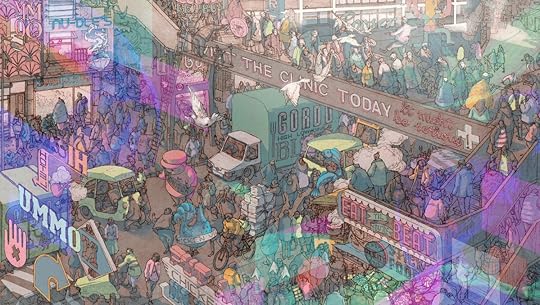
Let me make this very clear, this artwork is among the best in the history of graphic fiction. Think that’s too bold? If you doubt the veracity of my claim, go get it from your library--okay, I had to wait more than two years to get it here in my library--and tell me this artwork isn’t absolutely breathtaking. And then, like me, you will most likely buy it and share it with your friends. It’s unbelievable. Just viewing it, you have to rate this five stars. Why? Color, design; they allow the visuals most of the time to tell the main story. Each panel is a work of art. One of the works that show us of what comics are capable. This book represents eight years of drawing images!

The story is some combination of 1984 and the Matrix, a cautionary tale. And architecture. Mills says it was in part born of “a fascination with cities, spaces and objects, and a combined anxiety and excitement about technology and the future.” She also says, “he internet has become a digital mirror of our society.” The work explores the possibility that this digital technology may supersede our experience of reality. This is a dystopian tale, not entirely original in its conception, maybe, not really a character-driven work, but it’s nevertheless engrossing on the level of ideas. One of the best graphic works ever.
Profile Image for Blair.
2,041 reviews5,864 followers
January 30, 2019
(2.5) I'm afraid this book has to go on the 'beautiful art, incomprehensible story' shelf, where it will sit alongside My Favorite Thing is Monsters. Reminiscent of anime such as Ghost in the Shell, the visual world of Square Eyes is gorgeous and multilayered; you could easily spend hours studying every detail of each panel. If that (and that alone) sounds appealing, this book might be for you. If a comprehensible and interesting plot matters too, skip it.

Square Eyes takes place in a world where augmented reality is an integral part of everyday life, not just commonplace but necessary. The protagonist, Fin, has invented a powerful new technology that allows users to create virtual objects simply by imagining them, but she has suffered some kind of disgrace and has recently been released from a recovery centre. She's now 'off the network'; her life's work and social status are in ruins. That much, at least, is clear. It becomes unstuck from then on, prizing aesthetics above legibility, and I frequently had no idea where developments/subplots were coming from. I haven't read a single review of this book that doesn't mention how hard it is to follow. Even the most glowing write-ups say it.

When I look at the art (and I could say this about Monsters as well) I feel bad for being critical. Clearly, so much work has gone into the illustrations – it's not an exaggeration to say hundreds of images from this book could stand alone as works of art in their own right. However, this doesn't make up for the fact that the plot is (at best) underdeveloped and the text is sometimes barely readable. Gorgeous but disappointing.

TinyLetter | Twitter | Instagram | Tumblr
Profile Image for Kamakana.
Author 2 books416 followers
November 14, 2021
if you like this review, i now have website: www.michaelkamakana.com

070419: riley found this on his trip to france though i guess we are supposed to find it on the internet. graphics stores did not have it. i had read very positive review in guardian months ago, was ready for disappointment, and first thing r said was it’s not that good, he didn’t like it. he gave it to me, added, but you’ll like it... r knows me well. i loved it. new favoritegraphic. also characterizes exactly our differences in art/graphics and lit/story... this is not action, not character, not given easily. the reader/looker must participate in construction of work. this is great. for me...

great, detailed, layered images. this is graphics at its best: words, dialog, snippets, do not interfere but collaborate to form the work. plot is maybe familiar scientific breakthrough vs corporate malfeasance etc. but how the story is told is appropriately postmodern and self-referring. works. city of the future only slight extrapolation from current urban experience, but in layerings of graphic interface, constant immersion in computer reality until you do not know do not exist unless your clothes are online... this is sf satire simple, visual, obvious, credible... then again, i really like representation through lines and colors are washes...

so, not for everyone. dense, difficult, literate and maybe too static. but images to look at over and over...
Profile Image for Moira Macfarlane.
865 reviews103 followers
April 16, 2020
Het artwork in dit boek is werkelijk prachtig en een puur staaltje kunst en vakmanschap, maar wat heb ik tijdens het lezen lang gehoopt dat het verhaal wat meer van de grond zou komen.
'256 pages, with 878 images in the final book, but many more drawn. The book took a total of 8 years. 1 hour 20 minute drawing time per image, 7 images per day. And more than 144 pencils — I bought my favourite pencils in a delightful dozen dozen.' Dat zijn de cijfers achter al die prachtige afbeeldingen in deze graphic novel, ik vond ze zo mooi dat dit alleen al de reden was om het aan te schaffen. Het is precies een mix waar ik van hou, potloodtekeningen met een grafische touch en subtiele inkleuring.
Anna Mill, architectonisch designer en illustrator, en Luke Jones, architect en hoogleraar, vroegen zich af welke plaats de digitale vooruitgang in de nabije toekomst in ons leven in zou nemen. In de tijd dat ze aan dit boek werkten, zagen ze de wereld langzaamaan meer en meer veranderen en vormden zo hun eigen fictieve wereld in de niet eens zo verre toekomst.
Anna Mill vertelt in een interview over hoe het idee voor het boek ontstond en over de acht jaar die het duurde om dit uit de hand gelopen project af te ronden:
'This project came about as a real collision of interests; a love of drawing and stories, and a fascination with cities, spaces and objects, and a combined anxiety and excitement about technology and the future. Over the eight years we worked on the book, it became increasingly clear that large parts of human life were migrating from our homes, streets, pubs into online spaces. These digital spaces were developing characteristics of their own, some are gritty, weird or dangerous, some are polished and exclusive. In this way, the internet has become a digital mirror of our society. We wanted to make a story that explored what might happen in the near future, when those online spaces break free from the screen, and return, changed, to the physical world — submerging the solid streets we’ve always known behind capricious, shifting digital layers and the internet engulfs the city.'
Ook vertelt ze daarin dat het zwaarste onderdeel van hun project het feitelijke schrijven van het verhaal was. Ze hadden van alles bedacht om het verhaal van de grond te krijgen en wat vind ik het ontzettend jammer dat ze daar evenzogoed minder in geslaagd zijn. Ze hebben zich iets te veel vastgedraaid in het technische aspect, wat zeer gedetailleerd is en als je in die wereld werkt ook relevant, maar als lezer miste ik gelaagdheid en een bepaalde overview in het verhaal. Hoe ziet de maatschappij waarin we ons bevinden er eigenlijk uit, wie is er aan de macht, is er nog vrijheid of enkel een schijn van vrijheid? Wat vinden de hoofdpersonen van de wereld waarin ze leven, voelen ze zich nog persoonlijk met iemand verbonden, zijn ze nog iets anders dan computer scientist?
Uiteindelijk heb ik de dag nadat ik het uit had, het boek opnieuw opengeslagen en de spaarzame tekst gelaten voor wat die was, de beelden en mijn verbeelding laten spreken. Dat werkte geweldig en gaf het boek de dimensie die ik bij eerste lezing miste. Het leverde me een hoop filosofische vragen op en dat was precies waar ik in eerste instantie naar zocht. Waarom worden zo veel mensen gelukkig van oppervlakkigheid en het uit de weg gaan van een werkelijke verbinding met de mensen en de dingen om hen heen? Waarom is de diepste wens van de mens maakbaarheid? Ook al weet iedereen dat het ware geluk daar niet in te vinden is? Wat gebeurd er in de wereld waar we af en toe al een glimp van zien? Wat doe ik met het enorme gevoel van beklemming dat dit boek oproept, omdat eigen keuzes ons ontnomen zullen worden. Heel actueel, juist nu in deze corona-crisistijd en ook wat me nu het meest bezig houdt. Zullen de maatregelen die nu genomen worden gewoon worden? Zal in het kader van het hoogste doel dat wat ik het belangrijkst vind, warmte, voor elkaar zorgen, elkaar troosten, zal menselijk fysiek contact ontmoedigd worden en publiekelijk verdwijnen?

Want in feite is dat het thema van dit boek. Dat wat je visualiseert zich transformeert als een mooie filter over een lelijke realiteit. Als je naar de afbeeldingen kijkt zie je een holle wereld vol consumptie, aftakeling, pillen voor emotionele balans, overgewicht, maar met het juiste filter zijn we ineens allemaal de meest interessante mensen op aarde. Tenminste dat is wat we willen zien, niet wie we werkelijk zijn.

Voor een inkijkje: https://www.instagram.com/p/B_DDPTNA6UM/
Profile Image for Titus.
429 reviews56 followers
November 17, 2021
In my last review, of The River at Night by Kevin Huizenga, I suggested that Huizenga doesn’t receive as much acclaim as he deserves: he’s known and respected by readers of alternative comics, but even within this niche he’s seldom mentioned in discussions of top recommendations or all-time greats. I stand by that sentiment, but I’ve got to say I feel the injustice a lot less viscerally now that I’ve read Square Eyes by Anna Mill and Luke Jones. This is an underappreciated comic. Honestly, this is an absolutely amazing work, right up there with my favourites, and yet it seems to be virtually unknown – or at least ignored in the comic-related corners of the internet that I frequent.

First and foremost, this comic is absolutely beautiful. It took eight years to make, and it shows. The style somehow manages to be both very realistic and somewhat expressionistic, and the colour scheme is simply gorgeous. Artist and co-writer Anna Mill has studied architecture at university, and it really shows, her cityscapes having a magnificence and sense of scale that remind me of François Schuiten. The art generally has a bit of a European feel, being much more intricate and lifelike than most Anglo-American comics. It also reminds me of work I’ve seen from Japanese artists like Katsuhiro Otomo and Satoshi Kon, especially due to the grim, dystopian urban setting. Even the lettering is outstanding: kind of like a less meticulous Chris Ware.

Vitally, the art isn’t just eye candy. Mill demonstrates a mastery of the language of comics. Her approach is often experimental, but these experiments are consistently successful, and never feel obtuse or self-indulgent. She clearly has a perfect understanding of different formal techniques’ narrative effects, and of how to compose a page. She’s generous with her use of whole-page panels and double-page spreads, but also employs a tight ten-panel grid to fantastic effect (all the better for the book’s square dimensions), and she uses pretty much every conceivable arrangement in between. She also has a penchant for depicting events from unusual angles, a trick that not only allows for some great images, but also imparts an appropriate sense of disorientation and distraction. Most impressive of all is her use of colour: pages and panels vary from dour greyscale through to a dreamy, muted mix of kaleidescopic colours, always perfectly in line with what the story requires.

So what about the story? A lot of reviews complain that the plot’s thin or incomprehensible, but I strongly disagree. Like the art, the storytelling approach feels distinctly European: it’s enigmatic and ambiguous, with minimalistic dialogue, no real exposition, and an open-ended conclusion. If you want a straightforward adventure or an undemanding drama, look elsewhere, but I personally find the story eminently engaging. The reader has to put in a little work to piece it together, but I can confirm that there’s definitely a coherent, identifiable plot. This isn’t a character-driven work, so some may find the protagonist’s personality underdeveloped, but this doesn’t bother me at all. Rather, this is heady, thematically-driven science fiction, which explores our relationship with technology, and how that affects our relationships with one another and the world around us. Its dystopian vision of a high-tech hyper-capitalist future may not be groundbreaking, but it’s well realized, with some original touches, and it remains very relevant.

In sum, this may be the best-looking comic I’ve read yet, and it’s definitely one of the most exciting in terms of how it uses the medium. What’s more, the story is cerebral and engaging, and never feels like it fails to live up to the brilliant visuals. It beggars belief that this is the first comic these creators have ever published; I can scarcely imagine where they might go from here, and what they might be able to achieve in the future. In the meantime, this is a must-read for anyone with a taste for the more artistic and experimental end of comics.
Profile Image for Ludwig Aczel.
358 reviews23 followers
May 15, 2022
8.5/10
Have you ever met an incredibly beautiful woman, of aesthetically unseen level, and after getting to know her, also discovered that she is utterly smart and incredibly kind and wholesome and all that greatness? (I haven't, but I have seen such women in movies, so let me assume they exist for metaphor's sake.) Well, I dare to advocate the idea that this book is the equivalent of that in comics form.
On a first degree, Square Eyes is a masterpiece from a visual point of view, a vertiginous tour de force in urban landscape illustration. Flipping a couple of random pages is enough to realise it. But that is only the surface. More relevantly, this book is an example of comics storytelling at its best. I was really impressed by the amount of narrative tricks displayed all along its 250 pages. Strictly comics-related narrative tricks, available only and specifically in the medium of 'sequential pictographic storytelling', to mention McCloud's definition.
I had a lot of pleasure even before the actual start of the comics, in exploring the sophisticated interlinked credit page. And even before that, admiring the smartness of the inner cover illustration, where a pattern of bicolour rows of humanoid figures is disrupted by a single human being of different shape: the disruption of the pattern hidden in the structure. (The worm in the apple?)
Colours are used effectively to depict this futuristic world where people's sight is enriched and at the same time obscured by walls of holograms and information flows. The interfaces that these people see are designed with attention by the artist, and the reader needs to pay attention to them to understand what is going on.
Square eyes requires attentive readers. Attentive observers, if you prefer. Consider that the book takes two thirds of its length just to make us discover that the two main characters are siblings, and it does it in a subtle way, with a game of close-up of objects and visual references to child memories. It makes sense: how often conversing with your own brother or sister do you mention the fact that you are brother and sister?
Generally, I enjoyed the way the authors unveil their world-building, which is mostly composed of social rituals and technologies. We are not explained everything, we do not need to. As human beings, we don't know how the present world around us works, why would we be entitled to a full picture of this fictional near future one? That's how I want my sci-fi to be.
I liked the storytelling pace of the story. It is full of instant-to-instant panel transitions - that is, panels are more used to represent single moments in an action rather than the full action. But in a way more akin to European sensibility than manga, usually considered the reign of instant-to-instant transitions. At moments it felt like reading Nicolas de Crécy, although Mill + Jones lack the surrealistic approach of the latter, and even when they try to satirise our present there is more sad dryness in their take than irony.
Not everything is perfect. The characters of Finn and George remain always quite distant from the reader. There is something cold in the way they live on the page, in the way they move and interact with the environment. I do not know if it is a problem of narrative nature, or it is an effect of the hyperrealistic design-oriented style.
Last for me, but not least for many of you out there, the themes of the book. This story is asking questions about our present, of course. Which moral landscapes is information technology bringing us to? Nothing new, sure, but as a (former) computer scientist, I must say that the book felt relatively well grounded in actual programming-related philosophical dilemmas. Not that I really care about these issues, I am more of a 'tell me a nice story' kind of guy, or maybe 'tell me a dumb story in a nice way' kind of guy. Finally, I do not know anything about architecture, but I have a feeling that the authors may be referencing some moral debates related to certain forms of urban landscapes. In the end, Anna Mill and Luke Jones do are architects/designers. But I am not sure, honestly. Ask them.
What I can say is that Mill and Jones are not just two architects trying to monetise on the new cool trend of 'graphic novels'. (Is it even new at this point? Not to mention remunerative...) Even if, in full honesty, the marketing strategy of their publisher Jonathan Cape gives me those vibes. (Really, only reviews on the guardian? What is this, Posy Simmonds?)
This book was released and went mostly under silence in 2018, the same year when everyone - mainstream and independent outlets - were going crazy for My favourite Thing is Monster, an illustrated incomplete debut novel passed as comics, as if we were back to 1918. (They listen to Gary Groth only when the man is wrong, goddamit!) Square Eyes has received lukewarm reviews both in the UK and France, most of which complaining of how hard the story is to follow. I may be biased on this issue, but to me this is revealing on how bad the situation is when it comes to the ability of the audience - and some supposedly professional reviewers - to decode the language of comics. Because this book is actually simple to understand, to tell you the truth. And the mystery in it even unfolds in a relatively straightforward fashion. Only, you have to spend time looking at each panel to perceive the visual signs informing the narration. As a general rule, kids, when a comic page has no words in it, reading it should take you three times more time than if it had dialogues, not three times less. Otherwise you will come here on goodreads writing reviews that, honestly, will just look asinine, carved on the sacred marbles of the web for decades to come. Here under spoiler the story in a nutshell, for those who actually did not get it.
Profile Image for Barry.
19 reviews2 followers
June 17, 2019
5 stars for the beautiful artwork and fascinating world. 1 star if you are interested in a well told story. There were many places where simpler artwork and composition would have offered a clearer narrative. Confusion is written into the story-line (as it deals with blurring lines of reality), and I appreciate not being spoon-fed a plot, but I was overall disappointed with the experience. For graphic novel or sci-fi fans, worth picking up for the gorgeous art and as an introduction to a very plausible sci-fi world.
Profile Image for Margaret Bessai.
42 reviews3 followers
April 18, 2019
Beautifully drawn. It takes great concentration to read this, and look deeply at all of the details in this graphic novel. It is set in a dystopic future in which "boundaries between memory, dreams and data have begun dangerously to blur." (Rachel Cooke, The Guardian)
Extended reality, the matrix, Phillip K Dick swirled into a visual tour de force.

Cooke's review has a great plot description:
"Fin, a brilliant young woman celebrated for her advances in augmented reality, is off the network and in recovery from some kind of accident. In a series of flashbacks (or are they?), we learn that before the calamity occurred – and what greater calamity could befall a person than for all their digital information seemingly to be lost? – she invented an interface between mind and machine so powerful that part of her believed that in the wrong hands it could destroy the world. Whose are these wrong hands, and have they since wrested control of her creation? "
https://www.theguardian.com/books/201...

The ending of the book is enigmatic, the kind of ending that makes you want to start the book all over again. In fact, if you love a good plot and resolution this might not be for you. There is plenty to chew on though, in the artwork. As Cooke says, "What truly sets this book apart is its extraordinary illustrations. Mill has said that among her inspirations are Winsor McCay, the American cartoonist who created the Little Nemo strip; Katsuhiro Otomo, the Japanese manga artist; and Edmund Dulac, the French-born artist best known for his illustrations of the stories of Hans Christian Andersen."
James Smart, also of the Guardian gives a totally different take on the book, but also notes that it is the vision and satire in this book that engages us, not the plot.
https://www.theguardian.com/books/201...

"Square Eyes comes at you in a disorienting rush. Tight, square, grey panels quickly give way to code-laden flow charts and images of a rundown subway as Fin, unable to log in to her messages, social networks or apps, carves buttons into the ground and presses her hands into her body, desperate for something – anything – that can bring her back into the loop. Mill’s artwork does a wonderful job of capturing the chaos, invention and decay of Fin’s nameless city. This is a world where branding hovers in the air, shopfronts blur and shift and bored diners flick to “Maui Mode” to see the world decked in shell necklaces and swimwear."


I really enjoyed this interview with Anna Mill:
http://www.ar-eye.com/2018/11/21/anna...

Astonishingly, this interview says the artwork was drawn by hand, "An architect of the real world and a designer of the digital — Anna Mill, author of SQUARE EYES gives us a view of the Architecture of Augmented reality through her exquisite hand illustrations that depict her the multi-layered story-line of her new graphic novel. Her illustrations are done entirely by hand, adding the character and a beautiful human charm to the interaction with the digital realm."
Mill:
"Obviously, there is more to architecture than its outward appearance, and more significant amendments will require a deeper intervention and physical changes that go beyond the layer of augmentation. But it’s possible that the way that physical structures are designed will also change in reaction to the new design possibilities offered by augmented reality, and a sort of smoothing of our physical environment may occur. The requirement for a new building may be that it is delivered as a blank envelope, a canvas to which virtual augmentations can be easily and flexibly applied. The more elaborated the underlying physical architecture, the more it might interfere with the digital overlays, and so our physical built environment becomes nothing but an armature, a half-finished world requiring its virtual flesh to be complete. Buildings that are more willing to forego physical character and expression in order to accept a capricious digital changefulness are more insulated against obsolescence."
Profile Image for Freddie Alexander.
12 reviews1 follower
January 19, 2019
Square Eyes is an exceptionally well crafted graphic novel with an unfortunately vague and wandering narrative. It has both some of my favourite graphic-storytelling in recent years as well moments of intense frustration.

Anna Mill’s approach to graphic storytelling is less to try to literally portray what is happening in the story, and instead focus on the emotional and minute details that draw its characters attention. Movement will be represented by the flexing of an ankle, or a brief panel will be dedicated to rubbing an eye in tiredness. The fluid, digital-art Styles flows like a watercolour throughout the book, with full page spreads being particular highlights.

Unfortunately this attention to detail has a detrimental effect on the ability of Square Eyes to coherently tell it’s story. This would not be a problem if it were more a character piece of its protagonist, but Square Eyes commits to a rather overly-complex tale of industrial espionage, spying, and political unrest that at times feels like a distraction from its own strengths.

I’d highly recommend Square Eyes to anyone who is looking to see where 2019 will take the Graphic Novel medium.

Content warnings for: None that I can think of.
27 reviews1 follower
February 6, 2019
The artwork in the book is stunningly beautiful; you could put every page in a frame. In fact I really just wanted to hold it, flick through the pages, stroke the cover a little bit, sit with it on my lap and then have another flick through. I got a real sense of the love and effort that had gone into creating it.

However, I think to try to create a believable alternate reality in so few words is always going to be challenging. I am a fan of a dystopia but ultimately I found the whole idea of a digital dystopia, which seemed devoid of any humanity, a bit depressing really, largely because it didn't seem that implausible. It made me want to give someone a hug (maybe that's why I was hugging the book!). I think to follow the plot you need to really immerse yourself in it and do a lot of the work for yourself and whilst I thought there were some good ideas, I didn't like it enough to do that.

Creatively though it was amazing!
Profile Image for Anna.
2,119 reviews1,018 followers
July 17, 2019
The distinctive art and topic of saturation in social media and advertising attracted me to this graphic novel. As it turns out, the beautiful art was the best thing about it. The use of colour to denote the presence or otherwise of augmented reality is especially great. There is relatively little dialogue and what there is blends into the imagery, which makes it quite difficult to follow. Certainly the strangeness of being out of step with a digitally mediated reality is conveyed very well. However the actual plot was confusing and I’m not really sure what the ending meant. The world-building reminded me of Transmetropolitan, Vol. 1: Back on the Street and sequels, although the tone is totally different. There are some wonderfully convincing details, like paying a premium for an advertising-free level of the bus. It certainly rang true that the main character, apparently a tech genius, is just as addicted to checking her messages as everyone else. She codes in a language seemingly inspired by the Voynich Manuscript, another delightful detail. While I found it easy to be carried along by the lovely imagery, getting caught up in the background details seemed to distract me from what was happening. Visuals overwhelmed the narrative. That's actually quite similar to the social media experience, actually! Perhaps ‘Square Eyes’ should either have got rid of dialogue altogether or made it much more obtrusive? As it was, I didn’t find the mystery of a new virtual reality technology particularly compelling and would have preferred a simpler story of everyday life in the same quasi-dystopian world.
Profile Image for Michael.
252 reviews1 follower
January 6, 2021
Much like other reviewers, this book is stunning and totally worth it just for the art, which I could imagine took years to create. For 90% of it I was really engaged with the story too, though I had lots of questions. Unfortunately, those questions were just not answered by the end. If I'm honest, I couldn't really tell what happened in the end at all. Maybe it's just me not looking carefully enough at the images to figure out what was going on fully, but, ultimately, a graphic novel should tell a story with words and images and there wasn't enough explanation of the story for me. 3*s
Profile Image for Wendle.
290 reviews34 followers
March 14, 2023
The story explores ideas around identity, reality, memory, and freedom. As the back of the book itself says: In a city built on digital illusion, who really holds the power? In some ways these concepts are thrown at the reader so obviously and clearly, but it’s also open enough that the reader needs to do some work themself to put more subtle pieces together and consider what life in a world like this would genuinely be like (spoiler: it’s not good).

While the story and concepts are interesting, it is truly the art that brings them to life. It’s outstanding. The level of detail, use of colour, the overlaying of reality with the digital world, the digital interfaces, the use of negative space. Every page, every frame, is an entire piece of art worthy of being framed and hung. I took my time reading this book in order to fully soak up the art and I never got tired of looking at the pages.

A slightly longer review can be found on my book blog: Marvel at Words.
Profile Image for Sarah.
689 reviews34 followers
December 31, 2020
I bought this book at Thought Bubble 2019 and finally read it during virtal Thought Bubble 2020. I rememnber the artist saying it took eight years and I can see why. The art is amazing, so detailed and layered, with some great spreads and pages making use of white space, and it all carries the story. Which is a mystery, about technology, set in a dystopian style future. Our protagaonist, who has amnesia and has been disconected from the world, tries to work out what happened to a grand idea she had that she seems the think might have been capable of destroying everything...
Profile Image for Shaun Quinlivan.
5 reviews
June 25, 2019
A pretty book, but very hard to work out what is going on at all. I couldn't relate to the characters because they didn't say much at all. Lovely drawings and cool concepts cannot mask a disappointing story.
Profile Image for Bluebelle-the-Inquisitive (Catherine).
1,189 reviews34 followers
October 21, 2020
“Brainside?... Fin — you worked out how to write data to the human brain and you didn't tell anybody?"
"... I was focused on other things.”
— George & Fin Ueda-Soto

To me Square Eyes is re-readable, in fact, I think it might be a graphic novel that has to be read more than once to be understood. I think there might be some kind of message in there about the perils of technology and trusting the wrong people. This tells its story using beautiful and smart art, there is diversity in the art page to page as Fin learns more about her situation. I didn't dislike the characters as far as I understood them. They are easily distinguished and everyone has good and bad traits, they are human. That said the story is damn near incomprehensible on a first read. And I'm not in any hurry to read it again.

Square Eyes does have what is possibly some of the best use of white space I've seen in years outside of picture storybooks. I'm going to be honest, as clever as the art of this graphic novel is it makes me a little nauseous. Also the writing...the writing can be so very difficult to read with such low contrast between the textbox and the text. It isn't the easiest thing to read. I'm rating it 2.5 due to my confusion and discomfort while reading.

Look — anyone who invents anything really great has a moment where they think they are going to destroy the world. — Fin Ueda-Soto

A representative gif:
description

Profile Image for Gareth.
Author 21 books45 followers
Read
June 20, 2020
Square Eyes is a graphic novel by artist and designer Anna Mill, and Luke Jones, a lecturer at the Cass School of Art, Architecture and Design. It is published by Jonathan Cape, an imprint of Penguin Random House that specialises in graphic novels (among other things), and the book is a sumptuous, high-end hardback that is a thing of beauty in itself. Mill’s art is incredible, and both creators draw heavily on their background and knowledge of architectural design, which is evident in the meticulously realised cityscapes and interior environments which call to mind the manga of Katsuhiro Otomo (of "Akira" fame), and perhaps also Geoff Darrow’s "Hard Boiled". Mill is a consummate draughtsperson, and the art combines delicate use of traditional media (pencil and ink, I would guess) with a highly creative application of digital techniques. Overall, then, in terms of the physical look and feel of the book, it’s a truly lovely thing, saturated with detail, and something I could happily pore over for hours.

In terms of the story, Square Eyes is set in a near-future city where augmented reality has become a standard feature of everyday life. Through some technological means – which, at first reading at least, remained somewhat obscure (it doesn’t seem to use glasses or other AR devices) – people can interact with the space around them, and many of the book’s more striking images convincingly suggest how such an experience would look, as digital graphics overlay and superimpose upon underlying “real” physical space. In fact, this layering style communicates a core theme of the book, as there are a number of points where both the protagonist and reader are unsure what is real and what isn’t; what is dream, memory, hallucination, graphical overlay or digital playback. This is even suggested in the colour scheme, which often utilises a muted and restricted palette, thus blending and blurring the distinction between the augmented and the real closer. The dystopic suggestion, then, is that such a technology would undermine our grasp of what is real, while also allowing forces outside the self (government surveillance, corporate marketing) to manipulate and distort perception for their own ends.

The protagonist of the story is Fin Ueda-Soto, a brilliant augmented reality pioneer who has developed a particular form of AR that allows users to give virtual form to their own thoughts – to create their own augmented reality. But the system is unstable, and as her own grasp on reality begins to slip, she suffers a very public breakdown, and one day awakes to find herself in Recovar, a sort of rehab clinic for virtual addiction and psychological distress. From there, the book tracks her journey back as she attempts to reclaim her old life – which, while in Recovar, seems to have disappeared – all the while struggling to distinguish her own “memories” from unfamiliar “flashbacks”, and to untangle the mystery of what happened to the company she created and her former role in it.

These are, of course, well-worked dystopian sci-fi themes, especially cherished by the likes of Philip K. Dick: What is real? Who am I? Can I trust my memories? As John Locke proposed, the basis of identity is really memory – undermine that, and who “I” am begins to change and fall apart. But while it explores these issues, Square Eyes does so in a very subtle way, so that these concerns are often in the background, revealing themselves as much in the art itself as the dialogue or action. The reader doesn’t just abstractly consider the nature of such disorientation, but actively experiences it. This is also, perhaps, one of the challenges of the book. It’s often pretty hard to grasp what’s going on: while we follow Fin as she tries to work out who she is and what’s happened to her, we are simultaneously trying to establish what sort of future this is, what its norms are, what sort of technology is being used and what this means for how people interact with “reality” – all of which is frequently only hinted at, and must be pieced together from a close reading. And this is certainly a book that repays such scrutiny, as page after page reveals hyper-detailed environments – both physical and virtual – as they overlap and interplay, and technological terms and jargon are just thrown in (William Gibson style), so that the reader must simply “go with it”, hoping that it all makes sense in the end.

And does it all make sense? It’s difficult to say! Even now, I find myself questioning the basic synopsis I’ve presented here. I think, like some archaeological dig, I’ve only really scratched the surface, and that, after a few more readings, some more concerted effort to unpack the logic of the world Mill and Jones have painstakingly created, I’ll be repaid with a much richer and deeper understanding of the work. Is it worth such effort? I think so – the art alone merits that, and I suspect a similar amount of work has gone into the world building. All of which belies the notion that comics/graphic novels are “easy reading”. You might read Square Eyes in a few hours, but its themes and ideas, its world, its take on technology and its relation to reality – unearthing and understanding these will take a whole lot longer.

Gareth Southwell is a philosopher, writer and illustrator.
Profile Image for BiggiE.
10 reviews
May 31, 2022
The illustrations are incredible and the description is truly intriguing. Unfortunately the story itself is really taken a backseat. Text often is hard to read and underdeveloped in my opinion. It’s kind of a bad attempt of a black mirror episode turned graphic novel. Nevertheless, if you care a lot more about artwork then storyline, this graphic novel might be exactly what you are looking for!
Profile Image for Ben Holmes.
31 reviews1 follower
April 3, 2019
Incredible to look at; a plot would have been nice.
Profile Image for Rafaela Oliveira.
1,061 reviews8 followers
October 17, 2020
J'adore les BDs qui traitent le thème de la technologie et des réseaux sociaux...mais là j'ai été bien confuse. J'ai l'impression que c'est un objectif recherché par l'auteur...
Profile Image for Mister (B)aranowski.
43 reviews
April 26, 2024
You want a digital hellscape? You’ve got it.

*Square Eyes* is most successful at allowing the reader a glimpse into the world as its protagonist Fin sees it- the color-drenched pages represent the digital future she has developed and come to love, the world without it a bleak, bland, crumbling black and white. Likewise *Square Eyes* does not hand its plot over to the trader, they too will need to reckon with new discoveries and filled-in blanks in the same manner as Fin… sort of.

Some of the plot contrivances- viewing the lives of others through an imperfect piece of software, memory flashbacks, and an Easter egg hunt crafted by a former version of oneself- all feel a bit forced. I mean, one of the first steps towards clarity involves infiltrating a well-kept apartment and eavesdropping on its inhabitant without getting caught- how does that happen in the world that this novel presents? Most disappointing, however, is the lack of narrative payoff. This sci-fi dystopia is pulling the same threads as many of its contemporaries without offering much edge: endangering the poor while benefiting the rich, positing the untapped potential of its central piece of software, all the while playing things fairly safe. The nefarious scheme of its antagonists, for example, is hinted at throughout the text, but never explicitly commented upon due to Fin’s personal motivations, which seem to take higher priority in the grand scheme of the narrative. The most disappointing aspect is the highly abrupt conclusion, which offers little future for its characters, software, or society… but it does speak to the enduring strength of compassion and companionship, which is nice.

It’s impossible to argue the artistic prowess on display- there’s beauty to be found in that way characters navigate the physical world with layers of digital adverts and roadblocks lain atop. There’s also some great first-person panels expressing the language and intoxicating potential of *Square Eyes*’s technology. Yes, there are moments where the artists simply want us to get “lost in the sauce,” and it’s here where a very impatient reader might find themselves disrespected. Sometimes it feels warranted, sometimes it doesn’t. What piece of art is so perfect that not a single page feels wasted…? I’m not going to answer that, actually, because a couple of examples come to mind, but the graphic novel medium is one for experimentation, and for that, I am appreciative of this flawed, yet evocative work. For a book to get me fired-up enough to write this much is never a bad thing.
This entire review has been hidden because of spoilers.
Profile Image for Ben.
13 reviews
August 11, 2020
A beautiful book. Needless to say the vividly distorted, dystopian fragmented-memory visual style is incredible, I'm at a loss of better words for how truly remarkable the art in this book is. It's not just beautiful, but really adds an emotional foundation to the storytelling.

I'm new to the comic storytelling style, but this did feel like a faster read of a much greater story, a real fragment of an extraordinarily specific niche. I'm not surprised that so many of the other reviews comment on the story being plotless or hard to follow, however I could not disagree more, the storyline may just be too alienating for many without the proper context.

I didn't choose this book myself, and I had no idea of its contents before starting but it remarkably resonated with me being a programmer, who's developed new technology and navigated the surprisingly hollow world of tech business. Recreationally engaging in deep programming culture can be tricky, few-and-far between too, but finding almost abstract emotionally driven art focused around it is simply unheard of in such exceptional quality.

I feel this story gives an artistically exaggerated impression of a mashup of the workflow and mindset of a back-end developer, pushing technologies online, while navigating colleagues and employers. This story gives a feel for what developing with a small group or alone with the support of a similarly minded friend can feel like, artistically coupled with the clashing world of tech business and ethics. You get a real feel for the feelings and emotional scaffolding of being an inexperienced developer, and the scrambling, almost traumatic, peek behind the curtain on the way to the top.

All of this unfiltered and unexplained in a story of few actual words, then throw in some unfortunately stereotyped superiority and inferiority complexs, anxiety, stress, social media publicising, job hunting and a healthy dab of psychosis and/or substance misuse and you have this story - a real gem that I imagine few people would really resonate with on a first read.

The writers of this story must either be personally and deeply experienced with the matters covered, portraying those experiences beautifully in my opinion, or truly exceptional storytellers of a level I've not seen since the likes of Neil Gaiman and the greats... or I could just be projecting lol. ¯\_(ツ)_/¯
Profile Image for Mat.
35 reviews
February 25, 2021
Story and action mostly surrender to a sense of mood, place, setting and mystery, communicated through a striking approach to the form. Haunting cityscapes cleverly use texture and colour to depict a society in which the line between virtual and physical reality is blurred.

The trade-off of this minimalism is that the characters feel underdeveloped - since they don't talk much - and the thin plot is hard to discern. I couldn't really even tell you precisely what happens in this book, to be honest. The result is a kind of experiential mirroring, as both reader and Fin are disoriented together, slowly separating reality from perception.

I think this is my favourite graphic novel because it operates on a level I don't quite understand. I wasn't completely bowled over when reading it but something strange has happened since then. Like the addicted consumers wandering its robotic cities, I can't resist escaping into a world more intoxicating than my own. I have a stack of others I want to read, but before that... I'll keep thumbing its kaleidoscopic pages just "one last time".
Profile Image for e.
12 reviews
January 17, 2025
The art is a solid 10/10, without a doubt. But I can only say ‘ooo look pretty’ so many times before I have to face the fact that none of it is making up for its thin plot that isn’t conveyed all that well to begin with.

To its credit there are amazing ideas executed well throughout— like the panels of the new reality everyone has plugged that gradually shift into what is truly is in front of them. I thought the POVs of the digital interface with all of its notifications and visual noise was a treat to look through. And the part where they step into that sliver of pure white was stunning. There were so many pages beautifully, and creatively panelled— unfortunately it was not enough to mask the very lacking storyline.

This isn’t a book I’d ever get rid of— ever. The art is just too fantastic. But I think more time was needed during the writing stages for it to have hit home the story, characters, and themes it was trying to execute.

Bumping it up to 3 ⭐️⭐️⭐️ for the art, because once again, phenomenal.
Displaying 1 - 30 of 104 reviews

Can't find what you're looking for?

Get help and learn more about the design.