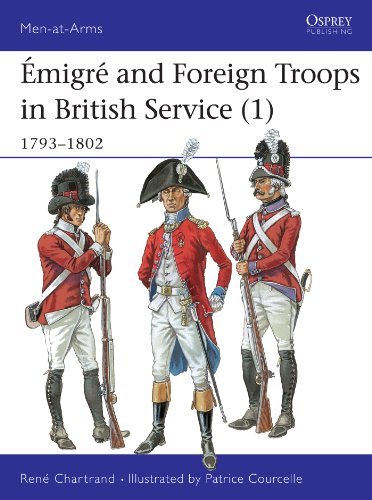
Following the Revolution in 1789, members of the aristocracy were increasingly persecuted, and many of them fled abroad. These exiles became known collectively as 'émigrés', and despite initial confusions and indecision, many of them were taken into British service. This fine text by René Chartrand examines the organisation, uniforms and insignia of the Émigré troops in British service from 1793 to 1802, accompanied by plenty of illustrations including eight full page colour plates by Patrice Courcelle.
The magic of the Osprey Men-At-Arms series is how much they cram into such a slim volume. This one is no exception and René Chartrand covers a remarkable array of emigré and foreign units in British service. These are listed alphabetically, so the book does not have a great narrative, but is an invaluable reference source on these largely unknown units. The highpoint of the book, though, is the magnificent set of colour plates by Patrice Courcelle; I'm not sure any other artist/illustrator captures the soldiers of this period so well and he has the coolest address - Waterloo!
First part of Chartrand’s overview of foreign units in British service. The 18th century tradition of employing troops from Switzerland and smaller German princedoms was continued and many French émigrées were recruited to fight the fledgling Republic. A number of similar units were taken over from Dutch service after the French overran Holland early 1795. Dutch and French colonial troops were also incorporated when overseas possessions were conquered by British expeditions.
Most of the units were employed in colonial warfare, especially the West Indies, where disease resulted in high rates of deaths. The reasons for employment overseas were probably to lower chances for desertion and to spare British troops from the bad conditions.
Like its sister book, this is rather an eclectic list of units and uniform details, lacking a overarching narrative, let alone analysis. Only for people with special interest in this subject.