George Louis Palmella Busson du Maurier was a Franco-British cartoonist and author, known for his cartoons in Punch and for his novel Trilby. He was the father of actor Sir Gerald du Maurier and grandfather of writers Angela du Maurier and Dame Daphne du Maurier.
It's a beautiful story about two soulmates who are brought together by destiny but kept apart by circumstance (specifically a life prison sentence), yet who manage to create a life together by constructing a virtual parallel world in the astral realm made of every past experience and memory they've ever had in their lives, which they look forward to going to every night when they sleep. They walk among their unchanging, fully reconstructed memories (like in the Pensieve in Harry Potter). Their dream world becomes more real and vivid than their waking lives. The ending is bittersweet but ultimately uplifting and satisfying.
The plot is surprisingly analogous to today's age of the Internet, when people maintain intimate relationships through remote means.
I actually own an 1891 first edition hardcover of this book, the only version I've ever read. The cover art is charming, with two gold hearts on fire stamped above a floral wreath and a violin. It's a beautiful book, with dozens of fantastic illustrations. My copy even has the owner's name, M. L. Farish, dated 1894, and in the most gorgeous script handwriting. It's the closest thing to a time machine that I own.
I chose to read Peter Ibbetson because it's been written by Daphne Du Maurier's grandfather and because I saw, a long time ago, the movie with Gary Cooper and loved it. But honestly, it was hard to read this book, even if at the beginning, the main character's childhood in France, with the familiar names, expressions, songs - even from another century - interested me. Or rather, I found things I knew and had forgotten about, or another vision of landscapes I know nowadays. However, I regret to say that my main feeling was that the author loved to read his own prose just like he must have loved to hear himself talk - and let's face it, he's whiny. Plus the dream part I was looking forward to reading about happened much, much later in the book and it takes us a very long time to find out why he was imprisoned. He mostly talks about his life and... it's boring. So, I regret to say that I gave up at more than 50% and don't think I'll ever pick it back again... Maybe I'll rewatch the movie instead !
I think I read George du Maurier's Trilby before I read anything by Daphne du Maurier but I have heard Daphne write about her grandfather's "Peter Ibbetson" in her autobiographies of her family and her letters written to a friend. I had wanted to read this novel and finally after hearing an old time radio version last week, it was time.
As I read a novel sometimes other stories are brought to my attention, though different I like to bring some similarities between the works which I find interesting. When I first started "Peter Ibbeston", I kept thinking of Marcel Proust's In Search of Lost Time; both have a kind of autobiographical story of their youth with reality mixed with fantasy, both concerning growing up in France and music and dreams become an important part. I must confess, Proust was rather tedious and George du Maurier was an enchanting story, yet "Trilby" was far my favorite.
I also thought Marie Corelli's "A Romance of Two Worlds" when I was reading "Peter Ibbetson", both have romance between a soul mate which connect to this life and afterlife but Corelli's story is religious and it is not clear if Maurier has his characters go to Heaven or another sphere. In the story Peter tells of his parents views on religion being more agnostic and having read Daphne's stories of her family, this rings true for George. Daphne du Maurier's "On the Strand" brings time travelling which her grandfather does with dreams not something injested.
There is a lot of George in Peter but the story is not about George. I wish that the illustrations were shown in the Kindle edition, it is unique when the writer is also an artist. I did not read this edition but a Kindle collection of his works. A fair amount of French passages, easily translated with a Kindle.
The story in short- Peter remembers his youth in Passy, France when his parents and his friends brought him the most wonderful time of his life and his desire for it brings him to another who dreams as he.
"I have left out much, but I feel that in suppressing it altogether, I should rob his sad story of all its moral significance; for it cannot be doubted that most of his unhappiness is attributable to the defective religious training of his childhood, and that his parents (otherwise the best and kindest people I have ever known) incurred a terrible responsibility when they determined to leave him "unbiased," as he calls it, at that tender and susceptible age when the mind is "Wax to receive, marble to retain." Madge Plunket.] "
"Some types are born and not made. I was a born "infidel;" if ever there was a congenital agnostic, one agnostically constituted from his very birth, it was I. Not that I had ever heard such an expression as agnosticism; it is an invention of late years…. "
"But there—I cannot describe her any more than one can describe a beautiful tune. "
The radio version worth the listen but leaves out a lot of storyline and changes it up a bit.
The philosophical dissertations are interesting and how one looks at life. Vincent van Gogh admired Maurier's work in Punch and his art, being a reader, I wonder if he lived longer how he would have felt him as an author. George du Maurier mentions artist works and a prize fighter which made me wonder if he ever meet Tom Sayers.
The radio version does a fairly good job kind of keeping to the story but many things are kept out. Mrs. Deanne wanted to marry Colonel Ibbeston before she found out his immoral ways, especially lying and ill talk of others. Peter meets Mary in England before his trip to Passy. Nothing regarding their soul attachment related to their great, great grandmother.
Peter being united to his childhood friend again and dreaming throughout the ages of past times at times gets a little tedious but the general storyline is wonderful. I thought Mary's description of the here after interesting but to me, Mary Corelli's version of Heaven is divine.
I felt sorry for Peter's imprisonment and his inability to love the Duchess of Towers in person but their dream escapes brought the romance to a higher light.
The writer of this singular autobiography was my cousin, who died at the ——- Criminal Lunatic Asylum, of which he had been an inmate three years.
He had been removed thither after a sudden and violent attack of homicidal mania (which fortunately led to no serious consequences), from ——- Jail, where he had spent twenty-five years, having been condemned to penal servitude for life, for the murder of —— ——, his relative.
He had been originally sentenced to death.
This is the exact same theme as Treveryan! Naughty Daughty.
Treveryan by Angela du Maurier, Page 179:
"Sweet, have you ever read 'Peter Ibbetson'?"
She shook her head.
"If I send it to you, will you promise to read it?"
"Perhaps. I don't read much."
"George du Maurier wrote it."
"The man who wrote 'Trilby'?"
"Yes. It's the greatest love story I know. The greatest and most tragic story of lover's seperation in modern fiction. You'll understand what I mean when you've read it."
Peter Ibbetson as drawn by G. du M.
to make the perfection of human happiness endure there must be something more than a sweet French garden, a small French wheelbarrow, and a nice little English boy who spoke French and had the love of approbation--a fourth dimension is required.
Very high-minded but not pretentious; surprisingly emotional with a good surrealist twist in the second half. A good book to think about the lesser known, bigger questions of life -- philosophical without being too much so. Make sure to get the edition that has the sketches throughout as they serve the story.
Mannnn. Wildd ride. I have never been so divide by a book for my rating. The first half I would give a 2, and the second half a 5, making the whole book so worth the read. Somewhere along the way, the story quietly transformed. profound and strangely moving. By the end, I was completely swept up.
This will stick with me. To ‘dream true’.. made me want to wake. See all clearly as it should be seen.
When reading a classic work I often feel unequipped to grasp that which it is laying before me. I feel this as I write. I longingly hope for the truth in this book to be impressed onto my consciousness so that it might continue to shape my reality from my imagination. I longingly hope to dream true in my waking life as Peter had accomplished. I desperately hope to cultivate in my marriage the kind of love that Peter and the duchess built in their dream house constructed by memory, shared experience and love. I pray my home becomes a place of dreaming true and that my children would delight in returning to their childhood once grown.
Reading the info on this book above I''m not sure I've got the right one, but I'm pretty sure "Peter Ibbetson" by George Du Maurier was published in 1891 and not 1963, but anyway:
Peter Ibbetson is a romantic novel from the late Victorian era - poignant, melancholic and deeply nostalgic, with a paranormal twist. The plot makes use of the idea of a shared lucid dream in bringing together lovers who are otherwise separated in waking reality, by class and circumstance. Although a powerful love story, it also makes for a fascinating speculative exploration of the nature of human consciousness and the meaning and "true" nature of life.
I thoroughly enjoyed the story, but found myself having to get into low gear early on,... I guess we early twenty first century readers are just too impatient to cope with this amount of descriptive detail, being fed instead on a diet of dubious sound bites. The early part of the story is a particular labour of love concerning Peter Ibbetson, aka Gogo's, idyllic upbringing in 1840's Paris and it's impossible to imagine how such pellucid imagery can be anything but autobiographical. Although I found it a little difficult at first to slow myself down enough, it proved to be a real treat, and many a vivid image of a time and place completely unknown to me now remain in memory, as surely as if those memories were my own.
The story seemed to change pace about half way through becoming more briskly paced, with a series of dramatic events befalling the hero, who is orphaned and finds himself transplanted to London and the hapless foil of a wicked Uncle who ultimately proves to be his undoing.
The loss of Gogo's innocence, like the loss of the older pre-Eiffel Paris, is keenly felt, and the novel is steeped in a poignant search for times lost and the idyll of youthful innocence. The later tragedy of Ibbetson, when it comes, is heart rending, but the triumph, and the point of the story is in its transcendence.
Du Maurier was a cartoonist for Punch magazine, and original copies of the book carry his own evocative illustrations. For this reason, it's worth paying a little and seeing if you can find second hand copies online. Otherwise the text is available as a free download from Project Gutenberg or the Internet Archive. The free PDF versions do have the illustrations, but I found they fell a little clumsily into my e-reader.
This book gets off to a slow start. DuMaurier loves describing trivial things (mostly nostalgic details about France) for pages on end. But once Peter Ibbetson learns to "dream true" (some kind of lucid dreaming/astral projection combination that allows him to meet with his lady love while he is in prison) this book becomes very cool. I really enjoyed reading about the dream paradise that DuMaurier imagines for Peter and the Duchess of Towers. I am interested to find out more about this book's relation to the developing mental sciences in Victorian Britain.
Good quote from the book:
"How easy and simple it seemed to lead a life without fear, or reproach, or self-seeking, or any sordid hope of personal reward, either here or hereafter!--a life of stoical endurance, invincible patience and meekness, indomitable cheerfulness and self-denial!"
I skimmed a lot of this book. While seemingly exciting things happen, they are glossed over in favor of long passages about Peter does with his dreamtime girlfriend, Mary. They chat a lot and look at stuff. And go to concerts. The author even makes a statement at one point to the effect that his waking life is not worth describing, as it would only be interesting as a foil to his delightful sleeping life. Well, precisely; this book needs a foil to uneventful picnics with your girlfriend! Sometimes, there is an interesting descriptive or philosophical passage that make the reading seem a bit worthwhile. However, my primary thought while reading was, "where is he going with this?" And the answer mostly seems to be, "Not far."
This book was recommended to me in another book that I truly enjoyed. However this book is indeed strange . I was not sure, when I was about half done, that I would finish it; but finish it I did. I did enjoy pars of it Burt my overall opinion of it is that is just strange.
Great book. Kind of dry in the first half, but really comes alive later. I read it after watching the film on TMC. The book was a lot better than the movie which changed the story, possibly to make the novel's somewhat supernatural plot seem more believable.
Peter Ibbetson is the second novel I have read by George du Maurier, renowned late 19th Century illustrator and sometime novelist and grandfather of Daphne du Maurier. Last year, I read his most famous novel, Trilby which featured the famous character Svengali. While I thought that book was overly melodramatic even for a sensational novel and had sub-par characterization, I also stated that:
… these defects didn’t prevent it from being an easy and engaging read that I enjoyed reading. Even some of the last chapter’s overly maudlin aspects were enjoyable as I had fun guffawing at them. I may even read du Maurier’s second most popular novel Peter Ibbetson someday, as it was well-regarded enough to be made into a movie with Gary Cooper and an opera, which I knew of before ever realizing it was based on the du Maurier novel.
So I decided to read Peter Ibbetson. It’s the story of the title character as told through his memoirs as read by his cousin Madge Plunket after Peter’s death at the Criminal Lunatic Asylum. Ibbetson starts his own story from the beginning of his memories. He was born as Peter “Gogo” Pasquier in England but moved to Paris, living in the Passy district. During the first half of the novel, Peter provides the reader a retrospective look at his idyllic childhood and youth in the Passy District of Paris, detailing fond memories in his beautiful surroundings, including his lush garden. But besides losing his parents and being agreeable to changing his name to Ibbetson to please an uncle, nothing much of consequence happens during this first half. One important development, though, is Peter’s enchantment with their neighbor, the beautiful Madame Seraskier, and her daughter and his playmate Mary, called Mimsey.
This whole first half is written in luscious overly descriptive verbiage that, while very readable, becomes almost mind-numbing after a while. This flamboyant verbiage combined with the lack of interesting events made the first half a fairly tedious reading experience. It’s value is as a lull to set-up the events of the second part. I rate the first half of the book as 2 stars.
In the second half, the book takes a totally new direction. After a very dramatic violent event, it turns into a romantic tale of Peter with a woman known as the Duchess of Towers. This romance is nostalgic at its source and is carried on at a level that I can only describe as fantastical. Although almost all blurbs of the novel reveal the details of this fantastical element, I have chosen to refrain from revealing what I consider spoiler details. I will say, though, that other GR reviewers have found the second part to be a great improvement over the first part, enough to elevate the novel from a 2 star to a 4 star novel.
I did not share this feeling. Yes, the second half contained some intriguing developments, but I was unable to do the buy in of the fantastical elements necessary to think the elements anything other than absurd. Further, the fantasy aspect suffered in two other ways. First, the events during the fantastical aspects were presented in broad and general terms rather than through a series of specific events. This lack of specificity or progression of events robbed the internal fantastical romance story of any drama. Second, the descriptions during the fantastical second half continued the overly florid descriptive language that I found tedious in the first half.
Thus the novel I thought was a 2 star novel during the more tedious first half remained a 2 star novel through the more fantastical events of the second half. A fairly unusual 2 star reading experience.
Some books betray their age and time of writing with every word. This one did not, it could have been written yesterday. The amount of French just randomly dropped in was a little heavy for a non-French speaker, but seemed intimately tied to the plot. I enjoyed the read, and especially the concept of "Dreaming true."
The book presents itself as the memoirs of Peter Ibbetson, posthumously edited and published by a relation of the family. His early years growing up in France are lovingly rendered in great detail. Both parents die, however, and he is sent to be raised by his wealthy, but less than loving uncle in England.
His uncle does not live up to young Peter's expectations, and vice versa, and they have a grand falling out. Peter manages to find himself employment as an architect, but recognizes that he is not very good at it, and his life is a humdrum misery.
After a chance encounter with the Duchess of Towers at a party, he sees her in his dreams and she begins to teach him the art of dreaming true. This enables a person to consciously control their dreams and use them to review any part of their life in great detail.
After a hotheaded encounter sends him to jail for life, Peter lives out his days in prison, but with the freedom of dreaming true every night, lives more fully than most ever do.
I know it seems I've told the whole book, but like any good story, there are some twists and turns that make it a better read and those I leave for you to discover. While some of the religious and philosophical views expressed I felt were unnecessary to the story and dragged on a bit long, I enjoyed the books windows into life in France and England of 150 years ago.
For me, this was an interesting love story spanning the lives of two people from their childhood to their timely ends. Although in love, the two were never able to join in the conventional sense, but with a paranormal twist, they were able to join their lives in their separate but intertwining dreams. While He sat in a prison, serving a life sentence for murder, he spent his time waiting for the proper hour to fall asleep when he could join her in their joint dreams. While he sat in prison, she, due to her station in life, traveled widely, experiencing fine food, world class entertainment, museums, the arts, and all, so that she could fall asleep at the proper hour and join him, taking him from his prison to all the wonders she experienced so that they could enjoy them together. The detail in this book is phenomenal and much appreciated.
This is one of the best books I have read to date and I highly recommend reading it.
This book is written by Daphne Du Maurier's grandfather, who was a famous author and illustrator during the Victorian era. His novel Trilby was a sensation. I still have not read that. I read this about 40 years ago. I seem to be going back a lot to books I loved but have not reread.
I am pleased to say that I still find this book weird and wonderful. It is one of the strangest fantasy books I know. Like in most great fantasy, it makes the fantastic 100% believable.
I won't give a summary of the plot, as the great joy of the book is seeing the plot unfold.
I must admit, this book was a very interesting and lively read and I looked very much forward to picking up and continuing reading it, up until chapter 5. (there are 6 chapters in the book). Unfortunately, from here on, the author lost me. Literally. Up until that point I actually loved the book. It was enjoyable, and so exquisitely written, that I felt it could easily pass for 4, maybe even 5 stars. The author clearly possessed a vast and rich vocabulary and was a master of wording!
Alas, the book took an unexpected turn from chapter 5 onwards. The reading became unbearable. Not because it was badly written, but due to the contents hereafter. Chapter 6 I simply skimmed through in order to complete the book, feeling somewhat disappointed as I finished it.
I knew beforehand that George De Maurier ended his days in a mental ward, and even though chapters 1-4 entertained the idea that the novel could very well be an autobiography of Georges's childhood, adolescence, and early adulthood, the final two chapters pretty much sealed the deal that the authors' imagination went a bit too far off course.
The book has quite a few French passages and aphorisms, and if you are not acquainted with French you'll miss the author's deliberate play of words as he is walking you through his life, most of these being written in French. Therefore, I suggest reading this book on Kindle as it is easy to highlight a passage and have it translate highlighted text into English.
I began reading this book because the first few pages seemed intriguing-Peter delivering this retelling from an insane asylum after a murder. However i did not find it particularly interesting. Peter has an idyllic childhood and after the death of his parents spends his whole life nostalgic and melancholy. There isn't a particular plot line. After the murder Peter ends up in prison and then the novel takes a more mystical turn as he meets his childhood friend in his dreams and reminisces about their childhood. It gets more outlandish as they visit each others' memories and then ancestors' memories. Overall it wasn't a particularly engaging story.
A beautiful edition of a deeply flawed book. The initial faux memoir is quite readable but the book loses its way once it embarks on a love affair in shared dreaming. Add in some Victorian approval of eugenics and commendation of the English aristocracy and there's quite a potent and unappealing mix. A curiosity!
I found this story absolutely fascinating and delightful. It gives one hope of the power of love even in another realm. Such a beautiful thought to be able to share something that no one else can alter. Alas, there is always one thing that can interrupt things temporarily…. Death. In this story, even that keeps the lovers separated only temporarily. I thoroughly enjoyed this read.
« Η ελπίδα για όλους εκείνους τους εραστές των απώτερων Συμπάντων του Άχρονου χρόνου… Του ασυγχρόνιστου.» Για αυτό ακριβώς πρόκειται αυτό το βιβλίο. Όλοι όσοι ερωτεύτηκαν θανάσιμα και δεν κατάφεραν ποτέ να συγχρονίσουν τους ρυθμούς τους, αντί να αφεθούν μοιραία και να σβήσουν στην λήθη, αποφασίζουν να βρίσκονται στον ονειρικό τους κόσμο όπου και μένουν για πάντα ενωμένοι. Φιλοσοφικά και λογοτεχνικά μου φαίνεται υπέροχο. Μα ένα κομμάτι μου πιο κυνικό μου λέει πως όλα αυτά είναι μπούρδες και άπλα αφήνεσαι να πιστεύεις σε κάτι πλασματικό και να χάνεις τον πολύτιμο χρόνο σου από τα τόσα άλλα υπέροχα που θα μπορούσες να έχεις ζήσει. Όπως προείπα, αυτό είναι το πιο « ρεαλιστικό» κομμάτι μέσα μου που ευτυχώς δεν είναι και πολύ μεγάλο. Το βιβλίο λοιπόν… Μια τεράστια φιλοσοφική ανάλυση των πάντων . Οι στοχασμοί του ήρωα μας, Πήτερ ΄Ιμπετσον, πάνω σε όλα τα ζητήματα ηθικής, φιλοσοφίας, διαλεκτικής που απασχόλησαν από τις απαρχές του χρόνου το ανθρώπινο ον και με λίγες κλεφτές ματιές – αναφορές από την έκβαση της «εξωτερικής» ζωής του. Το γεγονός ότι είναι γραμμένο σε πρώτο πρόσωπο και με ύφος αφηγηματικό είναι μια επικίνδυνη διελκυστίνδα. Την μια νιώθεις να ταυτίζεσαι και να βλέπεις μέσα από τα μάτια και τις σκέψεις του ήρωα ενώ ακριβώς την επομένη στιγμή αντιδράς σε όλο αυτό σαν να είναι ξενιστής που προσπαθεί να εισβάλει μέσα σου με κατακτητικές διαθέσεις. Είναι σίγουρα ενδιαφέρων με εκτενείς περιγραφές της γαλλικής επαρχίας μα και του Παρισιού όπως και αντίστοιχα της αγγλικής και του Λονδίνου. Όπου η μοίρα οδήγησε τον Πήτερ ΄Ιμπετσον ανέλαβε με επιτυχία να μας περιγράψει με υπερβολική λεπτομέρεια τον περιβάλλων χώρο του και τους ανθρώπους που εμπλεκόντουσαν σε αυτό. Σαν λίγο και ο ίδιος να αποστασιοποιούταν και να έγραφε τα απομνημονεύματα κάποιου άλλου, παρεκτός από μερικές εκρήξεις απόγνωσης, οργής ή αγάπης που δεν στάθηκε ικανός να αποποιηθεί. Με κούρασε λίγο είναι αλήθεια. Ίσως στο μέλλον ( στο απώτερο μέλλον ) να το ξαναδιαβάσω και να το απολαύω καλύτερα.
Read for Advanced Critical Reading. It's a long while since I've read anything by Du Maurier and it was nice to return to his writing style. He has a way of capturing a feeling that sets him apart from everyone else. I love how he builds the dream worlds, and he manages to put his finger on a childhood feeling of daydreaming that I think is rather difficult to capture.
Written by a prominent illustrator of his day, this is a wonderful book. His take on how love overcomes practical obstacles is completely new to me. This would have been five stars had there not been so many passages written in French. It didn't take away from the story, yet I'm sure it would have greatly enriched it had they been translated.




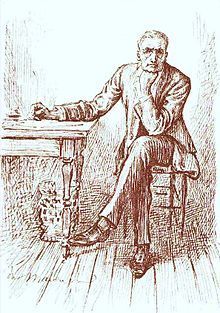 Peter Ibbetson as drawn by G. du M.
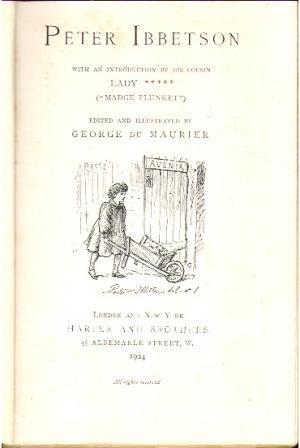 to make the perfection of