

What do you think?
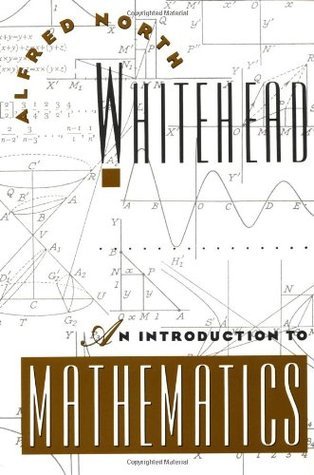
An Introduction to Mathematics
This distinguished little book is a brisk introduction to a series of mathematical concepts, a history of their development, and a concise summary of how today's reader may use them.
208 pages, Paperback
First published January 1, 1958
About the author
Alfred North Whitehead
150 books464 followersAlfred North Whitehead, OM FRS (15 February 1861 – 30 December 1947) was an English mathematician and philosopher. He is best known as the defining figure of the philosophical school known as process philosophy, which today has found application to a wide variety of disciplines, including ecology, theology, education, physics, biology, economics, and psychology, among other areas.
In his early career Whitehead wrote primarily on mathematics, logic, and physics. His most notable work in these fields is the three-volume Principia Mathematica (1910–13), which he co-wrote with former student Bertrand Russell. Principia Mathematica is considered one of the twentieth century's most important works in mathematical logic, and placed 23rd in a list of the top 100 English-language nonfiction books of the twentieth century by Modern Library.
Beginning in the late 1910s and early 1920s, Whitehead gradually turned his attention from mathematics to philosophy of science, and finally to metaphysics. He developed a comprehensive metaphysical system which radically departed from most of western philosophy. Whitehead argued that reality was fundamentally constructed by events rather than substances, and that these events cannot be defined apart from their relations to other events, thus rejecting the theory of independently existing substances. Today Whitehead's philosophical works – particularly Process and Reality – are regarded as the foundational texts of process philosophy.
Whitehead's process philosophy argues that "there is urgency in coming to see the world as a web of interrelated processes of which we are integral parts, so that all of our choices and actions have consequences for the world around us." For this reason, one of the most promising applications of Whitehead's thought in recent years has been in the area of ecological civilization and environmental ethics pioneered by John B. Cobb, Jr.
Isabelle Stengers wrote that "Whiteheadians are recruited among both philosophers and theologians, and the palette has been enriched by practitioners from the most diverse horizons, from ecology to feminism, practices that unite political struggle and spirituality with the sciences of education." Indeed, in recent decades attention to Whitehead's work has become more widespread, with interest extending to intellectuals in Europe and China, and coming from such diverse fields as ecology, physics, biology, education, economics, and psychology. However, it was not until the 1970s and 1980s that Whitehead's thought drew much attention outside of a small group of American philosophers and theologians, and even today he is not considered especially influential outside of relatively specialized circles.
In recent years, Whiteheadian thought has become a stimulating influence in scientific research.
In physics particularly, Whitehead's thought has been influential, articulating a rival doctrine to Albert Einstein's general relativity. Whitehead's theory of gravitation continues to be controversial. Even Yutaka Tanaka, who suggests that the gravitational constant disagrees with experimental findings, admits that Einstein's work does not actually refute Whitehead's formulation. Also, although Whitehead himself gave only secondary consideration to quantum theory, his metaphysics of events has proved attractive to physicists in that field. Henry Stapp and David Bohm are among those whose work has been influenced by Whitehead.
Whitehead is widely known for his influence in education theory. His philosophy inspired the formation of the Association for Process Philosophy of Education (APPE), which published eleven volumes of a journal titled Process Papers on process philosophy and education from 1996 to 2008. Whitehead's theories on education also led to the formation of new modes of learning and new models of teaching.
In his early career Whitehead wrote primarily on mathematics, logic, and physics. His most notable work in these fields is the three-volume Principia Mathematica (1910–13), which he co-wrote with former student Bertrand Russell. Principia Mathematica is considered one of the twentieth century's most important works in mathematical logic, and placed 23rd in a list of the top 100 English-language nonfiction books of the twentieth century by Modern Library.
Beginning in the late 1910s and early 1920s, Whitehead gradually turned his attention from mathematics to philosophy of science, and finally to metaphysics. He developed a comprehensive metaphysical system which radically departed from most of western philosophy. Whitehead argued that reality was fundamentally constructed by events rather than substances, and that these events cannot be defined apart from their relations to other events, thus rejecting the theory of independently existing substances. Today Whitehead's philosophical works – particularly Process and Reality – are regarded as the foundational texts of process philosophy.
Whitehead's process philosophy argues that "there is urgency in coming to see the world as a web of interrelated processes of which we are integral parts, so that all of our choices and actions have consequences for the world around us." For this reason, one of the most promising applications of Whitehead's thought in recent years has been in the area of ecological civilization and environmental ethics pioneered by John B. Cobb, Jr.
Isabelle Stengers wrote that "Whiteheadians are recruited among both philosophers and theologians, and the palette has been enriched by practitioners from the most diverse horizons, from ecology to feminism, practices that unite political struggle and spirituality with the sciences of education." Indeed, in recent decades attention to Whitehead's work has become more widespread, with interest extending to intellectuals in Europe and China, and coming from such diverse fields as ecology, physics, biology, education, economics, and psychology. However, it was not until the 1970s and 1980s that Whitehead's thought drew much attention outside of a small group of American philosophers and theologians, and even today he is not considered especially influential outside of relatively specialized circles.
In recent years, Whiteheadian thought has become a stimulating influence in scientific research.
In physics particularly, Whitehead's thought has been influential, articulating a rival doctrine to Albert Einstein's general relativity. Whitehead's theory of gravitation continues to be controversial. Even Yutaka Tanaka, who suggests that the gravitational constant disagrees with experimental findings, admits that Einstein's work does not actually refute Whitehead's formulation. Also, although Whitehead himself gave only secondary consideration to quantum theory, his metaphysics of events has proved attractive to physicists in that field. Henry Stapp and David Bohm are among those whose work has been influenced by Whitehead.
Whitehead is widely known for his influence in education theory. His philosophy inspired the formation of the Association for Process Philosophy of Education (APPE), which published eleven volumes of a journal titled Process Papers on process philosophy and education from 1996 to 2008. Whitehead's theories on education also led to the formation of new modes of learning and new models of teaching.
Ratings & Reviews
Friends & Following
Create a free account to discover what your friends think of this book!
Community Reviews
Displaying 1 - 23 of 23 reviews

November 17, 2013
A big fat book that has, of late, been sitting on the shelf in front of me is titled What is Mathematics? That book and this one should switch titles. When a student puts down What is Mathematics? they will know how to do various types of math problems, but not what math is. And when a student puts down this book, they will have a general idea of what math is, and won’t be able to solve any problems.
This is actually my favorite book of mathematics that I’ve read (which isn’t saying very much). It’s charming and interesting all the way through. Whitehead is a skilled writer—throwing in various anecdotes to enliven the otherwise dry material—so the book is a pleasure to read. He is also a skilled educator, and picks examples that are both crystal clear and that effectively build on one another as the book progresses.
But what I really enjoyed was that Whitehead actually attempted to explain what math is. For example, when I finished the chapter on trigonometry in this book, I had a realization: though I've solved dozens, perhaps hundreds, of trig problems in high school, I hadn’t the slightest idea what I was actually doing. I was little better than a chimpanzee following a routine in order to get a treat. But Whitehead, in just twenty pages, manages to get at the heart of trigonometry, and to show its relationship to other, more familiar, branches of math.
That being said, I’m not sure who I’d recommend this book to. If you are already a math whiz, you will almost certainly be bored. If you are looking to improve your skill in solving math problems, look elsewhere. But if you are (relatively) mathematically ignorant, while at the same time philosophically inclined, and appreciate a generally charming writer, then this book is perfect for you.
This is actually my favorite book of mathematics that I’ve read (which isn’t saying very much). It’s charming and interesting all the way through. Whitehead is a skilled writer—throwing in various anecdotes to enliven the otherwise dry material—so the book is a pleasure to read. He is also a skilled educator, and picks examples that are both crystal clear and that effectively build on one another as the book progresses.
But what I really enjoyed was that Whitehead actually attempted to explain what math is. For example, when I finished the chapter on trigonometry in this book, I had a realization: though I've solved dozens, perhaps hundreds, of trig problems in high school, I hadn’t the slightest idea what I was actually doing. I was little better than a chimpanzee following a routine in order to get a treat. But Whitehead, in just twenty pages, manages to get at the heart of trigonometry, and to show its relationship to other, more familiar, branches of math.
That being said, I’m not sure who I’d recommend this book to. If you are already a math whiz, you will almost certainly be bored. If you are looking to improve your skill in solving math problems, look elsewhere. But if you are (relatively) mathematically ignorant, while at the same time philosophically inclined, and appreciate a generally charming writer, then this book is perfect for you.

May 3, 2016
Striking review of fundamental concepts from a distinguished teacher. This is enlightening + engaging because you get the concepts plus its importance within the body of knowledge. Not to mention the historical context. For instance, Whitehead remember us that Archimedes was killed by a Roman soldier while contemplating a mathematical diagram and no Roman ever died in such conditions. This book is full of insights; go for it if you want to refresh your view of Mathematics having lots of fun.

July 7, 2017
He did an excellent job of explaining basic mathematics. As a math major many years ago, I understood this stuff. What the author did was to explain some of the core principles that underlie math. Showing why "any" and "some" are important words never occurred to me while studying math. It is now much clearer.

May 13, 2024
whitehead addresses the 'why' of mathematics, sensing correctly that all the emphasis on procedure and particulars are souring students on the subject. it's amazing how the simplest little things are abstracted to death by math until they are applicable to everything. it's all just triangles and circles, all the way down.

December 18, 2015
Great Book!
Anyone who has studied mathematics through differential and integral calculus will enjoy the historical and philosophical allusions in this book. I particularly enjoyed the exposition on trigonometry and triangulation.
Anyone who has studied mathematics through differential and integral calculus will enjoy the historical and philosophical allusions in this book. I particularly enjoyed the exposition on trigonometry and triangulation.
January 7, 2024
This book contains the best explanation of the value of pure math that I've seen yet. Whitehead uses compelling arguments and anecdotes to explain that when people pursue truth and abstract mathematical ideas for their own sake, the discoveries end up having completely unforseen and life-changing practical applications years or centuries down the road. This is in contrast to those who don't value this pursuit of truth and logic for it's own sake, and only work on problems with immediate practical application. Whitehead argues that these groups actually end up facing stagnation, and don't make as much progress on the practical problems they deem most important.
This book presents a very clear explanation of important mathematical ideas, without getting bogged down in exercises and calculations. More than just an accessible and engaging presentation of fundamental mathematical concepts, though, the book contains a lot of beautiful prose about the endeavor of thinking and reason in general.
This book presents a very clear explanation of important mathematical ideas, without getting bogged down in exercises and calculations. More than just an accessible and engaging presentation of fundamental mathematical concepts, though, the book contains a lot of beautiful prose about the endeavor of thinking and reason in general.
January 18, 2013
I was re-reading this book to see whether any part would work as a reading for one of my classes. Unfortunately, this book is too old for it to be of much use there. It talks about light moving through the ether and it refers to people and places in England that few of my students (if any) would know (I didn't know most of them).
There are good paragraphs and I appreciate the book because it was probably one of the first books that attempted to talk about mathematics to a general audience.
There are good paragraphs and I appreciate the book because it was probably one of the first books that attempted to talk about mathematics to a general audience.
January 6, 2019
Come non li fanno più.
April 29, 2019
Contains a surprising amount of insight even for those well versed in the subject.

January 10, 2020
However "small" this book offers wide range of mathematics foundation, from numbers/aritmerics, algebra, geometry, on numbers vs space, and basic calculus..
Read the following description on arithmetic:
"the first noticeable fact about arithmetic is that it applies to everything, to tastes and to sounds, to apples and to angels, to the ideas of the mind and to the bones of the body. The nature of the things is perfectly indifferent, of all things it is true that two and two make four. Thus we write down as the leading characteristic of mathematics that it deals with properties and ideas which are applicable to things just because they are things, and apart from any particular feelings, or emotions, or sensations, in any way connected with them."
Even it gives suggestion on proper syllabus for they who want to teach or learn mathematics in sequencing deepness.
Quiet interesting to read as it blends pretty well the science(s) and its historical ground. Although it often explain certain subjects in "philosophical" nuances that may make the reader frown...
Read the following description on arithmetic:
"the first noticeable fact about arithmetic is that it applies to everything, to tastes and to sounds, to apples and to angels, to the ideas of the mind and to the bones of the body. The nature of the things is perfectly indifferent, of all things it is true that two and two make four. Thus we write down as the leading characteristic of mathematics that it deals with properties and ideas which are applicable to things just because they are things, and apart from any particular feelings, or emotions, or sensations, in any way connected with them."
Even it gives suggestion on proper syllabus for they who want to teach or learn mathematics in sequencing deepness.
Quiet interesting to read as it blends pretty well the science(s) and its historical ground. Although it often explain certain subjects in "philosophical" nuances that may make the reader frown...

April 19, 2018
"These three notions, of the variable, of form, and of generality, compose a sort of mathematical trinity which preside over the whole subject. They all really spring from the same root, namely from the abstract nature of the science." - pg 67
"Now in creative thought common sense is a bad master. Its sole criterion for judgment is that the new ideas shall look like the old ones. In other words it can only act by suppressing originality." - pg 132
"The difficulty that beginners find in the study of this science is due to the large amount of technical detail which has been allowed to accumulate in the elementary text-books, obscuring the important ideas." - pg 213
"Now in creative thought common sense is a bad master. Its sole criterion for judgment is that the new ideas shall look like the old ones. In other words it can only act by suppressing originality." - pg 132
"The difficulty that beginners find in the study of this science is due to the large amount of technical detail which has been allowed to accumulate in the elementary text-books, obscuring the important ideas." - pg 213
This entire review has been hidden because of spoilers.

August 27, 2023
As it says in the forward of this book “The object of the following chapters is not to teach mathematics,” this book is not a teaching book on the fundamentals of math; but a introduction to mathematics theory. Which is not easy, to be honest with you I only understood about 40% of this book. I don’t think it was the way the book was written that made it hard for me to understand. I need to work and solve the problems to grasp the theory fully, that maybe just me. Not a easy read.

November 26, 2022
Connecting the important ideas of math and physics via a deep understanding and a wide historical perspective, the author provides a generality and a meaning that different math and physics courses lasting more than 10 school years fail to provide.
This book is definitely worth multiple rereads to fully understand the intricacy of its arguments and the importance of its general idea.
This book is definitely worth multiple rereads to fully understand the intricacy of its arguments and the importance of its general idea.

December 30, 2021
A seriously funny little something from England’s own “Governor of giggles”

September 11, 2020
Even though I’m a mathematical hobbyist who had four semesters of calculus at a university, I found “An Introduction to Mathematics” to have some tough reading in it – especially, some of the geometric drawings that Whitehead used to illustrate some of his ideas.
According to my understanding, Whitehead wrote this book after the advent of Einstein’s development of Special Relativity, in which the idea of an ether permeating space seemed to have been defeated. Yet, Whitehead says the following (page 158):
“Again, the motion of vibration of a violin string is submitted to a similar harmonic analysis, and so are the vibrations of the ether and the air….”
I wonder what was meant by the use of the term “ether”. Of course, it is possible that Whitehead simply rejected Einstein’s repudiation of a “luminiferous ether”. Einstein’s theory of the relativity of all non-accelerated motion had no use for the theory of an ether as a medium through which light was transmitted.
I like what Whitehead says in the last paragraph of Chap. XVI (page 201):
“(2) Space-perception accompanies our sensations, perhaps all of them, certainly many; but it does not seem to be a necessary quality of things that they should all exist in one space or in any space.”
The idea (very prevalent among materialists) that in order for something to exist, it must exist in a portion of “physical” space, is an idea that is, I am convinced, gravely erroneous, resulting in a most unfortunate devaluing of mind (consciousness), as well as postulating the impossibility of the objective existence of “transcendent spirit”. First of all, if one seeks to sustain such a view as held by many materialists, then what is one to do with mathematical “objects”? If they have any genuine existence, then that existence is OUTSIDE of space-time. If they have no actual existence, then most mathematicians probably operate within the framework of mathematical “superstitions” – being deluded into the conviction that the numbers they study and manipulate really exist and are not mere convenient fictions created in their minds (with minds also being convenient fictions). In such an outlook, reality becomes a desert filled with desiccated and inert entities in which hapless humanity finds itself lost in the dilemma of being forced to create innumerable fictions just to cope and thrive in this desert. I believe that this outlook is deserving of ridicule.
Suffice it to say that, given Alfred North Whitehead’s brilliance as a philosopher of the highest rank, his book about mathematics was a somewhat rewarding read for me. Mere mathematical hobbyists, such as myself, might find some portions of “An Introduction to Mathematics” somewhat tough going. It is worth the effort, though.
According to my understanding, Whitehead wrote this book after the advent of Einstein’s development of Special Relativity, in which the idea of an ether permeating space seemed to have been defeated. Yet, Whitehead says the following (page 158):
“Again, the motion of vibration of a violin string is submitted to a similar harmonic analysis, and so are the vibrations of the ether and the air….”
I wonder what was meant by the use of the term “ether”. Of course, it is possible that Whitehead simply rejected Einstein’s repudiation of a “luminiferous ether”. Einstein’s theory of the relativity of all non-accelerated motion had no use for the theory of an ether as a medium through which light was transmitted.
I like what Whitehead says in the last paragraph of Chap. XVI (page 201):
“(2) Space-perception accompanies our sensations, perhaps all of them, certainly many; but it does not seem to be a necessary quality of things that they should all exist in one space or in any space.”
The idea (very prevalent among materialists) that in order for something to exist, it must exist in a portion of “physical” space, is an idea that is, I am convinced, gravely erroneous, resulting in a most unfortunate devaluing of mind (consciousness), as well as postulating the impossibility of the objective existence of “transcendent spirit”. First of all, if one seeks to sustain such a view as held by many materialists, then what is one to do with mathematical “objects”? If they have any genuine existence, then that existence is OUTSIDE of space-time. If they have no actual existence, then most mathematicians probably operate within the framework of mathematical “superstitions” – being deluded into the conviction that the numbers they study and manipulate really exist and are not mere convenient fictions created in their minds (with minds also being convenient fictions). In such an outlook, reality becomes a desert filled with desiccated and inert entities in which hapless humanity finds itself lost in the dilemma of being forced to create innumerable fictions just to cope and thrive in this desert. I believe that this outlook is deserving of ridicule.
Suffice it to say that, given Alfred North Whitehead’s brilliance as a philosopher of the highest rank, his book about mathematics was a somewhat rewarding read for me. Mere mathematical hobbyists, such as myself, might find some portions of “An Introduction to Mathematics” somewhat tough going. It is worth the effort, though.

September 4, 2021
It is a misleading title for such a compound book. In modern times, it is the kind of title that would sit in a university bookstore 101 section, overpriced and reluctantly added to the freshman cart. However, Whitehead, drafts this as a more holistic book. Sure, there is plenty of math as advertised, but some history and interconnectedness and, for the liberal art student grabbing that math credit, some inspiration.
I’d be lying if I said I didn’t glaze over during some of the latter math sections. I appreciate the “introductory” nature of the book’s intent, but I wasn’t working through the examples as probably intended. I gravitated to the writing in-between the problems. The symbolism of mathematics. The history of every short chapter such as imaginary numbers and conic sections. Whitehead was known for his educational philosophy. A philosophy that placed great value on connecting ideas to one another and understanding how things came to be in addition to the mechanical application.
Even if I could not appreciate everything he demonstrated, I could appreciate the gift he believed mathematics could bestow. Another lens to view the universe; another language to communicate with it. When done with discipline, that is, for “[i]t is a safe rule to apply that, when a mathematical or philosophical author writes with a misty profundity, he is talking nonsense.” Pg. 187. However, that clear-eyed dedication does not mean that there is no room for imagination. And he looked askance at those who held back from pushing forward into the unknown.
I’d be lying if I said I didn’t glaze over during some of the latter math sections. I appreciate the “introductory” nature of the book’s intent, but I wasn’t working through the examples as probably intended. I gravitated to the writing in-between the problems. The symbolism of mathematics. The history of every short chapter such as imaginary numbers and conic sections. Whitehead was known for his educational philosophy. A philosophy that placed great value on connecting ideas to one another and understanding how things came to be in addition to the mechanical application.
Even if I could not appreciate everything he demonstrated, I could appreciate the gift he believed mathematics could bestow. Another lens to view the universe; another language to communicate with it. When done with discipline, that is, for “[i]t is a safe rule to apply that, when a mathematical or philosophical author writes with a misty profundity, he is talking nonsense.” Pg. 187. However, that clear-eyed dedication does not mean that there is no room for imagination. And he looked askance at those who held back from pushing forward into the unknown.
The death of Archimedes by the hands of the Roman soldier is symbolical of a world-change of the first magnitude: the theoretical Greeks, with their love of abstract science, were superseded by in the leadership of the European world by the practical Romans […] The Romans were a great race, but they were cursed with the sterility which waits upon practicality. They did not improve upon the knowledge of their forefathers, and all their advances were confined to the minor technical details of engineering. They were not dreamers enough to arrive at new points of view, which could give a more fundamental control over the forces of nature. No Roman lost his life because he was absorbed in the contemplation of a mathematical diagram. Pg. 28.

Read
January 30, 2022I've never been very good at math - for a long time it wasn't my worst subject, but it was never my best, and it quickly dropped to my worst in high school even as I did the advanced classes for pretty much any other subject. I spent a long time hating the subject as a whole before more recently realizing that hey, math is also just a special branch of philosophy, and I like philosophy! So why wouldn't I enjoy this book on math by an actual philosopher?
Turns out I was right in that intuition! God, this is how I wish math had been taught! Granted, some of it comes at me a little bit fast and could benefit from further elaboration - I'm not sure I fully understand the concept of a "standard of approximation" and I wish that had been explained a bit more in-depth beyond the simple mechanics of it. But if I ever wanted to get someone who's sick of how the school curriculum teaches the subject interested in math again (as well as teach some of the basic principles behind the mechanics of the discipline - I learned a lot!), this is the book I would hand them.
As a side note, I've been reading a bit of Lockhart's Lament alongside this out of curiosity and I find Whitehead actually makes a much better argument for why math reform is important, despite having written this book almost a century earlier than Lockhart's essay!
Turns out I was right in that intuition! God, this is how I wish math had been taught! Granted, some of it comes at me a little bit fast and could benefit from further elaboration - I'm not sure I fully understand the concept of a "standard of approximation" and I wish that had been explained a bit more in-depth beyond the simple mechanics of it. But if I ever wanted to get someone who's sick of how the school curriculum teaches the subject interested in math again (as well as teach some of the basic principles behind the mechanics of the discipline - I learned a lot!), this is the book I would hand them.
As a side note, I've been reading a bit of Lockhart's Lament alongside this out of curiosity and I find Whitehead actually makes a much better argument for why math reform is important, despite having written this book almost a century earlier than Lockhart's essay!
May 27, 2013
Essentially a review of pure-level math in high-school, with more emphasis on explicating concepts and their origins than practical applications and problem solving. It's not dumbed down and makes efforts to describe the developments and proofs of mathematical thought, so I couldn't recommend it to anyone not already a little familiar with the concepts.
This text is just over 100 years old, but despite a few changes in notation and some anachronisms (it mentions the ether when describing physics), elementary math has largely stayed the same. While I'm not bad at math, I've never had any interest in studying it for its own sake. This book has gone some way to show me the light, as it were. I recommend it to anyone who needs a fresh perspective on math, and is sufficiently ignorant about the subject so-as not to be bored to tears.
This text is just over 100 years old, but despite a few changes in notation and some anachronisms (it mentions the ether when describing physics), elementary math has largely stayed the same. While I'm not bad at math, I've never had any interest in studying it for its own sake. This book has gone some way to show me the light, as it were. I recommend it to anyone who needs a fresh perspective on math, and is sufficiently ignorant about the subject so-as not to be bored to tears.

April 5, 2026
Whitehead transforms mathematics from a collection of rote techniques into a living philosophy of abstraction, generalization, and applied power. This brilliant exposition - covering variables, imaginary numbers, dynamics, and periodicity - reveals why mathematics is the essential language of nature itself. A mind-expanding masterpiece for anyone who wants to understand what mathematics truly is.

January 4, 2014
I still get lost on some of this stuff, but Whitehead's exposition is great. Makes you wonder what happened to him. Wish I'd read this book a lot earlier, when I was actually working on mathematics. The problems he points out with textbooks seem to be worse today, and not only in mathematics.

June 18, 2009
A fine review of high school math, plus some history and context. I might have enjoyed it, if an editor had trimmed down some of the verbiage.
February 23, 2014
Simply fascinating. A pinch of maths, a pinch of philosophy, a pinch of wonderful writing... all combined to make a great instructional text on how to understand maths as a whole.

May 2, 2015
Fun, but mainly of historical interest rather than technical.
Displaying 1 - 23 of 23 reviews