

What do you think?

Blackbeard: America's Most Notorious Pirate
The definitive biography of history’s most fearsome and famous pirate
Of all the colorful cutthroats who scoured the seas in search of plunder during the Golden Age of Piracy in the early eighteenth century, none was more ferocious or notorious than Blackbeard. As unforgettable as his savage career was, much of Blackbeard's life has been shrouded in mystery--until now.
Drawing on vivid descriptions of Blackbeard's attacks from his rare surviving victims, pirate expert Angus Konstam traces Blackbeard's career from its beginnings to his final defeat in a tremendous sea battle near his base at Ocracoke Island. Presenting dramatic accounts of the pirate's very effective tactics and his reputation for cruelty, Konstam offers a fascinating examination of the life and business of piracy and the lure of this brutal and bloody trade.
Of all the colorful cutthroats who scoured the seas in search of plunder during the Golden Age of Piracy in the early eighteenth century, none was more ferocious or notorious than Blackbeard. As unforgettable as his savage career was, much of Blackbeard's life has been shrouded in mystery--until now.
Drawing on vivid descriptions of Blackbeard's attacks from his rare surviving victims, pirate expert Angus Konstam traces Blackbeard's career from its beginnings to his final defeat in a tremendous sea battle near his base at Ocracoke Island. Presenting dramatic accounts of the pirate's very effective tactics and his reputation for cruelty, Konstam offers a fascinating examination of the life and business of piracy and the lure of this brutal and bloody trade.
336 pages, Hardcover
First published June 1, 2006
About the author
Angus Konstam
232 books62 followersAngus Konstam is a Scottish writer of popular history. Born in Aberdeen, Scotland and raised on the Orkney Islands, he has written more than a hundred books on maritime history, naval history, historical atlases, with a special focus on the history of piracy.
Ratings & Reviews
Friends & Following
Create a free account to discover what your friends think of this book!
Community Reviews
Displaying 1 - 30 of 61 reviews

February 19, 2015
Another entry in “Nikki picks up the most random stuff at the library”, though this might’ve been around the time Assassin’s Creed: Black Flag came out, when I also picked up a book on George Washington I haven’t read yet… In any case, this turned out to be a bit disappointing. There’s a wealth of information here about pirates in general, their ports and habits and motivations, and yet it all seems to work out to a big heap of nothing when it comes to Blackbeard. The conclusion seems to be he’s more myth than man, because what we have of him was witnessed by terrified victims and the authors of sensational tales — i.e., not the most likely group to stick to the truth and nothing but the truth.
It’s interesting to get an idea of what does survive from the period, but most of it is very flimsy, and it makes it worse that Konstam will introduce it, dismiss it, and then still build other suppositions on it. For example, he establishes that there’s no proof beyond gossip for Blackbeard being a Bristol boy, and then goes on to build a whole theory about his piratical career on the basis of him being a Bristol boy. The two theories then prop each other up, neither very substantial. Not good practice!
It’s interesting to get an idea of what does survive from the period, but most of it is very flimsy, and it makes it worse that Konstam will introduce it, dismiss it, and then still build other suppositions on it. For example, he establishes that there’s no proof beyond gossip for Blackbeard being a Bristol boy, and then goes on to build a whole theory about his piratical career on the basis of him being a Bristol boy. The two theories then prop each other up, neither very substantial. Not good practice!

January 31, 2019
I rate this book two and a half stars. The book is more about pirates in general during the 1700s. Not much is known about Blackbeard prior to his notoriety as a pirate captain. It is interesting about tactics, pirate life of the period in general, and Blackbeard's final battle. The book ends with the probable discovery of his ship 'Queen Anne's Revenge' in 2000, and compares depictions of Blackbeard in literature and movies with the real life man. I feel the book bogs down after Blackbeard's final battle, where the Governor's of Virginia and North Carolina are basically having a political squabble.

November 2, 2023
As a long time Pirates of the Caribbean fan I was very excited to read about the real historical figures that inspired the genre of pirate fiction and was not disappointed. Konstam interweaves the story of Edward Teach (Blackbeard) with a more general history of the 'Golden Age of Piracy' to create a very compelling book.
December 3, 2021
It's okay... The book is more of a general history of the pirates then a biography on Blackbeard. Although, this is not a good book on the general history of the pirates either. The book spends more time talking about all the other pirates and what's going on in the 1700s then it does on blackbeard. The other problem with the book is that it jumps around, it doesn't give events in chronological order. The author will follow a pirate till he dies (pirate A) then jumps back 5 years and continues the story of another pirate (pirate B). To make it worse, the author will then talk about different events that include pirate A and his interactions with pirate B later in the book. The jumping back and forth between dates makes the story hard to follow. The author does provide multiple accounts on events that have differing story's about what happened. The last chapter is very interesting. The author talks about the archeological sights for different wrecks and the research that's currently going on.

June 13, 2023
Closer to 3.5. It picks up towards the last third, when the narrative narrows focus to Blackbeard and the administrations of Virginia and North Carolina.

November 23, 2025
Blackbeard was an English pirate who operated mostly in the British West Indies and along the coast of the British colonies in the United States. He captured a slave ship that he renamed Queen Anne's Revenge. He had a pretty colorful career as a pirate and went out in a pretty dramatic way as well. Blackbeard's life and pirating career was sufficiently research and outlined in this book. Not one of my favorites of the year, but glad to have it read and off my shelf.

November 12, 2023
This was too detailed and was bogged down in minutiae. About half the size would be a good amount.

January 7, 2024
Fascinating. Piracy was a game of intimidation, subterfuge, and reputation. The author dives into detective work to tell us well-known tales of piracy in the 1600s-1700s and less-well-confirmed stories about the famous Blackbeard. Contrary to other pirates such as the notoriously psychopathic Charles Vane, Blackbeard was not known to have committed violent atrocities. Instead, he cultivated a careful reputation for ferocity, bolstered by his amazing outfit: manic eyes, smoldering long slowmatches (lit fuses!) sizzling behind both ears, fur cap, and his huge black beard tied with ribbons!
Little is known about Blackbeard pre-piracy. Blackbeard probably hailed from Bristol, and the authors draws a few convincing clues into play to bolster this argument. For example, he may have avoided Barbados to avoid an old similarly-aged Bristolian who was the governor.
He had some attractice characteristics. For example, Blackbeard and other pirates often recruited Africans — escaped slaves or volunteers from slave ships that were captured -- to join their crews. (Needless to say, pirates were no abolitionist pioneers… often captured slaves were just treated as cargo.) Although, Blackbeard did seem a little wacko-- one time, when drunk, he exclaimed “Let us make a hell of our own and try how long we can bear it!” Blackbeard filled the hole with fire and brimstone and closed the hatches. Also, he was probably kind of greedy. Blackbeard seems to have stranded a big portion of his own crew in order to receive a larger portion of present and future booty (i.e., have fewer men to divide it upon).
If you're intrigued by the implication that pirates divided their booty equally, well, so was I. Here is the most fascinating part of the book.
Why Become A Pirate?
Sailors became pirates because they were treated so unfairly as sailors. Some ships mutinied against cruel or unjust captains and then became pirates. Many sailors resented corrupt authority figures who paid too little, did not divide food and rum equally, withheld wages, and more. Sailors had no say in their own workings or existence and riled against unjust conditions. The results? PIRACY.
And here's the coolest part: pirates had a code of ethics that stood in stark contrast to the unethical treatment of workers on merchant vessels! In this piratical contract, draconian authority was forbidden. Simple rules were written down to proect their communal interest.
Piratical Code:
● Pirates were DEMOCRATIC. Every man had a say in nearly every decision: hwoto divide food, what their next target should be, what to do with prisoners, who the elected officers would be, etc. The Captains were answerable to men!
● Pirates upheld a separation of power. Those who metered out discipline were not the captain, but separately-elected positions.
● Pirates preserved their sleep. Lights out was at 8 and if anyone wanted to keep drinking, they had to do it on the open deck.
● Pirates banned gambling for money.
● Pirates split the rum and food fairly among all men; no one got more or less.
Pirates were allowed last words before they hung, and a famous pirate named William Fly used his moment to rail against injustices: “all captains should take warning and pay wages when due." He criticized “bad usage.” His dying words were "for justice."
In general, piracy was full of intimidation and subterfuge. Pirates painted faint gunports on their ships, flew false flags, and generally blustered.
Three more fun facts. Buccaneer is an Arrowak word from "buccan," a wooden frame used to roast meat that was sold to corsairs (and pirates). Careening comes from the larin word for keel, and refers to turning a ship on its side for repairs. The Peace of Utrecht was a series of peace treaties signed by the belligerents in the War of the Spanish Succession, ending privateering-- and causing privateers to have to choose between piracy or returning to unjust merchant shipwork.
Little is known about Blackbeard pre-piracy. Blackbeard probably hailed from Bristol, and the authors draws a few convincing clues into play to bolster this argument. For example, he may have avoided Barbados to avoid an old similarly-aged Bristolian who was the governor.
He had some attractice characteristics. For example, Blackbeard and other pirates often recruited Africans — escaped slaves or volunteers from slave ships that were captured -- to join their crews. (Needless to say, pirates were no abolitionist pioneers… often captured slaves were just treated as cargo.) Although, Blackbeard did seem a little wacko-- one time, when drunk, he exclaimed “Let us make a hell of our own and try how long we can bear it!” Blackbeard filled the hole with fire and brimstone and closed the hatches. Also, he was probably kind of greedy. Blackbeard seems to have stranded a big portion of his own crew in order to receive a larger portion of present and future booty (i.e., have fewer men to divide it upon).
If you're intrigued by the implication that pirates divided their booty equally, well, so was I. Here is the most fascinating part of the book.
Why Become A Pirate?
Sailors became pirates because they were treated so unfairly as sailors. Some ships mutinied against cruel or unjust captains and then became pirates. Many sailors resented corrupt authority figures who paid too little, did not divide food and rum equally, withheld wages, and more. Sailors had no say in their own workings or existence and riled against unjust conditions. The results? PIRACY.
And here's the coolest part: pirates had a code of ethics that stood in stark contrast to the unethical treatment of workers on merchant vessels! In this piratical contract, draconian authority was forbidden. Simple rules were written down to proect their communal interest.
Piratical Code:
● Pirates were DEMOCRATIC. Every man had a say in nearly every decision: hwoto divide food, what their next target should be, what to do with prisoners, who the elected officers would be, etc. The Captains were answerable to men!
● Pirates upheld a separation of power. Those who metered out discipline were not the captain, but separately-elected positions.
● Pirates preserved their sleep. Lights out was at 8 and if anyone wanted to keep drinking, they had to do it on the open deck.
● Pirates banned gambling for money.
● Pirates split the rum and food fairly among all men; no one got more or less.
Pirates were allowed last words before they hung, and a famous pirate named William Fly used his moment to rail against injustices: “all captains should take warning and pay wages when due." He criticized “bad usage.” His dying words were "for justice."
In general, piracy was full of intimidation and subterfuge. Pirates painted faint gunports on their ships, flew false flags, and generally blustered.
Three more fun facts. Buccaneer is an Arrowak word from "buccan," a wooden frame used to roast meat that was sold to corsairs (and pirates). Careening comes from the larin word for keel, and refers to turning a ship on its side for repairs. The Peace of Utrecht was a series of peace treaties signed by the belligerents in the War of the Spanish Succession, ending privateering-- and causing privateers to have to choose between piracy or returning to unjust merchant shipwork.
August 26, 2020
I live in the Carolinas & am married to a beach lover. So there aren't too many Carolina beaches we haven't enjoyed. All of them have their Blackbeard landmarks, museums, businesses & stories of his local piratical adventures. As a historical marker reader, museum goer & brochure reader, over the years I've noticed that the accounts his exploits only got more confused in my mind. So I was hoping this biography would clear things up. The author, Angus Konstam does a masterful job of weighing through the evidence, myths and legend to identify facts when proven & giving the reader information to make their own conclusions when conclusive evidence is lacking, which is often the case. He presents Blackbeard "Edward Teach (or Thache)" as a skilled mariner who strategized his moves to plunder merchant ships from Philadelphia to the Spainish Main to the West Indies, a leader who was always a step or two ahead of his contancerous crew of freespirited pirates and a showman who used his appearance, conduct & language to create such a dasterdly reputation it compelled the captains of hapless merchant vessels in his sights to give up their booty without a fight & plead for mercy. The "golden age of pirates" in the Caribbean was relatively brief, during the 1710s. This is similar the the short lawless period in the US West following the Civli War. Blackbeard led his own vessel & crew a pirating for less than 2 years before losing his head to the forces of Governor Spotswood of VA. I learned that the coast of North Carolina was such a great haven for him due to the relative weakness of the colonial governor, Gov Eden, and his government to interrupt his activities. Hence a pirate commanding two or three ships with a force of 100 to 200 men could terrorize coastal cities and ports. What was really fascinating was that the lot of poor whites who were found themselves in the West Indies, particularly Barbados, either as freemen or indentures had an intolerable existence, which provided plenty of volunteers to go pirating, knowing that death in combat or on the gallows would be the likely result. Blacks made up a large contingent of pirate crews, many were slaves on captured slave ships who opted to pirate rather than the aution block or freed Africans, as African enslavement was only getting started as an institution at the time, who saw pirating as their only shot at freedom. This is largely unknown because when authorities captured them, in most cases they were listed as captured cargo and sold at auction. The truth is more amazing than any fiction written since about this colorful age in American history.
August 4, 2026
Angus Konstam has written some rather general books on the history of piracy, and seems like a genuine good bloke. Normally I’d say his other, less specific titles on pirates are a good place for newbies to start on the topic. But this one? Eh, maybe not?
This promises something it never delivers: a biography of the arch-pirate himself, Blackbeard. Stripped of the pointless weird fanfic of the Time-Life Seafarers series (you know the ones: faux black leather bindings, lots of smudgy original artwork, ABC Whipple’s cringy prose) but also devoid of any new, original or even compelling research, Konstam’s book is less a biography and more an undergrad’s paper when they forgot to hit up the library. A continual bad habit in most of his writings is that he leans far too heavily on Captain Charles Johnson’s General History. In short, the 1724 book that gave us the whole Blackbeard mythos. Like, literally, it’s the only source that Konstam uses throughout this biography and readers of his other works will notice that pattern. (See his Osprey books on pirates; the Angus McBride illustrations are worth the retread of the same source.) General History has never been out of print; we all have a copy (Dover or otherwise) on our shelf if we’re bothering to read this book and we all know its strengths and weaknesses. But it’s a lazy historian’s source; it’s watching the Godfather so you can discuss Puzo at the book club. Readers of a definitive Blackbeard bio deserve better than this tepid rehash. Lots of recent research has turned up previously unknown facts about Blackbeard’s career and a tiny slice, possibly, of his pre-pirate life. Sure, Konstam’s 2006 book might not have had access to these newer works, but brother sure as heck didn’t uncover anything new about that rascal Thatch while typing this book up.
And the greatest sin? Vast quantities of this book don’t even deal with Blackbeard. Long, multi-page explanations of the history of Bristol, UK or the publication history of Johnson’s General History fill the pages like that aforementioned proverbial undergrad padding what would otherwise be a pamphlet sized biography of the most famous pirate in the world.
I wanted to like this because of the subject matter, but I can’t in good conscience recommend this to readers looking for a little insight into Blackbeard’s life. You’ll get a little taste of the 18th century world of pirates, and Konstam’s writing is fine, just no frills. There are other, better sources for that topic though.
This promises something it never delivers: a biography of the arch-pirate himself, Blackbeard. Stripped of the pointless weird fanfic of the Time-Life Seafarers series (you know the ones: faux black leather bindings, lots of smudgy original artwork, ABC Whipple’s cringy prose) but also devoid of any new, original or even compelling research, Konstam’s book is less a biography and more an undergrad’s paper when they forgot to hit up the library. A continual bad habit in most of his writings is that he leans far too heavily on Captain Charles Johnson’s General History. In short, the 1724 book that gave us the whole Blackbeard mythos. Like, literally, it’s the only source that Konstam uses throughout this biography and readers of his other works will notice that pattern. (See his Osprey books on pirates; the Angus McBride illustrations are worth the retread of the same source.) General History has never been out of print; we all have a copy (Dover or otherwise) on our shelf if we’re bothering to read this book and we all know its strengths and weaknesses. But it’s a lazy historian’s source; it’s watching the Godfather so you can discuss Puzo at the book club. Readers of a definitive Blackbeard bio deserve better than this tepid rehash. Lots of recent research has turned up previously unknown facts about Blackbeard’s career and a tiny slice, possibly, of his pre-pirate life. Sure, Konstam’s 2006 book might not have had access to these newer works, but brother sure as heck didn’t uncover anything new about that rascal Thatch while typing this book up.
And the greatest sin? Vast quantities of this book don’t even deal with Blackbeard. Long, multi-page explanations of the history of Bristol, UK or the publication history of Johnson’s General History fill the pages like that aforementioned proverbial undergrad padding what would otherwise be a pamphlet sized biography of the most famous pirate in the world.
I wanted to like this because of the subject matter, but I can’t in good conscience recommend this to readers looking for a little insight into Blackbeard’s life. You’ll get a little taste of the 18th century world of pirates, and Konstam’s writing is fine, just no frills. There are other, better sources for that topic though.

December 30, 2022
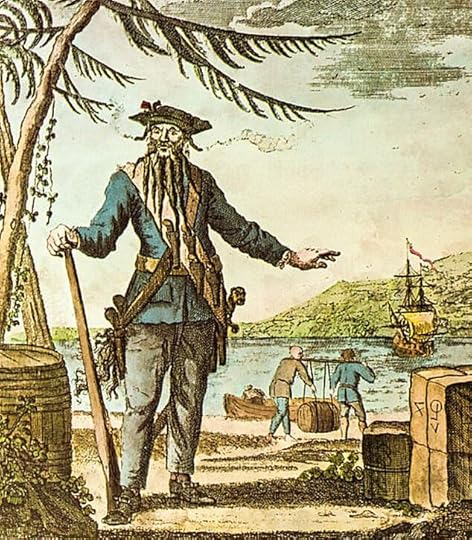
Blackbeard (aka Edward Teach, Thatch or Tatch) is often thought of as the quintessential pirate. But what do we know about the man himself? Turns out … not much. Criminals are generally averse to spending time in the public eye. However, by sifting through contemporaneous newspaper reports, it’s possible to piece together a semblance of his travels and misdeeds.
Historian Angus Konstam does just that in Blackbeard. He also relies on Captain Charles Johnson’s A General History of the Robberies and Murders of the most notorious Pyrates, but given the book’s sensationalized nature, he puts some effort into sorting truth from fiction.
Unfortunately, the book suffers from the fact that this source materials is rather thin gruel from which to reconstruct the life of America's Most Notorious Pirate. Thus we get little of the man himself beyond a few dates and events.
What is clear is that Blackbeard was neither the most successful pirate, nor the most ruthless (by all accounts he treated the crews of the ships he captured with leniency). His main talent seemed to be in cultivating an image of fearsomeness to elicit the desired response from those whom he robbed (that response being … cowering). His renown largely seems to be a result of romanticization by those that followed including the aforementioned Captain Johnson and the actor Robert Newton who invented what we know today as ‘pirate speech’ (or arrrgot) in his roles as Long John Silver in a Disney adaptation of "Treasure Island" and the title character in "Blackbeard, the Pirate."
Though it’s doubtful that Blackbeard ever said "shiver me timbers" or "walk the plank", we’ll probably never know for sure because, despite Konstam’s efforts, we remain no wiser about the man himself and likely never will.

August 26, 2022
If you're interested in learning about Colonial America during the Golden Age of Piracy (late 17th-18th century), this is the book for you. I learned a lot about Blackbeard and his plunders in the Carribean/Central Am. and North/South Carolina. A lot of his life is based on Captain Johnson's "A General History of the Robberies and Murders of the most Notorious Pyrates" which is speculation threaded from affidavits, newspaper stories, and legal notes and papers. The author does a good job of extrapolating facts and painting a picture of pirate life from its political to social atmosphere.
It was interesting to learn about other pirates, like Calico "Jack" Rackham, Mary Read, Anne Bonny, and Benjamin Hornigold. The only criticism I have is the wordiness; some parts, especially the last chapter, could have been more succinct.
It was interesting to learn about other pirates, like Calico "Jack" Rackham, Mary Read, Anne Bonny, and Benjamin Hornigold. The only criticism I have is the wordiness; some parts, especially the last chapter, could have been more succinct.

January 13, 2019
Blackbeard has gone down through history as one of the most fearsome pirates who ever existed. Along with Captain Kidd, Blackbeard might be the one pirate name that anyone knows if they don't know anything else about pirates. This fact does nothing but help the author's main point that Blackbeard was a master of cultivating his own image. While undoubtedly no pushover, the author provides evidence that Blackbeard, while unscrupulous, was not as vicious as many of his peers. Blackbeard was a master of PR and keeping his men in line through his image rather than blatant cruelty.
The book takes into account the Golden Age of piracy outside of just Blackbeard. I think many who have read or learned anything about pirates fails to realize most of them operated at the same time and in the same territory. Blackbeard's story overlaps that of Charles Vane (who might be remembered from Black Sails) and Stede Bonnet, one of the truly oddest pirates in history (he hired his own crew and bought his boat...and was clearly an inept pirate). The author weaves the story of Blackbeard through the history of pirates in the Caribbean.
My main complaint with the book is that it gets a bit dry. Parts of it are very interesting, but some of the scholarly information can get boring and repetitive. This is not a thrilling read along the lines of nonfiction like Devil in the White City. I learned a lot of new information about Blackbeard, but perhaps a book about pirates should have been more of a thrill ride than this book turned out to be.
The book takes into account the Golden Age of piracy outside of just Blackbeard. I think many who have read or learned anything about pirates fails to realize most of them operated at the same time and in the same territory. Blackbeard's story overlaps that of Charles Vane (who might be remembered from Black Sails) and Stede Bonnet, one of the truly oddest pirates in history (he hired his own crew and bought his boat...and was clearly an inept pirate). The author weaves the story of Blackbeard through the history of pirates in the Caribbean.
My main complaint with the book is that it gets a bit dry. Parts of it are very interesting, but some of the scholarly information can get boring and repetitive. This is not a thrilling read along the lines of nonfiction like Devil in the White City. I learned a lot of new information about Blackbeard, but perhaps a book about pirates should have been more of a thrill ride than this book turned out to be.

October 11, 2021
A very engaging account of Blackbeard's life and pirate deeds that also gives a good overview of what was going on during the Golden Age of Piracy and just after in the Bahamas. Konstam examines what little archeological and written evidence we have about Blackbeard, showing how conflicting witnesses' accounts and journalistic reports could be at the time. I especially enjoyed the exploration of the conflict between the governors of North Carolina and Virginia and how that directly impacted the trial of the pirates and our current image of Blackbeard. Well written and fun, Konstam knows how to transmit his enthusiasm about the subject!

July 17, 2023
More of a general history of the Golden Age of Piracy than a biography of Blackbeard. The book begins slowly as almost nothing is known for certain about Blackbeard's early life and the author discusses various topics related to piracy including pirate codes and Caribbean trade routes. The book is stronger in the final chapters, which focus on Blackbeard's conflicts with colonial authorities, his final battle and his legacy in popular culture. The audiobook narrator mispronounces some words, including "Blenheim."

July 20, 2024
Fascinating background on the history and tactics of pirates, particularly as they relate to colonial American (especially the Carolinas and Virginia). There's probably as much detail about colonial politics as Blackbeard, but it is interesting context. I appreciated the structure of alternating the storyline with broader backgrounds. Other pirates, such as Charles Vane and Jack Rackham, are also discussed in reasonable detail.
August 23, 2019
Never clicked with this narrative. I love Nautical stories and Historical Non-Fiction but I just could not get into this one.
As a North Carolina native Blackbeard is one of our states points of pride, but this did not feel like a book about Blackbeard but rather a history of pirates.
Maybe I could've gotten into this book if it was called "A history of pirates".
As a North Carolina native Blackbeard is one of our states points of pride, but this did not feel like a book about Blackbeard but rather a history of pirates.
Maybe I could've gotten into this book if it was called "A history of pirates".

October 1, 2022
I’m so disappointed! Though not much is known about Blackbeard’s life, I was excited to delve into this book and find out as much as I could. Sadly, it barely went into Blackbeard, and made it downright boring. It reads just like a textbook, and I could feel myself falling asleep at times. How can you take something as cool as pirates and make it boring?

October 26, 2024
Overall a great collection of pirate history and knowledge we have of Black Beard. Definitely enjoyed learn a lot about the world of this time and what led to the rise of Black Beard and his infamy, as well as his cultural influence and reality check of pirates as a whole. Definitely a great read for any pirate fan wanting to know more about them and BB in particular.
September 17, 2017
This is a very good book about Blackbeard and the golden age of piracy in general. It gives an insight on what it meant to be a pirate captain and why people became pirates, knowing the risks involved. A very good book indeed.
December 31, 2021
I enjoyed this book very much. It was rife with an abundance of facts and great personal musings. However it takes too much of its time expressing, "This is what historians from that time say happened but here is what really happened" way, way too much.

February 20, 2022
I really enjoyed this book! I listened to it on audio and I feel like I now have a better understanding of pirates. I am not sure how accurate the information is, but if everything is factual then this is a really great book!

February 9, 2023
Good writing, excellent audiobook.
A certain mr Bonnet, or Bennet, was well-born (son and heir of Barbados plantation owners) and liberally educated. We don't know why he took to piracy, it seems to have been some sort of an act of spite aimed at his wife, though perhaps some kind of boyhood fantasy was involved, too (you, too, have always wanted to be a pirate, yes?). He *purchased a ship (a real pirate would steal it, but that was too much work) and *hired a crew (no pirate ever did that)--so the operation was something more akin to a floating Disneyland. he didn't do much raiding, remaining in his nightgown most days and mainly reading in his vast onboard library. and that was how blackbeard started his career: "mr bennet, why don't you let me run your ship for you while you devote yourself to your reading?"
A certain mr Bonnet, or Bennet, was well-born (son and heir of Barbados plantation owners) and liberally educated. We don't know why he took to piracy, it seems to have been some sort of an act of spite aimed at his wife, though perhaps some kind of boyhood fantasy was involved, too (you, too, have always wanted to be a pirate, yes?). He *purchased a ship (a real pirate would steal it, but that was too much work) and *hired a crew (no pirate ever did that)--so the operation was something more akin to a floating Disneyland. he didn't do much raiding, remaining in his nightgown most days and mainly reading in his vast onboard library. and that was how blackbeard started his career: "mr bennet, why don't you let me run your ship for you while you devote yourself to your reading?"

February 13, 2023
Solid biography of Blackbeard with a focus on his last few years (when more about him is known)- and his differing relations with with two colonial governors would decide his fate and that of his crew.

March 16, 2023
Mostly boring backstory until chapter 5. The author speculates on Blackbeard’s origins and actions based on long winded narratives about other figures of the Golden Age of Piracy. Chapters 5, 9, and 10 are the highest payoff, adventure filled reading.
This entire review has been hidden because of spoilers.

January 15, 2024
3.5/5 - The middle third deviates too much from Blackbeard’s life into details of other pirates or gets bogged down in specific events for too long. The beginning and end paint a compelling portrait of a pirate more notorious in reputation than action.
September 16, 2024
Very little is known of the actual man called Blackbeard. His true name, birth date, and country of origin still unknown. His reputation is based a facts, conjecture, and exciting fiction. This is a good primer on piracy as a whole.
May 7, 2025
A lot of this book is about piracy in general rather than Blackbeard specifically, but it is a good overview of the subject and following Blackbeard's career helps keep it focused and gives it a solid conclusion.

April 22, 2022
I really wanted to like this book based on the source material. I feel like i know more about Pirates of the Caribbean now, yet it read more like a textbook based on assumptions :/

May 10, 2023
Alexander Spotswood is a rat
Displaying 1 - 30 of 61 reviews