Vivian Vande Velde is one of those writers of old who can create a fantasy world and give you believable, interesting characters in only a few pages. A lost art.
(1) She does YA romance in a way that YA romance has ceased to be, without the gushing of instalove (yes, it's a thing now), without the constant fixation on outward appearance, and without the need for definite, I-love-you, you-love-me HEA.
(2) She does the biggest paranormal romance plots and offers in three simple, satisfying books. Shapeshifting dragons - Dragon's Bait. Time travel & shapeshifter - A Well-Timed Enchantment. Vampire love - Companions of the Night She doesn't attempt to capitalize on these plots and just gives it to you straight. Stand-alone books. Gotta love 'em.
(3) I am a huge fan of her endings. I'm going to only focus on the endings of these three, because they follow a format that is commonly seen in PNR nowadays but with a lot more class. The endings are classy, mysterious, and leaves room for speculation. I know people don't like these sorts of endings anymore, because everything has to be talked to death and figured out before the last page of the book. (I put this down to the change of times. Black and white movies also reflect a mysticism in endings. A lack of the need for words to let the audience know what's there. But some of the newer movies out there recently have shown a reversal of times, so there's still hope.)
(4) I miss the teenage characters of old. The teenage female protagonists of old. I don't know if it's due to a change in the profile of writers, but it seems that there are a lot of boy-crazy protagonists out there. Fair enough. Girls are boy-crazy. It's called puberty. But is there nothing to them other than this? Does nothing else weigh on their minds? I don't believe that's true. Girls worry about all sorts of random, crazy things, things like their dads not liking their jobs, their parents getting a divorce, how sad they'll be if their parents died, what to do after graduation, the economy, worrying about why there's nothing to worry about. Girls think too much. This is true. There are tons of blogs, and the biggest theme is "girls think too much," and yet we don't see this in YA literature anymore. That's sad. In a Well-Timed Enchantment, the teenage protagonist thinks about the time before their parents split up, she thinks about what to say after the time to say it has passed, she doesn't know how to problem-solve and is best at crossing her fingers and hoping for the best. All this is real. It's immature. It's sweet and endearing. It's not a life filled with a giggle a minute and a sideway glance at the HAWT boy who you think is looking at you. (Wise up, little girl, he's looking at you because you're looking at him. Stop being full of yourself.)
About This Book
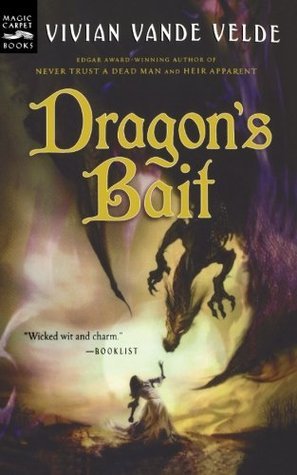
So I guess I should eventually get to talking about this book. Unlike A Well-Timed Enchantment, which was enchanting in its realness and humor, this book opens up with Alys, who apprentices with her father, a tin-maker, because he has no sons. He's also ailing, and the wheelwright next door has been eyeing their shop for his own expansion. Pretty soon, Alys is accused and framed of witchcraft in a cursory trial before the town by the wheelwright and an Inquisitor that travels between several towns. Before the trial is over, her ailing father has died of a heart attack, and she's dragged off to be sacrificed to the regional dragon to appease him.
Tied up to the stake, with it beginning to rain, you feel her utter depression and anger. Even when she manages to break free, she hears wolves crying in the distance and sees the dragon flying closer. And most importantly, she has nowhere else to go, not being a boy who could apprentice elsewhere. This is real. This isn't about a girl who suddenly manifests superpowers despite never having momentum and runs away and starts a new life somewhere in local small towns where everyone knows everyone else. So with the dragon circling overhead, Alys throws her future to the fates and hurls a rock at the dragon and yells for it to come eat her.
The dragon turns out to be Selendrile, a shapeshifter with long gold hair and purple eyes in human boy form. He learns of what has happened to Alys and then tells her that he can help her get revenge, because he's "fond of revenge." There's no instalove here; Alys is aware at all times that Selendrile isn't human and could eat her in one bite. There's no trust between them, since Selendrile tells her nothing at all and disappears at intervals.
Their revenge is planned out thus: frame the Inquisitor and then the wheelwright's family -- attack them where it hurts, their reputation in their business. The Inquisitor's revenge goes smoothly, despite feelings of mistrust. Then they head towards the wheelwright. But things go wrong.
I usually give all spoilers out, but the ending is such that I think this book really has both characters learning something of themselves. A book about friendship borne of small-mindedness and petty revenge. A little bit about the futility of revenge in how it doesn't bring back anything you've lost. Some about the lengths one has to go in order to really accomplish revenge. A book about trust between two loners who has lost the ability to trust others. All in all, it's a pretty darn good book as far as a simple YA novel goes. A little romance? Maybe. It's understated. But that's how I like it.