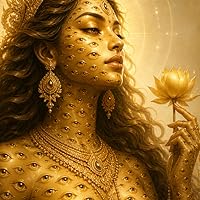
Mirra Alfassa, later Mirra Morisset and Mirra Richard, also known as The Mother, was the spiritual collaborator of Sri Aurobindo.
She was born in Paris to Turkish and Egyptian parents and came to Sri Aurobindo's retreat on March 29, 1914 in Pondicherry, India to collaborate on editing the Arya. Having to leave Pondicherry during World War I, she spent most of her time in Japan where she met the poet Rabindranath Tagore. Finally she returned to Pondicherry and settled there in 1920. After November 24, 1926, when Sri Aurobindo retired into seclusion, she founded his ashram (Sri Aurobindo Ashram), with a handful of disciples living around the Master. With Sri Aurobindo's full approval she became the leader of the community, a position she held until her death. The Trust she had registered after Sri Aurobindo's death in 1950 continues to look after the institution.
A DIVERSE SELECTION OF THE WORDS AND WRITINGS OF ‘THE MOTHER’
The ‘Sketch of the Mother’s Life’ that concludes this 1984 book explains, “The Mother was born in Paris on 21 February 1878. Mirra [Alfassa], as the child was named, received her early education at home… the Mother has written: ‘Between eleven and thirteen a series of psychic and spiritual experiences revealed to me not only to existence of God but man’s possibility of uniting with Him, of realizing Him integrally in a life divine.’ … she founded a group of spiritual seekers. Between 1911 and 1913 she gave many talks to various groups in Paris. In 1914 the Mother sailed to Pondicherry, India, to meet Sri Aurobindo… In 1920 the Mother returned to Pondicherry to resume her collaboration with Sri Aurobindo. With her coming, the number of disciples around Sri Aurobindo gradually increased… Sri Aurobindo entrusted the full material and spiritual charge of the Ashram to the Mother. Under her guidance, which covered a span of nearly fifty years, the Ashram has grown into a large, many-faceted community… On 17 November 1973, at the age of ninety-five, the Mother left her body.”
The ‘Publisher’s Note’ explains, “The passages of this compilation have been selected from the Collected Works of the Mother. Almost all of the passages have been taken from her conversations, a few from her writings.”
The book begins, “We are now witnessing the birth of a new world; it is very young, very weak---not in its essence but in its outer manifestation---not yet recognized, not even felt, denied by the majority. But it is here. It is here, making an effort to grow, absolutely SURE of the result…. It is a beginning, a UNIVERSAL beginning. So, it is an absolutely unexpected and unpredictable adventure.” (Pg. 1)
She states, “Reason is the master of the nature of mankind. One must obey reason and absolutely refuse to be the slave of instincts… every human being who obeys anything other than reason is a kind of brute lower than the animal. That’s all. And this should be taught everywhere; it is the basic education which should be given to children.” (Pg. 6)
She observes, “Religion belongs to the higher mind of humanity. It is the effort of man’s higher mind to approach, as far as lies in its power, something beyond it, something to which humanity gives the name God or Spirit or Truth or Faith or Knowledge or the Infinite, some kind of Absolute, which the human mind cannot reach and yet tries to reach. Religion may be divine in its ultimate origin; in its actual nature is it not divine but human. In truth we should speak rather of religions rather than of religion; for the religions made by man are many…” (Pg. 16)
She advises, “One must never neglect to clean one’s room, it is very important; inner cleanliness is at least as important as outer cleanliness.” (Pg. 37)
She says, “You are still very young, but you must learn RIGHT AWAY that to reach the goal you must know how to pay the price, and that to understand the supreme truths you must put them into practice in your daily life.” (Pg. 56)
She suggests, “There is NO spiritual obstacle which can resist a penetrating power of concentration. For instance, the discovery of the psychic being, union with the inner Divine, opening to the higher spheres, ALL can be obtained by an intense and obstinate power of concentration---but one must learn how to do it. There is nothing in the human or even in the superhuman field, to which the power of concentration is not the key.” (Pg. 65)
She explains, “[The Psychic Being] is a center of light and truth and knowledge and beauty and harmony which the Divine Self in each of you creates by his presence, little by little; it is influenced, formed and moved by the Divine Consciousness of which it is a part and parcel. It is in each of you the deep inner being which you have to find in order to that you may come in contact with the Divine in you. It is the intermediary between the Divine Consciousness and your external consciousness; it is the builder of the inner life, it is that which manifests in the outer nature the order and rue of the Divine Will.” (Pg. 86)
She states, “One must not admit bad thoughts not oneself under the pretext that they are merely thoughts. They are tools of execution. And one should not allow them to exist n oneself if one doesn’t want them to do their work of destruction.” (Pg. 108)
She notes, ‘There is this beauty, this dignity of soul---a thing about which I am very sensitive. It is a thing that moves me and evokes in me a great respect always. Yes, this beauty of soul that is visible in the fact, this kind of dignity, this harmony of integral realization. When the soul becomes visible in the physical, it gives this dignity, this beauty, this majesty that comes from one’s being the Tabernacle. Then, even things that have no particular beauty put on a sense of eternal beauty, of THE eternal beauty.” (Pg. 123)
She suggests, “the first thing to do when one has money is to give it. But as it is said that it should not be given without discernment, don’t go and give it like those who practice philanthropy, because that fills them with a sense of their own goodness, their generosity and their own importance. You must… make the best possible use of it… And truly money has no value unless it circulates. For each and every one, money is valuable only when one has spent it.” (Pg. 131)
She advises, “The strength of such impulses as those of sex lies usually in the fact that people take too much notice of them; they protest too vehemently and endeavor to control them by coercion, hold them within and sit upon them. But the more you think of a thing and say, ‘I don’t want it, I don’t want it,’ the more you are bound to it. What you should do is to keep the thing away from you, to dissociate from it, take as little notice of it as possible and, even if you happen to think of it, remain indifferent and unconcerned.” (Pg. 139)
She says, “This is what’s remarkable: that when one is perfectly surrendered to the Divine one is perfectly free, and THIS is the absolute condition for freedom, to belong to the Divine alone; you are free from the whole world because you belong only to Him. And this surrender is the supreme liberation, you are also free from your little personal ego and of all things this is the most difficult---and the happiest too, the only thing that can give you a constant peace, and uninterrupted joy and the feeling of an INFINITE freedom from all that afflicts you… and from all that can create the least anxiety in you, the least fear.” (Pg. 162)
She notes, “The believer thinks himself very superior to the atheist, but all that he has been able to seize of God is His shadow and he clings to this shadow imagining that it is God himself. For if he truly knew God, he would know that God is all things and in everything; then he would cease to think himself superior to anybody.” (Pg. 177)
This book will be of great interest to anyone studying The Mother.
This book appears to be written by someone with a higher spiritual consciousness than most. It possibly is good for inspiration, but getting to where she is probably needs practice and a teacher, assuming it's possible at all. This excerpt from page 118 seems to be speaking of the same idea:
"What one does exclusively in the head is subject to countless fluctuations; it is not possible to construct a theory, for instance, without there intervening immediately things which give all the opposite arguments. And so, there's the great skill of the mind, you know: it can prove no matter what, argue about anything at all. Consequently one does not go a step farther."
this is one of my favorite books, more details later.
"There is always (it is probably inevitable) the path of struggle and then there is the sunlit path. And after much study and investigation, I have had a sort of spiritual ambition, if it may be called that, to bring to the world a sunlit path in order to eliminate the need for suffering and struggle..." ~ The Mother