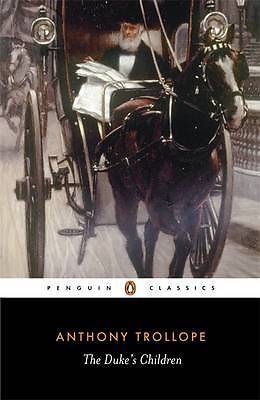
Jump to ratings and reviews
Rate this book

Palliser #6

The Duke's Children

Rate this book
4-2

643 pages, Paperback

First published January 1, 1880

212 people are currently reading
2825 people want to read

About the author

Anthony Trollope

2,284 books1,757 followers
Anthony Trollope became one of the most successful, prolific and respected English novelists of the Victorian era. Some of Trollope's best-loved works, known as the Chronicles of Barsetshire, revolve around the imaginary county of Barsetshire; he also wrote penetrating novels on political, social, and gender issues and conflicts of his day.

Trollope has always been a popular novelist. Noted fans have included Sir Alec Guinness (who never travelled without a Trollope novel), former British Prime Ministers Harold Macmillan and Sir John Major, economist John Kenneth Galbraith, American novelists Sue Grafton and Dominick Dunne and soap opera writer Harding Lemay. Trollope's literary reputation dipped somewhat during the last years of his life, but he regained the esteem of critics by the mid-twentieth century.
See also http://en.wikipedia.org/wiki/Anthony_...

Ratings & Reviews

What do you think?
Rate this book

Friends & Following

Create a free account to discover what your friends think of this book!

Community Reviews

5 stars
1,045 (36%)
4 stars
1,240 (42%)
3 stars
500 (17%)
2 stars
91 (3%)
1 star
23 (<1%)
Displaying 1 - 30 of 290 reviews
Profile Image for Katie Lumsden.
Author 3 books3,767 followers
September 7, 2019
Another fantastic Trollope read. I adored it. I cried and smiled and had a thoroughly enjoyable reading experience. A fantastic end to a great series.
Profile Image for Classic reverie.
1,833 reviews
March 16, 2019
For the last 15 months, I have enjoyed entering Trollope's England, Barchester and the Duke of Omnium's world. About every month, I would come back to familiar settings and characters and especially wondering how it will all end. Having just finished his last in the series, I wanted to comment about the whole before going on with the book review. When I began with "The Warden", I had no idea what a ride I was in for because though I enjoyed that book, it was lacking a little for me. Don't get me wrong I loved it but I did not think that as I read on that these two series were quite the treasure that they ended up for me! The next in the series started more characters interplay and social issue combined which continued to be Trollope's formula for success throughout. Sometimes you can guess how things are going to turn up but many times there were a tremendous amount of surprises. Not everyone ends up happy and some seem to be happy but troubles may come ahead. Though religion and politics are the crux of these series, the human interactions are the key which makes the story exciting to read. Some books concentrate more on the institutional aspect but that is not in abundance to cause a reader to become bored because even that is exciting. You have some characters come over to the other series but mostly these series are kept divided. Plantagenent Palliser makes his first appearance in Barchester's The Small House at Allington when he tries flirtation with a married young lady. Thinking back at this it is so unlike him and one wonders if Trollope when first thinking of this character changed his mind to his personality and virtuous behavior. The Palliser from the series is quite the true person of honesty and would not be thinking of an affair with a married women.
If I had to choose between the series, I would pick Palliser but luckily I can love both!

Now to comment on "The Duke's Children"; The politics in this are very little compared to some of the others. This is kind of a full circle in a way from the first, "Can You Forgive Her?" but instead of Glencora dealing with an unsuitable suitor, you have the daughter's love interest which brings memories back from both the parents. Should someone not of rank think they can attain a position in society to high? Can you marry who you love or must you succumb to others' demands? That is the main of this story.


"The man she loved was a gentleman, and an honest man, by no means a fool, and subject to no vices. Her father had no right to demand that she should give her heart to a rich man, or to one of high rank. Rank! As for rank, she told herself that she had the most supreme contempt for it. She thought that she had seen it near enough already to be sure that it ought to have no special allurements. What was it doing for her? Simply restraining her choice among comparatively a few who seemed to her by no means the best endowed of God’s creatures. "


Trollope lives in a time of changing society, really every society always changes to a point but the church structure, political changes with certain rights and society changes. He shows us the changes that have occurred and were occurring during his lifetime. In this story an American girl comes to England and has taken a liking for a man of rank. As I read this subplot, I remember Edith Wharton's unfinished work "The Buccaneers" which is about American wealthy young girls looking for husbands overseas, which was based on these true occurrences.

The son sentiment to social changes that the father is not aware yet.

"And he thought that there were certain changes going on in the management of the world which his father did not quite understand. Fathers never do quite understand the changes which are manifest to their sons. Some years ago it might have been improper. "

There is a lot of fatherly advice that is not always taken which is hard up on the Duke. Gambling, expulsion from school, scandals and loss of large amount of money. A kind of triangle with an extra character, quadangle, which makes it interesting. I love the name of the race horse, Prime Minister.


Again a brother's friend tried to control the brother and brings trouble to a sister for that friendship!


I am so happy that I decided to start with "The Warden" & finish up with "The Duke's Children", I highly recommend for classic and non classic fans that love drama with social issues that are not overly handed.

Also this novel which was first published in 1879, as a serial in Charles Dickens' All the Year Round. I suppose his reference to Turveytop from "The Bleak House" and especially a couple times was a wink to Dickens!


I did not read this edition but a Delphi Collection of his works which has lots and lots of notes and highlights, if interested.


I love my travels with these characters and Trollope gives stories with heart.💖💖💖💖💟💟💟💖

I am sorry of this coming to an end but so many more stories of his I have yet to read and maybe a character from these series maybe mentioned!


SPOILER ALERT BELOW
💢💢💢💢💢💢💢💢💢💢💢💢💢💢💢💢💢💢💢💢💢💢💢💢💢💢💢💢💢💢💢💢💢💢💢💢💢💢💢💢💢💢💢💢💢💢💢💢💢💢💢💢💢💢💢💢💢💢💢💢💢💢💢💢💢💢💢💢💢💢💢💢💢💢💢💢💢💢💢💢💢💢💢💢💢💢💢💢💢💢💢💢💢💢💢💢💢💢💢💢💢💢💢💢💢💢💢💢💢💢💢💢💢💢💢💢💢💢💢💢💢💢💢💢💢💢💢💢💢💢💢💢💢💢💢💢💢💢💢💢💢💢💢💢💢💢💢💢💢💢💢💢💢💢💢💢💢💢💢💢💢💢💢💢💢💢💢💢💢💢💢💢💢💢💢💢💢💢💢💢💢💢💢💢💢💢💢💢💢💢💢💢💢💢💢💢💢💢💢💢💢💢💢💢💢💢💢💢💢💢💢💢💢💢💢💢💢💢💢💢💢💢💢💢💢💢💢💢💢💢💢💢💢💢💢💢💢💢💢💢💢💢💢💢💢💢💢💢💢💢💢💢💢💢💢💢💢💢💢💢💢💢💢💢💢💢💢💢💢💢💢💢💢💢💢💢💢💢💢💢💢💢💢💢💢💢💢💢💢💢💢💢💢💢💢💢💢💢💢💢💢💢💢💢💢💢💢💢💢💢💢💢💢💢💢💢💢💢💢💢💢💢💢💢💢💢💢💢💢💢💢💢💢💢💢💢💢💢💢💢💢💢💢💢💢💢💢💢💢💢💢💢💢💢💢💢💢💢💢💢💢💢💢💢💢


Glencora dying was unexpected and it was then you saw how much Palliser loved her. Tregear though he wins out and is allowed to marry Mary but I wonder how much he loves her and how much is the position and money part of his love. I was glad Mabel did not win Silverbridge. I also grew to like Silverbridge more and more. Mabel subconsciously wanted to let Silverbridge of the hook but then she saw her mistake but it was too late. Silverbridge grows out of his boyhood and no longer is told by Tregear how to behave because he has found his footing.
Profile Image for Kerri.
1,100 reviews462 followers
October 16, 2022
"No one, probably, ever felt himself to be more alone in the world than our old friend, the Duke of Omnium, when the Duchess died."

Well, the Duke's Children are idiots - or at least, the boys are. Dear God, if they survive beyond their twenties I will be amazed at their good fortune! They muddle and gamble their way through life, knowing their father will bail them out if need be. They are mostly good-hearted though, so there is hope! After the heartbreakingly sudden, incredibly upsetting death of Glencora, Duchess of Omnium, the Duke of Omnium diminishes. I think she was what kept him going, he was so tied to her that the loss of her, this vibrant, force of a woman, leaves him utterly lost in grief and shock. From the not so splendid start of the first book, their relationship has become one my favourites (second only to Phineas Finn and Madame Max) and I cried when it came to an end. Neither I, nor the Duke, was prepared for it.

And that man needs that woman to knock some sense into those boys (verbally I mean) - he can speak eloquently and truthfully, but they will never comprehend what he means. I think his wife could have translated what he meant and together they might have raised children who were slightly more capable.

I see many consider this the weakest of the series, and I mostly agree - except they I adored the way it dealt with love and grief, and struggling to hold together a family when the core member has died.

"Had the heavens fallen and mixed themselves with the earth, had the people of London risen in rebellion with French ideas of equality, had the Queen persistently declined to comply with the constitutional advice of her ministers, had a majority in the House of Commons lost its influence in the country,—the utter prostration of the bereft husband could not have been more complete."

Plantagenet Palliser is a broken man, and I thought Trollope conveyed it beautifully. The book was upsetting and frustrating, but felt appropriate to the tragedy and difficulty of it all. His mistakes felt human, his inability to be fair to his daughter in allowing the marriage she wants understandable, as he is constantly returning to the less than romantic beginnings of the very marriage he is mourning. His letter to his son about the duty of being an Member of Parliament was also excellent, and still felt relevant.

There are no surprises here, and the energy of Lady Glencora is missed, but I thought it was a wonderful conclusion to a series I greatly enjoyed.
This entire review has been hidden because of spoilers.
Profile Image for Diane Barnes.
1,613 reviews446 followers
October 24, 2022
I was almost as grieved as the Duke himself was when Lady Glencora Palliser died ( in the first chapter, no less!) This is the last of the Palliser novels, and she was the saving grace of the first five. Her wit, her political savviness, her intelligence, and her ability to see through the hypocrisy of most of the landed Gentry and noblemen and ladies was what made these books so addictive.

Palliser is lost without her, and now must deal with his 3 adult children without her guidance. Lord Silverbridge is the oldest and heir to the Dukedom, yet got himself thrown out of Oxford for a stupid prank. His younger brother was thrown out of Cambridge for disobeying a professor's direct orders. Both boys have incurred ruinous gambling debts. His daughter Mary has fallen in love with an untitled man with no income. Then Lord Silverbridge falls in love with an American girl, of all things! The world of his aristocracy is in shambles, as these marriages cannot be allowed, but his children have the nerve to rebel and insist on their right to choose their own partners.

As always in a Trollope novel, things go from bad to worse, alliances and betrayals abound, misunderstandings are legion, and things mostly come out all right in the end. Not for everyone, but the Pallisers are not the wealthiest and most influential family in England for nothing.

This brings to an end the Palliser saga, but Trollope was a prolific author. I already read and enjoyed the Barchester series, but there's quite a few excellent novels still to be enjoyed.
Profile Image for Elizabeth.
1,576 reviews182 followers
October 26, 2024
2024 Reread: A brilliant novel! I think this is in my top 5 Trollope novels. I love how Trollope brings the arc of Plantagenet Palliser’s story to a close and his examination of the Duke’s grief and his struggle to parent his three young adult children. He expects obedience and gets children who are becoming adults and making bafflingly different decisions than he would make! Lady Mabel is another fascinating character. So complex. And I find Silverbridge endearing. His story arc is also a good one.

I read this with the Trollope Society using the Oxford World Classics edition. I highly recommend this 2020 OWC edition. Trollope had to cut over 60,000 words from his original manuscript to make it fit into Dickens’ magazine All the Year Round. Scholar Steven Amarnick and others painstakingly reconstructed the text to add back in those missing words and the text is much more robust in its characterization. If you search for Steven’s name on YouTube, you can find some interviews with him about the process that are fascinating! Highly recommend.

December 2020: I finished the Palliser series! And I immediately picked up County Chronicle by Angela Thirkell to read all about the Palliser descendants since Angela Thirkell sets her books in Trollope's Barsetshire in the 1930s and 40s. I read County Chronicle before reading these last two Palliser novels, so there were certain references I missed. What a pleasure to read back through County Chronicle now that I am acquainted with Lord Silverbridge, Isabel Boncassen, etc. The ending of County Chronicle for one couple makes so much more sense as does some of the politics in that book. Plus Lady Cora has all the spunkiness of her great-grandmother Lady Glencora.

I liked this book best of the Palliser books. I think because it was most like the Barsetshire Chronicles with its focus on characters who are coming-of-age. There are a lot of characters that are coming-of-age in the Palliser series, but their decisions and the consequences feel more fraught and darker than in the Barsetshire Chronicles. This book felt much lighter in tone, even though it starts out with grief. I really didn't know how it was going to end up with either Silverbridge or Mary until the last chapters, so Trollope really knows how to keep the suspense going.

The Duke continues to be one of my favorite characters. He is the most essential character in all six Palliser novels, and his character is developed so beautifully. In this novel, Trollope exposes some of the Duke's hypocrisies regarding class (aristocracy) and being English with the two marriages contemplated by his children: his oldest son Lord Silverbridge to an American (whose grandfather was a dock worker) and his daughter to the younger son of a country squire with no title or inherited income.

As a modern American, it would be easy to dismiss the Duke's concerns about these two marriages, but Trollope fleshes out the Duke so well in this. It's very clear that the heart of the Duke's concern is his real love for his children and his desire that they be both prudent and virtuous. Both his sons display concerning tendencies towards gambling with cards and horses that have real consequences in the novel. The Duke realizes that his sons don't realize the value of money since they have not had to work for it. Money literally doesn't mean anything to them; the supply seems endless. The Duke's gravitas in essentials like this makes his children respect him and know that he will support them, even when they make mistakes. When Silverbridge and Gerald own up to their mistakes, the Duke treats them squarely. (Gerald has more courage in this than Silverbridge.) The Duke is not faultless as a parent by any means, but his love is true and so he's endearing even when he's bound by class in a strange way. (Strange because the Duke himself is the last person in the world to avail himself of the privileges of his rank and fortune.)

I did find it amusing, historically speaking, that the Duke is originally opposed to having an American as a daughter-in-law because there will soon be a wave of British aristocrats marrying wealthy American women (e.g. Downton Abbey, Winston Churchill's American mother).
Profile Image for Nigeyb.
1,475 reviews405 followers
April 17, 2024
The Duke's Children (1880) is the sixth and final book in Anthony Trollope’s Palliser series. You probably don't need me to tell you that Trollope was one of the most successful, prolific and respected novelists of the Victorian era. The six Palliser books were my first experience reading Trollope and it was pretty much an unadulterated joy from start to finish.

The Audible editions are all superbly narrated by Timothy West. Apparently Trollope was incapable of writing a concise book or even chapter. He’s the most meandering and long winded writer I've ever come across but I care little as the language and storytelling are so consistently delightful.

The books offer a fascinating insight into the political and social world of the upper echelons of Victorian society. In this instance the expectation that a member of the aristocracy should marry someone of their own class and rank, or risk disgracing the family name. In this volume Planty Pal aka the Duke of Omnium is put through the wringer by his three children who have different expectations to his own and they seem to disappoint him at every turn. This all takes place against a world of shifting societal norms and personal loss for Planty.

As usual most characters get their just desserts however there is often one whose dreams turn to ashes, and so it is here. This is a really satisfying conclusion to a fabulously immersive and gripping Victorian family drama.

4/5


Plantagenet Palliser must face new challenges and a changing world if he is to hold his family together in the final installment of the Palliser Novels.

After losing his devoted wife, Glencora, Duke Plantagenet Palliser takes on a task he has never had the time or skills to bother with before: dealing with his children. Palliser has never been a doting father, what with the responsibilities of title and duty constantly beckoning him away, but now his government no longer needs him. And it does not take him long to realize that his children have somehow become adults of their own accord—though not for the better.

Unbeknownst to Palliser, his late wife had given their daughter, Lady Mary, her blessing to pursue a courtship with a poor gentleman friend of the duke’s eldest son, Lord Silverbridge. Meanwhile, Silverbridge has followed his father’s wishes by entering Parliament only to become enamored with an American heiress who refuses to marry unless Palliser willingly welcomes her into the family. And Palliser’s youngest, Lord Gerald, has managed to get himself expelled from Oxford.

With such odds set against him, the duke will have to find it within himself to change, to face the end of the proper world he has always known, and to accept the new world his family has embraced for the good of all.

With The Duke’s Children, Anthony Trollope brings one of the great classic Victorian sagas to a close.


Profile Image for Phrodrick slowed his growing backlog.
1,077 reviews68 followers
February 17, 2018
This is a review of the Everyman Library Edition of Anthony Trollope’s The Duke’s Children. The edition matters as the Everyman Edition includes The 65,000 words his editor had required the author to cut in from the first published edition. To the degree I can compare the two, I cannot say that this version is the better one. A more detailed reader may conclude differently, but my recommendation is to decide solely based on how much you enjoy reading Trollope. I have enjoyed the 6 book, 4000+ page journey and do not regret the extra pages to get to the ultimate The End.

Trollope is justly in the pantheon of great writers, but nothing I have read in these 6 books convinces me he belongs in the first row. I leave for others to debate if, for example, Dickens or Austin were the better writers. True fans of each will get little push back from me. Toss into the argument the Russian Greats or the Great Books 100 Lists that litter the landscape and I will mostly watch and comment from the sidelines. I am strongly of the opinion that Trollope belongs in the room. That said I am not that positive that The Duke’s Children would form the basis of my argument that Trollope is a great writer.

The Pallisers or Political novels were originally meant to be 4 books. Trollope may have added the last two because he needed the money or because he had more to say. Now that I know this, thanks to the introduction included in The Duke’s Children, I can see a definite separation between the first four and these last two.
Book 5, The Prime Minister has very little to do with politics. Across the series, politics have formed a back drop, allowing characters to have something to do and Trollope to pen some of his slyest satire. In Book 5 his central character, The Duke of Omnium and Gatherum is Prime Minister and has nothing to do.

Depending on your POV this may be the point to stop to avoid spoilers

Instead we given one of Trollope’s most modern characters, Mr. Lopez. Mr Lopez is one of his most villainous characters, no less so because his purpose is to invade the gentry. He is certainly entitled to gentleman status, but he is guilty of the sin of being, not English. In fact he has no known lineage, in any country. He may be Jewish and is certainly Hispanic. That he is a speculator and depends on other people’s money to practice his profession could have played out either way, but he was pushing into society in ways that marked him as a bad guy. That he is found unworthy to be an MP (Member of Parliament) should have been foreshadowing enough.

If he lesson on Book 5 is beware of the outsider, book 6, The Duke’s Children turns everything in the earlier book on its ear.
The Palliser Household is under direct attack and subversion from within.
The Dukes’ First born and natural inheritor of the Dukedom, Lord Silverbride has his eye on an American heiress. His only daughter, Lady Mary is deeply in love with an Englishman, and a gentleman. Alas Mr. Tregear has no title, no property, no inheritance and by the way is not, like The Duke a Liberal. In fact the only other thing to his credit is that he is returned (elected) to Parliament.

Over the series, The Duke, AKA Palanty Pal, AKA Plantagenet Palliser has been a dour, if learned intense figure. A figure of fun with a classic English fixation on a silly cause and a stern remote father figure. This book has him facing his deepest prejudices. For much of the book he is not a very likable person.

While other books have given us comedic figures and regular stings at the expense of British Politics, The Duke’s Children lack much in the way of a light touch. The villains of the piece are relatively minor players in what is only a sub plot.

Least you conclude that the Duke is revealed as the Evil presence in the book a little historic context may soften this notion. At this time there were legal limits on who the members of the Royal family could marry. As a Duke, Palliser is not directly under those rules, but a man of his character would feel the weight of the implied duties of the not quite royal as of great importance. To hand his daughter to a possible money grubber is as we have seen on book 5 a tragedy on top of the problems of mixing the classes. That he is liberal and of the belief that the distance between the classes should, slowly over time be reduced, simply makes his internal dialogue that much more complex.

An additional issue clouding the decision for both Father and Daughter, if less so for the son, is that Palliser had not been his wife’s choice as a husband. It was Duchess Glencora’s most passionate wish that her children would have the freedom to marry that was denied her.

The Dukes marginally greater tolerance for his son’s interest in an American has to scream outrageous to a modern reader. The relative lack of resistance again pushes the Duke into a darker relief. Trollope was writing at the beginning of a so called Gilded Age. Americans, especially daughters with the wealth that began to accumulate and concentrate during the Civil War, were beginning to arrive in Europe seeking to add a title to their social standing. Much literature will be written about these seekers of European escutcheons but here Trollope may be ahead of the trend.

The heiress in question, Isabel Boncassen is perhaps a better person than Lord Silverbridge. Likely she is exactly the person his Lordship needs to complete the processes he starts toward being an adult and not just the callow youth we first encounter. Her lineage is entry working class, heavily demonstrated by her mother. But her father is self-made and studiously minded.

Least you conclude that this is an early version of so many soap opera costume dramas that will follow. Most with some or all of the same issues. Trollope writes well. He can balance the issues and the characters with finesse. The common sense guidance of yet another outsider, Mrs Finn, nee Madame Max Goesler serves as a reminder that even among the titled, outsider influence has value. That is, in The Duke’s Children we have a last look into a complex and deeply built set of characters and sense of place.
Profile Image for Bruno Bouchet.
Author 15 books7 followers
November 22, 2011
After the sublime The Prime Minister, the final book in Palliser series is a bit of a let down (but only a little bit) - almost like the last episode of your favourite TV series that doesn’t focus on all characters you’ve grown to love over the series but introduces new characters instead. The Duke is naturally superb. His letter to his son on entering parliament should be obligatory reading for every MP at the start of each parliamentary session. It’s a wonderful manifesto of what they should be there for.

My disappointment was with the actual children. Mary doesn’t add much to the series in terms of portraits of young women facing marriage. Silverbridge just isn’t likeable enough and I would have lived a bit more exploration on the plight of ‘second sons’ in Gerald. Perhaps the fact that he only features for getting sent down from Cambridge, gambling debts and massacring a vast number of grouse in Scotland is in itself a statement about second sons – no-one’s interested them in Victorian society, unless they’re causing trouble – not even Trollope.

The most interesting character is Mabel Grex. How her fortunes contrast with Frank Tregear is fascinating. Frank and Mabel were in love (before the start of the novel) but were both too poor to marry each other. Mabel remains constant but realise she has to marry for money. She’s quite honest about it, says she will be the perfect wife, do and be everything a wife should be and may learn to love her husband, but she cannot deny to herself she loves someone else. There’s a fatal honest about it. Marriage is a legal contract in which is fully prepared to keep her end, but finances mean her own feelings of love must be put aside. Of course such an honest woman cannot be allowed to succeed. She stumbles when Silverbridge first ‘almost’ proposes and loses him altogether when the Amercian beauty appears on the scene. She’s reduced later to almost begging him to marry her. Had she only been more fickle in her love, allowed herself to fall in love with Silverbridge, then she would have been rich and happy. Alas she can’t. Unlike Frank Tregear, who does exactly that. He falls in love with Mary Palliser, and is ultimately rewarded for his ability to fall out and in of love easily. When Mabel speaks to Frank towards the end of the novel about how much easier life is for men because they do not ‘love’ as intensely as women, she is speaking so powerfully for all the ‘unsuccessful’ women in the Palliser series. You can only be allowed to triumph if you genuinely marry for love, which is fine for the men who can fall in and out of love easily, but for the women who can’t do that, it’s misery or spinsterhood or both.

It is characters like Mabel that make me love Trollope. All the polite stories of love hide brutally honest observations on the game of love and money, how it’s played and how the cards are always stacked up against the women. It doesn’t matter how smart, clever, honest, pretty or true you are, if you don’t fall for the right man first, you’ve had it. And you think you can ever beat the system, think again sister.
Profile Image for Ruthiella.
1,843 reviews69 followers
January 19, 2020
The last in the Palliser series. I started it on audio in December. I was less interested in the lifestyles of the rich and titled in this last installment. I only really like Planty Pall as a foil to Lady Glen and alas, that was not to be. I didn��t quite care for how this turned out. I hope there will be some hint as to Lady Mab’s (happy?) future in other books like there was in this one with Mr. Spooner.

The final book in the Palliser series, The Duke’s Children, was classic Trollope. The now widowed Duke of Omnium must navigate the carriers and marriages of his grown children without the assistance of his helpmeet and often foil, Lady Glencora. His daughter, Lady Mary, has fallen desperately in love with Frank Tregear, who though the son of a country squire, is far below Mary in rank and fortune. The Duke is adamant that she should marry someone whose bloodline and fortune are worthy of the daughter of a Duke, even if that someone is the vapid Lord Popplecourt. Meanwhile his eldest son and heir Lord Silverbridge, has been sent down from Oxford, is mixed up with lower class horse race aficionados and displays poor judgment when he falls in love with a visiting American girl. Finally, the youngest son, Lord Gerald, too young yet to marry, is not too young to fall into debt through gambling. What’s the highest ranking nobleman in England, and the richest, to do?

While I was sympathetic with Lady Mary’s situation, I did not take to Lord Silverbridge’s plight at all. The amount of money he wastes in honoring bets made on horses is appalling, even by today’s standards. And it is considered a trifle provided he “learn his lesson from it”. Perhaps that was Trollope’s point, I am not sure. I think he meant for the reader to sympathize at least somewhat. I also disliked Silverbridge because I found his heart to be fickle. I think he married the wrong woman. The book does have some interesting commentary on the advisability of marrying outside of one’s class, however.
Profile Image for Nancy.
416 reviews93 followers
January 18, 2019
That was a letdown; I'd hoped to go out with the Pallisers on a higher note.

For the last in a series known as the Parliamentary novels, where were the politics? Instead, we got a Trollopean length disquisition on romantic entanglements and youthful hijinks. Trollope is always a pleasure and this is enjoyable, but it's not one of the better novels; it certainly wasn't worth killing off Lady Glen (not a spoiler as it happens at the very beginning), a necessary condition to the ultimately trivial story. Yes, the world is changing, even for the Duke of Omnium, but this was a long-winded way to get the message across.

ETA: I also meant to say that I see there's a newly restored version of this available which is about one-third longer and the book is both funnier and darker; it might have addressed my issues. I'd have liked to read it, but there isn't an ebook version.
Profile Image for Paul.
1,472 reviews2,167 followers
July 1, 2012
Last of the Palliser novels, not the strongest by far, but a good read. The female characters in this book are fairly predictable, but Trollope almost makes up for it with his male characters.
On the first page of the novel Trollope kills off the strongest female character in the series, Lady Glencora Palliser, the Duchess of Omnium. This gives him scope to develop the character of the Duke from a mere politician to a family man who has to relate to his children who are now grown and stepping out into the world. Here Trollope creates two of the most stupid and vacuous sons of aristocrats in literature in the Duke's heir Lord Silverbridge and his brother Gerald. They would grace any P G Wodehouse novel with ease. We follow them and their too good to be true sister Mary through the 19th century marraige market (for Silverbridge and Mary) and through the ways the manage to distress and let down their long suffering father. Trollope draws useless aristocrats rather well and we come across several in this book, usually hunting or shooting; activities which the Duke seemed completely unable to grasp; unlike his sons. A counter point is set up with Mary's suitor Frank Tregear who is poor, but "worthy".
Trollope has great fun with them all and ties up all his loose ends; apart from poor Mabel Grex who sets her sights on silverbridge and Frank Tregear and manages to lose them both; ending up embittered.
Very readable, but missing some spark; the Duchess killed off on page 1, I suspect.
Profile Image for Deanna.
1,006 reviews72 followers
September 9, 2020
Ah, I do enjoy a Trollope novel. I particularly liked the social and political commentary in this one, and found the characters engaging. If not for his usual long-windedness that contributes to occasional rambling and sagging, this might rise another star.
Profile Image for Rick Slane .
706 reviews73 followers
February 25, 2021
It is a strong finish to the Palliser series dealing with the British aristocracy toward the late 19th century. Trollope deals with love versus appropriate marriages, commoners, and nobility. Now I can finish watching the 1974 BBC adaptation.
Profile Image for Lisa.
278 reviews15 followers
November 24, 2023
3.5⭐️ I skipped Phineas Redux and The Eustase Diamonds to read The Duke’s Children. I’m not so sure I liked his children, but I have respected Plantagenet Palliser throughout the series, even with all his flaws. I think he was pleased how things turn out so I will have to be satisfied also.
Profile Image for Elizabeth (Alaska).
1,569 reviews553 followers
February 10, 2014
And so Trollope's Palliser series comes to a close. This is, again, a stand alone novel, and doesn't rely on previous works in the series. But you would be missing the joy of having read the others.

Plantagenet Palliser, the Duke of Omnium, is one of the wealthiest men in all of England, if not in fact *the* wealthiest. He started life in that manner and added to his wealth through marriage. His wealth increased during his lifetime because he was more interested in politics than spending money. And, having been more interested in his life in politics than money, he also was not at home much to enjoy and influence his children as many fathers do.

The children (the heir, the second son, a beloved daughter) definitely respect their father. They don't just give that respect lip service, but truly feel it. However, they have lived with that wealth all of their lives and barely recognize their advantage. They also don't seem to fully understand their position in society and their *duty* as such. This causes the Duke much sadness. At one point, the Duke asks one of his sons, "What is money?" As the son gives the unsatisfactory answer of "sovereigns, coin, banknotes", the Duke then expounds "money is labor." Coming from the Duke this at first seems laughable, but read on - that paragraph or two continues to apply today.

Duty also applies to whom one is to marry.
The mutual assent which leads to marriage should no doubt be spontaneous. Who does not feel that? Young love should speak from its first doubtful unconscious spark, -- a spark which any breath of air may quench or cherish, -- till it becomes a flame which nothing can satisfy but the union of the two lovers. No one should be told to love, or bidden to marry, this man or that woman. The theory of this is plain to us all, and till we have sons or daughters whom we feel imperatively obliged to control, the theory is unassailable.
I have said elsewhere that Trollope talks to his readers.
Isabel Boncassen was certainly a very pretty girl. I wish that my reader would believe my simple assurance. But no such simple assurance was ever believed, and I doubt even whether any description will procure for me from the reader that amount of faith which I desire to achieve. But I must make the attempt.
Having now finished both of Trollope's series, I look forward to reading the other 30-something of his standalone novels. Some I have been given to understand are as good as those in his series and - hard as it is for me to believe - some are real stinkers. I guess I'll find out which is which.
Profile Image for Gwynplaine26th .
682 reviews75 followers
January 14, 2025
*Sipario*. Lacrime agli occhi.
Saranno più di dieci anni che sto dietro alle pubblicazioni Sellerio di Trollope, dei suoi capolavori mastodontici, per importanza storica, ma anche pagine. Prima con gli autoconclusivi, infine con le due saghe centrali. E siamo arrivati: ecco l'ultimo volume dell'ultima saga.

La serie di libri ambientati nell'immaginaria contea inglese del Barsetshire rimane, a detta di molti, la sua opera più amata e famosa, ma devo dire di essere molto affezionata anche ai convincenti romanzi di vita politica di questo ciclo. Uno dei maggiori punti di forza di Trollope, infatti, è una visione molto coerente delle strutture sociali dell'Inghilterra vittoriana, trasposta nei suoi libri con piacevole solidità.

Nel caso dei romanzi di questo ciclo di ultima pubblicazione (Serie Palliser, o ciclo politico), questi sono spesso uniti dalla preoccupazione per le questioni appunto politiche e sociali e dal personaggio Plantagenet Palliser, che appare in ciascuno con altri personaggi che ricorrono periodicamente e che con "I figli del duca" chiude perfettamente una saga brillante incentrata nella Londra metropoli della grande aristocrazia dominante. In questo caso, ormai vedovo, Palliser dovrà barcamenarsi con le vicissitudini della prole con più che vaghe tendenze a discostarsi dal credo del padre, sia in termini di politica che di buona società e contatti. Un en plein di stelle per il valore di tutta la saga, generosamente dotata di acume ed umorismo, ritratto vivido di un'epoca di intensi fermenti.

CRONACHE DEL BARSETSHRE, ciclo religioso/rurale (sei romanzi: L’amministratore, Le torri di Barchester, Il dottor Thorne, La canonica di Framley, La casetta ad Arlington, Le ultime cronache del Barset ).

SERIE PALLISER, ciclo politico/londinese (sei romanzi: Potete perdonarla, Phineas Finn, I diamanti Eustace, Il ritorno di Phineas Finn, Il primo ministro, I figli del duca).
Profile Image for Dana Loo.
767 reviews6 followers
January 29, 2025
Non potevo non dare 5 stelline a quest'ultimo episodio che conclude il ciclo politico Palliser e, al tempo stesso, un'esperienza meravigliosa tra le pagine di uno dei più grandi, a mio parere, romanzieri vittoriani: eccelso narratore, minuzioso, attento, arguto e ironico; fine cesellatore di caratteri umani indimenticabili, e di luoghi iconici: la campagna inglese con le sue pittoresche contee, le vetuste dimore dei nobili, la caccia alla volpe, la Londra fumosa ed esclusiva dei club, i luoghi deputati alla politica, dove avvengono le più avvincenti battaglie verbali...mi mancheranno!!
Profile Image for Paul Gaya Ochieng Simeon Juma.
617 reviews46 followers
May 20, 2018
I enjoyed greatly reading this book. In turn, I wish to highly recommend the novel to all my friends. It is the kind that remains with you forever. Here, we are told of the lives and loves of the Duke of Omnium's children. After his wife's death, he is obliged to undertake the difficult task of raising and guiding his children to what he believes is the right path. Just like many families, his is not without scandal. Let me pause here for some time and talk about Trollope's Prime Minister. The present book is unlike the former. Indeed, there are certain common themes but that does not lessen the worth of 'The Duke's Children'.

I feel greatly privileged to have heard the time and opportunity of reading this novel. Especially now, amidst all the glamour and pomp of the Royal wedding between the now Duke and Duchess of Sussex. I kept wondering, what would Trollope have said? In this story he alluded to the love between an American commoner, Isabel and Lord Silverbridge, his first born son. A match which his father was believed not to ever consent to. Isabel argued that the then convictions and conventions were absurd and that such a match would never amount to an abomination. Things have changed and the winds of change started blowing from during the time of Trollope.

The other cause of the Duke's sorrow and probably the most disturbing is the love between his daughter, Lady Mary and the lowly Frank Treager. He is objectionable to the match and wants ti hear nothing of the same so much so that when he learns that Mrs. Finn had knowledge of the it and failed to tell him, he cuts himself off from any contact with her. Their relationship is only repaired by Lady Cantrip, who is a friend of theirs. Unfortunately, their is one thing that cannot be solved. His daughter's love to Mr. Treager. The question that he must consider is whether to yield to jer daughter's choice of man or to steadfastly hold on to what he considers to be his rightful parental duty and discourage the match even if it is to result to the death of his daughter.

Other sorrows comes in between. For example, the discontinuation of Gerald from the university of Oxford. Lord Silverbridge's gambling problems which has caused him a great deal of loss. At some point he looses upto seven thousand pounds which does not cont compared to his standing in the public platform and in parliament. Indeed, it was great. Not to mention the nuggets of wisdom in Trollopes tale. I believe that we should make time for Trollope and you will not regret.
Profile Image for Susan in NC.
1,080 reviews
November 22, 2017
Fascinating look at Victorian society and marriage in particular- I wasn’t sure I could enjoy a book in this series without the indomitable presence of Lady Glencora, but of course I was pulled right in.

This final entry in the six-book story arc of the Pallisers starts up immediately after the previous book The Prime Minister; as the novel opens Lady Glen has just died, and the Duke of Omnium is forced to deal, on his own, with his young adult children.

As is typical among the Victorian aristocracy, young Lord Silverbridge (the heir) and Lord Gerald get into hijinx at University, and the fastidious Duke is forced to bail out the young men. Lady Mary Palliser, his only daughter, has apparently fallen in love with Frank Tragear, a penniless but dear friend of Silverbridge. The recently deceased Lady Glen apparently approved the match but hadn’t approached her proud husband about it before her last illness.

I have always found the duke a fascinating character, and his marriage to Lady Glen heartbreaking; she joked in The Prime Minister that she should’ve been the man and he the woman, as she had a much thicker skin, and was more suited to the rough hurly burly world of politics. The Duke is fascinating to me because he is so fastidious and thin-skinned; he adored his vivacious wife but she overwhelmed his quieter, more introspective nature, and when he is left without her as his warm and tenacious barrier to all the world he is lost.

He is betrayed and heartbroken at the idea of his daughter marrying a commoner who doesn’t have money. He feels it is a betrayal to his class and position; throughout these novels it has been abundantly clear that his title and position weighs heavily on him. Left to his own devices he would have gladly stayed a commoner slaving away in the Exchequer on his beloved decimal coinage.

As always, Trollope’s portrayal of wealth and its role in Victorian marriage and society is fascinating.
Profile Image for John Frankham.
679 reviews19 followers
May 9, 2017
After reading the six Barsetshire novels, I've now finished the six Palliser novels. With this, the last one, I'm really bereft in saying goodbye to his characters and thoughts in these two magnificent series.

There is, of course, in this volume, the problem the Duke has in connecting with his three children as they reach adulthood after the death of their mother? Trollope's detailed and knowing understanding and portrayal of the human predicament is just wonderful.

But as a commentator on political life and duty he is incomparable - just as relevant today as he was in the 19th century. The Prime Minister and this last volume tell us all we need to know about the problems of being true to one's principles in the political and parliamentary hurly-burly.
Profile Image for Mary Durrant .
348 reviews185 followers
February 28, 2016
Loved this series of books and feel sad now it's come to an end.

'No-one probably, ever felt himself to be more alone in the world than our friend, the Duke of Omnium, when the Duchess died.'

It was so sad when the Duchess died , the Duke being left with their three children.
Silverbridge the eldest has been sent down from Oxford,
Gerald isn't doing too well at Cambridge; Lady Mary is set on an unsuitable marriage.


Wonderful scenes of fox hunting, parliament, horse racing and gambling!
I loved this book which I've been totally engrossed in this past week.

A fitting end to the series.
Profile Image for Mrs. Danvers.
1,055 reviews53 followers
November 7, 2019
Well, goodbye to the Palliser novels. I've learned a lot. I've learned that if you are a charming and beautiful woman, you will have many chances for your happily ever after. I've learned that if you are a bad man, you will come to an evil end. I've learned that if you are an unsympathetic woman, you will not get a husband and that if you are a woman who can't find a husband, you will eventually be found to be unsympathetic. I've learned that if you are a wealthy man with an old name you can be expelled from Oxford and then, since you have no education and no trade, be elected to the House of Commons. I've learned that fathers may lecture their sons in Latin and that even Trollope will find that funny.

I'm going to take a little break from Trollope before beginning the Barsetshire Chronicles, although I realized about halfway through the Palliser novels that the Barsetshire ones are (I think) chronologically earlier than the Palliser ones. But this has been such a delight. I'm so glad I finally read these and I'm looking forward to more Trollope.
182 reviews3 followers
July 16, 2008
I thought I was not going to read this book, because with Glencora dead, really what was to be hoped from it? I thought the previous five books were brilliant (except for the Eustace Diamonds which seemed like it was written by someone else) not just because of her, but certainly her spirit was the one that rescued the books from ordinariness. Certainly I love other characters and find them funny, but she is the one who shines out from the books with real life in her. And so with her gone, I thought the books which be much more like Middlemarch (bleeehhhhhhh). So, I sill like this book. Without her, the Duke is more nuanced and human. After all his moping and obsessing, now he's being a parent and having to be more than just a statesman and whipped husband, he's showing some character.

And if Lady Mary isn't quite as interesting as her mother, wonderful Lord Silverbridge is the finest worthless aristocrat I've ever met.
Profile Image for Jess.
789 reviews
March 30, 2020
This book was another favorite (and the last) of the series for me. I loved how closely we grew to know and love the Palliser family. I loved how politics took a backseat to some unpredictable romances. And I loved how Trollope has become a new favorite Victorian author for me. I look forward to reading more of his works, perhaps starting with his autobiography. He was a postal worker, his mother (Frances Trollope) was an author, and he spent a good portion of his life in Ireland. I am so grateful he was such a prolific writer--I can spend the rest of my life tracking down his works!
Profile Image for John.
192 reviews28 followers
November 7, 2020
So sad that the Palliser series is finally finished and I can read no more of it for the first time.
Profile Image for Kristen.
673 reviews47 followers
October 6, 2024
This last installment in Trollope's Palliser series focuses on the Duke of Omnium's son and daughter and their efforts to convince their father to sanction their marriages to "unsuitable" partners—a commoner and an American, respectively. On one level, this was an enjoyable, Jane Austen-ish relationship novel, and we follow the characters as they fall in love and try to negotiate various entanglements on the path to adulthood.

There is less parliamentary action in this novel than in the previous ones, but there is an interesting political angle. The Duke is a committed Liberal, but he finds that his beliefs are tested when it's his own children who want to shake up the social order.

Anxious as he was that both his sons should be permeated by Liberal politics, studious as he had ever been to teach them that the highest duty of those high in rank was to use their authority to elevate those beneath them, still he was hardly less anxious to make them understand that their second duty required them to maintain their own position. It was by feeling this second duty,—by feeling it and performing it,—that they would be enabled to perform the rest.


Trollope treats the Duke's hypocrisy with a lot of humanity. It's hard to see your way of life changing and a new generation creating their own norms, even if you believe in the abstract that they are in the right. It's also impossible to fight that kind of change. Of course, this being Trollope, it all comes right in the end, and the Duke's sense of honor ultimately leads him to treat his children's spouses well, even if they were not what he imagined.
Profile Image for Sandy Anderson.
80 reviews
November 11, 2020
A wonderful novel giving me a lot to think about -- and some chuckles along the way. I have only read Books 5 and 6 in the Palliser series so there were a few characters reintroduced whom I didn't know or whose fortunes had changed since earlier books but that wasn't a problem.
Customs are changing; young people are not following the advice of their elders and think they know best who to love and marry. Americans are beginning to come to England and mingle with the aristocracy. So much for the Duke to try to adapt to. Will he? Will his children ever stop disappointing him -- or is he wrong to be disappointed? Are his two older children making disastrous choices of marriage partners -- or just different choices than he was allowed to make?
These are some of the major themes but there is also the witty writing, the wonderful descriptions, a little 19th-century politics, some social history -- and the opportunity for the modern reader to reflect on the fact that some things never seem to change.
Profile Image for Sean O.
880 reviews32 followers
October 24, 2023
I often feel that Trollope writes women so well, but he feels compelled to write stories of flawed men. He makes sure that all the problematic men get happy endings, but not all women get happy endings. I mean, Lady Mabel Grex is done very bad by both of the young men, and she gets no happy ending. That seems like a terrible shame.

And of course the best character in the Palliser novels is Madame Max Goesla/Mrs. Phineas Finn. She’s the best.

Anyhow, I’ve finished both the Barsetshire and Palliser series. What should I read next? Why, the Barsetshire books! I’m starting with the Warden in January. I really can’t wait to see my old friend Septimus Harding again.
Profile Image for Jake Bittle.
255 reviews
Read
August 25, 2019
Finished the Palliser series. Anyone who has spoken to me in the last nine months won’t be surprised to know that I found this last book as delightful as the previous five.
Displaying 1 - 30 of 290 reviews

Can't find what you're looking for?

Get help and learn more about the design.