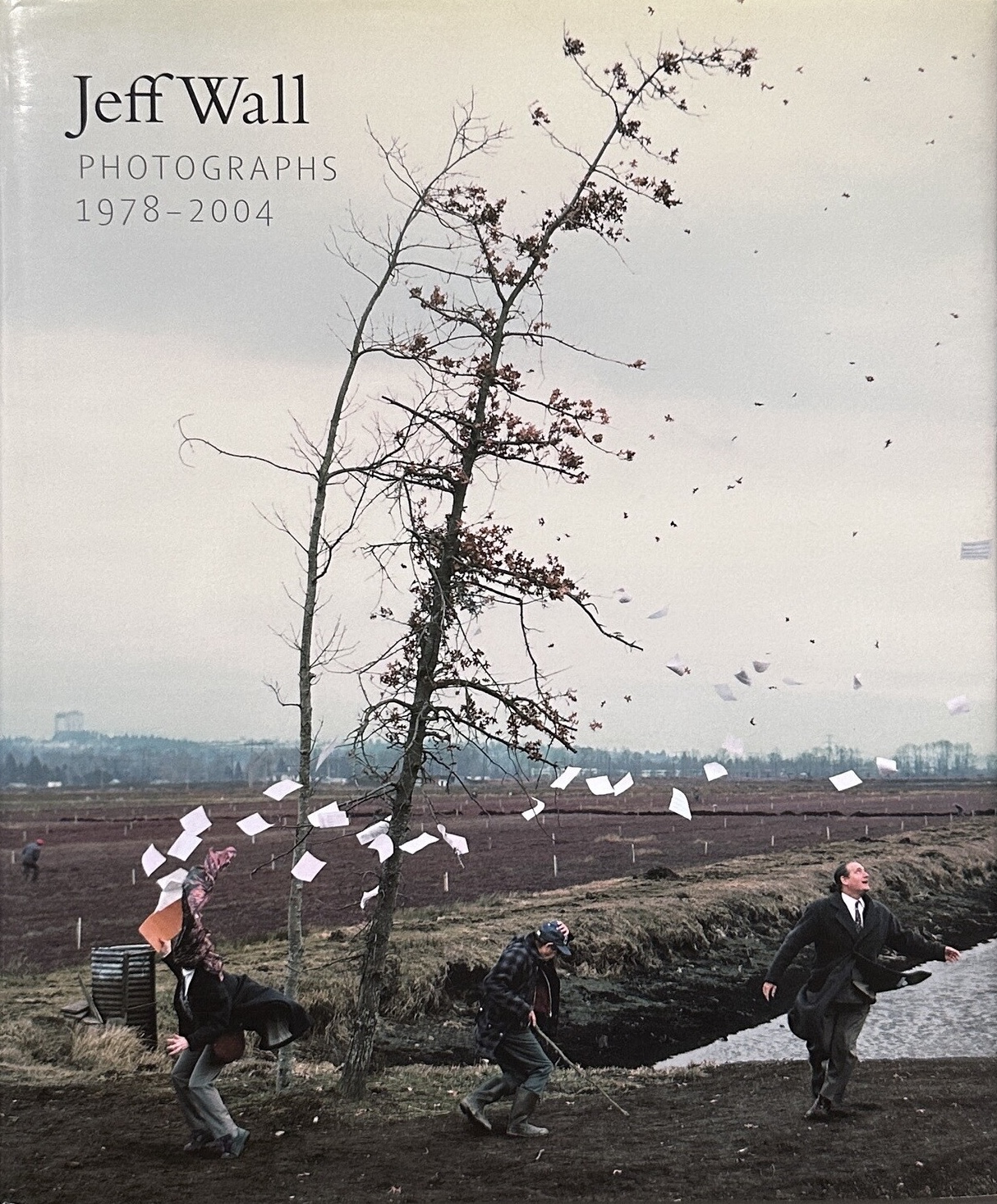
Jeff Wall: Photographs 1978-2004 is published to accompany a major monographic exhibition of photographs by Jeff Wall at Tate Modern, London, developed in close collaboration with the artist. The exhibition will feature works from throughout his career, as well as including new work produced especially for the exhibition.
Jeff Wall has been making photographs since 1967. He has helped to give photography a prominent place in contemporary art as well as effecting one of the most radical new developments in twentieth century photography. His highly innovative approach, best known through large colour transparencies of carefully constructed mise-en-scenes mounted in wall-hung lightboxes, has been complemented for the past ten years by large black and white photographs on paper. As well as illustrating these important works, the book explores the impact of the history of art and cinema on Wall's practice, revealing how he meshes documentary techniques with staged settings and digital collage.
Jeff Wall is a leading contemporary Canadian photographer whose work is concerned with ideas about the nature of images, representation, and memory. His large-scale photographs appropriate the visual language of advertising in their use of backlit transparencies and large scale. The subjects are “cinematographic” reconstructions of everyday moments, fiction, and art history, which he refers to as “near documentary”. “[Near documentary] means that they are pictures whose subjects were suggested by my direct experience, and ones in which I tried to recollect that experience as precisely as I could, and to reconstruct and represent it precisely and accurately,” he said of his process.
Born on September 29, 1946 in Vancouver, Canada, he received his MA from the University of British Columbia in 1970. Mainly focusing on academia during the following decade, he studied with the famed British historian T.J. Clark at the Courtauld Institute of Art in London. A Conceptual artist and art historian until the 1980s, Wall began creating photographs styled after artists including Hokusai and Édouard Manet as well as novels like the Invisible Man. In 2012, a print of his image Dead Troops Talk (1993) broke auction records at Christie’s and became the third most expensive photograph ever sold at the time.
Today, his works are held in the collections of the Tate Gallery in London, the Art Institute of Chicago, the Hammer Museum in Los Angeles, and the Kunstmuseum Basel, among others. Wall currently lives and works in his hometown of Vancouver, Canada.
Jeff Wall is a photographer working within the aesthetic of documentary photography, but within the conceptual photography movement that was and is challenging the authenticity of photography. He creates large sets that are meticulous with their location and prop choices. Oftentimes incredibly complex, these sets can take months to build. After that is accomplished, he hires actors who repeat the same scenario over and over until they cross an intangible boundary, and Wall believes that he has captured them truly believing that they are the character they are acting. This can take months as well. The resulting image is realistic, but off. Something indefinite is unsettling about the image, and it is only once you are informed of Wall’s methodology that you realize that that feeling is stemming from the fact that everything within these images is fake. This collection of his photographs is a fantastic representation of this particular process.