Jump to ratings and reviews
Rate this book

Through Darkest Europe

Rate this book
From the modern master of alternate history and New York Times bestselling author Harry Turtledove, Through Darkest Europe envisions a world dominated by a prosperous and democratic Middle East--and under threat from the world's worst trouble spot
Senior investigator Khalid al-Zarzisi is a modern man, a product of the unsurpassed educational systems of North Africa and the Middle East. Liberal, tolerant, and above all rich, the countries and cultures of North Africa and the Middle East have dominated the globe for centuries, from the Far East to the young nations of the Sunset Lands.

But one region has festered for decades: Europe, whose despots and monarchs can barely contain the simmering anger of their people. From Ireland to Scandinavia, Italy to Spain, European fundemantalists have carried out assassinations, hijackings, and bombings on their own soil and elsewhere. Extremist fundamentalist leaders have begun calling for a "crusade," an obscure term from the mists of European history.

Now Khalid has been sent to Rome, ground zero of backwater discontent. He and his partner Dawud have been tasked with figuring out how to protect the tinpot Grand Duke, the impoverished Pope, and the overall status quo, before European instability starts overflowing into the First World.

Then the bombs start to go off.

320 pages, Hardcover

First published September 18, 2018

103 people are currently reading
497 people want to read

About the author

Harry Turtledove

564 books1,970 followers
Dr Harry Norman Turtledove is an American novelist, who has produced a sizeable number of works in several genres including alternate history, historical fiction, fantasy and science fiction.

Harry Turtledove attended UCLA, where he received a Ph.D. in Byzantine history in 1977.

Turtledove has been dubbed "The Master of Alternate History". Within this genre he is known both for creating original scenarios: such as survival of the Byzantine Empire; an alien invasion in the middle of the World War II; and for giving a fresh and original treatment to themes previously dealt with by other authors, such as the victory of the South in the American Civil War; and of Nazi Germany in the Second World War.

His novels have been credited with bringing alternate history into the mainstream. His style of alternate history has a strong military theme.

Ratings & Reviews

What do you think?
Rate this book

Friends & Following

Create a free account to discover what your friends think of this book!

Community Reviews

5 stars
76 (14%)
4 stars
157 (30%)
3 stars
193 (37%)
2 stars
72 (13%)
1 star
23 (4%)
Displaying 1 - 30 of 112 reviews
Profile Image for Jenia.
556 reviews113 followers
September 23, 2018
Through Darkest Europe is an Alternate Universe book with an interesting concept. It's also a book that, in my opinion, felt about 200 pages longer than it actually was, and should have been 200 pages shorter to really shine.

The premise is that in this universe, the influential 13th century Christian philosopher Thomas Aquinas posited that science and God are irreconcilable, while the influential 12th century Muslim philosopher Al-Ghazali proposed that they are. (In our world, their views were the opposite.) Thus, Christian Western Europe stagnates and remains "backward", while the Muslim world's science and art flourish and it becomes the main world power. The book is set roughly around our present day, as a terrorist group called the "Crusaders" are destabilising Italy. Khalid, a secular Muslim investigator from Maghreb, and his Jewish assistant Dawud are sent to Italy to help resolve the situation.

So, as this is a book published in the political climate of 2018, it can only really be viewed as social commentary on what's going on in the world today. On the one hand, of course, commentary on ISIS, paralleled by the Crusaders; on the other hand, commentary on rising Islamophobia, paralleled by Khalid's unthinking stereotypes and prejudices against Europeans. It's a book that points out how dangerous and silly our unthinking stereotypes may be, a book that basically says, "There but for the grace of God go I". And if it manages to get all of us who read it to consider the prejudices we hold a little harder, it'll have done its job and I applaud its efforts.

However. As an actual book, I think it fails on several levels.

In terms of the social critique, for me it actually falls a little flat. Alternate Universes are very difficult to build comprehensively, and I know as a reader I'm maybe too picky and always wanna go, "But what about..." Seriously though, but what about the non-religious aspects of conflict? In our world, the rise of religious fanaticism in the Middle East and elsewhere can't be fully explained without pointing out interference and destabilisation from other countries: through colonialism, through proxy struggles during the Cold War, etc.

In Through Darkest Europe, the non-religious aspects are handwaved as, "Oh, also Europe is poor." Alright, sure, but has the Maghreb or Egypt been arming religious groups in order to oppose communism (does communism exist in this universe?) in the last century? Is climate change also contributing to resources vanishing and the region becoming poorer? Khalid and Dawud seem to have been genuinely sent to settle Italy down so that the Crusaders stop blowing things up in the "civilised" countries. Which... come on, in our world that has literally never been any country's primary motivation ever. I think the idea is to have a book where Muslims are totally 100% the good guys (although not without the latent racism, sexism, etc. similar to that in Western Europe/America today), which I do get. But I also think reducing the commentary on what's happening in the Middle East to an almost solely religious level makes the social critique feel kinda superficial.

Apart from the social critique level, I think the book is just kinda... boring. The problem is that everything is spelled out and repeated a lot. For example, Dawud makes a joke. Khalid knows him well enough to know he means it's a joke, not something serious. Then Dawud makes another joke. Khalid knows him well enough to know... Etc. Also, we're told that the airport has signs in Arabic, as it's the international language. Thirty pages later we're told this Italian person had a "musical accent" because he didn't speak Arabic, the international language, very often. In another fifteen pages, we're told that if a Chinese person and an Irish person ever met, they'd speak Arabic, as it's the international language. Etc. Because the social critique focuses almost exclusively on religion, we also get extremely similar discussions regarding secularism vs religion, but also we should respect people's beliefs, but also respecting people's beliefs is impossible when they don't respect yours, but also what about secularism vs religion, over and over again. This is what I mean when I say it'd work better as a novella: if you trimmed off the repeated information and the literal spelling out of reactions, you'd be down ca. half the book, and for the better.

The plot is also kind of muddled in the sense that I was never quite sure what Khalid and Dawud were supposed to really do. The idea that you could basically send two clever guys to Syria and nip ISIS in the bud is... certainly an interesting idea but one that's a bit hard to swallow. (Well, to be fair, two clever guys and Annarita, a Christian Italian feminist and patriot, who's equally clever but can't advance in backwards Europe, and also the only woman of importance in the book.) They give some smart but not exactly Machiavellian-level political advice to the overwhelmed local leaders, make some wry jokes, shoot at some terrorists, shake their heads at Europe's backwardness, work to uncover leaks in the Ministry of Information, and discuss religion. Tada, Christian!ISIS doesn't stand a chance.

(As a side-note, while I realise this book's author and primary audience are Americans, for somebody living in Europe, setting the book in Italy proves a little odd. I think maybe for Americans, all of Western Europe is very modern, advanced, "civilised", etc.? So describing Italy as backwards, hyper religious, sloppy, horrendous drivers, with everything running on bribes/personal favours/the Mafia, is supposed to be shocking and "make you think". I live in Austria and that's... uh, yeah, no, that's more or less the negative stereotypes of Southern Europe around here too. Maybe for full effect the story should have been set in Scandinavia instead.)

Well, to sum up, I thought Through Darkest Europe had a great concept but I was left disappointed. It might be worth reading if the setting's concept does really interest you, but I hope this review can serve as a heads up before you go in.
Profile Image for Bookwraiths.
700 reviews1,187 followers
Read
August 12, 2018
Sad to say it, but this story was just boring. Mr. Turtledove forgot that in order to write a compelling social commentary you have to couple it with an interesting story. This time out he failed to deliver that.
Profile Image for H (trying to keep up with GR friends) Balikov.
2,132 reviews824 followers
May 13, 2020
"“Do you know what’s good for you?” Khalid asked. “Well, I wouldn’t mind a big house in Tunis, a pile of money in the bank, and a beautiful girlfriend who thought I was the sexiest man alive,” Dawud said. “I’m not sure all that would be good for me, you understand, but I’d like to find out. How about you?” “You could do a lot worse than that. Or I think so, anyhow,” Khalid said. “Of course, if you asked an Aquinist, he’d tell you it was doing the things that got you into heaven and sending everybody who disagreed with you to hell.”"

For Harry Turtledove, the world is always turned upside-down. Turtledove specializes in alternative fiction. I believe last year I delved into a London of about 1600 that was part of the Spanish conquest. Ruled Britannia https://www.goodreads.com/review/show...

Here we have Islam dominant over Christian Europe in modern times. So when the political head of Italy requests help with a Christian terrorist threat, North Africa’s Maghrib sends two investigators to Rome, Khalid and Dawud. There they confront resentment, discrimination and the Aquinist threat.

"“It depends. If you called us because you really want us to accomplish something, that’s one thing. But if you called us because calling somebody from the Maghrib makes you look good—well, that’s a different story.” “One without a happy ending: for us, for you, for anybody,” Dawud added. “I assure you, my masters, we truly do oppose the Aquinist madness,” Major Badoglio said."

This premise leaves Turtledove free to comment about terrorism and religious fanaticism in a very entertaining manner.

"Some people—even some otherwise cultured people—still thought of everything before Muhammad’s day as part of the Jahiliyah, the time of ignorance. How anyone could look at the remains of the Colosseum and reckon the Romans ignorant was beyond Khalid. You had to keep a sense of history, a sense of proportion. Didn’t you?"


"Christians often came unmoored in these modern times. Not many felt as comfortable in the secular world as Muslims did. Christianity had to try to assimilate in a generation or two what had developed over centuries in Islam. No wonder even people who most wanted to be modern often found themselves betwixt and between instead. They couldn’t stay the way they had been, but they couldn’t turn into what they wanted to be, either."

There is sufficient character interaction and development:

"“What are we going to do?” Khalid asked. “Keeping Marcellus alive would make a good start. Cosimo, too,” Dawud answered. “And staying alive ourselves might be nice, if we can manage it.” “It would, wouldn’t it?” Khalid agreed—wistfully?"

But I enjoyed Turtledove’s willingness to drill down on what government should be and the relationship between the governed and those in power.

"To a certain degree, things everywhere worked that way. People with power helped other people they liked, and those people paid the favor back or else paid it forward. In the civilized world, though, law and custom put checks on the system. Not in places like this."

I will rate this book higher than some might because I enjoyed the comparison of our current world with this alternative. It made me consider how much things could change and still stay the same.

I have enjoyed other “alternative history” books by Turtledove. This one was not as compelling a plot --- more a vehicle for his thoughts on government, cultures and humankind.
3.5*

Profile Image for Alexia Cambaling.
237 reviews10 followers
September 6, 2018
I received a digital advanced reader's copy of this book in exchange for an honest review. Massive thanks to Tor Books!

One day, one of my professors asked us to tell him something he didn’t know about us. I said that I’m writing an alternate history book so he suggested that I read Harry Turtledove’s books. While browsing NetGalley, I saw that I can request his latest book from Tor. Because this blog is fairly small, I was surprised to see my request accepted. At that moment, it felt like fate drove me to read this book.

I would just like to get this out of the way first: I am a Catholic and I do practice my faith. My review may be a bit influenced by my faith but my enjoyment was not hampered because of my religion. As such, I will try to keep my biases to a minimum, although please note that what I will share are my opinions. I do not claim my opinions to be fact.

This is an enjoyable book which I liked in spite of my religion. I would recommend it to anyone no matter their faith (or lack thereof) as it may perhaps shed some light into how we view those whose opinions and way of life are opposite to ours. Through Darkest Europe made me uncomfortable at points and those moments opened my eyes to my own biases and prejudices. In some ways, this is a world that mirrors our own, despite being the opposite of it.

Through Darkest Europe imagines a world where St. Thomas Aquinas and the Muslim philosopher al-Ghazali held opposite views regarding God and science. What if al-Ghazali reconciled God and Aristotle while St. Thomas Aquinas didn’t? I will admit that the author’s notion that the two were irreconcilable (“St. Thomas Aquinas was right of course…”) was disconcerting. Just a disclaimer, I don’t believe the two to be irreconcilable. As such, this assertion only got more tedious as it gets hammered into the reader. I just rolled my eyes and moved on.

In this world, the Islamic world flourished (which historically, it did before the Renaissance) while the Christian world languished. This is a world where the Renaissance didn’t happen, where Christian Europe became the backwater of the world. The implications of this can be clearly seen in the world. The Ottoman empire still exists for one, as well as Persia. The Americas were also called the Sunset Lands here (I believe it was the Americas). The wordbuilding was certainly very good and I love how it touches upon dress, cuisine, and even customs. I love how it showed both the broader implications as well as the smaller ones. Unfortunately, while the worldbuilding was interesting, the characters failed to live up to it.

Through Darkest Europe’s greatest fault lies in how it in it insists upon hammering into the readers’ heads certain concepts such as how backwards Europe is compared to Islamic countries, how their culture is inferior, etc. It is novel at first, but it gets tedious fast. However, I do appreciate the fact that at the same time, it also got me to think about how I think of the Middle East (or West Asia) in real life. In a lot of ways, the protagonists here mirror the way we think of Muslims living in Middle Eastern countries.
The plot is a thriller involving the Grand Duke/s of Italy and the Pope. It was interesting to see the political machinations at work here, however little, along with the prejudices that hamper efficient bureaucracy.

The characters were interesting at first, until I realized that I am yet to see significant character development. Khalid and Dawud remained as contemptuous of Italy when they left as when they arrived. I don’t know if they were meant to be caricatures of the stereotypical westerner in Islamic countries but if they were, then the author succeeded. The story may be meant to be some form of social commentary but there are times where it felt sloppily executed and didn’t quite leave a strong enough impact. While the worldbuilding was interesting and promising, the characters were less so. Most of them felt one-note and only the story and plot itself kept me going. I didn’t feel attached to any of them but I did find the ending satisfying. There’s even a bit at the end that made me interested in a sort-of sequel taking place in the same world.

Despite that, I’d be lying if I said I didn’t enjoy the book. I did. It was fairly easy to get through and the story was also easy enough to digest. I also did enjoy how the book made me think of the world today and my own prejudices. In that regard, I’d call it an eye-opener. While I'd say I did not enjoy the characters, I realized that treating them as mirrors made the book more enjoyable for me. They are in a way, reflections of ourselves.

In the end, I’d call Through Darkest Europe a solid read. It may not quite what I expected, but it also made me interested in going through the author’s previous works. I would still recommend it if the premise interests you. I don’t think I’ve seen a premise like this one anywhere yet.

This review is also on The Bookworm Daydreamer
Profile Image for Aaron.
1,979 reviews61 followers
July 19, 2019
Imagine a world in which Europe never pulled itself out of the Middle Ages and the Arabic lands became the dominant culture, settling the Americas (the Sunset Lands). That is the alternate timeline in which Turtledove has set his newest novel.

Europe is sliding into unprecedented chaos as religious zealots are pushing to overthrow both the leadership of the Pope and various monarchs ruling the still largely split countries on the continent. While Europe has traditionally turned away from science and technology, it seems that this not enough for the Aquinists, who follow the word of Thomas Aquinas. There is sever cocern that as the rest of the world moves forward, the draw of modern conveniences and more free thinking will drive people to sin. They have started to commit terrorist acts, including assassinations, hijackings, and bombings, in both Europe and abroad.

All of this is causing fear in the Arab world, and the Maghrib of northern Africa have assigned a pair of investigators to go to Italy in the hopes of helping to bring peace to Europe and maybe even help nudge its leaders toward a more modern outlook, particularly since it seems like the current Pope and the Grand Duke of Italy is open to that.

Khalid al-Zarzisi is the senior investigator. He grew up in Tunis and seems to represent everything that is good about the sultanates of the Arabian world. He is accompanied by Dawud ibn Musa, a man in the Jewish tradition who is a humorous compatriot and partner for Khalid. They arrive and find themselves welcomed by both the Pope and the Grand Duke.

Things take a very unfortunate turn when Rome is hit by a series of suicide bombings by the Aquinists and one of the victims is the Grand Duke. This changes everything. One of the strongest leaders to stand against the Aquinists is now dead, and no one is sure as to whether his son will be able to do the same. The Pope is severely weakened by losing his closest ally with military power. Can Khalid and Dawud traverse the very difficult diplomatic challenges to help keep Europe stable and protect the First World?

This was such an interesting read. It does a nice job of examining religious zealotry and the harms it can do. This not only means in the area of terrorism, but also when considering the willful choice to turn against science and technology in areas like vaccines or other advances that have made our world safer and easier. The changes made as to which cultures wear which religious masks allows readers to see that we should not be painting whole cultures with broad strokes that are based on judgments of the zealous extremes.

As is the norm for Turtledove's books, he has masterfully created realistic and deep characters that help us not only explore his themes but also cause the reader to really care about them. The stories come alive because how real and human the characters are.
Profile Image for Nancy.
822 reviews7 followers
January 6, 2019
An intriguing premise is spoiled by Turtledove's creaky, pedestrian writing style that seems to have gotten worse with each successive book. The premise is a world where the Islamic and Christian worlds are interchanged. Islamic countries are the progressive, modern democracies marked by progressive women's rights, high standards of living and a casual approach to religion. Europe on the other hand is stuck in the Dark Ages - there has been no Renaissance, no Reformation, no Industrial Revolution. There are no modern nations, just small principalities. Some of the leaders are trying to bring their countries into the modern era, but there is strong opposition from Aquinists, groups of fanatics (followers of Thomas Aquinas) who are against any scientific, social or religious progress. These Aquinists are the jihadists of this alternate reality. This premise has lots of potential and leads to lots of questions: what happened (or didn't happen) to cause the world to turn out this way? and what is life like in the so-called "Sunset Lands" of the New World? Instead of exploring these questions and the world he has imagined, Turtledove limits himself to one place (Italy), repetitive and superficial observations about the dangers of religion, and cringe-inducing dialog that tries to be witty banter but fails utterly. I wonder if Turtledove is contemplating expanding this into a series ... but if he does I won't be reading the next installment.
Profile Image for Charlene.
1,084 reviews125 followers
December 20, 2025
Interesting basic idea in this alternative history by the author who wrote dozens of them (or so it seemed). Way back in medieval times, Christian philosopher/theologian Thomas Aquinas taught that Aristotle’s ideas and the Christian faith could reconciled; that the world could be explained by natural laws made by God.
Meanwhile, the very influential Muslim scholar and jurist, al-Ghazali decided the opposite, God’s will controlled the world. Over the centuries, Europe’s science and industry grow while the Muslim world stagnates intellectually. But what if the men had come to opposite conclusions and their societies had taken different paths because of that? In this book, Europe is still ruled by dukes and kings, it is mired in poverty and suspicion, and rebels against the rich Islamic world with bombs, riots and rebellions while shouting, “God wills it!”.

The Islamic state has sent 2 officials to advise the Duke of Italy on how to get the fanatics under control & the plot plods along with the story. There’s good stuff in the book, things to think about but the story needed editing and tightening — would have been better if faster paced and at least 25% cut. Cardboard characters. This was an audiobook & I could follow the story at 110% speed, really didn’t matter if I missed something since it probably would be mentioned again. 4 for the premise but 2 for the story, a rating of 3 overall. Not sure if I’ll try another Turtledove though I am fascinated by alternative history.


Profile Image for Craig Pearson.
442 reviews11 followers
July 20, 2018
Thank you to Netgalley for the opportunity to read and review this book. Normally a Turtledove book excites great anticipation. Alternative histories allow the author great latitude to devolp the story. This book describes how the great religions could have been. Unfortunately I could not stay interested with the plodding dialogue and slow moving action. The two investigators did not do any investigating.
Profile Image for John Purvis.
1,362 reviews23 followers
September 11, 2018
"Through Darkest Europe" eBook was published in 2018 and was written by Harry Turtledove (https://en.wikipedia.org/wiki/Harry_T...). Mr. Turtledove has published in excess of 100 novels. 

I received an ARC of this novel through https://www.netgalley.com in return for a fair and honest review. I categorize this novel as ‘R’ because it contains scenes of Violence and Mature Situations. The story is set in Europe, but not the Europe that we know. In this alternate history, Europe has fallen into a very dark age. 

In this world, Saint Thomas Aquinas back in the 13th century had written the Summa Theologica, a book which concluded that studying science corrupted religion because it reduced man's faith in God's omnipotence and omniscience. The intellectual pursuits of Christiandom have languished since that time. Nearly a century and a half earlier, the Muslim philosopher al-Ghazali had looked into the same issue but had come up with an entirely different opinion. To him, the more that man learned, the better he can glorify God. This resulted in the Muslim world advancing in science and technology, while Europe fell farther and farther behind. 

Now investigators Khalid al-Zarzisi and Dawud ibn Musa have been sent from Tunisia to Rome. Their mission is to do what they can to protect the Pope and the Grand Duke of Italy. The Maghrib, from whence al-Zarzisi and Musa come, does not want the Roman Grand Dutchy destabilized. There is a powerful underground Christian movement in Europe, The Aquinists. The Aquinists have 'seminaries' all over Europe for 'educating' the young men to strike out against the local governments as well as Muslim interests. Their goal is to turn the world back. To make the world over in their view of how people should live. 

As foreigners, al-Zarzisi and Musa have no authority, they can only advise. They work closely with Italian police and find themselves more than once in the way of the Christian terrorists. Al-Zarzisi unexpectedly finds himself attracted to a Christian woman, Annarita Pezzola. As they continue their work, it becomes obvious that there is someone close to them that is working with the Aquinists. Is it Pezzola or someone within the Italian Ministry of Information. 

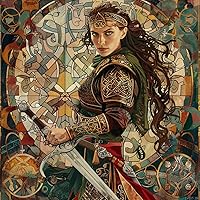
I thoroughly enjoyed the 9.5+ hours I spent reading this 320-page alternate history. The world this novel is set in is a complete reversal of what we see. The Muslim nations are democratic and lead the world in education and scientific discovery. Europe has changed little in decades. The Europeans suffer from much unrest and poverty among the common people. The Aquinists take advantage of this and recruit young men and women as soldiers who are willing to die for their cause and achieve heaven. The story starts a little abruptly and is a little slow. I like the characters of al-Zarzisi and Musa. The fact that al-Zarzisi is Muslim and Musa a Jew puts another spin on things. I also like the whole 'world-flipped-upside-down' premise for the novel. I think that the cover art is well chosen. I give this novel a 4 out of 5.

Further book reviews I have written can be accessed at https://johnpurvis.wordpress.com/blog/.
Profile Image for Jonathon McKenney.
641 reviews6 followers
May 1, 2023
Been a while since I read a full alt-history, and I was excited about this one, having looked for a copy for years. Enjoyable enough read, if predictable and a little clunky, often repeating the same observations or comments time and time again. But a well imagined and built world. For a first Turtledove, a good choice.I could’ve done with a little less of a straight line through, a few twists would’ve made the book more exciting. Falls beneath The Mirage and (of course) Rice and Salt
Profile Image for Sarah.
387 reviews8 followers
August 6, 2019
I give up. I can't take it anymore. I really, really wanted to like this one because I've heard such good things about Harry Turtledove, but it took 75 pages for anything to happen. By page 158 I just don't care about any of the characters and there doesn't seem to be any kind of plot in motion, so I'm not going to keep beating myself up about this.

I love the concept behind this book, but I really need a plot and characters to structure it. We're given so little information to go on about who the characters are--except that Dawud is Jewish, a fact that we are not allowed to forget for more than a few paragraphs--that I just have no emotional investment in them.

Most annoying to me, though, is the style of writing. Something finally happens but then we have to have a full paragraph of Khalid thinking about how things are different in the Maghrib from how they are in Italy. This sometimes even interrupted action so that I forgot what was happening! The text is just so self-aware and points out every single instance where things would be different in the sane, safe Muslim world. I just think that most readers would be smart enough to guess some of these things on their own, without needing them highlighted every single time it happened. It's like the main character is mainsplaining everything to me.

I'm not going to give up on Harry Turtledove--he's written a lot of things that sound interesting--but am calling Through Darkest Europe quits. On to something with plot and action!


Quotes & Notes

None of these are spoilers, they're all just little incidental things.

p. 87 - There's no way on earth that smallpox scars would be mistaken for acne.

p. 111 - I found it interesting that Turtledove created an Islamic equivalent to Hitler. I actually wish I knew more about this situation, because Hitler arose out of very specific circumstances largely shaped by the post-WWI Treaty of Versailles and the Great Depression, neither of which would have necessarily happened in this world.

p. 153 - They stopped at a little town called Montevarchi for a snack and more coffee. Anywhere in the Muslim world, such a stop would have been as ritualized as a visit to a mosque. One or two of the leading five or six anonymous societies would have sold gasoline. etc...
At first I was intrigued by the idea of these "anonymous societies", thinking that it might be some kind of cultural business difference that Turtledove is speculating might have evolved...but then I realized he was probably trying to say "there was a Macdonalds and a Taco Bell" without referencing specific names.
1,021 reviews30 followers
January 24, 2019
That's a big old DNF for me. I actually gave it longer than I should have.

Can we start with the syntax and diction? He is constantly trying to use these 1 dollar words when 10 cent ones are there for the picking. It slows everything down and really pulled me out of the story. It doesn't fit the tone, fails to build characters, and leaves me scratching my head over what he was trying to accomplish.

Then there is the sentence structure. He is constantly, CONSTANTLY, adding words to the end of sentences that don't need to be there. He builds sentences inside out, and has the absolute worse sense of rhythm and flow to his story. It was literally impossible to turn my head off and enjoy the story because I'm constantly having to reread to make sure I'm understanding what he is saying. English is his first language, right?

With that out of the way, this garbage book doesn't understand how anything works. Anything.

The substance of the book is terrible. His characters are absolute garbage. I hope you enjoy mind-numbing philosophical think pieces that basically reduce everyone to a single trait- faith. Then give them absolutely nothing to do, no reason to be doing it, and expect a little "comedic relief" (he uses the term generously) to carry this thing.

The story should have started a week after the explosion in the 80 page range. The characters had no logical reason to be there. 1/3 of the way through the book, and the book should be starting.

A Jew and a Muslim (when the entire world revolves around their faith) wouldn't work well together.

The bomb goes off. Oh, now we can crack jokes and be lighthearted. Dead bodies are everywhere, but now is the time we banter.

History progressed . . . Some how. It's like . . . Nothing's changed since the 11th century, except we have some technology. There's no world building. No sense of how things are different.

I don't want to touch the religious stuff with a 10 foot pole, but if you think any of that was accurate, ANY OF IT, then you're a moron. Out of context . . . everything.

What was the point of this! Any of it. This book belongs in the dumpster.
Profile Image for Steve Leitch.
32 reviews2 followers
September 28, 2018
Normally, I am a huge fan of Harry Turtledove, but I do not follow his thought processes in this case.

Most of Turtledove’s alternate history seems to explore how things might have gone differently if some pivotal event had happened in another manner. This novel almost seems like a apology to Islamic nations, suggesting that Christianity would behave no better if Islam had pursued a modernist agenda.

It is no secret to reasoning people that the current problems with Islamic terrorists or jihadists is rooted in the extreme fundamentalist branches of the religion. It is equally no secret that there are fundamentalist branches of Christianity which are little if any better. They just are less active because they are branches of the group which has historically wound up on top.

I honestly do not see the point a Turtledove is trying to make, beyond that. Although he, as usual, tells an excellent story, this time it seems to be a story without a purpose, at least that I can see.
60 reviews5 followers
October 12, 2018
Often, when I read a Harry Turtledove novel, my response is "There but for the love of God go I." That reaction has rarely been more pronounced than when I read Through Darkest Europe, a novel that forces us to confront the fact that our privileged position in prosperous countries is really the result of a lot of historical accidents.

Unlike many of his previous novels, Turtledove focuses on just one point of view. The protagonist Khalid is sent from a first-world power in the middle-east to a backwater european nation in order to help quell an insurrection. The point of divergence for this alternate history is that Euro-Christian philosophers rejected modernity during the middle ages, while the Islamic world embraced it.

This exploration may be a little heavyhanded at times, but it's definitely worth thinking about.
Profile Image for Katie O’Reilly.
699 reviews13 followers
February 17, 2020
This book has a crackling strong premise, but it is let down by the uninteresting and repetitious execution. The premise is an alternate timeline in which Europe never modernized, and instead is technologically backwards, poor, and ravaged by monastic terrorism. I was super intrigued by the premise! But after the introduction, the plot plods. The love story is anemic. The plot twists can be see from chapters away. The end is a little confusing and pointless. Also, in the alternate timeline, Middle Eastern countries are wealthy and liberal, which is great, but African countries are still low on the totem pole.

I want to read another Turtledove, though, because I liked the premise so much.
47 reviews
November 6, 2020
Horrible worst book ever from Turtledove. Had to force myself to finish it. Took over a month.
Profile Image for AoC.
132 reviews4 followers
February 17, 2025
In all honesty I think Through Darkest Europe would've made a much bigger impression on me had I not already read The Years of Rice and Salt some time ago which, at least on the surface level, dabbles with the same idea. In this instance author opts-in for a more straightforward 1:1 mirror situation, though. Does that diminish his novel in some capacity? You'll find out below.

Premise itself is simple enough to follow - back in the 13th Century teachings of Saint Thomas Aquinas took greater hold than anyone could have anticipated. His idea of "better surety of the next world than useless knowledge of this one" lead to languish of intellectual and cultural pursuits in Christian realms. Fast forward to modern day equivalent and our protagonists, Khalid al-Zarzisi and Dawud ibn Musa - pair of investigators from the constitutional monarchy of Maghrib - are on their way to the Grand Duchy of Italy to help. Why? Well, autocratic countries of Europe have seen the rise of religious extremism taking after their Saint of old over the last few generations. Calling themselves Aquinists and with a battle cry DEUS VULT spreading across Europe at alarming rate. Now lives of the Grand Duke and Pope themselves are in danger with our two leads being sent as aid from a more civilized sphere of influence south of the Mediterranean. Can anything truly be done before things reach their killing point, though?

I cannot emphasize enough that which could very well put off potential readers. Through Darkest Europe is, through and through, an inversion of how some people in the West, accurately or otherwise, look at the ongoing situation in the Middle East and by extent Africa. Novel constantly drip feeds you bits of background information in this strange world. Americas became Sunset Lands with Arkansistan one of the more prominent ones, Classic Arabic is effectively lingua franca and Aquinists start off as almost tacitly tolerated radicals at large with even seminaries of their own. Does that make you uncomfortable? Well, this IS an alternate history story and thus perfect format to explore such ideas. One particular unspoken opinion stood out for me when a ranking character all but says "yes yes, it's bad news we have domestic terrorists blowing up things, but we're wasting time when we should be fighting the heathens instead".

To novel's credit our man Khalid is a very level-headed investigator and his thought process comes more from him being a stranger rather than preaching to the reader. Maybe a bit bland at times, too. Good thing his Jewish partner Dawud brings some humor and personality to the table. They're both consummate professionals who have to carefully navigate both representing their government AND trying to do the security job. I would go out on a limb and say there's no character development here nor is Through Darkest Europe a character-driven piece. They share their thoughts on these weird Europeans who are still ruled by absolutist princes and kings. Religious and cultural contrast takes center stage. I would be remiss not to mention a somewhat predictable romance that neither added or subtracted. If anything it's a native Italian and Christian POV in case you needed one, as well as the role of women in such a world.

Harry Turtledove, a famed author in the alternate history scene, has somehow escaped my notice. Until now. Short of perhaps repeating certain points a bit too often for my taste I really like his style. Will I remember the characters? Not really. Did it tickle my world building fancy and I wished there was more of Europe we could have seen? Absolutely. You also don't need to know much about any of the religions or cultural norms which is impressive considering this investigative thriller hinges heavily on these. It's a case of backgrounds stealing the spotlight. To reference what I mentioned above - this is a story where preaching to your readers could've turned it into a very grating affair, and Turtledove avoids that entirely. As someone living in Italy's immediate neighborhood it was amusing to see ideas and stereotypes extrapolated upon with just enough real life recognizability to go on.

Would I recommend Through Darkest Europe? Very much so. Maybe you even take something from it considering the role reversal.
Profile Image for Quinton.
235 reviews8 followers
October 21, 2023
The idea, world-building, concept, what have you, are excellent. A fascinating alternative history, that masterfully imagines how the world could be if Christian theologian Thomas Aquinas and Muslim theologian al-Ghazali had reached opposite conclusions.
And yet the book is incredibly boring. The characters do... nothing. Except witness some terrorist attacks and try to be witty. Page after page describes the two main characters walking around and talking to people and... that's it. I found myself nodding off constantly while trying to finish this book even though I wasn't at all tired.
Honestly, this is typical of Harry Turtledove. He is an absolute genius at alternative history. I am fascinated by every one of his ideas. And yet I don't think he is good at writing fiction. The books would be better if the characters and plot were removed and it was just the world building. I can't stay away from his books because sometimes the idea is so amazing it gets me past the writing. But most of the time it isn't. His characters feel like they would resonate with someone of my grandparents' generation, if with anyone at all.
I am very grateful of Harry Turtledove for the incredible ideas and worldbuilding he creates, but I look forward to the hopefully near future where AI can rewrite "Through Darkest Europe" into something that better suits me.
227 reviews24 followers
December 6, 2019
Although I was tempted to wait until the second day of Christmas to read this author's work, I finished it early. It reminded me why I rarely read fiction. The plot was unremarkable, if not formulaic. Boy meets Girl. Boy is nearly blown up. Boy wins Girl. Everyone lives happily ever after.

It also reminded me how fiction can be more fun than non-fiction. The interesting part of this book is the setting. It is the early 21st century, but in the world Turtledove portrays it was Islamic civilization which embraced the Enlightenment of the 18th century and proceeded to secular modernity, while Christian Europe clung to religious fundamentalism and developed it's own version of jihad.

The author throws in many of the cliches and truisms that are currently hurled across the Islamic-Christian religious divide, but they seem less convincing when traveling in the opposite direction.
Profile Image for Geoff Habiger.
Author 18 books35 followers
February 13, 2021
Another interesting look at a history that might have been, a rich and powerful Muslim world, while Europe floundered under centuries of dogmatic and orthodox thinking. This has created a fundamentalist schism within the Catholic world, with the followers of St. Thomas Aquinas seeing progress and the modern world as antithetical to the true teachings of God. As the Aquinists simmer and plot, two investigators, Senior Investigator Khalid al-Zarzis and his partner Investigator Dawud ibn Musa, are sent from the Mahgreb, the constitutional monarchy based out of Tunis, to see if they can assist the Grand Duke of Italy keep a lid on the volatile situation.

As with many of Turtledove's books, the point of departure in the history, and the world he creates gives you many chances to pause and reflect on the situation in our own world. It is easy to see how fundamentalism could have taken root in the Catholic church, or to see how easily a modern, progressive Muslim world could develop. A departure from many of Turtledove's other words is to have the story told primarily through the POV of Khalid, as opposed to using multiple POV characters. I think this did a much better job of giving the reader a unique perspective on the tale, as well as to better develop the characters. My biggest concern about the story is that Khalid and Dawud are essentially just along for the ride, having almost no impact (other than in one place late in the story) on the outcome of events. That felt like a let down to me as I like seeing characters having more of an impact in the outcome of the story.

Overall, if you enjoy alternate history, and if you are a fan of Turtledove's work, then this is an enjoyable book and worth the time to read. Other readers may get more out of how the characters interact with the story than I did, but I did enjoy both Khalid and Dawud and their partnership felt real.
Profile Image for Loren.
216 reviews4 followers
March 5, 2019
I find this book to be a very lazy attempt to slam what's going on now into opposing sides. It tries to make the Arab world what the west is, complete with the former being modern in everything from women's rights to eating and drinking habits whereas Europe (while having no issue with food/drink) is every bit as repressive towards women and minorities as the Arab world is today. The characters are rather wooden - what they say is right, they have few issues, they are the fountain of wisdom for the backwards Europeans and they are never really in trouble or in danger. The love interest is of course a very modern woman and fighting through the repressive world after her former patron is cast aside - very colonialist and orientalist if the shoe was on the other foot.

Ironically one of the smallest things that screamed the loudest about how lazy this book is, is what happens to North America. Somehow a faith that invaded and conquered one of the largest empires in human history and was invading and conquering new land into the 1500s decided to NOT TOUCH a massive barely occupied pair of continents. They're called the sunset lands and of course they're every bit as evolved and technologically savy as the Arab world, including selling tech to the backwards Europeans for their military.

I've always loved Alternate History and I love Turtledove's works. But this has to be one of the laziest pieces of writing he's ever done. It's as subtle as a brick through plate glass in not only it's poor writing and characters but also in its vision of the world (see North America again) and the evils of what the Europeans have done (which of course the muslim world wouldn't have).
Profile Image for Chris Hart.
443 reviews3 followers
November 8, 2018
This was a sold 3 stars--until the last 30 pages of the book, where it sank to a 2 1/2. I'm feeling generous this morning, so I'll still give it 3. :-)

Harry Turtledove is noted for writing what's called "alternative history," in which some major difference in history results in a very different world than we know now (think, Hitler wins WW2). In this novel, the difference is that scientific and cultural progress came from the Islamic world, and "Christian" Europe is a backward, violent, and bigoted culture. It's thought provoking in its own way and a mostly interesting read. It's more interesting as a novel than as social commentary. Mr Turtledove ducks some of the hard questions, such as, where is Israel in this enlightened society?

However, for some reason he felt the need to throw in a totally unnecessary romantic relationship. The end of the book
17 reviews
February 7, 2020
I have heard a lot of great things about Turtledove from alternate history fans but unfortunately this was an underwhelming first read of his for me. Don't get me wrong; the actual alternate history, the reversal between St. Thomas Aquinas and Abu Hamid Al-Ghazali's historical philosophies, is so fantastically explored! Delhi Sultanate Garuda cars, Islamic Arkansistan, the premise of Maghribi diplomatic intervention in Italy makes for a very well-done and thought-provoking world. The racism against Europeans is a clear reflection of Islamophobia in Western societies. The whole novel is fundamentally a commentary on the relationship between Christian West and Muslim Middle East in our world, and a good commentary at that. The problem is the plot feels like a framing of that rather than something holding value in itself. I was never compelled to pick up this book, and it often felt like a slog. Nevertheless, I am sure Turtledove's other novels will make up for that and I absolute loved his brand of alternate history.
This entire review has been hidden because of spoilers.
Profile Image for Cynthia Dalton.
316 reviews2 followers
October 18, 2018
Alternate history in which Thomas Aquinas wrote opposing science instead of supporting it and subsequently it was the Muslim world that developed technology, explored the western hemisphere and established republics. Now fundamentalist Christian terrorists are threatening Europe's slow rise to modernize. Investigators are sent from Tunis to Rome to help the Grand Duke and Pope maintain the status quo.
I had problems with this book and I am still not sure exactly what bothers me. One think I did identify is that Italy has the same borders and government centers as it does today, even though in the real world Italy was the last European country to unify, while the book refers to "the Germanies" as if they didn't unify during the 19th century as they did in real life. Another problem for me is that apparently there was no Protestant reformation in this world. Again no reason given why.
Profile Image for Ron.
4,076 reviews11 followers
November 19, 2018
This is the closest I have seen of a modern thriller written by Harry Turtledove. You have two operatives sent from an advanced country to a land under siege by corruption, religious fanaticism, and leaders struggling to move their people forward into modern times while hanging onto their power. The twist is that the investigators are an Arab and a Jew sent from North Africa to Italy to aid the Pope and Grand Duke of Parma hang to power against the fanatical Aquinists. Turtledove switched the views of Thomas Aquinas and Al-Ghazali regarding reason and man's relation to God and then postulated how the world have developed. The background is interesting, but the tale is more pedestrian reeking of the standard thriller fare. Not the worst Turtledove I have read, but definitely not his best.
Profile Image for Federico Di Paolo.
21 reviews3 followers
February 7, 2022
About ¨Darkest Europe¨.

And one wonders, ¨¿how could someone write ¨The Guns of the South¨ and then allow this to be published with his signature?¨ … My fault. Again I expected too much. But in my defense, this book provides nothing at all. Its just another ¨what-if-Cats-were-dogs-and-dogs-cats¨ … and has no thrill about it either. The story in not interesting, the descriptions are lame, the prose is not better than the average … total waste of time, ink and paper. If machines are ever programmed for writing literature, I think the first batch will not be much different than this.
Profile Image for Carlos Aranaga.
9 reviews33 followers
January 2, 2019
This is a really fine Turtledove effort, consistently entertaining and witty throughout. Sometimes Turtledove in his works gets a bit redundant in his tropes. Not here. The ending leaves hope that there could be more to come in this alternate universe. I hope so. I’d love to see more of this world, especially what lies across the ocean in places like Arkansistan. Bravo, well-done, recommended!
Profile Image for Mary.
48 reviews1 follower
March 28, 2019
I was in the mood for an alternate reality book like this.
I barely made it through 2 chapters. Life is too short to attempt to read a book you don't like after 1 chapter.
The premise is interesting. However, this book missed the mark. I didn't like either of the main characters right away. The sentences were weirdly put together and hard to read.
1 star is being generous.
10 reviews
February 9, 2021
My first and probably last Turtledove book. I read almost 100 pages and never really understood the setting or ultimate plot. It seems to be a book in a series and I made the mistake of selecting the 4th or 5th book. Without knowing the background, setting and characters it was slow and tiring! Too many other excellent authors.
Profile Image for Shane Jardine.
184 reviews15 followers
October 3, 2018
Originally posted at www.archeddoorway.com

Alternate history is not usually a genre that I read all that often, but every now and then I’m sent or stumble across a book that just sounds far too interesting for me to ignore. Through Darkest Europe by Harry Turtledove was one of those books that I knew I had to read when the chance presented itself to me and it didn’t long at all before I was sucked completely into the story. When I started reading this book I made the foolish mistake of assuming I would be able to read a couple chapters to see what I thought of it before I went to bed that night and then I would just really get into after work the next day. I was not able to put the book down until I finished it and ended up going to work on practically no sleep.

I think one of the main things that made this book so interesting and difficult for me to put down was how different it was from the rest of the (admittedly few) alternate history books I have read. I feel like most of the books in this genre tend to be kind of lazy and just throw in some magic or something like advanced technology and use that as a way to change events. Through Darkest Europe does something I really haven’t seen much of and uses an alternate history for religion to change how historical events unfold. I found the way in which the world changed to be quite interesting in this book.

I found the worldbuilding in this book to be amazingly detailed and it’s pretty easy to see what Harry Turtledove is such a popular author of alternate and historical fiction. I only wish he had done a bit more with the characters in this book. I found them all to be fairly interesting, especially in the beginning but I feel like there wasn’t a lot of character grown over the course of the book. By the end of the last chapter, Khalid and Dawud are pretty much the exact same people they were at the beginning, it’s like everything they witnessed and went through barely had any long-lasting effects on them as people, which was the hardest thing in the book to believe.

That being said, Harry Turtledove is a fantastic author and I’ll definitely be checking out more of his books. I would have no problem recommending this book to anyone looking for something new to read. I would be really curious to see how someone more religious than I am felt about the changes made to Christianity or Islam in this book, I can just see some of the more zealous people I know being a bit upset.

I received a free copy of this book in exchange for an honest review.
Displaying 1 - 30 of 112 reviews

Can't find what you're looking for?

Get help and learn more about the design.