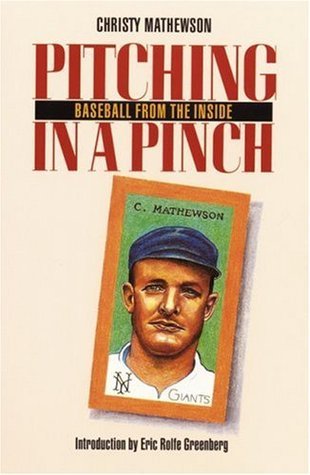
Christy Mathewson (1880–1925) was the greatest baseball pitcher of his day, a hero with appeal reaching beyond sports. A college-educated player from Pennsylvania farm country, he restored respectability to a game tarnished by the rowdies who had dominated baseball in the 1890s. Pitching in a Pinch , originally published in 1912, is an insider’s account blending anecdote, biography, instruction, and social history. It celebrates baseball as it was played in the first decade of the twentieth century by famous contemporaries like Honus Wagner and Rube Marquand, managers like John McGraw and Connie Mack, and many others. Always sensitive to psychology as well as technique, Mathewson describes the “dangerous batters” he faced, the “peculiarities” of big-league pitchers, the “good and bad” of coaching, umpiring, sign-stealing, base-running, spring training, and the importance of superstition to athletes. Matty, as he was called, makes the reader feel that tense moment when a player in a pinch must use his head.
Christy Mathewson played for the New York Giants from 1900 to 1916. He was one of the most dominant baseball pitchers of all time, ranking in the all-time top ten in several different categories including wins, shutouts, and ERA.
In 1918 he joined the army to serve in World War I but was accidentally gassed during a training exercise and developed tuberculosis. Mathewson never fully recovered his health and died in 1925 at the age of forty-five.
In 1936 he was named as one of the first five players to be inducted into the Baseball Hall of Fame, alongside Walter Johnson, Ty Cobb, Honus Wagner and Babe Ruth.
This is a fun re-read for me, having come across this book a few years back and enjoying it while understanding that there are some limitations to it. This book is ostensibly by Christopher "Christy" Mathewson, though it's ghostwritten by a professional sportswriter. Mathewson, one of the greatest pitchers in the history of baseball, played for the New York Giants in the early 20th century, helping lead them to a World Series victory in the second ever Series played (1905), and his consistent record of multiple seasons with twenty or more wins in a row is unlikely to be matched even today. Mathewson (through his ghostwriter) is a charming, witty narrator of what the game was really like in his day (the book is really a collection of pieces penned by the two during the 1911 season, printed in book form the following year). There's plenty of old-timey cringe material here, to be sure, but it's balanced to some extent by Mathewson's overall decency as a human being. He writes dialogue from the players that obviously feels scrubbed of anything suggestive or profane (as many old-time sports books do), and it's hard to believe that legendary Giants manager John McGraw didn't pepper some of his quotes here with a few more choice words than what the record reflects. But the book overall is a charming insider look at how baseball functioned at the turn of the 19th/20th century, and how the men who played it lived and thought about their profession and their place in it.
Loved this book. Mathewson's erudite descriptions of early 20th Century baseball are fascinating and insightful. His musings really bring to light how the game we watch today came to be.
Also, the chapter that describes Pittsburgh as the fancy town full of rich society people, with all its industry money and tycoons, in comparison to the relatively low-rent New York City, was hilarious. Once player even manicured his nails before trips to that city for fear of being made fun of by the snobby snobs there.
It's a fun read. Seeing the game from the perspective of one of the first HOFers while he was still in his great career is a rare treat. Mathewson goes through all the aspects of the game detailing what he feels are the important things to think of. He also tells stories of some of the things he has seen on the diamond to illustrate his point.
Highly recommended. Well written (well ghost written, though I'm sure the thoughts were his), and was a joy to read.
' "Larry" Doyle thought that he had received the raw end of a decision at second base one day. He ran down to first, where Klem had retreated after he passed his judgment. "Say, 'Bill,'" exploded "Larry," "that man didn't touch the bag - didn't come within six feet of it." "Say, Doyle," replied Klem, "when you talk to me, call me 'Mr. Klem.'" "But, Mr. Klem - " amended "Larry". Klem hurriedly drew a line with his foot as Doyle approached him menacingly. "But if you come over that line, you're out of the game, Mr. Doyle," he threatened. "All right," answered "Larry," letting his pugilistic attitude evaporate before the abruptness of Klem as the mist does before the classic noonday sun, "but, Mr. Klem, I only wanted to ask you if that clock in centre field is right by your watch, because I know everything about you is right." "Larry went back, grinning and considering that had put one over on Klem - Mr. Klem.'
This volume is replete with that sort of anecdote. Lovely and amazing.
In some ways, this was a painful book to read, due some stilted sports-reporter-isms, and the casual expressions of the bigotry and racism of the time and place To put it in context, it was published a few years before D.W. Griffith's "Birth of a Nation" was released.
On the other hand, it does provide a good sense of how baseball was played at its peak, in the dead ball era, by one of the greatest pitchers under the greatest manager. The material on base running and stealing is especially good.
The author was a very successful pitcher at the time this book was written, and unlike most autobiographies today, was also a decent writer. Chapters of this book read like newspaper columns (which some of them may have been), expounding on the pitchers views of managers, hitters, fielders, pitchers, and umpires. As much anecdotes as analysis, this easy-reading book remains relevant today. Recommended for baseball historians and true fans, probably over the head of anyone else.
This is a fun book written by the great pitcher Christy Mathewson, who was among the first college graduates to play pro baseball. The book is well-written, and of course there are lots of boring parts talking about certain plays with players from the first decade of the twentieth century. The best parts are when he explains either historical things--like why Mordecai Brown was called "Three fingers" (He'd cut off the first two joints of his index finger on a farm machine). Or explaining Merkel's Boner, the supposedly most controversial in the history of baseball. Fred Merkel was a rookie who was standing on first base. When the next batter got a hit that would have represented the winning run, Merkle for some reason didn't run to second, but thought the game was over and ran back to first, then through the dugout and into the locker room. The other team had to chase him into the locker room to tag him for the third out. The game was ultimately played again later in the season, but Merkle felt horrible about it.
After that, Merkle felt so bad that he lost 20 pounds and begged the manager to send him back to the minors because he'd ruined the season. The manager, the famous John Macgraw, refused to send him down, and in subsequent years Merkle became a star player for the NY Giants. Other interesting things that still apply to baseball today are the efforts to observe each opposing player during the game, and know who was "yellow" (backed away from a potential beanball). The only time I had heard of "yellow" sportsmen was in a Scott Fitzgerald short story, so being a yellow player must have lasted at least into the 1920s.
Other funny anecdotes were when players passed by an empty barrel it meant that they would get a hit. So Mcgraw ordered a wagon full of empty barrels every day to pass players on the way to the stadium. The Giants had a good week that week. If players passed by a person with crossed eyes, it would mean they would lose the game, so they invented long routes from the hotel to the stadium to avoid one particular cross-eyed man.
But a later problem occurred when a pitcher fell in love with a cross-eyed girl, who always sat behind third base in the stands. The pitcher could no longer throw to third base after that. Mcgraw said he would pay for eye surgery for the woman, but she gradually started sitting in the outfield and then quit attending altogether. So the pitcher could again throw to third base, but he had lost his girlfriend.
Another interesting tradition was players rubbing the hair of black boys for luck, which probably led to the book last year titled No, You Cannot Touch My Hair.
Between the plays by players you've never heard of, the anecdotes are worth the read.
A really fun look at early 20th-century baseball through the eyes of one of the greatest pitchers of that or any other era. Matty was a great pitcher and was aware of his talent, but he was also aware of the times that he was off his game and when the other team's batters were better than his pitching. The book is divided into chapters that each focus on a different aspect of what he calls the "inside game," such as the impact of the crowd, the umpires, good (and bad) coaching, jinxes, etc., all of which contain wonderful anecdotes about games he was in or that were well known at the time. One chapter focuses solely on the Giants' game against the Cubs on September 23, 1908...the game made famous (or infamous to Giants' fans) by the Merkle boner...and how the Giants and manager John McGraw rallied around rookie Fred Merkle after the game and through the end of the season. Merkle begged to be sent to the minors, and the press and the fans were merciless to him, but McGraw and the team stood behind him. That story had a lot of heart. I'm not sure that many teams today would be as magnanimous, but I'm sure that the media and fans would be just as merciless.
Most of the stories he relates require the reader to have some knowledge of professional baseball in that era as he doesn't clearly identify or provide any background information on any of the players in the stories, assuming that the reader is familiar with them all. He also uses occasional words or phrases that brought a smile, words such as "coachers" instead of "coaches" and "my salary wing" instead of "my pitching arm."
The narrator of the audiobook was Kyle Tait, and he did nothing to detract from the book, and I consider that well done.
If you love the history of baseball, put this one on your list.
The great Christy Mathewson’s 1912 book “Pitching in a Pinch” is first and foremost an insight into the psychology and technique of professional baseball rather than a typical autobiography. However, these chapters penned by Matty help the modern reader greatly in understanding the realm of the Dead Ball Era in all its tricks and turns, including the star ballplayers who made it what it was as well as the mindset of how to play the game (and perhaps most importantly, how to STAY in the game at the big-league level). As this book has been republished several times over the past century (even as recently as 2013), the insight shared here must be worthwhile, even to students of the modern game of hitting for the fences on every pitch. In any case, I thoroughly enjoyed learning about all the facets of the Dead Ball Era ballplayer, though I wished Mathewson had gone into some more detail into his own career, both personally and professionally.
Read this after reading "The Baseball 100" by Joe Posnanski. Loved that other book. This book is a very interesting look back in time before Babe Ruth and the live ball era. It often feels like old newspaper stories. The writing is clear, the old language is interesting (e.g. he constantly refers to pitchers as "twirlers"). Honestly, it was a bit of a chore to finish, but taken in context of how baseball was back then it was interesting. I appreciate that Christy Mathewson wrote this book for us to look back in time and see how baseball was through his eyes. The chapter on jynxes rubbed me the wrong way but it seems that is a reflection of white America at the time, and part of the history and mythology of Major League Baseball.
A fun illustration of how some things never change ... and how some things change utterly. The sections on ballplayer superstitions and sign stealing could have been written today ... and will probably still be valid in another hundred years.
On the other hand ... going into the one-game playoff to determine the 1908 championship, Matthewson talks about having pitched 8 times in fifteen days (six of those were complete games), then having a four-day rest before the playoff game. He says he had nothing for that playoff game because of the long rest.
Ol Matty gives the inside dope on old timey baseball. Everything from sign stealing to spring training. He explodes the myth that rubbing a negro’s hair before a game will bring good luck. I didn’t recognize nearly any of the names he dropped but I liked his sincere and cleancut way of telling stories. It’s a lil time capsule of baseball anecdotes.
Christy Mathewson shared a lot of information on what pitching in the early 1900s was like. Great book on the inside game of baseball. I wish I had the opportunity to see him pitch. This book is the closest thing to watching him ply his trade.
A purely baseball entertaining read from one of the best talented and educated players. It was pure pleasure. The flashback of how the game was played, the players, faults, stealing signs, pitches outlawed takes a reader into the majestic era of baseball.
A real nice book. You really get a sense of the character of Christy Matthewson. He has some nice insights on baseball and just life in general. One of the things that struck me about him is that he appeared to be a man of great integrity.
Ugg two choppy books at once. The inside information was 100 years old, a good read but not the best an not a true biography like I was thinking when I ordered this one.
Amazing time capsule of the dead ball era of baseball. Much of the game hasn't changed, but those little parts that have are what makes this book gold!
Just didn’t like it. Hard to follow because it doesn’t have a consistent storyline. Took me three weeks to read half and I had to read a palette cleanser in between halves. Would not recommend
Mathewson, the great right-handed pitcher of the New York Giants at the start of the 20th century, was one of the first inductees in the baseball Hall of Fame (along with Babe Ruth, Ty Cobb, Honus Wagner and Walter Johnson). He pitched for 16 years in the big leagues, won 373 games (185 more than he lost) with a career ERA of 2.13. His teams were twice World Series champions, including in 1905 when Mathewson pitched three shut-outs. Simply put, one of the best starting pitchers ever. The book, a collection of themed essays written by Mathewson with the un-credited help of newspaperman John Wheeler (though now credited thanks to Red Smith’s afterward) for syndication after the 1911 season. A year later they were collected into a book that was very popular from its publication in 1912 and beyond. In Smith’s essay he talks about borrowing it from the Green Bay library as a kid and wearing out the pages.
Reading Pitching in a Pinch a 102 years later is interesting, informative, and often entertaining but there are redundancies and dry patches. Unlike Lawrence Ritter’s The Glory of Their Times it is not essential reading, but if you’re a fan of the game and its history Mathewson and Wheeler provide sufficient insight, color, and story-telling to make this a pleasurable experience.
Mathewson pitched mostly his whole career in the “dead ball” era. A time when small ball was the rule and home runs were rare. The bunt base hit and sacrifice, the stolen base, the RBI groundout, flyball or single, were the ways runs accumulated. The ball was dirty and erratic, gloves small, infields and outfields irregular with stones and ruts. To underscore the point, Mathewson gave up one of the most famous home runs of that era, one that tied a crucial game in the ninth inning. The hitter was then christened “Home Run” Baker, although he never his more than 12 in a season.
The essays here talk about inside baseball in a colorful blend of baseball argot, spiked punch journalism and clear prose. Some meanings have changed. A “groove” in Mathewson day was the area of weakness in which a player could be handled. Some have stayed exactly the same. The balance of recognition and surprise in the language of the game is one of its pleasures.
The book's topics include how managers impact the game, the role of superstition, legal and illegal cheating (stealing signs from the dugout, coaching boxes or basepaths being legal, but using binoculars from the scoreboard and an electrically wired messaging system being illegal), how crowds affect players, spring training, etc. The essay on jinxes is very entertaining but also cringe inducing as one jinx buster used by a team was to keep a hunchback as a team mascot so players could rub his hunchback on the way to the field or a more universal one among the all white players of the day was to rub the head of a “colored person”. Other superstitions were more benign. A bunch of empty barrels, for example, was supposed to be good luck for hitters. (Why? One of the game’s divine mysteries.) His team lost in a slump, Giant manager John McGraw arranged for several days that a horse drawn wagon stacked with empty barrels just happened by streets his players traveled to the ballpark and, as they encountered the wagon, his players in commuter groups of one, two and three escaped from their slumps. Inside baseball at his best.
Stories from when the game was young, pitchers threw spitballs, batters didn’t wear helmets and every game was a day game. Pitching in a pitch is an enthralling step into a different era. It captures a feel for the country at the turn of century in a way a straight forward history never could. The anecdotes are delightful (the old inverting the pitching mound trick anyone?) but what really shines is the language. It’s so clearly of its era but colorful and playful that it doesn’t feel stiff at all. Casual phrases sparkle: “Managing like Gaul, and many other things, has three parts” or “Stealing second is the gentle art of taking a chance”. Those examples stuck in my head but the whole book is like that. My favorite book I’ve read this year. I can’t recommend it enough.
Many years before Jim Brosnan set the sports literary world on its ear with "The Long Season", a number of "tell-all" books about baseball found their way to market. One of the earliest, and one of the best, is "Pitching in a Pinch or Baseball from the Inside."
Ghosted by Christy Walsh, the book talks about the small-ball era of baseball as seen through the eyes of Christy Mathewson, the immortal "Big Six" of the New York Giants. For its time, the book is fairly controversial in that it contains honest looks at managers, players, coaches and umpires -- and their foibles -- along with perhaps the best examination of the legendary John McGraw in print at that time.
There are a number of concepts in the book that are still relevant to baseball today, but sadly not as many as the purist might like. The arts of base-stealing, bunting, bench-jockeying and sign-stealing are discussed in great detail. (Mathewson's position on sign stealing is the correct one: it's fine if it's done honestly.)
Yet, for its time, the book is both relevant and readable, with moments of humor interspersed with stories about the people who built the game in the early 20th Century. Back then, the game was made up of tough, hard players and social norms not being the same as what they are today, interesting personal situations are encountered. Mathewson wrote about them, which makes the book stand out.
On the list of great baseball diaries and recollections, it takes its place alongside Joe Garagiola's "Baseball is a Funny Game", both of Brosnan's works, "The Long Season" and "Pennant Race", and even Jim Bouton's "Ball Four" in some ways. That said, the player also known as "The Christian Gentleman" would not attempt to shock his audience the way Bouton, and to a lesser extent Brosnan, did.
The personal stories are engaging. For instance, 19-year old Fred Merkle's famous 1908 baserunning blunder is discussed in detail. Every student of the dead-ball era knows the story, but Mathewson's tale adds to the story in describing Merkle's personal misery as the Giants lost a late September lead and finally the pennant, to the Chicago Cubs. Feeling responsible for the club's misfortune, Merkle begged McGraw for his release, but the manager responded that he wanted tough players like Merkle (a "car full", Mathewson quotes him as saying), refused to release him and watched as Merkle became one of the best firstbasemen in the National League.
It's a short read, engaging and fun, even if naturally dated.
Another book you'll want on your shelf if you're a fan of the Deadball era.
Also something you might want to read over if you are a sim player (Strat, APBA, Replay, Diamond Mind, etc.) who is playing a season from the first decade of the 20th century.
This happens to be the 100th anniversary of this writing, as it appears this was put out sometime during 1912, the season after Matty and the Giants were taken down by "Home Run" Baker and the powerhouse that was Connie Mack's Philadelphia Athletics.
Mathewson opens up a lot about his New York Giants teammates from the first 12 years of his playing days, and if you are at all a fan of John McGraw, there's plenty of material in here of you. I have to admit that as much of a fan as I am of the Deadball Era, I really don't know too much more about "Mac" other than "Well, he sure won a lot of games". "Big Six" will give you some inside information here on how McGraw was able to routinely maximize his team's chances of winning games.
One thing that really struck me as I read through the book was how much of the strategy and talk about the inner workings of the game are really not too different from the way the game is still played today.
I believe this is actually freely available on sites like Project Gutenberg, so if you have any interest in just reading it and don't necessarily need a bound copy, you can always hop over there and check it out.
This is a fascinating look at baseball from the inside, in the early days of the major leagues and the first two decades of the twentieth century (ghost-)written by one of the great stars of the game. Mathewson, one of baseball's most magnificent pitchers and an intelligent and erudite man, allowed his friend, newspaperman John Wheeler, to expound upon the art of playing baseball as though Mathewson were himself telling the stories. No doubt, Mathewson had a good deal to say himself, and there is a mixed air about the book, one of authenticity mixed with what passed for lighthearted literary flair in the press of the 1920s. In any event, there is a lot of fun to be had in the musings about various players, teams, and umpires, and some additional amusement to be found in the differences (and similiarities) of the game then and now. Surprisingly, in those long ago days when coaches were called "coachers" and pitchers most frequently referred to as "twirlers," some of the sophistication of modern baseball is evident, and it is clear that the brainy, strategic game played today is nothing new. PITCHING IN A PINCH is an interesting flashback to a time when the game was young and naive, but not nearly so naive as one might think.
Pitching in a Pinch is one of the original baseball books written by one of the premier pitchers of the early 20th century. McGraw was an outstanding manager for the Giants and was a genuine creator of the "small ball" style of play. Throughout, Mathewson details a reader with strategies for double steals, baserunning, "honest" sign stealing, and the psychology of the batter and hitter. These strategems are interwoven with real life situations where they were used, making this an interesting historical piece... it seems that baseball hasn't changed much over the years.
Beyond the historical relevance of the piece, though, there is little to gain by reading it. Mathewson is clearly not a good writer, tending to ramble with little aim or purpose other than to tell a few old baseball stories. As for using this as a teaching tool, almost anyone with a working knowledge of the basics of the game will know what Mathewson is describing... these tricks are still around, so there's no great reveal. Still, a good read for any baseball fan with a sense of history. It is astounding how similar the game played today is to the one played 100 years ago this year.
Despite the title, this book isn't really about pitching specifically. It's written by one of the great pitchers of the early 1900s, and there are bits of it that do talk about different types of pitches, and pitching strategy. Most of the book though, waxes philosophical about the best ways to play the game, by way of lots of anecdotes. Parts of it come across as horribly dated, mostly in terms of the language he uses to describe things, and the baseball terminology used at the time (but also the chapter about superstition in baseball included the idea that some players found it lucky to rub a black child's head, and names a player who claimed that this was the cause of his hot streak at the plate). Reading this did give some interesting insight into the life of a professional baseball player 100 years ago; it was interesting to read the different anecdotes and what he was saying about them, and thinking about which of them still seemed relevant to the game today and which ones didn't.