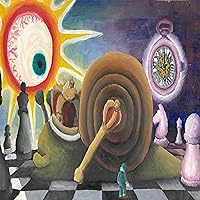
Deep in the heart of nowhere, near a place called Abbey Marston, there’s a caravan site. The perfect place to get away from it all. Close by, there’s a stone circle they used for human sacrifice in olden times. A little further afield, there’s an old RAF research station, where they did hushhush things in the War.
There’s only one rule: the use of radios, cassette recorders and portable televisions is strictly forbidden.
People come here to get away from it all, you see. No-one wants to hear the noise. No-one wants to hear the voices in the static…
Jonathan Morris is one of the most prolific and popular writers of Doctor Who books, including the highly-regarded novels 'Festival of Death' and 'Touched by an Angel' and the recent guide to monsters, 'The Monster Vault'. He has also written numerous comic strips, most of which were collected in 'The Child of Time', and audios for BBC Audio and Big Finish, including the highly-regarded comedies 'Max Warp' and 'The Auntie Matter', as well as the adaptation of Russell T Davies’ 'Damaged Goods'.
Recently he has started his own audio production company, Average Romp. Releases include a full-cast adaptation of Charles Dickens' The Chimes', an original play, 'When Michael Met Benny', and three episodes of a SF sitcom, 'Dick Dixon in the 21st Century'.
He also originated his own series, Vienna and script-edited the Nigel Planer series 'Jeremiah Bourne in Time'. He’s also written documentaries and for TV sketch shows.
Librarian note: There is more than one author in the GoodReads database with this name
A young couple take a break in an isolated caravan park deep in the woods... and when has that starting premise ever turned out well for the characters in a movie?
The result isn't a slasher flick, but it is a creepy horror tale about something scary out in the mist. It certainly piles on the cliches (indeed, some might find it overdoes this) with the sinister old caretaker, phones ringing when they should be cut off, and the couple trying to recover from a recent tragedy that plays back into the story. But it does this well, aided by some good characterisation of the guest stars as well as playing into Constance's backstory once it turns out that something odd was going on here during the War.
In fact, the cliches are part of the point, because this is still a Doctor Who story, allowing for a different take on a classic concept in the same way that - to pick just one example - Time Heist is a take on, well... heist movies. And, of course, people being cut off from the outside world and then facing something scary is a good fit for much of the TV series.
The horror elements also give way to something that's more obviously science fiction in the second half as some of the details of what's going on become clearer. Even then, though, the pace keeps up as the viewpoint switches between the 1940s and the "present day" (more precisely, the 1980s). For all the tropes being honoured in the first half, this is, as it turns out, a story you couldn't tell without time travel.
The final resolution is one that's pretty typical for the series but that's entirely forgivable given the strong tale that leads up to it. It's a pity that there was such a long break after this without Flip and Constance as companions - they honestly work far better than any of the pairings Six had on TV.
Writer Jonathan Morris establishes the setting, the characters and the mystery quickly, bringing in an aspect of a timely wimey mystery and a ghost story, while fascinatingly exploring themes of death, loss and relationships. It's a bit of a riff of Image o the Fendahl (1977) or The Stones of Blood (1978), but with a better setting and characters. Morris weaves two separate periods effectively together and introduces a couple of very good twists that give new energy to the plot.
The supporting cast is immensely likeable and Morris does a good job of making Andy and Joanna feel real; their relationship problems bring good character drama to the ploy. All performances are top-notch and the emotional input is among the strongest I've ever heard, bringing a whole new level of intensity to scary, sad or exciting moments. The strong characterization makes this story tick, whether it's through the scared couple stuck in the middle of the events, the obsessive maniac campsite owner or the dead sister consistently haunting the radio and telephone waves.
Static embraces the viewer with an effectively eerie and spooky atmosphere within the opening moments, mostly thanks to impeccable sound design from Joe Kramer and Jos Arakelian. The emotional impact of this story and the stakes are real, particularly in the final part of the story, where Morris takes the narrative into pretty dark territory. The world-building is very effective, utilizing typical Doctor Who moments of time travel, alien influence and deeply human supporting characters to tell a story that remains engaging, tense and emotional at all times.
The mental images you get from listening to the strong writing and the evocative performances are powerful.
(Plus Two)
Morris keeps the story dynamic by introducing the same setting 40 years earlier in the second half of this story, therefore developing the narrative from two points in time simultaneously. It's pretty clever how well the story flows even though there's no clear villain or monster here until the last part of the adventure. Part Four finally introduces the main alien threat in a very Ambassadors of Death (1970) like fashion but keeping the atmosphere firmly established within the boundaries set by Morris.
Colin Baker is right on point in a ghost story like this one, and companions Constance and Flip are also put into good use - all three put in very good performances.
Even the best stories can be at fault.
(Minus One)
The appearance of multiple versions of the dead characters makes some of the later plot developments slightly confusing, especially during Part Three.
This was a great idea for a story in a rich setting and not standard Doctor Who fare... a young couple arriving at a spartan caravan park wardened by a crusty old chap with his rules and regulations. And there's some fine A Matter of Life and Death stuff.
But there were a few too many twists and turns and the whole thing overlaid with too much "Doctah!" wailing and shrieking from multiple characters. Umpteen times someone starts to do something, another objects (generally quite reasonably) but the first person carries on - not despite but giving every appearance of simply not having heard. So it had lost me by the end.
This audio suffers from the same problem that many Classic Who stories are criticised for, being that part one is really good, but the other three fall flat. And that’s how “this” audio was for me; it had a really great first part with the Doctor, Flip and Constence arriving at a foggy camp sight, a couple are suffering from grief after the death of a loved one and then at the end, that dead loved one shows up out of the fog, exactly as they were when they died. I thought this was going to go somewhere interesting, but then so did the writer, and like me, he had no idea where it was going. It also feels like he had a whole load of ideas but didn’t know what to do with them or which ones to leave out. So, in the end, we were just left with a collection of desperate ideas scattered throughout, lacking a clear focus or central point.
This is by Jonathan Morris, whose other audios like Bloodtide, Curse of Davros, and We Are the Daleks, I’ve really enjoyed. However, I feel that the script for this one was rushed, so all the ideas didn’t have enough room to breathe or make sense. I believe the primary issue arises from the central premise of the story and how it plays out.
My favourite part of this audio is the human body growing out of trees in a surreal, body horror fashion, like a more Gothic version of Invasion of the Body Snatchers. I would have loved to have seen this idea expanded upon a lot more, but in the end, it had almost nothing to do with the plot and never got an explanation as to what they were or how they got there. They were just a plot device for the story's main villains, the Static. The plot points about the Static and the Tree people could have been two separate stories, but were forced together into one plot line, making things overly complicated for no good reason.
As for the Static themselves, I think they were a good concept, but were wasted by the messy script. I suspect that Jonathan Morris must have gotten the idea for this story after staying at a campsite like the one in the audio, where he was told he couldn’t have any radios or TV sets. The idea of a campsite where aliens can come through any kind of signal was a good concept, but it was ruined by everything else. If they had cut out the tree stuff and made it about the Static and the dead people, then this would have been a lot stronger. But I suspect the only reason they added the tree stuff in the first place was so they could bring Constans back after they killed her off. But then why did she have to die anyway if it doesn’t make any difference to the series?
Additionally, the Doctor and Constans travel back in time to World War II to investigate what happened there and why it was kept secret at the time, which I found to be too contrived. Overall, the second half of this story suffers from being too all over the place and just more running about with no direction. All the stuff with the Static going into the bodies of the Tree People, while also going into other people's bodies, but also the Static “are” the people while also being different, was way too complicated to follow. Plus, Constant's death felt very anticlimactic, but considering that she wasn’t going to be dead for long, it didn’t really matter in the end anyway.
Overall, I didn’t hate this audio for what it did right, but it was totally ruined by all the asses. It was like it was cramming three driftnet stories into one: the Static Campsite stuff, the people coming back from the dead stuff, and the people growing out of trees stuff could have three different audios on their own, so why did all have to be shoved in this one two-hour adventure? It was also affected by trying to kill off the companion without actually killing her off. They really needed to cut out all the Tree People and the WWII base stuff and just make it about the Static coming back on the campsite and dead loved ones. That way, this audio would have lived up to its reputation and but another one of my favourites. I still want to see the Tree People concept done in a different story where it is the central focus. Maybe if Johnathan Morris is allowed to write for the New Series, then he can expand on this idea more.
This entire review has been hidden because of spoilers.
A fascinating and atmospheric horror story with a few twists, taking in several manipulative characters, terrifying loss of identity, resurrection, and Bodysnatchers-style "pods", as well as linking back into World War II. Mrs Clarke is very much at the fore here and the war setting is far more dangerous than it ought to be for her. The scenes with the ghostly pilots are unnerving in how the RAF's motives are justified - deliberately in parallel with the way Andy and Jo justify their own actions.
A small caravan park in the middle of nowhere, a nearby stone circle that legend says was a site of human sacrifice, an abandoned RAF base, and ghosts within the mist.
All the hype around this one - saying it's just as good as "The Chimes of Midnight," yeah, I wouldn't go that far. It's still fine, but not that good.
For one thing, the two emotionally stunted 20-something teenagers at the beginning of the story? (Yes, I called them "20-something teenagers" on purpose.) The ones that set this whole thing in motion? I hated them. The girl was an insufferable nag and the guy was a total wet blanket. I felt bad for the sister that they resurrected, but in the end it was okay because she had to break ties with them anyway (lady, you can do SO MUCH better). They dragged the whole beginning down.
I remember thinking at the end of the third part that this story had better pull a fantastic ending off in order to live up to expectations and... it was pretty standard. The Sixth Doctor was wonderful and I would have loved to have had more interactions between Constance and Flip. The concept of the WWII radio base bringing soldiers back from the dead to get intelligence from them was interesting and I liked the moral conundrum that part of the story brought to the table. But outside of Team TARDIS, there are no likable characters. No one to cheer for or side with.
Sigh... There really is only one "The Chimes of Midnight." Which I'm going to listen to next.