Um relato baseado na infância do autor em que a avó (Nonnonba, personagem que dá título ao livro) lhe transmitiu algum do misticismo e temor em relação ao mundo dos espíritos, os yokai (entidades misteriosas e sobrenaturais da tradição medieval japonesa). Os ambientes fantásticos e as ilustrações pueris, valeram a Mizuki a sua reputação como contador de histórias.
Shigeru Mizuki (水木しげる) was a Japanese manga cartoonist, most known for his horror manga GeGeGe no Kitaro. He was a specialist in stories of yōkai and was considered a master of the genre. Mizuki was a member of The Japanese Society of Cultural Anthropology, and had travelled to over 60 countries in the world to engage in fieldwork of the yōkai and spirits of different cultures. He has been published in Japan, South Korea, France, Spain, Taiwan, the United States and Italy. He is also known for his World War II memoirs and his work as a biographer.
I first read Onward to our Noble Deaths by Mizuki, his serious anti-war story based in his own experience as a soldier. Lately I read the first volume of Showa, his epic history of twentieth century Japan. My understanding is he is best known, even revered, for his Kitaro YA series, which is light, humorous, and centers on yōkai (or roughly, ghosts), a class of supernatural monsters and spirits in Japanese folklore. What is an example of yōkai? A kappa, which is similar to a turtle. Yōkai usually have a spiritual supernatural power. Many are animals. Yōkai that have the ability to shapeshift are called obake.
NonNonba is a memoir about how Mizuki became a manga-ka, inspired by a grandmotherly woman who lived in his house while he was growing up. She was particularly aware of yōkai, and thus so was he, as it turns out. Her discussion of them shaped his world as a child, and he was always fascinated by them in Japanese and other cultures. In this book we get anecdotes early on of various types of yōkai that they encountered, but eventually the story begins to center on a young friend, a girl, who was also sensitive to yōkai. He naturally became a believer. A student of yōkai, which he remained all of his life.
The book is kind of an answer to fan questions about how he got to be an artist and how he got interested in yōkai, and it is a completely wonderful book for that, but in it you get to know him and NonNonBa very well, and you also get to know his artistic and unconventional and also encouraging father. It's a great story, with some surprising aspects of I feel reluctant to spoil for you, but one of these dimensions has to do with a spooky girl he meets and befriends who is also "psychic" or yōkai-aware.
We also shift in emphasis from ghost stories to some unfortunate circumstances the mysterious girl faces. Muzuki doesn't just care about yōkai; he cares about storytelling, about characters, about people. Onward to our Nobel Deaths and Showa are serious and humane works, with sometimes angry political content, but in NonNonba we get a softer, gentler Muzuki, sweet, telling of his family and friends as he grew up. The Muzuki adored by millions of fans.
In NonNonba Mizuki also shows himself involved early on in typical boyhood battles--war games--with other boys, an issue that I was initially less interested in, though this gets resolved satisfactorily as he runs from a typical macho boy world to the world of amore peaceful life, a life of art. I realized, as thought about it: This is the life Muzuki came to live, and he resents his participation in actual war, and Japan's misguided participation in wars. He turned and he turns us to art and the life of folklore and folk beliefs and the life of the spirit. Mostly in NonNonba I liked the yōkai stories and characters, all completely taken for granted as part of life as would be the case in many cultures. And his wonderful relationship to NonNonBa and the girl, of course.
An essay by Kimi Imura, a folklorist, comes in an appendix, discussing his life-long interest in ghosts and spirits. In fact, late in life he accompanied her to Ireland to look into local folklore on faeries. Muzuki, who died in October 2015, was a member of the Japanese Society of Cultural Anthropology, and was seen as a serious folklore scholar in Japan, as manga is more respected in Japan than comics still are in the west (though that is changing, surely, for the better here). He is a manga folklorist and is honored as that in Japan.
NonNonBa was the first manga to win the Angoulême Prize for Best Album. It is so great to have this finally translated in English! Muzuki also won the Tezuka Prize, which points to the way he assumed the role of the godfather of manga after Tezuka died. Muzuki balances old school cartoony figures with amazingly detailed realistic scenes as Tezuka did.
When Mizuki died he was a manga-ka rock star in Japan, with two major tv series focused on him and his work. His work and this volume in particular is highly recommended, sweet and fascinating, a master work of manga artistry.
It's a manga artist's fantastical memoir, a sort of ars poetica, and it draws a world in which intricate relationships are always to be navigated and the world doles out a lot of kicks and an occasional perfect kiss (what was it that Voltaire said?).
There is a great depth to the people and the story and a beautiful humor and lightness that makes it sad and joyful with the feeling of the unsimple simplicity of childhood wrapped around one's shoulders like a dear old flannel at every turn.
In this book we meet young Shigeru, or Shige, and a grandmother figure NonNonBa, who teaches him a lot about bravery and integrity, and also folkoric ghosts and spirits called yōkai. Much of the book is structured around Shige's relationship to NonNonBa and their run-ins with yōkai.
Shige struggles with a lot of things: school, friendship, his growing distaste for the war games played by his peers, and his growing desire to dedicate his time to drawing comics.
He makes friends with two girls who are very important to him, and who suffer in ways that he doesn't have the power to mitigate. This influences him and deepens his connection with NonNonBa and his father.
His father is something of a dreamer, a charming impractical man who encourages Shige and shares his love of stories. His mother is perhaps more practical and a bit more strict, but loving and also with soft edges.
Il percorso formativo, la genesi ed il primo periodo di vita del mangaka, è qui esposto, intrecciato, anzi, fuso con le storie del folklore giapponese dove gli spiriti sono parte della vita quotidiana pre-elettricità principalmente, dove alle luci soffuse ed al buio più completo, i demoni, i fantasmi e tutte le creature: gli yokai, fuoriescono e... Una scoperta fenomenale questo manga, che non è altro che il riassunto della sua presa di coscienza all'arte del disegno e delle storie della tradizione folkloristica giapponese dei tempi che furono. Ora nel 21° secolo, purtroppo il tutto si sta affievolendo, perchè sta salendo a galla il troppo razionalismo della gente, ma senza le leggende dei tempi che furono, senza quel pizzico di brivido verso ciò che si cela al di là della nostra concezione di realtà, senza quella fievole, ma presente, sensazione che i mostri esistano davvero e che ci identificano, cosa saremmo se non dei corpi vuoti senz'anima?
NonNonba es uno de esos libros mágicos en los que a medida que se acerca el final uno empieza a relentizar la lectura con la ilusión permanecer más tiempo con sus entrañables protagonistas. Shigeru Mizuki aborda con delicadeza algunos de los episodios fundamentales de la infancia: la renuncia, el dolor, la impotencia y la pérdida; pero también la determinación, la ilusión, la intuición, la imaginación y la magia. Sin duda se trata de una obra maestra creada por un autor de sensibilidad y talento excepcionales.
A loveable memoir of a boy growing up in Japan and his grandmother figure (NonNonBa) who tells him stories of the Yokai. You get a great feel for what the Japan country-side was like when he was growing up. Interesting insight into a different time.
I'm not sure why I decided to start with this as my introduction to the late Shigeru Mizuki - probably, if I'm honest, it was the promised monsters, though the Yokai play very much a supporting role in this charming, meandering childhood memoir. Authorial stand-in Shigeru is growing up in a struggling middle-class rural family in 1930s Japan - the book is the story of his relationship with his parents, his brothers, the local street gang he half-wants to lead, and NonNonBa ("Gran"), an old local woman, dirt-poor and illiterate but gifted with a store of knowledge of the yokai spirits she and Shigeru can see.
The story begins with scattered, lightly sketched stories where the yokai are central, but gets better the more Mizuki can chain these into longer plots where Shigeru's relationships, village life and the workings of the yokai blend to make something richer: a gentle, magic realist children's story in which the battles and upsets of youth can be retold through the lens of the adult Mizuki's hard-earned pacifism.
The results are funny and touching. Mizuki combines comical cartoon figurework with more detailed, finely rendered backgrounds: there's a bewitching atmosphere and stillness to his drawings of the sea, or the village at night. At first it's a weird fit with the slapstick figures - readers of the Beano or Dandy will be instantly at home with Shigeru's feckless but well meaning Dad, for instance. But once you're used to the combination it seems natural - a child's eye view both of the broad comedy-drama of everyday life and the mysteries of the world beyond it. NonNonBa has its faults - it peters out more than it concludes and repeats itself even within its brief length - but they don't spoil a quietly magical experience.
I'm not convinced by this one. The drawings are ugly to me. The story lacks a clear trail and shortcuts are taken in the storytelling resulting in a rush.
Add to that the fact that I lack a lot of required knowledge about the general context and it leads to a bad choice of book.
Como é colocado nos extras desta edição, se Osamu Tezuka é o deus dos mangás, Shigeru Mizuki é alguém que se situa no mesmo patamar. Diante de uma história que mescla elementos fantásticos para contar a história do jovem Shigeru, ficamos encantados com a riqueza de elementos da cultura oriental. É com essa proposta bem diferente de Nonnonba que somos apresentados finalmente a este grande mangaká. E tomara que outras obras dele venham ao Brasil.
Falando da edição da Devir, ela é simples, porém bem redondinha. O mangá é em capa cartonada com uma sobrecapa que identifica a obra dentro da proposta da coleção Tsuru da editora. O papel é de boa gramatura, sendo uma variante do Pisa Brite. Mas, para a alegria do público, o papel não deixa passar aquelas transparências chatas que atrapalham alguns mangás. Nonnonba tem um tamanho grande, o que faz com que possamos apreciar melhor o traço de Mizuki. Ao final da história, temos um glossário com os youkais que aparecem ao longo da narrativa e uma matéria bem legal sobre a vida e a obra do autor. Após a biografia, temos uma bibliografia selecionada e alguns dos prêmios que o autor conquistou ao longo de sua carreira. Quanto à tradução, ela tem alguns erros ortográficos que podem ser facilmente corrigidos em uma nova edição. Não é nada que atrapalhe a leitura.
Nonnonba é formado por vários pequenos capítulos que compõem a infância do autor. Essas histórias se interligam através de vários elementos, formando um todo bem coerente. Só previno os leitores que se deixam enganar pelas histórias simples e as situações de vida de Shigee para atentar melhor ao que está nas entrelinhas. Mizuki consegue entregar histórias bem profundas. O autor desfila todo o seu conhecimento sobre youkais na narrativa, mas em nenhum momento eles parecem ter sido colocados de qualquer maneira ali. Todos servem a um propósito. O enredo é competente ao ser capaz de falar de seus temas com muito sucesso.
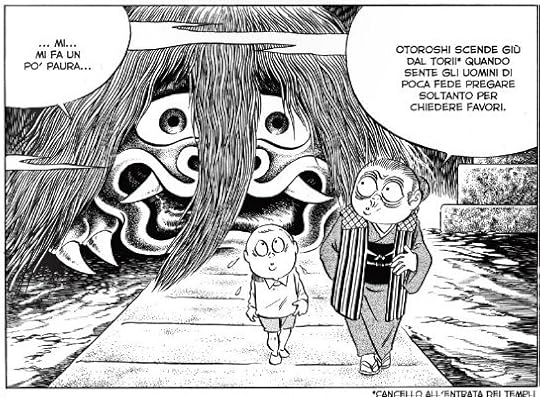
Outro elemento que não pode ser subestimado de forma alguma é o traço. Mizuki tem um traço sensacional. Alguns leitores vão parar no traço mais cartunesco do autor e esquecer de observar o resto. Os personagens são daquele jeito de uma forma proposital. Parece a visão de uma criança sobre aqueles que o cercam. Seja o seu pai com o queixo comprido e um ar de intelectual, a mãe com olhinhos apertados e desconfiados, os colegas do bando com o seu jeitão de moleques bravos ou o da Nonnonba com seu ar austero. Esse design de personagens é tão proposital que podemos ver como Mizuki sabe desenhar personagens bem delineados quando quer ao nos mostrar Chigusa. Ao mesmo tempo os cenários são deslumbrantes. O cuidado que o autor tem com os detalhes pequenos do cenário transparece nos detalhes dos kimonos de todas as personagens femininas. Ou as casas e árvores do fundo. Ou todos os objetos presentes nas casas. Outra coisa que impressiona é a habilidade de Mizuki de usar a técnica da perspectiva. Tudo fica com uma aparência mais longilínea, com uma profundidade maior. O uso habilidoso do sombreamento e do emprego do preto e do branco (e o que está no meio) coloca o autor em um outro patamar.
" - (...) ser forte ou fraco não é uma questão de ter músculos. - O quê? - Por mais que use a força física, não é possível conter a vontade. A sua vontade não se curvou a ele, certo? - Não, mas então o que é força? - É algo que aprenderá por si mesmo. São as dores e as humilhações como as que passou hoje que fortalecem as pessoas. (...)"
Os personagens criados pelo autor são apaixonantes. A narrativa se foca mais na família de Shigee e todos tem algum subplot a ser solucionado. Falando dos dois principais, Shigee e Nonnonba, eles vão sendo trabalhados lentamente pelo autor. O protagonista cresce bastante ao ter que passar por uma série de provações. Isso vai se solidificando na sua própria maneira de ver o mundo. Se pudermos trazer para a linguagem literária, Shigee passa por uma jornada de amadurecimento. Nonnonba atua como uma voz conselheira para ele. Ela ensina com calma e paciência lições necessárias sobre a vida. Tudo escondido nas suas inumeráveis citações sobre youkais que estariam ou não perseguindo o personagem.
Os pais de Shigee representam a passagem de um Japão mais tradicional para a modernidade. Enquanto a mãe é descendente de uma família rica, com propriedade e porte de espada (que ela faz questão de lembrar o tempo todo), o pai é um homem mais ligado à cultura. A mãe representa ali o modelo da mulher japonesa do início do século XX que é submissa ao homem (apesar de ela ter uma forte personalidade) e vem de uma família tradicional. Para isso, ela cobra do marido que seja uma pessoa mais séria nos negócios. Já ele é menos ambicioso, gosta de ler e vive de acordo com suas paixões. Até inaugura uma cinemateca na cidade usando o dinheiro de seu trabalho. Como pais, a mãe representa o rigor enquanto o pai deixa seus filhos fazerem o que lhes dá vontade.
Vários temas são tocados, mas vou comentar sobre alguns. A dor da perda do primeiro amor é um desses temas. Apesar de ser apresentado de uma forma bem inocente, o autor trata tudo com respeito. Ele não infantiliza o personagem e a conversa que Shigee e Nonnonba possuem sobre o significado da morte é muito lindo. Até mesmo as frases empregadas demonstram a sensibilidade do autor. Ou então o pai sentado à luz de lanternas na beira de um rio, dizendo: "Essa sua dor é um tesouro. Ganhou uma lembrança insubstituível." Essas frases simples e doces estão espalhadas pela narrativa. Outro tema é a do pai que não consegue parar em um emprego ou até do tráfico de pessoas. Fiquei espantado em como isso era comum no interior do Japão no início do século XX. Meninas que eram "adotadas" para serem vendidas para casas de prazeres como gueixas. Como eu disse no início, não se deixem levar pelo estilo cartunesco ou pelas temáticas aparentemente infantis. O mangá é muito mais profundo do que parece.
O elemento do sobrenatural é inserido com bastante naturalidade ao longo da trama. Os youkais fazem parte do cotidiano dessas pessoas. Eles estão presentes e precisam ser respeitados. Para isso alguns cuidados deveriam ser observados. O choque entre a descrença do que é o sobrenatural ao respeito por ele aparece em boa parte da narrativa. O mais curioso é que mesmo achando que tudo não passa de uma bobagem, os personagens sentem medo do Umi-Bozu, das kitsunes, dos ayakashis, dos uwan. Isso só demonstra como esse aspecto está entranhado nas relações entre os japoneses. Aliás, é até a relação que ocorre entre o homem e a natureza.
Recomendo muito Nonnonba. Não é um mangá violento, e pode até mesmo ser lido junto com uma criança. Ajuda a passar diversas lições sobre amizade, sobre respeito às tradições, sobre primeiros amores, sobre família. Mizuki é um gênio, de fato. Se posso usar um adjetivo para ele, é que ele parece uma kitsune. Como as raposas japonesas, ele nos prega peças em suas páginas fazendo com que tenhamos uma atenção maior acerca do que ele está escrevendo.
This is a book about yokai. Or rather, this is a book about childhood. Or rather, this is a book about growing up.
Much like Dennou Coil (not to compare one obscure thing to another...), this is a story about children and the way children imagine and play, and uses "imagination and play" as a method of addressing serious topics like death, abuse, etc. It's also ostensibly a fictionalized story about Shigeru Mizuki's childhood (the main character is named "Shigeru Muraki"), what drawing comics meant to him, and what inspires him. At one point, his father says, "Shigeru — it's not just the reality of things that moves people. Be inspired! Dream about how you wish things were and put that into your work." Kind of cheesy, yeah! But also a nice way of motivating the need for the fantastical and silly in our day-to-day lives.
The other book I've read of Mizuki's was "Onwards Towards Our Noble Death", which had a similar way of combining the silly and childish (the daily antics of soldiers), with the serious and sobering (the death toll of said soldiers) — which is also reflected in his artistic choices, that is, the combination of loose and cartoonishly idiosyncratic characters, with detailed and sometimes photorealistic backgrounds.
Drawn & Quarterly, as usual, did a thoroughly amazing job with the book's localization. Their usage of a typeface that I'm assuming was created specifically for localizing Mizuki's books is awesome, and the work they've put into cleaning out the SFX is similarly great. The translation flows well, and you can tell there's been an incredible amount of thought put into making sure that everything about the localization "feels" true to Mizuki's sensibilities.
Overall: some Good Shit, would recommend purchasing to hold in your hands and put on a bookshelf to admire.
Mi ha sempre incuriosita, ma, nelle mie incursioni in libreria, non mi sono mai messa a cercarla veramente. Il prestito bibliotecario è venuto in mio soccorso anche questa volta. Siamo nel Giappone degli anni 30, e “Nononba” altro non è che l’appellativo con cui il protagonista (che poi è l’autore, da bambino) chiama una contadina del suo paese, depositaria di tante storie di fantasmi giapponesi, che lo fanno rabbrividire. Racconti di apparizioni, spiriti e demoni e creature radicate nell’antica tradizione popolare giapponese e nel folklore nazionale ai quali il giovane protagonista viene introdotto da questa anziana figura che, in più momenti, gli fa da tata. E che lo impressionano al punto dal “ritrovarle” nella sua vita di tutti i giorni e dal segnare, in modo tuttavia fanciullesco, quasi comico, la sua infanzia. E‘ una graphic novel molto particolare, questa, a partire dal modo in cui la si legge, come un manga giapponese, dal fondo all’inizio, da destra a sinistra, esattamente l’opposto di ciò che facciamo noi….devo ammettere che ci ho messo un po’ ad abituarmici, e qualche pagina alla maniera “occidentale” l’ho letta sicuramente. Nel complesso ho trovato la graphic novel simpatica, soprattutto per le immagini, che mi hanno ricordato quelle dei miei amati cartoni animati giapponesi degli anni ’80. In particolare ho trovato fantastica la figura della “Nonnonba” (immagino il termine stia a significare il nostro “nonnina”, cui è molto simile), che pare avere sempre un cipiglio e gli occhioni sgranati, forse per ciò che riesce a vedere. Tuttavia, la storia, nel complesso fatta di tanti momenti non sempre ben chiusi e chiari, non mi ha conquistata come mi sarei immaginata.
I didn't realize I'd read so many of these stories in the first volume of Showa where they appear in a vignette fashion. Here the various stories are presented as part of a full narrative. This is the childhood memoirs of Mizuki and especially of the time in his life that he spent time with his nanny, or 'adopted' grandmother NonNonBa. She's a wonderful human being who taught Muzuki about the mystery of life as embodied in the folklore of Yokai. These stories of invisible demons who tamper in the lives of humans provides a wonderful contrast to the society around Mizuki which is rapidly becoming more modern and logical.
I can't do justice to Mizuki's stories. He's a true master of the art form. The book explores Mizuki's relationship with NonNonBa, his parents, his siblings, various 'encounters' with Yokai, and his relationship with his peers. The stories of Mizuki warring with the local kids and competeting to become the 'general' of his neighborhood kids was fascinating to read about.
There are so many other wonderful stories in this book. I really liked the dream sequences that combine Mizuki's character's fantasies with his current artwork and imagination of NonNonBa's Yokai.
A última crítica de 2017 para o aCalopsia, sobre um livro que foi das melhores surpresas do ano..
A mitologia tradicional em vias de esquecimento num Japão em pleno processo de modernização é revisitada pelo olhar deslumbrado de uma criança, que sente uma enorme curiosidade pelas criaturas fantásticas das histórias de uma velha ama. Em Nonnonba, tradições ancestrais e recordações de infância cruzam-se numa história cativante, que dá a conhecer ao público português um dos grandes marcos da obra de Shigeru Mizuki. Edição da Devir, reforçando com a sua aposta na coleção Tsuru a vontade de trazer aos leitores portugueses autores e obras marcantes do mangá. Crítica completa no aCalopsia: Nonnonba.
It is hard to describe this book. I found it enchanting, and at times sad. It s a view into a world long since passed. How do you explain a doughnut to someone how never seen one before. Would you walk miles, just to try one, with the scant change you had? Add Japanese myths, and spirits-you have a unique mix to savour.
This book is ostensibly about yokai - Japanese ghouls/goblins/fairies/etc, but really it's about early 20th century childhood in rural Japan, and spooky-cool grandma ladies, and as such its very sweet and successful and touches on that weird place of childhood where you don't even have to believe in the supernatural, it's just seamlessly real. Hooray! And nicely illustrated.
I really love his style. The realism of his drawings in some frames, and the more simple manga type drawing in others, juxtaposed with one another is somehow powerful. In this book, and also in Onward Towards Our Noble Deaths, he is able to convey the bigger picture of the time and circumstances through a very personal story. Highly recommend taking a look at Mizuki-san.
A semi-autobiographical tale relating/inspired by Mizuki's childhood and the teachings of NonNonBa, the grandmother figure who taught him about the spiritual world. Besides being an excellent primer for Japanese folklore, it's also a funny and bittersweet look at a child's life in early 20th century Japan.
I truly enjoyed the book. Nonnonba was a lovely granny that I felt i have known and loved forever. I traveled to the boys' world and felt the magic of Shige's imagination. And of course I loved the Yokais and how they helped Shige's journey to be a grown up.
Lindo demais! Que história linda, imaginativa. Tô apaixonada pela vovó. Só fiquei chateada com os erros tipográficos da edição - foram vários, a ponto de se destacarem :(
Leí este manga hace tanto tiempo que pasé por alto demasiadas cosas. Creo que una de las que me ha ayudado a disfrutarlo es entender la rigidez de los formatos de publicación japoneses: los capítulos, o duran quince páginas, o duran más o menos el doble. Según sus estándares, así es como debe ser, y eso ayuda a manejar el ritmo de lectura, a dosificar, algo que en historias más o menos autoconclusivas como esta, viene muy bien.
Sin embargo, en cuanto nos metemos en el contenido, la cosa cambia. Mensajes misóginos en boca de niños que sólo se divierten jugando a la guerra, a pesar de que son realmente las mujeres son las que llevan el peso de toda la historia. Un padre con una personalidad con la que es imposible identificarse, desentendido de su familia, que sale impune de toda situación, pero que al mismo tiempo suelta lecciones de vida desde el romanticismo y la inocencia, casi como un niño más de la trama. Detallitos que me sigue costando perdonar cada vez que me los encuentro, más allá de que sea una autobiografía enmarcada en los años treinta del siglo pasado.
En lo gráfico, hay una mezcla de dibujo viejo, muy, muy limitado técnicamente en los personajes pero con maestría en los fondos, una prueba más de que los asistentes de mangaka son mis nuevos héroes anónimos. Básicamente el repertorio del dibujante se reduce a dos o tres expresiones faciales, bocas tipo ":3", tres o cuatro poses y dos o tres recursos narrativos que se repiten a lo largo de las cuatrocienas páginas, con contadas sorpresas al voltear la página.
Cerrando con la edición, tanto el tamaño como la tapa blanda se sienten perfectos. Como siempre, se echa de menos algún extra del que supuestamente es uno de los mejores dibujantes de su época y del gekiga, que ahora está tan de moda, y más sabiendo que la obra original es de 1990, por lo que había material seguro. Muy recomendable.
Mizuki Shigeru is such an incredible talent, weaving together intimate day-to-day moments with the sublime encounter with the world's beyond. A reflection on his childhood in Sakaiminato, this book is really a distillation of his life's work. The reflection on Mizuki's youth is grounded in the historical moment of the rise of Japanese nationalism explored in his Showa series. Mizuki's relationship with Nonnonba teaches him about the Yokai who would become his life obsession, notably in his series Gegege no Kitaro. And even in this gentle portrait of youth, Gege plays out in neighborhood skirmishes the all-consuming pointlessness of war of Onwards Towards Our Noble Deaths.
Mizuki Shigeru is a master of his craft, drawing the characters in such a loose, expressive style, but foregrounded in contrast to these sublime stippled settings. This effect is very effective at differentiating these memories of people(relatable, but shifting and distorted by time) with the reality of places (and Yokai) as other.
Without succumbing to melodrama, Mizuki conveys a childhood of innocent wonder, but also of deep sadness. The death of childhood friends and the selling into sexual slavery of others are left as these unresolved pains, explainable only in terms of supernatural phenomena. The relationship between Gege and Nonnonba is such a beautiful thing, with Mizuki becoming a similar figure for a new generation.
There was an article in the Guardian about graphic novels towards the end of last year, in one section people listed their favourites. Each participant wrote out a long list, apart from one person who simply selected only this book. That was enough to intrigue me.
NonNonBa is a semi autobiographical recounting of the author's childhood in 1930s Japan, where he is taught about 'yokai' (folklore spirits) from a grandmother figure.
I wasn't at all sure what to expect going in, but I found the illustrative style to be charming, and the numerous interwoven plotlines about village life to be bittersweet. Overall, it never fully gripped me - but I found the book to be a pleasant and enjoyable read.
«È così strano?» (...) «Shigeru, il mondo reale non basta quando vuoi regalare emozioni agli altri...»
NonNonBâ è un'opera estremamente autobiografica, ha un inizio ma non una fine. Lo spaccato di vita che Shigeru Mizuki decide di mostrarci è costellato da mostri e spiriti della tradizione giapponese, di incontri e saluti, marachelle giovanili e sentimenti sempre autentici, che hanno creato l'autore di fumetti adulto da noi tanto amato. Nonostante la mancanza di un reale epilogo, il volume è stato piacevolissimo da leggere ed io mi sono sentita molto triste quando non ho avuto più pagine a disposizione.
a portrait of a childhood in a seaside town in 1930s japan. by its very nature, it is a ‘boyhood’ book, so girls are reduced to first loves, but having that characteristic, they are all drawn very sweetly. matsu, chigusa, and miwa are pure-hearted and their (if brief) presences create a strange sense of nostalgia. on art: i love the contrast between mizuki’s figures and his backgrounds. gege, his family, and nonnonba are squishy-faced, grotesque, but simplistic little creatures; contrastingly, mizuki’s backgrounds are done in strenuous detail, surreal, expansive, making the ‘otherworld’ (or the 10thousandth, 30thousandth world) that much more vital. really adored it 🌸
Muy molón, mi primera aproximación al autor. Me ha gustado mucho su estilo y lo que narra, esa infancia japonesa viejuna (que cualquiera que haya tenido un pueblo en el que pasar los veranos sentirá cercana). El padre del prota es un puntazo y tiene algunas viñetas para el recuerdo. Se va desinflando a medida que pasan las páginas, pero aún así merece mucho la pena.