"Within a day of receiving this book, I had consumed it... Absorbing, moving, and compulsively readable."—Lydia DavisIn this affectionate, heart-warming chronicle, Rosamund Young distills a lifetime of organic farming wisdom, describing the surprising personalities of her cows and other animalsAt her famous Kite's Nest Farm in Worcestershire, England, the cows (as well as sheep, hens, and pigs) all roam free. They make their own choices about rearing, grazing, and housing. Left to be themselves, the cows exhibit temperaments and interests as diverse as our own. "Fat Hat" prefers men to women; "Chippy Minton" refuses to sleep with muddy legs and always reports to the barn for grooming before bed; "Jake" has a thing for sniffing the carbon monoxide fumes of the Land Rover exhaust pipe; and "Gemima" greets all humans with an angry shake of the head and is fiercely independent.An organic farmer for decades, Young has an unaffected and homely voice. Her prose brims with genuine devotion to the wellbeing of animals. Most of us never apprehend the various inner lives animals possess, least of all those that we might eat. But Young has spent countless hours observing how these creatures love, play games, and form life-long friendships. She imparts hard-won wisdom about the both moral and real-world benefits of organic farming. (If preserving the dignity of animals isn't a good enough reason for you, consider how badly factory farming stunts the growth of animals, producing unhealthy and tasteless food.)This gorgeously-illustrated book, which includes an original introduction by the legendary British playwright Alan Bennett, is the summation of a life's work, and a delightful and moving tribute to the deep richness of animal sentience.
The book, though enjoyable in its way, was not what I think of as a good book. I thought too much of the 'secret life' was fanciful and not at all credible. And I speak from a point of view of knowledge. I know cows as cows who are not subject to people at all, I've been observing 'wild' ones for decades, mostly in my garden where they eat what they fancy every now and again. (They like psychedelic magic mushrooms but I've not seen if they get high or not on them). Cows are not farmed in farms here, the farmer lets the gardens of the whole island feed them and they just cull the baby bulls, the cows are free to live out their lives until old age weakens them, then they too go to the abbatoir.
The author has a farm where the animals are allowed to live more or less as they like until they go to the butcher. This last is referred to very briefly as in, Kite Farm is a beef farm. The rest of the time the animals are referred to in more or less the same way as people and as if they are going to live out their long lives until old age takes them. Perhaps this is true of the animals the author talks about, but what about the rest?
I take serious exception to an author saying they are writing a book about the true nature of cows and their intelligence, personalities and decision-making ability as animals but then writes that cows huddle in a corner together to discuss an impending birth, the older cow giving advice to the younger one. Really? There was too much anthropomorphising in the book. Just because an animal is intelligent in it's own way doesn't make it like a human.
As a pragmatist I have no belief whatsoever in spiritualism or magic, however you present it and homeopathy is ridiculous. Diluting a substance 'like' the disease in water so many times by shaking it in a 'special' way until not a scientifically-discernable atom of the substance is seen, works either as a placebo, or the subject gets better anyway, or a fault in perception.
We do, however, applaud the finer points of homeopathic diagnosis. For example, a sweet-natured cow might be prescribed one preparation while a bad-tempered one would be offered something totally unrelated for the same condition. This illustrates graphically that homeopathy recognises and treats animals as individuals.
She also writes, "Somehow she managed to negotiate the steep flight of a dozen narrow, Cotswoldstone steps up to the granary and early one frosty-cold morning we watched her come out onto the top step, yawn and look around to see if it was worth getting up – i.e. coming down. She had spent the night in great comfort on the wooden granary floor, away from mud and draughts and bullying. We had left the granary door open because we knew that no bovine could possibly climb the steps. Subsequently she taught two friends the same trick and we used to put hay and water upstairs for them.
I have about ten wide steps from the front to the back 'garden' (rainforest bush). The cows go up and down them with ease. The author thinks that because she has never observed something before it must be something that is unique and a sign of intelligence.
Cows usually in twos or threes will move off if you shout at them and move menacingly towards them as they eat your lettuces, marigolds and everything else. But if there are a dozen or more, they just sit there and stare insolently at you, they don't leave until they are ready. Cows also have a very good sense of how long it takes things to grow. They don't come back every week, they just turn up when everything is growing nicely and you are lulled (yet again) into a feeling that the cows have given up on your place. They haven't, they're biding their time.
When I grew up there was a bull in the field next to the school all by himself, we were all frightened of it. But here the bulls are different. Baby bulls are killed for beef, but not cows, and not a few breeding bulls. They are always part of a herd, and the herd is led by the biggest, probably oldest, female, never the bull. Baby cows will trot off slowly if you approach them, baby bulls will run, even teenage, pre-abbatoir ones, they are all scaredy cats.
I think the most beautiful thing I've ever seen with cows, is two that were in love. I saw them every day driving my son to school. They lived on a mountain, part of a small herd, they never strayed far. The cow was the leader of the herd and she and the bull were always together, never more than a yard or two apart. They were often rubbing their flanks together, or one of them licking the other. Mostly they would stand, touching, just grazing, their tails flicking each other's backs. If that isn't love I don't know what is?
A diversion, what wild chickens are really like. The author does get it more or less right about chickens and it is exceptionally cruel to keep them in cages. Right now my son has a flock of 3 that kind of like me, but not as much as him. On every Caribbean island there are a lot of chickens. On the richer ones they are just used as kitchen disposal units. They live around restaurants, hotels, anywhere there is food, no one eats them. When my son goes out in the morning, up come Hiss, Cackle and Cluck (they make different noises) and they run in front of him to his car where he always keeps stale bread. I feed them on dry cat food which they don't like quite so much. One of them is very bold and will eat from your hand. One of them is very aggressive and one of them more shy and you have to throw food at her for the others not to beat her to it.
There are two sorts of relationships chickens form, that I have seen over the years. Most of them live in flocks. But some of them get "married". You see a rooster and a hen walking together, and they are not part of a flock. I had a pair in my bar for a few years. There is a pair up here too. They are always together. Sometimes they are joined by a third, sometimes by a whole flock of little ones, but then after a while they will be just a pair again. This goes on for years.
A hen recently lost its under-a-week old chicks into a drainage grating that was about 12" deep and ran across the road. She was marching up and down making a lot of noise so we went to see what it was. We poked with sticks and got out three whom she fussed over. But we couldn't get out the fourth. She was quite frantic. Next morning when we came to work, the hen with three chicks was still there marching up and down clucking and crying mournfully, her chick now dead under the grating. I don't know how long she mourned for, she was gone by lunchtime.
Battery-farming such creatures is killing their natures.
It is a short book and there is a lot of padding. Lists 20 points long, saying things like, 'cows nurse grudges, cows take umbrage, cows can be unpredictable, cows can be dependable" with similar lists for pigs, sheep and hens are just filler and don't impress.
It wasn't an awful book, it read in part like propaganda for expensive locavore eating and to show how compassionate farming can be profitable, which is laudable. Because of that I rounded 1.5 stars up to 2.
I got to page 33 out of 137. These anecdotes about animal behavior, gathered over Young’s decades of working on Kite’s Nest Farm, a small family operation in the Cotswolds, were originally published in 2003. I’m not sure what led to them being reissued recently. I liked and couldn’t fail to agree with her introduction about the evils of factory farming and how much better it is to let animals live out their natural behaviors. One of her theses is that animals are just as individual as humans, and you can study their family relationships.
I had two problems with the book: the twee anthropomorphism (“almost every day, we see daughters consulting their mothers about impending confinements, or maybe just discussing the weather”), and the fact that she can be compassionate enough to call intensive animal-rearing “iniquitous criminality” (which seems like redundant phrasing to me, but never mind), yet raises animals and lovingly observes their behavior...only to let them be killed for humans to eat. I’m not a strict vegetarian, but more and more I think that raising creatures just to slaughter them is not just strange but downright barbaric. [Does how you treat them before that point really matter all that much if the end is the same? I suppose so, as I would advocate eliminating the suffering of sentient beings as much as possible.]
Guess what fascinating thing my cow did yesterday...!
We all know them. The dog or cat owners who find their pet's daring dos so astounding/ hilarious / ingenious / entertaining / adorable that they corner you for twenty minutes at lunch to tell you endless stories about them.
Well, this book is somewhat similar, except that the stories don't revolve around dogs or cats, but cows, sheep and chickens.
The style is an eclectic mix of astute animal observation, gossipy stories about what animal did what when, rather tedious geneology of all the wonderful cows the author has had the pleasure to know and some "All Creatures Great and Small" vibes.
What has bothered a number of readers is the cute, Beatrix-Potter-style language the author uses to describe animal behaviour. At times it's so overwhelming, you expect the next page to contain patterns for the jackets and caps the author has lovingly sewn for her livestock. (She hasn't, obviously. How silly would that look?)
Cows and sheep "ask politely for help," or they "have a chat" with each other, or they "stand together and enjoy the view" or they "ask advice of older animals".
Unlike other reviewers, I see this not so much as being saccharine cute or attempting to put human mentalities onto non-human animals but rather...
1) linguistically attempting to highlight the overall message of how individual ALL animals are (if given a chance to develop) and
2) to avoid going into long physical descriptions of how cows greet, or scold, show distaste, etc, which would make the book much longer and far more scientific than the author intended.
Some of the observations are really fascinating, I found.
Like that certain cows - although some are very intelligent themselves - realise early that humans are smarter than they are and will often conclude that people are omniscient! Some will come and ask humans for help with things they know they can't do themselves; others will just assume the humans know what's wrong and will put things to rights eventually.
This reminds me a lot of how humans think of God!
All-in-all, I can very much see how this would have been a Sunday Times bestseller and a Times Book of the Year. It's exactly that mix of robust Englishness, revelling in the idyllic countryside and doing right by animals, that the English so love.
Besides that, the message that even livestock are individuals - not just dull-witted meat providers- that drives the book is one that cannot be reiterated enough.
It's charming, pleasant read to pass an hour or two with.
I read this book as it is to be our nonfiction book of the month and being a vegan was interested in learning more about cows. However as lovely as it is to name all your cows ,and I do appreciate the fact that they have free reign to a degree as to where they go the end result is still the same. It is still a business, maybe not in the way of factory farming but they are still killed however humanely. I smiled at parts of the book but still feel that this should not be happening. I can believe a lot of what Rosamund said as I walk a lot and have found cows to be very curious animals. My daughter has even played music to them and I'm sure they appreciated it as the whole herd stopped to listen. I agree with the fact that often animals can cure themselves and applaud the fact she doesn't always turn to medicine straight away but I cannot agree with farming full stop but if people feel they cannot live without meat I guess this way is better than factory farming.
I loved the stories about the cows, and how Rosamund recognises them as individuals with their own personalities. However, I cannot fathom how she can claim to love these cows yet sells their bodies for beef
Most people probably don’t even consider where the milk comes from when they reach to get it from the fridge for their morning cuppa. When they do venture into the countryside, the may be vaguely aware of these black and white animals in the fields as they flash past in the car. It is only when they have left the climate controlled atmosphere that they realise quite how big they are. Sadly, modern factory farming sees them as machines to either pump milk from or to be dosed full of antibiotics to grow at a rapid rate for slaughter.
At Kite’s Nest Farm, Rosamund Young sees all her animals in a very different way, and her cows hold a special place in her heart. Each cow is named and rather than being forced to stay in a single field, they are allowed to roam freely around the farm so they can find the best grass or shelter as necessary. This freedom, coupled with the fact they there are not treated as commodities, means that their own personalities shine through. Her observations have shown that they are capable of forming life-long friendships, can hold grudges, play games when younger and grieve when another in the herd dies and in their own way can communicate with us mere humans.
In this gently written, quirky and charming little book, Young sets about rewriting everything that you thought that you knew about cattle. In telling the stories of her animals, there are amusing anecdotes, moments of sadness and examples that show just how highly intelligent they can be. They seek out the plants that can help them when they are ill, and many of them know when to approach the family for extra assistance. This a book that is strangely moving and shows what can be gained from treating animals with the respect that they deserve and is a compelling case against the horrors of factory farming. 3.5 Stars
I was surprised at the mediocre rating of this book. That was, until I started reading the comments. Let me say this: If you are vegan or vegetarian and are looking to read a story in which animals are rescued from mass-production and get to live out their remaining years on a quiet little farm, this is not the book for you. This is a book about farming. About a family trying to make a living. And even though – as many, many people have repeatedly mentioned here – they accomplish this by “raising cattle just to slaughter them”, they manage to treat the animals with utmost respect. Yes, the cows and calves get slaughtered when their time comes. But that doesn’t influence the fact that, while they were alive, every single person on this farm gave their everything to make the lives of these animals as comfortable as possible. To give a fair warning, there is quite a lot of anthropomorphism in this book. But I think this just shows how much these farmers love their animals. And in my experience, any person who has spent an extensive amount of time with cattle will understand the feeling of trying to interpret the actions of a cow, despite the difference in means of communication.
This is a wonderful little book, and a breeze to read. Young has a deep respect and affection for the animals in her charge, and a great knowledge of sustainable and ethical organic farming. Her years of experience tending to animals is a fitting testament (if you still needed it) to the fact that all creatures, including cows, have their own unique personhoods - thoughts, feelings, imaginations, desires - just like humans do.
She and her family are right when they claim that all farms should prioritise the wellbeing of animals (this also results in increased quality of farmed produce), it just makes sense on every level (no one can claim that mass market farms are more "productive" when the quality of their produce is severely lacking, and in some cases detrimental to our health).
The impassioned plea for ethical, sustainable farming included towards the end of the book is both sincere and earnest (although this could have been a little longer). Overall, for someone completely knew to the field of animal behaviour and farming like myself, this was a great eye opener. As a result of reading this I'm now very keen to learn more about the study of animals and their relationship to agriculture as a whole.
Tell us about the beautiful minds of these magnificent creatures and THEN KILL THEM!!!
I love it when malzoans tell people how much they "love" animals, scritching them behind the ears and under the chin as if that justifies their slaughter. My copy of this book is heading immediately to my compost pile, since it is nothing but male cow manure. Of course, that's assuming the vile message inside doesn't taint my garden.
A short review of this book: Hypocritical author tries to sugarcoat mass-murder, as if we are idiots.
I was excited to read this because I thought it would give information about the intelligence of cows but I found that this felt like Rosamund just taking notes of the day-to-day happenings on her farm, with the odd preachy section dotted throughout. I completely understand the frustrations that the author has regarding mass-farming and I agree, but on the whole I found that the book was more about describing the personalities of particular cows on her farm rather than a more scientific approach which would have discussed cows as a species.
Overall I wouldn't recommend this. It made for a short and quick read but I was struggling to get through it at points. There were a few sections I liked but on the whole it felt incoherent and badly put together, the 'plot' or thoughts darting about all over the place.
This could have been a nice little book in favor of vegetarianism and veganism, with all its cute stories about cows and hens and piglets, their families and friends, and their diverse personalities. Alas despite the decent treatment and freedom these creatures get, they still end up being butchered.
Additionally, the book felt commercial at times, and got boring at others.
Rosamund Young is a farmer who runs Kite's Nest Farm in the Cotswolds. She writes of her observations of cows and how they are intelligent animals with personalities as diverse as our own. She shares anecdotes about her interactions with her animals and their behaviours.
When I read about this book I was confident that this was going to be a very good read but in reality I felt let down and while the book was interesting in spells it failed to grip me like I hoped.
This book is charming, adorable, and at times laugh-out-loud funny. It’s perfect for anyone who’s fond of animals or - like me - attributes personality traits and facial expressions to them. It also makes a very good case for organic farming, and although it is a little odd that Young only briefly touches on the fact that her cows are mostly bred for meat, she does make it clear that that is not what this book is about: rather, it is a portrait of her cows, pigs, sheep and chickens, and a beautiful one at that. Definitely one to recommend!
Ben pek sevemedim ya, yani endüstriyel hayvancılığa karşı geliyor ama bir yandan da organik diye ineklerin güvenini kazanıp aynı sonuca götürüyor? Biraz da bilimsellik ve ‘bakın inekler nasıl da karekterli hayvanlar’ ın altını çizmek için de kasmışta kasmış. Evet, inekler çok duygusal ve utangaç. Güven verip verip aynı kaderi sende yaşatıyorsun ablacım?
Un pomeriggio di lettura leggerissima, molte simpatiche banalità, molte allegre ministorie, un tantino piccino di ipocrisia perché da nessuna parte si dice che moltissime di quelle bestiole felici finiranno in pentola. Legittimo eh... in qualche modo devono produrre reddito, meglio allevate in maniera umana in pascolo che in stalle lager, ma glissare su quel particolare mi sembra un po' furbetto.
Direi più interessante per chi è vissuto da sempre in centro a Manhattan e non ha mai visto una mucca viva che per chi vive in Alto Adige e incontra nella sua vita più mucche, cavalli, maiali che esseri umani.
I so enjoyed (and learned so much from) this enchanting and informative look at the secret lives of cows, pigs, hens and sheep. Young is a good storyteller and educator as well.
Bambaşka bir kitap bekliyordum açıkçası. Gerek başlık , gerekse kapağı dolayısıyla daha çok masalsı şirin bir öykü beklemekteydim ama baya bir bilimsel araştırma denemesi gibi olmuş. Açıkçasa sevdim. Köyde büyümüş bir çocuk olarak annemin can yoldaşı haline gelen ineğimiz Mükü geldi aklıma ve kesinlikle ineklerin çok değişik ve karakter sahibi hayvanlar olduğuna ikna oldum.
How can you resist a book with a title like that? When I heard of this book, I just had to read it with my fellow animal-loving friend. We chuckled over the passages in this book, and I think I will never look at a cow in the same way again!
Rosamund Young's love for her farm animals shines through the book - I only rated it a tad low because I struggled to keep up with all the names, but that doesn't take away the fun of reading this book. This is not a writer's book. You read it because you love those darling cows. And well some hens. And some pigs. And some sheep. Darn it all, let me go find a farm to spend the night.
I had heard a lot about Rosamund Young's The Secret Life of Cows, first published in 2003 and recently reissued, and was keen to get my hands on a copy. I love nature writing, but have never read anything cow-specific before, and am always ready to learn new things. Lydia Davis calls this slim book, which runs to less than 140 pages, 'absorbing, moving, and compulsively readable', and Philip Callow believes that it is 'a little masterpiece of animal sentience.' Other reviews have been rather more mixed, but when I spotted the lovely navy hardback edition in Fopp, I picked myself up a copy.
The blurb states that cows 'are as varied as people. They can be highly intelligent or slow to understand, vain, considerate, proud, shy or inventive.' The book is described as 'an affectionate record of a hitherto secret world'. Young elaborates upon this in her introduction, where she writes: 'If you know animals as individuals you notice how often older brothers are kind to younger ones, how sisters seek or avoid each other's company, and which families always get together at night to sleep and which never do so.'
The Faber reissue comes with a very short foreword written by Alan Bennett. He comments: 'It's a delightful book, though insofar as it reveals that cows (and indeed sheep and even hens) have far more awareness and know-how than they have ever been given credit for, it could also be thought deeply depressing, as it means entirely revising one's view of the world.' He goes on to add: 'It's a book that alters the way one sees things and passing a field of cows nowadays I find myself wondering about their friendships and their outlook, notions that before reading Young's book I would have thought comical, even daft.'
Author Rosamund Young runs Kite's Nest Farm, on the edge of the Cotswolds, with her brother and partner. She has lived on the farm since her childhood, and has been observing the animals ever since. Her ethos is admirable; they let the cows decide when they wish to finish weaning, allow them to live in mixed generational groups to give the younger members the opportunity to learn from their elders, and give the animals constant access to food and water. Young writes: 'We decided that the animals themselves are by far the most qualified individuals to make decisions about their own welfare and it is the decisions they make, as well as many other occurrences both humdrum and extraordinary, that I have observed, learned from and written down here.' Young then goes on to elaborate further, explaining that she and her colleagues 'have tried on this farm to create an environment that allows all of the animals the freedom to communicate with or dissociate themselves from us as they choose.' Throughout, she makes highly thoughtful points; for instance: 'Just because we are not clever enough to notice the differences between individual spiders or butterflies, yellowhammers or cows is not a reason for presuming that there are none.'
The Secret Life of Cows is a mixture of musings about ethical farming, things which the owners of Kite's Nest have implemented to better the welfare of their animals, and anecdotes about particular animals. Some of these are amusing, and others quite sweet. For instance, we meet Meg, a calf who learns to climb some very steep steps so that she can spend the night in the granary, 'away from mud and draughts and bullying'. Meg then teaches two of her fellow calves how to climb the stairs too. There is Alice, who is fond of hide and seek. Young writes: 'She would do her best to hide behind a walnut tree but of course she was too big and as soon as she realised I had seen her she would gallop off again and hide behind the next one, and so on until we reached the cow pen.'
The book opens, rather charmingly I thought, with a cow family tree. This by no means covers every cow whom Young writes about, but it does give an idea of the number of generations who live on the farm. Some lovely details have been included here; for instance, Bonnet is 'passionate about apples', Blue Devil is 'remarkably bossy', and the Duke of York drinks water like a cat. There is a brief section at the end of the book which includes twenty facts which Young feels one should know about cows, hens, pigs, and sheep respectively.
The structure of the book is split into small sections, sometimes only a paragraph or two long, rather than into distinct chapters. Young writes in her introduction that she believes such a structure gives a more interlinking feel to the anecdotes she presents, but I felt as though it became a little jumbled in places. She will mention a particular cow, and then go on to talk about another one from another line, before coming back to the original cow pages later. I would have preferred more of an organised structure, and feel as though this would have suited the book better, as well as making it easier to follow. As it stands, The Secret Life of Cows feels a little bitty, and it is unfortunate rather too brief.
I read the entirety of The Secret Life of Cows in one go, but I feel, upon reflection, that it would be a better choice to dip in and out of it. Young's writing is gentle and undemanding, but some of the anecdotes do feel a touch repetitive in places. I did like the sense of anthropomorphism which Young lent to her cows, and I do feel as though I learnt quite a few things about the intelligence and empathy of cows - for example, the grieving process which they go through when a member of their herd dies or is taken away, and the way in which poorly cows only want to eat willow bark for its aspirin properties. They are incredibly intelligent, independent animals, who know how to ask for help when they need it, and can display such a range of emotions.
This was an enjoyable read, even with the anthropomorphism I saw in there. This is just one more proof that you can respect animal welfare and nature but still understand that we live in a world with a food web that includes predator-prey as well as animal husbandry. The cattle and other animals in this book were raised very humanely in a sustainable way on land that in no way can grow crops. Young points out, accurately, that most of the grassland in the UK is not arable (ie you can't grow crops on it), but animals can convert it into food. This, my friends, is how the planet is set up.
The problems lie, as Young points out, with cruel and inhumane ways of raising livestock.
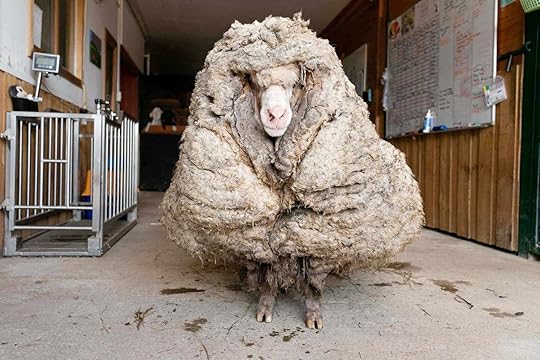
I'd also like to point out that it's far more cruel to never shear sheep because they don't shed and their wool never stops growing. Feral sheep need to be rescued or they get too hot and eventually can't walk anymore. Here is one that was rescued in Canberra and saved from 77 pounds of wool
Cows are simply not 'just things that produce meat/milk'. This little book made this once more clear. Being a vet tech student I needed to learn about cows, but only for their use, the breeds and a little bit about their behaviour. It was after a couple of practice days on a dairy farm that I saw that cows aren't just 'things': they've got feelings, a hierarchy, social contacts, deep friendships...It amazed me again and again. In 'The secrect life of cows' Rosamund Young shared her experiences on her farm. It's not the typical farm we know, but the more sustainable and organic farm, like there need to be more of that. From her anecdotes she tells the reader about every single cow that left a print in their stay at the farm. She shows us that cows can 'talk', if only we take the time and the effort to listen. From her view cows are emotional creatures with real feelings, that are forced to be used for human 'needs'. It's not a moralizing book or straight to the point, but it shows that farms need to make the effort to prioritise the well being of these animals. In return their productivity and life span will increase. In these current times where a lot of people talk about the ethics of eating animals, of increasing the intensity of farming instead of going to a more organic way of farming, this book can start a lot of interesting discussions.
I really enjoyed this little book about cows...there is also a bit about sheep, hens and pigs. Living in the Countryside as I do I really appreciate this insight into the behaviour of farm animals. Cows usually freak me out just staring and following me when our paths cross but now I realise there is meaning behind those stares! I might have to go about with an apple in my pocket on future walks! On a more serious note, this is how farming should be and I fully endorse this farm and will continue to support organic farming as best I can.
Charming and absolutely random stories about animals on an English farm. The narrator obviously loves all her animals and has made some fascinating observations, which made me want to visit her farm. Nevertheless, the book would have profited from even a little editorial attention. As it is now, the book is all over the place, pays in depth attention to details that aren't really essential and glosses over the more interesting bits, while having no structure at all. Still, Young obviously means well and her cows sound lovely :)
This was a very different kind of read for me and while I'm really happy I branched out and gave this one a go, I'm disappointed by the book in general. There were definitely some good takeaways from it but the whole thing overall left me feeling a bit strange and unsatisfied.
I’m vegetarian myself, but I don’t have an issue with others eating meat. I just think everyone should take a minute to think about what they’re consuming and make better choices. Try and buy locally and organic etc. This is something I thought this book might touch on a little, as the author herself owns a farm, but it was far more about what cows are like as animals, which was totally fine! Until she started anthropomorphising them to the extreme!
I’m perfectly happy accepting that cows communicate with each other, of course they do, like all animals do! However, I found it a bit off-putting when Young would say something about cows “consulting” or “discussing the weather”. The whole thing left a bit of a weird taste in my mouth.
I guess my biggest struggle with this book, and it appears to be the same thing for a lot of reviewers, is how Young talked so lovingly of these cows all the way through but in the end, she slaughtered them anyway. That feels bizarre to me. Factory farmers don’t care about the animals so there is no feeling there when they are killed. With Young, she talked about these cows as though they were pet dogs. You wouldn’t kill your pet dog! It just didn’t sit right with me and I can assure you it still wouldn’t have if I was still eating meat.
I did enjoy some of the anecdotes throughout this book. It was really interesting to learn about the intelligence and cunning of cows when they appear, to an outsider, such docile and clumsy beings. I think I would have enjoyed all the facts more if they were set up as such, rather than like looking back through a photo family album.
Overall, I would be interested in more books along these lines, this was a new kind of nonfiction for me that was fun to discover. But if you’re ever looking for a book about cows, I don’t think this is the best one to pick up!
A very kind friend sent me this book out of the kindness of her heart!!! Angel!!! @bclubbetty on Instagram.
Mam trochę problem z tą książką. Z jednej strony, bardzo przyjemnie czytało mi się wszystkie anegdotki związanie z krówkami i innymi zwierzakami, ale z drugiej strony, nie bardzo wiem co ta książka miała na celu. Pomyśleć by można, że książka, która pokazuje indywidualność zwierząt, to że mają emocje, przywiązują się i ufają człowiekowi, będzie raczej nawoływała do zaprzestania traktowania ich tak przedmiotowo jak robi to większość ludzi. I okay, może w pewnym sensie to robi, ale nie potrafię zrozumieć jak może pokazywać, że można przyjaźnić się ze zwierzęciem całe jego życie, a później je zamordować i zjeść. Wydaje mi się, że autorka chciała zareklamować i pokazać chów organiczny, który mimo tego, że jest lepszy niż przemysłowy, wciąż prowadzi do tego samego - zysku człowieka na śmierci niewinnych istot. Mnie ta książka w ogóle nie uspokoiła, a wręcz momentami denerwowała tym, że autorka wybiela się mówiąc, że jeśli krowa chodzi po trawie (do czego ma prawo i co powinno być obowiązkiem!) to w porządku jeśli się ją zabije. Absurd!
I listened to this book over two days while I worked alone in my office. I really loved all the stories of the cows and the commitment Rosamund Young and her family display to ensuring their stock of animals is healthy and, I suppose, happy. I am not a vegetarian and will probably never be one, but this book has made me think about what type of meat I buy and consume.
A book about the intelligence and beauty of cows, how personable and emotional they are, that, without any remorse whatsoever, sends them off to be slaughtered for beef products. The cognitive dissonance is so genuinely maddening at times that it's impossible to fully comprehend.
Rosamund Young driver Kite’s Nest Farm i Gloucestershire i England. Gården er kendt for at producere bæredygtige fødevarer, og den drives ud fra grundprincipper om god dyrevelfærd – og mere til. Hendes forældre startede som selvstændige landmænd på Kite’s Nest Farm I 1953, og her begav de sig ud i at drive et økologisk landbrug, før begrebet ’økologi’ overhovedet var opfundet.
Young indleder bogen med at problematisere tendensen til at anfægte produktionsdyrs individualitet. Hun fortæller, at intelligensniveau og præferencer hos en flok køer er lige så varieret som i en skoleklasse og andre menneskegrupper. Når man har forsøgt at måle på køers intelligens, har det ofte været med et menneskeligt – og for en ko ubrugeligt – teoretisk udgangspunkt fremfor en praktisk intelligens, som koen rent faktisk kan drage nytte af. Det betyder at udfaldet som oftest har været, at køer er dumme, og troen på at dyret alligevel ikke ved, hvad der foregår, gør det selvfølgelig langt lettere at behandle det som intet mere end et produktionsapparat.
Det er ikke kun køernes intelligens, Young kommer omkring. Det er også deres sociale samvær, deres evne til at knytte bånd og drage omsorg for hinanden. Vi lærer, hvordan de kommunikerer på forskellig vis og om deres evne til at huske og genkende. Hun tilbyder kun få videnskabelige forklaringer, men bruger i stedet egne erfaringer og konkrete eksempler fra livet på gården til at bakke op om hendes teser omkring køers indre liv. De få konkrete fakta rammer dog som en knytnæve, når hun trækker på undersøgelser, der har kunne påvise indskrænkning af køers hjernekapacitet på baggrund af pladsmangel og forkert foder.
Undervejs glemmer læseren næsten, at det er køer, der er hovedpersonerne i Youngs fortællinger, for hun beskriver deres individualitet som værende lige så forskellig og kompleks som menneskers. Hos Kite’s Nest har de intelligente køer, dovne køer, stædige køer, generte køer, udadvendte køer og alle de andre egenskaber, man sædvanligvis knytter til en menneskelig personlighed. Men Young beskriver samtidig også, hvordan alle disse karaktertræk går tabt, hvis ikke køer får lov til at udfolde sig og udvikle deres egen unikke personlighed.
Det er en fin lille bog, og der er mange gode fortællinger, men jeg nåede også til at punkt, hvor jeg var lidt mættet i de mange historier fra Kite’s Nest. Jeg savnede mere videnskabelig opbakning og konkrete fakta, men jeg anerkender samtidig også, at det netop er narrativet, der gør den lille bog til noget ganske særligt. Den er både vedkommende og tankevækkende og introduktionen burde være pligtlæsning for enhver.